Respiratory virus activity is high and rising across the United States, CDC data shows

https://www.yahoo.com/lifestyle/respiratory-virus-activity-high-rising-192815114.html
As seasonal virus activity surges across the United States, experts stress the importance of preventive measures – such as masking and vaccination – and the value of treatment for those who do get sick.

Tens of thousands of people have been admitted to hospitals for respiratory illness each week this season. During the week ending December 23, there were more than 29,000 patients admitted with Covid-19, about 15,000 admitted with the flu and thousands more with respiratory syncytial virus, or RSV, according to data from the US Centers for Disease Control and Prevention.

Nationally, Covid-19 levels in wastewater, a leading measure of viral transmission, are very high – higher than they were at this time last year in every region, CDC data shows. Weekly emergency department visits rose 12%, and hospitalizations jumped about 17% in the most recent week.

And while Covid-19 remains the leading driver of respiratory virus hospitalizations, flu activity is rising rapidly. The CDC estimates that there have been more than 7 million illnesses, 73,000 hospitalizations and 4,500 deaths related to the flu this season, and multiple indicators are high and rising.

RSV activity is showing signs of slowing in some parts of the US, but many measures, including hospitalization rates, remain elevated. Overall, young children and older adults are most affected.

“It’s a wave of winter respiratory pathogens, especially respiratory viruses. So it’s Covid, it’s flu, and we can’t diminish the importance of RSV,” said Dr. Peter Hotez, dean of the National School of Tropical Medicine at the Baylor College of Medicine. “So it’s a triple threat, and arguably a fourth threat because we also have pneumococcal pneumonia, which complicates a lot of these virus infections.”

Respiratory virus activity has been on the rise for weeks. Now, flu-like activity is high or very high in two-thirds of the United States, including California, New York City and Washington, as well as throughout the South and Northeast, according to the CDC.

“Remember, all of these numbers are before people got together for the holidays,” Hotez said. “So don’t be disappointed or surprised that we even see a bigger bump as we head into January.”

Vaccines can help prevent severe illness and death, but uptake remains low this season – despite a historic first, with vaccines available to protect against each of the three major viruses. Just 19% of adults and 8% of children have gotten the latest Covid-19 vaccine, and 17% of adults 60 and older have gotten the new RSV vaccine, CDC data shows. Less than half of adults and children have gotten the flu vaccine this season.

“We have, as a population, underutilized both influenza and the updated Covid vaccines, unfortunately,” said Dr. William Schaffner, an infectious disease expert at Vanderbilt University. “But it’s not too late to get vaccinated, because these viruses are going to be around for a while yet.”

According to the CDC, hospital bed capacity remains “stable” nationally, including within intensive care units. But with high levels of respiratory viruses, hospitals in at least five states are returning to requiring masks.

Mass General Brigham spokesman Timothy Sullivan said it will require masking for health-care staff who interact directly with patients starting Tuesday, and patients and visitors will be “strongly encouraged to wear a facility-issued mask.”

In Wisconsin, UW Health and UnityPoint Health – Meriter have expanded mask policies to cover more people. UW requires all staff, patients and visitors to wear a mask for patient interactions in clinic settings, including waiting areas and exam rooms.

UnityPoint Health – Meriter says masks continue to be required for team members and visitors in patient rooms.

Bellevue, a public hospital in New York City, said on social media last week that it had reinstated its mandatory masking policy due to an uptick in respiratory illnesses.

In Pennsylvania, the University of Pittsburgh Medical Center has required everyone to wear a mask when entering or inside since December 20. The systemwide masking policies were adjusted to “address the increase of respiratory virus cases” but may change when there is a “marked decrease in respiratory health cases,” according to the health care system.

An order posted last week by the Los Angeles County Health Officer requires all health-care personnel and visitors to mask while in contact with patients or in patient-care areas, based on the CDC’s categorization of Covid-19 hospital admission levels.

During the week ending December 23, more than 230 US counties were considered to have “high” levels of Covid-19 hospital admissions, defined by the CDC by at least 20 new hospital admissions for every 100,000 people. Nearly a thousand other counties, about a third of the country, have “medium” Covid-19 hospital admission levels, with at least 10 admissions for every 100,000 people.

Vaccines and masks can help reduce the risk of severe illness before getting sick, but treatments are also available to help prevent people from getting very sick if they do become infected.

Antiviral treatments for Covid-19, such as Paxlovid, and flu, such as Tamiflu, can be especially helpful for people who are more likely to get very sick, including people who are 50 or older and those with certain underlying conditions, such as a weakened immune system, heart disease, obesity, diabetes or chronic lung disease.

“If more people at higher risk for severe illness get treatment in a timely manner, we will save lives,” the CDC said in a recent blog post. But “not enough people are taking them.”

Seasonal respiratory virus activity can be hard to predict, but CDC forecasts suggest that hospitalization rates will continue at elevated levels for weeks and that this season, overall, will probably result in a similar number of hospitalizations as last season.

“One of the ways to help us all go into a happy new year is for us to be as protected as we can against these viruses,” Schaffner said.

“Of course, I continue to recommend vaccination, prudent use of the mask by high-risk people and, should you become sick, do not go to work and spread the virus further. Call your health care provider, because you may have some treatment available that will get you healthier sooner.”

COVID, RSV and flu cases rising as Americans gather for the holidays

Virus activity is picking up again as millions of Americans crisscross the country for Thanksgiving, taking fewer precautions to protect themselves against illness as concerns about COVID-19 fade away.

Why it matters: 

Indoor holiday gatherings are expected to fuel a spike in cases of COVID-19, RSV and the flu — and with vaccinations against all three respiratory viruses lagging, health experts worry hospitals could be slammed again this winter.

What they’re saying: 

“The concern here with this vaccination gap is: Could this get worse as the number of transmissions increases from November, December, into January?” Marc Watkins, chief medical officer for Kroger Health, told Axios.

State of play: 

Health officials are urging vaccinations to head off a repeat of last winter’s “tripledemic,” when particularly nasty RSV and flu seasons collided with a COVID surge.

  • About 15% of adults have received the updated COVID vaccine two months after it became available, according to the Centers for Disease Control and Prevention. That includes about a third of seniors, who are at highest risk from COVID.
  • Most adults aren’t planning to get the updated COVID shot, according to a recent KFF survey that also found small shares were worried about COVID affecting their holiday plans.
  • About half said they would take at least one precaution this fall and winter to limit their risk of getting COVID, such as avoiding large gatherings (35%) or masking in crowded places (30%).
  • The vast majority of Americans have some form of immunity against COVID — from past infection, vaccination or both — but the updated shots can help protect against the latest circulating variants.

Meanwhile, flu vaccinations for adults and kids are slightly behind last year’s pace.

  • Experts are hoping that new shots protecting older adults and infants against RSV will help keep patients out of the hospital. However, supplies have been limited, and some patients have run into hurdles getting insurers to pay for them.
  • To help ease the supply strain, the CDC last week announced the release of 77,000 additional doses of a monoclonal antibody that protects against RSV in infants.
  • 14% of adults 60 and older have received an RSV shot so far, according to the CDC. There isn’t yet data on pediatric vaccination rates.

Zoom in: 

Texas is among the states that have been hit particularly hard by RSV early on, as emergency departments filled up with young patients in recent weeks.

  • “We really were hoping that after two years of getting hit harder again with these viruses, it would kind of naturally be a milder season,” said Victoria Regan, a pediatrician at Children’s Memorial Hermann Hospital in Houston. “But it hasn’t happened yet.”
  • There’s been a sharp rise in RSV cases in the last two weeks, according to CDC data.
  • Flu cases rose 4% last week, and there’s high flu activity in several Southeastern states, as well as Washington, D.C., and Puerto Rico, according to CDC tracking.
  • Though COVID isn’t being tracked as intensely since the pandemic ended, Midwestern and Western states have recently seen the highest rates of positive tests.
  • And nationwide, COVID hospitalizations were up 8.6% in the most recent week for which the CDC has data, but still far below pandemic levels.

Be smart: 

Those who are traveling should mask up in crowded areas like airports, have a game plan for getting tested or treated, and skip gatherings if feeling sick, recommended Mary Jacobson, chief medical officer at primary care company Alpha Medical.

The bottom line: 

Expect a post-Thanksgiving spike in illness as respiratory virus season picks up and fewer people take precautions.

  • “I think people are just fatigued you know, and they just want to go back to pre-COVID,” Jacobson said. “But this is here to stay.”

The current “tripledemic” is putting pressure on hospitals  

https://mailchi.mp/e44630c5c8c0/the-weekly-gist-december-16-2022?e=d1e747d2d8

Hospitals across the country are being hit with a spike in respiratory syncytial virus (RSV) and influenza cases, while still dealing with a steady flow of COVID admissions, in what’s been dubbed a tripledemic. The graphic above uses hospitalization data from the Centers for Disease Control and Prevention (CDC) to show that each disease has been sending similar shares of the population to hospitals across late fall, with flu hospitalizations having just overtaken COVID admissions after Thanksgiving.

These numbers reflect that we’re experiencing the worst RSV season in at least five years, and we’re set to endure the worst flu season since 2009-10. As RSV is most severe in very young children, its recent surge has revealed another capacity shortage in our nation’s hospitals: pediatric beds. From 2008 to 2018, pediatric inpatient bed counts fell by 19 percent, as hospitals shifted resources to higher revenue services. 

This strategy has now come to a head in many parts of the country, as RSV has driven pediatric bed usage rates to a recent high. (The Department of Health and Human Services’ pediatric capacity data only dates back to August 2020.) With three straight weeks of declining RSV hospitalizations, there is reason to hope that pediatric care units will soon feel a reprieve. However, flu season has yet to reach its peak, prompting calls for a return to widespread mask-wearing and a renewed emphasis on flu shots, given that more than half of Americans have not yet gotten vaccinated this season. 

COVID Cases to Jump 80%; Surgery by Flashlight; Flu Hospitalizations Rising

Daily COVID-19 cases in the U.S. are projected to jump 80% in the next 2 weeks, according to forecasts from the Mayo Clinic. (Becker’s Hospital Review)

Most U.S. COVID deaths are occurring in older adults, with 9 out of 10 fatalities in people age 65 and up. (Washington Post)

After protests broke out in China over COVID lockdowns, the country eased some virus restrictions but maintained its “zero-COVID” strategy. (PBS)

Chinese authorities have started inquiries into people who attended protests against the COVID lockdowns. (Reuters)

Shanghai Disneyland announced it will remain temporarily closed to comply with COVID prevention measures. (Reuters)

Surgeons in Ukraine operated on a patient in the dark using only a flashlight after Russia unleashed a missile barrage on the nation’s power grid. (NBC News)

Pharma industry groups and CVS Health expressed skepticism over a plan proposed by the FDA that would allow certain generic drugs to pick up over-the-counter indications. (Endpoints News)

Marketing biosimilars with skinny labels — labels for biosimilars or generics that include a smaller set of indications than the brand-name drugs — saved Medicare $1.5 billion from 2015 to 2020, 5% of what it spent on five biologics during that period. (JAMA Internal Medicine)

Flu hospitalizations are up nearly 30% from last week, as scientists and public health experts express concern about the virus spreading during holiday gatherings. (CNBC)

As the CDC prepares to announce nearly $4 billion to improve public health infrastructure, most of which will be allocated to local health departments, community-based health groups say they’re being left out of funding. (CNN)

A doctor in the San Francisco area pleaded guilty to using misbranded products that she sold as genuine Botox and Juvederm, the Department of Justice announced.

Houston lifted the boil water notice it had issued after a power outage led water pressure levels to dip below safe levels. (Houston Chronicle)

Roche Pharmaceuticals has withdrawn the U.S. indication for atezolizumab (Tecentriq) to treat a form of bladder cancer, after a clinical trial failed and the drug could not move from accelerated to regular approval.

The U.S. is looking to developing countries for a new paradigm of mental health care. (Vox)

A resurgence of polio cases in Indonesia has sparked a mass vaccination campaign in the country. (AP)

A tripledemic hurricane is making landfall. We need masks, not just tent hospitals

A viral hurricane is making landfall on health care systems battered by three pandemic years. With the official start of winter still weeks away, pediatric hospitals are facing crushing caseloads of children sick with RSV and other viral illnesses. Schools that promised a “return to normal” now report widespread absences and even closures from RSV and flu in many parts of the country, contributing to parents missing work in record numbers. With this year’s flu season beginning some six weeks early, the CDC has already declared a flu epidemic as hospitalizations for influenza soared to the highest point in more than a decade.

A storm of these proportions should demand not only crisis clinical measures, but also community prevention efforts. Yet instead of deploying public health strategies to weather the storm, the U.S. is abandoning them.

Even before the arrival of the so-called tripledemic, U.S. health systems were on the brink. But as the fall surge of illness threatens to capsize teetering hospitals, the will to deploy public health measures has also collapsed. Pediatricians are declaring “This is our March 2020” and issuing pleas for help while public health efforts to flatten the curve and reduce transmission rates of Covid-19 — or any infectious disease — have effectively evaporated. Unmanageable patient volumes are seen as inevitable, or billed as the predictable outcome of an “immunity debt,” despite considerable uncertainty surrounding the scientific underpinnings and practical utility of this concept.

The Covid-19 pandemic should have left us better prepared for this moment. It helped the public to understand that respiratory viruses primarily spread through shared indoor air. Public health practices to stop the spread of Covid-19 — such as masking, moving activities outdoors, and limiting large gatherings during surges — were incorporated into the daily routines of many Americans. RSV and flu are also much less transmissible than Covid-19, making them easier to control with common-sense public health practices.

Instead of dialing up those first-line practices as pediatric ICUs overflow and classrooms close, though, the U.S. is relying on its precious and fragile last lines of defense to combat the tripledemic: health care professionals and medical facilities.

Warnings and advisories recently issued by U.S. public health leadersclinical leaderspoliticians, and the media have consistently neglected to mention masking as a powerful short-term public health strategy that can blunt the surge of viral illness. Instead, recent guidance has exclusively promoted handwashing and cough etiquette. These recommendations run counter to recent calls to build on improved understanding of the transmission of respiratory viruses.

In the U.S.’s efforts to “move on” from thinking about Covid, it has created a “new normal” that is deeply abnormal — one in which we normalize resorting to crisis measures, such as treating patients in tents, instead of using common-sense public health strategies. Treating Covid like the flu — or the flu like Covid — has effectively meant that we treat neither illness as if it were a serious threat to health systems and to public health. Mobilizing Department of Defense troops and Federal Emergency Management Agency personnel to cover health system shortfalls is apparently more palatable than asking people to wear masks.

The tripledemic has already claimed its first child deaths in the U.S., adding to a large ongoing death toll from Covid. Allowing health systems to reach the brink of collapse will lead to many more preventable deaths among pediatric and other vulnerable patients who can’t access the care they need.

By any accounting, these losses are shocking and tragic. But they should strike us as particularly abhorrent and shameful because the tripledemic is a crisis that leaders, health agencies, and institutions have, in a sense, chosen. Over the past year, the Biden administration and its allies have repeatedly encouraged the public to stand down on public health measures, with the President even stating in September that “the pandemic is over.” By moving real risks out of view and failing to push for more robust measures to mitigate Covid, these messages have put the country on a path to its present circumstances, in which pediatric RSV patients are transferred to hospitals hundreds of miles away because there is no capacity to treat them in their own communities.

Living with viruses should mean embracing simple public health measures rather than learning to live with staggering levels of illness and death. Leaders in public health and medicine should issue timely and appropriate guidance that reflects the latest science instead of second-guessing the prevailing winds in public opinion. Instead of self-censoring their recommendations out of fear of political consequences, they should continue to promote the full range of public health strategies, including masking in crowded indoor public places during surges.

The tripledemic should bring renewed urgency to policies that will reduce the toll of seasonal illness on health, education, and the economy. Improvements in indoor air quality in public spaces, including schools, child care centers, and workplaces, can limit the spread of diseases and have many demonstrated health and economic benefits, yet the U.S. continues to lack standards to guide infrastructure or workplace safety standards. Paid leave enabling workers to stay home when they are ill can reduce the transmission of disease as well as loss of income, yet the U.S. is one of the only high-income countries without universal paid sick leave or family medical leave.

Greater effort must also be made to increase vaccination coverage for flu and Covid and bring an RSV vaccine online as quickly as possible. Only about half of high-risk adults under 65 received a flu shot last year, a gap that can be closed with more energetic vaccination campaigns. Reducing annual flu deaths using a broader range of strategies enabled by the pandemic — rather than pegging Covid deaths to them — should be the goal.

Amid the many sobering stories of the tripledemic, there is some good news. As the experience of Covid-19 has shown, it is possible to limit the toll of respiratory viruses like flu and RSV. However, this work requires resources, appropriate policies, and political will. Americans don’t need to accept winter disease surges and overrun health systems as an inevitable new normal. Instead, the country should see the tripledemic as a call to reinvigorate public health strategies in response to these threats to the health of our communities.

Houston Methodist reports flu levels not usually seen until December

Houston Methodist is reporting an early increase in flu cases, with numbers hitting levels not usually seen until the end of the year.

The hospital recorded 100 cases of influenza A and B in the week ending Sept. 21. A week prior, this figure hit 226. 

“We experienced an early uptick in mid-September, which relaxed some last week, but still these are the sorts of numbers we usually see in December, not now,” Wesley Long, MD, PhD, a pathologist and medical director of diagnostic microbiology at Houston Methodist, tweeted Sept. 26.

Texas is the only state in the U.S. — outside of Washington, D.C. — that already has a moderately high rate of flu cases, according to the CDC’s latest weekly flu report published Sept. 23.

The early rise in cases comes amid warnings that this season’s flu season may be severe.

What happens after a year without the flu?

https://mailchi.mp/85f08f5211a4/the-weekly-gist-february-5-2021?e=d1e747d2d8

Image result for What happens after a year without the flu?

Doctors and scientists have been relieved that the dreaded “twindemic”—the usual winter spike of seasonal influenza superimposed on the COVID pandemic—did not materialize.

In fact, flu cases are at one of the lowest levels ever recorded, with just 155 flu-related hospitalizations this season (compared to over 490K in 2019). A new piece in the Atlantic looks at the long-term ramifications of a year without the flu. 

Public health measures like masking and handwashing have surely lowered flu transmission, but scientists remain uncertain why flu cases have flatlined as COVID-19, which spreads via the same mechanisms, surged.

Children are a much greater vector for influenza, and reduced mingling in schools and childcare likely slowed spread. Perhaps the shutdown in travel slowed the viruses’ ability to hop a ride from continent to continent, and the cancellation of gatherings further dampened transmission.

Nor are scientists sure what to expect next year. Optimists hope that record-low levels of flu could take a strain out of circulation. But others warn that flu could return with a vengeance, as the virus continues to mutate while population immunity declines. 

Researchers developing next year’s vaccines, meanwhile, face a lack of data on what strains and mutations to target—although many hope the mRNA technologies that proved effective for COVID will enable more agile flu vaccine development in the future. 

Regardless, renewed vigilance in flu prevention and vaccination next fall will be essential, as a COVID-fatigued population will be inclined to breathe a sigh of relief as the current pandemic comes under control.

The Flu Shot

Image may contain: 1 person, indoor

“Last night I shared a post on Facebook that said, ‘Hey, the flu shot isn’t about you.’ Sitting here, soaking up every ounce of caffeine before my night shift, I figured I should elaborate.

The flu shot is for Influenza, a severe respiratory illness that can lead to death. Have you ever had it? I have, and it’s awful. You spike fevers, every bone and muscle in your body aches, and no matter how hard you try, you just can’t seem to catch your breath.

You get the flu shot not always for you, but for those around you. For the grandparents, whose bodies are not what they used to be, and they just can’t kick an illness in the butt like when they were young.

For the 30 year old, with HIV or AIDS, who has a weakened immune system.

For the 25-year-old mother of 3 who has cancer. She has absolutely zero immune system because of chemotherapy.

For the newborn baby who was just welcomed into the world, and isn’t quite strong enough to fight off infections on his own.

For the nurses and doctors that take care of you. If they get sick, they can’t go to work and take care of the countless patients that need them.

For the 50-year-old husband who needs a medication for his chronic illness, and that medication also weakens his immune system.

For the pregnant mom that has been trying to get pregnant for years, and now she’s trying to stay healthy for her unborn baby.

For the single dad who can’t take any more sick days and needs to provide for his kids.

For the 7-year-old boy that just wants to play with his friends. But he has a disease that puts him at a higher risk for infection, so he has to stay inside.

The flu shot is NOT always about you. It’s about protecting those around you, who cannot always protect themselves. I have been in the room as a patient has passed away, because of influenza. I have watched patients struggle to breathe, because of influenza. I have busted my butt to provide tylenol, warm blankets, nebulizers, etc. to keep that patient comfortable and fighting a terrible respiratory infection.

Herd immunity is a thing.

Influenza killing people is a thing.

You getting the flu shot, should be a thing.

Credit: Nurse Amanda Catherine Bitz

U.S. Still in First Wave of COVID-19, Fauci Says

https://www.webmd.com/lung/news/20200925/us-still-in-first-wave-of-covid-19-fauci-says

US still in first Covid-19 wave and should be prepared for 'challenge' of  fall and winter, Fauci says

Anthony Fauci, MD, says talk about a second wave of the coronavirus is premature because the United States is still dealing with the first one.

The idea of a second wave is based on the 1918 flu pandemic, when many cases were seen in the spring, he says. The spring cases “literally disappeared” and were followed by a spike in flu cases in the fall, he told CNN’s Sanjay Gupta, MD, on Thursday in an online conversation organized by Emory University.

“Rather than say, ‘A second wave,’ why don’t we say, ‘Are we prepared for the challenge of the fall and the winter?’” said Fauci, director of the National Institute of Allergy and Infectious Diseases and a member of the White House coronavirus task force.

Flu shots are an important measure to help the U.S. get through the winter, he said.

He and other health care professionals have observed that the Southern Hemisphere has had a very light flu season, probably because measures to curb the coronavirus, such as social distancing and mask-wearing, have limited the spread of the flu.

“If we listen to the public health measures, not only would we diminish the effect of COVID-19, we might get away with a very, very light flu season if we combine that with getting the flu vaccine,” Fauci said.

In a separate interview, he said the arrival of the coronavirus vaccine will not stop the need for tried-and-true measures such as mask-wearing, hand-washing, and social distancing.

In a Facebook Live conversation with New Jersey Gov. Phil Murphy, Fauci said the coronavirus vaccine will not be 100% effective and won’t be taken by the entire population. That means the virus could still spread.

“So when a vaccine comes, we look at it as an important tool to supplement the public health measures that we do,” he said. “It will allow us to more quickly and with less stringency get back to some degree of normal. But it is not going to eliminate the need to be prudent and careful with our public health measures.”

Fauci said that vaccinating 75% to 80% of the population “would be a really good accomplishment.” He expects 700 million doses to be produced by the end of this year or early 2021.


Getting a flu shot this year is more important than ever because of COVID-19

https://theconversation.com/getting-a-flu-shot-this-year-is-more-important-than-ever-because-of-covid-19-144034?utm_medium=email&utm_campaign=Latest%20from%20The%20Conversation%20for%20August%2019%202020%20-%201707616486&utm_content=Latest%20from%20The%20Conversation%20for%20August%2019%202020%20-%201707616486+Version+A+CID_ee5f6e1a20d69ba14ac919d3b2025202&utm_source=campaign_monitor_us&utm_term=Getting%20a%20flu%20shot%20this%20year%20is%20more%20important%20than%20ever%20because%20of%20COVID-19

Flu shot more important than ever during COVID-19 pandemic, expert ...

With the coronavirus still spreading widely, it’s time to start thinking seriously about influenza, which typically spreads in fall and winter. A major flu outbreak would not only overwhelm hospitals this fall and winter, but also likely overwhelm a person who might contract both at once.

Doctors have no way of knowing yet what the effect of a dual diagnosis might be on a person’s body, but they do know the havoc that the flu alone can do to a person’s body. And, we know the U.S. death toll of COVID-19 as of Aug. 17, 2020 was 170,000, and doctors are learning more each day about the effects of the disease on the body. Public health officials in the U.S. are therefore urging people to get the flu vaccine, which is already being shipped in many areas to be ready for September vaccinations.

Flu cases are expected to start increasing early in October and could last late into May. This makes September and early October the ideal time to get your flu shot.

But there’s reason to be concerned that flu vaccination rates could be lower this year than in past years, even though the risk of getting seriously ill may be higher because of widespread circulation of the coronavirus.

In an effort to avoid getting sick, millions of Americans avoided seeing their health care provider the past few months. Social distancing and stay-at-home orders have resulted in a decreased use of routine medical preventive services such as vaccinations. Many employers that often provide the flu shot at no cost to employees are allowing employees to work from home, potentially limiting the number of people who will get the flu shot at their jobs.

As a health care professional, I urge everyone to get the flu vaccine in September. Please do not wait for flu cases to start to peak. The flu vaccine takes up to two weeks to reach peak effectiveness, so getting the vaccine in September will help provide the best protection as the flu increases in October and later in the season.

A lifesaver in previous years, but more so now

Both COVID-19 and the flu are contagious respiratory illness that present with similar symptoms. Both viruses can impact the elderly and those with certain chronic conditions, such as heart and lung disease, the hardest.

Data on flu vaccination rates from 2018-2019 show that only 49% of Americans six months of age and older received the flu vaccine. The vaccine’s effectiveness varies each season, with early data from the 2019-2020 flu season indicating a vaccine effectiveness rate of 50% overall, and 55% in youth.

While some may think this effectiveness rate is low, the flu vaccine remains the single best way to prevent the flu and related complications. For example, during the 2018-2019 flu season, flu vaccination was estimated to prevent 4.4 million flu illnesses, 58,000 flu hospitalizations and 3,500 deaths. Early data from the 2019-2020 flu season estimates there were 39-56 million flu illnesses, 18-26 million flu-related medical visits, 410-740,000 hospitalizations and up to 62,000 deaths. Much of this disease burden is preventable from higher flu vaccination rates.

It is now quite apparent that COVID-19 will still be circulating during flu season, which makes getting a flu vaccine more important than ever. As schools, our communities and our economy continue to reopen, it is vital to get the flu vaccine for personal, family and community protection.

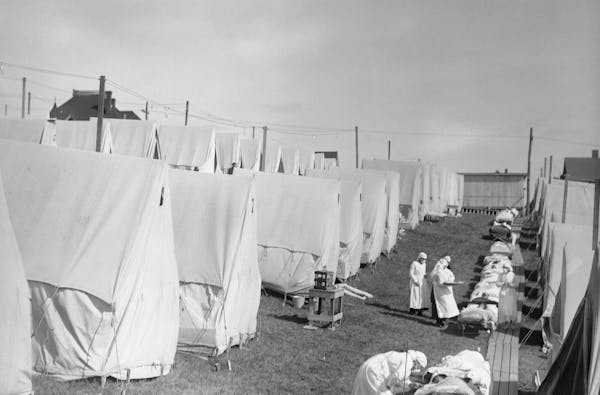
A flu camp in Lawrence, Maine during the 1918 influenza pandemic. Nurses and doctors tried desperate measures to stop the spread of the disease, which ultimately killed more than 675,000 people in the U.S. alone. Bettmann/Getty Images

Severe cases of both COVID-19 and the flu require the same lifesaving medical equipment. This highlights the importance of getting the flu vaccine for not only your own personal health but also the health of your community. Receiving the flu vaccine will help reduce the burden of respiratory illness on our already very overstretched health care system. By increasing flu vaccination rates, we can reduce the overall impact of respiratory illnesses on the population and hence lower the resulting burden on the health care system during the COVID-19 pandemic.

Because flu vaccination protects against one of these respiratory illnesses, the CDC recommends everyone (with few exceptions) six months of age and older get an annual flu vaccine. While the flu vaccine will not protect you against COVID-19, the flu vaccine will reduce your risk of developing the flu as well as reduce your risks of flu-related complications including hospitalization and even death.

While it may seem like there is so much out of our control during this pandemic, getting the flu vaccine, practicing proper hand washing, social distancing and wearing face coverings are within our control and will protect not only you but also your family and community.

If you are not getting the flu vaccine from your employer, think about alternative sources now. Vaccines should be available in most areas by Sept. 1.

  • Call you doctor’s office to ask how you can get a flu shot.
  • Call your local public health department.
  • Consider getting a vaccine while you are grocery shopping or picking up prescriptions.

Mainly, make sure you take advantage of this potentially lifesaving vaccine. Get it on your calendar for early September now. And remember, the flu shot cannot give you the flu.