Drug shortages reach all-time high

https://www.axios.com/2024/04/11/drug-shortage-record-high
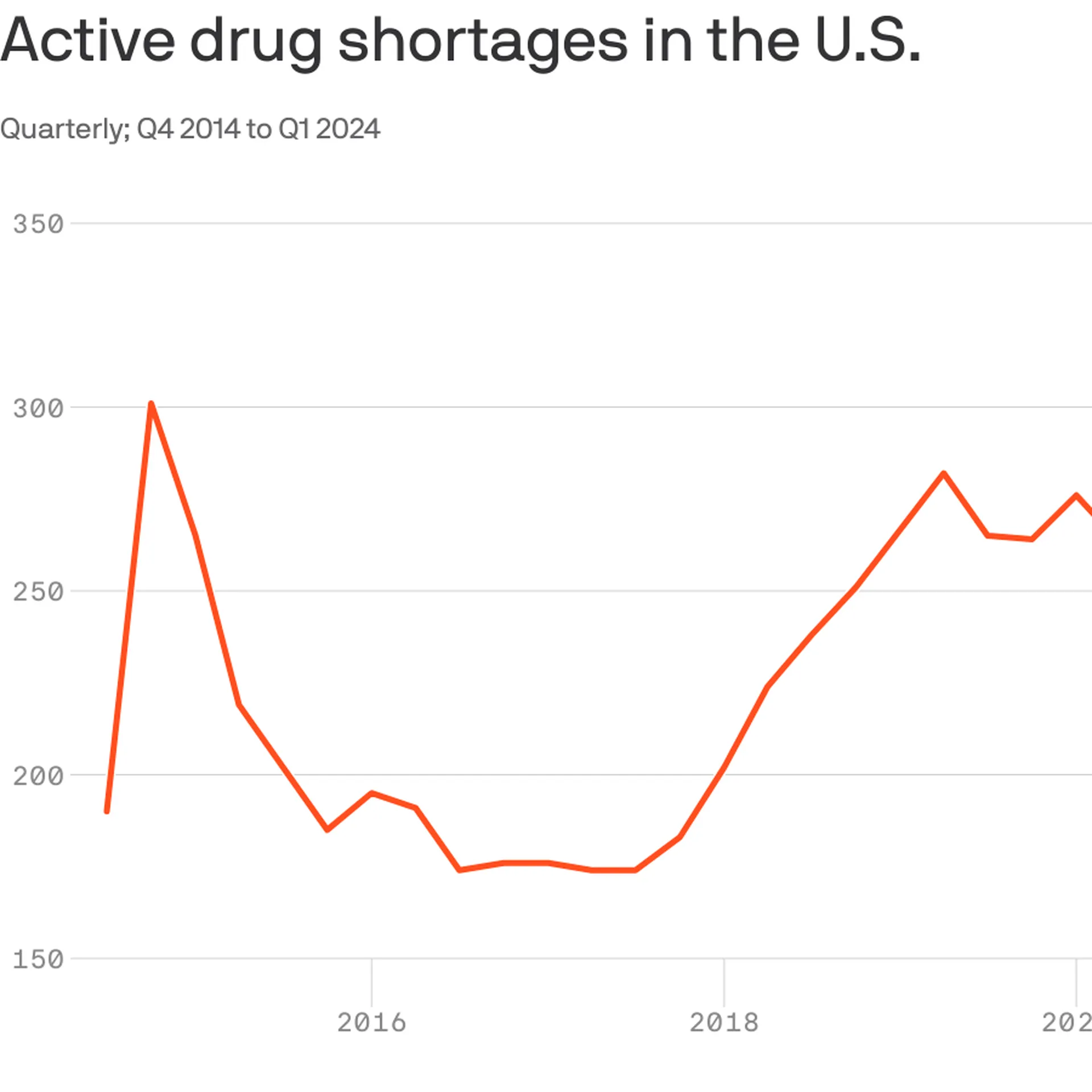
With 323 medicines in short supply, U.S. drug shortages have risen to their highest level since the American Society of Health-System Pharmacists began tracking in 2001.

Why it matters: 

This high-water mark should energize efforts in Congress and federal agencies to address the broken market around what are often critical generic drugs, the organization says.

  • The Biden administration last week issued a drug-shortage plan that called on Congress to pass legislation that would reward hospitals for maintaining an adequate supply of key drugs, among other measures.
  • As a “first step,” Medicare yesterday proposed incentives for roughly 500 small hospitals to establish and maintain a six-month buffer stock of essential medicines.

The big picture: 

Many of the issues behind shortages are tied to low prices for generics that leave manufacturers competing on price.

  • “It’s been a race to the bottom. We need more transparency around quality so that buyers have a reason to not chase the lowest price,” said Michael Ganio, senior director at the ASHP.
  • Drugmakers that can demonstrate safer, higher-quality manufacturing practices should earn a higher price, he said.
  • Manufacturing quality concerns in particular have fueled shortages of chemotherapy drugs and some antibiotics.

Between the lines: Other factors are also driving drug shortages.

  • Controlled substances, such as pain and sedation medications, account for 12% of active shortages, which are tied to recent legal settlements and Drug Enforcement Administration changes to production limits, per ASHP.
  • Not surprisingly, the blockbuster category of anti-obesity drugs known as GLP-1s are in shortage largely because of outsized demand.
  • That’s also the case for ADHD drugs and hormone therapies used in gender-affirming care.

Why the Pentagon is concerned about our generic drug supply

https://mailchi.mp/a93cd0b56a21/the-weekly-gist-june-9-2023?e=d1e747d2d8

Published this week in Bloomberg, this article explores the Department of Defense (DOD)’s rationale for reportedly piloting a partnership with Valisure, an independent laboratory, to test the quality of the generic drugs it purchases for military members, veterans, and their families. 

The DOD’s current plan is to follow the example of Kaiser Permanente, which contracted with the same drug testing company to ensure quality standards for generic drugs that exceed Food and Drug Administration (FDA) requirements. While the FDA has discouraged the use of third-party testing programs, recent stories of toothless enforcement for troubled manufacturing facilities have weakened the agency’s credibility.

The Gist: Amid the current backdrop of drug shortages and cost concerns, this article shines a light on the lesser-known issue of quality oversight of generic drugs. This is especially important as generic medications make up around 90 percent of all prescriptions dispensed in the US. 

With generic drug production, largely a low-margin business, moving overseas, the FDA has increasingly struggled to perform oversight and quality control—though Valisure’s scientific methods have been criticized both in court and by the FDA itself. 

While Pentagon officials have labeled the vulnerabilities in our drug supply chain a threat to national security, the problems the DOD is hoping to resolve are the same ones faced by all purchasers of generic drugs in the US.

Mark Cuban’s drug company to sell name-brand diabetes drugs

https://mailchi.mp/c9e26ad7702a/the-weekly-gist-april-7-2023?e=d1e747d2d8

On Monday, the Mark Cuban Cost Plus Drugs Company (MCCPDC) announced via Twitter that it will begin to offer two branded diabetes drugs, Invokana and Invokamet, produced by Janssen, a Johnson & Johnson subsidiary. A month’s supply of these drugs, the first non-generics it has offered, will cost patients around $244, over 60 percent less than average retail prices. Prescriptions for these diabetes drugs fell from nearly 2M in 2020 to under 1M in 2022, and a key Invokama patent will expire next year, both factors that may have influenced Janssen’s decision to partner with MCCPDC.

The Gist: MCCPDC estimates that as many as 1M people who use these or similar drugs could benefit from the lower prices—not only the uninsured but also those considered “underinsured” due to high deductibles. 

Even though the deal is for two drugs with declining revenues, selling brand-name drugs from a pharmaceutical heavyweight is a notable step for the company.

As Congress continues to investigate PBMs for driving up drug spending through their pricing tactics, MCCPDC’s move offers a path to PBM disruption through direct competition. By cutting out the rebates retained by health plans and PBMs, MCCDPC can potentially offer better net payments to pharmaceutical companies, as well as reduced cost-sharing for patients—an arrangement that benefits both parties at the expense of traditional PBMs.

California partners with Civica Rx to produce generic insulin

https://mailchi.mp/6f4bb5a2183a/the-weekly-gist-march-24-2023?e=d1e747d2d8

This week, California Governor Gavin Newsom announced the state has struck a 10-year, $50M partnership with nonprofit drugmaker Civica Rx to produce three versions of generic insulin.

These are intended to be made available nationwide for list prices of no more than $30 a vial.

Production is slated to begin in late 2023 at Civica’s Petersburg, VA plant, and Food and Drug Administration approval will be required. This deal advances California’s CalRx initiative to produce and distribute generic drugs at low costs; according to a Newsom administration official, the low-cost insulin will be available to state residents through mail-order and retail pharmacies. This is the first state-level partnership for Civica, a health system collaborative whose members now cover a third of all US hospital capacity.

The Gist: Since Congress capped insulin copays for Medicare beneficiaries at $35 per month, there’s been a remarkable sea change in the pricing of the drug. Last week, Sanofi joined Eli Lilly and Novo Nordisk, the three of which together control 90 percent of the US insulin market, in dramatically reducing insulin list prices and capping out-of-pocket costs (including for the uninsured), bringing them in line with the costs now paid by Medicare beneficiaries. 

Given that most Americans needing insulin are already covered by these policies, the impact of California’s initiative may be muted. However, it sets an important precedent for state partnership in pharmaceutical production that will surely expand to other drugs (Newsom stated generic naloxone could be next)—and works to position Newsom as an advocate for lower drug costs, should he seek higher office. 

Amazon launches subscription service for generic prescription medications

https://mailchi.mp/8f3f698b8612/the-weekly-gist-january-27-2023?e=d1e747d2d8

On Tuesday, Amazon unveiled its latest healthcare offering, RxPass, which will deliver generic prescription drugs to Prime members who pay an additional flat $5 monthly surcharge. The service, which currently covers 53 medications for common conditions, requires consumers to pay out-of-pocket rather than through insurance, but does not limit the number of drugs a subscriber can receive for the flat monthly fee.

RxPass is not yet able to ship medications to eight states, including (notably) California, Texas, and Pennsylvania.

The Gist: Paying $60 a year to avoid the hassle of going to a pharmacy or dealing with another mail-order delivery program will be a very attractive offer for many of the 168M US-based Amazon Prime subscribers, as much for the convenience as for the potential cost savings. 

But the concept isn’t novel. Case in point: Walmart continues to offer its $4 generic drug program, launched in 2006. Given that the average Prime member is 37 years old, Amazon’s flat-fee service offering will target a younger demographic with fewer medication needs—and complement the service offered by PillPack, acquired in 2018, which is built for older customers on multiple medications. An evolutionary, not revolutionary, step in Amazon’s ongoing moves into healthcare.

Study finds Medicare could save billions buying generic drugs from Mark Cuban’s pharmacy

https://mailchi.mp/3390763e65bb/the-weekly-gist-june-24-2022?e=d1e747d2d8

 An analysis published in the Annals of Internal Medicine finds that if Medicare had purchased 77 common generic drugs from Mark Cuban’s Cost-Plus Pharmacy in 2020, it would have saved $3.6B dollars. That translates to more than a third of the $9.6B Medicare spent on generic drugs that year. 

In January, Dallas Mavericks owner and billionaire Cuban launched the generic drug company as a transparency play, cutting out pharmacy benefit managers (PBMs), negotiating directly with manufacturers, and selling drugs at a flat 15 percent markup.

The Gist: This isn’t the first study to find that Medicare overpays for generic drugs, as it’s unable to negotiate drug prices under current law. Another recent analysis found that Costco can offer consumers lower prices than Medicare drug plans for half of the most common generic drugs.

The fact that both Costco’s and Cuban’s pharmacies, neither of which accepts health insurance, can offer consumers cheaper generics is another indication of how PBMs’ perverse incentives and opaque pricing and rebate models lead to consumers being steered to higher priced drugs. We’re hopeful that the FTC’s new investigation into PBMs will shed light on their pricing practices, and create a path for lawmakers to finally address unsustainably high prescription drug prices.  

The prescription drug pricing paradox

Net prices of brand-name drugs have increased significantly over the last decade. But savings from generics have driven average prescription prices down in Medicare and Medicaid, Axios’ Caitlin Owens writes about a new analysis by the Congressional Budget Office.

Why it matters: The analysis reiterates that the generic market is largely working as it’s intended to.

By the numbers: The average net price of a prescription fell from $57 in 2009 to $50 in 2018 in Medicare Part D, and from $63 to $48 in Medicaid.

  • The drop is largely attributable to the growing use of generics, which jumped from 75% to 90% of all prescriptions nationally during that time frame. The average price for a generic prescription also fell in both programs.
  • But the average net brand-name prescription price more than doubled in Part D and increased by 50% in Medicaid, per the analysis. These increases were driven by higher launch prices for new drugs and price increases for drugs already on the market.

Drug Prices: We’ve Seen This Movie Before

As happened with cars in the 1960s, price competition among brand-name drugs is hard to find.

Before 1973, when the Arab oil embargo upended the U.S. auto industry, Americans witnessed an annual ritual by carmakers. In the late summer, the Big Three — Ford, Chrysler, and General Motors — would release sticker prices for their products, always showing increases, of course.

Almost always, the increases from each company for similar models were nearly identical. If one company’s was out of line — substantially bigger or smaller than its erstwhile competitors’ — it quickly made an adjustment. Explicit collusion to fix prices was never proven, but the effect for consumers was the same.

Now, researchers report that something very similar seems to be occurring for big-market brand-name drugs, including anti-diabetic medications and blood thinners.

Average wholesale prices for products in five classes — direct-acting oral anticoagulants (DOACs), P2Y12 inhibitors, glucagon-like peptide-1 (GLP-1) agonists, dipeptidyl dipeptidase-4 (DPP-4) inhibitors, and sodium-glucose transport protein-2 (SGLT-2) inhibitors — increased in “lock-step” each year from 2015 to 2020, according to Joseph Ross, MD, of Yale University in New Haven, Connecticut, and colleagues writing in JAMA Network Open.

These increases ranged from annual averages of 6.6% for DDP4 inhibitors to 13.5% for P2Y12 inhibitors — far outpacing not only inflation in general, but even the 2.1% average for all prescription drugs.

Within each class, Kendall τb correlation coefficients for average wholesale prices were as follows:

  • DOACs: 0.98
  • SGLT-2 inhibitors: 0.98
  • DPP-4 inhibitors: 0.96
  • GLP-1 agonists: 0.92
  • P2Y12 inhibitors: 0.75

“These results suggest there was little price competition among the sponsors of these products,” Ross and colleagues wrote.

Although the analysis came with significant limitations — it didn’t account for rebates or other discounts, for example — the researchers said some patients must suffer from these increases.

“Rebates, list prices, and net prices have been growing for brand-name medications, and rebate growth has been shown to positively correlate with list price growth, thereby impacting costs faced by patients paying a percentage of (or the full) list price, the group noted. “Therefore, the lock-step price increases of brand-name medications, without evidence of price competition, raise concerns and would be expected to adversely affect patient adherence to medications and thus clinical outcomes.”

For the car buyers, the solution to lock-step price increases was imposed from outside: soaring gas prices in the mid-1970s prompted demand for vehicles with better fuel economy than domestic makers were prepared to sell. That opened the market to Japanese cars that not only got better mileage, but were also more reliable and (in many cases) cheaper than Big Three products. Thus ended Detroit’s ability to set prices.

How to rein in Big Pharma is less clear. For their part, Ross and colleagues suggested policies to limit such lock-step price hikes, shortened patent exclusivity periods, and faster introduction of generic equivalents.

Cigna sues dozens of drugmakers in alleged price-fixing scheme

https://www.beckershospitalreview.com/pharmacy/cigna-sues-dozens-of-drugmakers-in-alleged-price-fixing-scheme.html?utm_medium=email

26 Generic Drugmakers Accused of Price-Fixing, 'Multibillion ...

Cigna, one of the country’s largest health insurers, filed a lawsuit this week accusing dozens of generic drugmakers of breaking national and state antitrust laws by fixing prices. 

The lawsuit, filed June 9 in a Pennsylvania district court, alleges the drugmakers conspired to fix, increase, stabilize or maintain prices of generic drugs, allocate customers and markets and rig bids for generic drugs in violation of federal and state antitrust and competition laws.

A similar lawsuit was filed by all 50 states June 10 accusing 26 drugmakers of a price-fixing scheme. 

Cigna wrote that the drugmakers orchestrated the conspiracy through secret communications and meetings. The scheme increased the drugmakers’ profits at the expense of many customers, including Cigna, the lawsuit alleges.

“This scheme to fix, increase, stabilize or maintain prices, allocate customers and markets, and rig bids for generic pharmaceutical drugs, and otherwise stifle competition caused, and continues to cause, significant harm to the United States healthcare system,” the lawsuit states.

Cigna is seeking damages incurred from overcharges it paid for generic drugs. 

Find the full lawsuit here.


AARP, United Healthcare and CVS keep prescription drug prices higher for seniors

https://www.washingtontimes.com/news/2020/feb/11/aarp-united-healthcare-and-cvs-keep-prescription-d/

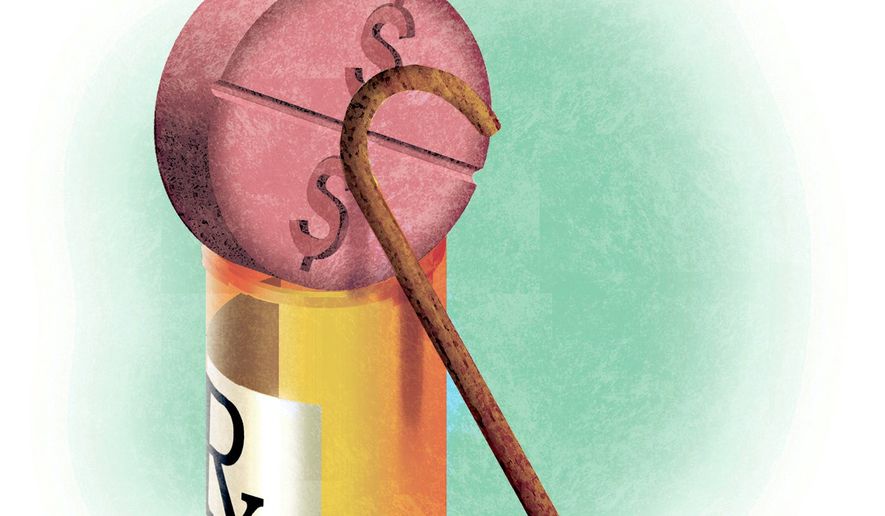
Illustration on overpriced prescription drugs for seniors by Alexander Hunter/The Washington Times

Most folks think of the AARP as a membership organization that gives older Americans discounts on magazine subscriptions and cellphone plans. In fact, those business lines are secondary to AARP’s real source of income, a lucrative partnership with United Healthcare.

AARP partners with United Healthcare to offer health insurance plans to its membership. On its face, there’s nothing inappropriate about this type of affinity branding; the problem is that United Healthcare (and, frankly, other insurance companies) have made some decisions at the expense of seniors and the Medicare program, which should run counter to what a seniors-focused advocacy organization endorses. Recent actions by United Healthcare to limit seniors’ access to less expensive versions of Medicare drugs calls into question whether the AARP is looking out for older Americans or its own bottom line.

During the past three years, President Trump has maintained a laser focus on drug prices, causing pharmaceutical companies to respond in a variety of ways, including reducing or, in some instances, halting altogether annual price increases, pledging responsible pricing for new medications and reducing the price of medicines in certain instances.

For example, last year Eli Lilly launched a half-price version of its insulin drug, Humalog, to address affordability barriers for diabetic patients. Gilead created a subsidiary company in order to offer its two revolutionary hepatitis C products, Harvoni and Epclusa, as “authorized generics” at prices more than 70 percent lower than the identical brand version. In 2018, two companies competing in the cardiovascular space, Sanofi and Amgen, each introduced less costly versions of their cholesterol medications for patients who are unresponsive to statins — at 60 percent below the original price. These are all big wins for Mr. Trump’s jawboning campaign.

But the system is not working: These less expensive versions of innovative drugs are not available to many seniors because of how insurance companies and their negotiators (known as “pharmacy benefit managers” or PBMs) design drug coverage via formularies, particularly in Medicare. A perfect case study is cardiovascular disease, the No. 1 cause of death in the United States: For the past 14 months, in many instances, United Healthcare formulary design kept patients on the more expensive versions of the Sanofi and Amgen cholesterol medicines which came coupled with a high out-of-pocket co-insurance for the patient. Further, CVS (which is merging with insurance company Aetna) admitted to creating barriers for patients by requiring doctors to provide a “documented clinical reason” for prescribing the identical, cheaper version of the same medicine. Today in Medicare, CVS continues to block affordable access to the lower cost versions by not covering these medicines anywhere on their national formulary, effectively dissuading a patient at high risk for a heart attack or stroke from purchasing the medicine prescribed by his/her cardiologist.

Why would insurance companies and PBMs want to keep paying for the more expensive version of an identical drug? The answer lies in the backward way drugs are priced in America. Drug manufacturers set the “list price” of a drug the same way a car dealership lists the price of cars or colleges list the price of tuition. What’s actually paid by an insurer in the final transaction is usually steeply discounted from the starting price by the drug company “rebating” a portion — 40 percent on average, oftentimes more — to the PBM/insurance company (which then pocket it). That negotiation should result in reduced out-of-pocket drug costs for seniors. The problem is that this model results in perverse incentives.

Medicines have high “list prices” because the drug company knows that it will need to provide significant discounts/rebates in order to be listed on a health plan’s formulary. Positive formulary placement = patient access to a medicine. Insurance companies and PBMs like the higher list prices because they profit from both the steep, negotiated rebates and the higher co-insurance the patient pays to the plan. In Medicare, once a patient barrels through the initial drug coverage phase, the federal government picks up 80 percent of a senior’s drug costs, reducing the insurer’s liability. In the end, it’s patients who suffer at the pharmacy counter and in the long run.