UnitedHealthcare’s policy will limit outpatient surgery payments to hospitals

https://www.beckershospitalreview.com/finance/unitedhealthcare-s-policy-will-limit-outpatient-surgery-payments-to-hospitals.html?oly_enc_id=2893H2397267F7G

Related image

UnitedHealthcare has expanded prior authorization requirements and site of service medical necessity reviews for certain surgeries in an effort to shift surgical procedures to less expensive locations, according to Modern Healthcare.

The outpatient surgery policy will limit the circumstances under which UnitedHealthcare will pay for certain surgeries in a hospital outpatient setting.

Taking effect in November for fully insured groups in most states, UnitedHealthcare will only pay for a surgical procedure performed in an outpatient hospital setting if the insurer determines the site of service for the procedure is medically necessary, UnitedHealthcare told Becker’s Hospital Review.

“Medical necessity reviews for site of service occur during our prior authorization process and are only conducted if the surgical procedure will be performed in an outpatient hospital setting,” UnitedHealthcare said. “We utilize our Outpatient Surgical Procedures – Site of Service Utilization Review Guideline to help make our site of service medical necessity determinations. Site of service medical necessity reviews are currently being conducted for certain surgical procedures and will apply to additional surgical procedures beginning on Nov. 1, 2019 for most states.”

In California, Colorado, Connecticut, New Jersey and New York, medical necessity reviews will begin for certain surgeries occurring on or after Dec. 1, according to a UnitedHealthcare bulletin. Site of service medical necessity reviews do not apply to providers in Alaska, Kentucky, Massachusetts, Maryland and Texas.  

With the outpatient surgery policy, the insurer said it hopes to reduce healthcare spending by guiding patients toward ambulatory surgery centers, where care may be cheaper when there isn’t a substantial medical reason for the surgery to be performed in a hospital outpatient setting.

Surprise Settlement In Sutter Health Antitrust Case

https://khn.org/news/surprise-settlement-in-sutter-health-antitrust-case/

Sutter Health has reached a tentative settlement agreement in a closely watched antitrust case brought by self-funded employers, and later joined by the California Attorney General’s Office. The agreement was announced in San Francisco Superior Court on Wednesday morning, just moments before opening statements were expected to begin.

While representatives for both sides confirmed they had reached a tentative settlement, they would not divulge details of the agreement, which must be approved by the court.  Superior Court Judge Anne-Christine Massullo told the jury impaneled for the case that details likely would be made public during approval hearings in February or March.

There were audible cheers from the jury following the announcement that the trial, which was expected to last three months, would not continue. Officials with the attorney general’s office and Sutter Health declined requests for comment.

Sutter stood accused of violating California’s antitrust laws by using its market power to illegally drive up prices. Health care costs in Northern California, where Sutter is dominant, are 20% to 30% higher than in Southern California, even after adjusting for cost of living, according to a 2018 study from the Nicholas C. Petris Center at the University of California-Berkeley that was cited in the complaint.

The case was a massive undertaking, encompassing years of work and millions of pages of documents, California Attorney General Xavier Becerra said beforehand. If the plaintiffs prevailed, Sutter was expected to face damages of up to $2.7 billion.

The nonprofit giant has 24 hospitals, 34 surgery centers and 5,500 physicians across Northern California, with $13 billion in operating revenue in 2018. The state’s lawsuit alleged Sutter has aggressively bought up hospitals and physician practices throughout the Bay Area and Northern California, and exploited that market dominance for profit.

Among other tactics, it accused Sutter of employing an “all-or-none” approach to contracting with insurance companies, demanding that an insurer that wanted to include any one of the Sutter hospitals or clinics in its network must include all of them — even if some of those facilities were more expensive than a competitor.

Sutter Health consistently denied the allegations, saying its large, integrated health system offers tangible benefits for patients, including more seamless, high-quality care and increased access for residents in rural areas. Sutter also disputed that its prices are higher than other major health care providers, saying its internal analyses tell a different story.

The case was expected to have nationwide implications on how hospital systems negotiate prices with insurers. Even with details of the agreement not yet public, attorneys and patient advocates said they expect the settlement to mark a pivotal moment.

David Balto, a former federal regulator who is now an antitrust lawyer in Washington D.C., called the developments “precedent-setting.”

“You have all these metropolitan markets where you have large hospital systems, but Sutter Health in the Bay Area is like the filet mignon of the problem,” Balto said. “The problems in San Francisco are bigger than anywhere else. And you see that in how Sutter has exploited its market power to the nth degree.”

Sutter’s tactics were hard to challenge under antitrust law, Balto added. But “what [Becerra] did was bring together hard facts with top-notch scholarship proving there was an overwhelming problem and that Sutter’s strong-arm tactics were the cause of the problem.”

Anthony Wright, executive director of the advocacy group Health Access California, said he wasn’t privy to the settlement details, but that he expected it to include “some meaningful remedies in terms of adjusting some of the anti-competitive practices and contract provisions that Sutter has advanced over the years.”

“While we await the details of the settlement,” he said, “the lawsuit itself sends a strong signal to hospital chains across the nation and all health care providers planning to adopt predatory prices.”

Jaime King, associate dean and a professor of law at UC Hastings College of the Law, said Sutter’s decision to settle “in some ways is not a surprise. On the eve of trial, we often see big settlements.”

Still, she said, it comes at a cost: “I think it’s a shame we won’t ever get to see the evidence that would have been brought forward in this case about Sutter’s contracting and pricing practices. There are a lot of very large health systems that are charging a lot of money for their services, and this case had the opportunity to give us much more insight into what we’re spending our health care dollars on.”

Sutter continues to face trial on a separate federal antitrust lawsuit.


RWJBarnabas to acquire Trinitas

https://www.beckershospitalreview.com/hospital-transactions-and-valuation/rwjbarnabas-to-acquire-trinitas.html

Image result for RWJBarnabas to acquire Trinitas

After months of negotiations, Elizabeth, N.J.-based Trinitas Regional Health Network has signed a letter of intent to join Robert Wood Johnson Barnabas Health System in West Orange, N.J.

Under the agreement, RWJBarnabas will become the parent company of Trinitas, a 554-bed Catholic acute care teaching facility. Trinitas will remain a Catholic institution, and its board will maintain oversight of the day-to-day operations of the facility.

According to the letter of intent, RWJBarnabas plans to invest money into the medical center and its affiliates for expansion.

The two parties expect to reach a definitive agreement before the end of the year. 

RWJBarnabas is an academic medical system comprising 11 acute care hospitals, three acute care children’s hospitals and a pediatric rehabilitation hospital, among other physician practices and outpatient clinics. 


Health care’s fraud and abuse laws are getting overhauled

https://www.axios.com/health-care-fraud-abuse-stark-law-antikickback-changes-fd354212-9583-44c7-85e4-86e4690cc56e.html

Doctors dressed in blue operate on a patient in a surgical suite.

The Trump administration is proposing to loosen regulations that prohibit doctors from steering patients insured by federal programs to facilities where they have a financial interest and that outlaw health care companies from offering bribes and kickbacks in exchange for patient referrals.

Why it matters: The industry has long clamored for an overhaul to these laws, which companies say obstruct their goals of providing “value-based care.” But critics worry the broad and vague changes could engender more fraud and abuse than there already is.

Driving the news: The Department of Health and Human Services would create new exemptions for the physician self-referral law and the federal anti-kickback statute — decades-old, complex laws that forbid payments that encourage unnecessary care and increase taxpayer costs.

  • Hospitals, doctors, nursing homes and other entities would be able to create “value-based arrangements,” and those deals could include exchanging bonuses or other types of “remuneration” without running afoul of referral laws.
  • For example, under these exemptions, a hospital could provide a nursing home with a behavioral health nurse for certain discharged patients, or a hospital could donate cybersecurity technology to a physician’s office.
  • Many exemptions already exist, including for organizations called “accountable care organizations” that try to keep a patient’s care within a narrow set of hospitals and doctors, but these changes would go much further.

Between the lines: The overarching concern is everyone’s definition of “value” is different. How will regulators know whether providers are acting in good faith to coordinate care, or if they are using “value-based care” as a cover to control patient referrals and enrich themselves?

A major exclusion: Pharmaceutical companies, medical device firms, labs and medical equipment makers are cut out from the changes because the federal government is afraid those companies would “misuse the proposed safe harbors.”

  • Pharma lobbyists, in particular, have pushed hard to change the law so drug companies could directly subsidize drug copays for Medicare and Medicaid patients, even though federal officials have said that practice “masks the high prices those companies charge for their drugs.”
  • HHS Secretary Alex Azar told reporters the government may consider separate regulations for value-based drug contracts, even though the evidence of those deals’ effectiveness is limited at best.

The bottom line: These changes come at the same time that hospitals, physicians, pharmaceutical companies and others are paying out billions of dollars every year in fraud settlements.

  • Public comments are due Dec. 31, and if this comment process is anything like the initial requests that asked for guidance, the industry will be heavily involved.


Medicare overpays hospitals $1B each year for graduate medical education, study finds

https://www.beckershospitalreview.com/payer-issues/medicare-overpays-hospitals-1b-each-year-for-graduate-medical-education-study-finds.html?oly_enc_id=2893H2397267F7G

Related image

Medicare overpaid hospitals about $1.3 billion in 2015 for the government’s Teaching Health Center Graduate Medical Education program, according to a study published in JAMA Internal Medicine.

The Graduate Medical Education rate is $150,000 per resident. While 25 percent of hospitals received less than $106,000 per resident in 2015, 25 percent received more than $182,000 per resident. That same year, nearly half of teaching hospitals got more than $150,000 per resident.

If Medicare GME payments were capped at the $150,000 rate, researchers predict Medicare would save more than $1 billion every year.

“Our study suggests Medicare GME may be overpaying some hospitals up to $1.28 billion annually,” said Candice Chen, MD, lead study author and associate professor of health policy and management at the George Washington University Milken Institute School of Public Health in Washington, D.C. “Those funds could be redirected and used to strengthen the physician workforce, especially in underserved areas.”


25% of US healthcare spending is waste, study finds

https://www.beckershospitalreview.com/finance/25-of-us-healthcare-spending-is-waste-study-finds.html?oly_enc_id=2893H2397267F7G

Image result for Journal of the American Medical Association (JAMA) Publishes Humana Study on Health Care Spending


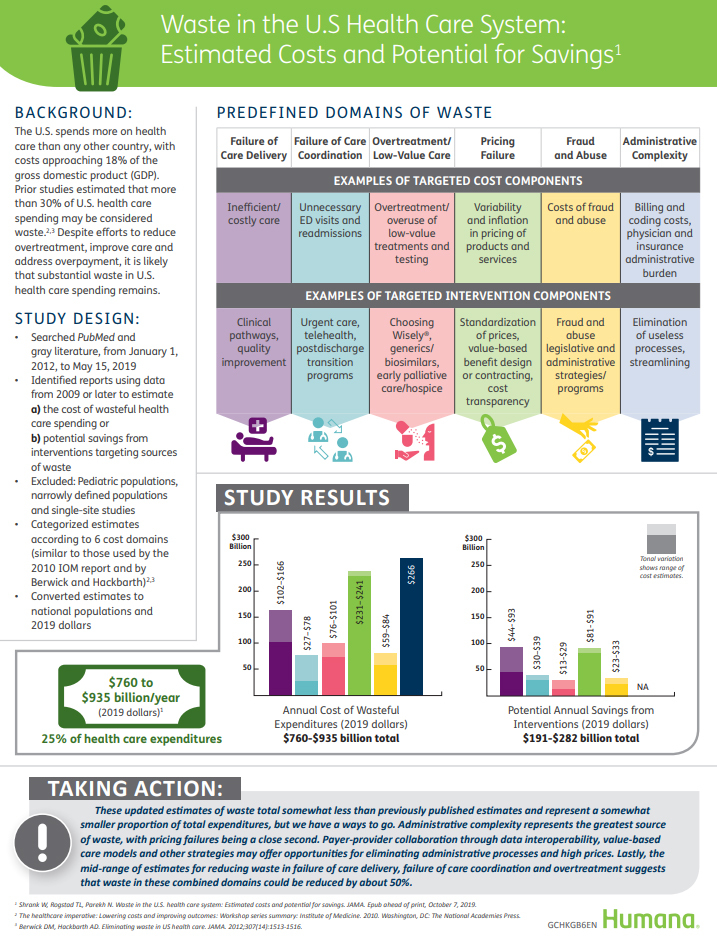
About 25 percent of U.S. healthcare spending can be classified as waste, according to a new study published in JAMA Oct. 7. 

For the study, researchers from Humana and the University of Pittsburgh School of Medicine analyzed 54 peer-reviewed studies, government reports and other medical literature to estimate the levels of waste in the U.S. healthcare system.

Researchers divided waste into six previously developed categories including: failure of care delivery; failure of care coordination; overtreatment or low-value care; pricing failure; fraud and waste; and administrative complexity. 

Administrative complexity accounted for the most waste with $265.6 billion annually, followed by pricing failure or inefficiencies, which accounted for up to $240.6 billion in waste per year.

Approximately $300 billion in waste accrued from failure of care delivery, failure of care coordination and overtreatment. The study estimated that about half of this waste could be avoided.

Overall, the researchers found that the cost of waste in the U.S. healthcare system ranges from $760 billion to $935 billion annually.

Of the $760 billion to $935 billion of waste, researchers estimated that using interventions found to reduce waste could cut between $191 billion and $282.1 billion in healthcare spending.

Access the full report here


CommonSpirit ends fiscal year with $582M operating loss, lays out plan for improvement

https://www.beckershospitalreview.com/finance/commonspirit-ends-fiscal-year-582m-operating-loss-lays-out-plan-for-improvement.html?em=&oly_enc_id=2893H2397267F7G

Image result for commonspirit health headquarters

CommonSpirit Health, which operates 142 hospitals in 21 states, reported an operating loss in the fiscal year ended June 30, but top executives say they expect the system’s performance to improve. 

Chicago-based CommonSpirit was formed through the Feb. 1 merger of San Francisco-based Dignity Health and Englewood, Colo.-based Catholic Health Initiatives. Since the merger occurred less than a year ago, financial and operating results were presented on a pro forma basis, using accounting records of CHI and Dignity Health as if they had been combined for the full fiscal 2019.

CommonSpirit reported operating revenues of $28.8 billion in fiscal 2019, down from $29.2 billion in the year prior. The health system said the year-over-year decline in revenue was largely attributable to California provider-fee program income recognized in fiscal 2018. Last year’s results also included income from the operations of U.S. HealthWorks and the gain on its sale.

After factoring in a year-over-year increase in operating expenses, CommonSpirit posted an operating loss of $582 million in fiscal 2019. That’s compared to operating income of $244 million a year earlier. The system’s nonoperating income dropped from $966 million in fiscal 2018 to $328 million.

CommonSpirit CFO Daniel Morissette told Becker’s Hospital Review the results were expected given the scope and complexity of the merger. 

“We’re simply not where we need to be in terms of performance,” he said. “The whole organization is motivated and is aware of the work that needs to be done to improve these results.”

Over the past eight months, CommonSpirit has centralized key functions, such as IT and contracting, and established 11 geographic divisions across 21 states. It has also begun to scale successful service lines and executed a $6.5 billion debt restructuring, which drew demand from investors and support from financial analysts.

Looking ahead, Mr. Morissette said a strong operating model and a systemwide performance plan will help CommonSpirit achieve an 8 percent EBIDA margin within the next four years. The plan will also help the system build healthier communities, which is the real purpose behind the merger, he said.

CommonSpirit’s CEOs Kevin E. Lofton and Lloyd H. Dean reiterated those goals.

“CommonSpirit has made huge strides toward creating a bold new health organization that will deliver care for many years to come and improve the health of communities across the country,” Mr. Dean said in an earnings release. “We know this is not an easy task and that we face challenges in the near term, which is why we are investing in a strong, disciplined business model that will help the organization evolve to meet the changing health care needs of our communities.”