Trump craves big action on drug prices to take to the campaign trail

https://www.washingtonpost.com/news/powerpost/paloma/the-health-202/2019/07/03/the-health-202-trump-craves-big-action-on-drug-prices-to-take-to-the-campaign-trail/5d1b9aa21ad2e552a21d5228/?utm_term=.e49cb9f99e60

Image result for high drug prices

There may be a modest slowdown this year in the growth of drug prices, but it’s nowhere near the seismic shift President Trump has called for. And that seems to be irking the president to no end.

Much of the president’s frustration has been borne by Health and Human Services Secretary Alex Azar, a former drug executive who until very recently pushed back on proposals to allow the importation of lower-cost drugs from Canada and give the government the tools to directly negotiate lower drug prices in the Medicare program, my Washington Post colleagues Yasmeen Abutaleb, Josh Dawsey and Laurie McGinley report.

But now, under intense pressure, Azar has reversed his long-standing opposition to at least one of those ideas: drug importation, an idea typically embraced by Democrats and dismissed by Republicans and the drug industry.

“Inspired by the president’s passion, Secretary Azar has been pushing FDA to go even bigger and broader on importation,” a senior administration official told my colleagues, although the official declined to detail specific policy changes.

It’s been a little more than a year since Trump promised Americans, in a speech from the Rose Garden, he would slash the price of prescription drugs in the United States. In that time, his administration has proposed some bold new regulations that could help move the needle, but only one has so far been finalized — a new requirement that went into effect this month for drugmakers to list prices in television ads.

While Azar has championed a proposal to eliminate the secretive rebates drug manufacturers pay to insurers, opposition to the idea from Domestic Policy Council head Joe Grogan is hamstringing the effort, my colleagues report. Grogan dislikes its estimated $180 billion price tag and doesn’t view the measure as central to the administration’s drug-pricing effort, they write.

There’s another proposal under review at the Office of Management and Budget to tie some Medicare drug prices to those paid by other countries, but it’s opposed by key Senate Republicans and the drug industry.

A senior administration official downplayed talk of tension between Azar and Grogan, saying the two, along with White House legislative affairs director Eric Ueland, speak three times a week about what is happening on Capitol Hill.

And on Monday, the New York Post published a joint op-ed by Azar and Grogan praising a recent executive order from Trump aimed at more transparency around the prices negotiated between hospitals and insurers.

“President Trump has promised a better vision: a health care system that treats you like a person, not a number,” Azar and Grogan write. “He wants to hold providers and Big Pharma accountable to transparency and reasonable prices.”

Meanwhile, drugmakers have continued hiking prices, albeit a bit more slowly on average. List prices for branded drugs grew 3.3 percent in this year’s first quarter, compared with 6.3 percent in the first quarter of 2018, according to SSR Health pharmaceutical analysts. Bernstein analysts told Politico that drug prices jumped 10.5 percent over the past six months, less than over the same period last year but still four times the rate of inflation.

Trump has frequently referenced some encouraging data from the consumer price index, where the index for prescription drugs fell by 0.6 percent for the 12 months ending in December, according to the Bureau of Labor Statistics. The index also dropped in January, February, March and May — a string of monthly declines not seen since 1973, my Post fact-checking colleagues recently noted.

Yet these data are a far cry from the drastic price reductions Trump would love to tout on the campaign trail as he seeks reelection in 2020.

“By all accounts, drug prices are a fixation for Trump, who frequently sends advisers news clippings and summons them to the White House to rant about the issue,” Yasmeen, Josh and Laurie write. “The guy likes to make money, and he thinks they make too much money,” said one former senior administration official.

A senior administration official told my colleagues there was frustration at a lack of executive branch tools to lower drug prices and that some of Trump’s ideas were ambitious but unworkable.

“Disagreements over how to proceed have created a policy free-for-all as different advisers — and the president himself — pursue what appear to be ad hoc and sometimes dueling approaches,” they write. “Trump entertains proposals usually pushed by progressive Democrats one moment and free-market GOP ideas the next.”


Out-of-pocket costs rising even as patients transition to lower-cost care settings

https://www.healthcarefinancenews.com/news/out-pocket-costs-rising-even-patients-transition-lower-cost-care-settings?mkt_tok=eyJpIjoiWldZeVlXTm1aVEF6TVdKbSIsInQiOiJjbWFzeVA2TGlWZkNkXC9odGxcLzdLczFZSDYxd1hoYW04b0wxY0ljQ25zblpYN1VWc2FMWFFCQWpmc2tCYmE4d1Z3eVdMd2htY3JiSjZ3N2Urek43SHFJbWFsckdRbUNycFJoQjhzZm5VcGpJUUhKUDlBMWF2eGJzRUhmZGFlUUx0In0%3D

Patients saw increases of up to 12% in their out-of-pocket responsibilities for inpatient, outpatient and ED care in 2018.

A new TransUnion Healthcare analysis has found that most patients likely felt a bigger pinch to their wallets as out-of-pocket costs across all settings of care increased in 2018. The new findings were made public yesterday at the 2019 Healthcare Financial Management Association Annual Conference in Orlando.

The analysis reveals that patients experienced annual increases of up to 12% in their out-of-pocket responsibilities for inpatient, outpatient and emergency department care last year.

In 2017, the average inpatient cost was $4,068; the average outpatient cost was $990; and the average emergency department cost was $577.

In 2018, the average inpatient cost was $4,659; the average outpatient cost was $1,109; and the average emergency department cost was $617.

FUELING THE TREND

There are certain factors that are influencing this trend, according to Jonathan Wiik, principal of healthcare strategy at TransUnion Healthcare.

“Patients are becoming more aware that emergency care is expensive and somewhat inefficient,” Wiik said. “No one wants to go to the emergency room unless we have to, because we don’t want to deal with the time there or the expense. They aren’t the best place to get primary or even urgent care.”

Another factor, he said, is that providers realize the emergency department is a care setting of last resort for many. Providers want to make sure that have room in the ED for cases that are real emergencies, so they’re essentially curating their patients, steering patients to the most cost effective settings possible — often primary care, which is the least expensive setting.

Noting that the biggest annual increases were in inpatient and outpatient care, Wiik said that was largely a function of utilization and just a general wariness, in addition to the fact that most EDs have pretty flat contracts. Financial communication with patients is also an issue.

“Most people can’t afford the average out-of-pocket, so providers are really trying to educate patients as early as they can about those costs,” said Wiik. “Emergency care is a really hard place to educate people on finances, let alone collect on them.”

RISING COSTS

The analysis found that, during a hospital visit, patients are likely experiencing cost increases that continue the trend of higher out-of-pocket costs. About 59% of patients in 2018 had an average out-of-pocket expense between $501 and $1,000 during a healthcare visit. This was a dramatic increase from 39% in 2017. Conversely, the number of patients that had an average out- of-pocket expense of $500 or below decreased from 49% in 2017 to 36% in 2018.

And with out-of-pocket costs increasing, the trend toward consumerism is growing as more patients, payers and providers transition to lower cost settings of care.

One example: Inpatient care, traditionally the most expensive healthcare option, has seen a leveling off with the percentage of price estimates remaining at 8% between 2017 and 2018. The percentage of outpatient services estimates, generally about one-quarter of the cost of inpatient services, rose in that same timeframe from 65% to 73%.

“Patients are likely seeing more providers and payers recommending that they take advantage of cost-effective healthcare options, which brings down costs for all parties,” said Wiik. “This is especially important as costs continue to rise in all areas of healthcare, particularly in inpatient, outpatient and emergency department services.”

This is having an impact on providers, payers and patients, he said.

“Let’s pretend Joanna had an MRI in her head, and that ran $3,200. That might have been paid by Blue Cross Blue Shield, and $100 out of Joanna’s pocket. Now Joanna’s paying $300. Most patients don’t look up how much the MRI’s going to be. They just get the bill later and try to figure it out. I think the patient portion of the bill is going to be in the 35, 40% range very soon. What that means is we’re quickly approaching half of the bill coming from the patient and half from the payer. That’s not insurance anymore, that’s a bank account.”

A recent Kaiser Family Foundation study indicated that 34% of patients are finding it difficult to pay their deductible before insurance kicks in. In addition to patients being challenged to make payments, the trend is that providers are also feeling the pressure of increased denial rates and write-offs, which is increasing bad debt.

Considering these factors together — increased out-of-pocket expenses, a patient’s challenge to make payment, and increased denial rates — collecting payments from all payers is critical for providers. In order for providers to ensure they receive payment for the patient-care services rendered, it is vital that they implement strategies that maximize reimbursements.


On the Doorstep With a Plea: Will You Support Medicare for All?

Art Miller listened patiently as the stranger on his doorstep tried to sell him on the Medicare for All Act of 2019, the single-payer health care bill that has sharply divided Democrats in Congress and on the presidential campaign trail.

The visitor, Steven Meier, was a volunteer canvasser who wanted Mr. Miller to call his congresswoman, Abby Finkenauer, the young Democrat who took a Republican’s seat last year in this closely divided district — and press her to embrace Medicare for all. Beyond congressional politics, there was the familiar role that Iowa plays as the first state to weigh in on the fight for the Democratic presidential nomination.

“I want to know how my grandkids are going to pay for it, O.K.?” Mr. Miller, 71, mused, peering at the flier that Mr. Meier had handed him.

It was a fairly typical encounter for Mr. Meier, 39, who with hundreds of volunteers around the country is working with National Nurses United, the country’s largest nurses’ union, to build grass-roots support for the single-payer bill, a long shot on Capitol Hill and a disruptive force in the party. House Democrats have declared this Saturday and Sunday to be “a weekend of action on health care” — but they are split over whether to embrace extreme change or something closer to the status quo.

A single-payer health care system would more or less scrap private health insurance, including employer-sponsored coverage, for a system like Canada’s in which the government pays for everyone’s health care with tax dollars. Democrats not ready for that big a step are falling back on a “public option,” an alternative in which anyone could buy into Medicare or another public program, or stick with private insurance — a position once a considered firmly on the party’s left wing.

Lawmakers like Ms. Finkenauer, mindful of the delicate political balance in their districts, fear the “socialism” epithet that President Trump and his party are attaching to Medicare for all. On Friday, Mr. Trump called the House bill “socialist health care” that would “crush American workers with higher taxes, long wait times and far worse care.” But even Ms. Finkenauer, who beat the incumbent Republican in November by 16,900 votes, has been pulled left by the debate, embracing the public option, which could not get through Congress when the Affordable Care Act passed in 2010.

“In a divided Congress, I’m focused on what we can do to bring immediate relief to Iowans,” she said in an email.

The nurses’ union and a number of other progressive groups want nothing less than a government system that pays for everyone’s health care, seizing on the issue’s prominence and a round of Medicare for all hearings in the House with canvassing in the districts of many of the 123 House Democrats who have not thrown their support behind a single-payer system.

“Hearings are a moment for us to have a national stage for this campaign,” Jasmine Ruddy, the lead organizer for the nurse union’s Medicare for all campaign, told several dozen new volunteers on a training call last month. “It’s up to us to take advantage of the momentum we already see happening and turn it into political power.”

But building support for a single-payer health care system has been slow going. On Wednesday, the chairman of the Ways and Means Committee, Representative Richard E. Neal of Massachusetts, convening the House’s third Medicare for all hearing, said it was about “exploring ideas.”

Republicans warned darkly of sky-high tax increases, doctor shortages and long waits for care. Representative Kevin Brady of Texas, the senior Republican on the committee, said his constituents were “frightened” about their private coverage being “ripped out from under them.”

The nurses’ union campaign began just after Democrats won the House in November, when the union and several other groups held a strategy call with Representative Pramila Jayapal, Democrat of Washington, the chief author of the Medicare for All Act, and Senator Bernie Sanders of Vermont, who pushed Medicare for all into the mainstream during his 2016 presidential campaign.

“Rather than try to convince people it’s the right system,” Ms. Ruddy said, “our strategy is to reach the people who are already convinced that health care is a human right, to bring them in and actually make them feel the action they are taking matters.”

In Dubuque, Mr. Meier and his partner, Briana Moss, have knocked on 250 doors and gathered about 50 signatures over the past few months. About 20 volunteers, including a retired nurse and several college students, are also involved. Nationwide, canvassers have knocked on 20,000 doors and collected 14,000 signatures since February.

On a Saturday afternoon, Mr. Miller, a Vietnam veteran, told Mr. Meier about his positive experience with government health care through the Department of Veterans Affairs, saying, “I’ve seen how it can work.”

A few houses down, a woman who owns a cleaning service and would give only her first name, Sharon, and her party affiliation, Republican, said that if the bill covered abortions, “I won’t go for that.”

She added that she would be happy to stop paying $170 a month for supplemental insurance to cover what Medicare does not, but she did not want to see people who do not work receive free care. From the garage, her husband hollered that he agreed. Conceding defeat, Mr. Meier and Ms. Moss moved along.

Both Sanders supporters, they took on the cause in part because Ms. Moss has Type 1 diabetes and has struggled on and off to stay insured, though now she has Medicaid under the Affordable Care Act’s expansion of the program. Ms. Moss, 30, went to see Ms. Finkenauer in her district office this year and asked if she supported a government system that eliminated insurance. Ms. Finkenauer, she said, stated her preference for a public option.

“That’s simply a compromise that leaves the insurance companies still in the game,” said Mr. Meier, who recently started working at John Deere building backhoes and will soon have employer-based coverage after being uninsured for his entire adult life.

The Jayapal and Sanders bills would both expand traditional Medicare to cover all Americans, and change the structure of the program to cover more services and eliminate most deductibles and co-payments. There would effectively be no private health insurance, because the new system would cover almost everything; Mr. Sanders has said private coverage could be sold for extras like cosmetic surgery.

While polling does show that Medicare for all has broad public support, that drops once people learn it would involve raising taxes or eliminating private insurance. That finding bewilders Mr. Meier, given many of the conversations he has on people’s front steps.

Those conversations keep coming. Rick Plowman 66, complained bitterly about how despite having Medicare, he had to pay nearly $500 for inhalers to treat his chronic obstructive pulmonary disease. Still, he was skeptical.

“I just don’t know what it’s going to look like down the road,” Mr. Plowman said. “Even Social Security for kids, you know? Even for you guys?”

“I’m willing to start making that sacrifice right now,” Mr. Meier pushed back. Mr. Plowman signed the petition.

At a white bungalow around the corner, Mr. Meier found — finally — that he was preaching to the choir with Bobby Daniels, 50, and his wife, Andrea, 46. Mr. Daniels, a forklift operator from Waterloo, said their coverage came with a $3,000 deductible and he would “most definitely” support Medicare for all. Ray Edwards, 36, an uninsured barber, also heartily signed on.

At the final stop of the day, Mr. Meier and Ms. Moss encountered Jeremy Shade, 36, a registered Republican who promptly told them his sister lived in Canada and had spent “hours and hours in the hospital, waiting for care” under that country’s single-payer system.

“I get that concern, and it’s something I’m worried about, too,” Mr. Meier said as Mr. Shade’s dog barked. “Would you be interested in maybe just calling Abby Finkenauer and saying, ‘Hey, what are we doing about the health care problem in this country?’”

“My wife would,” Mr. Shade said, explaining that she was a Democrat. “I’m real wary about it.”

Two hours of hot canvassing amid swarms of gnats had yielded six petition signatures and a few pledges to call Ms. Finkenauer. Mr. Meier was determined to end on a positive note. “I really think health care could be the issue that could get people to stop being so on one side or the other,” he said, a point that Mr. Shade accepted, shaking his hand before retreating inside.


House committee to discuss DSH cut repeal next week

https://www.modernhealthcare.com/government/house-committee-discuss-dsh-cut-repeal-next-week?utm_source=modern-healthcare-daily-dose-thursday&utm_medium=email&utm_campaign=20190530&utm_content=article1-readmore

The House Energy and Commerce Committee next week will consider a full repeal of the Medicaid disproportionate share hospital cuts, a sign that hospitals are getting closer to securing the top lobbying priority for safety net providers and academic medical centers.

The committee will hold a hearing next Tuesday on proposed legislation from Rep. Eliot Engel (D-N.Y.), whose home state gets the single largest so-called Medicaid DSH allotment in the country. In fiscal 2018, New York received $1.8 billion of the roughly $12 billion in annual federal payments.

Engel has pitched a full repeal of the cuts mandated by the Affordable Care Act, which are set to take effect Oct. 1. Should those cuts move forward, they would reduce federal DSH payments to states by $4 billion in fiscal 2020 and $8 billion in fiscal 2021. An aide to Engel said that a full repeal “provides the long-term solution.”

Medicaid DSH is the second-largest federal program to boost hospital Medicaid funding, representing about $12 billion in federal spending annually. It has been the subject of a political fight over proposed reforms to the program.

Last week, 300 of the 435 U.S. House of Representatives lawmakers sent a letter to the chamber’s leadership urging a two-year delay to the DSH cuts, and hinted that some in Congress believe the Medicaid DSH formulas need to be reconfigured, calling for a “sustainable, permanent” solution.

“This delay will ensure that hospitals can continue to care for the most vulnerable in our communities,” the lawmakers wrote, led by Engel and Rep. Pete Olson (R-Texas).

The amount the federal government pays out for DSH varies enormously across states and is mostly arbitrary, reflecting the caps set by Congress in 1992 instead of a relevant benchmark.

Florida, where about 3.3 million people are uninsured, gets the exact same federal DSH allotment as Connecticut, where about 245,000 people are uninsured.

Finance Committee Chair Chuck Grassley (R-Iowa) has said he wants to see a reset. Sen. Marco Rubio (R-Fla.), whose state has a strong vested interest in a formula change, has used the Sept. 30 deadline to push a proposal that would base the federal dollar allotment on a particular state’s share of U.S. citizens living below the poverty level.

But the major trade groups representing DSH hospitals continue to push for a simple delay, since their constituents include hospitals in all the states. Dr. Bruce Siegel, CEO of America’s Essential Hospitals, said at a briefing to House staff earlier this month that he’d be open to a formula change as long as hospitals don’t see cuts to existing funding. That means Congress would have to allocate even more money to the program.

House Speaker Nancy Pelosi (D-Calif.) said she backed another delay when she addressed American Hospital Association’s annual meeting in April. She noted that she wouldn’t back a program overhaul.

“We cannot support efforts that will reward states for not expanding Medicaid or simply take DSH money from some other state and give it to others,” she said. “Who thought that was a good idea?”

The DSH debate doesn’t fall along the lines of which states expanded Medicaid or not. Alabama and Missouri haven’t expanded Medicaid but receive high federal DSH allotments, and would likely lose money if Congress decided to redistribute the existing payments.

Although the policy rationale behind the ACA-mandated cuts was that Medicaid expansion would shrink hospitals’ need for DSH money, high-DSH expansion states such as New York and New Jersey aren’t giving an inch.

Siegel framed the debate over expansion states’ need as being “a little more complicated now” than in the early years of the ACA.

“I think the market has changed in the last eight years or nine years when we started down the road of Medicaid expansion,” he said at the Capitol Hill staff briefing.

He pointed to the slight rise in the uninsured rate recently, as well as the increase of high-deductible plans that put more fiscal burden on enrollees.

“We are frankly concerned about any moves to move us toward skinny health plans,” he added.

Enrollment in more bare-bones commercial plans doesn’t really affect the Medicaid enrollment, but he argued that expansion still brings Medicaid shortfall — which is the difference between Medicaid and Medicare reimbursement.

“If you have 70% Medicaid patients which some of our hospitals do, you are in a terrible disadvantage in terms of payment streams, with the shortfall becoming enormous for you,” he said.

There is another Medicaid program that can help hospitals with shortfall: the “upper payment limit” supplement for Medicaid fee-for-service. States can deploy UPL payments to hospitals in order to increase their reimbursement based on rates Medicare would have paid for the same treatment.

UPL is the largest Medicaid supplemental funding program, with about $13 billion in annual spending according to the Medicaid and CHIP Payment and Access Commission data from fiscal 2017.

The UPL program is also under scrutiny by MACPAC, whose analysts found that 17 states have overspent billions of these payments.


Toward 2020: A Survey of ACA Market Insurers

Click to access Toward_2020_A_Survey_of_ACA_Market_Insurers.pdf


Even the most seasoned patients are no match for the Medical Insurance Industrial Complex

https://www.kevinmd.com/blog/2019/05/even-the-most-seasoned-patients-are-no-match-for-the-medical-insurance-industrial-complex.html

Image result for Medical Insurance Industrial Complex

“Does my insurance cover this?”

I cannot calculate how often a patient poses this inquiry to me assuming wrongly that I have expertise in the insurance and reimbursement aspects of medicine. If I — a gastroenterologist — do not even know how much a colonoscopy costs, it is unlikely that I can speak with authority to a patient’s general insurance coverage issues.

Of course, patients assume that we physicians have an expansive expertise of the medical universe, both in the business and the practice of medicine. Often, friends and acquaintances will informally present a medical issue for my consideration that is wildly beyond my limited specialty knowledge, and yet they expect an informed opinion. “Hey, aren’t you a doctor?” Yes, I am, but if you think a gastroenterologist — a colonoscopy crusader — can advise you on your upcoming hip surgery, psoriasis treatment retinal detachment, or cardiac rehab, think again.

And, I likely know more about psoriasis treatment than I do about the enigma of insurance coverage. I have to check with our billing expert to understand my own medical coverage, and I’m in the business. And, at the risk of appearing as a simpleton to my erudite readers, I cannot aver that I fully grasp the meaning of the EOB (explanation of benefits) forms that I receive for my own care that purport to explain exactly where my insurance company responsibilities end and mine begin.

Imagine for a moment that you are an actual physician as you counsel a patient who is sent to you for a screening colonoscopy. (To assist you in this role play, a screening colonoscopy means there are no symptoms or any other abnormalities that would justify the procedure. A screening study is done on patients who are entirely well as a preventive medicine exercise. In contrast, if a patient has a symptom, such as pain or bleeding, then the colonoscopy is considered diagnostic and not screening.) You advise your 50-year-old patient that his screening colonoscopy will be fully covered by insurance. The patient is happy.

However, during the screening colonoscopy, a polyp is discovered and removed. Indeed, removing polyps is the mission of the procedure. However, polyp removal automatically changes the procedure from screening to diagnostic. And, guess what? Now, the procedure may not be free and the patient may be subject to copays or diving into his deductible. When the patient receives his EOB, and properly decodes it, he is no longer happy. Then, our office is likely to receive a phone call.

This is but one example of the Medical Insurance Industrial Complex. Even our most seasoned patients are no match against this machine. It’s not a fair fight. They make the rules, change them at will and serve as the referees. And, if the insurance company ruling doesn’t fall your way, relax, you can certainly appeal. This process is about as pleasurable as undergoing a rigid sigmoidoscopy. The appeals process is not for the faint of heart. You must have the patience of Job, the fortitude of a Navy SEAL, accept rejection gracefully, welcome irrationality, regard a dropped phone connection as an amusing event and have several consecutive hours available typically at times most inconvenient for you. On reflection, perhaps the sigmoidoscopy is the more pleasant option.


Federal Reserve Report on the Economic Well Being of U.S. Holdholds in 2018

Click to access 2018-report-economic-well-being-us-households-201905.pdf

2018 Employer Health Benefits Survey – Section 7: Employee Cost Sharing

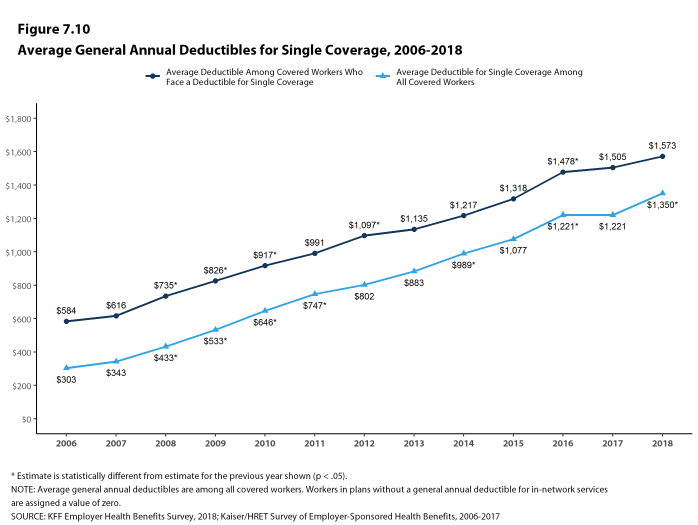
Figure 7.10: Average General Annual Deductibles for Single Coverage, 2006-2018

Shot: Almost 40% of Americans would struggle to handle a surprise expense of $400, according to a new Federal Reserve report.

Chaser: The average deductible today among all workers is more than $1,300, according to the Kaiser Family Foundation.


The Health 202: Large employers don’t want Medicare-for-all

https://www.washingtonpost.com/news/powerpost/paloma/the-health-202/2019/05/20/the-health-202-large-employers-don-t-want-medicare-for-all/5ce1aa38a7a0a435cff8c0d4/?utm_term=.47900c042418

Medicare-for-all advocates argue enacting their plan would lift a heavy burden off employers to provide their workers with health-care coverage, which is the way 180 million Americans get their insurance.

But large employers are just fine with being the suppliers of insurance and don’t want to give up that role, according to an association that represents them.

Overwhelmingly they would like to continue doing it,” Jim Klein, president of the American Benefits Council, told me. “They think they’re doing a good job.”

The American Benefits Council — which represents the country’s largest employers including Walmart, ExxonMobil and Apple — hasn’t joined the large industry coalition of insurers, pharmaceutical makers and hospitals who are vigorously fighting every iteration of Medicare-for-all proposals coming from Capitol Hill (we’ve written about that partnership here).

But its leaders are plenty skeptical of the prospect of a single-payer system, stressing it would upend the way most people in the United States get their coverage and potentially subject employers to big new taxes so the government could pay for the whole thing.

“I think they’re very concerned about sort of a blank check which the government would be filling in the blank, in terms of cost,” Klein said of his members.

The future of employer-sponsored coverage is one of the stickiest questions raised by the Medicare-for-all debate. The shortcomings — and merits — of the system got a lot of airtime during last month’s Medicare-for-all hearing at the House Rules Committee and probably will be part of the debate at a similar hearing House Budget Chairman John Yarmuth (D-Ky.) has scheduled for Wednesday.

Just look at how some of the Democrats running for president have recently danced around the issue.

Sens. Cory Booker (D-N.J.) and Kamala Harris (D-Calif.) are co-sponsors of the latest Medicare-for-all bill from Sen. Bernie Sanders (I-Vt.), which would upend the country’s health insurance system, replacing virtually all private plans with a generous set of benefits provided by the federal government. But both candidates have tried to take a softer stance on what would happen to workplace coverage.

—“I stand by supporting Medicare-for-all, but I’m also that pragmatist that, when I’m chief executive of the country … I’m going to find the immediate things that we can do,” Booker told CNN’s Jake Tapper this month.

“Because I’m telling you right now, we’re not going to pull health insurance from 150 million Americans who have private insurance who like their insurance — my union friends, brothers and sisters, who have negotiated for their health insurance,” Booker added.

—Sen. Kamala Harris (D-Calif.) told Tapper last week “that’s not what I meant” when he asked her to clarify previous comments in which she said she supports eliminating the private insurance industry.

“I support Medicare-for-all but I really do need to clear up what happened on that stage,” Harris said. “It was in the context of saying let’s get rid of all the bureaucracy.”

— Yarmuth poured cold water on the idea of Medicare-for-all being law anytime soon, despite the hearing he’s holding on the issue this week.

“A lot of people, I think, co-sponsored Pramila’s bill for the same reason they co-sponsored H.R. 676; it was the metaphor for Medicare-for-all,” Yarmuth told my colleague Dave Weigel last week. Yarmuth was referring to the House bill proposed by Rep. Pramila Jayapal (D-Wash.).

“Now, people have seen some of the details and said, ‘Okay, we need to look at this.’ There doesn’t seem to be much of a sense of urgency because it’s not going anywhere,” Yarmuth added.

Rep. Donna Shalala (D-Fla.), former Health and Human Services secretary under President Bill Clinton, is also a Medicare-for-all skeptic:

Perhaps these Democrats recall President Barack Obama’s infamous “if you like it, you can keep it,” pledge, where Obama learned the hard way what happens when people lose insurance they wanted to keep. Obama repeatedly promised people they could retain coverage they liked under his 2010 Affordable Care Act. When around 4 million people got notices their plans were being canceled — because they weren’t ACA-compliant — the administration came under heavy fire. The website PolitiFact dubbed Obama’s promise its “Lie of the Year” in 2013.

Yet employer-sponsored plans are still far from perfect. In fact, many health policy wonks have said many of the problems with health insurance in the United States stem from people getting it through the workplace instead of shopping for it on their own.

Costs are a big problem for both employers and their workers. For years, employers have grappled with rapid health-care cost inflation, resulting in higher monthly premiums and annual deductibles. Last year, health benefits for the average employee at a large company cost more than $13,000, according to a Mercer survey of employer-sponsored plans.

In response, employers have trended toward high-deductible plans or asked their workers to contribute more to their monthly premiums. Some have also invested in workplace wellness programs, in hopes of creating a healthier, lower-cost workforce.

“It puts a huge burden on employers,” House Rules Committee Chairman James McGovern (D-Mass.) said at his committee’s Medicare-for-all hearing.

Then there’s the issue of portability — the problem created when people change jobs and are forced to also change their health plan. This can be especially costly for those with chronic health conditions, who can’t afford any gaps in coverage and may find themselves having to satisfy an annual deductible for the second time in one year.

Yet to those enmeshed in the system, such as large employers, overhauling the whole thing is a daunting prospect. While health-care costs continue to rise, employers are more fearful of having to help fund the expensive single-payer system proposed in the Sanders and Jayapal bills.

Sanders argues his Medicare-for-all plan would be net cheaper for employers. He has proposed charging them either 75 percent of what they’re paying for each of their employees enrolling in Medicare-for-all or a 7.5 percent payroll tax, whichever is higher.

This would result in a net savings for employers, Sanders argues. Large employers don’t appear convinced.

Klein said the council isn’t necessarily opposed to expanding Medicare to more people — and stresses that its members are deeply interested in reining in cost growth.

But he said employers don’t want a health insurance overhaul, arguing they spend more than $4 on health benefits for every dollar the government loses by exempting the benefits from taxes.

“Our employers are not calling for Uncle Sam,” he said.