Judge Mary McElroy of the U.S. District Court for the District of Rhode Island ruled Friday to extend a temporary restrainingorder she issued last month that barred the Trump administration from wiping out pandemic-era funding to Washington D.C., and 23 Democratic-led states.
States behind the lawsuit argued that HHS acted unlawfully by abruptly ending the grant funding without any analysis of the move’s benefits or consequences.
HHS said that the $11.4 billion worth of grant funding was mainly used to pay for testing, vaccines and hiring community health workers to combat COVID-19. And the agency argues since the pandemic is over, state and local health agencies no longer need that money.
Although the grants were initially authorized by COVID-19 relief legislation, the funds were allowed to be spent on other efforts like combating the ongoing measles outbreak in Texas. State and local health departments said the funds were already being used for such efforts.
McElroy ruled that the agency does not have the legal right to unilaterally withhold the grant funding that has already been allocated to localities, especially in states where that funding has been used to build essential health programs.
She wrote in her ruling that the funding cuts would “result in devastating consequences to their local jurisdictions … would constrain the States’ infectious disease research, thwart treatment efforts to those struggling with mental health and addiction, and impact the availability of vaccines to children, the elderly and those living in rural areas.”
In February, the American Hospital Association and five other hospital organizations had urged the court to review the case. The current formula costs DHS hospitals more than a billion dollars each year, according to the AHA.
“The AHA is pleased that the Supreme Court agreed to consider this case,” said Chad Golder, AHA general counsel and secretary, by statement. “As we explained in our amicus brief urging the Court to grant certiorari, it is critical to hospitals and health systems that HHS interpret the DSH fraction consistently across the statute. The agency’s longstanding failure to do so has cost hospitals more than a billion dollars each year, directly harming the hospitals that serve America’s most vulnerable patients. We look forward to the Supreme Court rectifying this legal error next term.”
WHY THIS MATTERS
This case, and one heard by SCOTUS in 2002 called Becerra v. Empire Health Foundation, can be viewed as being two sides of the same coin. Both deal with a different portion of the DSH fraction that determines payment. The Empire Health case dealt with the Medicare portion. This latest case is about the Supplemental Security Income portion.
The AHA and other organizations have argued that HHS incorrectly adopted the view that a patient is entitled to Supplemental Security Income benefits only if the patient actually received cash SSI payments during a hospital stay. This interpretation is inconsistent with the court’s reasoning in Becerra v. Empire Health Foundation, the AHA said.
That 2022 decision said that patients are entitled to Medicare Part A benefits for purposes of the DSH formula if they qualify for the program, even if Medicare is not paying for their hospital stay.
“This case concerns a question that is critical to calculating the Medicare DSH fraction: When are patients ‘entitled to’ SSI benefits and so counted in the numerator? Is it when they are eligible for SSI benefits, or when they are actually receiving cash SSI benefits,” the AHA and other organizations wrote in their brief to the court.
THE LARGER TREND
In February, the American Hospital Association and five other national hospital associations representing hospitals urged the Court to review the case challenging how HHS applies Congress’ formula for calculating Disproportionate Share Hospital payments..
“The correct interpretation of the DSH formula is vitally important to America’s hospitals,” the brief said. “Although HHS has refused to share the data that would allow hospitals to accurately count the SSI-eligible patients whom the agency’s approach excludes, the available estimates suggest that hospitals will lose more than a billion dollars each year in DSH funds. What’s more, a hospital’s eligibility for DSH payments affects its entitlement to other federal benefits designed to help hospitals ‘provide a wide range of medical services’ to vulnerable populations. HHS’s error thus has far-reaching implications for hospitals, patients, and the American healthcare system.”
Becerra v. Empire Health Foundation was a United States Supreme Court case that in 2022 clarified calculations for the Medicare fraction — one of two fractions the Medicare program uses to adjust the rates paid to hospitals that serve a higher-than-usual percentage of low-income patients, according to SCOTUSblog. Those individuals “entitled to [Medicare Part A] benefits” are all those qualifying for the program, regardless of whether they receive Medicare payments for part or all of a hospital stay, the court ruled.
In Becerra v. Empire Health Foundation, the court ruled 5-4 that HHS had properly interpreted the underlying statute and reversed and remanded the decision of the United States Court of Appeals for the Ninth Circuit.
On Tuesday, health system leaders testified before the House Energy and Commerce Subcommittee onOversight and Investigations about potential changes to the 340B Drug Pricing Program.
The committee was receptive to witnesses’ claims that the program is essential to the financial survival of many systems, but representatives stated that “the status quo is not acceptable” and that they had a responsibility to “step in and provide oversight.”
There was little interest expressed in broad overhauls to the program, but both witnesses and representatives focused on how it could benefit from greater transparency, for example requiring hospitals to disclose 340B revenue, how savings are used, and which patient populations are served through the program.
Meanwhile, Republicans and Democrats in both houses have introduced multiple bills this session that focus on various aspects of the 340B program, including transparency.
The Gist: It’s encouraging to see members of congress recognize how essential the 340B program is to health system finances, and of the potential reforms on the table, increased transparency is a relatively palatable option.
Congress is exploring statutory tweaks to the program in response to the myriad legal challenges concerning it, many of which involve the Department of Health and Human Services. Several of these lawsuits stem from more than 20 major drugmakers restricting 340B discounts at contract pharmacies, which has led multiple states to enact legislation protecting these discounts, in turn prompting further lawsuits.
The mess of conflicting rulings these cases have produced so far is a clear sign that the 340B statute will be amended, and health system advocates should continue working with Congress to find solutions that preserve the integrity of the program.
Regulators sued the PE firm last year for consolidating anesthesiology services in Texas with its portfolio company, U.S. Anesthesia Partners. Now, a judge is holding Welsh Carson blameless.
A Texas federal judge has dismissed the Federal Trade Commission’s antitrust lawsuit against Welsh, Carson, Anderson and Stowe in a big win for the private equity firm. However, the government’s suit against Welsh Carson’s portfolio company U.S. Anesthesia Partners was allowed to continue.
Last year, the FTC sued Welsh Carson and USAP, alleging they pursued a buying spree of anethesiology practices in Texas to create a dominant provider that used its market power to suppress competition and increase the cost of anesthesiology services.
Welsh Carson, which formed USAP in 2012, has since whittled down its ownership of the provider from more than 50% to 23%, and argued that precludes it from being included in the suit. The FTC argued the firm effectively remains in control of USAP.
However, U.S. District Judge Kenneth Hoyt granted Welsh Carson’s motion to dismiss the suit on Tuesday, essentially finding that private equity firms are not liable for the actions of their portfolio companies.
The FTC was unable to prove “any authority for the proposition that receiving profits from an entity that may be violating antitrust laws is itself a violation of antitrust laws,” Hoyt wrote in his opinion.
Hoyt found that Welsh Carson holding a minority share in USAP does not reduce competition, despite USAP’s acquisitions potentially being anticompetitive themselves. In addition, comments from Welsh Carson executives expressing a desire to consolidate other healthcare markets don’t show that the PE firm plans to violate antitrust laws.
If Welsh Carson signals “beyond mere speculation and conjecture” that it’s actually about to violate the law, the FTC can lodge a new lawsuit, the judge wrote.
A spokesperson for Welsh Carson said the firm is “gratified” that the court dismissed the case.
”As we have said from the beginning, this case was without factual or legal basis,” the spokesperson said.
However, Hoyt denied USAP’s motion to dismiss.
The FTC is arguing that USAP — which is the largest anesthesia practice in Texas — leveraged its size to raise prices in the state, resulting in patients, employers and insurers paying tens of millions of dollars more each year for anesthesia services. In addition, USAP allegedly paid a competitor, Envision Healthcare, $9 million to stay out of the Dallas market for five years.
USAP has been criticized for using similar practices to grow in other states, including Colorado.
USAP argued the FTC was overreaching its authority, and regulators’ allegations of anticompetitive conduct were meritless. Hoyt disagreed, pointing out that USAP continues to own the acquired anesthesia groups and continues to charge high prices, including under price-setting agreements. Overall, USAP’s “monopolization scheme remains intact,” according to the opinion.
“The FTC has plausibly alleged acquisitions resulting in higher prices for consumers, along with a market allocation and price-setting scheme. It would be premature to dismiss these claims at this stage,” Hoyt said.
Either way, the dismissal against Welsh Carson is a setback for the FTC, which has taken a more aggressive stance against anticompetitive behaviors in the healthcare industry under the Biden administration.
In December, the FTC and the Department of Justice finalized new guidelines for merger reviews taking aim at previously overlooked practices. Those include private equity roll-ups, when firms acquire and merge multiple small businesses into one larger company — like Welsh Carson’s strategy to grow USAP.
PE firms have acquired hundreds of physician practices across the U.S. in recent years, despite controversy over negative effects on medical quality and cost. One study from 2022 found when private equity took over physician practices, they raised prices by 20% on average.
Late last week, the Department of Health and Human Services (HHS) published a final rule establishing a new administrative dispute resolution process for the 340B drug discount program.
A panel, composed of government experts from the Office of Pharmacy Affairs, will resolve claims raised by covered entity providers about drugmakers overcharging them for 340B drugs, as well as claims from pharmaceutical companies that covered entities are diverting or duplicating discounts improperly. The new process, which will go into effect in mid-June, allows the panel to review claims on issues related to those pending in federal court. It’s intended to be “more accessible, administratively feasible, and timely” than a prior process established by HHS in 2020 that was paused after legal challenges.
The Gist:
This new 340B dispute resolution process is likely to see extensive use, as battles between providers and drugmakers over the drug discount program have heated up significantly in recent years. There are more than 50 ongoing court cases related to the program, many of which concern actions taken by at least 20 major drugmakers to restrict 340B sales to contract pharmacies. Although this new process may provide more effective dispute resolution, none of its decisions can be considered final until courts have settled the myriad cases before them.
Dallas, TX-based US Anesthesia Partners (USAP), one of the nation’s largest providers of anesthesia services, reached a settlement with the Colorado Attorney General’s Office, which had alleged that USAP engaged in anticompetitive behavior in the state.
Although it denies any wrongdoing, USAP agreed to relinquish exclusive contracts with five Colorado hospitals and revise its practice of adding noncompete agreements to its physician contracts.
This settlement is separate from the similar FTC suit against USAP and its creator-turned-minority owner, private-equity (PE) firm Welsh, Carson, Anderson, and Stowe. That suit, filed in federal district court in Texas in September 2023, alleges that USAP monopolized the Texas anesthesiology market in order to drive up prices unlawfully.
The Gist:USAP isn’t the only large anesthesia group in the news this week for allegations of anticompetitive behavior—hospitals in New York and Florida are suing North American Partners in Anesthesia, claiming it stifles competition by forcing its physicians to sign noncompete agreements.
Health systems and regulators are increasingly dissatisfied with the highly concentrated anesthesia provider market, which has become dominated by large, PE-backed groups.
Because the Colorado case was settled out of court, no precedent has been established for antitrust enforcement, but the result of the ongoing FTC suit against USAP may have significant ramifications for other large, PE-backed physician organizations.
Baptist Health said reimbursements for the medications were determined by a payment model that was later invalidated, and the insurer continues to benefit from a “windfall” of underpayments due to the health system, according to the lawsuit.
The suit comes months after the CMS finalized a rule that aimed to fix years of illegal payment cuts in the 340B program. Hospitals had previously argued the solution didn’t consider how MA insurers would benefit financially from the remedy.
Dive Insight:
The 340B program requires pharmaceutical companies to give discounts — which can range from 25% to 50% of the medication’s cost — to providers who serve low-income communities.
The program aims to help safety-net providers better serve vulnerable groups, and it has grown significantly since 340B was created in 1992.
But in 2018, the CMS cut Medicare payments for certain drugs acquired under the 340B program, setting off a legal challenge that hospitals eventually won in front of the Supreme Court four years later.
To fix the underpayments, regulators decided to pay each hospital in 340B a lump sum that would total $9 billion overall. But the fix needed to be budget neutral, so the CMS would cut payments to all hospitals for non-drug items and services over 16 years.
In comments on the proposal, the American Hospital Association argued there was a “significant problem” with the plan, noting many MA insurers pay hospitals according to traditional Medicare rates.
Payers would benefit from reducing the non-drug payments to hospitals, and wouldn’t be required to repay 340B providers for the lower payments between 2018 and 2022, commenters argued on the rule, which was finalized in November.
In response, regulators said they appreciated the concerns, but that they were outside the scope of the rule and “CMS cannot interfere in the payment rates that MAOs [Medicare Advantage organizations] set in contracts with providers and facilities.”
In the Baptist lawsuit, the health system reported it contacted Humana multiple times about retroactive adjustments and remedy payments, but the insurer’s counsel disputed any obligation to make those payments.
“Humana’s refusal to act has worked a substantial windfall to Humana as it continues to hold funds provided by CMS for Humana’s Medicare Advantage plans without reimbursing Baptist Health for the amounts owed to it under the Agreement,” the system said in the lawsuit.
Humana said it does not comment on ongoing litigation.
Last Monday, two lawsuits were filed that strike at a fundamental challenge facing the U.S. health system:
In the District Court of NJ, a class action lawsuit (ANN LEWANDOWSKI v THE PENSION & BENEFITS COMMITTEE OF JOHNSON AND JOHNSON) was filed against J&J alleging the company had mismanaged health benefits in violation of the Employee Retirement Income Security Act (“ERISA”). As noted in the 74-page filing “This case principally involves mismanagement of prescription-drug benefits. “Over the past several years, defendants breached their fiduciary duties and mismanaged Johnson and Johnson’s prescription-drug benefits program, costing their ERISA plans and their employees millions of dollars in the form of higher payments for prescription drugs, higher premiums, higher deductibles, higher coinsurance, higher copays, and lower wages or limited wage growth… Defendants’ mismanagement is most evident in (but not limited to) the prices it agreed to pay one of its vendors—its Pharmacy Benefits Manager (“PBM”)—for many generic drugs that are widely available at drastically lower prices.”
The issue is this: what liability risk does a self-insured employer have in providing health benefits to their employees?
Is the structure of the plan, the selection of providers and vendors, and costs and prices experienced by employees subject to litigation? What’s the role of the employer in protecting employees against unnecessary costs?
On the same day, in the District Court of Eastern Wisconsin, an 85-page class action lawsuit was filed against Advocate-Aurora Health (AAH) claiming it “uses its market power to raise prices, limit competition and harm consumers in Wisconsin:
Forces commercial health plans to include all its “overpriced facilities” in-network even when they would prefer to include only some facilities.
Goes to “extreme efforts to drive out innovative insurance products that save commercial health plans and their members money.”
Suppresses competition through “secret and restrictive contract terms that have been the subject of bipartisan criticism.”
Acquires new facilities, which then allows it to raise prices due to reduced competition
… without intervention, the health system will continue to use “anticompetitive contracting and negotiating tactics to raise prices on Wisconsin commercial health plans and their members and use those funds for aggressive acquisitions and executive compensation.”
The issue is this: is a health system’s liable when its consolidation activities result in higher prices for services provided communities and employers in communities where they operate?
Is there a direct causal relationship between a system’s consolidation activities and their prices, and how should alleged harm be measured and remedied?
Two complicated issues for two reputable mega-players in the U.S. health system. Both lawsuits were brought as class actions which guarantees widespread media attention and a protracted legal process. And each contributes directly to the gradual erosion of public trust in the health system since the plaintiffs essentially claim the business practices of J&J and Advocate-Aurora willfully harm the individuals they pledge to serve.
In the November 2023 Keckley Poll, I asked the sample of 817 U.S. adults to assess the health system overall. The results were clear:
69% think the system is fundamentally flawed and in need of major change vs. 7% who think otherwise.
60% believe it puts its profits above patient care vs. 13% who disagree.
74% think price controls are needed vs. 7% who disagree.
83% believe having health insurance that’s ‘affordable and comprehensive’ is essential to financial security vs 3% who disagree.
52% feel confident in their ability to navigate the U.S. system “when I have a problem” vs. 32% who have mixed feelings and 16% who aren’t.
And 76% think politicians avoid dealing with healthcare issues because they’re complex and politically risky vs/ 6% who think they tackle them head-on.
The poll also asked their level of trust and confidence in five major institutions “to develop a plan for the U.S. health system that maximizes what it has done well and corrects its major flaws.”
Clearly, trust and confidence in the health system is low, and expectations about solutions fall primarily on hospitals and doctors. Lawsuits like these widen suspicion that the industry’s dominated first and foremost by Big Businesses focused on their own profitability before all else. And they pose particular problems for sectors in healthcare dominated by not-for-profit and public ownership i.e. hospitals, home care, public health agencies and others.
My take
These lawsuits address two distinct issues: the roles of employers in designing their health benefits for employees including the use of PBMs, and the justification for consolidation of hospital and ancillary services in markets.
But each lawsuit s predicated on a legal theory that prices set by organizations are geared more to corporate profits than public good and justifiable costs.
Pricing is the Achilles of the health system. Pushback against price transparency by some, however justified, has amplified exposure to litigation risk like these two and contributed to the public’s loss of trust in the system.
It is unlikely greater price transparency and business practice disclosures by J&J and Advocate-Aurora could have avoided these lawsuits, but it’s clearly a message that needs consideration in every organization.
Healthcare organizations and their trade groups can no longer defend against lack of transparency by defaulting to the complexity of our supply chains and payment systems. They’re excuses. The realities of generative AI and interoperability assure information driven healthcare that’s publicly accessible and inclusive of prices, costs, outcomes and business practices. In the process, the public’s interest will heighten and lawsuits will increase.
The lawsuit filed in federal court seeks to represent thousands of other UPMC employees.
Dive Brief:
A nurse is suing the University of Pittsburgh Medical Center for allegedly leveraging its monopoly control over the employment market in Pennsylvania to keep wages down and prevent workers from leaving for competitors, all while increasing their workload.
The lawsuit, filed late last week in a federal court, seeks class action status to represent other staff at the nonprofit health system. Plaintiff Victoria Ross, who worked as a nurse at UPMC Hamot in Erie, Pennsylvania, seeks damages and is asking the judge to enjoin UPMC from continuing its unfair business practices.
If granted class action status, the lawsuit could represent thousands of current and former UPMC workers, including registered nurses, medical assistants and orderlies. UPMC has denied the allegations in statements to other outlets but did not respond to a request for comment by time of publication.
Dive Insight:
UPMC has grown steadily over the past few decades into the largest private employer in Pennsylvania, employing 95,000 workers overall.
From 1996 to 2018, the system acquired 28 competing healthcare providers, greatly expanding its market power, according to the lawsuit. The acquisitions also shrunk the availability of healthcare services. Over the same period, UPMC closed four hospitals and downsized operations in three other facilities, eliminating 1,800 full- and part-time jobs, the lawsuit said.
UPMC relied on “draconian” mobility restrictions and labor law violations to lock employees into lower pay and subcompetitive working conditions, according to the 44-page complaint.
Specifically, the system enacted restraints like noncompete clauses and “do-not-rehire blacklists” to stop workers from leaving. Meanwhile, UPMC allegedly suppressed workers’ labor law rights to prevent them from unionizing.
“Each of these restraints alone is anticompetitive, but combined, their effects are magnified.UPMC wielded these restraints together as a systemic strategy to suppress worker bargaining power and wages,” the lawsuit said. “As a result, UPMC’s skilled healthcare workers were required to do more while earning less — while they were also subjected to increasingly unfair and coercive workplace conditions.”
According to the complaint, UPMC has faced 133 unfair labor practice charges since 2012, and 159 separate allegations. Roughly 74% of the violations were related to workers’ efforts to unionize, the lawsuit said.
Meanwhile, UPMC workers’ wages have fallen at a rate of 30 to 57 cents per hour on average compared to other hospital workers for every 10% increase in UPMC’s market share, said the lawsuit, citing a consultant’s economic analysis.
The lawsuit also noted that UPMC’s staffing ratios have been decreasing, even as staffing ratios on average have increased at other Pennsylvania hospitals.
The alleged labor abuses and UPMC’s market power are linked, according to the complaint.
“Had UPMC been subject to competitive market forces, it would have had to raise wages to attract more workers and provide higher staffing levels in order to avoid degrading the care it provided to its patients, and in order to prevent losing patients to competitors who could provide better quality care,” the lawsuit said.
UPMC is facing similar labor allegations. In May, two unions filed a complaint asking the Department of Justice to investigate labor abuses at the nonprofit.
Hospitals were plagued by staffing shortages during the COVID-19 pandemic. Many facilities still bemoan the difficulty of hiring and retaining full-time workers, and point to shortages (of nurses in particular) as the reason for overworked employees and poor staffing ratios.
Yet some studies suggest that’s not the case. One recent analysis of Bureau of Labor Statistics data found employment in hospitals — including registered nurses — is now slightly higher than it was at the start of the pandemic.
Despite the controversy, UPMC — which now operates 40 hospitals with annual revenue of $26 billion — continues to try and expand its market share. Late last year, the system signed a definitive agreement to acquire Washington Health Care Services, a Pennsylvania system with more than 2,000 employees and two hospitals. The deal faces pushback from local unions.
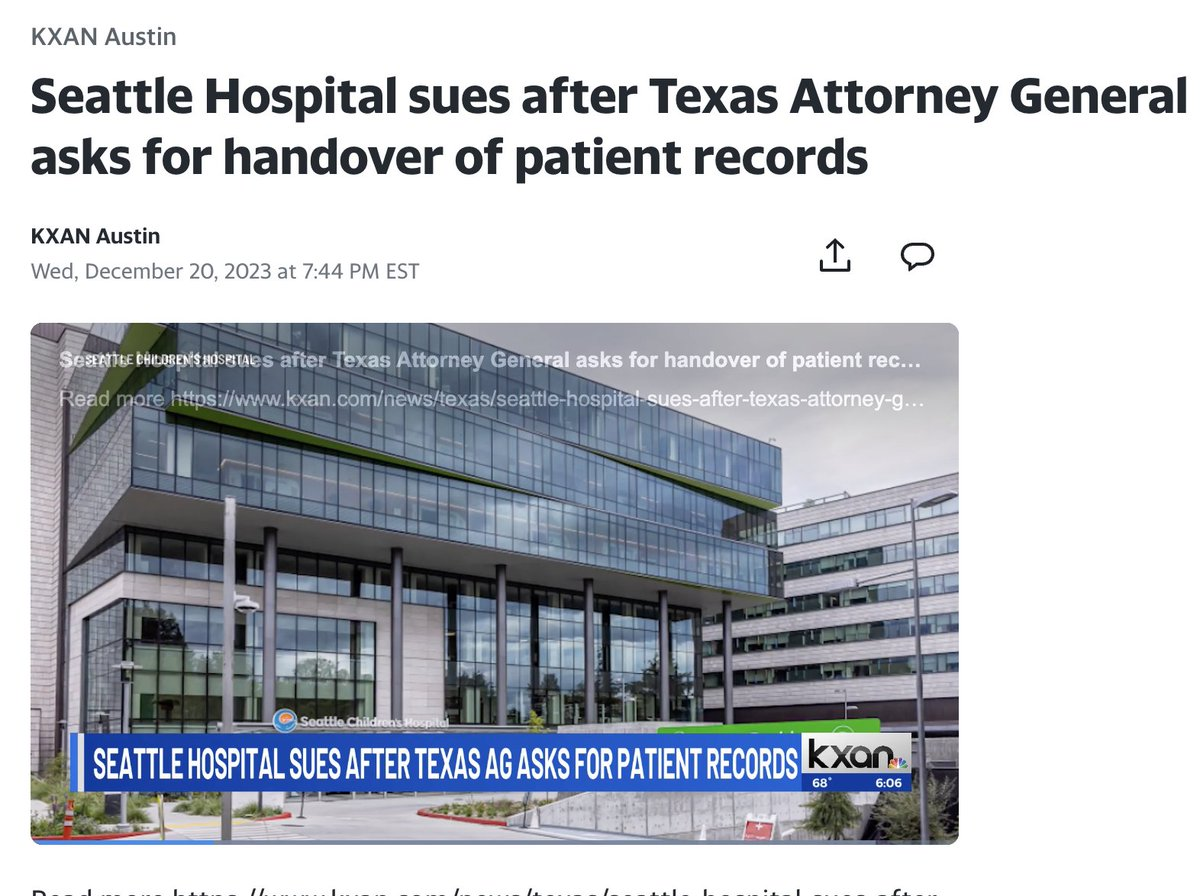
Seattle Children’s Hospital has filed a lawsuit against the Texas Office of the Attorney General after the agency requested documents related to gender transition policies and such care provided to Texas children, NBC affiliate KXAN reported Dec. 20.
In a lawsuit filed Dec. 7, Seattle Children’s argues that the Texas attorney general does not have the jurisdiction to demand patient records from the hospital. It also states that Washington’s Shield Law, signed by Gov. Jay Inslee on April 27, protects it from requests made by states that “restrict or criminalize reproductive and gender-affirming care,” according to the report.
The Shield Law creates a cause of action for interference with protected healthcare services, which protects against lawsuits filed in other states related to reproductive or gender-affirming care that is lawful in Washington. Those harmed by such out-of-state lawsuits can also file a countersuit in Washington for damages and recover their costs and attorneys’ fees.
The Texas attorney general said it is investigating misrepresentations involving gender transitioning and reassignment treatments and procedures that allegedly violated the Texas Deceptive Trade Practices-Consumer Protection Act.It has demanded that Seattle Children’s provide the following documents:
All medications prescribed by the hospital to Texas children
The number of Texas children treated by the hospital
Diagnosis for every medication provided by the hospital to Texas children
Texas labs that performed tests for the hospital before prescribing medications
Protocol/guidance for treating Texas children diagnosed with gender identity disorder, gender dysphoria or endocrine disorders
Protocol/guidance on how to “wean” a Texas child off gender transitioning care
Seattle Children’s maintains that it does not have property, accounts, nor employees who provide gender-affirming care or administrative services for that care in Texas, according to affidavits obtained by KXAN. Hospital leaders also said that Seattle Children’s has not marketed or advertised this type of care in Texas either.
Attorneys for the hospitals argue that the demands are an “improper attempt” to enforce Texas’ SB 14 bill — signed June 2 by Gov. Greg Abbott — and investigate healthcare services that did not occur in Texas.
“Seattle Children’s took legal action to protect private patient information related to gender-affirming care services at our organization sought by the Texas attorney general,” a spokesperson for the hospital told Becker’s. “Seattle Children’s complies with the law for all healthcare services provided. Due to active litigation, we cannot comment further at this time.”
The Texas attorney general’s office did not respond to Becker’s request for comment.







 HENRY KOTULA