What the “org chart” can reveal about physician culture 

https://mailchi.mp/ce4d4e40f714/the-weekly-gist-june-10-2022?e=d1e747d2d8

A consultant colleague recently recounted a call from a health system looking for support in physician alignment. He mused, “It’s never a good sign when I hear that the medical group reports to the system CFO [chief financial officer].” We agree. It’s not that CFOs are necessarily bad managers of physician networks, or aren’t collaborative with doctors—as you’d expect from any group of leaders, there are CFOs who excel at these capabilities, and ones that don’t. 

The reporting relationship reveals less about the individual executive, and more about how the system views its medical group: less as a strategic partner, and more as “an asset to feed the [hospital] mothership.” Or worse, as a high-cost asset that is underperforming, with the CFO brought in as a “fixer”, taking over management of the physician group to “stop the bleed.”

Ideally the medical group would be led by a senior physician leader, often with the title of chief clinical officer or chief physician executive, who has oversight of all of the system’s physician network relationships, and can coordinate work across all these entities, sitting at the highest level of the executive team, reporting to the CEO. Of course, these kinds of physician leaders—with executive presence, management acumen, respected by physician and executive peers—can be difficult to find. 

Having a respected physician leader at the helm is even more important in a time of crisis, whether they lead alone or are paired with the CFO or another executive. Systems should have a plan to build the leadership talent needed to guide doctors through the coming clinical, generational, and strategic shifts in practice. 
Taking Away the Vetoes

LICA - LICA Continues To Fight Sand Mine Legislation

A brainstorming session with the CEO of a digital health startup this week highlighted a frustration familiar to anyone who’s tried to make innovation happen in the slow-moving world of health systems.

Meeting with a system executive team to discuss a new approach to virtual care delivery, he described the cross-enterprise collaboration required, and said, “You could see everyone looking around the table to see what everyone else thought, before anyone was willing to react.” 

No surprise, as complex bureaucracies don’t reward risk-taking by leaders; often, innovation is slowly suffocated by internal politics and turf-protecting behavior.

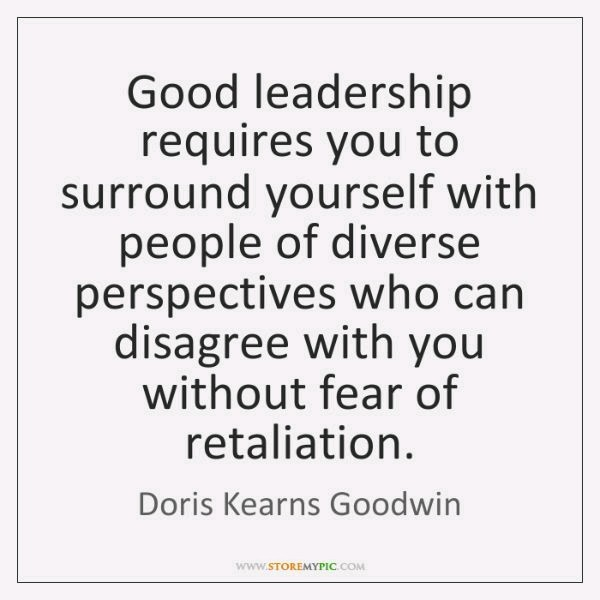
That’s why we often repeat advice from one of the most progressive, successful system CEOs we’ve worked with: “You’ve got to eliminate the vetoes if you want to get stuff done. I don’t let people leave the room until we’ve managed to set aside all the reflexive objections and arrive at a resolution. 

I expect leaders to be solution-driven, not objection-driven.” For all the times we’ve been asked how to build a successful “innovation infrastructure,” it strikes us often the answer lies in leadership, not org charts.

Strategic misalignment at the heart of a governance issue

https://mailchi.mp/016621f2184b/the-weekly-gist-december-3-2021?e=d1e747d2d8

When Innovation and Strategy Don't Align - TENZING Strategic

In our work with health systems, physician groups, and other organizations over the years, we’ve often been asked to facilitate board-level discussions about governance—resolving board conflicts, navigating difficult decisions, evaluating board composition.

A recent discussion again highlighted one of our main observations in working with boards: governance problems are often strategy problems in disguise. Working with a system that has grown through acquisition over the years, and whose board includes members from several of the “legacy” hospitals which had merged into the system over time, we were asked to help facilitate a dialogue about investment priorities across the component parts of the system.

At the root of the issue: each of the “representatives” of the subsidiary entities were pushing to have their own investment needs take precedence. On the face of it, that’s a governance problem: boards shouldn’t be constituent assemblies, with each member representing the interests of a sub-unit. Rather, they should act with one purpose: to advance the interests of the whole.

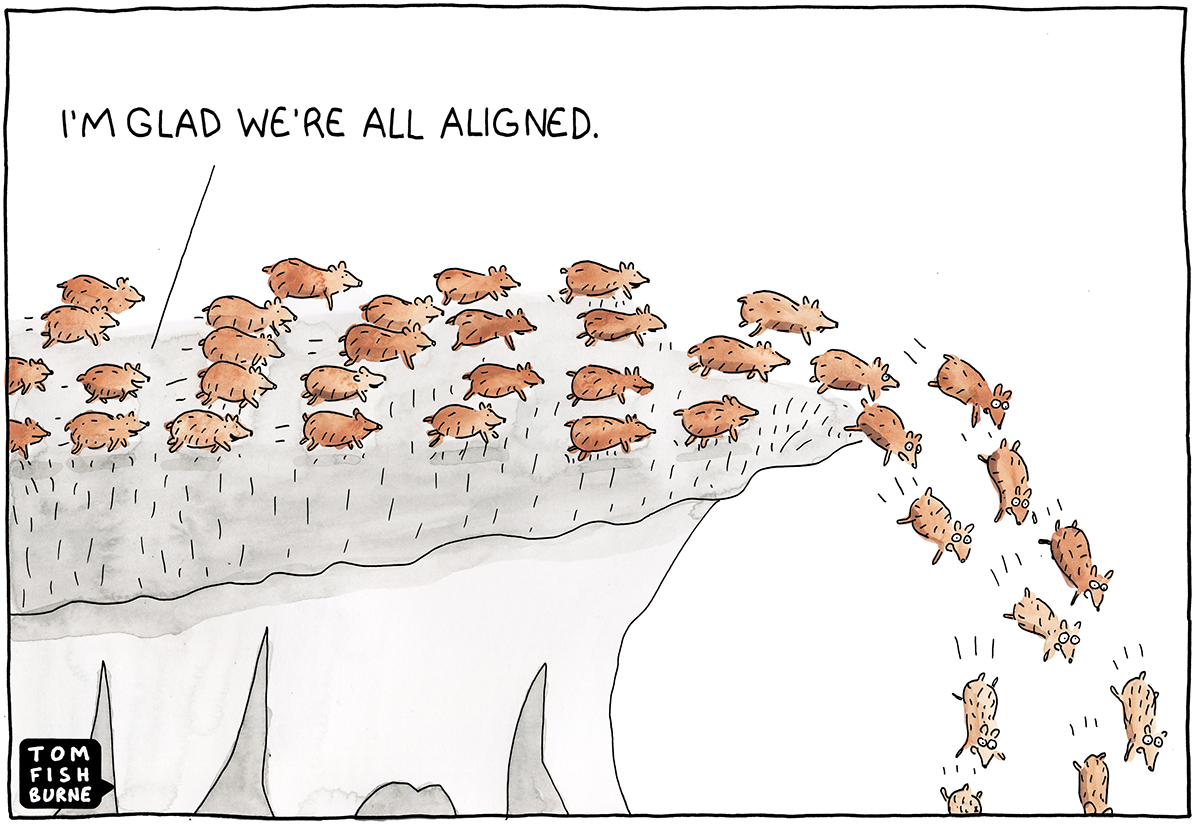
But that misalignment turned out to be a symptom of a larger problem: there was no consensus at the board level about what the strategic direction of the combined system should be, and what role each component part played in that direction.

That’s a strategy problem, masquerading as a governance issue. Identifying the strategic issue allowed the board to reframe the dialogue around vision, which then unblocked the subsequent decisions about investments. Good strategy and good governance go hand in hand.

The KISS Principle

The C4Leader Blog: Colin Powell's Leadership Lessons - 14

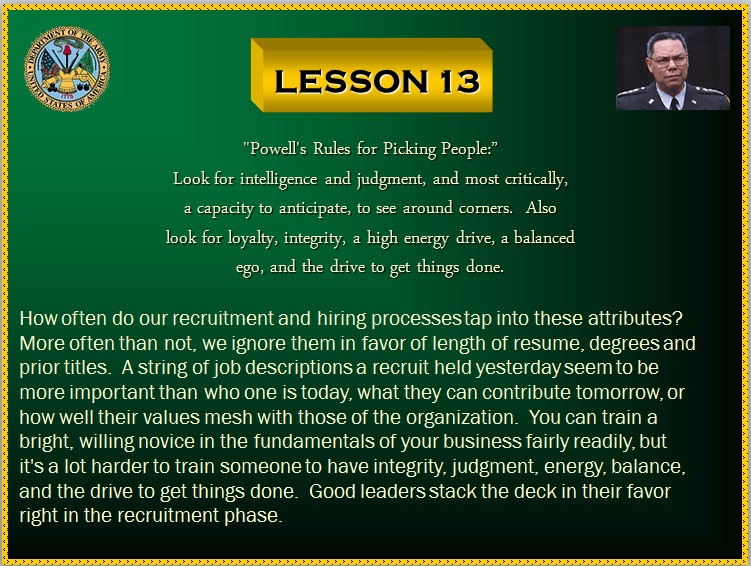
Colin Powell’s Rules for Picking People

The C4Leader Blog: Colin Powell's Leadership Lessons - 13

Will choosing a “white coat CEO” advance physician alignment?

https://mailchi.mp/a2cd96a48c9b/the-weekly-gist-october-1-2021?e=d1e747d2d8

Physician Advocates Docs Ditch The White Coat - Too Germy | WUKY

We recently got a call from a health system board chair seeking our perspective on the system’s ongoing search for a new CEO. At the top of his list: trying to understand how important it will be for the next CEO to be a physician. “We’ve never had a doctor in the role,” he mused. “But now we employ hundreds of doctors. And you’d have to imagine that having a physician as CEO would help with physician alignment.” 

While choosing a physician CEO brings great signal value to the medical staff, we cautioned that it’s far from a panacea. 

Of course, there are advantages in having walked in a frontline clinician’s shoes, being able to personally identify with their challenges and speak their language. But over the years, working with hundreds of health system CEOs, we’ve found that the most important characteristic of a CEO who will advance physician strategy is the desire to form strong personal relationships with doctors and draw on their counsel.

Does the CEO build a “kitchen cabinet” of physician leaders whom he can consult? Are physicians viewed as something to be managed, a problem to solve, or seen as true partners in strategy? Even more simply, does she like spending time with physicians, or groan every time a meeting with doctors pops up on the calendar? We’ve seen many non-physician CEOs excel at building strong, strategic ties with doctors, and some physician executives, who become jaded by never-ending physician alignment struggles, fail to advance partnerships with their colleagues.

One retiring physician CEO, reflecting on his replacement by a nonclinical executive, summed it up well: “I have a feeling he’ll do well with our doctors. He counts several physicians among his closest friends, which is a great sign.”

Sentara, Cone Health nix merger

Norfolk, Va.-based Sentara Healthcare and Greensboro, N.C.-based Cone Health have abandoned plans to merge into an $11.5 billion system, the organizations said in a joint statement June 2. 

The health systems said they mutually agreed to end the plans late last week. Leaders said they believe their respective organizations will be better served by remaining independent. 

The two healthcare systems announced plans to combine last August. The deal would have formed an $11.5 billion system with 17 hospitals in Virginia and North Carolina.  

“Sentara Healthcare and Cone Health are high performing, well respected, community-focused organizations. Those similarities served as the basis for efforts toward an affiliation. I am confident that this mutual decision will not alter either organization’s ongoing commitment to meet the needs of our respective communities,” Howard Kern, president and CEO of Sentara, said in a prepared statement. “I have no doubt that Cone Health will remain a top tier health system and will continue to pursue new and innovative ways to provide value for North Carolinians for years to come.”

“We appreciate the efforts of Sentara to work with Cone Health to determine whether an affiliation of our two high-performing organizations is in the best interest of those we serve. Recently, in the final analysis, we mutually decided that we can best serve our communities by remaining independent organizations,” Terry Akin, CEO of Cone Health, said in the news release.