At least 250,000 people in the United States have died of covid-19, the disease caused by the coronavirus, since February, and many public health officials warn the pandemic is just entering its deadliest phase. Yet, as the country confronts this horrifying death toll, there is little understanding of what a loss of this size represents.
Here is some historical perspective about losing a quarter of a million people, looking at major events in our past that have cost American lives.
More than 58,000 Americans were killed during the decade-plus of involvement in the Vietnam War. So the pandemic’s fatalities represent four Vietnam Wars since February.
During the Korean War, nearly 37,000 Americans were lost; covid-19 has claimed nearly seven times more.
During World War II, the country mourned 405,000 members of the “Greatest Generation.” The pandemic has taken nearly two-thirds as many people, a lot of them old enough to remember the fight against the Nazis and the Japanese.
And World War I? 116,000 U.S. dead in two years of fighting. The pandemic has more than doubled that number in a fraction of the time.
What about our deadliest conflict, the Civil War? Death toll estimates range from 600,000 to 850,000. Even at the high end of that range, the pandemic has permanently taken nearly 30 percent as many family members from Thanksgiving tables.
On Sept. 11, 2001, almost 3,000 people were killed in terrorist attacks in New York, Washington and Shanksville, Pa.
The deadliest day of the pandemic so far — Sept. 18 — surpassed that, at 3,660 deaths. Wednesday, as the virus surged across the country, the daily death toll had risen again to 1,894. Public health officials fear that by the end of this month, the United States could lose more people per day from the pandemic than the 2,403 Americans killed inthe Japanese attack on Pearl Harbor on Dec. 7, 1941.
And how does this pandemic compare to others in U.S. history?
The Centers for Disease Control and Prevention keeps records on four of them. The 2009 H1N1 pandemic killed 12,469 Americans. The 1968 Influenza A pandemic killed about 100,000 people. And the 1957-1958 Influenza A pandemic took 116,000 U.S. lives.
One of the more conservative disease models currently projects the United States could reach 438,000 deaths, more than during World War II, by March 1, 2021.
No state in America could clear the threshold right now to safely allow indoor gatherings, Axios’ Sam Baker and Andrew Witherspoon report.
The big picture: This is bad as the pandemic has ever been — the most cases, the most explosive growth and the greatest strain on hospitals.
If businesses were closed right now, it would not be safe to reopen them. And holiday travel will be risky no matter where you’re coming from or where you’re going.
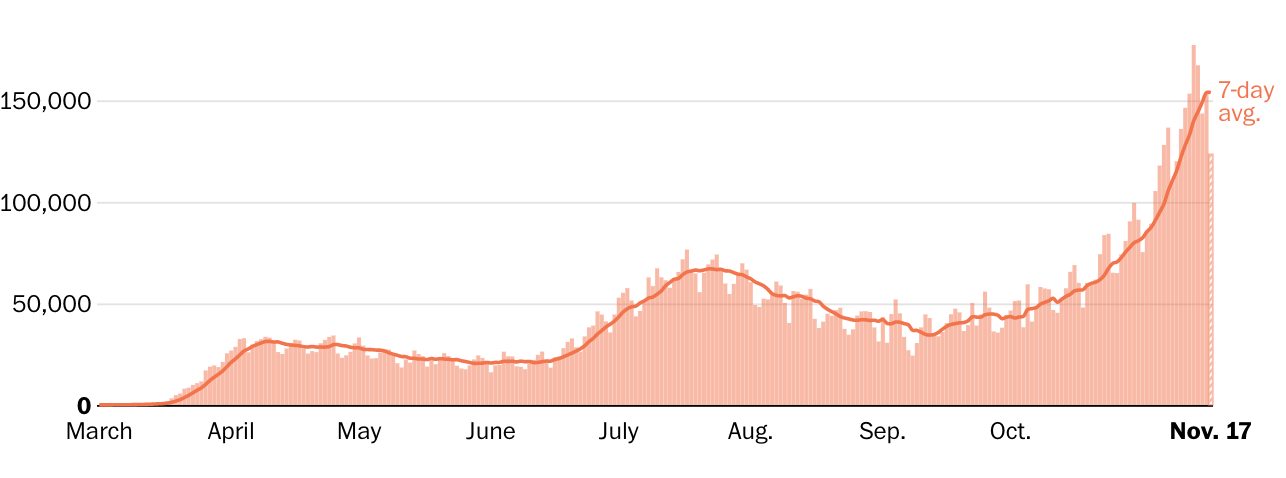
By the numbers: Over the past week, the U.S. averaged more than 154,000 new cases per day, the highest rate of the entire pandemic.
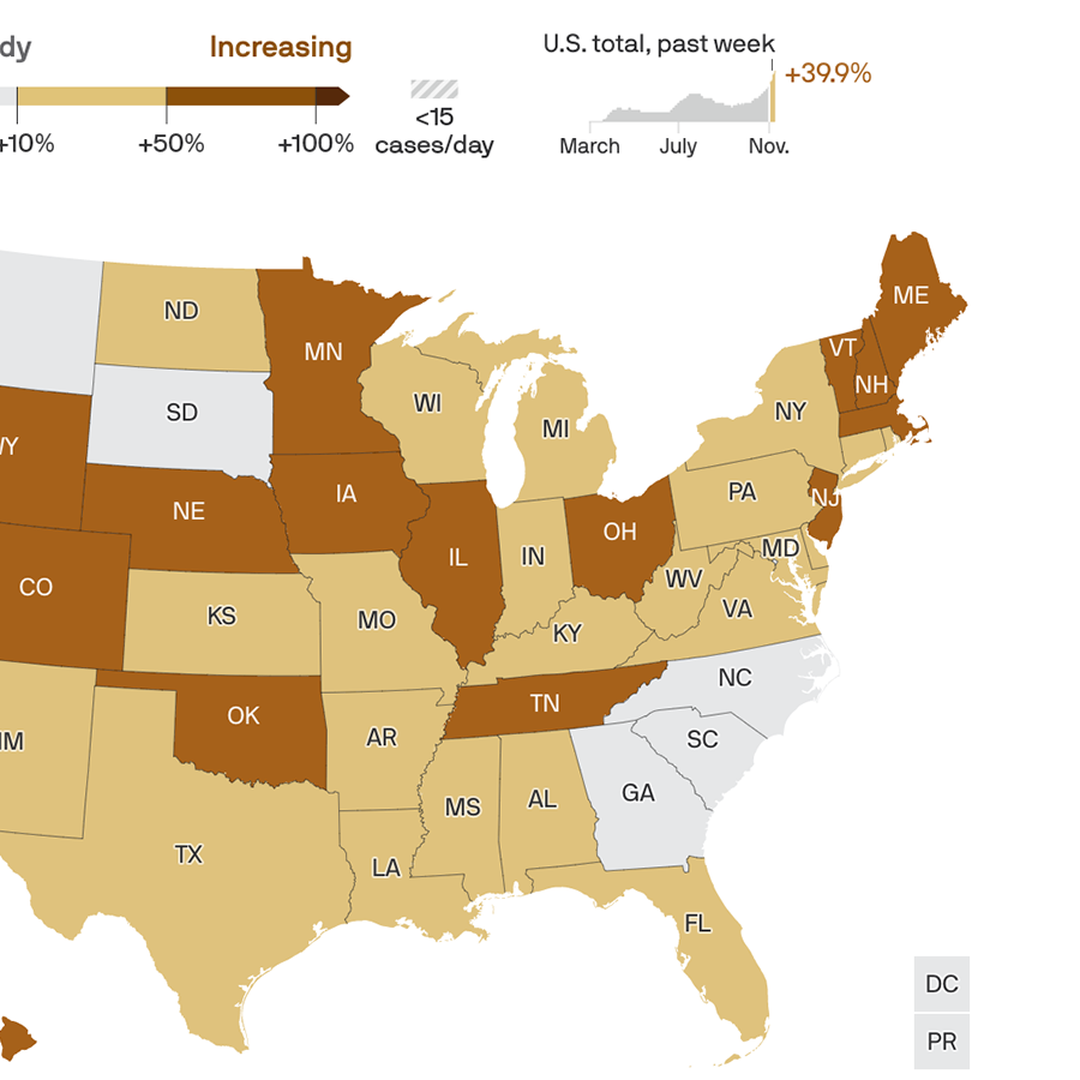
The number of new infections rose in 46 states, held steady in three, and declined in only one — Hawaii.
This week’s nationwide totals are a 30% increase over last week, which was a 40% increase over the week before that. Daily infections have been rising by at least 15% for the past six weeks.
Testing was up about 11% over the past week. The U.S. is now conducting about 1.5 million tests per day. That’s a lot, but cases clearly are still rising faster than testing.
Between the lines:Whatever metric you might use to decide whether it’s safe to have a large Thanksgiving get-together, or to sit inside a bar or restaurant, the answer is probably no.
Experts recently told The Atlantic that they wouldn’t feel comfortable attending an indoor dinner party at all, but that it would be least risky in areas with only about 10–25 new cases per day, per 100,000 people.
The bottom line: Eating and drinking indoors with large groups of people, at a time when 150,000 people are contracting the virus every day, is about as risky as it gets.
The disease caused by the novel coronavirus has killed at least 247,000 people in the United States since February and has enveloped nearly every part of the country.
As health officials long predicted, autumn brought soaring case counts, strained hospital capacity and increased deaths nationwide, as the virus is not only popping up in new places but also circling back to areas that once appeared to have it contained. Nearly all metrics in most of the country are trending in the wrong direction.
During an April peak, the seven-day-average U.S. death toll hit more than 2,000 per day, but cases were concentrated largely in the Northeast. During a July lull, average deaths sank to a low of 463 per day, although cases surged in the Sun Belt.
By early November, however, the country was recording more new cases than ever — well over 100,000 per day — and many states reported record-high caseloads and hospitalizations. The average U.S. deaths per day again shot past 1,000, despite improvements in treatment that make survival more likely.
In the past week in the U.S….New daily reported cases rose 26% New daily reported deaths rose 13.5% Covid related hospitalizations rose 23.9%.
Among reported tests, the positivity rate was 10%.
The number of tests reported rose 9.6% from the previous week.
Numbers in this article have fluctuated as testing and reporting criteria have evolved, particularly in areas that were hit early. Three spikes in the deaths chart above reflect large, one-time adjustments: In mid-April, New York City added more than 3,700 deaths. New Jersey added more than 1,800 on June 25. And in September, The Post changed its methodology for reporting deaths in New York and added a one-day increase of more than 2,700 on Sept. 18.
Health officials, including the country’s top infectious disease expert, Anthony S. Fauci, have said the virus has killed more people than official death tolls indicate.
New York, which was slammed with the new disease in spring and where at least 33,000 have died, is one of several states experiencing a second or even third wave.
Sun Belt states had serious outbreaks after Memorial Day when people flocked to beaches. By late summer, parts of the Midwest were inundated. In August and September, clusters appeared in newly reopened college campuses, particularly in the Northeast and Midwest. By October, Upper Midwest, Great Plains and Western states that had previously been mostly spared were reporting major outbreaks, including Minnesota, Wisconsin, Arkansas, the Dakotas and Alaska.
In November, most states reported record-high case counts and greater demand for hospital beds. Several set records for single-day fatalities.
A majority of states and many retail chains required masks in public places by late July, and public health officials touted them as one of the easiest ways to stop the pandemic. Still, some people in even the hardest-hit areas refuse to wear them, despite evidence that they protect wearers and those around them.
People older than 65 and those with obesity and underlying health problems are the mostly likely to die from covid-19, but a large percentage of infections occur in younger, more mobile people. People younger than 40 tend to become less sick but also unknowingly may pass the disease to others around them.
Sparsely populated areas don’t have the huge raw numbers that cities have reported, but some rank among the highest in deaths and cases per capita.
By late October, covid-19 had been documented in all but three U.S. counties and areas in Montana, the Dakotas and Idaho had some of the highest per capita caseloads.
People in very rural areas may be more vulnerable to covid-19 than urbanites, according to a Post analysis of CDC data.
Demand has often overwhelmed testing infrastructure, muddying the ability of officials to get a true picture of the virus’s reach. In June, CDC Director Robert Redfield estimated that, based on antibody tests, the actual number of U.S. residents who had been infected by the virus was likely to be 10 times as high as the number of confirmed cases. More recently, conflicting CDC guidelines about whether people without symptoms should be tested caused confusion and inhibited contact tracing.
A sharp increase in hospitalizations in late October and November demonstrates that the virus is spreading, not just that more testing is finding more asymptomatic cases. A group of Illinois health-care workers predicted in a Nov. 10 open letter to state and Chicago officials that “Illinois will surpass its ICU bed capacity by Thanksgiving.”
Some hospitals, straining to find beds and health-care workers to handle the crush of patients, are considering unusual measures.
In North Dakota, health-care workers who test positive but have no symptoms can continue working in covid-19 wards, according to Gov. Doug Burgum (R). Some facilities in Oklahoma, Kansas and Ohio are limiting routine care and deferring non-emergency surgeries.
Not all news is bleak, however.
On Nov. 9, Pfizer announced that its promising vaccine — one of many in the works — appeared more than 90 percent effective in an ongoing trial. The same day, regulators granted emergency authorization to an antibody treatment that may keep mild illness from becoming severe.
And the next day, Fauci told CNN that the average American may have access to a vaccine by April.
Governors across the country are grappling with an alarming surge of coronavirus cases and hospitalizations, so far putting forward a fractured response.
Despite the escalating public health crisis, many governors have taken only modest actions; most states still allow major sources of spread such as bars and indoor restaurants to remain open.
President Trump on Friday touted progress on a vaccine but did not announce any major new steps aimed at slowing the spread of the virus in the short term, and he is leaving most of those decisions to states.
Experts are urging governors to impose stronger measures such as closing bars and gyms, prohibiting indoor dining, mandating masks, and advising people to limit in-person gatherings.
“There are many very troubling warning signs in outbreaks across the U.S.,” said Anita Cicero, deputy director of the Johns Hopkins Center for Health Security. “I do feel that more immediate action is required.”
While most state actions have been relatively minor, stricter rules are starting to pop up, particularly from states with Democratic officials, underscoring the red versus blue divide on public health measures reminiscent of earlier this year.
New Mexico Gov. Michelle Lujan Grisham (D) on Friday instructed residents to stay home except for essential business, and Chicago Mayor Lori Lightfoot (D) issued a similar advisory. More such orders could be coming as the situation worsens.
Experts for the most part are not calling for a return to full-scale lockdowns, saying much has been learned since the spring about how the virus spreads, and there is little reason to stop low-risk activities such as curbside pickup from a store.
But significant sources of spread such as bars, indoor restaurants and gyms should be closed in hard-hit areas, they said.
Many states have not taken those steps, despite the ever-mounting case counts.
The country is now recording an unprecedented 150,000 new cases every day, with hospitalizations at record levels of more than 60,000 and deaths at around 1,000 per day and starting to rise. Hospitals in some areas are reaching capacity and becoming overwhelmed.
These trends show no signs of slowing as temperatures get colder and more activity moves indoors.
Just 13 states have closed their bars, according to a tracker from the Kaiser Family Foundation.
But there’s bipartisan pressure for states to do more.
A Washington Post op-ed on Wednesday — authored by Richard Danzig, Navy secretary under former President Clinton; James Lawler, an infectious disease doctor at the University of Nebraska; and Tom Bossert, a former homeland security adviser to President Trump —called on states to take three specific actions: limit indoor gatherings to no more than 10 people, close indoor restaurants and bars, and require masks in public.
The authors said those steps should be taken in any region where there are more than 20 new cases per 100,000 people per day. Forty states are already above that threshold, according to the COVID Exit Strategy tracking site.
Still, governors in some of the hardest-hit states have resisted actions such as statewide mask mandates and bar closures.
Iowa Gov. Kim Reynolds (R) has long opposed a statewide mask mandate, but amid the worsening outbreak, she issued an order last week requiring masks at businesses such as barbershops and at large gatherings.
At the same time, she emphasized that she did not want to close businesses.
“You can still eat in a restaurant, you can still go to a movie and work out at a gym, and in many states you can’t do that,” she said at a press conference on Tuesday. “Iowa is open for business, and we intend to keep it that way.”
Mississippi Gov. Tate Reeves (R) struck a similar note in an address on Thursday.
“We’re trying to open things up but to do it in a safe, responsible way,” he said. “We’re not going to shut down businesses. We’re not going to have long term mandates with no end in sight.”
On Capitol Hill, congressional leaders have been deadlocked over a new round of economic aid, which could provide relief for businesses such as bars and restaurants and allow them to temporarily close to slow the spread of the virus without taking a major financial hit.
“There needs to be a policy lever to help support and maintain those small businesses,” said Preeti Malani, chief health officer and professor of medicine at the University of Michigan.
In New York City, bars and restaurants are still open, with a new 10 p.m. curfew. But the prospect of schools closing has sparked criticism about the city’s priorities.
“If NYC closes schools and continues to allow indoor dining our priorities are totally backwards,” tweeted New York City Council member Mark Levine.
Malani said schools have been a “good-news situation” and have not been a significant source of transmission.
“If the balance is between keeping the bars open and keeping the schools open, that’s an easy decision in my mind,” she said.
Celine Gounder, a coronavirus adviser to President-elect Joe Biden, made a similar point on Friday.
“Some of those higher-risk places are, for example, restaurants, bars and gyms, whereas schools are not zero risk, but they’re much much lower risk, and they’re an essential service really,” she told CNBC. “So I think we need to close only those things that really are contributing to the spread and really try to let as much as possible remain open, like schools, if they’re not contributing to spread.”
Anthony Fauci, the government’s top infectious disease expert, said at an event hosted by the think tank Chatham House on Thursday that the news that Pfizer’s vaccine candidate was more than 90 percent effective in an interim analysis provides something of a light at the end of the tunnel.
That promising news, he said, should encourage people to take some tough steps for a few months until the vaccine is widely available.
“Ever since it became clear a few days ago that we have a really quite effective vaccine getting ready to deploy, [the message] is rather than ‘Hey. Don’t worry. You’re OK,’ it’s ‘Don’t stop shooting. The cavalry is coming. But don’t put your weapons down. You better keep fighting because they’re not here yet,'” Fauci said.


/cloudfront-us-east-1.images.arcpublishing.com/sltrib/N2O6A445TNBPTN7OGAFQO4ONLY.jpg)


 HENRY KOTULA