

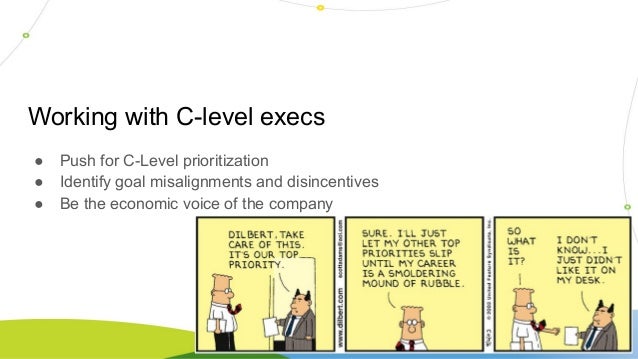
Cartoon – Working with C-level Executives
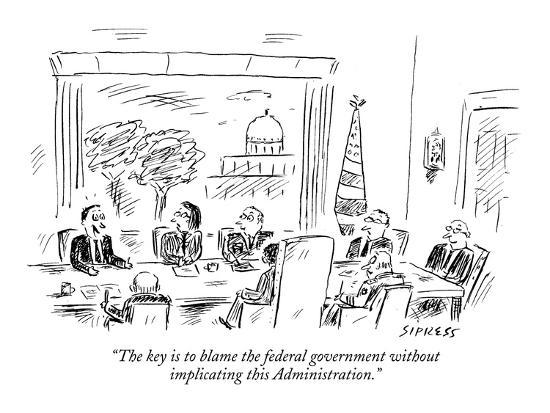

https://interimcfo.wordpress.com/2021/01/04/what-they-dont-teach-in-school-decision-making/

Abstract: This article is a continuation of the theme of ‘What they don’t teach in school.’ The subject of this article is the importance of the development of your decision-making skill.
In my article on career advancement, I observed the correlation between decision-making ability, career, and income level. So how do you improve your decision making or cognitive ability? Several strategies have proven successful for many people. Unfortunately, most of them require doing something that can be very hard – exercising and expanding your brain. Ziglar, Foreman others have argued that most of us rarely use more than 10% of our intellectual capacity at any given time so we have plenty of unexploited potential. So how do you develop your cognitive capability? One thing for me was taking courses in software development. The most challenging course I encountered in college was a computer programming course that I took as an elective! Computers do not do what you intend; they do exactly what you tell them. Computer programming requires the development of precise and highly structured instruction sets. The skillset required to develop computer code has excellent application to problem-solving that goes along with improved decision making.
One day, I was sitting in a conference room in a Catholic hospital listening to debate about whether or not to buy upgraded lights for neurosurgery operating rooms or continue pouring money into a failed clinical program. The longer this discussion went on, the more frustrated I became. Finally, when I could take no more, I accused the leadership team of decision making on a scale that ran from the Ouija Board to a Magic Eight Ball. The reaction that provoked surprised me. I had no idea Catholics did not like Ouija Boards, and I had heard about being excoriated by a Nun, but I had not yet had the experience. I asked the Nun whether or not she thought it was important for a neurosurgeon to be able to see what he was doing in the OR?
Interestingly, some of the young people in the room had no idea what a magic eight ball was. In the ensuing discussion, I reminded the leadership team that their continuing, collective engagement in non-evidence-based, politicized, expeditious decision-making was too often focused on non-strategic initiatives or lost causes instead of pursuing the best interests of the institution and its patients. I told the group that this type of reasoning was one of the primary reasons the organization had come to make my acquaintance in the first place. I am lucky I did not get fired on the spot, but everyone in that room that day learned something. For the leadership team, the lesson was that they had to resolve to do a better job making decisions. I have argued that an organization’s performance, however that is measured, is a direct function of the efficacy of the leadership team’s decision-making. To this day, I keep a Magic Eight Ball on my desk. It reminds me of my innocent dispassion about Catholics’ sensitivity to something as simple as an Ouija Board and my admonition to that leadership team and myself never to stop improving decision-making capability.
Another of the things that have helped me a lot is the study of ‘sadistics.’ I know. The mediocre performance of my first and second articles on this topic is sufficient evidence of how well accepted this idea is. I will not try to sell you on this idea again other than observing that statistics arose from the need for an objective structure to analyze and interpret data. If this is not improved decision making, I do not know what is.
Self-study helps decision making. There are books, articles, and other resources available for research to better understand topics that you do not comprehend as well as you envision. Two of my favorite resources are Wikipedia and YouTube. What you can find is amazing. While some concepts can be hard to read and grasp at first, academic articles can be beneficial, especially if you understand the underlying statistical analysis. In an earlier post, I referenced an article on Normative Decision Theory by Chua. This research looks into how people make decisions in the absence of complete information. When was the last time you had complete information at the point you had to make a decision? There is never enough time or information. Decisions regularly occur in situations where data is incomplete and may be inaccurate. Improving your ability to make better calls in this fog is crucial to leadership at higher levels.
To be sure, collegiate courses help improve your cognitive abilities, although plenty of University programs fall way short of achieving cognitive gains in decision-making ability among their graduates. I think the issue is not so much with what you know but how well you learn to apply academic and theoretical intelligence to real-world problems and challenges. Everyone would be better served if more university programs offered courses focused on applied decision making. My practice has convinced me that one of the critical factors that lead to unacceptable organizational performance is a consistent track record of decision making that does not produce the expected results.
In undergraduate school, I took an elective course on logic. I can’t remember what I was thinking when I made this decision, but like many of my electives, this one ended up requiring a disproportionate amount of time and energy. However, the return on investment has been immense. Not only did I learn a lot about disciplined decision making, I learned how to spot flaws in arguments whose logic is not sound. The study of logic is vital if you ever intend to spend time developing computer code.
Since college, I discovered philosophy, which most liberal arts students have in their core curriculum. You could spend a lifetime studying Socrates, Aristotle, and other philosophers that advanced society by advocating for the cause of beneficial argument and probing assumptions. If you haven’t already done so, I highly recommend you pick up a copy of Plato and let me know if it changes your life.
Finally, the University of Alabama at Birmingham’s Doctorate in Healthcare Administration program mantra is, ‘Evidence-Based Decision Making in Healthcare Administration.’ As is the case in other disciplines, academics worldwide are conducting research in healthcare administration and continually publishing learning that is beneficial to practitioners. Sadly, I cannot remember a case where a leader stopped a team in the process of making a decision and sent them to the literature to find all available evidence on the topic before committing to a course of action. Then they are surprised when things do not work out as they expect?
One of the ironies of healthcare is that physicians and other clinicians are deeply ingrained with objective, evidence-based decision-making theory and practice. One of the reasons that clinicians get so frustrated with healthcare administrators is when they see what appears (accurately) to them be malaise in organizational decision-making. A couple of one-liners come to mind. The road to failure is paved with good intentions. The road to disaster is littered with run-over squirrels.
The upshot of all of this is that your preparation for higher stakes decision making supports career advancement aspirations. I promise you that anything you do to improve your decision-making ability will serve you very well long into the future.
Contact me to discuss any questions or observations you might have about these articles, leadership, transitions, or interim services. I might have an idea or two that might be valuable to you. An observation from my experience is that we need better leadership at every level in organizations. Some of my feedback comes from people who are demonstrating an interest in advancing their careers, and I am writing content to address those inquiries.
The easiest way to keep abreast of this blog is to become a follower. I will notify you of all updates as they occur. To become a follower, click the “Following” bubble that usually appears near each web page’s bottom.
I encourage you to use the comment section at the bottom of each article to provide feedback and stimulate discussion. I welcome input and feedback that will help me to improve the quality and relevance of this work.
This is an original work. This material is copyrighted by me, with reproduction prohibited without attribution. I note and provide links to supporting documentation for non-original material. If you choose to link any of my articles, I’d appreciate a notification.
If you would like to discuss any of this content, provide private feedback or ask questions, You may reach me at ras2@me.com
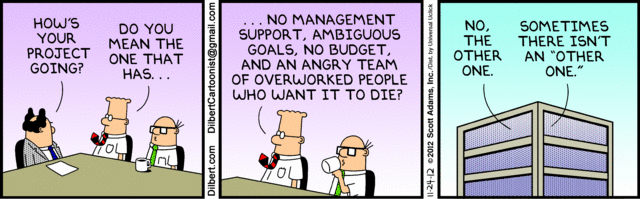
![Rasu Shrestha MD MBA on Twitter: "Dilbert called it. THIS was my day today. Seriously. [This is today's comic strip, by the way!] #hcldr… "](https://pbs.twimg.com/media/EKVzDqdXsAIzFwV.jpg)


The first month of the pandemic was also supposed to be the month I got pregnant, but my clinic closed and plans changed. Doctors and nurses needed personal protective equipment to tend to patients with covid-19, not women with recurrent miscarriages.
When the clinic reopened several months later, it turned out my husband and I had only been delaying yet another loss: In late August, he obeyed the medical center’s strict coronavirus protocols by waiting anxiously in the car while I trudged inside, masked and hand-sanitized, to receive a miscarriage diagnosis alone. I searched the ultrasound screen for the rhythmic beat of a heart, and then accepted that whatever had once been there was now gone.
But that was 2020 for you, consistent only in its utter crappiness. For every inspiring video of neighbors applauding a shift change at the hospital, another video of a bone-tired nurse begging viewers to believe covid was real, it wasn’t a hoax, wear a mask.
For every protest organized by activists who understood racism is also a long-term crisis, an appearance by the Proud Boys; for every GoFundMe successfully raising money for a beloved teacher’s hospital bills, a bitter acknowledgment that online panhandling is our country’s version of a safety net.
Millions of citizens stood in line for hours to vote for the next president and then endured weeks of legal petitions arguing that their votes should be negated. The basis for these legal actions were conspiracy theories too wild to be believed, except that millions of other citizens believed them.
And that was 2020 for you, too: accepting the increasingly obvious reality that the country was in peril, built on iffy foundations that now buckled under pressure. My loved ones who worked as waiters or bartenders or physical therapists were choosing between health and paychecks, and even from the lucky safety of my work-from-home job, each day began to feel like watching America itself arrive at a hospital in bad shape, praying that doctors or clergy could find something they were able to save.
Is there a heartbeat?
You want the answer to be yes, but even so, it was hard to imagine how we would come back from this.
What kind of delusional person would even try to get pregnant in this world? In my case it would never be a happy accident; it would always be a herculean effort. And so it seemed I should have some answers.
How do you explain to a future child: Sorry, we can’t fix climate change; we can’t even get people to agree that we should wear masks in grocery stores? How do you explain the frustration of seeing brokenness, and then the wearying choice of trying to fix it instead of abandoning it? How do you say, Love it anyway. You’re inheriting an absolute mess, but love it anyway?
I found myself asking a lot of things like this in 2020, but really they were all variations of the same question: What does it mean to have hope?
But in the middle of this, scientists worked quietly in labs all over the world. They applied the scientific method with extraordinary discipline and speed. A vaccine was developed. Tens of thousands of volunteers rolled up their sleeves and said, Try it out on me.
It was approved, and a nurse from Long Island was the first American televised receiving it. Her name was Sandra Lindsay, an immigrant from Jamaica who had come to the United States 30 years ago and who had spent the last year overseeing critical care teams in back-to-back shifts. She said she had agreed to go first to show communities of color, long abused, brushed-off or condescended to by the medical system, that the vaccine was safe.
Here was hope. And more than that, here was hope from a woman who had more reason than most to be embittered: an exhausted health-care worker who knew too well America’s hideous racial past and present, who nonetheless also knew there was only one way out of the tunnel. Here she was, rolling up her own sleeve, and there were the lines of hospital employees ready to go after her, and there were the truck drivers ferrying shipments of syringes.
I can’t have been the only person to watch the video of those early inoculations, feeling elated and tired, and to then burst into tears. I can’t have been the only person to realize that even as 2020 revealed brokenness, it also contained such astounding undercurrents of good.
The scientific method works whether you accept it or not. Doctors try to save you whether you respected public-health guidelines or not. Voter turnout was astronomical because individual citizens realized they were all, every one of them, necessary pieces in a puzzle, even if they couldn’t see what the final picture was supposed to look like.
The way to believe in America is to believe those things are passed down, too.
Sometime in October, a couple of months after my last miscarriage — when the country was riding up on eight months of lonely and stoic birthdays, graduations, deaths and weddings — I went into the bathroom and saw a faint second line on a First Response pregnancy test. It was far from my first rodeo, so I knew better than to get excited. I mentioned it to my husband with studied nonchalance, I told him that I’d test again in a few days but that we should assume the worst would happen.
Two weeks after that, I had a doctor’s appointment, and then another a week later, each time assuming the worst, but each time scheduling another appointment anyway, until eventually I was further along than I’d ever gotten before — by one day, then three days, then thirty.
I am not a superstitious person. I don’t believe that good things always come to those who deserve them. I believe that stories regularly have sad endings and that it’s often nobody’s fault when they do, and that we should tell more stories with sad endings so that people who experience them know that they’re not alone.
But 2020 has taught me that I am, for better or worse, someone who wants to hope for things. To believe in the people who developed vaccines. In the people who administered them. In Sandra Lindsay. In the people who delivered groceries, who sewed masks, who have long cursed America’s imperfect systems and long fought to change them, who still donate $10 to a sick teacher’s GoFundMe.
At my most recent appointment, the doctor’s office was backed up in a holiday logjam. I sat in the exam room for nearly three hours while my husband again waited anxiously in the car. I texted him sporadic updates and tried to put hope in a process that so far had not seemed to warrant my hope.
It all felt precarious. The current reality always feels precarious.
And yet there we all are together, searching for signs of life, hoping that whatever we emerge to can be better than what we had before, and that whatever we build will become our new legacy. The sonographer finally arrived and turned on the machine.
There was a heartbeat. There was a heartbeat.

 HENRY KOTULA