

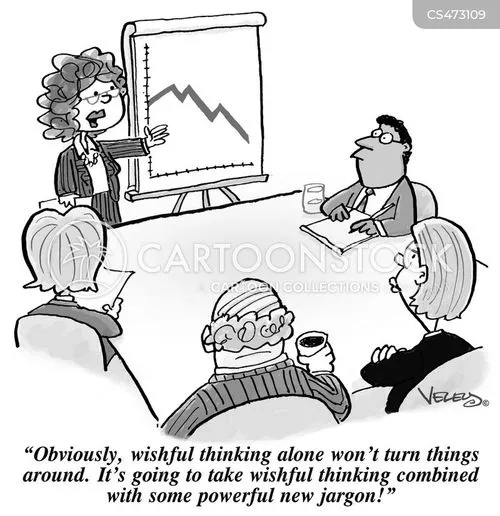
Cartoon – Wishful Thinking + Powerful New Jargon

Saint Peter’s Healthcare System in New Brunswick, N.J., was six years ahead of the C-suite streamlining curve.
The health system slimmed down its leadership structure in 2017, President and CEO Les Hirsch told Becker’s. A top-heavy executive team grew unsustainable as the system struggled financially, operating at a loss. Saint Peter’s board decided to combine the president and CEO positions — which were previously split in two. Then, as president and CEO, Mr. Hirsch cut five vice presidents’ positions, including the consolidation of the chief information officer and chief medical information officer roles. More than 20 middle-manager positions were also cut or consolidated.
The streamlining of senior leadership positions alone at the time eliminated over $4 million in salaries and benefits, according to Mr. Hirsch. With the old leadership structure, Saint Peter’s spent about 2.4% of its revenue on senior leaders’ compensation. Last year, that percentage sank to 1.34%.
But finances shouldn’t be the only consideration for a health system planning to whittle down its structure.
“The good news is, we’re lean,” Mr. Hirsch said. “The bad news is, we’re lean.”
Since consolidating the president and CEO roles — and not having a chief operating officer — succession planning is more complicated, per Mr. Hirsch.
“There’s no designated No. 2,” he said. “Our senior leadership team structure is very flat.”
A condensed C-suite also means more work for some members of the leadership team — which is taken in stride, Mr. Hirsch said. There’s no specific “planning” department, so executives put their heads together on strategy, growth and development initiatives. There is no government relations officer, but Mr. Hirsch, as CEO, takes primary responsibility for this function and is very active in advocacy.
Anyone who works on a lean team like this also “has to be a generalist,” Mr. Hirsch said. He stays up to date on the literature and sends relevant articles to other executives.
“Considering our size as one of the few remaining single-hospital health systems in New Jersey, we don’t have the luxury of having somebody specifically responsible for artificial intelligence or other niche responsibilities as these are functions that are absorbed within people’s roles,” Mr. Hirsch said. “And we all develop the knowledge needed so that we can understand how new ideas or resources may apply to us. When you’re smaller and don’t have the scale of these mega-organizations, you have to do more yourself. You roll up your sleeves.”
Despite these challenges, a little can go a long way; three departmental administrators now split the job once shared by seven people at Saint Peter’s. There’s been no hit to efficiency; “they’re more effective in their roles as departmental administrators than anybody that I’ve ever seen,” Mr. Hirsch said.
The changes to streamline management were also well-received by the workforce. Often layoffs affect front-line workers more than management or senior leadership — which may have contributed to the lack of outcry, per Mr. Hirsch. But he primarily attributes the positive reception to intentional transparency.
“Most importantly, I’m a very active communicator. So, I communicated about it. It wasn’t that there was some intrigue and mystery in the organization that people were hearing by rumor,” Mr. Hirsch said.
“Rumors — like fear — are two things that equate to being like a cancer in an organization,” he continued. “I always want to do everything I possibly can to set the facts straight and communicate with people. If it’s not confidential and I can communicate it, I will. In fact, I’ll err more on the side of communicating than keeping information close to the vest.”
Regardless of who is affected by layoffs, executives should always handle them with sensitivity, Mr. Hirsch emphasized; the right choice for an organization is not always the easy choice for its people.
“It’s always painful when you’re making these kinds of changes because they affect people, and you always have to go about those changes in a very thoughtful, considerate, and compassionate way,” Mr. Hirsch said. “You’re eliminating roles and impacting people’s lives, their careers and their family. So, I always keep that top of mind.”

I am often asked how board members can play a helpful role in rating agency meetings if they are invited to attend.
Below are three ways in which board members can add value to the rating presentation:
1) Acknowledge the organization’s challenges. Too many times the key issues that need to be addressed upfront are left to the end, when time is short. Examples may include a covenant violation, unfavorable variance to budget, downturn in liquidity, or an unexpected change in management. A rating should be able to endure the ups and downs of a business cycle but large swings in performance or covenant violations challenge the bandwidth of tolerance and need to be addressed early. Better meetings acknowledge these issues upfront before the analysts ask about them (said another way: the best defense is a good offense). If the analysts leave the meeting with the sense that management is on top of the issues, then that same confidence is brought forward to the rating committee.
Covenant violations have been on the rise since 2022 and board members should be well versed in the ramifications when there is a breach. In its simplest form, a bond is a promise to pay. To ensure full and timely repayment of that bond, hospitals agree to maintain certain financial covenants that serve as financial guardrails. Covenants are typically measured on an annual basis but may be measured more frequently per the terms of the agreements. The penalties for violating a covenant can range from a consultant call-in to an event of default with acceleration provisions. In any circumstance, covenant violations require an inordinate amount of time and resources to address and should be understood, even if at a basic level, by the board.
To that end, board members should maintain a basic understanding of hospital reimbursement and the ongoing challenges hospitals face, namely: inadequate reimbursement levels, labor shortages, perennial scrutiny over tax-exempt status, and the need to improve access and equity in healthcare. An informed trustee is a great trustee. One of the most impressive board members I met in my years as a ratings analyst was a business executive who was chair of a 25-bed critical access hospital and well-versed on the complexities of reimbursement. (You read that correctly: a 25-bed hospital, not a 500-bed hospital, academic medical center, regional or national system). Despite large-scale challenges as a small facility, that hospital continued to show good financial performance. Knowledgeable governance, working in tandem with management, had something to do with that.
2) Address how the organization will absorb additional debt if adding leverage. Ratings express the ability of a hospital to repay its debt; when debt increases, the ability to repay that debt can weaken. A board member or senior management should explain how they got comfortable adding leverage to the organization and what the benefits are of using debt to fund the projects, rather than, say, cash. Detailed, multi-year financial projections should show how the hospital will rebuild the balance sheet and absorb higher debt service. Projections are especially important when the size of the construction project or acquisition funded with the debt is material. This is also an opportunity for boards to demonstrate how the various skills and expertise they bring to the organization can be helpful. For example, individuals with real estate or construction experience can bring their experience to large projects. Individuals with experience in highly regulated or highly unionized industries can also bring their know-how to senior leadership.
3) Share the organization’s succession plan. Succession planning is one of the most important responsibilities of the board. Sam Altman’s wild ride (he’s in/he’s out/he’s in, again) as CEO of OpenAI and the mutiny his departure would have caused is a timely example of why succession planning is essential. From a ratings perspective, curating the very best leadership is viewed as a best practice of high-performing organizations. A good example of strong succession planning is Texas Children’s Hospital, the largest pediatric provider in the U.S. Earlier this year, the board and the CEO created the separate role of President (this title was previously combined with the CEO’s title) and launched a search that was completed in September. The new President will report to the CEO, who will continue in his role. The Chair of the Texas Children’s Board of Trustees notes that the new structure is intended to prepare the organization for its “next evolution in leadership.” The opportunity for the new President to work with Texas Children’s long-serving CEO should ultimately provide for a smooth leadership transition.
If we’ve learned anything from the past four years, it is the importance of strong governance and management. Undoubtedly, board members will be called upon for their guidance and expertise as turbulent times continue for the industry. Maintaining a basic understanding of the hospital’s financial challenges, supporting management, and building a succession playbook will be integral to the organization’s long-term success.


HCA Healthcare is the single hospital operator that Bloomberg identifies as one of “50 Companies to Watch in 2024.”
“From Alphabet and BYD to Eli Lilly and Vivendi, keep an eye on these global stocks this year,” the outlet proposes for the 50 companies out of the 2,000 firms assessed. Bloomberg analysts highlighted the companies as those warranting a closer look, based on “contrarian views and upcoming catalysts for change such as new leadership, asset sales or acquisitions, and plans for new products and services.”
With 182 hospitals and more than 37,000 hospital beds, Bloomberg analyst Glen Losev said HCA “faces cost and revenue challenges that point to a reduction in its operating margin. Wages are increasing, especially for nurses, as are non-labor costs because of general inflation. And fewer physician visits indicate softening demand for care in areas such as elective surgeries.”
HCA is tied to an estimated 5% increase to its revenue in 2024 with a market cap of $72 billion.
The company posted $47.66 billion in revenue for the first nine months of 2023 compared to $44.73 billion in the same period of 2022. Its fourth quarter earnings are due later this month.
Other healthcare companies recognized by Bloomberg as worth watching are Novo Nordisk, BeiGene, Boston Scientific and Eli Lilly. Weight loss drug possibilities drive potential for Novo Nordisk and Eli Lilly, with estimated revenue increases of 22% and 16%, respectively.

The new year is always an ideal time for healthcare leaders to reflect on the state of our industry and their own organizations, as well as the challenges and opportunities ahead.
As the CEO of a large health system, I always like to reflect on one basic question at the end of each year: Are we staying true to our mission?
Certainly, maintaining an organization’s financial health must always be a priority but we should also never lose sight of our core purpose. In a business like ours that has confronted and endured a global pandemic and immense financial struggles over the past several years, I recognize it’s increasingly difficult to maintain our focus on mission while trying to find ways to pay for rising labor and supply costs, infrastructure improvements needed to remain competitive and other pressures on our day-to-day operations.
After all, the investments we need to make to promote community wellness, mental health, environmental sustainability and health equity receive little or no reimbursement, negatively impacting our financial bottom lines. During an era of unprecedented expansion of Medicaid and Medicare, we get less and less relief from commercial insurers, whose denial and delay tactics for reimbursing medical claims continue to erode the stability of many health systems and hospitals, especially those caring for low-income communities.
Despite those enormous pressures, it’s imperative that we continue to support underserved communities, military veterans struggling with post-traumatic stress, and intervention programs that help deter gun violence and addiction.
The list of other worthy investments goes on and on: charity care to uninsured or underinsured patients who can’t pay their medical bills, funding for emergency services that play such a critical role during public health emergencies, nutritional services for families struggling to put food on the table, programs that combat human trafficking and support women’s health, the LGBTQIA+ community and global health initiatives that aid Ukraine, the Middle East and other countries torn apart by war, famine and natural disasters.
We must also recognize the key role of healthcare providers as educators. School-based mental health programs are saving lives by identifying children exhibiting suicidal behaviors, anger management issues and other troublesome behaviors. School outreach efforts have the added benefit of helping health systems and hospitals address their own labor shortages by introducing young people to career paths that will help shape the future healthcare workforce.
Without a doubt, the “to-do” list of community health initiatives that support our mission is daunting. We can’t do it all alone, but as the largest employers in cities and towns across America, health systems and hospitals can serve as a catalyst to get all sectors of our society — government, businesses, schools, law enforcement, churches, social service groups and other community-based organizations — to recognize that “health” goes far beyond the delivery of medical care.
The health of individuals, families and communities hinges on the prevalence of good-paying jobs, decent and affordable housing, quality education, access to healthy foods, medical care, transportation, clean air and water, low prevalence of crime and illicit drugs, and numerous other variables that typically depend on the zip codes where we live. Those so-called social determinants of health are the driving factors that enable communities and the people who live there to either prosper or struggle, resulting in disparities that are the underlying cause of why so many cities and towns across the country fall into economic decay and become havens for crime and hotbeds for gun violence, which shamefully is now the leading cause of death for children and adolescents.
To revive these underserved communities, many of which are in our own backyards, we have to look at all of the socioeconomic issues they struggle with through the prism of health and use the collective resources of all stakeholders to bring about positive change.
Health is how we work together to build a sense of community. Having a healthy community also requires everyone doing what they can to tone down the political rhetoric and social media-fueled anger that is polarizing our society. Health is bringing back a sense of civility and respect in our public discourse, and promoting the values of honesty, decency and integrity.
As healthcare providers and respected business leaders, we should all make a New Year’s resolution to stay true to our mission and do what we can within our communities to bring oxygen to hope, optimism and a healthier future.

As 2023 comes to an end and prognostics for 2024 pepper Inboxes, high anxiety is understandable. The near-term environment for hospitals, especially public hospitals and not-for-profit health systems, is tepid at best: despite the November uptick in operating margins to 2% (Fitch, Syntellis), the future for hospitals is uncertain and it’s due to more than payer reimbursement, labor costs and regulatory changes.
Putting lipstick on the pig serves no useful purpose:
though state hospital associations, AHA, FAH, AEH and others have been effective in fending off unwelcome threats ranging from 340B cuts, site neutral payments and others at least temporarily, the welcoming environment for hospitals in the throes of the pandemic has been replaced by animosity and distrust.
The majority of the population believes U.S. the health system is heading in the wrong direction and think hospitals are complicit (See Polling data from Gallup and Keckley Poll below). They believe the system puts its profit above patient care and welcome greater transparency about prices and business practices. In states like Colorado (hospital expenditure report), Minnesota (billing and collection), and Oregon (nurse staffing levels), new regulations feed the public’s appetite for hospital accountability alongside bipartisan Congressional efforts to limit tax exemptions and funding for hospitals.
It’s a tsunami hospital boards must address if they are to carry out their fiduciary responsibilities:
Regretfully, near-term pressures on hospitals have compromised long-term strategic planning in which the Board play’s the central role. But most hospital boards lack adequate preparedness to independently assess the long-term future for their organization i.e. analysis of trends and assumptions that cumulatively reshape markets, define opportunities and frame possible destinations for hospitals drawn from 5 zones of surveillance:
In reality, the near-term issues i.e. labor and supply chain costs, insurer reimbursement, workforce burnout et al—dominate board meetings; long-range strategic planning is relegated to an annual retreat where the management team and often a consultant present a recommendation for approval. But in many organizations, the long-term strategic plans (LTSPs) fall short:
My take:
The Board’s role in Long-Range Strategic Planning is, in many ways, it’s most important. It is the basis for deciding the capital requirements necessary to its implementation and the basis for hiring, keeping and compensating the CEO. But in most hospitals, the board’s desire to engage more directly around long-term strategy for the organization is not addressed. Understandable…
Hospital boards intuitively understand that surviving/thriving in 2024 is important but no guarantee of long-term stability given sobering realities with long-term impact:
Granted: the issues facing hospitals are reliably short-term: as Congress returns next week, for instance, funding for the FDA, Community Health Center Fund, Teaching Health Center Graduate Medical Education Program, National Health Services Corps and Veterans Health is not authorized and $16 billion in cuts to Medicaid disproportionate share payments remains unsettled, so the short-term matters.
But arguably, engaging the hospital board in longer term planning is equally important. It’s not a luxury.
Happy New Year. Buckle up!

If you are a hospital executive—and if you are reading this, you probably are—then you have no shortage of worries. The worry list is long:
And the list could go on and on.
But maybe the biggest concern is one that is not on many worry lists: the remarkable development of artificial intelligence (AI) and how AI is relentlessly pushing into business practice generally and into healthcare more specifically.
While the long-term worry is how your hospital will carefully and properly adopt AI inside the business and clinical parts of your organization, the more immediate and short-term worry is whether you, as an executive, understand AI in a way that you can be ultimately useful to your organization.
Full disclosure: I can’t help here much. For me, AI is a pretty big black box. But when I confront this kind of business problem I start reading and learning. One of the most useful AI articles I have come across is “The Optimists: The Full Story of Microsoft’s Relationship with OpenAI,” which was published in the December 11, 2023, issue of The New Yorker magazine. The article was written by Charles Duhigg, a former winner of the Pulitzer Prize.
I am hoping that for your own professional development you will read the Duhigg article, but just in case, here are the highlights:
Duhigg reports that Microsoft previously acquired a company called GitHub. GitHub is “a website where users shared code and collaborated on software.” Microsoft operates GitHub as an independent division. GitHub has been a very big success and is used by software engineers and, in a short period of time, has grown to over 100 million users.
OpenAI created an artificial intelligence tool that autocompletes software code. Despite reservations at Microsoft, GitHub President Nat Friedman decided to release the GitHub Copilot autocomplete tool. The result has been $100 million in revenue to GitHub in less than a year.
At the end of the article, Duhigg notes that these early AI business applications are both “impressive and banal.” Banal because they don’t yet live up to the sci-fi predictions for AI and its long-term impact on society.
Honestly, I don’t see it that way. This OpenAI/Microsoft collaboration is only scratching the surface and its potential uses are already endless, waiting to be invented by 100s of millions of users all over the world, including in healthcare. From my seat, the sky is the limit here. Almost anything seems possible.
I hope this summary of Mr. Duhigg’s exceptional article proves useful and advances your awareness of AI’s aggressive and rapid move into day-to-day business—here, through many of the Microsoft productivity programs that every one of us uses every day. In any case, I recommend that you read Duhigg’s entire article. It is most certainly worth your time.
 HENRY KOTULA