COVID-19 Goes Viral on College Campuses
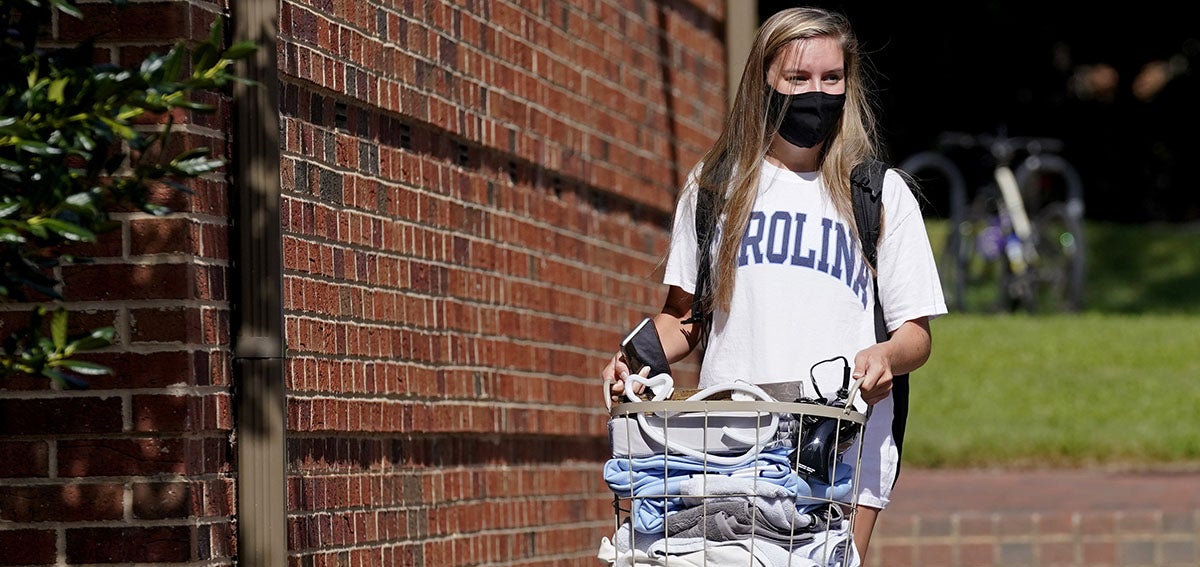
Freshman Sarah Anne Cook carries her belongings as she packs to leave the University of North Carolina at Chapel Hill, on August 18, because of a COVID-19 outbreak. All in-person undergraduate learning was canceled.
On August 10, students at the University of North Carolina at Chapel Hill (UNC) began the fall semester in person. Freshman Jasmine Baker was cautiously optimistic — as an incoming student in the Hussman School of Journalism, she was excited to experience college and get to know her suitemates. But she also worried that the university’s health and safety protocols would not prevent the spread of the coronavirus on campus.
She was right. Just one week after classes started, UNC announced that all undergraduate classes would move to remote learning for an indefinite period following a surge of COVID-19 cases. The case positivity rate on campus jumped from 2.8% to nearly 14%, Colleen Flaherty reported in Inside Higher Ed. After the second week, the positivity rate skyrocketed to 31%.
Baker, an out-of-state student, learned about the change in learning plans while attending an in-person class. “The email was very vague about housing,” she told Slate. “There were no specifics. Everyone kind of started freaking out. . . . We learned about it at the same time the professors did.” To top it off, she and a roommate soon tested positive for COVID-19. “We were all in such close quarters,” Baker said. “I know people that barely left their dorms, and they still ended up catching it.”
The situation at UNC is not unique. A New York Times tracker has revealed at least 88,000 COVID-19 cases and 60 deaths at American colleges since the pandemic began. Photos and videos of students flouting public health guidelines at indoor parties or other gatherings have gone viral. Some university administrators have condemned the socializing as “reprehensible” and reprimanded students for “disrespectful, selfish, and dangerous” behavior.
Experts like Julia Marcus, PhD, MPH, an epidemiologist at Harvard Medical School, and Jessica Gold, MD, MS, a psychiatrist at Washington University, saw this coming from a mile away. “Students will get infected, and universities will rebuke them for it; campuses will close, and students will be blamed for it,” they warned in the Atlantic over the summer. “Relying on the self-control of young adults, rather than deploying the public-health infrastructure needed to control a disease that spreads easily among people who live, eat, study, and socialize together, is not a safe reopening strategy.”
If you put 10,000 [students] in a small space, eating, sleeping, and socializing together, there’ll be an explosion of cases. . . . I don’t know what colleges were expecting.
—UNC epidemiologist Whitney Robinson
As the Editorial Board of the Daily Tar Heel, UNC’s student newspaper, wrote one week into the semester, “Reports of parties throughout the weekend come as no surprise. Though these students are not faultless, it was the University’s responsibility to disincentivize such gatherings by reconsidering its plans to operate in person earlier on.” The local health department recommended that UNC implement remote learning for the first five weeks of the fall term, but administrators ignored that advice.
Lack of Guidelines for Safe Return
Throughout the summer, even as COVID-19 hot spots emerged across the country, President Donald Trump aggressively pushed for schools to reopen in person. Without federal guidance on how to do this safely, university administrators were left to cobble together their own plans for preventing coronavirus from spreading into the community.
“I don’t think there are two universities that have the same protocol,” Irwin Redlener, director of the Pandemic Resource and Response Initiative at Columbia University, told Politico. “It’s national chaos.”
Universities have a strong financial incentive to reopen in person. Many are hoping to recover revenue from housing fees and out-of-state tuition payments that were lost when the pandemic forced them to suspend in-person classes in March. But as many universities have learned in recent weeks, reopening in person comes at a cost to the health of students, faculty members, and the surrounding community.
The New York Times reviewed 203 counties in which college students comprise at least 10% of the population and found that about half experienced their worst weeks of the pandemic after August 1, around the time students returned to campus. An analysis by USA Today revealed that communities with a significant college student population represent 19 of the 25 largest current coronavirus outbreaks in the US.
“What has happened on campus hasn’t stayed on campus,” Shawn Hubler and Anemona Hartocollis wrote in the New York Times.
California Fares Better Than Other States
While California is not represented on USA Today’s list of big outbreaks, it is dealing with surges on some campuses. According to the New York Times campus tracker, there are nearly 2,600 coronavirus cases at 57 schools in California. (Because there is no national tracking system for coronavirus cases on college campuses, the New York Times is believed to have the most comprehensive count available.)
I expect this will blow up outbreaks in places that never had outbreaks, or in places that had outbreaks under control.
—Boston University epidemiologist
Eleanor Murray
With 444 confirmed cases, San Diego State University tops the list among California schools, followed by the University of Southern California with 358 cases and UC San Diego with 237. By comparison, North Carolina has nearly 5,200 coronavirus cases at 42 schools, including 1,150 cases at UNC.
California’s relative success at mitigating the spread of COVID-19 on campus can be attributed in part to the conservative reopening plans of many schools. The California State University (CSU) system, California Community Colleges, and University of California (UC) schools moved nearly all fall classes online. UC Berkeley is fully remote for the fall semester. Stanford University planned to have half of its undergraduate students on campus during different quarters, but it switched to mostly remote learning as coronavirus cases continued to rise in the Bay Area over the summer.
Even a hybrid learning model, however, has failed to stave off new coronavirus cases on campuses. Chico State University and San Diego State University, both part of the CSU system, became the first and second California campuses to pause in-person classes after COVID-19 cases spiked, Ashley Smith reported for EdSource.
Resources are a factor in prevention efforts. Chico State’s health center doesn’t have coronavirus tests for students. San Diego State, which has more resources, has two coronavirus testing sites on campus. Across the CSU system, only 2 out of 23 campuses (CSU Maritime Academy and Humboldt State University) have tested all students living in dorms, according to CalMatters. The UC system, which has a budget roughly four times that of the CSU system, is testing all students living in dorms across all 10 campuses. (The UC system has restricted on-campus housing to students who have no alternative housing options.)
An Avoidable Situation
With the academic year off to a rocky start and students being sent home amid coronavirus outbreaks on campuses, experts across the country are nervously tracking the spread of the virus. “I expect this will blow up outbreaks in places that never had outbreaks, or in places that had outbreaks under control,” Eleanor Murray, ScD, MPH, an epidemiologist at Boston University, told Ed Yong in the Atlantic.
COVID-19 surges on college campuses were preventable. “If you put 10,000 [students] in a small space, eating, sleeping, and socializing together, there’ll be an explosion of cases,” Whitney Robinson, PhD, an epidemiologist at UNC, told Yong. “I don’t know what colleges were expecting.”








 HENRY KOTULA