
Here are six key ways Biden is promising to fight the coronavirus pandemic

By the time President-elect Joe Biden takes the oath of office on Wednesday, more than 400,000 Americans will have died of covid-19 — a dismal milestone in the deadly pandemic.

Yet the crucial task he faces  rapidly distributing coronavirus vaccines to the American public  is one that most experts one year ago didn’t think would even be an option by this point. Few expected multiple vaccines to be approved within a year — a record for vaccine development, by any measure. And although the rollout has been criticized, Israel and Great Britain are the only major nations the United States lags in vaccinations per capita and its daily rate of immunizations has more than doubled in the past two weeks.

“You have my word: We will manage the hell out of this operation,” Biden said in a speech on Friday, announcing his own vaccination plan. 

Regardless of whether one views the vaccine effort up to this point as a failure or success, this much is true: Biden and his new administration will face an enormous task, not only in getting the vaccines distributed but also in ramping up testing, convincing Americans to follow public health recommendations and responding to the economic fallout from the pandemic. 

Here are six key promises Biden is making about his pandemic response:

1. Administer 100 million doses of coronavirus vaccine during the first 100 days of his administration.

Biden previously cited this as a goal. He reiterated it Friday while rolling out a broader plan for coronavirus vaccinations

The plan would require a rate of 1 million immunizations per day — and the United States isn’t too far away from that goal right now. Nearly 800,000 Americans are getting shots every day on average. That’s a considerable improvement from two weeks ago, when the daily rate was closer to 350,000.

The 100-shot goal is “absolutely a doable thing,” Anthony S. Fauci, direct of the National Institute for Allergy and Infectious Disease, told NBC’s Chuck Todd yesterday.

“The feasibility of his goal is absolutely clear; there’s no doubt about it,” Fauci said. “That can be done.”

But top Biden advisers are also cautioning ramping up immunizations will be gradual and will require lots of coordination.

“The first days of that 100 days may be substantially slower than it will be towards the end,” Michael Osterholm, a member of Biden’s covid-19 task force, told Stat News. “It’s not going to occur quickly … you’re going to see the ramp-up occurring only when the resources really begin to flow.”

2. Set up mass vaccination clinics.

By the end of his first month in office, Biden has promised to open 100 federally managed clinics to administer shots. According to his vaccination plan, these sites would be set up by the Federal Emergency Management Agency. The federal government would reimburse states for sending National Guard members to help run them.

Biden says he also wants to deploy mobile units to rural and underserved areas, along with boosting the role already being played by pharmacies in distributing shots. 

This approach would diverge significantly from how things are being done now, with the Trump administration leaving it up to hospitals, doctors, pharmacies and state public health departments to administer the shots. Some cities and states have set up large vaccination sites, but many haven’t.

“Overall, the president-elect’s plan lays out a more muscular federal role than the Trump administration’s approach, which has relied heavily on each state to administer vaccines once the federal government ships them out,” Anne Gearan, Amy Goldstein and Laurie McGinley report.

“Many of the elements — such as seeking to expand the number of vaccination sites and setting up mobile vaccination clinics — were foreshadowed in a radio interview Biden gave last week and in an economic and health ‘relief plan’ he issued Thursday, which contains a $20 billion request of Congress to pay for a stepped-up campaign of mass vaccination,” our colleagues add.

3. Allow federally qualified health centers to directly access vaccines.

These community health centers — which receive higher government reimbursements but are required to accept all patients regardless of their ability to pay — are a core part of the nation’s safety net for low-income Americans.

Biden’s plan proposes a new program “to ensure [federally qualified health centers] can directly access vaccine supply where needed,” although here, too, it’s unclear exactly how that might work.

Under the Trump administration’s plan, these centers have been asked to enroll with state health departments as vaccine providers. States were then supposed to communicate to the federal government how many doses were needed and where they should go.

How well this is actually working is “all over the map,” said Amy Simmons Farber of the National Association of Community Health Centers. She said supplies vary from county to county and many health centers have received their supplies with little notice, making it challenging to prioritize and plan.

Farber declined to comment on the Biden plan, saying she doesn’t have a lot of details about it. But she’s “very encouraged by the recognition of the important role health centers have played in fighting the pandemic and the need to adequately resource them.”

4. Use the Defense Production Act to ensure plenty of vaccine supplies.

Several times over the course of the pandemic, President Trump has invoked the Defense Production Act, which allows the president to require companies to prioritize contracts deemed essential for national security.

Ventilator tubes are attached to a covid-19 patient at Providence Holy Cross Medical Center in Los Angeles. 

He has used the DPA to speed the production of coronavirus tests and ventilators, and to keep meatpacking plants open. But he hasn’t invoked the authority to compel faster production of the supplies needed for packaging and administering the vaccine.

Biden says he will invoke DPA to ensure a steady stream of these supplies, which include glass vials, stoppers, syringes, needles and the capacity for companies to rapidly fill vaccine vials and finish packaging them.

5. Sign executive actions to combat the virus.

Biden has promised a raft of executive actions in his first ten days as president, laid out over the weekend in a memo from incoming White House Chief of Staff Ron Klain. They’ll include a number of pandemic-related orders.

On Inauguration Day, Biden intends to issue a mask mandate on federal property and for interstate travel, while encouraging all Americans to wear masks for what he’s calling a “100 Day Masking Challenge.”

The following day, Thursday, he’ll sign executive orders aimed at helping schools and businesses reopen safely, expanding testing, protecting workers and establishing clearer public health standards. And on Friday, Biden will direct his Cabinet secretaries to take immediate action to deliver economic relief to families.

“President-elect Biden will take action — not just to reverse the gravest damages of the Trump administration — but also to start moving our country forward,” Klain wrote.

6. Launch a vaccine education campaign.

The memo says Biden will run a “federally-run, locally-focused public education campaign.”

“The campaign will work to elevate trusted local voices and outline the historic efforts to deliver a safe and effective vaccine as part of a national strategy for beating covid-19,” it says.

But the transition team hasn’t detailed how the education campaign might differ from one launched by the Trump administration last month. 

The Department of Health and Human Services said it plans to spend $250 million on efforts to promote vaccine awareness. It kicked off the effort with a $150,000 buy on YouTube for ads that feature Fauci and Food and Drug Administration Commissioner Stephen Hahn. 
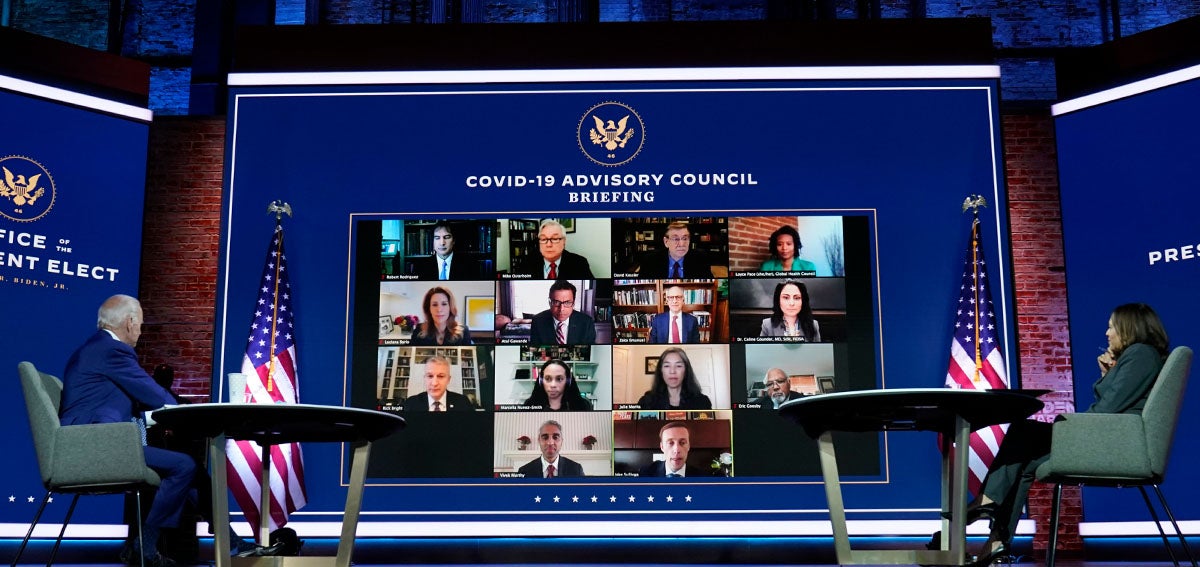
Biden’s Panel Outlines Proactive Pandemic Response as COVID-19 Toll Soars

Essential Coverage

On the morning of November 7, major news networks starting with CNN called the presidential election for Joe Biden. Although the election has yet to be officially certified, Biden and Vice President-elect Kamala Harris have wasted no time preparing their response to the rapidly worsening coronavirus pandemic.

Over the past week, the US has averaged more than 150,000 new COVID-19 cases per day, an increase of 81% from the average on November 1. The US had a record 181,200 new reported cases on November 13. Over 11 million Americans have been infected, and the nation is nearing a grim milestone of 250,000 deaths. Experts warn that the worst is yet to come. As temperatures drop and family-centric holidays approach, people are likely to spend more time socializing indoors with non-household members, increasing the risk for COVID-19 transmission.

Mitigating the spread of the coronavirus and preventing more deaths are top priorities for the incoming Biden-Harris administration. Biden’s campaign team published a seven-point plan to beat COVID-19, and on November 9, the Biden-Harris transition team named a COVID-19 Advisory Council tasked with guiding the federal response to the pandemic immediately after the inauguration.

The council “will be consulting with state and local officials to gauge public-health steps needed to bring the virus under control,” Evan Halper and Noam Levey reported in the Los Angeles Times. “The board will also focus on racial and ethnic disparities in how, where, and how quickly the virus is spreading.”

Innovative Plan: Tell the Truth

The Biden-Harris plan sets a new tone for the nation’s coronavirus response, using federal powers and leadership to centralize the acquisition and distribution of personal protective equipment (PPE), along with the coordination of testing and contact tracing, instead of leaving those vital resources to be led in 50 different ways by state governors. It emphasizes evidence-based guidance and empowers public health officials and scientists to guide and revise the nation’s reopening strategy as the pandemic evolves.

You’ll immediately see a change of tone, a change in communication,” Ezekiel Emanuel, MD, PhD, the vice provost for global initiatives at the University of Pennsylvania, told Politico. “This is the stuff of real leadership: telling the truth, modeling the right behaviors like wearing a mask, only having small crowds, putting the scientists out there.”

The first priority in the plan is to ensure that all Americans have access to regular, reliable, and free coronavirus testing. Rapid testing is vital for identifying, isolating, and treating new cases of COVID-19, but the US has been crippled by continuing test shortages and long lag times before results are reported. Biden plans to double the number of drive-through testing sites while scaling up next-generation solutions like home tests.

Contact tracing goes hand-in-hand with testing in the public health response to COVID-19, and the plan would establish a US Public Health Job Corps to train and mobilize 100,000 Americans to perform culturally competent contact tracing in communities most affected by COVID-19.

The second priority is to fix the nation’s PPE problems. N95 masks, gloves, gowns, and other PPE used by health care staff are still in short supply. AARP reported that one in four nursing homes ran short of PPE between August 24 and September 20. (Nursing homes continue to be a hot spot for coronavirus transmission.) Biden would use the Defense Production Act to increase production of PPE and distribute the supply to states instead of leaving states to fend for themselves.

For the third priority, Biden would tap the nation’s wealth of science experts to provide clear public guidance on how communities should navigate the pandemic. The US Centers for Disease Control and Prevention (CDC) would lead this effort, with an emphasis on helping communities determine when it is safe to reopen schools and various types of businesses.

Navigating Hurdles to Safe, Effective, Accepted Vaccine

Although the pharmaceutical company Pfizer announced on November 9 that its coronavirus vaccine trial showed positive early results, the road to vaccinating all Americans is tortuous. Pfizer still needs to seek emergency use authorization from the Food and Drug Administration (FDA) and ramp up vaccine production to meet the global need. In the meantime, Biden plans to invest $25 billion in a vaccine manufacturing and distribution plan that ensures every American can get vaccinated for free. This fourth priority would make the vaccine accessible to all people and communities regardless of income or any other factor.

The fifth priority is to protect Americans who are at high risk of getting seriously ill or dying from COVID-19. This includes people over 65, nursing home residents, and people living in neighborhoods with higher rates of COVID-19. Biden would establish a COVID-19 Racial and Ethnic Disparities Task Force (PDF) to report on disparities in COVID-19 infection, hospitalization, and death rates, as well as to provide recommendations to Congress and the Federal Emergency Management Agency on how best to distribute resources and relief funds to combat these disparities. The plan also calls for strengthening the Affordable Care Act to ensure that during the pandemic, Americans have health insurance coverage.

During the presidential campaign, Biden called for a national mask mandate based on the growing body of evidence that mask-wearing can considerably reduce the transmission of respiratory viruses like the one that causes COVID-19. Biden plans to coordinate with governors and mayors to convince Americans to wear a mask when they are around people outside their household. Currently, 34 states and the District of Columbia mandate face masks in public, but there is no nationwide requirement.

Finally, the plan takes the long view on pandemic threats by rebuilding and reinvesting in defenses that will help the world predict and prevent future pandemics. The Biden administration has declared that the US will rejoin the World Health Organization, restore the White House National Security Council Directorate for Global Health Security and Biodefense, which was eliminated by the Trump administration in 2018, and shore up CDC’s global corps of disease detectives.

Public Health Experts at the Helm

The newly announced COVID-19 Advisory Council is a who’s who of public health experts, former government officials, and doctors, including several from California. The panel currently comprises 13 members, but Biden has said it may be expanded.

The three cochairs of the advisory board are former surgeon general Vivek Murthy, MD; former FDA commissioner David Kessler, MD, a UCSF professor of pediatrics, and of epidemiology and biostatistics; and Marcella Nunez-Smith, MD, MPH, an associate professor of internal medicine, public health, and management at Yale University whose research focuses on health disparities.

The other members appointed so far include:

  • Luciana Borio, MD, vice president at the venture capital firm In-Q-It. Borio served in multiple leadership roles in the Trump and Obama administrations in the National Security Council and FDA.
  • Rick Bright, PhD, director of the Biomedical Advanced Research and Development Authority under Trump and Obama. Bright resigned from the government in October after being removed from his vaccine development role by President Trump.
  • Ezekiel Emanuel, MD, PhD, the vice provost for global initiatives at the University of Pennsylvania. Emanuel served in the Obama administration as special advisor for health policy to Peter Orszag, PhD, the former director of the Office of Management and Budget.
  • Atul Gawande, MD, MPH, a professor at Harvard Medical School and the Harvard T.H. Chan School of Public Health. Gawande is a staff writer covering health and medicine at the New Yorker and served in the Clinton administration as senior adviser in the Department of Health and Human Services.
  • Eric Goosby, MD, a professor of medicine at UCSF. Goosby, an expert on HIV/AIDS, led policy work in this field under Clinton and Obama.
  • Celine Gounder, MD, a clinical assistant professor of internal medicine and infectious diseases at New York University.
  • Julie Morita, MD, executive vice president of the Robert Wood Johnson Foundation and former commissioner of the Chicago Department of Public Health.
  • Michael Osterholm, PhD, MPH, director of the Center for Infectious Disease Research and Policy at the University of Minnesota.
  • Loyce Pace, MPH, president and executive director of the Global Health Council.
  • Robert Rodriguez, MD, a professor of emergency medicine at UCSF.

COVID-19 sparks national security concerns with top brass in quarantine

COVID-19 sparks national security concerns with top brass in quarantine

COVID-19 sparks national security concerns with top brass in quarantine

The quarantining of most of the Joint Chiefs of Staff, coming on the heels of President Trump’s COVID-19 diagnosis, is raising fears that U.S. adversaries might seek to exploit a perceived weakness.

Few expect any sort of overt military action, but there are other ways to wreak havoc on the United States.

Chief among them is disinformation. Experts have been warning ever since Trump tested positive for the coronavirus last week that disinformation is likely to kick into overdrive.

Now, with six of the seven members of the Joint Chiefs of Staff waylaid at home, warnings are being amplified about the national security implications of the growing COVID-19 outbreak among U.S. leadership.

“All these kinds of things are just a huge distraction for us where our national security apparatus is consumed with matters domestic and internal,” former Director of National Intelligence James Clapper said at a Washington Post event after news broke of the Joint Chiefs quarantining. “So this is an ideal time for adversaries, particularly in adversary intelligence services, to look for ways to further confuse us, to distract us.”

Adding that “you can bet particularly our good friends the Russians are doing this,” Clapper warned of them “further sowing seeds of disinformation.” 

“They will appeal to all the various tribes and continue to capitalize on the polarization in this country,” he said. “So it is a vulnerable time, and it’s an opportunity for them while we’re not looking and not being alert to further sow seeds of disinformation, casting doubt, discord, distrust in the country.”

The quarantining of top military officers stems from the Coast Guard’s No. 2 admiral contracting COVID-19. The Coast Guard announced Tuesday that its vice commandant, Adm. Charles Ray, tested positive for the coronavirus on Monday after feeling mild symptoms over the weekend.

The test result came after Ray met with most of the Joint Chiefs of Staff at the Pentagon on Friday.

That put Joint Chiefs of Staff Chairman Gen. Mark Milley into quarantine, as well as the chiefs of the Army, Navy, Air Force, Space Force and National Guard. The vice chairman, Gen. John Hyten, was also in the meetings and is quarantining.

The only member of the Joint Chiefs who didn’t meet with Ray was Marine Corps Commandant Gen. David Berger, who was traveling.

Berger’s deputy, Gen. Gary Thomas, met with Ray instead and went into quarantine Tuesday. The Marine Corps announced Wednesday evening that he has tested positive for the virus.

Gen. Paul Nakasone, commander of U.S. Cyber Command and director of the National Security Agency, also met with Ray and went into quarantine.

It’s unclear exactly where Ray caught the virus, but his schedule within the incubation period included a visit to the White House, which is now considered the epicenter of a coronavirus outbreak that includes Trump himself.

Ray — along with Milley, Defense Secretary Mark Esper and other top defense officials — attended a White House ceremony for Gold Star families on Sept. 27.

The event happened the day after Trump announced he was nominating Amy Coney Barrett for the Supreme Court, a gathering for which several attendees have since been diagnosed with COVID-19.

Since Trump’s diagnosis, the Department of Defense has sought to allay any national security concerns.

When Trump’s positive test was first announced last week, the Pentagon insisted there has been “no change to DoD alert levels.”

After news broke Tuesday of the Joint Chiefs quarantining, chief Pentagon spokesman Jonathan Hoffman reiterated that “there is no change to the operational readiness or mission capability of the U.S. Armed Forces.”

“Senior military leaders are able to remain fully mission capable and perform their duties from an alternative work location,” Hoffman said in a statement.

The military chiefs are well-equipped to work from home, and besides Ray and Thomas, none have tested positive for the virus yet.

But the development has raised questions about whether adversaries will try to take advantage of the situation nonetheless.

After the military quarantines were revealed, House Armed Services Committee Chairman Adam Smith (D-Wash.) said “the national security implications of the president’s recklessness cannot be overstated” even though the military “can still operate while leadership is quarantined.”

“Since announcing that he tested positive for the virus, the president’s antics have been downright reckless and harmful,” Smith said in a statement. “Our adversaries are always looking for any weakness to exploit. President Trump’s pathetic attempts to exude strength aren’t fooling anyone — Americans know he is weak and so do those who wish us harm.”

Rep. Jackie Speier (D-Calif.), another senior member of the Armed Services Committee, questioned why so many senior military leaders were meeting in person in the first place, as well as attending a White House reception in which they were pictured maskless.

“What if the Joint Chiefs’ responsibilities cannot be done remotely while they are isolating?” Speier wrote in a series of questions on Twitter. “How many other senior military leaders have tested positive? Why weren’t we safeguarding the health of senior military leaders like the natural security asset that it clearly is?”

Barry Pavel, senior vice president and director of the Atlantic Council’s Scowcroft Center for Strategy and Security, stressed that there is “no degradation in operational command and control” from the Joint Chiefs quarantining.

But, he added, adversaries such as Russia and China could misperceive that the United States is distracted and decide to act. For example, he cited concerns about China moving against Taiwan or Russia trying to grab more territory.

Pavel also listed what he called Russia’s “non-kinetic war” against the United States in the cybersecurity, influence and disinformation realm.

“This is a KGB officer’s most wildest dream coming true almost on a daily basis,” he said. “And so I think it’s a big threat. Who knows what proportion of our current public divisions are sown by Russian influence and bots or are just part of our current division. I don’t know the answer to that question. But they’re certainly right now exploiting it.”

To diminish those concerns, Pavel said, the Pentagon should keep emphasizing its military readiness, as well as demonstrating it by taking actions like publicizing a previously planned exercise.

“It’s probably a good idea to keep repeating those messages,” he said, “to be reiterating those messages, sending them publicly, privately, by third parties and through various forms of military activity so adversaries have no misunderstanding about our readiness and capabilities despite the chairman being quarantined in his quarters.”

The pandemic didn’t come out of nowhere. The U.S. ignored the warnings.

https://www.washingtonpost.com/opinions/global-opinions/the-pandemic-didnt-come-out-of-nowhere-the-us-ignored-the-warnings/2020/04/21/3bf37566-7db3-11ea-a3ee-13e1ae0a3571_story.html?utm_campaign=wp_opinions&utm_medium=email&utm_source=newsletter&wpis

The pandemic didn't come out of nowhere. The U.S. ignored the ...

“CAME OUT of nowhere,” President Trump said March 6 of the coronavirus pandemic. “I just think this is something . . . that you can never really think is going to happen.” A few weeks later, he added, “I would view it as something that just surprised the whole world.” Mr. Trump also said, “Nobody knew there would be a pandemic or epidemic of this proportion.”

Of course, no one can pinpoint the exact moment that lightning will strike. But a global pandemic? Experts have predicted it, warned about the preparedness gaps and urged action. Again and again and again.

Just look at 2019. In January, the U.S. intelligence community issued its annual global threat assessment. It declared, “We assess that the United States and the world will remain vulnerable to the next flu pandemic or large-scale outbreak of a contagious disease that could lead to massive rates of death and disability, severely affect the world economy, strain international resources, and increase calls on the United States for support. . . . The growing proximity of humans and animals has increased the risk of disease transmission. The number of outbreaks has increased in part because pathogens originally found in animals have spread to human populations.”

In September, the Johns Hopkins Center for Health Security issued a report titled “Preparedness for a High-Impact Respiratory Pathogen Pandemic.” The report found that if such a pathogen emerged, “it would likely have significant public health, economic, social, and political consequences. . . . The combined possibilities of short incubation periods and asymptomatic spread can result in very small windows for interrupting transmission, making such an outbreak difficult to contain.” The report pointed to “large national and international readiness gaps.”

In October, the Nuclear Threat Initiative, working with the Johns Hopkins center and the Economist Intelligence Unit, published its latest Global Health Security Index, examining open-source information about the state of health security across 195 nations, and scoring them. The report warned, “No country is fully prepared for epidemics or pandemics, and every country has important gaps to address.” The report found that “Fewer than 5 percent of countries scored in the highest tier for their ability to rapidly respond to and mitigate the spread of an epidemic.”

In November, the Center for Strategic and International Studies published a study by its Commission on Strengthening America’s Health Security. It warned, “The American people are far from safe. To the contrary, the United States remains woefully ill-prepared to respond to global health security threats. This kind of vulnerability should not be acceptable to anyone. At the extreme, it is a matter of life and death. . . . Outbreaks proliferate that can spread swiftly across the globe and become pandemics, disrupting supply chains, trade, transport, and ultimately entire societies and economies.” The report recommended: “Restore health security leadership at the White House National Security Council.”

Came out of nowhere? Not even close. The question that must be addressed in future postmortems is why all this expertise and warning was ignored.


World coronavirus updates

https://www.axios.com/coronavirus-latest-developments-8b8990c4-6762-494a-8ee0-5091746bda9b.html

Coronavirus brings clearer skies but darker world to 50th Earth ...

Children in Spain were allowed to go outside on Sunday for the first time since a nationwide lockdown aimed at slowing the spread of the novel coronavirus began six weeks ago.

By the numbers: The coronavirus has infected over 2.9 million people and killed over 200,000, Johns Hopkins data shows. More than 829,000 people have recovered from COVID-19. The U.S. has reported the most cases in the world (more than 940,000 from 5.1 million tests), followed by Spain (over 223,000).

What’s happening: Australian Health Minister Greg Hunt announced a new coronavirus tracing app on Sunday that the government hopes at least 50 percent of the population will use. A top health official said the app is “only for one purpose, to help contact tracing,” as he sought to reassure Australians on privacy issues.

  • China reported 11 new cases and no deaths on Sunday. It’s been 10 days since the country reported any deaths. China’s reported infections and deaths have been treated with suspicion by foreign leaders and the CIA.
  • Argentina is extending a nationwide shelter-in-place order that was due to expire Sunday until May 10, President Alberto Fernandez said on Saturday, per Reuters. The country has confirmed over 3,700 cases, according to Johns Hopkins.
  • Spain will gradually ease nationwide stay-at-home restrictions starting May 2 if coronavirus cases continue to decline, Prime Minister Pedro Sánchez said Saturday.
  • British Prime Minister Boris Johnson plans to return to work on Monday after recovering from the coronavirus.
  • The World Health Organization said Saturday there is “no evidence” that people who recover from COVID-19 and have antibodies are protected from a second infection.
  • India announced it will be easing lockdown measures for its 1.3 billion people in the areas outside of hotspots — providing some relief for locally owned businesses and daily wage workers.
  • The director of Israel’s foreign intelligence agency, Mossad, said in a briefing to health care officials on Thursday that Iran and its regional allies are intentionally underreporting cases and deaths from the coronavirus.
  • Brazil and Ecuador are becoming coronavirus epicenters in Latin America, as prolonged lapses in tracking and testing have led to severely undercounted death tolls, the Washington Post and the N.Y. Times report.
  • New Zealand’s level 4 lockdown measures requiring non-essential workers to stay home have been extended to 11:59 p.m next Monday, when the country moves into a still-strict level 3. NZ reported just three cases on Thursday.
  • Pakistan has decided to keep mosques open during the fasting month of Ramadan, which began Thursday, as cases continue to climb, AP reports.

The big picture: The world faces its gravest challenge in decades, but geopolitical tensions won’t wait until it’s over. Trump’s threat on Wednesday to “destroy” Iranian boats that harass U.S. ships comes amid arrests of Hong Kong pro-democracy activists and clashes in Afghanistan that could further undermine peace there.

Between the lines: Policy responses to the crisis have been every-country-for-itself and — in the case of the U.S. and China — tinged with geopolitical rivalry.

  • But the scientific work under way to understand the virus and develop a vaccine has been globalized on an unprecedented scale.

Coronavirus symptoms: Fever, cough, shortness of breath.


Navy chief resigns amid uproar over handling of aircraft carrier coronavirus crisis

https://thehill.com/policy/defense/491626-navy-chief-offers-to-resign-amid-uproar-over-handling-of-aircraft-carrier?rnd=1586292384?rnd=1586275342?userid=12325

Navy boss resigns amid uproar over firing of ship captain – WATE 6 ...

Acting Navy Secretary Thomas Modly resigned Tuesday after fanning the flames of a controversy over a coronavirus outbreak on board an aircraft carrier.

In a tweet, Defense Secretary Mark Esper said he accepted Modly’s resignation and that undersecretary of the Army James McPherson will take over as acting Navy secretary.

“This morning I accepted Secretary Modly’s resignation. He resigned of his own accord, putting the Navy and the sailors above self so that the USS Theodore Roosevelt, and the Navy as an institution, can move forward,” Esper said in a statement attached to the tweet.

The resignation comes a day after transcripts and audio of an inflammatory speech, in which Modly defended his decision to fire Capt. Brett Crozier as commander of the USS Theodore Roosevelt, leaked to the media.

Modly relieved Crozier of his command of the Roosevelt last week after a letter the captain wrote pleading for help with a coronavirus outbreak on the ship leaked in the media. Modly did not explicitly accuse Crozier of leaking the letter, but noted it appeared first in his hometown paper, the San Francisco Chronicle, and that he sent a copy to too many people to expect it not to leak.

In the speech aboard the Roosevelt, Modly said that if Crozier didn’t think the letter would leak, he was “too naive or too stupid to be a commanding officer of a ship like this.”

Alternatively, Modly said, if Crozier leaked the letter on purpose, that would be a “serious violation” of the Uniform Code of Military Justice.

He also called Crozier’s action a “betrayal” and warned sailors that there is “no situation” in which they should go to the media, alleging “the media has an agenda” that “depends on which side of the political aisle they sit.”

Modly at first said Monday afternoon he stands by “every word,” but by Monday night was apologizing.

“Let me be clear: I do not think Captain Brett Crozier is naive or stupid,” Modly said in a statement. “I apologize for any confusion this choice of words may have caused.”

At a White House press briefing, President Trump said he would not have asked Modly to resign.

“I had heard he did because he didn’t want to cause any disturbance for our country. He wouldn’t have had to resign. I would not have asked him. I don’t know him. I didn’t speak to him. But he did that I think just to end that problem. And I think in many ways that was a very unselfish thing to do.”

Trump said he was unsure what would happen to Crozier, leaving it up to Defense Secretary Mark Esper and the Naval chain of command. He called the letter a “mistake,” harping on its eventual leak to the media.

“The whole thing was very unfortunate. The captain should not have written a letter. He didn’t have to be Ernest Hemingway.”

The day before, as uproar over Modly’s speech and Crozier’s firing was growing, Trump had said he “may just get involved” with the situation.

Modly initially had Esper’s support in firing Crozier, but the fallout from his speech became too much to overcome as a growing chorus of lawmakers called for his removal from office, including House Armed Services Committee Chairman Adam Smith (D-Wash.) and Speaker Nancy Pelosi (D-Calif.).

“When I listened to the speech that acting Secretary Modly gave, it was almost like he was trying to do sort of a half-assed imitation of how Donald Trump would have given a speech,” Smith told reporters Tuesday in a response to a question from The Hill.

After the resignation, Smith said in statement that Modly “submitting his formal resignation to Secretary Esper was the right thing to do.”

Sen. Jack Reed (D-R.I.), the top Democrat on the Senate Armed Services, also said he agreed with Esper’s desicion to accept Modly’s resignation because Modly “mishandled the situation.”

“These actions were inappropriate for the leader of the U.S. Navy at any time, particularly in a crisis, and did a disservice to Captain Crozier, the sailors of the USS Theodore Roosevelt, and all Navy personnel,” Reed said in a statement. “The new leadership of the Navy must do better in leading and protecting sailors, Marines and their families in this unprecedented crisis.”

Senate Armed Services Committee Chairman Jim Inhofe (R-Okla.) said he supports Esper’s personnel decisions “especially as we deal with this pandemics,” but that “it’s disturbing to me that there’s been so much turmoil at the top of the Department of the Navy over the last year.”

In his statement on Tuesday, Esper said Modly’s “care for the sailors was genuine” and that he “wish[es] him all the best.”

Esper said he briefed Trump after his conversation with Modly and that the president supported his appointment of McPherson to replace Modly.

Esper said he also met with McPherson, Chief of Naval Operation Adm. Michael Gilday, Deputy Defense Secretary David Norquist and Joint Chiefs of Staff Chairman Gen. Mark Milley. He gave Gilday and McPherson guidance “on the way ahead.”

Esper also said he emphasized that his first priority in the coronavirus crisis is “protect our people, which means putting the health, safety and welfare of the USS Theodore Roosevelt’s crew first.”

“We must now put the needs of the Navy, including the crew of the USS Theodore Roosevelt, first, and we must all move forward together,” he said.

Crozier’s letter warned sailors could die if all but 10 percent of the 4,800-percent crew wasn’t evacuated from the ship.

“We are not at war. Sailors do not need to die,” Crozier wrote. “If we do not act now, we are failing to properly take care of our most trusted asset — our sailors.”

After he was fired, his crew gave him a hero’s sendoff, clapping and chanting his name as he walked off the ship.

As of Tuesday, the Navy reported 230 cases of coronavirus on the Roosevelt after 79 percent of the crew has been tested. The Navy said 1,999 sailors have been taken off the ship as it is docked in Guam, with 1,232 staying at hotels.

Over the weekend, Modly told The Washington Post he stepped in to fire Crozier in part because he wanted to get out in front of any action by the president. Modly’s predecessor, Richard Spencer, was ousted amid a dispute with Trump.

Spencer was fired amid the fallout from Trump’s decision to restore the rank of Navy Chief Petty Officer Eddie Gallagher, who was convicted in the military justice system of posing with the corpse of an ISIS fighter but acquitted of murder.

In addition to restoring Gallagher’s rank, Trump ordered the Navy to allow Gallagher to keep his status as a SEAL after news broke the Navy was reviewing his Trident pin.

Last month, Trump nominated U.S. Ambassador to Norway Kenneth Braithwaite to be Navy secretary after first saying he would immediately after Spencer’s departure in November.

But it’s unclear when the Senate will be able to hold a confirmation hearing for Braithwaite and approve his nomination as lawmakers remain largely out of Washington during the coronavirus pandemic.

“Once the Senate is back in session, I will make sure the Armed Services Committee considers the nomination of the next secretary of the Navy quickly, and I ask my fellow committee members to help me expedite this nomination as well,” Inhofe said in his statement. “Our Sailors, Marines and their families deserve to have stable, capable leadership at the helm during these challenging times.”