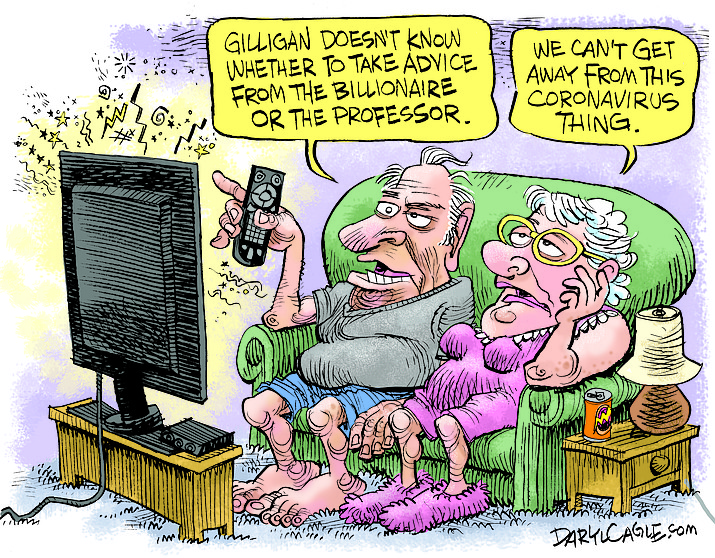
Cartoon – Gilligan’s Island

Editorial cartoon (2): June 6, 2020 | The Daily Courier | Prescott, AZ

Cartoon – Containing Your Hot Spot?

Editorial cartoons for Sunday, June 21 | HeraldNet.com

High numbers of Los Angeles patients complained about coughs as early as December, study says

https://www.washingtonpost.com/science/2020/09/10/los-angeles-patients-covid-coughing/?utm_campaign=wp_main&utm_medium=social&utm_source=facebook&fbclid=IwAR35fvTDN4Tq476ktGM0O8aIT3cvjVP1wP7I104tEQU3bRRgiLZs_nk6PYE

The number of patients complaining of coughs and respiratory illnesses surged at a sprawling Los Angeles medical system from late December through February, raising questions about whether the novel coronavirus was spreading earlier than thought, according to a study of electronic medical records.

The authors of the report, published Thursday in the Journal of Medical Internet Research, suggested that coronavirus infections may have caused this rise weeks before U.S. officials began warning the public about an outbreak. But the researchers cautioned that the results cannot prove that the pathogen reached California so soon, and other disease trackers expressed skepticism that the findings signaled an early arrival.

The debate about the findings underscores just how much remains to be known about the coronavirus, which has killed at least 187,000 people in the United States, according to a Washington Post analysis.

“This is consistent with the growing body of data that suggests that there’s been community spread much earlier than we had anticipated,” said study author Joann G. Elmore, a doctor and epidemiologist at the David Geffen School of Medicine at the University of California at Los Angeles.

The researchers examined six years of electronic health records, representing nearly 10 million patients, at the UCLA health system from July 2014 through February. That included patient visits to three UCLA hospitals and to nearly 200 associated outpatient clinics.

Health agencies have surveillance systems in place to detect the early signals of disease outbreaks, such as a rise in patients with fever checking into hospitals. But medical records were an under-tapped resource, Elmore said. “People weren’t paying attention to the outpatient setting,” she said.

The study authors searched outpatient and emergency department reports that used the word “cough,” and tallied the number of people hospitalized for acute respiratory failure.

That approach revealed an uptick in patients that began the week of Dec. 22 and remained elevated for 10 weeks. The number of extra people exceeded the researchers’ predictions by 50 percent, totaling about 1,000 more patients compared with the previous five flu seasons.

Influenza cannot be ruled out as a cause of the increase, Elmore said. “And, you know, we did see a bad bout of flu this year,” she said. But what gave her pause was the consistent, weeks-long trend found only in this most recent season and not others.

Some experts said they doubted that coronavirus infections were the likely cause of respiratory problems in California so far back in time. “The data countywide would suggest that it really began to spread in March,” said Brad Spellberg, chief medical officer at the Los Angeles County+USC Medical Center, who was not involved with the new research.

Although the virus may have infected a small number of people sooner than previously reported, Spellberg said he doubted that “meaningful transmission” occurred in December or January.

Using data from emergency departments that reported patients with flu-like illnesses, Spellberg and his colleagues observed two peaks in patients in December and February, as they reported in JAMA this spring.

Those increases were consistent with a severe flu season, Spellberg said. Los Angeles’s third spike in flu-like illnesses, this time caused by the coronavirus, came later.

What’s more, between March 2 and March 18, only 5 percent of 131 patients with flu-like illnesses tested positive for the coronavirus in the JAMA study. Spellberg said that if the virus had an earlier foothold in California, he would have expected that percentage to be higher. “You would have seen an explosion of cases,” he said.

Understanding how long the virus circulated within a population helps refine epidemiological models of transmission. Infectious-disease scientists and doctors in many pockets of the world are eager to uncover when the coronavirus first spread outside of China.

In late December 2019, Chinese health officials identified clusters of viral pneumonia in Wuhan. Researchers sequenced the culprit’s genome, describing the new coronavirus strain, in early January. The first officially reported U.S. case of coronavirus, a man who traveled home from Wuhan, occurred two weeks later.

A few observations indicate that the virus may have traveled farther, earlier, before it flared into a global pandemic. A study of Italian sewage revealed traces of the virus in December. When researchers retested a nasal swab from a man hospitalized near Paris dating to Dec. 27, they detected the coronavirus.

Genetic sequencing of coronavirus samples in New York suggests that the virus was spreading there by the end of January. In April, two autopsies in Santa Clara County, Calif., pushed back the first U.S. covid-19 deaths from late to early February.

Study author Judith Currier, a UCLA infectious-disease physician, said that when it comes to people who wonder whether they were exposed to the virus many months ago, she does not recommend “antibody testing for people who never had a symptomatic illness,” citing guidelines from the Centers for Disease Control and Prevention.

“If someone had a compatible clinical illness but never had testing for covid during that time, antibody testing could help to confirm,” she said. “Although we don’t know how long the antibodies last, so it would not be definitive.”


A New Front in America’s Pandemic: College Towns

The coronavirus is spiking around campuses from Texas to Iowa to North Carolina as students return.

Last month, facing a budget shortfall of at least $75 million because of the pandemic, the University of Iowa welcomed thousands of students back to its campus — and into the surrounding community.

Iowa City braced, cautious optimism mixing with rising panic. The university had taken precautions, and only about a quarter of classes would be delivered in person. But each fresh face in town could also carry the virus, and more than 26,000 area residents were university employees.

“Covid has a way of coming in,” said Bruce Teague, the city’s mayor, “even when you’re doing all the right things.”

Within days, students were complaining that they couldn’t get coronavirus tests or were bumping into people who were supposed to be in isolation. Undergraduates were jamming sidewalks and downtown bars, masks hanging below their chins, never mind the city’s mask mandate.

Now, Iowa City is a full-blown pandemic hot spot — one of about 100 college communities around the country where infections have spiked in recent weeks as students have returned for the fall semester. Though the rate of infection has bent downward in the Northeast, where the virus first peaked in the U.S., it continues to remain high across many states in the Midwest and South — and evidence suggests that students returning to big campuses are a major factor.

In a New York Times review of 203 counties in the country where students comprise at least 10 percent of the population, about half experienced their worst weeks of the pandemic since Aug. 1. In about half of those, figures showed the number of new infections is peaking right now.

Despite the surge in cases, there has been no uptick in deaths in college communities, data shows. This suggests that most of the infections are stemming from campuses, since young people who contract the virus are far less likely to die than older people. However, leaders fear that young people who are infected will contribute to a spread of the virus throughout the community.

The surge in infections reported by county health departments comes as many college administrations are also disclosing clusters on their campuses.

*Brazos County, Tex., home to Texas A&M University, added 742 new coronavirus cases during the last week of August, the county’s worst week so far, as the university reported hundreds of new cases.

*Pitt County, N.C., site of East Carolina University, saw its coronavirus cases rise above 800 in a single week at the end of August. The Times has identified at least 846 infections involving students, faculty and staff since mid-August.

*In South Dakota’s Clay and Brookings counties, ballooning infections in the past two weeks have reflected outbreaks at the state’s major universities. In McLean County, Ill., the virus has been spreading as more than 1,200 people have contracted the virus at Illinois State University.

*At Washington State University and the University of Idaho, about eight miles apart, combined coronavirus cases have risen since early July to more than 300 infections. In the surrounding communities — rural Whitman County, Wash., and Latah County, Idaho — cases per week have climbed from low single-digits in the first three months of the pandemic, to double-digits in July, to more than 300 cases in the last week of August.

The Times has collected infection data from both state and local health departments and individual colleges. Academic institutions generally report cases involving students, faculty and staff, while the countywide data includes infections for all residents of the county.

It’s unclear precisely how the figures overlap and how many infections in a community outside of campus are definitively tied to campus outbreaks. But epidemiologists have warned that, even with exceptional contact tracing, it would be difficult to completely contain the virus on a campus when students shop, eat and drink in town, and local residents work at the college.

The potential spread of the virus beyond campus greens has deeply affected the workplaces, schools, governments and other institutions of local communities. The result often is an exacerbation of traditional town-and-gown tensions as college towns have tried to balance economic dependence on universities with visceral public health fears.

In Story County, Iowa, a local outcry following a burst of new Iowa State University cases pressured the university on Wednesday to reverse plans to welcome 25,000 football fans for its Sept. 12 opener against the University of Louisiana at Lafayette. In Monroe County, Indiana, the health department quarantined 30 Indiana University fraternity and sorority houses, prompting the university to publicly recommend that members shut them down and move elsewhere.

In Johnson County, where the University of Iowa is located, cases have more than doubled since the start of August, to more than 4,000. Over the past two weeks, Iowa City’s metro area added the fourth-most cases per capita in the country. The university has recorded more than 1,400 cases for the semester.

With a population of roughly 75,000, Iowa City relies on the university as an economic engine. The University of Iowa is by far the community’s largest employer, and its approximately 30,000 students are a critical market. Hawkeye football alone brings $120 million a year into the community, said Nancy Bird, executive director of the Iowa City Downtown District.

When the pandemic first hit in March, the university sent students home and pivoted to remote instruction, like most of the country’s approximately 5,000 colleges and universities. That exodus, heightened by health restrictions, has been an existential challenge for many downtown businesses, Ms. Bird said.

Jim Rinella, who owns The Airliner bar and restaurant, said the 76-year-old landmark across the street from campus “had zero revenue the whole month of April.” May was almost as scant, he said, and in June, he shut down after a couple of employees became infected.

By the time he reopened after July 4, too few students were in town to come close to making up the losses. He and his wife, Sherry, had hoped the campus reopening in August might be a lifeline.

The Rinellas live in Detroit, where they have other businesses, and Mr. Rinella said he was out of town when crowds jammed downtown on the weekend before the Aug. 24 start of classes. He said he immediately called his manager to make sure they were following state and local health rules.

But the photos taken by the local press from outside his establishment and others were damning. In an open letter, the university president lashed out, saying he was “exceedingly disappointed” in the failure of local businesses to keep students masked and socially distanced. Days later, the governor cited high infection rates among young people as she closed bars and restricted restaurants in Johnson County and five other counties with high concentrations of students.

Now The Airliner — where a booth is named for the University of Iowa’s most famous dropout, Tom Brokaw, and a modeling scout is said to have discovered Ashton Kutcher — has to close at 10 p.m. as well as require customers to buy a meal and sit far apart if they want to drink there.

“I’m at a pain point,” Mr. Rinella said. “If my grandfather hadn’t started the place, I’d question whether I want to be in the restaurant business.” A recent lunch hour visit found one customer at the bar drinking a beer.

The rise in local case counts reverberated at the county’s community college, which decided to start its fall semester with continued online instruction. Iowa City’s K-12 schools followed suit, which also meant canceling extracurricular activities, including sports, until students come back to the classroom in person.

“This is one of our last chances for college coaches to see us play or to get recent films sent out to college coaches. For some of us, playing in college is a goal we have been working toward since we were 11 or 12,” Lauren Roman, a 17-year-old high school volleyball player, told the school board last month. She burst into tears as she explained that she has waited since March for college recruiters to see her play. “Some of us really do need that scholarship money.”

“This sucks,” the board vice-president Ruthina Malone, agreed at the same meeting, choking up as she described emails she had received from families of children whose education relies on in-person instruction. But, she told the board, “we do not operate in isolation.” Her husband, she said, is an art teacher who would like nothing more than to teach again in person, and she works at the university.

The pandemic has hurt colleges’ finances in multiple ways, adding pressure on many schools to bring students back to campus. It has caused enrollment declines as students have opted for gap years or chosen to stay closer to home, added substantial costs for safety measures, reduced revenue from student room and board and canceled money-generating athletic events.

Governments have not always stepped into the breach: In Iowa, the state cut $8 million from its higher education appropriation even after the Board of Regents, which oversees the state’s universities, requested an $18 million increase. Over the summer, the University of Iowa announced a salary freeze and other significant cuts. This was before the Big Ten Conference postponed fall competition, erasing more than $60 million from the university’s athletics program.

When the university announced its plans for reopening with a combination of in-person and virtual instruction, it did not mention its finances as a factor, though it froze tuition rather than reduce it, as some universities have done. It also mandated mask wearing inside buildings and said it would test students with symptoms or who had been exposed to the virus.

Still, its decision to hold in-person classes drew criticism from some faculty. “We’re scared for our health and yours,” one group of instructors wrote in an open letter to students in July.

And its decision not to test asymptomatic students unless they had been exposed unnerved some city officials. Dr. Dan Fick, the campus health officer, said the university wanted to avoid a false sense of security.

But Janice Weiner, who represented the City Council in meetings with the business community and campus, questioned the approach. “We have a robust and capable medical community, we have good public health officials, we have everything we need,” she said. “But then the university didn’t require everyone coming back to campus to be tested.”

Iowa City is a blue town in a state with a pro-Trump Republican governor, Kim Reynolds, who has clashed with the state’s cities over masks and Covid policies.

Though the governor in March restricted large gatherings, closed Iowa schools and banned indoor operations of many businesses, she began relaxing those orders in May and has argued that face-mask mandates couldn’t be legally enforced.

Several municipalities have nonetheless passed ordinances requiring face masks, including Johnson County and Iowa City — largely in preparation for the return of students. But because state health rules have become a patchwork, not all returning students come from places where mask wearing is required, said Ms. Weiner. And, she said, the inconsistency offers an excuse to those who don’t want to wear them.

Interviews with students suggested that concern had at least some justification.

“If people get sick, they get sick — it happens,” Mady Hanson, a 21-year-old exercise science major, said last week on campus. She added that she and her family had survived Covid-19 and that she resented the city’s “ridiculous” restrictions.

“We’re all farmers and don’t really care about germs, so if we get it, we get it and we have the immunity to it.”

Both university and city officials said they believe the spike in cases has been a wake-up. “When we look back,” said Dr. Fick, “I think we’ll be proud that when students got the message, a majority stepped up.”

On the City Council, Ms. Weiner was less upbeat.

“There’s not a whole use in placing blame — we have to figure out a way forward,” she said. “But it’s going to take a herculean effort here for our numbers to start to go down.”


The coronavirus and a $12 billion motorcycle rally

https://www.axios.com/newsletters/axios-vitals-9f3757d6-dde4-4b75-a994-9572837e9d3f.html?utm_source=newsletter&utm_medium=email&utm_campaign=newsletter_axiosvitals&stream=top

The coronavirus outbreak tied to the annual motorcycle rally in Sturgis, South Dakota, ended up generating more than $12 billion in public health costs, according to a new discussion paper.

Why it matters: The analysis puts a point on just how bad these superspreader events can be — and the difficulty of preventing them solely with voluntary policies.

Background: The annual rally was held this year over 10 days in August, and included a Smash Mouth concert. The nearly 500,000 attendees came from all over the country, and social distancing and mask-wearing were mostly optional.

By the numbers: The rally led to 266,796 additional cases, or 19% of the new cases in the U.S. between Aug. 2 and Sept. 2., the paper found.

  • The event led to a 35% increase in cases in South Dakota. In counties that are home to the highest number of rally attendees, cases rose by 10.7% compared to counties without any attendees.
  • If each coronavirus case costs $46,000, that’s an additional $12.2 billion added on to the pandemic’s price tag.

The other side: “Overall, I think the ‘Sturgis Effect’ that the authors document is in large part just a Midwest surge that took place during this time period. There is likely still a small Sturgis Effect … but the results are likely biased upward,” tweeted Devin Pope, a professor at the University of Chicago.

The big picture: Given the state of contact tracing in the U.S. (bad), we’ll never know how many coronavirus cases were actually tied to the Sturgis rally.

  • But it’s a reminder that it takes collective action to contain the virus: As Sturgis revelers head back home, this South Dakota-centered outbreak has the potential to infect people who never went anywhere near Sturgis and thought they were doing everything right.


Sturgis Motorcycle Rally Is Now Linked to More Than 250,000 Coronavirus Cases

Sturgis Motorcycle Rally Is Now Linked to More Than 250,000 Coronavirus Cases

Sturgis Motorcycle Rally Is Now Linked to More Than 250,000 Coronavirus  Cases – Mother Jones

One study estimates the public health cost of the super-spreading event is near $12 billion.

The inevitable fallout from last month’s Sturgis Motorcycle Rally, an annual event that packed nearly 500,000 people into a small town in South Dakota, is becoming clear, and the emerging picture is grim.

According to a new study, which tracked anonymized cellphone data from the rally, over 250,000 coronavirus cases have now been tied to the 10-day event, one of the largest to be held since the start of the pandemic. It drew motorcycle enthusiasts from around the country, many of whom were seen without face coverings inside crowded bars, restaurants, and other indoor establishments.

The explosion in cases, the study from the Germany-based IZA Institute of Labor Economics finds, is expected to reach $12 billion in public health costs.

“The Sturgis Motorcycle Rally represents a situation where many of the ‘worst-case scenarios’ for super-spreading occurred simultaneously,” the researchers wrote, “the event was prolonged, included individuals packed closely together, involved a large out-of-town population, and had low compliance with recommended infection countermeasures such as the use of masks.”

The conclusion, while staggering, is unlikely to surprise to public health officials who warned that proceeding with the rally could be disastrous, particularly given the region’s relaxed attitude towards social distancing guidelines and some of the attendees’ mockery of the pandemic. “Screw COVID. I went to Sturgis,” read one t-shirt from the rally, where overwhelming support for President Trump was the norm.

The study comes on the heels of the first reported death from the event, a Minnesota man in his 60’s who attended the rally who died last week. South Dakota now has one of the country’s highest rates of coronavirus cases. 


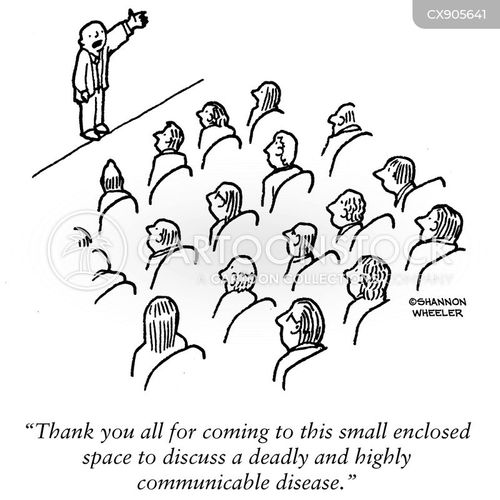
Cartoon – State of the Union: Thank You All for Coming

Medical Conferences Cartoons and Comics - funny pictures from CartoonStock

Cartoon – Federal Coronavirus Testing Guidelines

This company boasted to Trump about its COVID-19 vaccine. Experts are  skeptical. - Hartford Courant

Cartoon – Something that would greatly Prevent Covid 19

U.S. sets record for new coronavirus cases, surpassing 53,000 - The  Washington Post

ANALYSIS: ADMINISTRATION’S CORONAVIRUS ADVICE IS SECRET, FRAGMENTED AND CONTRADICTORY

Analysis: Trump administration’s coronavirus advice is secret, fragmented and contradictory

Analysis: Trump administration's coronavirus advice is secret, fragmented  and contradictory – Center for Public Integrity

ANALYSIS: TRUMP ADMINISTRATION’S CORONAVIRUS ADVICE IS SECRET, FRAGMENTED AND CONTRADICTORY

Dr. Deborah Birx speaks to reporters in the rotunda of the State Capitol in Lincoln, Neb., Aug. 14, 2020, after meeting with Gov. Pete Ricketts and community and state health officials. (AP Photo/Nati Harnik)

Private calls and unpublished reports leave many Americans and local officials in the dark.


INTRODUCTION

This is a news analysis from the Center for Public Integrity.

From behind a podium and a black mask, Tulsa mayor G.T. Bynum faced the press. It was late July, and one percent of his city had tested positive for COVID-19 since the beginning of the pandemic.


A reporter had a question: What did Bynum have to say about the newly leaked White House Coronavirus Task Force document that recommended Tulsa close bars and limit gatherings to 10 people?

The “alleged White House document” was “never officially presented to us … by either the federal government or the state government,” the mayor said. But he was familiar with the document’s recommendations, having read them online. “All of that remains very much on the table.” 

Fast-forward a month, at a press conference that looked exactly like the last, and Bynum still hadn’t received any of the weekly reports from the White House. “It was news to me that there had been eight different reports. I only knew about the one that was leaked to the media,” he said. “That’s all data that, of course, we would like to know.”

Indeed, the White House reports — chock full of local data and recommendations — would be useful for many city leaders, many of whom still don’t know what percentage of coronavirus tests in their metro areas are positive. But Bynum and others didn’t have that information. The White House was sending each state’s report directly to its governor and a select group of other officials instead of distributing the documents widely or posting them publicly.

The nation’s coronavirus response must be “locally executed, state managed, federally supported,” White House officials have said repeatedly. In fact, much of their public health advice has been secret, segmented and inconsistent. Federal guidance isn’t always reaching the local officials it’s meant to support. And scattershot messages mean that average citizens weighing visits to grandparents or countless other daily risks have limited  — and sometimes conflicting — information from the officials they are expected to trust.


THE SUMMER OF SECRET WARNINGS

In late June, the White House Coronavirus Task Force began sending reports to governors showing how their states were faring in the pandemic. Dr. Deborah Birx, a leader of the task force, held the documents aloft at a press conference July 8, but they weren’t distributed to reporters. Birx said several states were in the coronavirus “red zone — with high numbers of cases — and should take special precautions, but Vice President Mike Pence delivered the primary message of the press conference: Reopen schools.

Later that month, the Center for Public Integrity obtained a copy of the compiled report for all 50 states and published it, revealing that 18 states were in the red zone. The next morning, presidential adviser Kellyanne Conway suggested Public Integrity, a  30-year-old nonprofit, nonpartisan newsroom, had nefarious motives for disclosing public information: “I don’t know about that particular document, and respectfully the Center for Public Integrity is an outside organization that I’m sure doesn’t support the president’s election,” she told reporters.

A spokesman for Pence, Devin O’Malley, later acknowledged the document’s authenticity. But the White House still didn’t release the reports and stayed mum on why it was keeping them secret. Weeks later, White House spokesman Judd Deere sent an email to Public Integrity that didn’t quite answer the question: “The White House Coronavirus Task Force is providing tailored recommendations weekly to every governor and health commissioner for their states and counties,” he wrote. “Local leaders are best positioned to make on-the-ground decisions for their communities … The United States will not be shut down again.”

Meanwhile, Birx hit the road, zigzagging across the country to meet with governors in person and privately urge some of them to ratchet up virus precautions. On closed-to-the-press conference calls with state and local officials, Birx warned individual cities that they should take “aggressive action” to curb the coronavirus, according to recordings obtained by Public Integrity.

But officials from those cities weren’t always on the calls: Baltimore and Cleveland leaders missed a call in which Birx pinpointed them. And some of them weren’t getting the reports she was referencing. In late August, the most recent White House report the Arkansas Department of Health had was three weeks old. 

Public health experts say the reports should be public. “This is a pandemic,” Harvard epidemiologist Bill Hanage told Public Integrity in July. “You cannot hide it under the carpet.”

Dr. David Rubin, who has provided epidemiological modeling to the task force as director of PolicyLab at the Children’s Hospital of Philadelphia Research Institute, is also befuddled as to why the reports are secret. “I think we’d be in a lot different place today if we had national standards around certain things,” he said. But he doesn’t blame Birx or other scientists working with the White House. “They’re playing the hand that they were dealt.”


CUSTOM-MADE OR CONFUSING?

In mid-March, a 4×6” blue-and-white postcard appeared in mailboxes across the nation, emblazoned with “President Trump’s Coronavirus Guidelines for America” and both the White House and Centers for Disease Control and Prevention logos. On the back were a dozen lines of advice, including: “Even if you are young, or otherwise healthy, you are at risk and your activities can increase the risk for others.”

The postcard appeared in the days when the president, vice president, Birx and National Institute of Allergy and Infectious Diseases Director Anthony Fauci together updated the nation daily on television about the state of the coronavirus. The administration had already pressed the mute button on the CDC (though the agency posted guidance online, it wasn’t giving the regular briefings it had in past epidemics), but the White House was still attempting to send out a cohesive public health message.  

Then, as the economy cratered, Trump shifted gears to reopening and pushed responsibility for the pandemic response to the states. After decades of relying on national entities for public health advice and regulation — the CDC, the Food and Drug Administration, the surgeon general and others — America handed responsibility for infectious-disease containment to the states. 

Doing so allows governors to respond to their unique virus conditions, defenders of the administration said. The U.S. needs “a decentralized approach” said Heritage Foundation visiting fellow Doug Badger, because states have police powers to enforce lockdowns and because they are “better suited to responding to this pandemic, where there is great variation between and within states. […] There’s no one-size-fits-all policy.” Indeed, epidemics unfold at different rates in different geographies, and it makes sense to adjust advice based on whether people live close together or far apart, and how widely the virus is spreading in their communities.

But experts say that even though some public health warnings should be specific to local areas, many messages, such as the need to wear masks, should be nationally consistent. Contradictory guidance undermines trust, and the virus exploits the communities with weakest defenses. “Diseases don’t care about national or state borders,” said Jessica Malaty Rivera, Science Communication Lead at the Covid Tracking Project, a volunteer organization collecting pandemic data. “You can’t look at this in a fragmented way otherwise we’re going to continue this fragmented progress.”


“Diseases don’t care about national or state borders.”

JESSICA MALATY RIVERA, SCIENCE COMMUNICATION LEAD AT THE COVID TRACKING PROJECT


And some think the Trump administration’s advice isn’t as tailored or helpful as it should be. “For weeks, the Trump Administration has been issuing these cookie-cutter reports based on little or no review of existing regulations or conditions on the ground, while failing to pull together a national strategy for COVID-19 testing, contact tracing, and response,” Charles Boyle, a spokesman for Oregon Gov. Kate Brown, wrote in an email. “None of the recommendations in these weekly reports have been paired with the resources or the federal support to implement them.”

In addition, Trump’s desire for state leadership has been selective. After weeks of insisting on a governor-led response, in July Trump Tweeted, “SCHOOLS MUST OPEN IN THE FALL!!!” and threatened to withhold federal funding from school districts that did not open their doors. 


WHO DO YOU LISTEN TO?

Splitting public health advice into pieces means that some of those fragments don’t line up. On a private call with state and local leaders earlier this month, Birx said colleges should be testing students as they return to campus, and even be prepared to do 5,000 or 10,000 tests in one day. But the CDC hasn’t endorsed such testing because its effectiveness hasn’t been “systematically studied.”

Nowhere has the fractured advice been more evident than on the topic of how to reopen K-12 schools. The CDC in May issued guidelines, but later replaced them with a more lenient version after the president objected. After insisting schools open their doors, Trump acknowledged that some hot spots may need to delay opening. CDC director Robert Redfield said that schools should go virtual if their areas have more than 5 percent test positivity — a threshold that only 17 states and the District of Columbia met as of Aug. 26 according to a New York Times tracker. Birx has stayed noticeably quiet on the topic. The secret reports from her task force recently endorsed West Virginia’s school reopening guidelines, which say schools must switch to virtual learning if daily new cases in a county exceed 25 per 100,000 residents.

All this leaves local officials with a dizzying set of choices and advice, stuck making the decisions others don’t want blame for.

“This really stinks for local health departments,” said Lori Tremmel Freeman, CEO of the National Association of County and City Health Officials. “Everybody wants to relinquish authority to the local health department. The authority ends up coming and going depending on how hard it is to address the issue. And it just is not fair to them.”

In addition, perhaps due in part to the mixed messaging, whatever advice the White House does have isn’t always followed. In Arkansas, where the task force has recommended that bars close, they remain open. In Georgia, where the task force recommended a state mask mandate, Gov. Brian Kemp sued to block Atlanta from requiring face coverings, though he later relented. In Tennessee in July, Gov. Bill Lee ignored Birx’s suggestion that he close bars, limit indoor dining and mandate masks.

All this has meant that in the first major pandemic in a century, despite the feeble and disjointed efforts of the White House to corral them, the United States were not united, not even in the messages sent to citizens. That has some experts worried about what’s to come in the fall, when the reluctance of some to be vaccinated could mean the nation fails to reach the threshold for herd immunity that would protect everyone. Rivera, of the Covid Tracking Project, is “absolutely terrified” about that possibility; united messaging is key when trying to help people understand the scientific rigor behind a vaccine, she said. “All it takes is one rumor to completely shift public health behavior.”


HELP FROM THE FOURTH ESTATE

In Tulsa, Bynum can now see all the White House reports. That’s because Public Integrity published a recent Oklahoma report, and local journalists pressed the governor on why he hadn’t handed it out. Last week he agreed to post all of the state’s White House reports.

In other parts of the country, people still don’t know what White House experts are saying about their states or counties. The federal map of red, yellow and green zones — an easy-to-understand stoplight that could help people quickly decide whether to cross state lines, for example — remains off limits to the public. President Trump resumed daily coronavirus briefings this month, but Birx remains relegated to private calls and local press briefings on her treks across states. The CDC continues its silence; Fauci is recovering from a vocal cord surgery and can’t speak.

For more than a century, Congress has given the federal government a prominent role in helping stop the spread of disease from state to state. Americans can debate whether governors or the president should make the big decisions in this particular pandemic. But neither statute nor scientific wisdom puts limits on the federal government’s ability to dole out health advice. And there is no national security reason to make such advice secret.