More than 4K Stanford nurses vote to strike in California

UPDATE: April 14, 2022: Nurses will begin striking April 25 if they are unable to reach a deal with the system by then, according to a Wednesday statement from the union. The two sides have met with a federal mediator three times, and the strike would be open-ended.

Dive Brief:

  • Unionized nurses at Stanford hospitals in California voted in favor of authorizing a strike Thursday, meaning more than 4,500 nurses could walk off the job in a bid for better staffing, wages and mental health measures in new contracts.
  • Some 93% of nurses represented by the Committee for Recognition of Nursing Achievement voted in favor of the work stoppage, though the union did not set a date, according to a union release. It must give the hospitals 10 days notice before going on strike.
  • Nurses’ contracts expired March 31 and the union and hospital have engaged in more than 30 bargaining sessions over the past three months, including with a federal mediator, according to the union.

Dive Insight:

As the COVID-19 pandemic has worsened working conditions for nurses, some unions have made negotiating contracts a priority. Better staffing is key, along with higher wages and other benefits to help attract and retain employees amid ongoing shortages.

The California nurses’ demands in new contracts focus heavily on recruitment and retention of nursing staff “amid an industry-wide shortage and nurses being exhausted after working through the pandemic, many in short-staffed units,” the union said in the release.

They’re also asking for improved access to time off and more mental health support.

Nurses say their working conditions are becoming untenable and relying on travel staff and overtime shifts is not sustainable, according to the release.

The hospitals are taking precautionary steps to prepare for a potential strike and will resume negotiations with the union and a federal mediator Tuesday, according to a statement from Stanford.

But according to CRONA, nurses have filed significantly more assignment despite objections documents from 2020 to 2021 — forms that notify hospital supervisors of assignments nurses take despite personal objections around lacking resources, training or staff.

And a survey of CRONA nurses conducted in November 2021 founds that as many as 45% were considering quitting their jobs, according to the union.

That’s in line with other national surveys, including one from staffing firm Incredible Health released in March that found more than a third of nurses said they plan to leave their current jobs by the end of this year.

The CRONA nurses “readiness to strike demonstrates the urgency of the great professional and personal crisis they are facing and the solutions they are demanding from hospital executives,” the union said in the release.

No major strikes among healthcare workers have occurred so far this year, though several happened in 2021 and in 2020, the first year of the pandemic.
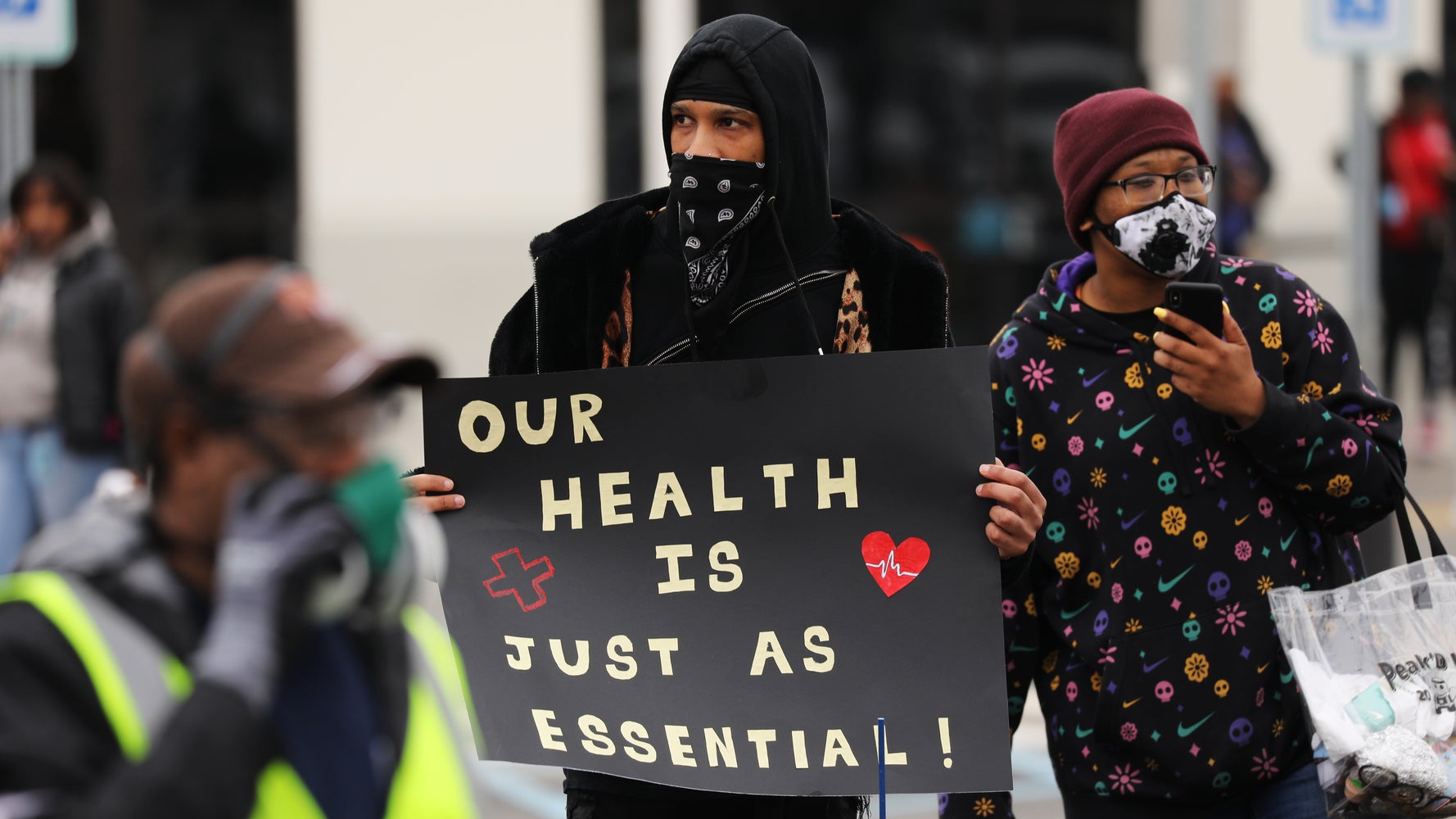
Amazon Worker Fired After Staging Walkout Over Company’s Handling Of Coronavirus Risk

https://www.yahoo.com/huffpost/amazon-fires-worker-chris-smalls-033240313.html

Amazon Worker Fired After Staging Walkout Over Company's Handling ...

Amazon fired an employee who helped organize a walkout at one of its fulfillment centers over the company’s response to the ongoing coronavirus pandemic on Monday.

Chris Smalls, the employee who helped organize the demonstration, said he felt Amazon had failed to enact adequate measures to protect workers at the facility as many Americans turn to online shopping as stay-at-home mandates expand around the country. Smalls was one of a small group who walked out at a fulfillment center on Staten Island, demanding the company close the site and sanitize it before reopening. He said Amazon had notified employees at the warehouse of one confirmed case of the virus but claimed there were several others that hadn’t yet been reported.

Shortly after the strike, Smalls was terminated after working at Amazon for five years.

“Amazon would rather fire workers than face up to its total failure to do what it should to keep us, our families, and our communities safe,” Smalls said in a statement obtained by HuffPost. “I am outraged and disappointed, but I’m not shocked. As usual, Amazon would rather sweep a problem under the rug than act to keep workers and working communities safe.”

Amazon disputed Smalls’ account in a statement on Monday, saying he had been warned several times for “violating social distancing guidelines” and had been fired after failing to stay home. The company said Smalls’ claims were “simply unfounded.”

“He was also found to have had close contact with a diagnosed associate with a confirmed case of COVID-19 and was asked to remain home with pay for 14 days, which is a measure we’re taking at sites around the world,” a company spokesperson told HuffPost. “Despite that instruction to stay home with pay, he came onsite today, March 30, further putting the teams at risk. This is unacceptable and we have terminated his employment as a result of these multiple safety issues.”

The company also said just 15 employees out of 5,000 at its Staten Island location had participated in the demonstration.

“Our employees are heroes fighting for their communities and helping people get critical items they need in this crisis,” the spokesperson said. “Like all businesses grappling with the ongoing coronavirus pandemic, we are working hard to keep employees safe while serving communities and the most vulnerable.”

The Washington Post notes workers in at least 21 Amazon warehouses and shipping facilities in the U.S. have tested positive for the virus.

Employees at several other major companies staged walkouts on Monday. Workers at Instacart, the grocery delivery company, went on strike nationwide to demand better protections, including hazard pay and expanded paid sick leave. And employees at Whole Foods, owned by Amazon, said they planned to hold a nationwide “sick out” on Tuesday.

Workers at the Staten Island warehouse were first told last week that an employee had tested positive for the novel coronavirus, but they told HuffPost’s Emily Peck that business was “normal” and “running just as it had been” after the declaration. Others said they were afraid of getting sick at work, saying there wasn’t enough protection equipment on site, such as hand sanitizer or masks.

Amazon said it has extended a range of benefits to help protect workers during the pandemic, including extended paid leave options for some employees and increased health and safety measures. Employees diagnosed with COVID-19 are entitled to up to two weeks of paid leave, and Amazon says it notifies workers at sites with infected individuals.

The ongoing efforts by warehouse workers throughout the coronavirus pandemic have garnered support from several lawmakers. Rep. Alexandria Ocasio-Cortez (D-N.Y.) wrote Monday that the employees were simply “demanding dignity.”

“When people work an hourly job, it’s suggested in many ways that you‘re unimportant or expendable,” she wrote on Twitter. “Except you aren’t. Everyone deserves safe work, paid leave, & a living wage.”


University of Chicago Medical Center closes level 1 trauma center ahead of strike

https://www.beckershospitalreview.com/human-resources/university-of-chicago-medical-center-closes-level-1-trauma-center-ahead-of-strike.html

Related image

University of Chicago Medical Center has closed its level 1 trauma center for adult and pediatric patients as it prepares for about 2,200 nurses to go on strike next week, medical center leaders announced.

Medical center leaders said UCMC closed its pediatric level 1 trauma program Nov. 18 and its adult trauma program Nov. 20. Its adult and pediatric emergency rooms continue to take walk-in patients.

Nurses are scheduled to strike Nov. 26, two days before Thanksgiving. The nurses also walked off the job Sept. 20 in a strike organized by National Nurses Organizing Committee/National Nurses United. They were allowed to return to work Sept. 25, after the medical center said it fulfilled its contract with temporary nurses to replace the striking ones for five days.

In preparation for the strike, UCMC announced earlier this week that it is moving about 50 babies and 20 children in its neonatal and pediatric intensive care units to other facilities.

UCMC President Sharon O’Keefe is also recruiting about 900 replacement nurses.

However, “it’s exceptionally difficult to hire people who are willing to leave their families during Thanksgiving,” she said in a news release. “At the same time, other hospitals in the city are already at or near capacity, which means they will not be able accept transfers of current inpatients if that need arises when nurses walk out. The combination of the two led us to take the step of temporarily closing our trauma program ahead of the strike.”

UCMC said the hospital was required to offer replacement nurses five days of work “to best recruit qualified and experienced replacement nurses.” Therefore, the nurses on strike will not be able to return to work until 7 a.m. Dec. 1.

Negotiations between UCMC and National Nurses Organizing Committee/National Nurses United began earlier this year. Medical center leaders say incentive pay — and whether the hospital should end the pay for newly hired nurses — is a sticking point in negotiations, according to the Chicago Tribune. The union has continued to express concerns about staffing levels.

The nurses said they plan to strike unless an agreement is reached.


Kaiser strike called off as company, unions reach tentative agreement

https://www.healthcaredive.com/news/kaiser-strike-called-off-as-company-unions-reach-tentative-agreement/563523/

UPDATE: Sept. 25, 2019: Following two days of discussion, Kaiser Permanente has come to an agreement with the Coalition of Kaiser Permanente Unions, which has called off the strike. Under the terms of the four-year tentative agreement, some 85,000 unionized Kaiser employees will receive guaranteed annual wage increases through 2023, additional education, training and advancement opportunities, a defined benefit pension plan, higher travel reimbursement and incentives for using Kaiser’s mail-order prescription service.

The coalition of unions and Kaiser reached a consensus Tuesday following roughly five months of bargaining. The agreement still needs to be ratified by coalition union members. Voting is expected to be completed by the end of October and, if approved, the contract will have an effective date of Oct. 1.

Arlene Peasnall, Kaiser’s interim chief human resources officer, said the company and its workforce “may disagree at times, but we have always been able to work through our challenges to align on common goals,” she said.

Dive Brief:

  • An overwhelming majority of Kaiser Permanente workers voted to authorize a strike in October over the not-for-profit integrated health system’s labor practices. It will be one of the largest strikes in the last two decades if the system and the union coalition fail to come to an understanding.
  • The final unions voted over the weekend, bringing the total of U.S. Kaiser employees in support of the strike to almost 51,000 (97% of all Kaiser coalition union members). Three percent, or 1,348 workers, voted ‘no’ on the strike.
  • The Coalition of Kaiser Permanente Unions are meeting with Kaiser leadership Monday and Tuesday for a two-day bargaining session. If no agreement is reached, the strike is scheduled to begin Oct. 14 and run for seven days.

Dive Insight:

The final votes on a Kaiser Permanente strike trickled in over the weekend. The last three unions located in Washington, D.C. and Southern California finished voting on Friday, though a Coalition representative declined to break down votes by individual union.

Union leaders counted 50,884 ‘yes’ votes in support of the strike and 1,348 ‘no’ votes, accounting for 97% and 3% of workers represented by unions under the coalition, respectively.

Kaiser, which has previously blamed worker support for the strike on “misleading” ballot questions, said it would continue to work with the union coalition toward a mutually beneficial outcome. For example, the not-for-profit giant’s most recent contract proposal for its Colorado workers offers guaranteed wage increases and no changes to pension benefits.

“We are offering a proposal that’s fair, equitable, and aligned with our other union agreements,” Arlene Peasnall, Senior Vice President for Human Resources at Kaiser told Healthcare Dive. “We hope the Coalition will not call a strike on October 14. However, we are preparing to deal with all scenarios.”

Support for the strike has continued to mount over the past few months, with labor interests across the country skewering the Oakland, California-based nonprofit provider for soaring profits and what they see as unfair labor practices.

Along with sitting on more than $37 billion in reserves, Kaiser took in more than $5.2 billion in income in the first half of the year alone, heightening scrutiny of the system.

California Governor Gavin Newsom, a Democrat, signed a bill into law earlier this month mandating Kaiser be more transparent within its financial disclosures, including breaking down expenses and revenue on a per-facility basis, revenue by type of payer and rate increases by type of medical service provided starting in 2020.

It’s been almost a full year since the Kaiser workforce’s national contract expired. Kaiser was charged by the National Labor Relations Board for failing to bargain in good faith in December, and union employees have been working without a national contract ever since.

However, it appears matters have come to a head, with the strike garnering support from California community leaders, religious figures and influential politicians, including House Speaker Nancy Pelosi, presidential hopeful Senator Kamala Harris, D-Calif., Sens. Ron Wyden, D-Ore. and Jeff Merkley, D-Ore., and Rep. Maxine Waters, D-Calif.


‘We have not lost our way’: Kaiser CEO’s memo to staff after Labor Day protests

https://www.beckershospitalreview.com/hospital-management-administration/we-have-not-lost-our-way-kaiser-ceo-s-memo-to-staff-after-labor-day-protests.html

Image result for 'We have not lost our way'

Bernard J. Tyson, chairman and CEO of Oakland, Calif.-based Kaiser Permanente, sent a memo to his staff Sept. 3 to address Labor Day protests employees held in five cities amid threats of a potential nationwide strike.  

In the memo, obtained by Becker’s Hospital Review, Mr. Tyson claims leaders of the Service Employees International Union-United Healthcare Workers used the protests to “deliver a false narrative” and “misconstrue what is really happening with [contract] negotiations.”

SEIU-UHW is one of the 16 international unions representing Kaiser employees, and one of three unions that form the Coalition of Kaiser Permanente Unions. The coalition’s bargaining team and Kaiser have been negotiating a new contract for workers, as the current contract is set to expire this month. The coalition alleges Kaiser is using unfair labor practices and prioritizing profits over patients. Last month, union members voted to authorize a nationwide strike that would affect more than 80,000 Kaiser employees nationwide.

“Kaiser Permanente has put multiple options on the table for Coalition/SEIU-UHW leadership to consider, and we remain open to these options within the established parameters consistent with all our 60 unions,” Mr. Tyson wrote in the memo. The 16 international unions that represent Kaiser employees are divided into 60 local unions, each of which has its own contract.

Mr. Tyson said Kaiser has always been committed to working collaboratively and forging positive relationships with the unions representing its 165,000 employees.

“Going forward, we will respond more definitively to allegations against our organization’s stellar brand and reputation. We have not lost our way,” Mr. Tyson wrote. “We have an incredible workforce and will always treat them with dignity and respect, along with offering market competitive wages and benefits fit for the times.”


Kaiser workers block traffic in Labor Day protest

https://www.beckershospitalreview.com/human-capital-and-risk/kaiser-workers-block-traffic-in-labor-day-protest.html

Image result for Kaiser workers block traffic in Labor Day protestImage result for Kaiser workers block traffic in Labor Day protest

About 50 employees blocked traffic in front of Kaiser Permanente’s downtown Sacramento, Calif., office on Sept. 2 as part of a planned Labor Day protest in five cities, reports The Sacramento Bee.

The workers held strikes in Los Angeles, Sacramento, Denver, Portland, Ore., and Oakland, Calif. Police said 54 people were cited and released after the protest in Sacramento, according to CBS Sacramento.

“We support the rights of workers to publicly demonstrate and celebrate Labor Day,” Sandy Sharon, RN, senior vice president and area manager of Kaiser’s Sacramento office, told The Sacramento Bee. “Unfortunately, there were acts of civil disobedience that taxed our city and police resources.”

The Kaiser employees are protesting the system’s “unfair labor practices and shift from prioritizing patients and the community to profits and enriching top executives,” the Coalition of Kaiser Permanente Unions said in a press release cited by The Sacramento Bee.

The coalition’s bargaining team and Kaiser have been negotiating a new contract for workers, as the current contract is set to expire this month.

The protests come as workers continue voting on whether to call a nationwide strike in early October. If a nationwide strike is called, it would be the country’s largest since 1997, according to the coalition. The strike would affect more than 80,000 workers in California, Oregon, Washington, Colorado, Maryland, Virginia and the District of Columbia.

John Nelson, vice president of communications at Kaiser, previously accused the unions of using the strike threat as a bargaining tactic, “designed to divide employees and mischaracterize Kaiser Permanente’s position, even though most of the [union] contracts don’t expire until October.”


U of Chicago nurses vote to authorize strike

https://www.beckershospitalreview.com/human-capital-and-risk/u-of-chicago-nurses-vote-to-authorize-strike.html

Image result for nurses strike university of chicago

University of Chicago Medicine nurses have voted to authorize their union to strike, according to The Chicago Tribune.

The vote, conducted Aug. 29, allows the National Nurses Organizing Committee/National Nurses United to call a strike at any time without further approval from nurses. They must give the hospital 10 days’ notice before calling a strike. If the strike goes forward, about 2,300 nurses will walk off the job and the hospital will hire agency nurses to temporarily replace them.

The contract between the hospital and the union expired in April. The union hopes the vote authorizing a strike will help them make progress on contract negotiations, said Talisa Hardin, RN, a nurse at the hospital and a chief nurse representative for the union.

The nurses are asking for lower nurse-to-patient ratios and more security officers, among other things. They picketed in July to call attention to these concerns and filed complaints with state and federal agencies in June. An investigation from the state health department found some deficiencies at the hospital but concluded it was still in compliance with Medicare standards.

“The University of Chicago Medical Center does not want a strike, and UCMC continues to focus on bargaining in good faith toward a contract,” the hospital said in an emailed statement to Becker’s. “We have a full strike plan in place to ensure our patient care will continue should the union call for a walkout in the future.”