Last week we discussed how hospitals are still struggling to retain talent. This week’s graphic offers one explanation for this trend:
a significant share of older nurses, who continued to work during the height of the pandemic, have now exited the workforce, and health systems are even more reliant on younger nurses.
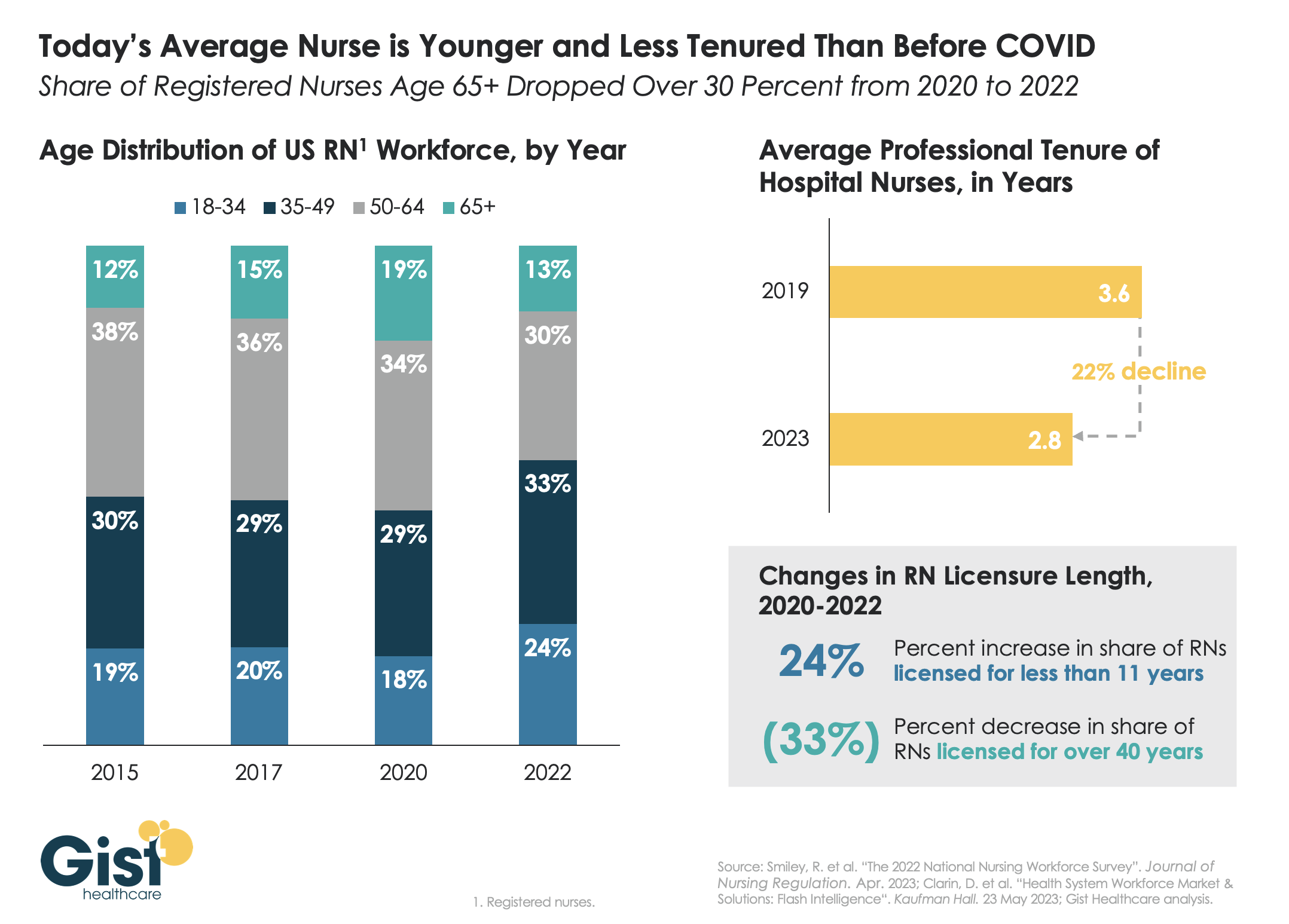
Between 2020 and 2022, the number of nurses ages 65 and older decreased by 200K, resulting in a reduction of that age cohort from 19 percent to 13 percent of the total nursing workforce. While the total number of nurses in the workforce still increased, the younger nurses filling these roles are both earlier in their nursing careers (thus less experienced), and more likely to change jobs.
Case in point:
From 2019 to 2023, the average tenure of a hospital nurse dropped by 22 percent. The wave of Baby Boomer nurse retirements has also resulted in a 33 percent decrease from 2020 to 2022 in the number of registered nurses who have been licensed for over 40 years.
Given these shifts, hospitals must adjust their current recruitment, retention, training, and mentorship initiatives to match the needs of younger, early-career nurses.
At a recent board meeting, the discussion turned to what Millennial consumers want from healthcare. The system COO put the administrative coordinator, the sole Millennial in the room, on the spot to speak for the preferences of an entire generation.
Nearly every health system we work with is debating how to engage Millennial consumers or understand Millennial (and now Gen Z) employees—perhaps an even more pressing need, given that Millennials now outnumber Baby Boomers in the healthcare workforce. But having a real, live Millennial participating in a health system board meeting is a rarity.
Most often we rely on secondhand information, either from studies analyzing their behavior, or Boomer board members’ personal experiences as the parents of Millennials. When we suggested that systems are at a disadvantage in not having Millennial board members, the system CEO agreed, and said they had tried—and failed—to recruit younger members.
It was largely a question of availability. Family commitments were one challenge, butthe greatest obstacle was committing to days away from work. Younger executives and community leaders are in the “high-growth” stage of their careers, and rarely in control of their own schedules, making the commitment to a (typically unpaid) board seat difficult.
As boards push for more diversity among members, recruiting younger directors is a critical component. Even if systems aren’t ready to reshape the director role for Millennials, they must find a way to directly engage younger leaders and integrate them into decision-making at all levels of the organization.
With companies fighting for financial know-how, a spotlight is beginning to shine on leaders who can bring the skill sets and expertise firms need in the moment.
Demand for interim leaders shot up significantly during the past 12 months, a report by Business Talent Group, a Heidrick & Struggles company, found, rising 116% year-over-year. Requests for on-demand finance chiefs in particular saw a considerable spike, increasing by 103% YoY, boosted by both continued economic uncertainty and the growing complexities of the CFO role.
The rising demand for interim CFOs is also partly due to growing awareness of the availability of such short-term expertise, said Sandra Pinnavaia, Chief Innovation Officer for BTG.
“Companies, as they get more comfortable and aware of the fact that there is this on-demand talent world, it allows them to contemplate different kinds of changes and uses than before,” Pinnavaia said. “So I do think there’s an underlying driver here, that is in a sense, supply creates demand.”
The interim CFO’s appeal
For companies, interims can help firms navigate through tricky periods or transitions. Requests for interim CFOs made up half of all interim C-suite requests, according to the BTG report. Companies are specifically searching for financial leadership skilled in financial controls, accounting and audit. Demand for such expertise rose 76% YoY.
For finance leaders, the higher demand coincides with gains in the compensation and benefits that accompany the role, said Jack McCullough, President of the CFO Leadership Council.
There’s better money available for CFOs who do this type of contract or interim work, leading to more executives interested in these types of jobs, McCullough said in an interview. For example, some part-time CFOs have begun to receive stock options, he said, referring to a CFO who received the benefit at three startups.
Taking an interim role can also be a refreshing change for finance leaders who want to apply their skills in new areas, according to Diane Buckley, managing partner of Forte Financial Consulting LLC. Buckley, a veteran of Big Four accounting firm Ernst & Young, was drawn to interim and fractional CFO work because it afforded her the option to share her skills with growing companies and “really be impactful day one,” she said.
“It was like, ‘I can bring value to smaller companies that may not at this point in their growth warrant a full-time CFO, but I can bring that skill set to them,’” she said in an interview.
On the supply side, shifting workforce trends may be prompting more companies to take a second look at what they need from their leadership.
Talent shortages across the accounting and finance space mean companies may be facing a year-long period to find a qualified CFO, making it more necessary to put in an interim “even if it’s not the ideal person,” McCullough said.
Meanwhile, the pandemic has also left a lasting mark: BTG clients have tapped more interims because “they have been forced over the last few years, to redefine their whole way of working,” Pinnavaia said.
“Now obviously we have a huge spectrum — there are companies that are back full-time, in-person every day, and there are companies that have really changed their business model and they’re not in-person at all,” she said. “But I think that has loosened up the aperture for what would be an acceptable solution” when it comes to leadership, she said.
The right talent at the right time
Hiring on-demand talent also allows companies to find a leader who can meet their needs in the moment — and since many interims come into a company to solve a particular problem or meet a specific goal, one’s skills are “kind of by definition matched to what the issues are,” said Reed Malleck, CFO of Ratio Therapeutics.
CFOs often need to operate in “four dimensions,” he said in an interview, including accounting, operational skills, investor relations and the ability to participate in the execution of strategy for the business.
“If you’re a permanent CFO, you have to cover all of those, even though you might be really good at only one of them,” according to Malleck, an experienced interim executive who took on several such roles as an engagement partner with executive talent firm Tatum, a Randstad company. “But as an interim person, it’s more targeted, like, ‘we need a guy who’s really good at operations. We need this thing to be fixed.’”
Being able to slot one’s skills perfectly into the situation can be a huge benefit for CFOs, many of whom are dealing with expanding job creep. While becoming an interim is not necessarily less stressful than a permanent CFO position, “in a way, you get relief when you get to the point where you fix everything, and when you’re in a permanent role that never happens,” Malleck said. “When you’re in a permanent role, there’s always something new that’s a new problem.”
With CFOs taking on more responsibility for areas like digital transformation, keeping up with the books and juggling other operational needs across the organization, “the CFO is blamed for this and blamed for that … increasingly, people get burnt out or there’s a loss of trust,” he said.
“Hundreds of analysts are looking at your stock and your performance, the market and the competitors and the technology and you have to explain things not once a quarter, but like five times a day,” Malleck said.
Succession planning is vital
Another often unexplored benefit of on-demand talent is as a source of expertise for future company leaders. A shortage of talent in the finance and accounting fields is worsening, with potential accountants lured away by shinier fields such as technology.
As a result, building a pipeline for executives with CFO skills is crucial.
Moreover, CFOs who were at the top financial seat the last time the U.S. saw serious inflation in the 1980s have long since retired, McCullough said. Finance leaders today face a “steep learning curve.”
“CFOs, through no fault of their own, they haven’t had to develop the skills” necessary to navigate current economic turmoil, he said.
Many CFOs with decades of experience are also either looking to retire, or seeking promotion rather than lateral opportunities, said Shawn Cole, president of boutique executive search firm Cowen Partners.
The jump from the CFO to the CEO seat is “way more commonplace” today than it was just a few decades ago, Cole said in an interview, opening up more opportunities for finance heads. Promoting internal candidates to an interim chair can be an easier and more affordable way for certain companies — faced with both a dearth of qualified external candidates and shaky succession planning — to fill the seat while they hunt for a long-term replacement, he said.
“For the last decade or so, businesses have been in like a boom or bust kind of scenario,” Cole said. “And so I think there’s just this lack of investment in a future generation.”
Whether an internal or external interim hire, the executive should also be a welcome and engaged part of the search for a long-term candidate, Cole said. It is part of their fiduciary obligations to a company and its shareholders to “do the necessary due diligence to make an informed hire.”
While internal interims can be an affordable choice, there can also be drawbacks: the “most damning issue” being when an internal interim pick is acting both as interim CFO as well as retaining the responsibilities of their original role at the company, Cole said.
“So what they wind up being is CFO in name only and they still are fulfilling the role of financial reporting or something like that,” he said.
Interims and on-demand talent will probably play a greater role in a company as time goes on, Pinnavaia said. She pointed to clients who might think they need an interim CFO, for example, but who are really searching for an expert or CFO who is able to do a specific project with the existing leadership team. In such a scenario, hiring an interim controller or another executive on-demand with the right finance skills would be the best way forward, she said.
“I’m very excited about this as an innovation in how business gets done,” she said. “It is a way of applying … real time alignment of skill and capacity against particular challenges or opportunities in the business.”
With input from stakeholders across the industry, Modern Healthcare outlines six challenges health care is likely to face in 2023—and what leaders can do about them.
1. Financial difficulties
In 2023, health systems will likely continue to face financial difficulties due to ongoing staffing problems, reduced patient volumes, and rising inflation.
According to Tina Wheeler, U.S. health care leader at Deloitte, hospitals can expect wage growth to continue to increase even as they try to contain labor costs. They can also expect expenses, including for supplies and pharmaceuticals, to remain elevated.
Health systems are also no longer able to rely on federal Covid-19 relief funding to offset some of these rising costs. Cuts to Medicare reimbursement rates could also negatively impact revenue.
“You’re going to have all these forces that are counterproductive that you’re going to have to navigate,” Wheeler said.
In addition, Erik Swanson, SVP of data and analytics at Kaufman Hall, said the continued shift to outpatient care will likely affect hospitals’ profit margins.
“The reality is … those sites of care in many cases tend to be lower-cost ways of delivering care, so ultimately it could be beneficial to health systems as a whole, but only for those systems that are able to offer those services and have that footprint,” he said.
2. Health system mergers
Although hospital transactions have slowed in the last few years, market watchers say mergers are expected to rebound as health systems aim to spread their growing expenses over larger organizations and increase their bargaining leverage with insurers.
“There is going to be some organizational soul-searching for some health systems that might force them to affiliate, even though they prefer not to,” said Patrick Cross, a partner at Faegre Drinker Biddle & Reath. “Health systems are soliciting partners, not because they are on the verge of bankruptcy, but because they are looking at their crystal ball and not seeing an easy road ahead.”
Financial challenges may also lead more physician practices to join health systems, private-equity groups, larger practices, or insurance companies.
“Many independent physicians are really struggling with their ability to maintain their independence,” said Joshua Kaye, chair of U.S. health care practice at DLA Piper. “There will be a fair amount of deal activity. The question will be more about the size and specialty of the practices that will be part of the next consolidation wave.”
3. Recruiting and retaining staff
According to data from Fitch Ratings, health care job openings reached an all-time high of 9.2% in September 2022—more than double the average rate of 4.2% between 2010 and 2019. With this trend likely to continue, organizations will need to find effective ways to recruit and retain workers.
Currently, some organizations are upgrading their processes and technology to hire people more quickly. They are also creating service-level agreements between recruiting and hiring teams to ensure interviews are scheduled within 48 hours or decisions are made within 24 hours.
Eric Burch, executive principal of operations and workforce services at Vizient, also predicted that there will be a continued need for contract labors, so health systems will need to consider travel nurses in their staffing plans.
“It’s really important to approach contract labor vendors as a strategic partner,” Burch said. “So when you need the staff, it’s a partnership and they’re able to help you get to your goals, versus suddenly reaching out to them and they don’t know your needs when you’re in crisis.”
When it comes to retention, Tochi Iroku-Malize, president of the American Academy of Family Physicians (AAFP), said health systems are adequately compensated for their work and have enough staff to alleviate potential burnout.
AAFP also supports legislation to streamline prior authorization in the Medicare Advantage program and avoid additional cuts to Medicare payments, which will help physicians provide care to patients with less stress.
4. Payer-provider contract disputes
A potential recession, along with the ensuing job cuts that typically follow, would limit insurers’ commercial business, which is their most profitable product line. Instead, many people who lose their jobs will likely sign up for Medicaid plans, which is much less profitable.
Because of increased labor, supply, and infrastructure costs, Brad Ellis, senior director at Fitch Ratings, said providers could pressure insurers into increasing the amount they pay for services. This will lead insurers to passing these increased costs onto members’ premiums.
Currently, Ellis said insurers are keeping an eye on how legislators finalize rules to implement the No Surprise Act’s independent resolution process. Regulators will also begin issuing fines for payers who are not in compliance with the law’s price transparency requirement.
5. Investment in digital health
Much like 2022, investment in digital health is likely to remain strong but subdued in 2023.
“You’ll continue to see layoffs, and startup funding is going to be hard to come by,” said Russell Glass, CEO of Headspace Health.
However, investors and health care leaders say they expect a strong market for digital health technology, such as tools for revenue cycle management and hospital-at-home programs.
According to Julian Pham, founding and managing partner at Third Culture Capital, he expects corporations such as CVS Health to continue to invest in health tech companies and for there to be more digital health mergers and acquisitions overall.
In addition, he predicted that investors, pharmaceutical companies, and insurers will show more interest in digital therapeutics, which are software applications prescribed by clinicians.
“As a physician, I’ve always dreamed of a future where I could prescribe an app,” Pham said. “Is it the right time? Time will tell. A lot needs to happen in digital therapeutics and it’s going to be hard.”
6. Health equity efforts
This year, CMS will continue rolling out new health equity initiatives and quality measurements for providers and insurers who serve marketplace, Medicare, and Medicaid beneficiaries. Some new quality measures include maternal health, opioid related adverse events, and social need/risk factor screenings.
CMS, the Joint Commission, and the National Committee for Quality Assurance are also partnering together to establish standards for health equity and data collection.
In addition, HHS is slated to restore a rule under the Affordable Care Act that prohibits discrimination based on a person’s gender identity or sexual orientation. According to experts, this rule may conflict with recently passed state laws that ban gender-affirming care for minors.
“It’s something that’s going to bear out in the courts and will likely lack clarity. We’ll see differences in what different courts decide,” said Lindsey Dawson, associate director of HIV policy and director of LGBTQ health policy at the Kaiser Family Foundation. “The Supreme Court acknowledged that there was this tension. So it’s an important place to watch and understand better moving forward.”
CFOs are planning to increase their compensation spend in 2023, with 86% of finance chiefs noting they plan to raise it by at least 3% year-over-year, according to a recent survey by Gartner.
CFOs are still facing a tight labor market in 2023. As CFOs weigh increased turnover and a more remote workforce, “they’re thinking through, how do they use compensation as a lever to engage and retain talent across their workforce,” said Alexander Bant, chief of research in the Gartner finance practice.
Only 5% of the 279 CFOs surveyed stated they planned to reduce their compensation spend in 2023, according to Gartner.
Dive Insight:
While CFOs typically budget more for compensation every year, ongoing inflationary pressures and a still-tight labor market puts compensation plans “front and center” in CFOs’ “ability to engage and retain top talent,” Bant said in an interview.
However, this does not mean finance chiefs will be budgeting for sweeping pay raises across their entire workforce — CFOs are “not trying to keep up with inflation across the board,” Bant said.
Rather, they are working with other members of the C-Suite such as the chief human resource officer and using tools like advanced analytics to single out and reward top performers which might be at more risk of departing for other opportunities, he said.
“CFOs are being more deliberate about how they allocate that money,” Bant said.
While the pace of wage growth slowed in the fourth quarter of 2022, according to recent data from the Labor Department, tamping down fears of a wage-price spiral, the war on talent remains a top worry for finance chiefs. Raising compensation can allow companies to be more competitive in the face of ongoing talent shortages, especially as workforce needs change.
For those companies which are moving employees back into the office, for example, raising compensation can help them to better compete against the remote or hybrid work opportunities which are becoming increasingly common, for example, Bant said.
Upping compensation can also help firms to find or hold onto employees with the key skills they need in areas such as digital transformation. Despite cost pressures, 43% of finance chiefs said they plan to increase their companies’ technology spend by 10%or more, according to the Gartner survey.
“What we’re hearing is, ’Yes, we are right-sizing parts of our organization and reducing head count in certain areas, but at the same time, we still have open roles and we’re still searching for talent in those areas that align to our digital transformation priorities,” Bant said of the search for technology talent.
Such skills still come at a premium, for that matter, despite the recent spat of layoffs across high-profile tech companies such as Google parent Alphabet, IBM and Microsoft. While these companies have reduced staff, they may not be letting go of employees with critical hardcore coding, data analytics or artificial intelligence related skills, Bant said.
“There is more talent available from technology companies, but that doesn’t mean that talent necessarily has the technical skills to drive the digital transformations that many CFOs and their leadership teams need,” he said.
The shortage of accountants is one of the main concerns keeping KPMG’s Greg Engel up at night. The firm is teaming up with universities to expand the talent pool.
KPMG’s Greg Engel likens the accounting profession to the turtle in the proverbial race with the hare — a turtle that’s seeking to pull ahead even as it competes with flashier industry sectors for workers.
The shortage of accounting talent is one of the main concerns keeping Engel — vice chair of tax in the U.S. for the Big Four accounting firm — up at night as he assesses the new year’s challenges, even as KPMG has undertaken numerous initiatives to ease the talent crunch.
At the same time, he sees a potential silver lining for his sector in the recent surge of layoffs in the formerly sizzling tech sector that has won over some college graduates who might have otherwise gone into accounting.
“A lot of people went to the technology sector because it was exciting. But now that Meta and Twitter and all these other companies are laying off people, kids going into college might go, ‘wait a minute, maybe KPMG sounds a little better than Twitter,’” Engel said in an interview. “Accounting is that boring, stable profession that doesn’t do as well in hugely expansive economies but does great when the economy’s on the downslide.”
Making accounting’s case
Historically, the Big Four accounting and consulting firms have mounted robust programs designed to recruit and train accounting students right out of colleges and major universities.
KPMG, along with PwC, Ernst & Young and Deloitte, hire thousands of graduates and students each year out of colleges, often training them through internships which lead to full-time jobs. Many of the certified public accountants go on to be controllers, tax directors and even CFOs. The entry level accounting salary range at such programs in the tax area can be roughly in the $70,000 to $80,000 range, depending on the market, according to some industry estimates.
“The hallmark of the Big Four was to train people really, really well,” Engel said. The longer employees stay at a firm, the better their prospects after they leave, Engel said.
That means an employee who leaves after a couple years could probably join a company’s accounting department at a lower level, he said. But if the employee leaves after rising to the level of senior manager, he or she could join the same company as controller — and those who leave as a partner might join as a CFO, Engel said.
CFO machine showing signs of wear
But the machine generating CPAs and CFOs has shown signs of wear in recent years. For one thing, KPMG has not been immune to the Great Resignation. It was hit by the surge in turnover that weakened the middle ladder rungs of its workforce. “There’s a kind of battle in the middle,” Engel said. The company responded in part by hiring experienced accountants from companies like Apple and Home Depot, he said.
At the same time, accounting has attracted fewer students in recent years. The total number of U.S. students completing a Bachelor’s degree in accounting fell about 8% in the 2019-2020 school year compared with the 2011-2012 period, shrinking to 52,481 graduates from 57,482, according to a 2021 report from the American Institute of Certified Public Accountants.
Priming the pipeline
Firms and accounting organizations have been taking deliberative steps in recent years to boost their case with talent and solve the talent shortage. For instance, the AICPA and the Department of Labor announced in November that they had teamed up to cultivate candidates and expand the pool of professionals, CFO Dive reported.
If students are not deterred by the accounting profession’s long hours and subdued reputation, they may feel reluctant to put in the credit hours required before taking the exam to become a Certified Public Accountant. That typically means a student will need more study beyond that of a four-year degree.
In an effort to make the extra course work pay off, KPMG worked with a number of universities to develop a Master in Accounting and Data Analytics Program that gives students the data analysis skills that are increasingly important in the field.
Recently, an additional seven universities were added to the program and KPMG has pledged to provide more than $7 million in scholarships. The schools added to the program included some historically Black Colleges and Universities such as Howard University School of Business and North Carolina Agricultural and Technical State University. Other universities that offer the program include Villanova University and The Ohio State University.
Separately, KPMG has teamed up with Engel’s alma mater, the University of Northern Iowa in Cedar Falls, Iowa, to help strengthen the accounting program and opportunities for students attending Des Moines Area Community College.
The company will also aim to provide internships to the students who often attend school at night or part-time, which can make it difficult to obtain the credit hours needed to become a CPA.
“We’re going to start adding people to the profession with two-year associates degrees,” Engel said, noting that similar programs are cropping up elsewhere. “We’ll give them a pathway to add the extra courses and programs they need.”
Healthcare added almost 45,000 jobs in November, but many hospitals and health systems will continue to struggle to meet staffing needs, retain top executives and providers, and foster long-term pipelines for talent, Ted Chien, president and CEO of independent consulting firm SullivanCotter, wrote in a Dec. 15 article for Nasdaq.
Hospitals and health systems are living “paycheck to paycheck” and unable to make long-term investments at the height of the current workforce crisis, Mr. Chien said.
The challenge boils down to a healthcare delivery problem, not a demand problem.
Baby Boomers are the greatest source of care demand on the healthcare system, but are unable to contribute to the provider workforce in the numbers needed to achieve balance, according to Mr. Chien. To compound that issue, burnout is a major factor why “too many” frontline workers have left or plan to exit healthcare, he said.
Last year, an estimated 333,942 healthcare providers dropped out of the workforce, including about 53,000 nurse practitioners, which has led hospitals to spend more on contract labor and feeling more pressure to consolidate, according to an October report published by Definitive Healthcare.
Long term, a continued lack of healthcare workers would force hospitals to operate in a heightened crisis mode, according to Mr. Chien, depriving non-critical patients of sufficient health prevention and demanding too much of providers who are already overly taxed.
Mr. Chien highlighted three key areas to tackle the workforce crisis: smarter technology, resilient teams and excellent leadership.
Technologies that alleviate providers’ administrative burdens will be critical to reduce burnout and keep caregivers focused on patient care, while smarter tech can also forge pipelines for future providers by streamlining clinical experience operations and aligning student placements with existing opportunities.
Building resilient teams begins with competitive pay and robust benefit packages, which fosters trust and demonstrates that a hospital values its staff, according to Mr. Chen. Supporting career growth, including upskilling and redeploying staff when appropriate, empowers employees.
Lastly, capable executive leadership teams, under intense scrutiny from industry stakeholders, must clearly outline their hospital or health system’s strategy and provide the change needed to support their staff. Lack of trust in leaders drives staff out of healthcare, so it is crucial to recruit and retain “modern, strategic thinkers with depth of experience who are prepared to lead,” Mr. Chien wrote.
Contract or “temp” employment used to be viewed as a means of supplemental income: a side hustle to an average day job, or a way to pay the bills while searching for full-time work. Now, gig work is back in style, and more workers want in on the flexibility — including C-suite executives, Korn Ferry recently reported.
The gig economy surged when older millennials, born in the 1980s, began rejecting the one-firm careers their parents had, according to Korn Ferry. Although they are currently midcareer, older millennials have switched jobs 7.8 times on average. Baby boomers are also using temporary work to keep busy during retirement, and Generation Z appreciates the flexibility that comes with contract labor.
As temporary work grows in popularity, its influence is spreading to the C-suite. Interim executives are becoming more likely to be tapped when a leader departs, Korn Ferry reported. This gives organizations like health systems, which urgently need leadership in a rapidly changing industry, more time to conduct their searches for full-time replacements.
Sixty percent of executives predict that the number of interim workers at their companies will “substantially increase” within the next three years, Korn Ferry reported. In a period of economic instability, temporary labor can mean less commitment and cost than a permanent worker. But there are downsides to contract labor, too. Since they lack benefits, many contract workers demand higher pay — which can trickle down and lead their permanent counterparts to ask for matched salaries. In the healthcare industry, this is visible in travel nurses’ paychecks, and their controversial effects on health systems’ finances.
For better or for worse, contract labor does not appear to be dying out anytime soon. Fifty-eight million U.S. workers now consider themselves “independent,” Korn Ferry reported — an estimated 36 percent of the total workforce.
There are few easy ways to cut expenses. But in hospitals and health systems, there are quieter ways.
Workforce reductions are never painless — or never should be, especially for those doing the reducing. Involuntary job loss is one of the most stressful events workers and families experience, carrying mental and physical health risks in addition to the disruption it poses to peoples’ short- and long-term life plans.
But as health systems find themselves in untenable financial positions and looming risk of an economic recession, job cuts and layoffs in hospitals and health systems are increasingly likely. In a report released Oct. 18 from Kaufman Hall based on response from 86 health system leaders, 46 percent said labor costs are the largest opportunity for cost reduction — up significantly from the 17 percent of leaders who said the same last year.
Job cuts at hospitals may seem counterintuitive given the nation’s widely known shortages of healthcare workers. But as hospitals weather one of their most financially difficult years, some are reducing their administrative staff, eliminating vacant jobs and reorganizing or shrinking their executive teams to curb costs.
Decisions to reduce administrative labor tend to garner quieter reactions compared to budgetary decisions to end service lines or close sites of patient care, including hospitals. While the implications of administrative shakeups may be felt throughout a health system, the disruption they pose to patients is less immediately palpable. Few people know the name of their community hospitals’ senior vice presidents, but most do know how many minutes it takes to travel to a nearby site of care for an appointment during a workday or a tolerable amount of time to wait for said appointment.
It doesn’t hurt that hospital and health systems’ administrative ranks have ballooned compared to their patient-facing counterparts. While the number of practicing physicians in the U.S. grew 150 percent between 1975 and 2010, the number of healthcare administrators increased 3,200 percent in the same period. More broadly, administrative spending accounts for 15 to 30 percent of healthcare spending in the U.S. and at least half of that “does not contribute to health outcomes in any discernible way,” according to a report published Oct. 6 in Health Affairs.
A couple of health systems have denoted their plans to cut nonclinical employees and jobs in the past week.
Cleveland-based University Hospitals announced efforts to reduce system expenses by $100 million Oct. 12, including the elimination of 326 vacant jobs and layoffs affecting 117 administrative employees. The workforce reduction comes as the 21-hospital system faces a net operating loss of $184.6 million from the first eight months of 2022.
Sioux Falls, S.D.-based Sanford Health is laying off an undisclosed number of staff, a decision the organization’s top leader says is “to streamline leadership structure and simplify operations” in certain areas, the Argus Leader reported Oct. 19. Bill Gassen, president and CEO of Sanford Health, also said the layoffs primarily affect nonclinical areas and that they will “not adversely impact patient or resident care in any way.”
These developments are only several days old, but have not yet triggered any newsworthy follow-up developments or pushback. Cost reduction efforts that close facilities or reduce services tend to — on the other hand — catalyze scrutiny, debate and conflict in communities that can span for months and even years.
Look to Atlanta. Marietta, Ga.-based Wellstar unexpectedly announced on Aug. 31 that its 460-bed Atlanta Medical Center will end operations on Nov. 1, with plans to progressively wind down services leading up to that date. The system attributed the decision to the $107 million loss incurred operating the hospital over the last 12 months. Noteworthy is that the system has said that 1,430 (82 percent) of Atlanta Medical Center workers affected by the facility’s impending closure have accepted job offers at other Wellstar Health System facilities.
Since, the decision to close one of Atlanta’s level 1 trauma centers has drawn attention from Georgia’s governor and gubernatorial candidate, congressional members and Atlanta Mayor Andre Dickens, who in a town hall Oct. 19 said that in closing Atlanta Medical Center, “Wellstar said they don’t want to be in the business of urban healthcare.”
The decision has also spilled over to affect area hospitals, namely Atlanta’s public Grady Health System, which received a $130 million cash infusion from the state and reported a 30 percent increase in patient volume after the emergency department of Atlanta Medical Center closed.
Health systems have a lot to weigh. Their administrative layers are thick, varied and necessary to a degree, meaning this broad category of workers still poses tough decisions when it comes to cost containment efforts. But in a very simple view, laying off people who care for patients will only hurt health systems’ chances of recruiting and retaining clinical talent — in a time when no health systems’ odds of doing so are especially outsized.









 HENRY KOTULA