Nurse practitioners fueling primary care workforce growth

https://mailchi.mp/fc76f0b48924/gist-weekly-march-1-2024?e=d1e747d2d8
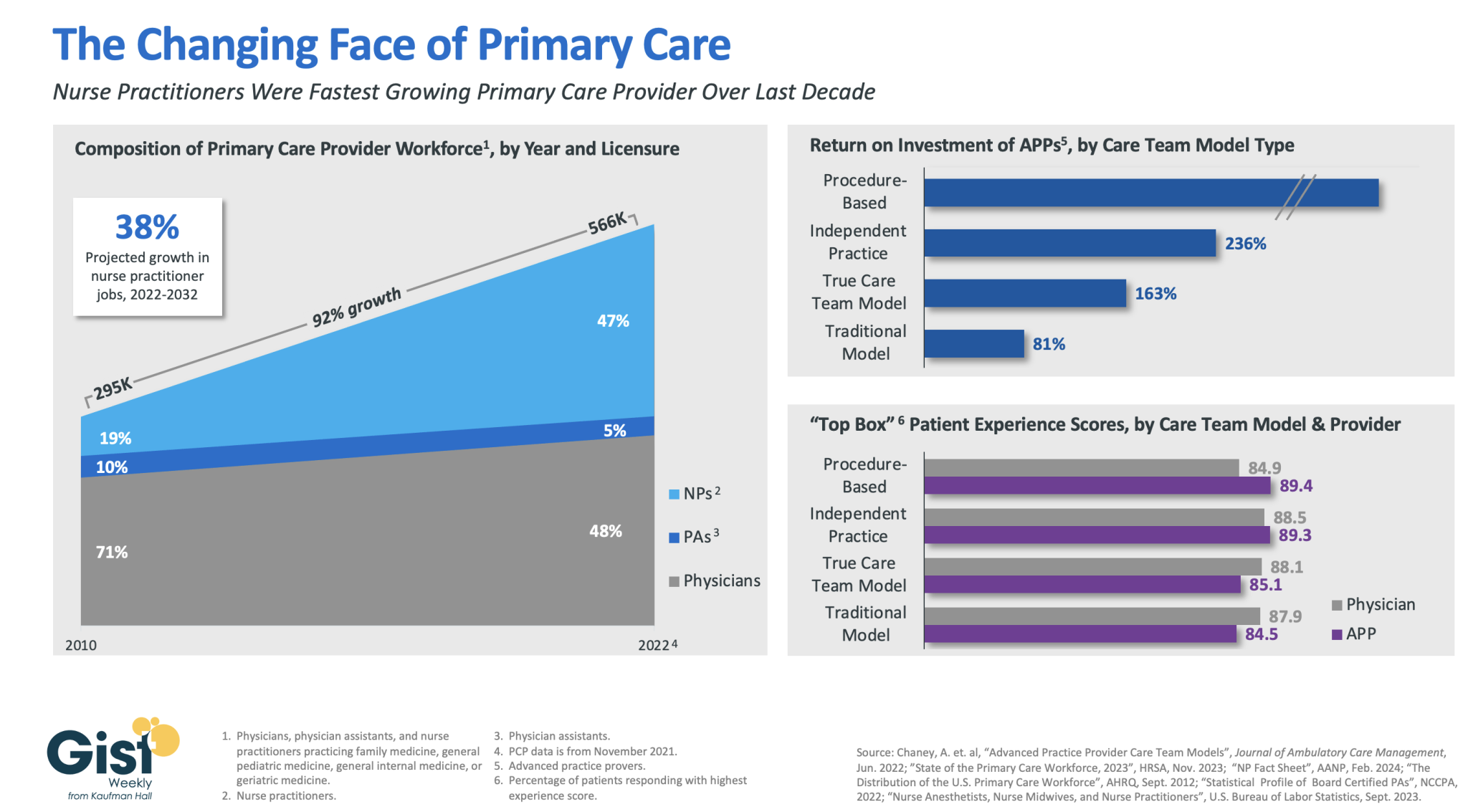
In this week’s graphic, we highlight how the primary care provider workforce has evolved over the past decade in both the pursuit of team-based care models and value-based care, as well as in response to rising labor costs and physician shortages.

In 2010, physicians made up more than 70 percent of the primary care workforce. But over the next 12 years, the number of primary care providers nearly doubled, largely driven by immense growth of nurse practitioners in the workforce. 

As of 2022, more than half of primary care providers were advanced practice providers (APPs), who continue to have a strong job outlook across the next decade (especially nurse practitioners).This shift has been beneficial to many provider organizations.

In a study from the Mayo Clinic, the return on investment was positive across a variety of APP practice models, especially in procedural-based specialties but across both independent practice models and full care team models as well. 

APPs also receive similar patient experience scores as their physician counterparts. 

Continued integration of APPs in team-based care models remains a key strategy for health systems seeking to improve access while lowering costs, especially in primary care.
Spotting a “skills mismatch” in the nursing pipeline

https://mailchi.mp/27e58978fc54/the-weekly-gist-august-11-2023?e=d1e747d2d8

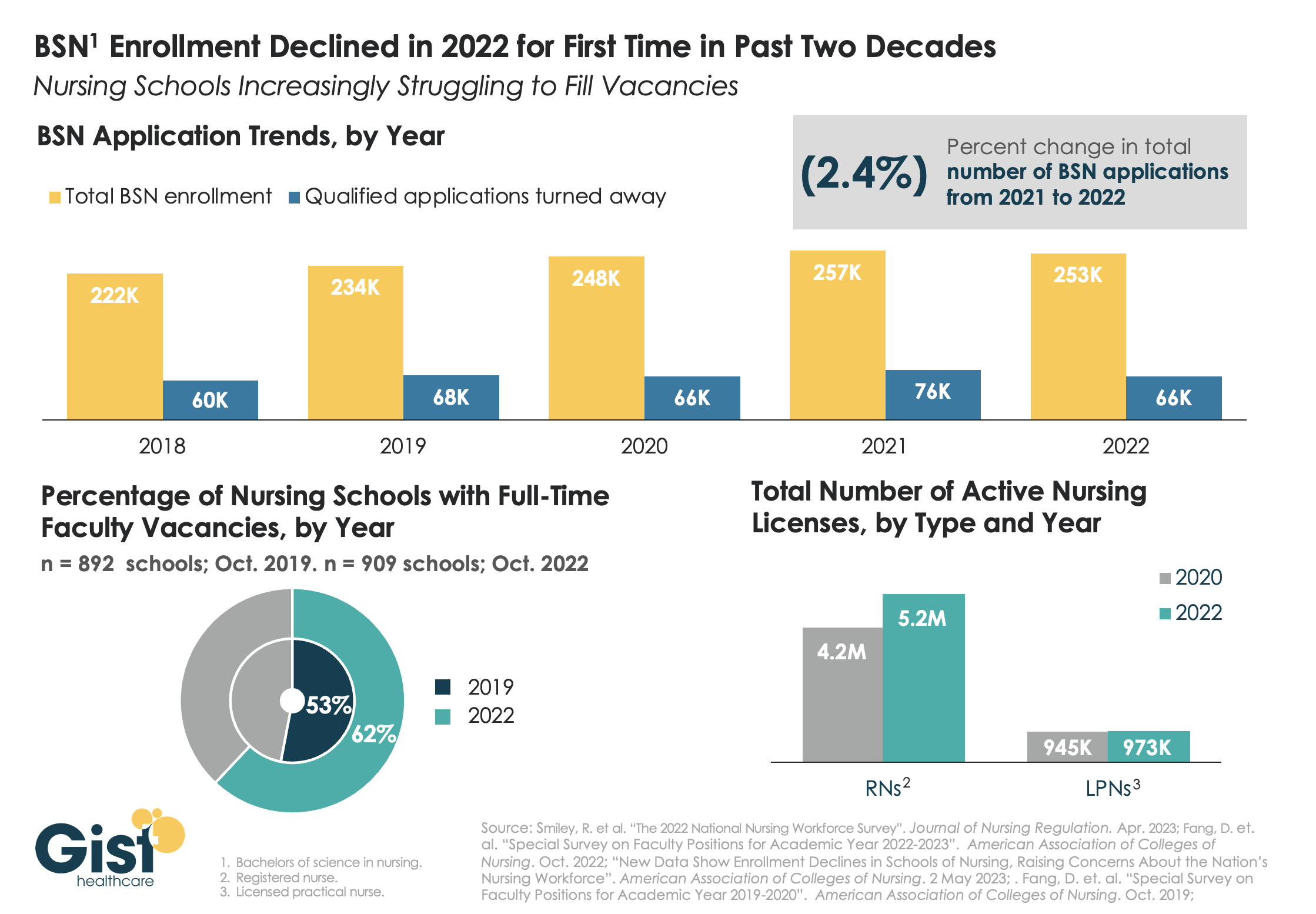
While last week’s graphic looked at how a wave of retirements has hit the nursing workforce, this week we take a look at the pipeline of nurses in training to fill that gap. In recent years, there has been a consistent stream of qualified applicants who want to become BSN nurses, but schools don’t have the capacity to admit them.

One reason: an ongoing shortage of nursing faculty, which recent retirements have exacerbated. The percentage of nursing schools with at least one full-time faculty vacancy grew from 53 percent in 2019 to 62 percent in 2022. 

Looking at registered nurses (RNs), the number with active licenses has continued to grow at a much higher rate than the supply of licensed practice nurses (LPNs) with active licenses. 

The relatively small LPN workforce is especially significant, given rising interest in team-based nursing care, which aims to utilize a higher number of LPNs, supervised by RNs and BSNs.

Expanding training programs with an eye toward the skills and mix needed to deliver team-based care will be critical to ensuring a stable, efficient nursing workforce for future decades.

Do Hospitals share the blame for the COVID staffing crisis?

https://mailchi.mp/e44630c5c8c0/the-weekly-gist-december-16-2022?e=d1e747d2d8

The latest piece in the New York Times ’“Profits over Patients” series focuses on the staffing policies of Ascension, one of the nation’s largest nonprofit health systems, drawing a straight line from its cost-cutting practices over the last decade to its current staffing woes. Like previous articles in the series, the piece hones in on Ascension’s profit-seeking motives, pairing pre-pandemic accounts of Ascension executives boasting about savings from slashed labor costs with story after story of its frontline clinicians struggling to provide adequate patient care once COVID hit.

In responses included in the article, an Ascension spokesperson rejected the idea that the system’s workforce policies were responsible for its current staffing crisis, claiming that Ascension has maintained better staff-to-patient ratios than many of its peers. 

The Gist: Yet again, the New York Times is shining a harsh light on a health system that has been engaged in management practices common across the industry. 

While the piece omits some relevant information, such as the recent spike in labor costs, it’s useful to point out that many hospitals were so thinly staffed prior to COVID that they had virtually no slack in their labor pools, hindering their response to the crisis. 

In our experience, the reasons for this have less to do with lining executives’ pockets, and more to do with the realities of dealing with a worsening payer mix and rising input costs. While future hospital workforce strategy is going to have to focus on reducing dependency on nurses—especially in the inpatient setting—any effort to that end must augment nurses with team-based care models and technology solutions, rather than pushing further on already-tight nurse-to-patient ratios.

Physician burnout reaches record levels 

https://mailchi.mp/3a7244145206/the-weekly-gist-december-9-2022?e=d1e747d2d8

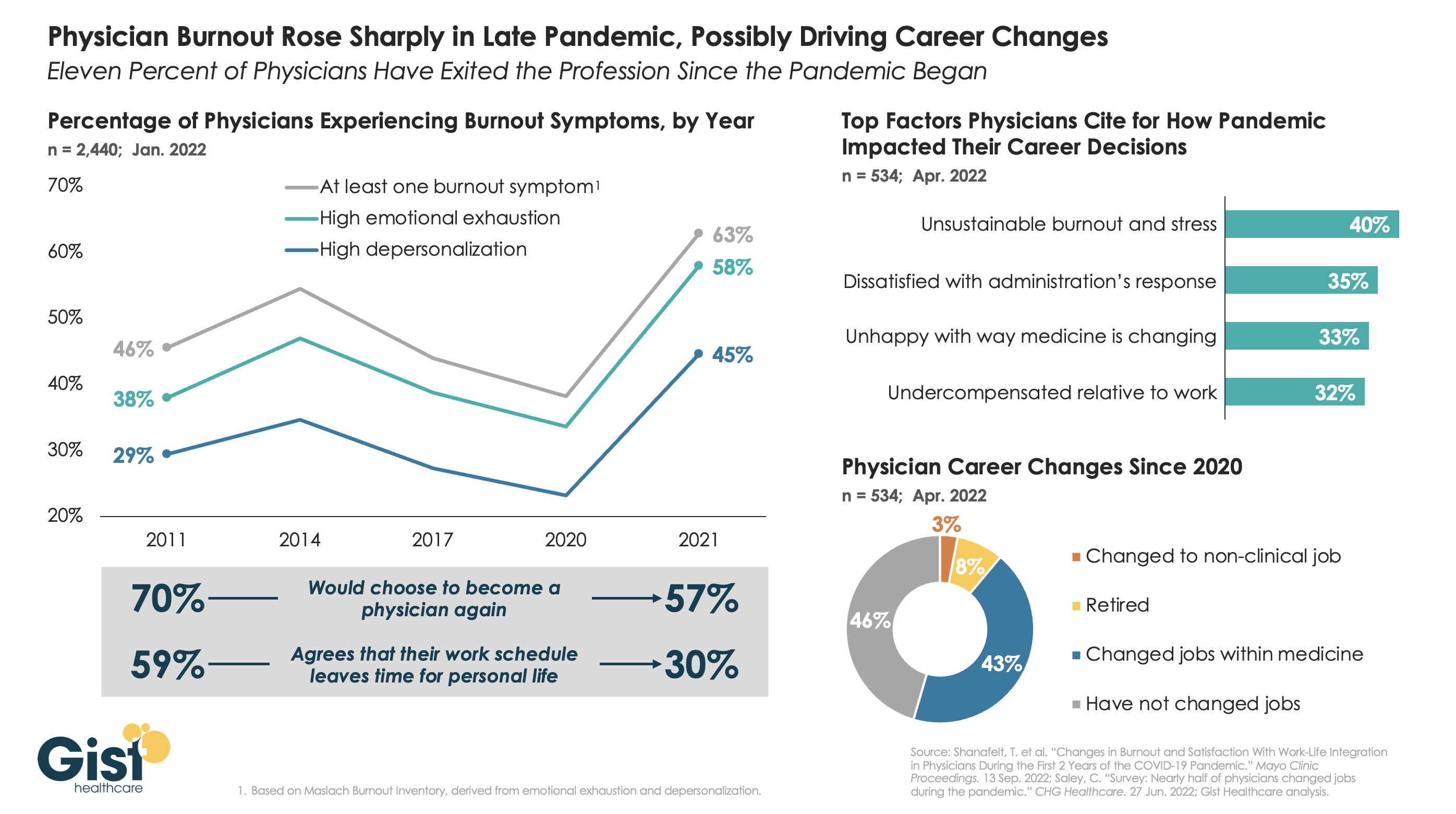
The long hours, stressful conditions, and labor shortages brought on by the pandemic have done serious harm to the physician workforce. The graphic above tracks physician burnout, a combination of emotional exhaustion, loss of agency, and depersonalization that has become the primary measure of the pandemic’s toll on workers, to reveal that physicians are demoralized like never before. 

Physician burnout levels had been decreasing since 2014, in part due to practice consolidation and the expansion of team-based care models. Burnout reached its lowest levels in 2020—perhaps explained by a pandemic-induced sense of purpose—but 2021 then saw a dramatic spike in every measure of physician dissatisfaction, as the heroic glow of the early pandemic faded, and an overtaxed and understaffed delivery system became the new norm.

In explaining how the pandemic has impacted their career decisions, surveyed physicians list unsustainable burnout and stress as their top concern, and 11 percent say they have exited the profession, either for retirement or a non-clinical job, in the past two years. Four in ten surveyed physicians report changing jobs since 2020, mainly within similar or different practice settings, citing a desire for better work-life balance as their primary motivation. (It should be caveated that these data are from a smaller survey of 534 physicians, 40 percent of whom identified as “early career”.) 

While the solutions here aren’t new, they are challenging: we must continue to implement team-based care models that provide physicians top-of-license practice and improved work-life balance, remove administrative tasks wherever possible, and ensure that we are communicating and engaging physicians—employed and independent alike—in organizational strategy and decision-making.