

Category Archives: Uncategorized

Anthem ER policy could deny 1 in 6 visits if universally adopted, JAMA study warns

Dive Brief:
- Anthem Blue Cross Blue Shield’s controversial policy that denies emergency coverage based on a patient’s diagnosis after a visit to the ER, would affect as many as one in six (15.7%) ER visits if adopted universally by commercial insurers, according to a new study from JAMA Network.
- Anthem’s policy is currently active in six states. In July, the American College of Emergency Physicians and the Medical Association of Georgia filed a federal lawsuit asserting that Anthem BCBS of Georgia is violating federal law requiring insurers to cover the costs of emergency care based on a patient’s symptoms rather than their final diagnosis.
- “Our results demonstrate the inaccuracy of such a policy in identifying unnecessary emergency department visits,” Shih-Chuan Chou, lead author of the JAMA study, wrote. “This policy could place many patients who reasonably seek emergency care at risk of coverage denial.”
Dive Insight:
As healthcare costs rise, insurers continue to seek ways to stem payments for emergency care, which hit their pockets the hardest. Anthem’s approach, taken in the summer of 2017, is to disincentivize what it deems to be unnecessary ER visits by denying coverage for patients with non-emergent ER discharge diagnoses.
Earlier this year, UnitedHealth Group began reviewing ER claims with the most serious conditions in an effort to reduce or deny claims with improper evaluation and management codes. While similar in that they both crack down on ER visits, Anthem’s policy looks to move patients away from ERs and into less expensive urgent care centers and retail clinics, while UnitedHealth’s policy change is about making sure hospitals are billing properly.
The backlash has been much harsher for Anthem. According to a report issued this past July by Sen. Claire McCaskill, D-Mo., Anthem denied roughly 12,200, or 5.8%, of all emergency room claims in Missouri, Kentucky and Georgia from July 2017 to Dec. 2017 through this policy. Missouri’s hospital association was one of many health organizations to publicly oppose the policy.
In a statement to Healthcare Dive, Anthem defended its ER policy as a way to “ensure access to high quality, affordable healthcare” by encouraging consumers to receive care in “the most appropriate setting.”
“If a consumer reasonably believes that he or she is experiencing an emergency medical condition, then they should always call 911 or go to the ED,” the statement reads. “But for non-emergency health care needs, EDs are often a time-consuming place to receive care and in many instances 10 times higher in cost than urgent care.”
Cartoon – My Career Just Reached an All Time Low

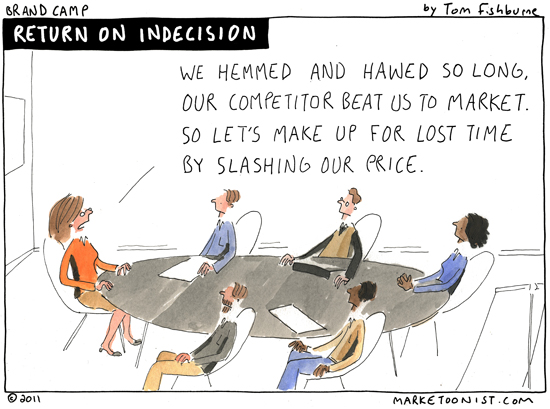
Cartoon – We Hemmed and Hawed So Long
Cartoon – Boss vs. Leader

Cartoon – Knowing All Your Options

3 Shifts that Expand Influence

The way you treat others is the chief culture building influence in your organization.
Lousy leaders act like individual contributors. Incompetent leaders can’t see the impact of their attitudes, words, and actions.
Newton said, “For every action there is an equal and opposite reaction.” The relationships you enjoy, for example, begin with you.
When you focus on weaknesses and ignore strengths, others build protective walls.
Adversarial leaders invite conflict.
Passive leaders create anxiety.
Teams don’t practice accountability until leaders follow-up and follow-through.
When you confront tough issues with kindness, others have tough conversations with greater confidence.
3 shifts that expand influence:
#1 Shift from who is right to what is right.
In one sense, leadership isn’t personal. The issue is the issue. It doesn’t matter who comes up with solutions. The person who screwed up last week might be this week’s genius.
#2. Shift from talking-at to talking-with.
Engagement requires “with.” The more you talk “at” the more you lose “with.” Talking-with requires humility, honesty, curiosity, openness, and forgiveness.
- Humility acknowledges the perspective and strengths of others.
- Honesty explains issues without hidden agendas.
- Curiosity asks, “What do you think?”
- Openness listens and explores. Defensiveness is the end of innovation.
- Forgiveness gives second chances after responsible failure. Honor sincere effort. Don’t punish ignorance.
#3. Shift from right and wrong to better.
Most issues are solved with progress. It’s about next steps, not moral imperatives. Stop judging so much. Start cheering more.
Complex issues have more than one answer. Their answer is better than yours, even if it’s not quite as good, because they own it.
Bonus: Shift from punishing to learning.
Treat responsible failure as a learning opportunity and risk is easier. But treat people like tools and you propagate self-serving attitudes.
Carol Dweck says the #1 quality of a growth mindset is learning from failure.
What shifts expand a leader’s influence?
What behaviors short-circuit a leader’s influence?
Despite Coverage Gains, One-Third Of People In Small-Firm Low-Income Families Were Uninsured In 2014–15

DOJ Indicts 4 Florida Men in $1B Telemedicine Fraud Conspiracy
https://www.healthleadersmedia.com/doj-indicts-4-florida-men-1b-telemedicine-fraud-conspiracy

Private payers, including Blue Cross Blue Shield of Tennessee, were bilked out of about $174 million in the compounding pharmacy scam, which inflated prices for invalidly prescribed pain creams and other drugs.
KEY TAKEAWAYS
Seven compounding pharmacies were indicted along with their owners in the scheme.
The scam affected tens of thousands of patients around the country.
The alleged scammers billed private payers for about $931 million in fraudulent claims.
Four Florida men were charged in a multistate telemedicine scheme that billed at least $931 million in fraudulent claims to private insurance companies, the Department of Justice said Monday.
According to a 32-count indictment filed in U.S. District Court in Greeneville, Tennessee, the four defendants, owners of seven compounding pharmacies in Florida and Texas, set up an elaborate telemedicine scheme that solicited insurance and prescription drug information from consumers across the country.
Physicians unwittingly approved the prescriptions for pain creams and other drugs without knowing that the defendants were jacking up the prices of the invalidly prescribed drugs, which were billed to private payers.
Tens of thousands of patients and more than 100 physicians in East Tennessee bore the brunt of the scam, which ran from mid-2015 through April 2018. Private payers in the region, including Blue Cross Blue Shield of Tennessee, were bilked out of about $174 million, prosecutors said.
BCBS Tennessee issued a statement on Tuesday noting that it was “only one of hundreds of insurers impacted by this case.”
“We remain committed to partnering with our customers, providers and law enforcement to fight fraud, waste, and abuse in the healthcare system,” BCBST said.
All totaled, the indictment alleges that the defendants submitted not less than $931 million in fraudulent claims for payment. It’s not clear how much was paid out.
The four Florida defendants were identified as Andrew Assad, 33, of Palm Harbor, Peter Bolos, 41, of Lutz, and Michael Palso, 44, of Odessa, and Larry Everett Smith, 48, of Pinellas Park.
The companies were identified as: Germaine Pharmacy in Tampa; Synergy Pharmacy Services, in Palm Harbor; Precision Pharmacy Management, Tanith Enterprises, ULD Wholesale Group, and Alpha-Omega Pharmacy, all in Clearwater; and Zoetic Pharmacy in Houston, Texas.
The four defendants were each charged with conspiracy to commit healthcare fraud, mail fraud, and introducing misbranded drugs into interstate commerce.
If convicted, the four men face prison terms of up to 20 years for each mail fraud charge, up to 10 years for conspiracy, and up to three years in prison for introducing misbranded drugs into interstate commerce.
The indictment also seeks forfeiture of approximately $154 million.
The indictments come on the heels of the related Sept. 26 guilty plea by Scott Roix, 52, the CEO of HealthRight LLC, a telemedicine company in Pennsylvania and Florida, for his role in the scheme. Roix and HealthRight also pleaded guilty to wire fraud charges in a separate scheme that fraudulently telemarketed dietary supplements, skin creams, and testosterone.
Dinged, Dented, Defiant: The ACA Is Still Standing
https://www.healthleadersmedia.com/dinged-dented-defiant-aca-still-standing

Texas v. Azar is the latest in a long line of lawsuits and legislation that Republicans have used to undermine the Affordable Care Act, which has shown itself to be remarkably resilient.
KEY TAKEAWAYS
A federal judge in Texas could slap a preliminary injunction on the ACA.
The case is the latest in a long string of efforts to dismantle the ACA since its inception in 2010.
A federal judge in Texas is poised to drop a ruling that could determine the future of the Affordable Care Act.
Or, maybe not.
The Republican plaintiffs from 20 states in Texas v. Azar argued before U.S. District Judge Reed O’Connor in early September that the entire ACA became unconstitutional when Congress zeroed out the individual mandate penalty, effective 2019.
Led by Texas Attorney General Ken Paxton, the Republican plaintiffs are asking for a preliminary injunction. The Department of Justice, which declined to defend portions of the ACA, also urged O’Conner to delay any injunction until after the enrollment period, saying any attempts to impose the injunction during the enrollment period would invite “chaos.”
If the injunction goes through, it could end premium subsidies for ACA beneficiaries and cripple enrollment. The Urban Institute has estimated that 17 million people would lose their health insurance coverage if the ACA was overturned.
As potentially catastrophic as this sounds, the healthcare sector doesn’t seem to be overly concerned. In fact, business couldn’t be better.
A report in Axios shows that many players in the healthcare sector are prospering under the ACA. The website notes that S&P 500 healthcare index of 63 major companies has grown by 186% since the ACA became law in 2010, outstripping the S&P 500 and the Dow Jones.
In addition, health insurance companies are flush. Shares of UnitedHealth Group have gone up more than 700% since 2010, and the stock price of ACA marketplace insurer Centene has gone up 1,100% over the same period, Axios reports.
While hospitals have had a tougher time of it, especially in states that refused to expand Medicaid, they’re still seeing reductions in charity care and bad debt owing.
Regardless of how O’Connor rules in Texas v. Azar, ACA payers, providers, and other stakeholders will continue to presume that the law isn’t going anywhere, says healthcare economist Gail Wilensky.
“They’re assuming it’ll be around, or something very similar will be,” says Wilensky, a former director of Medicare and Medicaid, and a former chair of the Medicare Payment Advisory Commission.
“I don’t think people are regarding any serious likelihood of it going away again,” she says.
Even if O’Connor, appointed to the court in 2007 by President George W. Bush, agrees with the severability arguments raised by the Republican governors and attorneys general in 20 states who brought the suit, the matter likely would get shot down on appeal, Wilensky says.
” I would be surprised if it doesn’t get reversed someplace else,” says Wilensky, now a senior fellow at Project HOPE.
“If it had go all the way to the Supreme Court, the Supreme Court isn’t going to tolerate it, but I don’t know that it would even get that far,” she says.
The case is just one in a long string of legal and legislative actions Republicans are taking at the state and federal level to either undermine or bolster the ACA.
Earlier this year, O’Connor sided with Texas and five other states and threw out an Obama administration tax on states receiving Medicaid funds.
The Republican-controlled Congress has tried more than 50 times to repeal Obamacare, and Senate Majority Leader Mitch McConnell said this week that Republicans may try again in 2019.
While the signature legislation of the Obama era has been dinged and dented, it’s also proven to be remarkably resilient.
Wilensky says the ACA is resilient because it solves a problem “for a small but non-trivial group of people,” and that Republicans don’t have a credible alternative.
“Once a benefit is in place for any measurable amount of time, certainly two or three years would qualify, there’s no precedent for removing it,” she says.
“And most of the proposals that had come up did not seriously get the job done,” Wilensky says.
“They really weren’t effective as an alternative and you simply aren’t going to take away a benefit, like the extension of insurance to people who are above the poverty line and not offered traditionally employer sponsored insurance without having a credible alternative.”
“It’s just not going to happen because there are too many issues that have already been adjudicated at a more serious level,” Wilensky says. “I don’t know why they did this other than that this is 20 attorneys general and they’re running for something.”

