


Cartoon – Loved Your Bit on Market Share


This week’s open enrollment for Obamacare once again made me wonder: How can conservatives be so convinced of the healthcare law’s failure when the opposite is demonstrably clear? Obamacare is far from perfect, but it’s in no way a “disaster,” a “catastrophe” or “imploding.”
In 2010, the year the Affordable Care Act was signed into law, nearly 50 million people in this country were uninsured. As of 2016, that number had dropped to about 29 million, according to the National Center for Health Statistics.
People with preexisting conditions could no longer be charged more or denied coverage by insurers. Young people could remain on their parents’ plans up to age 26.
Yet Republican politicians and voters remain determined to do away with Obamacare, regardless of the shortcomings of their proposed replacements.
Those are fancy ways of saying conservatives are more willing than liberals to accept what their leaders say as true and have little appetite for rocking the boat.
“This underlying difference helps to explain why conservatives resist new consumer offerings that represent dramatic change — for example, Obamacare,” he said.
The Australian academics delved into complaint databases run by America’s Consumer Financial Protection Bureau, National Highway Traffic Safety Administration and Federal Communications Commission. They inferred political leanings with county-level data from the 2012 U.S. presidential election.
According to the paper, research on right-wing authoritarianism “shows that conservatives are more likely than liberals to yield to authority figures.”
At the same time, it says, conservatives are more willing to “justify potential failings of the existing social system and its institutions.” Such system justification aims to legitimize the status quo, “seeing it as ‘good, fair, natural, desirable and even inevitable.’”
This reflects conservatives’ belief that people should act “in ways to preserve either societal orderliness or its illusion.”
Note that last bit: societal orderliness or its illusion.
That goes a long way in explaining why so many Republicans are willing to accept a party line that U.S. healthcare was much better before former President Obama tinkered with things, despite the Affordable Care Act’s obvious improvements.
“Obamacare is a total and complete disaster,” President Trump said at a campaign rally in February 2016.
He tweeted in March: “Obamacare is imploding. It is a disaster and 2017 will be the worst year yet, by far!”
In June he said that “we’re going to come out with a real bill, not Obamacare. And the results are going to be fantastic … and everybody is going to be happy.”
Republicans never passed such a bill. In October, Trump resorted to an executive order slashing subsidies for Obamacare, which most experts said would, yes, cause the program to implode.
Marketers have long understood that political ideology can shape consumer behavior.
“Messages appealing to individuality were more effective for liberal than conservative consumers, while those appealing to a sense of duty to the group were more effective for conservative than liberal consumers,” the Australian researchers found.
Obviously there are pitfalls in generalizing people’s attitudes. So I contacted Joseph Antos, a resident scholar at the conservative American Enterprise Institute who focuses on health policy.
He laughed when I described the Australian study’s conclusions and said it was “quite comical” that conservatives would be characterized as having a knee-jerk aversion to change.
“Any normal human being is going to be concerned about changes where the impact is unclear,” Antos said. “Ordinary people don’t care about the Affordable Care Act. They care about their insurance and the cost of healthcare.”
Fair point. And, yes, premiums on the Obamacare exchanges have climbed much more than expected.
However, that’s not the disaster Trump makes it out to be. It’s primarily a factor of insurers failing to anticipate a surge in claims as millions obtained coverage, as well as a too-weak mandate that allowed healthier people to avoid buying insurance, thus raising costs for everyone else.
These are problems awaiting solutions from reasonable people capable of having grown-up discussions.
I find the Aussie researchers’ work reassuring. The dysfunction of our pre-Obamacare health system was so profound that it’s hard to imagine anyone thinking those were the good old days. Again: 50 million uninsured, coverage denied to people with preexisting conditions.
Not to mention annual and lifetime caps on insurance payouts, women paying more than men, premiums in the individual market rising by 10% annually, skimpy coverage for many plans, a very real fear of being uninsured if you lose your job.
If Republicans can build on Obamacare’s advances, they should do so — there’s certainly room for improvement. What we’ve gotten instead has been dozens of votes to repeal the law without a viable alternative to replace it.
The party’s most recent healthcare bill, known as Graham-Cassidy, would have slashed Medicaid spending by $1 trillion, stripped insurance from millions of people and eliminated consumer protections for many with preexisting conditions.
“Graham-Cassidy Bill is GREAT!” Trump said in a tweet.
As the Aussie researchers found, conservatives “act in ways to preserve either societal orderliness or its illusion.”
That’s a polite way of saying these people are deluding themselves.
https://www.healthcaredive.com/news/cms-finalizes-340b-drug-program-cut/509892/

The cut to drug payments in the 340B program, which is mostly used by safety net hospitals, is dramatic. Instead of being paid the average sales price plus 6%, they will now be paid 22.5% less than the average price. Children’s hospitals and community hospitals in rural areas are exempt from the reduction.
Hospitals that use the program say it is necessary to helping them care for vulnerable populations, and have cautioned the cut will jeopardize that. There is little oversight, however, over how hospitals track and use the savings generating through 340B. Some lawmakers have said hospitals should be required to make this information readily available.
A controversial study released last month showed hospitals participating in 340B had more of a decline in charity care than other hospitals. AHA said the report is misleading and doesn’t take into account other community benefits hospitals provide.
Hospitals will also be angered by the CMS decision to allow total knee replacement surgeries to take place in outpatient settings. The agency is following the lead of commercial payers, who are pushing for care to move away from more expensive inpatient settings. CMS has said the change will let Medicare beneficiaries get a knee replacement at lower cost, but hospitals say the quality of care for those procedures could decrease.
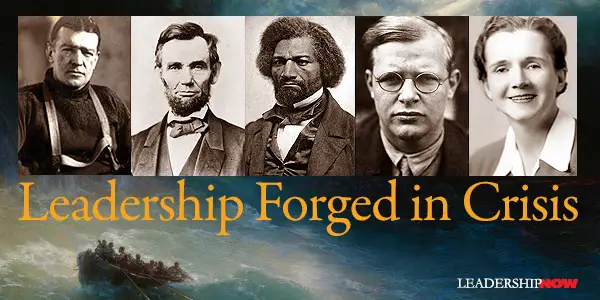
LEADERSHIP development is a very personal endeavor. The better you become, the better your leadership becomes.
It is a misconception of leadership that if you engage in the best practices of a great leader, you will become that leader. Applying the idea that if I do this or if I have this quality I will become a great leader like my chosen mentor, can derail your leadership development.
That said, there are principles you can discover that if adhered to will propel you in the right direction. Harvard professor Nancy Koehn illuminates some of these principles for us in Forged in Crisis as seen through the lives of five exemplary leaders: polar explorer Ernest Shackleton, President Abraham Lincoln, legendary abolitionist Frederick Douglass, Nazi-resisting clergyman Dietrich Bonhoeffer, and environmental crusader Rachel Carson. These principles set the stage for leadership effectiveness, but the decision to step into leadership is yours alone.
Koehn borrows from David Foster Wallace and defines an effective leader as one “who can help us overcome the limitations of our own individual laziness and selfishness and weakness and fear and get us to do better, harder things than we can get ourselves to do on our own.”
Coach Tom Landry said it this way: “Leadership is getting someone to do what they don’t want to do, to achieve what they want to achieve.” Henry Kissinger said, “The task of the leader is to get his people from where they are to where they have not been.” It’s intentional influence. But the ability to do that doesn’t come to us naturally. We have to work at it. But that’s good news. We can all get there. Leaders are not born, they are forged.
Each of the leaders Koehn has chosen faced an uncertain outcome in the midst of a crisis. Shackleton was marooned on an Antarctic ice floe trying to bring his men home alive; Lincoln was on the verge of seeing the Union collapse even as he tried to save it; escaped slave Douglass faced possible capture while wanting to free black Americans held in slavery; Bonhoeffer was agonizing over how to counter absolute evil with faith while imprisoned by the Gestapo; Carson raced against the cancer ravaging her to finish her book Silent Spring, in a bid to save the planet.
The crisis that can break one person can give birth to leadership in another. It’s a conscious choice to lead. Koehn brings out key lessons common to these people as they struggled with their thoughts in what were do or die situations. Here are some of the lessons that we should all take to heart:
They Were Made, Not Born
These leaders “were made into effective leaders as they walked their respective paths, tried to understand what was happening around them, and encountered failure and disappointment.”
They Were Ambitious but…
“The drive to make their respective marks was important in shaping them. It took each of them some of the way. But then, interestingly, ambition ceased to motivate and influence them as it once had. As they discovered a larger purpose and embraced it, each found his or her impetus, strength, and validation in the mission itself.” And importantly, Koehn adds, that “their leadership was partly shaped by a willingness to subordinate personal drive in a broader end, one inexorably linked with service to others.”
They Did the Inner Work of Leadership
They all worked on themselves, looking for opportunities to grow. “They did not do this as a single endeavor, but rather as a lifelong project in which they each kept working on themselves, learning specific lessons, developing more resilience, and using these resources to lead more effectively.”
(“Lincoln would have been flummoxed by talk of authentic leadership when he told a few constituents in 1862 that he did not have the luxury of publically expressing his disappointment about Union army defeats.”)
They Understood the Importance of Solitude
These leaders learned to detach themselves from the situation in order to see things from different perspectives. They “learned how to step back from a specific instant, assess the larger landscape, take the measure of their own emotions, and only then make a decision about what, if anything, they wanted to do.” Reflection and solitude helped them stay focused on the big picture.
They Learned to Manage Their Emotions
In dark moments, what Bonhoeffer called a “boundary situation,” they determined to manage their emotions. It was not willful blindness or forced optimism. They knew what they were up against. “Because they did, they used their emotional awareness and discipline to concentrate directly, almost exclusively, on how to move forward, how to take the next step, however small.” These people realized that “the emotional penetrability they experienced and that caused them so much suffering was also a door into new insights about themselves and new ways of being in the world.”
They Learned to Respond Rather Than to React
“At times, doing nothing at all was the best action each of these leaders could take. Time and time again as president, [Lincoln] refused to be goaded by the force of his own emotions or of those around him into taking precipitate action that might compromise his larger mission. Even when he was at his most frustrated, he managed somehow to acknowledge his feelings without acting on them in a way that was destructive to larger matters.”
They Were Resilient
Though these leaders didn’t always see a way through in the heat of the moment, “they vowed to find a way through the obstacles they confronted. They came out the other side of calamity without falling through the floorboards of doubt, without giving up on their mission and themselves.”
All five leaders were well chosen because of their humanity. They were not born leaders. They became leaders through successes, but mostly through failures and mistakes. Leaders can come from anywhere. As we look around the world today, if we are looking for larger-than-life heroes, we misunderstand what leadership is.
Although these leaders appear to be larger than life to us now, as you read their stories you see that they are you and me. They are ordinary people in turbulent and trying circumstances. They were often overwhelmed and depressed, but they kept moving on. What distinguishes these people from many of the leaders we see today is their approach to the experiences of their lives. Throughout their lives, they purposefully extracted the lessons they needed to grow. It was thoughtful and intentional. If you go through life any other way, you are just collecting experiences to no end. Experiences alone ensure nothing. We must reflect on them to gain insights and learn from them.

For the first time in four years, overall enrollment in Medicaid did not grow significantly in 2017—though managed care continues to become more prevalent.
PwC’s annual report (PDF) on the state of the program—released this week to coincide with the Medicaid Health Plans of America conference—found that total enrollment in 2017 was 74.8 million. That’s just 98,000 above the enrollment total in 2016.
The reasons for that flattening growth include the fact that no new states expanded Medicaid this year, a strengthening economy, and some states’ moves to “aggressively redetermine eligibility status.”
By comparison, total enrollment was 72.9 million in 2015, 66.6 million in 2014 and 57.1 million in 2013. Thanks to that steady growth over the past five years, 23.2% of the U.S. population is now enrolled in Medicaid.
On the state level, enrollment changes in 2017 were more varied than in years past, the report notes. Twenty-two states reported declines, while 28 states and the District of Columbia saw increases—including a 23% rise in Alaska and a 20% rise in Montana tied to the states’ decision to expand Medicaid.
Looking at the last five years, divergent enrollment trends in Nevada and Maine offer a prime example of how powerful an effect state decision-making can have on Medicaid programs.
Nevada, whose leaders embraced the Affordable Care Act, has seen its program grow by 105% since 2013. But Maine has seen its Medicaid enrollment decline by 18% since 2013. The primary reason? Maine’s anti-ACA governor Paul LePage, who has vetoed the state legislature’s attempt to expand Medicaid five times.
Policy decisions at the national level can also have a big impact on Medicaid enrollment, the PwC report’s author, Ari Gottlieb, said during the MHPA conference. For example, the Trump administration’s ACA outreach cuts and conflicting information about whether the individual mandate will be enforced will affect more than just the individual insurance market.
Gottlieb predicted that total Medicaid enrollment might be lower next year because of those factors.
Meanwhile, the number of enrollees in private managed care plans continued its steady rise.
In 2017, 73% of Medicaid beneficiaries were in managed care plans, an increase of 1.9% year over year, or an additional 1 million Americans. In addition, 12 states now have at least 90% of their Medicaid populations covered by private plans, compared to just nine last year and four in 2013.
Over the past five years, an additional 20.9 million people were served by a managed care plan, while 3.1 million fewer were served by Medicaid fee-for-service.
But while the past year was mostly a stable one for Medicaid managed care, “the future is going to be more complicated,” Gottlieb said.
One reason is that all the talk about changing Medicaid, while not likely to result in major coverage reductions, will likely result in changes to how it’s paid for, which could prove challenging for health plans.
Further, the trend of consolidation in the managed care industry shows no signs of abating.
That means, according to Gottlieb, that “you’re going to need more scale to participate in the Medicaid of the future.”
Clean Up on Aisle 12! The Obamacare Pop-Up Store is Open but Stocks are Limited

The fifth Open Enrollment period under the Affordable Care Act (ACA) started on November 1st, and will continue for a scant 45 days ending on December 15, 2017. This year, not only has the Open Enrollment been cut in half, but obstacles abound – obstacles that were not part of the 2016 Open Enrollment Period. For example:
Plan Departure: A Continuing Trend from Prior Years
In 2016, a significant number of large, national insurance companies announced that they were withdrawing from the exchanges and would no longer offer health insurance coverage during 2017. As for 2018, the following chart identifies, as of October 12, 2017, both (1) those national insurance companies that will fully withdraw from one or more exchanges effective January 1, 2018, and (2) those national insurance companies that will continue to offer plans on the state exchanges in 2018 as they did in 2017.
| Insurance Company: | Insurance Exchange Exits for 2018: | Insurance Exchange Participation in 2018: |
| Aetna | Delaware, Iowa, Nebraska, Virginia | None |
| Anthem | Indiana, Maine, Missouri, Nevada, Ohio, Wisconsin | California, Colorado, Connecticut, Georgia, Kentucky, Missouri, New Hampshire, New York, Virginia |
| Centene | None | Arizona, Arkansas, California, Florida, Georgia, Indiana, Kansas, Mississippi, Missouri, Nevada, New Hampshire, Ohio, Texas, Washington |
| Cigna | Maryland | Colorado, Illinois, Missouri, North Carolina, Tennessee, Virginia |
| Molina | Wisconsin, Utah | California, Florida, Michigan, New Mexico, Ohio, Texas, Washington |
| Humana | Florida, Georgia, Illinois, Louisiana, Kentucky, Michigan, Missouri, Mississippi, Ohio, Tennessee, Texas | None |
| UnitedHealthcare | Virginia | Nevada, New York |
Who Ordered the Retreat?
There are a variety of reasons that large national insurers are retreating from the federal and state exchanges, but as a general rule, they stem from uncertainty regarding the profitability of state exchange participation.
CSR Funding Uncertainty
President Trump’s inauguration spurred speculation that the ACA’s CSR subsidy payments could be discontinued, and insurance companies priced exchange plans accordingly. The Congressional Budget Office estimated that the cessation of CSR payments for the 2018 calendar year – which has since come to pass – would result in a 25% increase in premiums by 2020 and at least a temporary increase in the number of areas with zero individual exchange offerings (as a result of further insurer exits and stifled entry / expansion).
The Individual Mandate
One year-over-year driver of the insurance company exodus from the exchanges is the weakness of the individual mandate.
The individual mandate is critical to whether the health insurance companies can turn a profit on the exchange plans. In an ideal world, the individual mandate would successfully induce all eligible citizens to obtain health coverage. Under such circumstances, health insurers would have a much easier time estimating enrollment, risk pools and, ultimately, profits from participation on the insurance exchanges. In practice, however, many of the “young invincibles” whose participation in the health insurance market could offset the costs of insuring older and sicker populations elect to incur the relatively modest tax penalty resulting from a failure to obtain coverage.
Even if the penalty were tougher (and as a consequence, presumably more effective), enforcement is rather lax, and the Trump administration has signaled in 2017 it may instruct the Internal Revenue Service to deprioritize enforcement of the individual mandate.
Enrollee Fraud and Gaming the System
The large national insurance companies have also complained about enrollee fraud that increases the actuarial unpredictability of the performance of a particular risk pool. For example, insurers have complained that enrollees in an exchange plan may have an expensive procedure early in the year, and then stop paying premiums after the insurance plan has paid for the procedure.
The Importance of the Big Players in the ACA Exchanges
Because they have greater resources to understand, and hedge, the actuarial risks of the exchange plans – including balancing the prospects of fraud, unhealthy patient mix and less then desirable compliance with the individual mandate – large national health insurers are better positioned than their smaller counterparts to succeed in the ACA exchanges.
As such national insurers have migrated away from exchange participation, they have in many instances been replaced by regional players, such as health plans associated with regional hospital systems, physician groups and faith-based organizations. Such entities generally do not have the same financial wherewithal as the large national insurance companies to successfully diversify risk or endure greater potential losses with respect to the exchange risk pools. As a result, many healthcare analysts and commentators have concluded that regional plans are ill-equipped to fully replace the large national insurance plans if the large national insurance plans continue to leave the state exchanges.
Notwithstanding the foregoing concerns regarding regional plan participation on the exchanges, Centene Corporation, a publicly-traded healthcare company that is the parent corporation of multiple state-based plans that participate in the state exchanges, has elected to expand its participation in 2018. Whether Centene Corporation succeeds with its expansion into more state ACA exchanges, and whether it chooses to further expand in future years, will be an important indicator of the health of the ACA health insurance exchanges in years to come.
“Repair and Encourage”
The remedy for stabilizing the exchanges is not overly complicated, and realizable, if the political will existed to accomplish what needs to be done.
A strong first step would be changing the conversation in Washington D.C. about the ACA – get rid of the “repeal and replace” mantra and instead make the conversation about “repair and encourage.” The point is that the manner in which the political class is addressing healthcare and the ACA is toxic, and the result is driving the insurance companies away from participation. A change in tone from our elected leaders would probably do remarkable good in stabilizing the state insurance exchanges over time.
In addition to calming the political dialogue regarding the ACA, for 2018 (ahead of the 2019 open enrollment period), we propose some specific policies that we think would help encourage participation by the large, national insurance companies in the exchanges in 2019 and beyond:
In the current political climate, such dedicated action seems unlikely, but the political winds may yet shift and blow the health insurers safely home to the exchanges.

