Democratic Debate Turns Ferocious Over Health Care

Candidates in the first night of this week’s Democratic presidential debates sparred over health care coverage.

It took only one question — the very first — in Tuesday night’s Democratic presidential primary debate to make it clear that the issue that united the party in last year’s congressional elections in many ways now divides it.

When Jake Tapper of CNN asked Senator Bernie Sanders whether his Medicare for All health care plan was “bad policy” and “political suicide,” it set off a half-hour brawl that drew in almost every one of the 10 candidates on the stage. Suddenly, members of the party that had been all about protecting and expanding health care coverage were leveling accusations before a national audience at some of their own — in particular, that they wanted to take it away.

“It used to be Republicans that wanted to repeal and replace,” Gov. Steve Bullock of Montana said in one of the more jolting statements on the subject. “Now many Democrats do as well.”

Those disagreements set a combative tone that continued for the next 90 minutes. The health care arguments underscored the powerful shift the Democratic Party is undergoing, and that was illustrated in a substantive debate that also included trade, race, reparations, border security and the war in Afghanistan.

In the end, it was a battle between aspiration and pragmatism, a crystallization of the struggle between the party’s left and moderate factions.

It is likely to repeat itself during Wednesday night’s debate, whose lineup includes former Vice President Joseph R. Biden Jr. and Senator Kamala Harris of California. He supports building on the Affordable Care Act by adding an option to buy into a public health plan. She released a proposal this week that would go further, eventually having everyone choose either Medicare or private plans that she said would be tightly regulated by the government.

Democrats know all too well that the issue of choice in health care is a potent one. When President Barack Obama’s promise that people who liked their health plans could keep them under the Affordable Care Act proved to be untrue, Republicans seized on the fallout so effectively that it then propelled them to majorities in both the House and Senate.

On Tuesday night, Representative Tim Ryan of Ohio evoked those Republican attacks of years ago on the Affordable Care Act, saying the Sanders plan “will tell the union members that give away wages in order to get good health care that they will lose their health care because Washington is going to come in and tell them they have a better plan.”

Republicans watching the debate may well have been smiling; the infighting about taking away people’s ability to choose their health care plan and spending too much on a pipe-dream plan played into some of President Trump’s favorite talking points. Mr. Trump is focusing on health proposals that do not involve coverage — lowering drug prices, for example — as his administration sides with the plaintiffs in a court case seeking to invalidate the entire Affordable Care Act, putting millions of people’s coverage at risk.

It was easy to imagine House Democrats who campaigned on health care, helping their party retake control of the chamber, being aghast at the fact that not a single candidate mentioned the case.

Mr. Sanders’s plan would eliminate private health care coverage and set up a universal government-run health system that would provide free coverage for everyone, financed by taxes, including on the middle class. John Delaney, the former congressman from Maryland, repeatedly took swings at the Sanders plan, suggesting that it was reckless and too radical for the majority of voters and could deliver a second term to Mr. Trump.

Mr. Sanders held firm, looking ready to boil over at time — “I wrote the damn bill,” he fumed after Mr. Ryan questioned whether benefits in his plan would prove as comprehensive as he was promising. Senator Elizabeth Warren of Massachusetts, the only other candidate in favor of a complete overhaul of the health insurance system that would include getting rid of private coverage, chimed in to back him up.

At one point she seemed to almost plead. “We are not about trying to take away health care from anyone,” she interjected. “That’s what the Republicans are trying to do.”

Mr. Delaney has been making a signature issue of his opposition to Medicare for all, instead holding up his own plan, which would automatically enroll every American under 65 in a new public health care plan or let them choose to receive a credit to buy private insurance instead. He repeatedly disparaged what he called “impossible promises.”

He was one of a number of candidates — including Beto O’Rourke, the former congressman from Texas; Senator Amy Klobuchar of Minnesota and Mayor Pete Buttigieg of South Bend, Ind. — who sought to stake out a middle ground by portraying themselves as defenders of free choice with plans that would allow, but not force, people to join Medicare or a new government health plan, or public option. (Some candidates would require people to pay into those plans, while others would not.)

The debate moderators also pressed Mr. Sanders and Ms. Warren on whether the middle class would have to help pay for a Sanders-style plan, which would provide a generous set of benefits — beyond what Medicare covers — to every American without charging them premiums or deductibles. One of the revenue options Mr. Sanders has suggested is a 4 percent tax on the income of families earning more than $29,000.

In defending his plan, Mr. Sanders repeatedly pointed out how many Americans are uninsured or underinsured, unable to pay high deductibles and other out-of-pocket costs and thus unable to seek care.

Analysts often point out that the focus on raising taxes to pay for universal health care leaves out the fact that in exchange, personal health care costs would drop or disappear.

“A health reform plan might involve tax increases, but it’s important to quantify the savings in out-of-pocket health costs as well,” Larry Levitt, executive vice president for health policy at the nonpartisan Kaiser Family Foundation, tweeted during the debate. “Political attacks don’t play by the same rules.”

A Kaiser poll released Tuesday found that two-thirds of the public supports a public option, though most Republicans oppose it. The poll also found about half the public supports a Medicare for all plan, down from 56 percent in April. The vast majority of respondents with employer coverage — which more than 150 million Americans have — rated it as excellent or good.

In truth, Mr. Delaney’s own universal health care plan could also face political obstacles, not least because it, too, would cost a lot. He has proposed paying for it by, among other steps, letting the government negotiate drug prices with pharmaceutical companies and requiring wealthy Americans to cover part of the cost of their health care.

Had Mr. Sanders not responded so forcefully to the attacks, it would have felt like piling on, though some who criticized his goals sounded more earnest than harsh.

“I think how we win an election is to bring everyone with us,” Ms. Klobuchar said, adding later in the debate that a public option would be “the easiest way to move forward quickly, and I want to get things done.”



Family of four faces $25,000 in average annual unsubsidized ACA costs in 2019

https://www.healthcarefinancenews.com/news/families-four-face-25000-average-annual-unsubsidized-aca-costs-2019?mkt_tok=eyJpIjoiTjJVNE9HTm1OelEwTlRkaiIsInQiOiJsaDZIK0JaczhmMFBzWElmSDluT1VROHc3ckM2azFCZ0NvUnR2U2NmYlRIa2VnYkw2dnR1NmJEMnFrcEFVZUVVSEpVTjlBcXkxaXZaSFFlUFR6djBvRjBTM2NpRFFQMXBDQkRVaFpQSEVtMVFTRlNqUTRBaUxTUmg2MnNrVXFiYiJ9

Costs for two- and four-person families rose despite overall premiums being relatively flat compared to last year.

Average 2019 health insurance premiums are $1,403 per month for families of four who don’t qualify for subsidies under the Affordable Care Act, according to a report released today by eHealth.

The 2019 Health Insurance Index Report analyzes costs and trends among unsubsidized consumers who purchased individual and family coverage for the 2019 plan year at eHealth during the ACA’s most recent open enrollment period. eHealth, Inc. dba as eHealthInsurance, is a private online marketplace for health insurance.

The data and research is focused on ACA market consumers who earn too much per year to qualify for government subsidies that help to reduce what they spend on insurance premiums and out-of-pocket costs. The new report is based on individual and family health insurance applications submitted by unsubsidized eHealth consumers between November 1 and December 15, 2018.

WHAT’S THE IMPACT

While overall premiums were relatively flat compared to the 2018 open enrollment period, costs for two- and four-person families hit a couple of new milestones.

The first is that total combined annual premiums plus deductibles for a four-person family topped $25,000 for 2019. The second is that average premiums for two-person families broke $1,000 per month for the first time this year.

Deductibles marked their first significant decline since 2014, when the ACA took effect. he average individual deductible decreased 6% for 2019, while the average family deductible decreased 8%.

Plan selection trends for 2019 show that HMO plans continue to dominate the market, representing 56% of all plan selections, the same as in 2018.

Meanwhile, exclusive provider organization, or EPO plans reach 26% of all plan selections, up from 20% in 2018; and silver plans reach 35% of all plan selections, up from 30% over last year.

THE LARGER TREND

An estimated 87% of Healthcare.gov customers received subsidies. Their premium cost after subsidies is $87 a month, according to the report. But costs borne by the unsubsidized are significantly greater. At eHealth during the fourth quarter of 2018, which included the ACA’s 2019 open enrollment period, 64% of applications were for consumers purchasing ACA-compliant plans not eligible for use with subsidies.

Premiums for those with employer-sponsored health insurance plans have also been on the rise.

Between 2008 and 2018, such premiums increased 55 percent — twice as fast as workers’ earnings, according to a June report from Kaiser Family Foundation. And since 2006, the average health insurance deductible for covered workers soared by more than 200 percent — from an inflation-adjusted average of $379 to more than $1,300 today.


The Battle for Health Care

https://www.newyorker.com/podcast/comment/the-health-care-defense?reload=true

The Battle for Health Care

The latest Republican effort to destroy the Affordable Care Act appears likely to reach the Supreme Court in the heat of the 2020 Presidential race.

One of the central questions of the 2020 Presidential campaign was posed last week before the Court of Appeals for the Fifth Circuit, in New Orleans, to a lawyer for the Trump Administration, who didn’t even pretend to have an answer. A three-judge panel was hearing the appeal of a ruling by Reed O’Connor, a Texas district-court judge, that the Affordable Care Act, or Obamacare, was unconstitutional in its entirety—an opinion that the Administration has endorsed. O’Connor had ordered that the government cease implementing or enforcing all aspects of the A.C.A., including its protections for people with preëxisting conditions, its ban on lifetime caps, its expansion of Medicaid and coverage for young adults on their parents’ plan, and its support for the treatment of addiction. The order could cost tens of millions of people all or much of their coverage, and throw the health-care system, which accounts for a fifth of the economy, into chaos. But O’Connor, in what Judge Jennifer Elrod, of the Fifth Circuit, described with no apparent irony as a “modest” act, had stayed his own order, pending appeals. Here, now, was the first appeal. So, if the stay is lifted, Elrod asked, “What’s the government planning to do?”

As the lawyer, August Flentje, struggled to answer (“This is a very complicated program—multifaceted, obviously”), it became clear that Republican opposition to the A.C.A. remains a project of blind destruction. One of President Trump’s few health-care initiatives, on drug prices, fell into disarray last week, with one measure defeated in court and another abandoned. Otherwise, he has mostly complained that Democrats want to extend care to, among others, undocumented people. His almost pathological need to undo President Obama’s legacy can be added to the mix; the restraint sometimes said to characterize conservatism can be subtracted. And there is a growing conviction among the A.C.A.’s opponents that the current Supreme Court, given the addition of Neil Gorsuch and Brett Kavanaugh, will back them up.

They may be right; the threat that this case, Texas et al. v. United States, presents to Obamacare should not be underestimated, especially as it is likely to reach the Court in the heat of the 2020 campaign. The case was brought by twenty states whose most distinct common quality is their redness. Maine and Wisconsin dropped out of the suit after the 2018 midterm elections, when their Republican governors were replaced by Democrats. When the Trump Administration declined to defend the law, a group of mostly blue states—currently twenty-one—got permission from the district court to do so. They were joined by a lawyer for the Democratic-controlled House of Representatives. When Kurt Engelhardt, another of the appeals judges, pointedly asked that lawyer why the Senate hadn’t sent someone to defend the law, he replied that the Senate “operates differently.” It is, after all, led by Mitch McConnell, not Nancy Pelosi.

The complaint concerns the so-called “individual mandate.” When the A.C.A. was enacted, in 2010, it directed every American to get insurance or face a penalty, which was calculated on a sliding scale (and dropped altogether for low-income people; other groups, such as prisoners, were exempt). The constitutionality of the mandate was the subject of an earlier challenge to the A.C.A., but Chief Justice John Roberts wrote an opinion classifying the penalty as a tax, which Congress has the power to levy. Trump’s 2017 tax package, however, reduced the penalty to zero. For the A.C.A.’s opponents, this led to a wild surmise: if the mandate had survived because the penalty was a tax, the absence of a tax might make the mandate unconstitutional. That point might seem academic—constitutional or not, the mandate is, for all practical purposes, already gone, now that there is no penalty for ignoring it. But Texas et al. makes a far more radical claim: The phantom mandate is not only unconstitutional but “inseverable” from the rest of the law. If it is invalid, then all nine hundred and six pages of Obamacare are also invalid.

This argument is as senseless as it is ruinous. It’s like saying that the 2017 tax bill was a stealth total repeal of the A.C.A., something that even leading Republicans denied at the time. And yet at least two of the judges, Elrod and Engelhardt, appeared inclined to accept it. The main issue for them seemed to be just how much of Obamacare to trash.

On that question, too, the Administration has been erratic. Initially, it argued that the court should invalidate only certain provisions, such as preëxisting-condition protections—a major feature that Trump has elsewhere claimed to like. Then, in March, the Administration said that it agreed with the Texas ruling: burn it all. Two months later, though, it argued that, while every word of the law was invalid, any relief that the lower court granted should be limited to damages suffered by Texas and the other states, without defining what those damages might be. This led to utter confusion in the oral arguments: Would there be different versions of the law for different states? Which provisions might the government want to keep? (“You would leave in place the calorie guides?” Judge Elrod asked.) Flentje, the Justice Department’s lawyer, told Elrod that, really, “things don’t need to get sorted out until there’s a final ruling”—that is, from the Supreme Court.

Obamacare has reduced the number of uninsured Americans by twenty million and, while the system is imperfect, premiums are more manageable than is often reported. But, as the Texas case suggests, it can still all be undone. And there is much more to do; the United States has not achieved universal coverage. All the Democratic Presidential front-runners share that goal, but they have what are sometimes sharply diverging proposals for getting there. Vice-President Joseph Biden, Mayor Pete Buttigieg, of South Bend, and former Representative Beto O’Rourke, of El Paso, want to build on the A.C.A. and make Medicare available to all as a public option, alongside private insurance. Senator Bernie Sanders, of Vermont, has a Medicare for All bill that aims to displace private insurance, and in most cases make it unlawful, leaving a public option as the only real option. Senators Elizabeth Warren and Kamala Harris have signed on to Sanders’s plan, although Harris has at times tried to downplay the impact on private insurance.

The next Democratic debates, which will be held on July 30th and 31st, may sharpen the candidates’ positions or further polarize them. The Democrats need a plan to protect Americans’ health coverage. And they need a plan to win in 2020. Those might even be the same thing. ♦

Efforts to save new moms clash with GOP’s Medicaid cuts

https://www.politico.com/story/2019/06/14/new-moms-clash-gop-medicaid-cuts-1364564

Image result for medicaid cuts

The push to address the soaring U.S. maternal morality rate is colliding with a broader, more ideological public health imperative: Republican-led efforts to scale back Medicaid.

The safety net program pays for half of all births in the nation. Democrats and many public health experts see it as a natural vessel for slowing the death toll of pregnant women and new mothers, by extending care in the crucial year following childbirth.

But concern over the potentially staggering cost has already quashed efforts in states such as Texas and left liberals in Congress glum over the prospects for a nationwide legislative fix.

“Medicaid represents the best of America and the administration’s effort to gut it would be a massive step backwards on confronting America’s maternal mortality crisis,” Sen. Elizabeth Warren (D-Mass.) wrote in an email.

The dynamic mirrors the federal response to the opioid epidemic, in which Republicans and the Trump administration support making addiction services more available while simultaneously working to shrink Medicaid, the largest single payer of behavioral and maternal health care.

Research has shown the risk of death after childbirth persists for a full year, from such factors as heart disease, stroke, infections and severe bleeding. Black and Native American women are about three times more likely to die from a pregnancy-related cause as white women, according to the Centers for Disease Control and Prevention.

Warren, along with fellow 2020 Democratic presidential contenders Sens. Bernie Sanders, Cory Booker and Amy Klobuchar, back extending Medicaid’s current requirement to cover new mothers from 60 days to one year after childbirth. Democratic proposals in the Senate from Dick Durbin of Illinois, and in the House, from Reps. Robin Kelly of Illinois and Ayanna Pressley of Massachusetts would do that along with provide states grants to improve hospital deliver practices, among other things.

But the efforts aren’t yielding GOP buy-in across the country, as conservative lawmakers keen on shrinking the program press for narrower fixes, such as increased data collection on deaths and a national standard of best medical practices. Proposals to enhance Medicaid coverage to address maternal mortality haven’t attracted a single Republican co-sponsor in Congress, with both sides at loggerheads on whether to grow or shrink the entitlement program.

“All mothers must have access to adequate care before and after delivery, and we should provide states with the tools and flexibility they need to ensure coverage of their most vulnerable populations,” Sen. John Cornyn (R-Texas) told POLITICO.

A Republican aide said GOP lawmakers are focused on getting a better picture of how many pregnant and postpartum women actually need coverage before exploring how to expand access to care. “That is a laborious process to undertake as we have to talk to both the states, stakeholders, and CMS to discern what coverage gaps exist. And we need to know the role other sources of coverage play as well,” the aide said.

Democrats say the prospect of expanding Medicaid benefits scares Republicans in an era of pitched partisan battles over health policy.

“Following the ACA and repeal Obamacare debates, health care, especially Medicaid experience, has become a hot issue — not quite a third rail but definitely hot and our GOP counterparts are a little squeamish,” a Democratic aide working on the issue said.

President Donald Trump last year signed a maternal care measure that directed millions of dollars in new spending to help states collect data on maternal mortality, but has been mum on extending Medicaid coverage to new mothers. His administration will weigh whether to allow Missouri to use its Medicaid programs to offer extended coverage to mothers struggling with addiction — but not the broader Medicaid population.

Meanwhile, the administration is aggressively pursuing an overhaul of Medicaid, finalizing proposals to allow states to apply for block grants that cap program spending and approving requests to condition benefits on work. The administration’s separate efforts to overturn Obamacare would also jeopardize federal subsidies that low-income mothers use to purchase coverage.

The focus on maternal mortality is driven by rising trend lines showing about 700 women die each year due to pregnancy related conditions a rate that’s more than doubled over the last three decades. About a third of the fatalities occur between one week and one year postpartum, according to a recent CDC report, putting the U.S. behind other developed countries for maternal health. And 60 percent of maternal deaths are preventable, with African American women and other minorities disproportionately affected.

Researchers studying the pattern say that extending Medicaid coverage would provide comprehensive benefits for chronic health conditions like heart disease, which accounts for a quarter of maternal deaths.

The postpartum period is such a period of vulnerability,” said Houston physician Lisa Hollier, immediate past president of American College of Obstetricians and Gynecologists and chair of Texas’s Maternal Mortality and Morbidity task force. “The transition time [from pregnancy to full recovery] is one when we see unmet health needs.”

Obamacare helped boost coverage for new mothers. The uninsured rate for women who reported giving birth in the past year fell to 11.3 percent in 2016 from 19.2 percent in 2013 according to a study in Health Affairs.

The gains in states that expanded their Medicaid programs under Obamacare were especially pronounced, with the uninsured rate among new mothers falling 56 percent compared with 29 percent in non-expansion states.

But the Republican-led push to dial back Medicaid expansion has put a spotlight on controlling spending across the entire program.

Some states are exploring alternatives. Missouri’s Department of Social Services this month intends to ask the Trump administration for a waiver that would allow it to offer Medicaid coverage to postpartum women struggling with substance abuse for one year after they give birth. The move would cover about 1,500 of the 24,000 women in the state whose benefits lapse 60 days after childbirth.

The state’s Republican-controlled legislature endorsed the idea last year after killing a broader expansion of Medicaid benefits to postpartum women.

In Texas, where 382 women died within a year of giving birth between 2012 and 2015, Republican Gov. Greg Abbott this week downplayed the state’s maternal mortality rate on Twitter and said that the state was already doing enough to deal with the issue.

Last month, legislators opted to develop postpartum care services within an existing state program geared towards family planning, which will cost about $56 million over five years, instead of extending Medicaid for 12 months, which carried a five-year price tag of nearly $1 billion in state and federal funds.

Kay Ghahremani, the state’s Medicaid director disputes the cost analysis, saying it would actually save money in the long run by promoting wellness and averting potential emergencies.

“It’s the most important thing we can do for maternal health in this state,” said Ghahremani, now president of the Texas Association of Community Health Plans. “We don’t want to see a single mom die from things that are avoidable.”


Why Are at So Many Children Losing Medicaid/CHIP Coverage?

Why Are So Many Children Losing Medicaid/CHIP Coverage?

Along with the American Academy of Pediatrics, First Focus and Children’s Defense Fund, Georgetown University CCF held a press tele-conference and released a report examining an alarming trend in children’s health coverage. The report shows that more 800,000 fewer children had Medicaid/CHIP coverage at the end of 2018 compared to 2017. This trend comes amid broader efforts to restrict access to health coverage and discourage participation by legal immigrants.

The report found little evidence to support claims that the improving economy was responsible for the 2.2 percent decline in enrollment. Instead data suggest this 2018 could be the second year in a row that the rate of uninsured children increases. The U.S. Census Bureau will release the 2018 child uninsured rate data later in the fall.

Enrollment declines are concentrated in seven states – California, Florida, Illinois, Missouri, Ohio, Tennessee, and Texas – which account for nearly 70 percent of the losses. Nine states – Idaho, Illinois, Maine, Mississippi, Missouri, Ohio, Tennessee, Utah, and Wyoming – had decreases of more than double the national average.

Please listen to the recording of the press call or read the report for more details. Here a few excerpts from Thursday’s press conference:

Joan Alker of CCF moderated the call and explained why this drop in child enrollment is so alarming.

“We are extremely concerned about what we are seeing and what it portends for the uninsured numbers these fall,” she said. “For many years there’s been a national bipartisan commitment to reduce the number of uninsured children and the effort have borne fruit. Unfortunately, today we do not feel confident that this national commitment still exists.”

Tricia Brooks, lead author of the report, explained the many factors have likely led to the decline in child enrollment.

“Knowing that the economy had a minimal impact at best, we must call on state and national policymakers to address the factors contributing to the enrollment decline,” said Brooks. “From systems and renewal issues to enrollment barriers to threats like public charge, we must take a hard look at what these administrative actions and barriers to coverage mean for our kids’ health.”

Dr. Laura Guerra-Cardus, Deputy Director for the Children’s Defense Fund of Texas  said overly cumbersome eligibility checks are causing thousands of eligible children to lose coverage in her state. Nine out of every 10 Texas children being dropped are losing coverage due to red-tape. She said this is causing significant confusion for families and throughout the Texas health care system as many families don’t learn their children are uninsured until they show up for an appointment with their health care provider.

“These income checks are erroneously flagging families – at the very least 30% of the time. Families are not being given enough time to respond,” she said. “They are given only ten days to respond and the timeline starts once flagged by the system which could be before the parents even receive notification.”

Bruce Lesley, President of First Focus, pointed out that bipartisan legislation in the U.S. Congress would address the issues raised by Dr. Guerra by requiring 12 months continuous health coverage for children. He also cited polls that show strong support for children’s health coverage in general.

“The American public is with us on this. Kids are a priority but we’re seeing a failure of policymakers to adhere to what voters want and make children a priority,” Lesley said.

Dr. Lanre Falusi, a pediatrician at the Children’s National Health System and national spokesperson for the American Academy of Pediatrics said pediatricians are very concerned about the decline in Medicaid and CHIP enrollment. In addition to cumbersome enrollment process and administrative burdens discouraging families from enrolling eligible children, she pointed out that immigrant families also encounter the chilling effect the proposed public charge rule.

“The public charge proposal presents immigrant families with an impossible choice: keep your family healthy but risk being separated or forgo vital services like Medicaid so your family can remain together in this country. Although the final rule has yet to be issued, the proposal has already caused immigrant families to avoid or even disenroll from programs they are eligible for out of fear, like Medicaid. I have seen this myself,” Dr. Falusi said.

“We need all children in the United States to reach their full potential if we are to reach ours as a nation. Ensuring children are enrolled in health coverage designed to meet their needs is necessary to making that possible. Our lawmakers must pass policies that keep programs like Medicaid and CHIP strong, not those that jeopardize the critical gains we’ve made in children’s coverage.”


The hospitals staying silent on Medicare for All

https://www.axios.com/hospitals-medicare-for-all-health-care-bernie-sanders-5d28dc00-05cd-411b-98cc-556ddfa12c9b.html

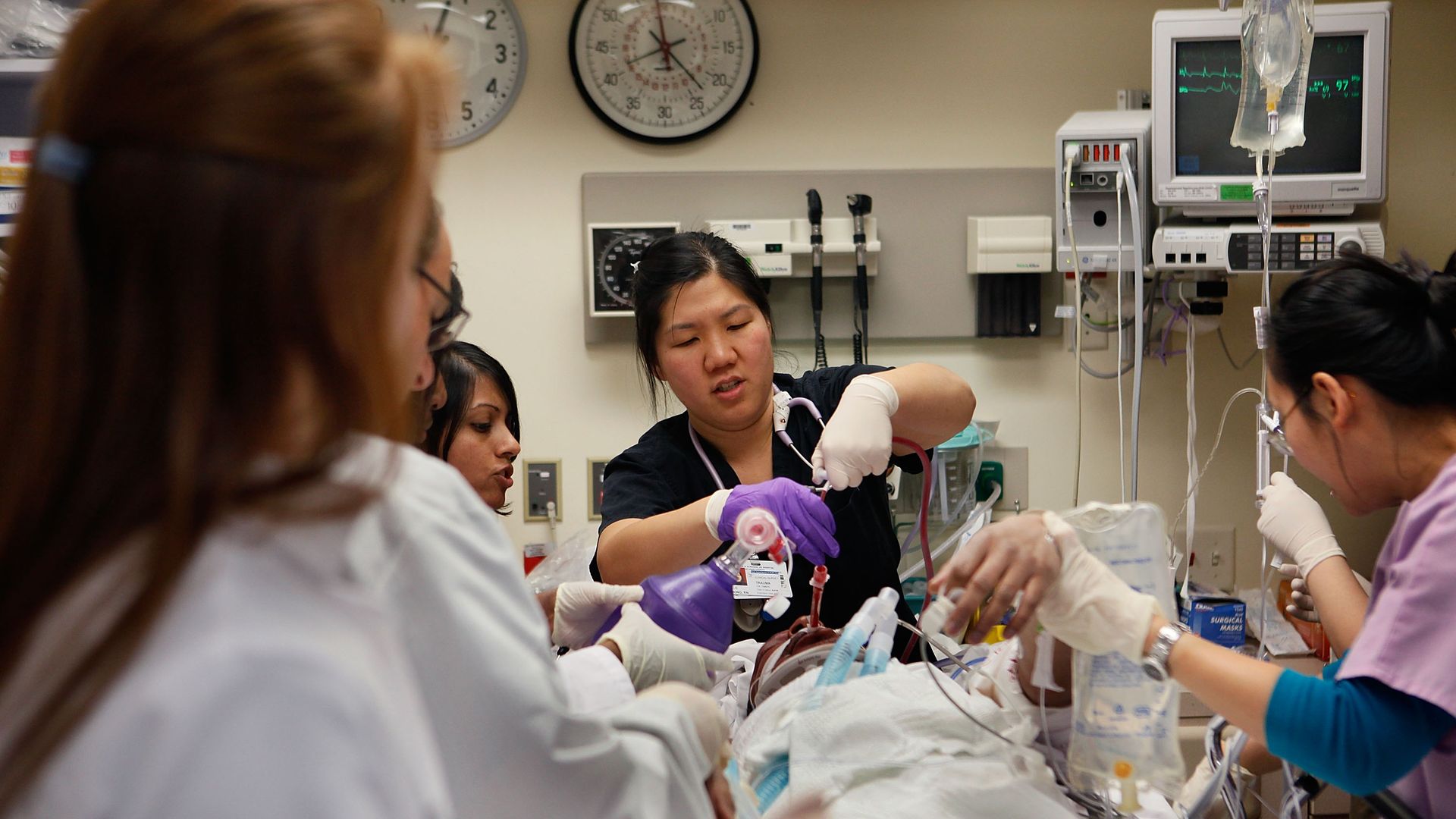
Doctors and nurses treat a patient in a hospital trauma room.

Large hospital systems and trade groups have vociferously criticized Democrats’ “Medicare for All” proposals, but rural facilities and public hospitals that treat mostly low-income patients are sitting on the sidelines of the debate.

Why it matters: Safety nets and many rural hospitals could hypothetically benefit under Medicare for All, but expressing support would put them at odds with their larger brethren.

Between the lines: The Partnership for America’s Health Care Future has become one of the loudest industry-funded voices against Medicare for All.

  • Pharmaceutical companies, health insurers and others are part of PAHCF. But 10 hospital systems and lobbying groups, like Ascension and the American Hospital Association, drive PAHCF.
  • Chip Kahn, the head of the Federation of American Hospitals, said PAHCF was his “brainchild,” according to Modern Healthcare.

Yes, but: Some hospital constituencies aren’t part of the anti-single-payer lobbying.

  • America’s Essential Hospitals, the trade group for safety net hospitals, and the National Rural Health Association, which represents rural hospitals and providers, are not part of PAHCF. They also don’t have official positions on Medicare for All.
  • A spokesperson for AEH said the group recognizes industry peers “have raised reasonable questions” about Medicare for All, but “our focus right now is where our members want it: on stopping the $4 billion cut” to supplemental Medicaid payments.
  • “With specific legislation not moving forward at this time, I don’t see us weighing in anytime soon,” NRHA CEO Alan Morgan said. “I don’t see us at odds. We just haven’t entered the national debate yet.”
  • In an interview, Kahn would not discuss on the record why those two groups were not part of PAHCF.

The big picture: Hospitals that mostly care for poor and uninsured patients could see higher, more stable revenues if everyone had Medicare — a program that often pays higher base rates than Medicaid and infinitely higher rates than nothing at all.

  • Cook County’s public hospital system in Chicago, for instance, gets 79% of its gross patient revenue from the uninsured and Medicaid. That system and multiple other hospitals did not respond to interview requests.
  • Separately, Medicare pays rural “critical access” hospitals 101% of their allowable costs, although those payments have suffered since Congress instituted mandated cuts in 2013.

The intrigue:If you’re trying to solve the problem that we want to get everybody covered and we want to level the playing field between the hospitals that take care of the poor people and hospitals that take care of the rich people, Medicare for All is something we better take a look at,” Eric Dickson, CEO of UMass Memorial Health Care, told Politico.


Toward 2020: A Survey of ACA Market Insurers

Click to access Toward_2020_A_Survey_of_ACA_Market_Insurers.pdf


GOP Needs a Health Care Plan, Not an Immigration Plan

https://www.realclearpolitics.com/articles/2019/05/20/gop_needs_a_health_care_plan_not_an_immigration_plan_140372.html?utm_source=morning-scan&utm_medium=email&utm_campaign=mailchimp-newsletter&utm_source=RC+Health+Morning+Scan&utm_campaign=85626cbe0d-MAILCHIMP_RSS_EMAIL_CAMPAIGN&utm_medium=email&utm_term=0_b4baf6b587-85626cbe0d-84752421

Image result for health policy

On Thursday, President Trump unveiled his proposal for shifting the United States to a merit-based program for admitting future immigrants. The plan, which offers meaningful change and deserves serious consideration, is a non-starter politically, given that it does nothing to address the question of the Dreamers, or the millions of other immigrants already in the country illegally. Democrats, as expected, quickly condemned the president’s plan.

Trump isn’t wrong to highlight immigration. A broad-based restructuring of our immigration system is a laudable goal, and we do have a crisis on our southern border – as some Democrats now begrudgingly admit.

So immigration, legal and illegal, is an important issue, particularly to the president’s political base. The problem is that it’s not the most important issue for a most Americans, including many Republicans. It’s not even close. On the issue that is considered the most important – health care –Trump and the Republican Party have no plan at all.

Last week our polling firm, RealClear Opinion Research, released a new survey showing that health care is far and away the most important issue to Americans. At 36%, it was 10 percentage points above the number two issue – the economy – and more than 21 points ahead immigration, which ranked as the number three issue at 15%. (Education and the environment were tied at 11%, and foreign policy ranked last at just 3%.)

Attitudes about our current health care system were even more striking. Although 72% of registered voters rated their own health care as “excellent” or “good,” just 4% said the system was working for all Americans well enough that it needs no significant changes, while 28% think the current system is broken and needs to be replaced.  The vast majority (68%) is somewhere in the middle, viewing the current system either positively or negatively but agreeing that it is in need of improvements.

RealClear Opinion Research pollster John Della Volpe described the findings this way: “Significant proportions of Democrats, Republicans, and Independents agree that the current system needs substantial reform. The debate will be where to start, and how dramatic the correction.”

Democrats are already having that debate. Every single one of the 23 candidates running for the party’s nomination has embraced some form of reform, from expanding Obamacare or advocating “Medicare for All” to calling for a government-run single-payer system.

Meanwhile Trump and the GOP are standing on the sidelines. Nearly two months ago, Trump’s Justice Department came out in support of a Texas district court ruling striking down all of Obamacare. At the same time, the president took to Twitter (where else?) to declare that “the Republican Party will become ‘The Party of Healthcare!'”

Trump claimed that “the Republicans are developing a really great healthcare plan with far lower premiums (cost) & deductibles than Obamacare,” further promising that a “vote will be taken right after the Election when Republicans hold the Senate & win…”

After Republicans complained Trump had caught them off guard, on April 3 the president tweeted, “I was never planning a vote prior to the 2020 Election on the wonderful HealthCare package that some very talented people are now developing for me & the Republican Party. It will be on full display during the Election as a much better & less expensive alternative to ObamaCare…”

Since then, crickets. The thumping the GOP took in the House in 2018 should have been a wake-up call given the prominent role health care played in sending Republicans down to defeat. According to exit polls, 41% of voters in 2018 said health care was the most important issue facing the country, with immigration and the economy running a distant second and third place at 23% and 22%, respectively. More than two-thirds of voters said the health care system needed “major changes.”

Notice how closely those numbers mirror our new findings from RealClear Opinion Research. Six months after Republicans lost the House, voters’ opinions about the importance of health care and the need for reform haven’t budged. If  the president and his party don’t come up with a viable plan to address voters’ concerns, they may find it’s “déjà vu all over again” in 2020.