Here’s our personal bellwether for how the Delta variant is impacting health systems:we’ve had three different, in-person leadership retreats cancel across the course of the past week, due to COVID concerns. Three very different parts of the country, on both coasts and in the heartland.
Case counts are up, hospitalizations are up, and clinical leaders are (rightly) becoming more skittish about large, in-person meetings. As many have noted, this latest wave of infections is unevenly distributed across the country, primarily affecting the unvaccinated but also putting vaccinated people at risk of transmitting the virus or becoming ill.
As frequent business travelers who thrive on meeting face-to-face with our members, we had just begun to get comfortable being back out “on the road”—but now that’s changing, too. The recent cancellations are a good reminder that we’re still in a fluid situation in this pandemic, and that being flexible and adaptable will continue to be critical for the foreseeable future. (Thank goodness we’re not in the conference business—that’s got to be a nightmare right now.)
Just as we always check the weather forecast for places we’re traveling to, we’ve started checking the number of cases per 100,000 and the test positivity rate as well—over 10 per 100,000, or over 5 percent, and we’ll think twice about visiting.
And our masks have gone back on. We’ll hope to see you out there soon, but in the meantime—stay safe and get vaccinated!
With the Delta variant now accounting for more than 83 percent of all new COVID cases in the US, daily new case counts more than quadrupling across the month of July, and hospitalizations—particularly in states with low vaccination rates—beginning to climb significantly, we appear to have entered a new and uncertain phase of the pandemic, now being dubbed a “pandemic of the unvaccinated”.
Welcome news, then, that this week the American Hospital Association (AHA) publicly encouraged its members to put in place vaccine mandates for their employees. While several large health systems have taken the lead in implementing vaccine mandates, including Trinity Health, the Livonia, MI-based Catholic system that operates hospitals across 22 states, Phoenix, AZ-based Banner Health, Houston Methodist in Texas, and the academic giant NewYork-Presbyterian, others have been more reticent to compel employees to get vaccinated, citing concerns over employee privacy and the potential for workforce backlash.
The New York Timesreports that a quarter of all hospital employees remain unvaccinated nationwide, with many facilities reporting that more than half of their healthcare workers have not gotten the COVID vaccine. In our discussions with health system executives, one consideration frequently cited is the desire for full Food and Drug Administration (FDA) approval of the new vaccines before mandates are put in place.
In a CNN town hall meeting this week, President Biden suggested that approval could come as soon as the end of August, although other reports point to likely approval much later, potentially not until January of next year. Facing a new variant of the virus that is much more transmissible and possibly more virulent than earlier strains, hospitals—and their patients—can’t afford to wait that long.
For safety’s sake, hospitals should quickly put in place vaccine mandates, with appropriate exceptions.
Trinity Health is the latest—and now the largest—U.S. provider organization to roll out a COVID-19 vaccination requirement for all of its employees.
Announced Thursday and effective immediately, the nonprofit, Catholic healthcare system said the policy will extend across its entire workforce of more than 117,000 employees, including clinical staff, remote employees, contractors and “those conducting business in its healthcare facilities.”
Trinity said it will approve exemptions for religious or health reasons that are formally requested and documented. Others who don’t meet the criteria for exemption and fail to provide proof of vaccination “will face termination of employment,” according to the announcement.
Trinity said an estimated 75% of its employees have already received at least one dose of a COVID-19 vaccine, and it hopes the new policy will bring that number closer to 100%.
“Safety is one of our core values. We feel it is important that we take every step available to us to stop the spread and protect those around us—especially the most vulnerable in our communities who cannot be vaccinated including young children and the more than 10 million people who are immunocompromised,” Trinity Health President and CEO Mike Slubowski said in a statement.
“Over the last year, Trinity Health has counted our own colleagues and patients in the too-high coronavirus death toll. Now that we have a proven way to prevent COVID-19 deaths, we are not hesitating to do our part,” he said.
Livonia, Michigan-based Trinity operates 91 hospitals and 113 continuing care locations serving more than 30 million people across 22 states. The system reports $19.4 billion in annual operating revenues and is on track to top that number having recently reported $15.1 billion in operating revenues for the nine-month period between July 2020 and March 2021.
Trinity said that most of its locations will be requiring employees to submit their proof of vaccination by Sept. 21. Should it be determined that COVID-19 vaccine boosters will be necessary down the line, the hospital said that it would similarly require employees to submit proof of their receipt “as needed.”
“The science has shown us that the COVID-19 vaccine is the single most effective tool in slowing, and even stopping, the spread of the virus,” Dan Roth, M.D., Trinity Health executive vice president and chief clinical officer, said in a statement. “As a Catholic Health Ministry—even if we work remotely or do not regularly encounter patients—we view ourselves as caregivers, and it’s important that we do everything we can to end the pandemic and save lives.”
But perhaps the best known of the bunch has been Houston Methodist, which drew a line in the sand on June 8 and has since cut loose 153 employees who did not comply with the vaccine mandate.
That policy led to protests from the dissenting employees as well as a lawsuit that argued the system was “forcing its employees to be human ‘guinea pigs’ as a condition for continued employment.” The case was dismissed by a U.S. district judge and quickly appealed by the employees.
Other organizations such as Mass General Brigham have signaled support for a mandatory COVID-19 vaccination policy but said that they would not enforce the requirement until a COVID-19 vaccine receives formal approval from the FDA.
Earlier this year, the U.S. Equal Employment Opportunity Commission paved the way for employer-mandated COVID-19 vaccine policies with guidance permitting the requirements “so long as employers comply with the reasonable accommodation provisions of the [Americans with Disabilities Act] and Title VII of the Civil Rights Act of 1964 and other [Equal Employment Opportunity] considerations.”
The largest union for registered nurses in the U.S. called on the Centers for Disease Control and Prevention (CDC) to bring back recommendations for universal masking in public regardless of people’s vaccination status.
The National Nurses Union (NNU) in a Monday letter to CDC Director Rochelle Walensky requested that the agency reinstitute guidelines for all people to wear masks in public and in close proximity to those outside their household.
NNU Executive Director Bonnie Castillo pointed to a 16 percent uptick in U.S. COVID-19 cases from last week, according to CDC data, as well as rises in case counts in more than 40 states and hospitalizations in more than 25 states as reasons to return to previous, stricter guidelines.
“NNU strongly urges the CDC to reinstate universal masking, irrespective of vaccination status, to help reduce the spread of the virus, especially from infected individuals who do not have any symptoms,” Castillo wrote in the letter. “Our suggestions are based on science and the precautionary principle and are made in order to protect nurses, other essential workers, patients, and the public from Covid-19.”
The union also cited the World Health Organization’s (WHO) call for vaccinated people to continue wearing masks in public amid the spread of the highly transmissible delta variant. Several U.S. officials and experts have said the WHO’s guidance reflects the state of the pandemic worldwide, which overall has seen lower vaccination rates than the U.S.
Castillo acknowledged that COVID-19 vaccines are effective at preventing severe illness and death but noted “no vaccine is 100 percent effective, and the emergence and spread of variants of concern may reduce vaccine effectiveness.”
The NNU in its letter also appeals for the CDC to update its guidance to “fully recognize aerosol transmission,” mandate tracking and reporting of cases among health care and essential workers, and keep records of cases, including mild and asymptomatic infections, among fully vaccinated people to measure the shots’ effectiveness.
The CDC did not immediately return a request for comment on the letter, but officials have consistently defended the updated mask guidance, saying fully vaccinated individuals are protected against the virus.
The NNU vocally opposed the CDC’s current mask guidance updated in May to permit fully vaccinated individuals to go maskless in virtually all settings. The union has argued that the change in recommendations endangered patients, front-line workers and nurses as the pandemic continues.
In the Monday letter, the union wrote that the CDC’s relaxation of mask guidance “failed to account for” the possibility of fully vaccinated people contracting and spreading the virus. It also said the agency’s guidelines do not protect people, including children, who cannot get the vaccine.
The NNU sent the letter days after the CDC urged schools to reopen for full in-person learning in the fall, saying that fully vaccinated teachers and students do not need to wear masks.
It also comes after Los Angeles County and St. Louis County recommended their residents to wear masks in public indoors.
The average number of new daily COVID-19 cases has increased 94 percent over the past two weeks, according to data from The New York Times, as worries over outbreaks climb nationwide.
The U.S. recorded a seven-day average of more than 23,000 daily cases on Monday, almost doubling from the average two weeks ago, as less than half of the total population is fully vaccinated.
Monday’s count of 32,105 newly confirmed cases pushed the seven-day average up from its Sunday level of more than 19,000 new cases — a 60 percent increase from two weeks prior.
All but four states — West Virginia, Maine, South Dakota and Iowa — have seen increased daily averages in the past 14 days, and the average in 16 states at least doubled in that period.
This comes as the highly transmissible delta variant was declared the dominant strain in the U.S. last week.
At the same time, vaccinations have stalled, with the daily rate reaching its lowest point during President Biden’s tenure on Sunday at slightly more than 506,000. Monday saw a small uptick in the average rate to more than 527,000 per day, according to Our World in Data.
The rise in case counts comes as the Centers for Disease Control and Prevention says just 48 percent of the total population is fully vaccinated. Officials have said fully vaccinated people are protected from the virus, while unvaccinated people are at much higher risk for serious illness and death.
This leaves a majority of Americans still vulnerable to the virus, particularly children under 12 years old, who are not authorized to get the vaccine. More than 56 percent of the eligible population aged 12 and older is fully vaccinated.
The Biden administration has strived to boost vaccination numbers over the past few months and signaled a new strategy focused on grassroots campaigning to promote the vaccine last week. The country fell short of the president’s goal to get 70 percent of adults at least one dose by the Fourth of July.
Increases in COVID-19 cases have previously signaled during the pandemic an upcoming rise in hospitalizations and deaths. The Times data shows that average deaths are still decreasing, but average daily hospitalizations are climbing, with a 16 percent increase from two weeks ago.
Still, case counts are much lower than the devastating peak that hit the U.S. in January, and experts say the country will not reach that level of infection again, as vulnerable populations have gotten vaccinated. Seventy-nine percent of those aged 65 and older are considered fully vaccinated.
It’s “a trickle that will become a torrent,” Ashish Jha, dean at Brown University’s School of Public Health, tweeted.
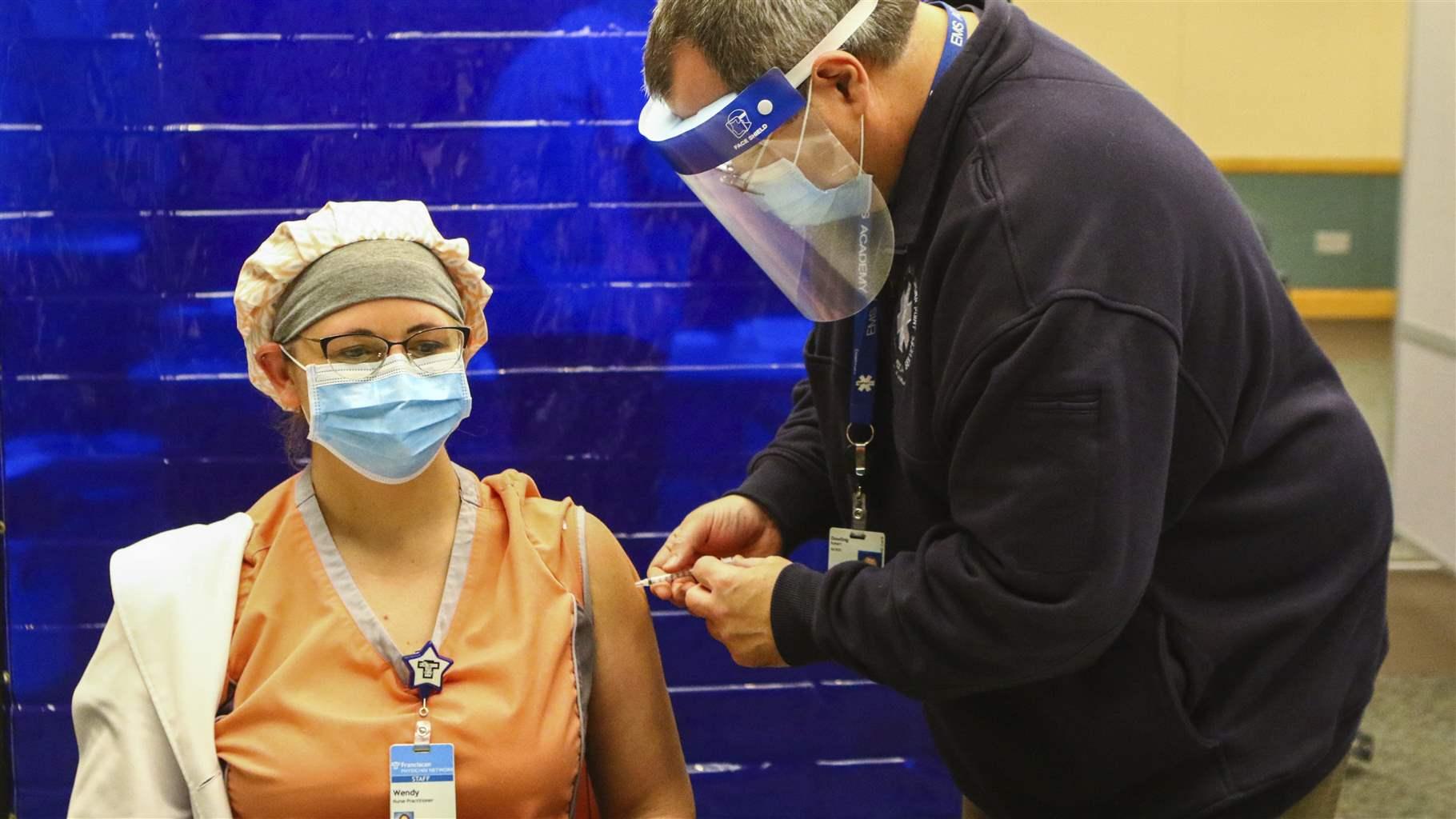
More hospitals are likely to require employees receive a COVID-19 vaccine, experts said, to further protect the sick and vulnerable patients who rely on them for care.
A Houston-area hospital captured headlines after taking a firm stance on requiring vaccines that prevent severe illness of the coronavirus, which has killed more than 600,000 in the U.S. and ravaged the economy.
Houston Methodist employees who refused the vaccine were either terminated or resigned. A judge earlier this month sided with the hospital and tossed out an employee lawsuit that was seeking to block the mandated inoculation. The ruling may give other hospitals the green light to require the jab, and as more facilities put a similar policy in place, others are likely to follow, experts said.
It’s “a trickle that will become a torrent,” Ashish Jha, professor and dean at Brown University’s School of Public Health, posted Thursday on Twitter.
3 large health systems in Massachusetts to require all workers to be vaccinated.
Given the critical need to protect vulnerable patients, its critical all hospitals do this.
Some of the nation’s largest health systems have yet to mandate the shot, including Kaiser Permanente and CommonSpirit Health.
“Vaccination will only be required for Kaiser Permanente employees if a state or county where we operate mandates the vaccine for health care workers,” the company said in an email.
The American Hospital Association continues to hear that a growing number of its members are requiring the vaccine, with some exemptions. However, many member hospitals are waiting until the FDA grants full approval, a time when more safety and efficacy data will be made available.
“Getting vaccinated is especially critical for health care professionals because they work with patients with underlying health conditions whose immune systems may be compromised,”AHA, which has not taken on stance on the requirement, said in a statement.
The mandates raise ethical questions, some say, pointing to the profession’s promise to “do no harm.”
Arthur Caplan, head of medical ethics at New York University School of Medicine, said the codes of ethics that doctors and nurses says to put patients first, do no harm and protect the vulnerable.
“Of course they should be vaccinated,” he said. “If they don’t want to get vaccinated, I think they’re in the wrong profession.”
The Equal Employment Opportunity Commission said employment law does not prohibit employers from requiring the jab, essentially giving the green light to employers to put incentives and requirements in place for their workers. The EEOC is the federal agency tasked with ensuring that workplaces do not discriminate.
Some states are going against the tide and signing legislation that bars vaccine mandates, including Florida. The city of San Francisco will require hospital employees and workers in high-risk settings to get the vaccine. San Francisco, like other employers and universities, will require all city workers get inoculated.
The differing policy stances across the country creates additional hurdles for corporations with a large footprint.
As we’ve talked to health system executives about the challenges of rolling out COVID vaccines in their communities, one topic keeps coming up: how difficult it’s been to get hospitals’ own workers fully vaccinated. One system told us recently that only 55 percent of their frontline caregivers have opted to get vaccinated, despite early and easy availability, and ongoing encouragement from the hospital’s leaders.
Healthcare workers, it turns out, are just like the general population, bringing the same diversity of perspectives and concerns about vaccination to work with them from their own communities. Vaccine hesitancy is not a new issue for hospital staffers; getting the workforce to take the flu vaccine is an annual struggle for many hospitals.
But given the risks of COVID-19, why not just mandate that hospital employees get the vaccine, as other employers have started to do? We commonly hear two concerns.
One is a labor relations worry: will mandating vaccination cause workers to quit, or make it harder to hire staff in an already difficult market for talent? And given growing concerns about unionization of healthcare workers, will mandatory vaccination become a flashpoint issue?
The second concern is medical liability: can we force workers to get a vaccine that hasn’t been fully approved by the FDA? Would that expose the hospital to legal challenges down the road, if there turn out to be long-term complications from the vaccine?
Our own view is that the first concern is overblown—we suspect vaccine mandates are going to become more and more common as the economy reopens. As to the second, we’re more sympathetic. But once the FDA does grant full approval for the vaccines, we’d hope hospitals will get tougher about vaccine mandates (with the necessary exemptions for health, religious, and other concerns).
At the end of the day, hospitals are in the patient care business, and they should view vaccine mandates—whether for COVID or for influenza—as a patient safety issue, not a workforce engagement issue.
Workers have rights, but the answer is more complicated than you think.
En español | With millions of people out of work and millions of others forced to work from home, the pandemic has reshaped the nation’s labor force. And it’s not done yet. As the unemployed look ahead to getting hired and remote employees prepare for a return to the workplace, many are contemplating the same question: Could they eventually be required to get a COVID-19 vaccination if they want to keep their jobs?
The question has become more urgent since the U.S. Food and Drug Administration (FDA) granted Pfizer and BioNTech’s coronavirus vaccine emergency use authorization on Dec. 11. The short answer: Yes. An employer can make a vaccination a requirement if you want to continue working there. But there are significant exceptions for potential concerns related to any disability you may have and for religious beliefs that prohibit vaccinations. And experts say that employers are more likely to simply encourage their workers to get immunized rather that issue a company-wide mandate.
On Dec. 16, the Equal Employment Opportunity Commission (EEOC) confirmed that a COVID-19 vaccination requirement by itself would not violate Americans with Disabilities Act (ADA). That law prohibits employers from conducting some types of medical examinations.
“If a vaccine is administered to an employee by an employer for protection against contracting COVID-19, the employer is not seeking information about an individual’s impairments or current health status and, therefore, it is not a medical examination,” the EEOC says.
But some employees may be exempted from mandatory vaccinations based on potential concerns related to any disability you may have and for religious beliefs that prohibit vaccinations. And experts say that employers are more likely to simply encourage their workers to get immunized rather that issue a company-wide mandate.
“Employment in the United States is generally ‘at will,’ which means that your employer can set working conditions,” says Dorit Reiss, a law professor at the University of California, Hastings, who specializes in legal and policy issues related to vaccines. “Certainly, employers can set health and safety work conditions, with a few limits.”
Those restrictions generally are tied to the federal Americans with Disabilities Act (ADA) and Title VII of the Civil Rights Act of 1964. If employees have medical reasons or sincerely held religious beliefs that prevent them from taking a potential coronavirus vaccine, employers could be legally required to give the workers some reasonable alternative to continue to work, Reiss says.
The EEOC guidance notes that even if an employer finds that a worker who cannot be vaccinated due to disability poses a risk to the workplace, the employer cannot exclude the employee from the job — or take any other action — unless there is no way to provide a reasonable accommodation that would reduce this risk to others.
“That might be a [wearing a] mask, a working from home, or a working separately from other people alternative. As long as it’s not too significant a barrier for the employer,” Reiss says. “If you can achieve the same level of safety as the vaccine via mask, or remote working, you can’t fire the employee. You need to give them an accommodation.”
Vaccine recommendations vs. requirements
The potential medical and religious accommodations are just two of the factors employers will have to consider when deciding whether to put a vaccination requirement in place. Experts say that given all the different concerns employers will need to balance with a potential COVID-19 vaccine, many might choose to simply recommend their workers get immunized rather than make vaccination a condition of employment.
For example, employers also need to weigh any liability issues a vaccination requirement might raise. Some federal lawmakers already have raised concerns that employers are vulnerable to lawsuits from workers and customers who might have contracted COVID-19 at the business. A mandate that all their employees get inoculated could complicate the risks for companies.
“It’s a treacherous area for employers,” says Jay Rosenlieb, an employment law attorney at the Klein DeNatale Goldner law group in California. “The reason it’s treacherous for employers is liability that arises from requiring a vaccine where the vaccine goes sideways and creates harm to the employee. That’s going to probably be a workers compensation claim against the employer. And, of course, some kind of claim against the vaccine manufacturer. There’s a lot of weighing that goes on here.”
L.J. Tan, chief strategy officer for the Immunization Action Coalition — an advocacy group that supports vaccinations — says that because potential COVID-19 vaccines are largely being developed in the same manner as earlier vaccines, researchers have the benefit of past scientific experience to better ensure that a vaccine for this coronavirus will be safe. But he noted that the speed of the development of a COVID-19 vaccine — compressed into months rather than the usual years — and the politics that have accompanied it add to the reasons employers may be unwilling to make vaccination a requirement.
“One of the challenges we’re going to be dealing with, obviously, especially now is that there is a shadow of politics over the vaccine,” Tan says. “As a result, there’s some fear about whether the vaccine can be safe, whether it can be approved appropriately. Because of that shadow, I think it’s going to be extremely difficult for an employer to make COVID-19 vaccination a condition of employment.”
Vaccine requirement more likely in health care, other high-risk jobs
The industry most likely to require COVID-19 vaccinations for workers is health care, where most employers already require workers to get a flu shot annually. In fact, interim guidance from the Centers for Disease Control and Prevention (CDC) on which groups might be among the first to have access to a coronavirus vaccine placed “healthcare personnel likely to be exposed to or treat people with COVID-19” at the top of the list.
But once enough doses of a vaccine have been produced for distribution to the broader public, some employers might start to consider a mandate.
“For example, essential workers in retail stores or in food production plants, such as a meat-packing plant, seem to be at high risk,” Reiss says. “Those employers could reasonably require [a COVID vaccination], because remember, if an employee doesn’t vaccinate, it’s not just a risk to them. It’s a risk to other employees, and — if it’s a customer-facing business — a risk to the customers. So, in high-risk places, I think it’s reasonable.”
Some companies may make inoculation voluntary but make it as easy as possible for workers to get the shot. For instance, Ford already has purchased twelve of the ultracold freezers required to store doses of Pfizer’s vaccine so it can provide the shot to employees who want it.
For those workers who might be told to get a vaccination, remember to raise any concerns you might have with your employer.
“Ask for reasonable accommodation and have a discussion with the employer as to whether there might be reasonable alternatives such as work from home or such as continued use” of personal protective equipment, Rosenlieb says.
If vaccination requirements do become more common, both workers and their employers will have to find ways to balance personal concerns with public safety.
“On one hand, [vaccine requirements] do limit the autonomy of workers that have reservations,” Reiss says. “On the other hand, they also protect workers by making the workplace safer from the disease. So, it’s not just a mandate to limit your rights. A mandate can also protect your right to a safe work environment.“





 HENRY KOTULA