


Cartoon – Non Traditional Medicine


Businesses who suffered from the Great Resignation, in which large numbers of workers voluntarily resigned during the pandemic looking for more fulfilling work or higher wages, are now hoping the “Great Regret” might bring workers back. According to recent surveys, over 70 percent of workers who switched employment during the pandemic found that their new jobs didn’t live up to their expectations, and nearly half wish they had their old job back.
After scores of nurses left hospital positions for travel roles, health system leaders are seeing some nurses return. One physician told us about a favorite nurse on his oncology unit who returned from over a year as a traveler, ready to settle down and be closer to family.
A chief nursing officer relayed that her system was seeing nurses who took agency positions to work toward personal financial goals, like earning a down payment for a house, wanting to come back now that they’ve reached it: “Travel roles are intense, and most nurses can’t do them forever”.
But other nursing leaders caution that they’re preparing for agency nurses to become a permanent fixture in the workforce: “More nurses will see travel as an option for different points in their career, when they have personal flexibility or need the extra money”.
The “Great Regret” might help some hospitals lessen their reliance on agency nursing in the short-term. But building a stable clinical workforce will require addressing underlying structural challenges, through changes in education, rethinking job roles and care models, and finding ways to build individualized job flexibility and customization.
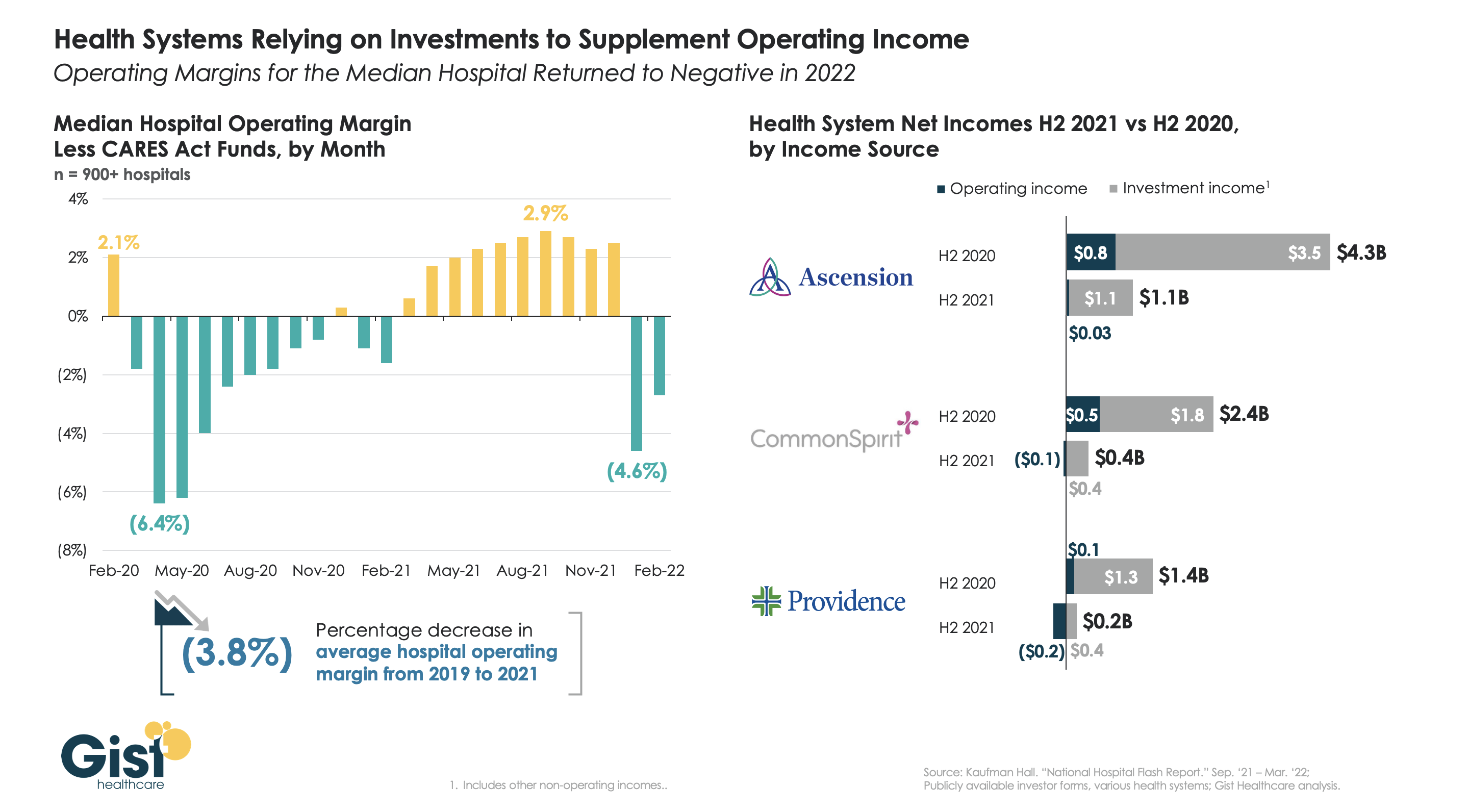
The combination of the Omicron surge, lackluster volume recovery, and rising expenses have contributed to a poor financial start of the year for most health systems. The graphic above shows that, after a healthier-than-expected 2021, the average hospital’s operating margin fell back into the red in early 2022, clocking in more than four percent lower than pre-pandemic levels.
Despite operational challenges, however, many of the largest health systems continue to garner headlines for their sizable profits, thanks to significant returns on their investment portfolios in 2021.
While CommonSpirit and Providence each posted negative operating margins for the second half of 2021, and Ascension managed a small operating profit, all three were able to use investment income to cushion their performance.
A growing number of health systems are doubling down on investment strategies in an effort to diversify revenue streams, and capture the kind of returns from investments generated by venture capital firms. However, it is unlikely that revenue diversification will be a sustainable long-term strategy.
To succeed, health systems must look to reconfigure elements of the legacy business model that are proving financially unsustainable amid rising expenses, shifts of care to lower-cost settings, and an evolving, consumer-centric landscape.

Salt Lake City-based Intermountain and Broomfield, CO-based SCL Health have now formed a 33-hospital, $14B nonprofit health system, which immediately becomes the 11th largest nationwide. The system will operate across seven states under the Intermountain brand, although the SCL hospitals will keep their legacy names and Catholic affiliation. Regulators signed off on the interstate merger after the systems agreed not to close any locations or services.
The Gist: Intermountain has been trying to build scale across the Mountain West in the last few years, having recently come up short in an attempt to merge with South Dakota-based Sanford Health.
The SCL deal will allow Intermountain to expand its SelectHealth insurance plan and integrated care model into the fast-growing Denver metro area, as well as into Kansas and Montana. As with any merger, the difficult work of combining cultures and demonstrating meaningful value for patients and consumers lies ahead.

According to unnamed Axios sources, UnitedHealth Group’s Optum has signed a deal to acquire the independent 500-physician multispecialty group, which operates more than 30 clinic locations and one of the largest ambulatory surgery centers in Texas. With more than 41,000 enrollees, Kelsey-Seybold controls 8 percent of the lucrative Medicare Advantage market in the Houston metro area.
In January 2020, private equity firm TPG Capital made a minority investment in the 73-year-old group, valuing it at $1.3B, to help expand its footprint. Should the current deal come to fruition, Kelsey-Seybold’s physicians would join the ranks of over 60K physicians owned by, or exclusively affiliated with, Optum.
The Gist: Fresh off last year’s acquisition of 700-physician, Boston-based Atrius Health, Optum is continuing its buying spree of large physician groups with a history of managing risk. It will be interesting to see how quickly UnitedHealth Group can combine its Optum-owned physician assets with its commercial insurance platform to create a compelling, lower-cost option for employers and Medicare Advantage enrollees—building on the model of its Harmony network in Southern California.
Of note, Kelsey-Seybold and United Healthcare have offered a co-branded insurance product for years, and UHG executives have said they plan to roll out Harmony in Texas and Seattle next.
Kelsey-Seybold is one a dwindling number of very large, independent multispecialty groups, and its sale to Optum may have other groups wondering about their ability to remain independent in an increasingly concentrated healthcare market.
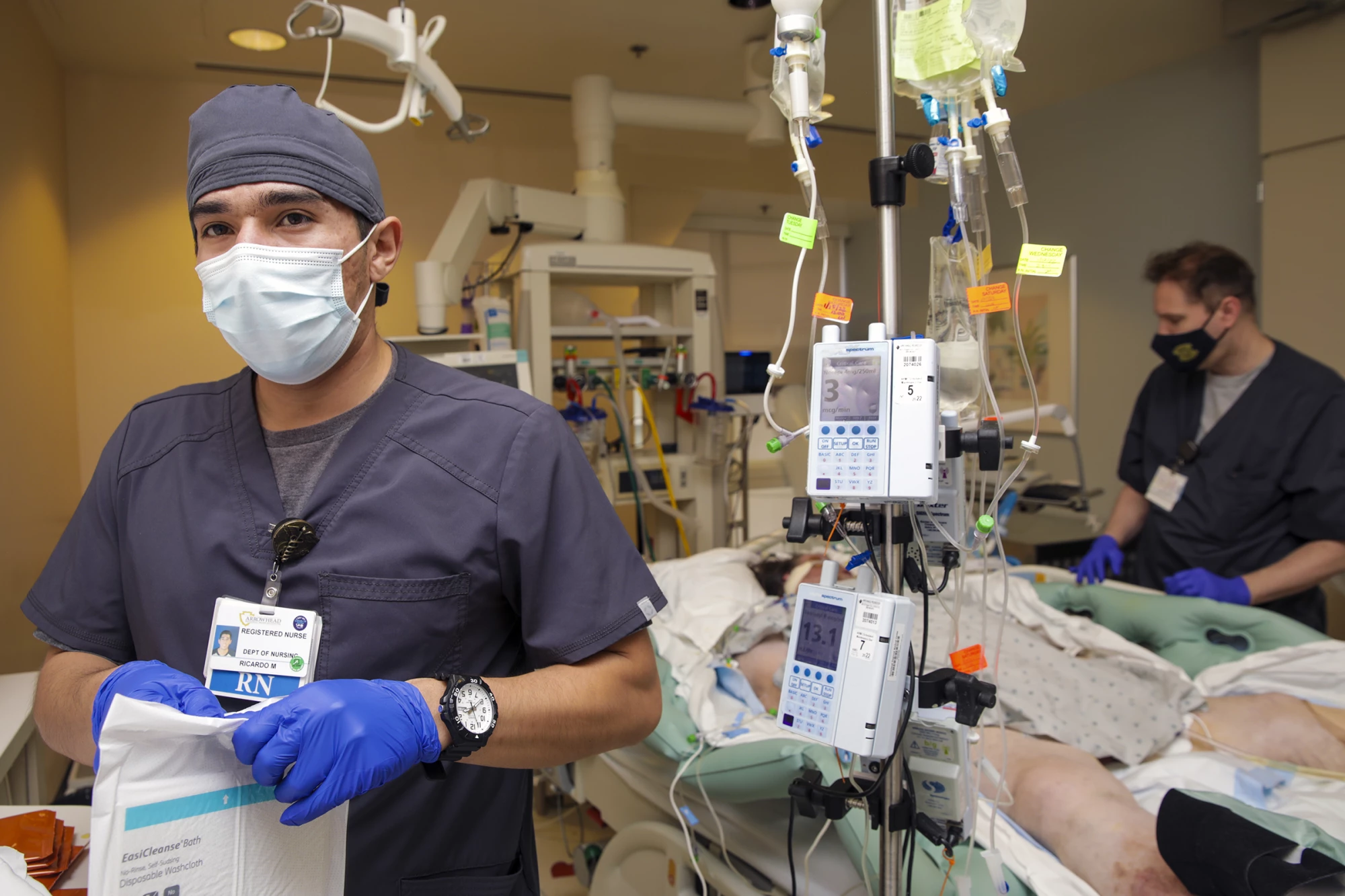
Hospitals’ reliance on travel workers is nothing new. The pandemic intensified it and highlighted the gap between full-time workers’ pay and lucrative temporary contracts.
While the average salary for a travel nurse can vary based on location, regional demand, hospital type and specialty, the compensation for a travel nurse has increased significantly compared to pre-pandemic, Bill Morgan, president of the Orlando, Fla.-based travel nurse staffing firm Jackson Nurse Professionals, told Becker’s in September.
Meanwhile, hospitals and health systems have offered bonuses, increased wages and made other investments in employee retention for their staff workers. Still, the compensation gap between hospital employed nurses and travel or agency nurses remains stark.
The gap poses the seemingly simple question: Why aren’t hospitals paying full-time staff more instead of paying higher prices for travel workers?
Travel nursing’s start
Taking a look back at the history of why hospitals started using travel nurses in the first place helps answer that question, said Kathy Sanford, DBA, RN, chief nursing officer at Chicago-based CommonSpirit Health.
Dr. Sanford recalls first using local agencies and travel nurses in the 1980s as a cost-effective staffing strategy for periods when the patient census fluctuates, such as during flu epidemics.
“When you have those fluctuations, you need to have a staffing strategy of what you want to do when the census goes up higher than we are staffed for, but it’s only going to last maybe a month, or a little longer,” she told Becker’s. “Because of the fluctuations, our nursing strategy for staffing was to use these non-employed nurses to fill in when there were gaps.”
The COVID-19 pandemic, however, has created a situation where volumes are consistently higher than normal. And while rates for a travel or agency nurse have traditionally been higher than those of a hospital staff nurse, the current demand has pushed travel rates to record highs.
Rising rates
Pittsburgh-based UPMC, for example, paid an estimated $85 an hour for a traveling nurse or a nurse from an agency before the pandemic. The health system is now experiencing rates between $225 and $250 an hour. Such rates have made nurses who may not have considered traveling before take the leap.
“And the nurses are making more, and we don’t fault the nurses for taking advantage of that opportunity. But … now not only are nurses making more, but the agencies have taken the opportunity to triple their profits … and it shouldn’t be permitted during a pandemic, just like we don’t permit building companies to triple the price of lumber after a hurricane. It just shouldn’t be allowed,” said John Galley, chief human resource officer at UPMC.
“Hospitals are all trying to fill the positions that need to be filled to help us get through this crisis with travel nurses, but because there aren’t enough, it becomes a cycle of bidding of who will pay me the most to travel,” Dr. Sanford said. Because of that, many nurses who may have never considered traveling before are now choosing to do so and leaving hospitals in areas of the country with a lower wage index, she said.
Pay for travel nurses has always been higher for the same reasons hospitals pay float pool nurses more, Dr. Sanford explained.
“Nurses are specialists and they work on a particular type of unit, and sometimes one unit’s census will be down and another unit’s census will be up,” she said. Float pool nurses are willing to shift to different units that need help “and it’s not a favorite thing for nurses to do,” Dr. Sanford said. “You have to pay them a little extra to be willing to learn different types of nursing and be willing to float.”
The same line of thinking applies to agency or travel nurses. Travelers don’t have the perks that come with a full-time job, like job security and benefits. That coupled with the burden of travel itself and short-term assignments was the initial justification for why travel nurses had higher rates.
Simply put, hospitals can’t afford to pay full-time staff wages that were meant for temporary assignments.
“The bottom line is it would not be sustainable for hospitals to pay the kind of dollars that they’re paying right now for travel nurses in the long run. Because nurses are our backbone … they’re our heart, but they’re also our backbone. They’re the majority of our staff.” Dr. Sanford said.
Mr. Galley of UPMC echoed that sentiment, noting that salaries and benefits make up about 50 percent of a health system’s entire expenses. “If you were to double a good portion of that — the nursing salaries — you’d completely wipe out any operating margin. Then you wouldn’t be able to invest in anything to keep the hospitals going,” he said.
And healthcare has a lot of costly demands that would go unaddressed if such rates became the expectation for staff nurses.
“There are a lot of needs that healthcare has in technology, and making sure that we have the equipment to take care of patients, and that we can do programs for the poor and vulnerable that we wouldn’t be able to afford if we pay these non-sustainable prices forever,” Dr. Sanford of CommonSpirit said.
The value of in-house agencies
To combat skyrocketing travel nursing costs, some health systems have introduced their own travel agencies, including CommonSpirit and UPMC, where travel nurses work within the system.
Mr. Galley said UPMC started the agency for its 40-hospital system not only to combat the nursing shortage — and attract back nurses the health system has lost to outside travel agencies — but also to address increased rates from outside travel agencies.
Nurses and surgical techs who qualify for UPMC’s in-house agency will earn $85 an hour and $63 an hour, respectively, in addition to a $2,880 stipend at the beginning of each six-week assignment.
Compensation for travel nurses at UPMC is still higher than full-time employees because the job comes with its own set of challenges. While full-time nurses get to know their facilities and have a more regular schedule, travel nurses are constantly on the move.
“They’re going to have assignments for a few weeks at a time at a particular location, then we’re going to pick them up and move them somewhere else, so they’re going to be constantly traveling, living out of a suitcase, and that’s what external travelers do, so we want to be just like the market, create roles like that and pay like that,” Mr. Galley said. “I think our employees understand the difference between that kind of a lifestyle that goes along with the higher salary.”
CommonSpirit’s internal agency plans to start traveling in the early spring and is in the process of hiring a national director for the program. The system’s goal is to have 500 nurses.
Dr. Sanford said the program will be beneficial because it will bring down competition, and people who want to travel can still be employees within the health system.
“It gives nurses who are our employees a choice if they want to be travelers or if they want to do it part time and then come back to a job within one of our hospitals or in one of our clinics. … They won’t lose their benefits, they won’t lose their seniority. They’ll be our employees,” Dr. Sanford said.
Other systems are exploring similar programs, such as Charlotte, N.C.-based Atrium Health, which recently ran a pilot in-house traveler program. The health system has also used outside agencies, which cost about triple compared to pre-pandemic.
“This program was very successful, less expensive than using an external travel agency and worked really well across our large health system that covers multiple states,” said Patricia Mook, MSN, RN, vice president of nursing operations at Atrium Health.
But internal travel programs may not be easy for other health systems to mimic, especially smaller ones. Hospitals have to be of a certain size for an internal travel program to work, meaning an individual hospital wouldn’t be able to have one, Mr. Galley said.
More than that, it’s a complex undertaking, he said.
“It’s not without its challenges,” Mr. Galley said. “I just think it’s something that takes the resources and thought leadership to be able to do. But you’re not going to find independent hospitals being able to mirror this.”
Dr. Sanford also recommends having a few different strategies in place to combat nurse shortages.
“Don’t make it your only strategy because there are so many issues that we could do better with our nursing staff. … You need to be looking at all of the different things that give nurses voice in your organization,” Dr. Sanford said.

The Justice Department has intervened in a whistleblower lawsuit accusing former executives of San Antonio-based Merida Health Care Group of violating the False Claims Act, according to Law360.
The Justice Department is intervening in the action, which dates back to 2015, alleging the former executives submitted more than $120 million in false claims to Medicare for medically unnecessary home health services and hospice care. The Justice Department is also adding Merida Health Group’s former CEO Henry McInnis to the complaint, according to the report.
The Justice Department alleges Mr. McInnis and Rodney Mesquias, the former owner of Merida Health Care Group, violated the False Claims Act, and the government is also seeking damages under the common law and equitable theories of fraud and payment by mistake, according to court documents filed April 7 in the U.S. District Court for the Southern District of Texas.
Mr. McInnis was sentenced to 15 years in prison in February 2021 for his role in a healthcare fraud and money laundering scheme. Mr. Mesquias was sentenced to 20 years in prison in late 2020.

While healthcare workers battle burnout, hospitals have been ramping up wages and other benefits to recruit and retain workers. It has created a culture of competition among health systems as well as travel agencies that offer considerably higher pay.
But other healthcare organizations are not hospitals’ only competitors. Some hospitals, particularly those in rural areas, are struggling to match rising employee pay among nonindustry employers such as Target and Walmart.
“We monitor and we’ve been looking and we ask around in the community and we can ask who’s paying what,” Troy Bruntz, CEO of Community Hospital in McCook, Neb., told Becker’s. “So we know where Walmart is on different things, and we’re OK. But if Walmart tried to match what Target’s doing, that would not be good.”
At Target, the hourly starting wage now ranges from $15-$24. The organization is making a $300 million investment total to boost wages and benefits, including health plans. Starting pay is dependent on the job, the market and local wage data, according to NPR.
Walmart raised the hourly wages for 565,000 workers in 2021 by at least $1 an hour, The New York Times reported. The company’s average hourly wage is $16.40, with the lowest being $12 and the highest being $17.
Meanwhile, Costco raised its minimum wage to $17 an hour, according to NPR. The federal minimum wage is $7.25.
Estimated employment for healthcare practitioners and technical occupations is 8.8 million, according to the latest data released March 31 by the U.S. Bureau of Labor Statistics. This includes nurse practitioners, physicians, registered nurses, physician assistants and respiratory therapists, among others.
In sales and related occupations, estimated employment is 13.3 million, according to the bureau. This includes retail salespersons, cashiers and first-line supervisors of retail salespersons, among others.
While retail companies up their wages, at least one hospital CEO is monitoring the issue.
Healthcare leaders weigh their options
Mr. Bruntz said rising wages among retailers is an issue his organization monitors. Although Target does not have a store in McCook, there is a Walmart, where pay is increasing.
“I was quoted a few months ago saying Walmart was approaching $15 an hour, and we can handle that,” Mr. Bruntz said. “But when it gets to $20 or $25, it’s going to be an issue.”
He also said he cannot solely increase the wages of the people making less than $15 or less than $25 because he has to be fair in terms of wages for different types of roles.
Specifically, he said he is concerned about what matching rising wages at retailers would mean for labor expenses, which make up about half of the hospital’s cost structure.
“I double that half, that’s 25 percent more expenses instantly,” Mr. Bruntz said. “And how is that going to ratchet to a bottom line anything less than a massive negative number? So it’s a huge problem.”
Clinical positions are not the only ones hospitals and health systems are struggling to fill; they are encountering similar difficulties with technicians and food service workers. Regarding these roles, competition from industries outside healthcare is particularly challenging.
This is an issue Patrice Weiss, MD, executive vice president and chief medical officer of Roanoke, Va.-based Carilion Clinic, addressed during a Becker’s panel discussion April 4. The organization saw workforce issues not just in its clinical staff, but among environmental services staff.
“When you look at what … even fast food restaurants were offering to pay per hour, well gosh, those hours are a whole lot better,” she said during the panel discussion. “There’s no exposure. You’re not walking into a building where there’s an infectious disease or patients with pandemics are being admitted.”
Amid workforce challenges, Community Hospital is elevating its recruitment and retention efforts.
Mr. Bruntz touted the hospital as a hard place to leave because of the culture while acknowledging the monetary efforts his organization is making to keep staff.
He said the hospital has a retention program where full-time employees get a bonus amount if they are at the employer on Dec. 31 and have been there at least since April 15. Part-time workers are also eligible for a bonus, though a lesser amount.
“It also encourages staff [who work on an as-needed basis] to go part-time or full-time, and [those who are] part-time to go full-time,” Mr. Bruntz said. “That’s another thing we’re doing is higher amounts for higher status to encourage that trend.”
Additionally, Community Hospital, which has 330 employees, offers a referral bonus to staff to encourage people they know to come work with them.
“We want staff to bring people they like. [We are] encouraging staff to be their own ambassadors for filling positions,” Mr. Bruntz said.
He said the hospital also will offer employees a sizable market wage adjustment not because of competition from Walmart but because of inflation.
Graham County Hospital in Hill City, Kan., is also affected by the tight labor market, although it has not experienced much competition with retail companies, CEO Melissa Atkins told Becker’s. However, the hospital is struggling with competition from other healthcare organizations, particularly when it comes to patient care departments and nursing. While many hospitals have struggled to retain employees from travel agencies, Graham County Hospital has mostly been able to avoid it.
“As the demand increases, so does the wage,” Ms. Atkins said. “In addition to other hospitals offering sign-on bonuses and increased wages, nurse agency companies are offering higher wages for traveling nurse aides and nurses. We are extremely fortunate in that we have not had to use agency nurses. Our current staff has stepped up and filled in the shortages [with additional incentive pay].”
To combat this trend, the hospital has increased hourly wages and shift differentials, as many healthcare organizations have done. It has also provided bonuses using COVID-19 relief funds.
Overall, Mr. Bruntz said he prefers “not to get into an arms race with wages” among nonindustry competitors.
“It’s not going to end well for anybody. We prefer not to use that,” he said. “At the same time, we’re trying to do as much as possible without being in a full arms race. But if Walmart started paying $25 for a door greeter and cashier, we would have to reassess.”

UPDATE: April 14, 2022: Nurses will begin striking April 25 if they are unable to reach a deal with the system by then, according to a Wednesday statement from the union. The two sides have met with a federal mediator three times, and the strike would be open-ended.
As the COVID-19 pandemic has worsened working conditions for nurses, some unions have made negotiating contracts a priority. Better staffing is key, along with higher wages and other benefits to help attract and retain employees amid ongoing shortages.
The California nurses’ demands in new contracts focus heavily on recruitment and retention of nursing staff “amid an industry-wide shortage and nurses being exhausted after working through the pandemic, many in short-staffed units,” the union said in the release.
They’re also asking for improved access to time off and more mental health support.
Nurses say their working conditions are becoming untenable and relying on travel staff and overtime shifts is not sustainable, according to the release.
The hospitals are taking precautionary steps to prepare for a potential strike and will resume negotiations with the union and a federal mediator Tuesday, according to a statement from Stanford.
But according to CRONA, nurses have filed significantly more assignment despite objections documents from 2020 to 2021 — forms that notify hospital supervisors of assignments nurses take despite personal objections around lacking resources, training or staff.
And a survey of CRONA nurses conducted in November 2021 founds that as many as 45% were considering quitting their jobs, according to the union.
That’s in line with other national surveys, including one from staffing firm Incredible Health released in March that found more than a third of nurses said they plan to leave their current jobs by the end of this year.
The CRONA nurses “readiness to strike demonstrates the urgency of the great professional and personal crisis they are facing and the solutions they are demanding from hospital executives,” the union said in the release.
No major strikes among healthcare workers have occurred so far this year, though several happened in 2021 and in 2020, the first year of the pandemic.
 HENRY KOTULA