Haven began informing employees Monday that it will shut down by the end of next month, according to people with direct knowledge of the matter.
Many of the Boston-based firm’s 57 workers are expected to be placed at Amazon, Berkshire Hathaway or JPMorgan Chase as the firms each individually push forward in their efforts, the people said.
One key issue facing Haven was that each of the three founding companies executed their own projects separately with their own employees, obviating the need for the joint venture to begin with, according to the people, who declined to be identified speaking about the matter.
Haven, the joint venture formed by three of America’s most powerful companies to lower costs and improve outcomes in health care, is disbanding after three years, CNBC has learned exclusively.
The company began informing employees Monday that it will shut down by the end of next month, according to people with direct knowledge of the matter.
Many of the Boston-based firm’s 57 workers are expected to be placed at Amazon, Berkshire Hathaway or JPMorgan Chase as the firms each individually push forward in their efforts, and the three companies are still expected to collaborate informally on health-care projects, the people said.
The announcement three years ago that the CEOs of Amazon, Berkshire Hathaway and JPMorgan Chase had teamed up to tackle one of the biggest problems facing corporate America – high and rising costs for employee health care – sent shock waves throughout the world of medicine. Shares of health-care companies tumbled on fears about how the combined might of leaders in technology and finance could wring costs out of the system.
The move to shutter Haven may be a sign of how difficult it is to radically improve American health care, a complicated and entrenched system of doctors, insurers, drugmakers and middlemen that costs the country $3.5 trillion every year. Last year, Berkshire CEO Warren Buffett seemed to indicate as much, saying that were was no guarantee that Haven would succeed in improving health care.
One key issue facing Haven was that while the firm came up with ideas, each of the three founding companies executed their own projects separately with their own employees, obviating the need for the joint venture to begin with, according to the people, who declined to be identified speaking about the matter.
Coming just three years after the initial rush of fanfare about the possibilities for what Haven could accomplish, its closure is a disappointment to some. But insiders claim that it will allow the founding companies to implement ideas from the project on their own, tailoring them to the specific needs of their employees, who are mostly concentrated in different cities.
The move comes after Haven’s CEO, Dr. Atul Gawande, stepped down from day-to-day management of the nonprofit in May, a change that sparked a search for his successor.
Brooke Thurston, a spokeswoman for Haven, confirmed the company’s plans to close and gave this statement:
″The Haven team made good progress exploring a wide range of healthcare solutions, as well as piloting new ways to make primary care easier to access, insurance benefits simpler to understand and easier to use, and prescription drugs more affordable,” Thurston said in an email.
“Moving forward, Amazon, Berkshire Hathaway, and JPMorgan Chase & Co. will leverage these insights and continue to collaborate informally to design programs tailored to address the specific needs of our individual employee populations and locations,” she said.
Top executives at some of the biggest commercial insurers outlined their shifting strategies and what markets are growth opportunities in light of the recession at Morgan Stanley’s annual conference.
Top executives at some of the biggest commercial insurers provided a peak behind their curtains at Morgan Stanley’s annual investor conference this week, discussing the pace of utilization recovery and how they’re approaching rate setting and risk going into next year
Though there’s significant uncertainty around the future of the insurance industry, many remarks can be summed up in a line from Cigna CEO David Cordani: “We feel bullish on 2021.”
And despite the major role of government in regulating healthcare, most officials seemed agnostic on the presidential election looming in less than two months.
Payers are reporting skyrocketing profits amid the COVID-19 pandemic as patients deferred care in droves in the second quarter, sparking a congressional investigation into business practices. Use of healthcare services continues to recover from a nadir in March and April, and that recovery has continued into the third quarter, payer executives said. But the pace has differed by segment.
At the start of the pandemic, Humana saw beneficiary use drop to about 30% of pre-COVID-19 levels until mid-May, when it slowly started to tick back up. The Louisville, Kentucky-based insurer’s utilization is now still “a little below par,” but well above that depression and meeting internal expectations, CEO Bruce Broussard said.
CVS Health-owned Aetna has seen its commercial business come back faster than Medicare, CFO Eva Boratto said. Primary care and labs have seen a quicker rebound, but it’s been slower in inpatient and ambulatory.
Centene CEO Michael Neidorff predicts utilization will be between 65% to 80% of normal by the end of the year, but remains cautious due to the shifting nature of the pandemic, and how it could coincide with a potentially nasty flu season.
“We don’t know what other peaks we’re going to see,” Neidorff said.
2021 rate setting, strategic pivots
Unsurprisingly, COVID-19 is also shaping major payer’s go-to-market approaches and how they’re thinking about 2021 bids.
Humana, for example, studied both historical data prior to COVID-19 and did scenario planning around what the pandemic could do to factors like utilization, testing and treatment if it continued throughout the year. Eventually, the payer decided to base bid assumptions off trending historical information forward, according to Broussard.
“We were very oriented to pricing that was more conservative as we thought about the approach,” he said.
It appears Centene, contrastingly, is using 2020 data to risk score. When asked how the payer is approaching rate setting, Neidorff said: “We’re dealing with this year. And we’re saying that any concessions this year should not necessarily carry into next year, which is an entirely different year.”
Employers and plans nationwide are struggling with this issue. Only about 60% of employers are using 2020 claims to set rates for next year, while another 26% are calculating expected medical costs based on data from 2019, and 9% are using data from the first two months of 2020 alone, according to Credit Suisse.
The pandemic has also shifted insurers’ broader strategic priorities in 2021 and beyond, especially by hammering home the need for diversified revenue streams to keep afloat, top execs said.
“We’re in 37 states. If you have a stock that’s not performing well in your portfolio, you probably have some that are offsetting it,” Centene’s Neidorff said.
Humana has been investing in telesales, at-home and in-community offerings and digital capabilities, with an eye for growth. Broussard said Humana’s customers have been mostreactive to an omnichannel approach to care delivery.
For example, the payer is seeing home as an increasingly valid path for care a little more acute in service than in the past. As a result, Humana plans to continue investing in areas that dovetail with that trend, and those with biggest impact on downstream healthcare costs, including primary care, social determinants of health, behavioral health and pharmacy.
CVS has also accelerated development of its virtual care offering, eClinic, as a result of the pandemic and relaxed federal regulations. Visits are up 40% since the end of June, CEO Larry Merlo said, noting he believes the future of healthcare delivery is at the intersection between digital and physical.
Because of the pandemic, “we are seeing an accelerated shift to this multichannel, integrated approach,” Merlo said. “We did change some of our priorities, and accelerate some things that may have been further down the road.”
CVS is continuing to convert existing stores to health- and wellness-focused locations, called HealthHUBs, which devote a fifth of floor space to healthcare products and services. Currently, the Rhode Island-based giant has 275 HUBs up and running, despite pausing conversions for a time in March.
Cigna is also looking to drive revenue by moving beyond a payer’s traditional wheelhouse. On Wednesday, the insurer announced it was rebranding its health services division as Evernorth, in a next step for the Cigna-Express Scripts megamerger completed almost two years ago.
For its part, Centene is introducing more value-based contracts in 2021, after seeing providers it contracts with in alternative payment models are reporting stronger cash flow and patient relationships amid COVID-19 than those in fee-for-service relationships.
Going into next year, the payer is also focused on margin expansion, working with states to set rates and federal lobbying for friendly policies like an increased Medicaid match rate, Neidorff said.
Attractive markets
The COVID-19 recession booted millions of Americans off employer-sponsored insurance, though the full scope of the insurance crisis isn’t yet clear. Cigna’s Cordani noted the disenrollment in the first half of the year in its commercial population was lower than expected, helped by the fact the payer is less active in sectors hit hardest by the pandemic like travel and leisure.
But disenrollment could still snowball in the second half of 2020. As a result, a number of major commercial payers are building out offerings in two coverage backstops in the market: Medicaid and the Affordable Care Act exchanges.
Broussard said Humana sees ample opportunity in Medicaid — including the dually eligible — but wants to be more surgical in expansion moving forward, especially as states look for a more contemporary delivery of services and engagement with clinical programs. Humana is going to look for tuck-in acquisitions.
“Is there a way to enter the market in a small way, and leverage our capabilities and grow from that?,” Broussard said.
Cordani agreed that budget-strapped states are looking for new ways to lower costs, but said “Medicaid has always been a lower priority growth platform” for Cigna. Instead, the insurer sees the safety net program as an opportunity for Evernorth in the near term, more than its government business.
Of the 1.1 million new members Centene added from March through August, the majority were in Medicaid, but a significant portion were in the ACA exchanges, Neidorff said. Capitalizing on that momentum, Centene — already the largest payer in the exchanges — is adding 2 new states to its footprint for 2021. “I think we’ll grow in marketplace, given the level of people and the subsidies they get,” Neidorff said. “I see it as a positive going forward.”
Humana, however, is leery on entering the exchange market, given political uncertainty around the upcoming 2020 presidential election, according to its top exec.
“The exchange market has stabilized in a lot of different ways, but still has elements where it tends to be a sicker, more transient population,” Broussard said. “We’d rather not be in the situation where we go in and have to pull out because of the political realm.”
Payers also continue to forecast strong growth in Medicare Advantage. Currently, about 34% of Medicare beneficiaries are in the privately run Medicare plans. It’s a popular program: The Congressional Budget Office predicts MA’s share of the overall Medicare population will swell to 47% by 2029.
CVS is currently on track for mid-single-digit growth next year, and sees Aetna’s continued growth in MA as one of the building blocks to continued earnings power, Boratto said.
Similarly, Cigna is well on track to meeting its goal of 10% to 15% annual organic growth in MA, Cordani said. Historically, Cigna has only been present in about 18% to 19% of the addressable government market, but is trying to eventually expand to 50%.
Shrugging off election
Unlike years past when some payers worried of Democratic plans for Medicare and other aspects of insurance, most executives seemed to shrugged off the coming presidential election.
President Donald Trump has made undermining the ACA one of the chief goals of his first term, while Democrat nominee former Vice President Joe Biden’s healthcare plan revolves around shoring up the decade-old law, enacting a public option and lowering Medicare’s age of eligibility.
But executives noted Trump’s tenure hasn’t necessarily been bad for them, and having Biden at the helm could provide some opportunity for savvy operators.
Humana could be particularly at risk going into a period of political uncertainty. The payer has a smaller portfolio and fewer assets than some of its bigger peers, Ricky Goldwasser, managing director at Morgan Stanley, said.
But Broussard said regardless of whether the inhabitant of the White House is blue or red, they’ll likely support value-based payment models — a key tenet of its strategy. Additionally, the seemingly-threatening Medicare buy-in option is “very similar to MA,” Broussard said. “We’d see that as the opportunity to expand our ability to bring our capabilities to maybe a younger population, but with a lot of the same elements.”
Some industry experts see the public option, which has bipartisan support among voters, as a potential benefit for companies with leading market share in MA, like UnitedHealth, Humana and Aetna.
“We’ve had public options and done well in public options. So history says that’s fine,” Centene’s Neidorff said. “I think Biden would not be a threat, but an opportunity. I think a Trump re-election would just be more of what we’ve seen. And we’ve done OK with that.”
Centene has entered into a definitive agreement to acquire Phoenix, Arizona-based Magellan Health for $2.2 billion, or $95 per share, the payer said Monday. Magellan will operate independently under the Centene umbrella.
Executives said the combination will result in one of the nation’s largest behavioral health platforms as the two will provide behavioral services to about 41 million members in the U.S.
The deal also boosts Centene’s already established footprint in government sponsored health plans with the addition of 5.5 million lives and another 2.2 million to add to its pharmacy benefit management platform.
Dive Insight:
The deal is designed to boost Centene’s ability to market a “whole health” approach for its members. The COVID-19 pandemic has underscored the need to care for more than just a member’s physical health by also caring for their mental health, the company said Monday.
“This has become even more evident in light of the pandemic which has driven a dramatic rise in behavioral health needs,” Centene CEO Michael Neidorff said in statement. Both boards unanimously approved the deal.
Magellan Health provides managed care and pharmacy services for an array of clients that include health plans, unions and third-party administrators. Centene has been a client of Magellan’s in years past.
Magellan leans on analytics and other technologies in an attempt to improve health outcomes and lower costs. In addition to behavioral health, Magellan focuses on high-cost or complex patients for its clients. In its presentation to investors on Monday, Centene said 71% of total healthcare costs in the U.S. are spent on complex patients, illustrating the need for the deal.
For its healthcare management services, Magellan typically enters into risk-based contracts with its clients where it assumes all or a substantial portion of the risk in exchange for a per member, per month fee. Or, Magellan will enter into an administrative services only agreement in which it reviews utilization and claims administration and manages provider networks, according to its latest 10-Q filing.
The deal is expected to close in the second half of the year pending regulatory approvals. CEO Ken Fasola and other Magellan executives will continue their leadership roles.
Last year, Centene completed its blockbuster acquisition of rival WellCare, a $17 billion deal that catapulted the company to the fourth-largest insurer by membership when including Aetna, which is now part of CVS Health. The deal also doubled Centene’s Medicare Advantage footprint. Centene’s core business is Medicaid managed care and it is the largest insurer on the Affordable Care Act exchanges.
Around half a million Americans are now getting a coronavirus vaccine shot every day. But that pace must accelerate considerably if the United States has any hope of quashing the virus in 2021.
Public health experts differ on how quickly that might happen — and when things might start to feel “normal” again around the country.
To inaugurate our first Health 202 of the new year, we asked eight experts for their predictions.
After all, we all want to know when we can go to concerts and ballgames again. Or even just go to the office. (Let’s start small.)
We asked two questions. The first has to do with when the United States will reach “herd immunity” — the point at which enough people are immune to a virus, either by recovering from it or getting vaccinated against it. Herd immunity generally kicks in when about 70 percent of people are immune, although experts differ on the precise threshold.
To reach herd immunity with the coronavirus, approximately 230 million Americans would need the vaccine. As of yesterday, just 4 million had gotten the first of two shots. Daily immunizations have increased considerably over the past few days, with about 500,000 people getting the shot each day, but experts say that number needs to at least double and ideally quadruple.
We also asked these experts when they personally expect their lives to return to normal.
Here are their responses, edited lightly for clarity and brevity.
When will enough Americans be vaccinated for the U.S. to reach herd immunity, based on how things look right now?
Carlos del Rio, professor of medicine and global health at Emory University:
“At the current pace it will take a really long time. … I think if we can get our act together and start vaccinating 1 million people a day like President-elect Biden is promising, then we can get to 260 million people getting at least one dose … more or less or by late August or early September.If we really scale up and get to 3 million per day, then we can get to 260 million people in [less than] 100 days or three months. Can we do it? Yes! But it will require coordination, leadership and funding. So, as you see, my answer is: It depends.”
Eric Topol, director and founder of Scripps Research Translational Institute:
“I think by July, if we get 2 to 3 million people vaccinated per day, and even sooner, if we have a rapid neutralization antibody assay to be able to defer those who have had a prior infection and mounted a durable immune response. Yes, that is optimistic, but it can be done.”
Jay Bhattacharya, professor of medicine at Stanford University:
“There is a lot of disagreement in the scientific literature about the herd immunity threshold, which is certain to vary from place to place. I don’t think anyone responsible would confidently say what it is, and would never put forward a single number for the U.S. as a whole. Rather, the key question is how rapidly we inoculate people who have a high risk of mortality conditional on infection — most older folks and some late middle-aged folks with severe chronic conditions. Prioritizing them for vaccination will yield the greatest benefit in reducing covid-19-related mortality, regardless of when herd immunity is hit.”
Jesse Goodman, professor of medicine and infectious diseases at Georgetown University:
“I am not sure that in the near future we will reach a level of population immunity where the virus will be virtually shut down, as we are accustomed to with measles. Through immunity due to vaccination, combined, unfortunately, with infections in the unvaccinated, we should reach a state where the risk of exposure is reduced due to a mostly immune population. While cases will still occur, our health system will no longer be stressed and large outbreaks should be less common.
“I am hopeful we can get to such a situation in the last quarter of this year, provided vaccine production, access and acceptance go well and no mutant viruses arise that gain the ability to escape current vaccines.”
Kimberly Powers, associate professor of epidemiology at the University of North Carolina at Chapel Hill:
“That question is difficult to answer, as there is considerable uncertainty around the level of immunity we would need in the population to achieve herd immunity, along with the speed with which we can expect widespread vaccine uptake to occur.”
Leana Wen, public health professor at George Washington University and former Baltimore health commissioner:
“Right now, vaccine distribution is progressing at an unacceptably slow speed, and at this current rate, it will take years to reach herd immunity — if ever. If we are able to pick up speed by many times in January, there is still a chance we could substantially slow down the infection and perhaps approach herd immunity in 2021.”
Marc Lipsitch, professor of epidemiology at Harvard University:
“I think you mean ‘will enough Americans be vaccinated to reach the herd immunity threshold?’ My answer is possibly not because we don’t know if the vaccines protect enough against transmission for the threshold to be achievable, and because the new variant may increase that threshold substantially.”
Michael Osterholm, chairman of the Center for Infectious Disease Research and Policy at the University of Minnesota:
“There are three factors that will independently determine when enough Americans will either be protected from covid-19 via vaccination or development of antibody following actual infection.
“First, when will there be sufficient vaccine produced and distributed so everyone can receive their two doses? This includes vaccinating those who may have immune protection from actual infection but are vaccinated anyway to increase durable protection. Second, will enough people agree to be vaccinated? And finally, what is the durability of vaccine-induced protection over time?
“Each of these factors will play a role in achieving local, regional or national herd immunity protection. I feel confident we can achieve the first factor of sufficient vaccine by the late summer or early fall. But ultimately, the second two factors, how many will be vaccinated and how durable is immune protection will determine the answer to this question. I hope, when considering all three factors, it will be late summer or early fall, but we all realize hope is not a strategy.”
When do you expect your own daily life to feel similar to pre-pandemic times?
Carlos del Rio:
“I am hoping to be ‘close to normal’ by December 2021 more or less. However, as a physician seeing patients, I will probably continue to wearing a face mask and goggles for much longer.”
Eric Topol:
“In 2022.”
Jay Bhattacharya:
“Given the changes that the previous year has had on my professional and personal life, I do not expect my daily life to ever feel similar to pre-pandemic times. More broadly though and given the disappointingly slow roll out of the vaccine to the vulnerable in many states, I anticipate that American society will start to feel more like normal by April 2021.”
Jesse Goodman:
“Hopefully late this year, life should begin to feel similar to pre-pandemic times. However, it is likely that both great vigilance and some social distancing will still be needed, particularly if the population is not nearly all vaccinated. In addition, we may well require periodic immunization against the current and, possibly, other emerging coronavirus variants.”
Kimberly Powers:
“I expect daily life to feel more normal by sometime this summer, but I think it will be 2022 before some mitigation measures can be fully relaxed. And I expect that our society will feel ongoing consequences of this pandemic — physical, mental, emotional, and economic — for years to come.”
Leana Wen:
“I don’t know. I was much more optimistic a few weeks ago. But given the lag in vaccine rollout thus far and how under-resourced our public health systems are, I am concerned things for much of 2021 will feel more like 2020 than 2019.”
Marc Lipsitch:
“I think that sometime in the second half of the yearthere will be enough vaccination in the U.S. and some other countries that we will begin to treat covid-19 more like seasonal flu, which is deadly to large numbers of people but does not overwhelm health care and does not cause us to curtail normal social contact. This is because with enough vaccine in those at high risk of death and hospitalization, transmission may continue (at a reduced level thanks to some immunity in the population from prior infection and vaccine) but the outcomes will be less severe.”
Michael Osterholm:
“I’m not sure it ever will. We will not go back to a pre-covid-19 normal. We will instead exist in world with a new normal. And even that will in part be determined by the availability of adequate vaccine supply to cover everyone in high, middle and low income countries. I look forward to the day when my office hours are as they were pre-covid-19.”
Twenty states and dozens of localities increased their minimum wage on Friday, giving a financial boost to many frontline workers during the pandemic.
New Mexico will see the largest jump, adding $1.50 to its hourly minimum and bringing it up to $10.50. Arkansas, California, Illinois and New Jersey will each increase their minimum wages by $1.
Alaska, Maine and South Dakota will increase wages by just 15 cents an hour, while the rate in Minnesota will rise by half that, at 8 cents, to $10.08 an hour.
Additional increases are scheduled for elsewhere this year, with most changes taking effect on July 1.
Low-income earners, like much of the country’s workforce, have seen their wages remain relatively stagnant for decades when inflation is taken into account. Proponents say the new raises will help reduce poverty and offer much-needed pay hikes to some of the most vulnerable workers.
“Minimum wage increases income levels, reduces poverty, so I think it’s pretty clear that it improves conditions in the lower end of the wage distribution,” said Daniel Kuehn a research associate at The Urban Institute.
Localities are also boosting their minimum pay. Flagstaff, Ariz., will see wages rise from $13 an hour to $15, as will Burlingame, Calif.
In some municipalities, the increases are dependent on business size. Hayward, Calif., for example, will follow the same wage hike as Burlingame, but employers who 25 or fewer workers will need to raise wages from $12 an hour to $14.
Varying minimum wages across localities, Kuehn said, lets governments take into account different cost-of-living conditions.
“I think the ideal policy would include a lot of local variation, but that doesn’t mean a federal floor isn’t helpful,” he said.
The federal minimum wage has been stuck at $7.25 since 2009. In recent years, the goal of a $15 minimum wage has become a standard progressive policy.
House Democrats in July 2019 passed a bill that would gradually increase the federal minimum wage to $15 gradually through 2025, but the measure died in the GOP-controlled Senate.
“While families work hard to make ends meet, their cost of living has surged to unsustainable highs, inflation has eaten nearly 20 percent of their wages and the GOP’s special interested agenda has left them behind,” Speaker Nancy Pelosi (D-Calif.) said at the time.
“No one can live with dignity on a $7.25 an hour wage,” she added.
The issue is back in the political spotlight again with Tuesday’s runoff elections in Georgia that will determine which party controls the Senate for the next two years.
The Democratic challengers are arguing that the federal minimum wage will only increase if they win both races.
“If the federal minimum wage kept up with the cost of living, it would be even higher than $15,” Democratic candidate Jon Ossoff said last week. “The basic premise is that anybody in this country working a single full-time job should be bringing home enough money to sustain themselves and then some.”
But critics argue that minimum wage increases could slow job growth by raising labor costs for employers, an issue of particular concern during the fragile recovery from the coronavirus recession.
“A dramatic increase in the minimum wage even in good economic times has been shown to be harmful,” said Michael Saltsman, the managing director for the Employment Policy Institute, a think tank tied to the restaurant and hospitality industry.
“In the current climate, for many employers it could be the final nail in the coffin,” he added.
Saltsman argued that increasing anti-poverty programs such as the Earned Income Tax Credit are better policies than wage increases. The tax credit essentially operates as a government subsidy for low-wage work, shifting the onus of paying the extra wages from businesses to taxpayers.
Kuehn said there is little evidence to suggest that small and gradual increases of the minimum wage have significant effects on employment.
“The minimum wage increase levels we see get passed are not large enough to have significant employment effects,” he said.
But he concedes that it’s harder to predict the effects of a quick nationwide boost toward $15.
“I think it’s important to note that since we’ve never had a federal increase of that magnitude, there’s a lot we don’t know,” he said. “With something of that size, you would worry about low-wage places like Mississippi or Alabama.”
A report from the nonpartisan Congressional Budget Office in 2019 projected that a gradual increase to $15 through 2025 would mean “1.3 million workers who would otherwise be employed would be jobless in an average week in 2025.”
But it also specified a range of possible outcomes, including no job losses on the low end and as many as 3.7 million jobs lost on the high end.
The report found that 27 million people would see higher income, and that the poorest families would have wages rise as much as 5.2 percent.
Researchers such as Kuehn are adamant that businesses can handle increasing wages at moderate levels, even in the midst of a global health crisis.
“It certainly doesn’t make businesses’ lives easier, but businesses aren’t struggling right now because of wage costs,” he said.
Anthony Fauci, the nation’s top infectious diseases expert, said Sunday he did not expect the death toll from the coronavirus to be so high in the U.S.
“There is no running away from the numbers,” Fauci told guest host Martha Raddatz on ABC’s “This Week.”
“It’s something that we absolutely have got to grasp and get our arms around and turn that, turn that inflection down by very intensive adherence to the public health measures uniformly throughout the country with no exceptions,” he added.
Statistics held by John Hopkins University show that 350,215 deaths have been recorded in the United States so far, a number that has been quickly growing over the last two months.
“I did not” expect the death toll to reach the recent milestone of 350,000 in the U.S., Fauci said.
“But, you know, that’s what happens when you’re in a situation where you have surges related to so many factors inconsistent adhering to the public health measures, the winter months coming in right now with the cold allowing people or essentially forcing people to do most of their things indoors as opposed to outdoors.”
Raddatz asked Fauci how effective he thought proposals by President-elect Joe Biden would be, such as a 100-day mask mandate and a target of 100 million vaccinations.
“The goal of vaccinating 100 million people in the first 100 days is a realistic goal. We can do 1 million people per day,” Fauci said. “You know we’ve done massive vaccination programs, Martha, in our history. There’s no reason why we can’t do it right now.”
More than 350,000 people have died of the coronavirus in the U.S., with another surge of cases and deaths expected in the coming weeks as a result of smaller holiday gatherings.
The country reached the grim milestone early Sunday morning, according to data compiled by Johns Hopkins University. More than 20 million people have been infected since the pandemic began nearly one year ago, according to the tally.
Public health experts attributed a nationwide spike in cases, hospitalizations and deaths in early December to a large number of Americans traveling over the Thanksgiving holiday, and pleaded with citizens to stay home for Christmas and New Year’s celebrations.
Multiple states have reported a record number of cases, including North Carolina and Arizona, according to the Associated Press. New York hit 1 millions cases total as of Saturday, becoming the fourth state to do so along with Texas, Florida and California.
Last month, federal officials approved two vaccines by Pfizer and Moderna for emergency use. The first round of doses have been administered to doctors, nurses and other front line healthcare workers as well as nursing home residents.
The elderly and other patients deemed “high risk” are the next group of Americans slated to receive vaccines with public health officials estimating younger and healthy citizens can expect to be eligible for vaccination toward the middle to end of spring.
The Centers of Disease Control and Prevention last week reported more than 2 million people in America have been vaccinated, far short of the 20 million figure the federal government initially said it hoped to top by this time. That number has since grown to 4.2 million as of Sunday.
“We would have liked to have seen it run smoothly and have 20 million doses into people today by the end of the 2020, which was the projection,” saidDr. Anthony Fauci, the nation’s leading infectious disease doctor. “Obviously, it didn’t happen, and that’s disappointing.”
Fauci said a targeted approach in assisting local governments in vaccine rollout programs is the best way for the federal government to make up for lost time.
“There really has to be a lot more effort in the sense of resources for the locals, namely, the states, the cities, the counties, the places where the vaccine is actually going into the arms of individuals,” Fauci said.
Atul Gawande is outlandishly accomplished. The son of Indian immigrants, he grew up in Athens, Ohio, and was educated at Athens High School, Stanford, Oxford, and Harvard, where he studied issues of public health. Before working as a surgeon at Brigham and Women’s Hospital, in Boston, he advised such politicians as Jim Cooper and Bill Clinton. He teaches at Harvard and is the chairman of Ariadne Labs, which works on innovation in health-care delivery and solutions, and he recently spent two years as the C.E.O. of a health-care venture called Haven, which is co-owned by Amazon, JPMorgan Chase, and Berkshire Hathaway.
Gawande is also a writer, and he has been publishing in The New Yorker for more than two decades. In 2009, heading into the debate over the Affordable Care Act, President Obama told colleagues that he had been deeply affected by Gawande’s article in the magazine called “The Cost Conundrum,” a study conducted in McAllen, Texas. Obama made the piece required reading for his staff. Gawande’s most recent book, a Times No. 1 best-seller, is “Being Mortal: Medicine and What Matters in the End.”
Since the beginning of the coronavirus pandemic, Gawande has been sharp in his criticism of the Trump Administration and, like Anthony Fauci and other prominent figures in public health, insistent on clear, basic measures to reduce levels of disease. After the election in November, President-elect Biden formed a covid-19 advisory board and included Gawande among its members. Earlier this week, I spoke with Gawande for The New Yorker Radio Hour. In the interview, which has been edited for length and clarity, Gawande says that President Trump’s relative silence on the issue after the election might be a blessing (considering the alternative). He suggests that the development of vaccines promises great things down the line, a return to relative normalcy some months from now. But, before that happens, he says, we may not only see terrible rates of illness and death—we will also experience an almost inevitably contentious rollout of the vaccine. Questions of who gets the vaccine and when will test a deeply divided society. As Gawande put it, “The bus drivers never came before the bankers before.”
We currently have one of the highest death and transmission rates of covid-19 in the world. What went wrong?
There’s so many things that went wrong, but you can boil it down to the difficulty of pulling together. One of the most critical things you have in the toolbox in public health is communications. It’s your ability to have clear priorities and communication about those priorities to your own public and to all of the players who get stuff done. We didn’t get testing started early. We weren’t calling the laboratories together to get testing built and created right from the get-go. And then fast-forward to where we are today. We still are in a world where we have not had clear communications from the top of the government around whether we should be wearing masks and having an actual national strategy to fight the virus. I would boil down what went wrong to not committing to communicating clearly and with one voice about the seriousness of what we’re up against and what the measures are to solve it.
When this began, I read “The Great Influenza,” John M. Barry’s book about 1918 and the horrendous flu that killed millions worldwide, and many hundreds of thousands in the United States. I thought to myself, Well, it’s not possible that we would repeat these mistakes, because, after all, we learn from history, even if the President of the United States does not. How is it possible that we made these same mistakes on such a mass scale? Do you lay it all at the feet of the President?
There’s a big part of this that I lay at the feet of the President. Imagine Pearl Harbor happened, and then we spent seven or eight months deciding whether or not we were going to fight back. And then, seven or eight months into it, a new President is going to come in who says, O.K., we are going to fight now. But you now have substantial parts of the country already arrayed against the idea that fighting it is worthwhile. In the meantime, some states have fought the attack and other states have not, and they’ve had to compete with each other for supplies. That’s the mess we have.
In May, I got to write about this in The New Yorker: the hospitals learned how to bring people to work and have them succeed. It was a formula that included masks, included some basic hygiene, some basic distancing, and testing. That’s been the formula, and is the formula still, for making it possible for people to resume a normal life. But we did not have a commitment from the very top to make this happen on a national basis. And we are continuing to litigate that issue to this very day.
You are now on President-elect Biden’s advisory board on covid-19, and I wonder what kind of coöperation you’re getting from the Trump Administration’s own advisory board.
Well, remember: up until just a few days ago, there was no contact allowed at all between any Administration officials and the Biden-Harris transition team. So only in the last few days have there started to be the contacts that would allow for basic information to be passed. I think it’s too early to say how well those channels of communication are turning out.
I’m sorry to interrupt, Atul, but, just to be clear here: we’re in a public-health emergency. Are you saying that the President’s theories, ill-founded and fantastical theories about the election, held up any communication whatsoever between President Trump’s advisory board and President-elect Biden’s board?
Absolutely. And I want to put a pin in what that means, in concrete fact. Here, we had a vaccine trial that came out three weeks ago showing a successful, effective vaccine, followed, just a few days later, by another vaccine trial. We did not have access to the information they were getting about the status of those trials. We did not have access to information about supplies. So, at the beginning of the year, with Operation Warp Speed, the target was three hundred million vaccines produced by the end of the year. Instead, what we’re seeing is reportedly thirty million or so by the end of [December]. We’re seeing in the press some backtracking from that as well. What were the bottlenecks that meant that this couldn’t be done? Is it a shortage of raw ingredients? Are they having stockpile problems? Is it a problem with the actual production processes?
Here’s another one when I’m talking to colleagues around the country who are going to be involved in distributing the vaccine: We hear about everything from shortages of gloves, uncertainty about supplies of needles and syringes for three hundred and thirty million people to get two rounds of doses. There’s no information yet on how many vaccines will be allocated to a given state or a given big pharmacy company like CVS or Walgreens—places that are an important part of the distribution chain. So there’s a lot of basic information that hasn’t been known. That discovery process is just starting.
The Biden Administration-to-be’s covid-19 task force has got a seven-point plan to stop the pandemic. What are the crucial elements of that plan?
It’s the same story that we’ve known since April: It’s mandating masks—that’s one of the most important tools we have for driving transmission down. It’s testing and being able to make sure that there’s widespread availability of testing. It’s supplies for the places that are going to need proper gloves, masks, et cetera. It’s continuing, based on the level of spread in a given community, to tune how much capacity restriction you have on indoor environments, whether it’s bars and restaurants or weddings or other gatherings that are seen to be currently driving transmission. Those are all critical elements. I’m firmly in agreement with where the President-elect is going on heeding the advice from public-health people that schools can be opened. But, in order for kids to be back in schools, especially elementary and middle schools, there’s still a lot of work to do to insure they have the supplies that they need to maintain distancing, to have the right ventilation.
Thanksgiving was a week ago. Anthony Fauci says that what he fears is a spike on top of a spike, a leap on top of a leap. Do you share that fear?
I do. A lot of people heeded the C.D.C. advice to not travel during Thanksgiving and to limit the size of family get-togethers. And I think that will help a great deal. But clearly large numbers of people did not heed that advice. And that’s the reason for the fear of the spike on top of a spike. We saw that, during the Thanksgiving weekend, we had the highest level of hospitalizations at any time in this pandemic, including the darkest days of spring. That’s going to have consequences in the days to come. I’m concerned that we’ll go into the Christmas holiday week with even higher spikes that will make that holiday all that much more challenging. Spike upon spike upon spike is the fear in this six-week-long period.
One of the signal disasters, as you said earlier, in the Trump Administration was communications, both what the President said about the pandemic and how he said it, the language he couched it in and the attitude he took toward it. Since the election, Trump doesn’t even talk about it on a daily basis.
No, he’s, he’s been awol. He had said in his statements: You know, it’s covid, covid, covid; all they want to talk about is covid. But watch, he said, the news will go away the day after the election. Instead, he’s the one who went away the day after the election. He has hardly spoken on what we’re up against, how bad things are, and what is going to be required. It’s interesting, however. In some ways, that is preferable to his coming in and constantly undermining the public-health messaging. So you have seen the C.D.C. and F.D.A. be able to step up. I can only surmise that what he’s clearly been focussed on is figuring out how to hold on to power. The irony is it’s left the field clear.
President-elect Biden is saying very clearly that this should be thought of as a war. We have to be on a war footing and understand how grave this is. Now you’re getting a unified message that’s coming across, and it’s coming from the President-elect on down and from the career scientists. In the face of the rising levels of disease in the country, you now have some Republican governors who had [opposed] a mask mandate now implementing the mask mandate. And they’re not getting contradicted by the President in that process. So, ironically, look, if I have to have President Trump on the airwaves contradicting everybody, or being awol, I’d rather have him be awol.
Thankfully, we can look forward to a vaccine, but that presents enormous logistical challenges. What are the challenges, and how do you view that rolling out?
Well, this is an undertaking on another scale from anything we’ve been doing in the last year. We have deployed north of a hundred and twenty million coronavirus tests in the course of eight months.This is going to be three hundred and thirty million vaccinations, done twice, and hoping to accomplish it in the course of six months or less. This is with vaccines that are new and that haven’t been produced at this volume before. Their clinical data is just undergoing review for approval by the F.D.A. The task is muddied by the fact that we don’t have a clear understanding of what the supply situation is that we have inherited from the Trump Administration. We also don’t know even what the prioritization is.
I’m concerned that what will happen when the new Administration starts is that they will inherit a lot of public confusion, because each state is now coming to its own conclusion about how they’re going to prioritize things. There’s going to be such demand. People are going to clamor for this vaccine. And, if they think that the system is rigged, we will have even more trouble.
After health-care workers and nursing homes, who gets the vaccine next? It’s almost like some terrible philosophical, moral, ethical conundrum that philosophers are faced with all the time. What are your discussions like when it comes to those next levels?
There are eighty-seven million essential workers who are at heightened risk of exposure. They are, say, meatpackers who are exposed to co-workers, or grocery-store workers or bus drivers who are exposed. You’ll be able to go to your local pharmacy and get a vaccine, but what they need to know is, how do they identify who’s the bus driver and who’s not?
Will the government be able to guarantee us that wealthy people, connected people, won’t be able to jump the line?
I think this is one of the critical tests—and an opportunity. The chance to prove that the system is not rigged should not be underestimated. It’s hard. Think about it. The bus drivers never came before the bankers before. You’re going to have Zoom workers who want to go back to normal, and I cannot blame the number of people who will say, You know, thank God I can finally not be in fear. Let me get the vaccine. What do you mean, I have to wait five months? I can imagine a million ways [of jumping the line], people paying someone twenty-five hundred bucks to get your work I.D. tag. This is all about rallying people together. It can’t just be about the rules. It has to be about how we all understand this and work together to say, These are the folks most at risk. They make our subways work. They make our buses work. They get our food supply to us. They make it possible for me to go grocery shopping, and I’ll just have to wait three or four months for my turn.
What you’re talking about is community and common interest and fairness. Many people are very good about that on the level of rhetoric, but, when it comes to their health and their children’s health or their parents’ health, that’s where rubber meets the road.
The mass debate and antagonism we’ve had over the last few months is nothing compared to the splits we will see over “I want my family to be vaccinated.” You know, one person in the family might get vaccinated. Another person might not because they have an illness profile or they have a job that fits in that way. You’ll have children who some families will want to have vaccinated and others will not want to have vaccinated. Pediatric clinical trials have only just gotten under way, and we won’t see those results for a while.
I have a child with severe autism, and so I pay very close attention to the anti-vaxxer movement. And the statistics, the numbers of people who say they will not be vaccinated, is enormous. Doesn’t that have serious implications not only for them but for our over-all effort?
It does. It seems, if we can get around seventy per cent or so of people vaccinated, that would stop the transmission just through vaccination alone. Now if, once people start getting vaccinated, they start throwing their masks away and you can’t get them to do anything else like distancing, then you’re really relying on vaccination as the sole prong of the strategy come three, four months from now. I think there are lots of things that are pushing in the direction of keeping the numbers of people who resist vaccination smaller than those surveys indicate.
What are the numbers?
The numbers suggest that it’s up to as much as forty per cent, even up to fifty per cent, who have said that they are not ready to take the vaccine [even] if the F.D.A. approves it. Part of the reason it’s good that health-care workers would go first is just demonstrating that we ourselves are willing to get vaccinated. Health-care workers are everywhere, which means we’re all going to know people who got vaccinated, and we’re going to see that they did all right.
The reality is that there are memes around anti-vaccination, like: the vaccine will change your D.N.A., or people are injecting a location transmitter into you, a conspiracy to be tagging everybody in the country. We’ll have to be able to combat crazy conspiracy theories. I’ll just summarize by saying this will be contentious, but I’m quite hopeful that we will get to large enough levels of vaccination so that we will be able to get this under control and return to a significant degree of normalcy.
Has there ever been any kind of distribution effort like this in American history?
I draw on things like the polio campaigns, which, you know, took polio from being an annual summer pandemic, in the early fifties, that left kids paralyzed, to essentially being gone a few years after the vaccines came out. Then you had H1N1, where we were in position to vaccinate seventy-million-plus people. So I think there is some precedent. We have not tried to say, Let’s eradicate this disease in one year. Smallpox took a couple of decades. I think we can get [the coronavirus] under control without necessarily eradicating it.
What would it take to eradicate it—or are we never going to eradicate it?
You don’t have to vaccinate every single human being in order to eradicate it. You need to get enough people vaccinated so that the disease stops spreading and dies out. I’m hopeful that we can get it under control here, but, to get eradication, to go back to global travel like before, you would have to get the whole world vaccinated. And that will take years. If we are well vaccinated here, we will feel comfortable over time lifting our restrictions on travel in the United States. And we will become freer to travel to many places around the world. And we will begin to realize what a lot of public-health people like me have been saying, which is that this can’t just be about distribution of vaccine in the United States. This is also going to need to be about enabling global vaccination.
At what point do you think you will be comfortable eating in crowded restaurants, flying on planes, living the life that you lived a year ago?
I think it will be after I get vaccinated [and we have enough data to know the vaccines are stopping transmission]. I’m actually a trial participant. One of the things that’s running through my brain is when I’m going to feel comfortable—when I find out whether I got a placebo or I got the vaccine.
What trial are you in?
I’m in the Moderna trial. After the booster shot, I got a fever, and I had the whole reaction that you would have expected. So I’m going to guess that I got the vaccine. But I won’t feel comfortable that I got it until I actually get that confirmation. But this isn’t about me. I want to see the evidence that the vaccine is lasting. What is the story three months from now? Are the antibodies showing indications that it lasts? I suspect that we’ll really feel comfortable, that we’re able to largely return to normal, maybe in about six months’ time. But, you know, we’re going to go through this gray-zone period where a lot of people have been vaccinated, and I will feel among them. I’m so desperate to go to a concert! Live music is the thing I’ve missed the absolute most.
Dr. Fauci has been a paragon. At the same time, he said, it could be a year and a half for a vaccine to be deployable. Why was the timeline so much faster in the end?
It was insane, some of the timelines that the scientists hit. For example, from the moment that the genome for the virus got sequenced to the moment when the N.I.H.-Moderna team actually was producing the vaccine, it was days. I think it was like a week or something like that. That’s just beyond belief.
What was the science, the discoveries, that made that possible?
Well, it was years of work to build the platform that could deliver the genetic information. Those first few days of success were built on years of work that folks like Dr. Fauci get credit for, because he’s been contributing to the creation of that kind of platform for some years now, as have many biotech companies and many university labs and the government.
Atul, we’re sitting here and watching the year 2020 end—and not a moment too soon. What do you expect will be our situation in December, 2021?
Well, for one thing, I think we’ll be having normal holiday experiences. We’ll be able to get together with our families and spend time. It’s harder for me to predict from my vantage point with as much confidence, but I think that if that’s happening, we will be on better economic terms as well. Right now, airlines, hotels, and any face-to-face service industry—bars, restaurants, child care, health care—I think all of those things are coming back.
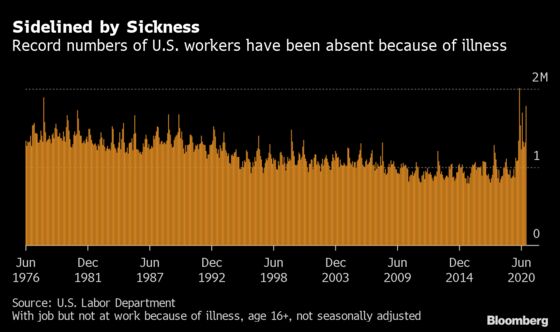
Amid the surge in the ranks of the unemployed during the pandemic, another crucial problem in the labor market has gone mostly overlooked: Workers are calling out sick in record numbers this year.
Whether it’s because they have Covid-19 themselves, are worried about getting it or are taking care of someone who already has it, the number of workers who’ve missed days on the job has doubled in the pandemic.
What’s more, unlike the jobless rate, which has steadily declined from its April peak, the rate of abseenteism — as it is called by economists — has remained stubbornly high. Almost 1.8 million workers were absent in November because of illness, nearly matching the record 2 million set back in April, according to Labor Department data.
These lost days of work are sapping an economic recovery that’s been progressing in fits and starts for much of the past several months. While some indicators have improved markedly, others such as retail sales and consumer spending and incomes have weakened as the pandemic rages on and local governments impose fresh restrictions on businesses and travel.
Michael Gapen, chief U.S. economist at Barclays Plc, said that the vaccine could start driving down absenteeism by the second quarter. Until then, he said, the missed work is leading to supply chain disruptions.
Absenteeism “could lead to shortages, it could lead to higher prices and more restrained output,” Gapen said.
With about 1.5 million new cases per week and deaths at a record pace, employee absenteeism may remain elevated for some time, especially in early 2021 before vaccines are widely distributed and with the rollout in the U.S. moving slower than government officials expected.
Factory Workers
While the Labor Department data tracks people currently in the labor force who are out sick, a separate survey by the Census Bureau captures an even wider view of the challenge. Its latest Household Pulse Survey — based on responses in late November and early December — estimates that more than 11 million people weren’t working because of the virus. The figures also include those who refrained from working because they were worried about getting or spreading the virus, and those caring for someone with symptoms.
The effects of missing workers are especially concentrated in manufacturing. Absenteeism, combined with short-term shutdowns to sanitize facilities and difficulties in returning and hiring workers, limit the sector’s growth potential, according to Timothy Fiore, chair of the Institute for Supply Management’s Manufacturing Business Survey Committee.
The group’s gauge of factory activity grew at a slower pace in November, with the employment component falling back to a level that indicates contraction.
“It’s not a lack of work,” Fiore said on a recent call with reporters, noting absenteeism especially for low- to medium-skill roles. “It’s a lack of people.”
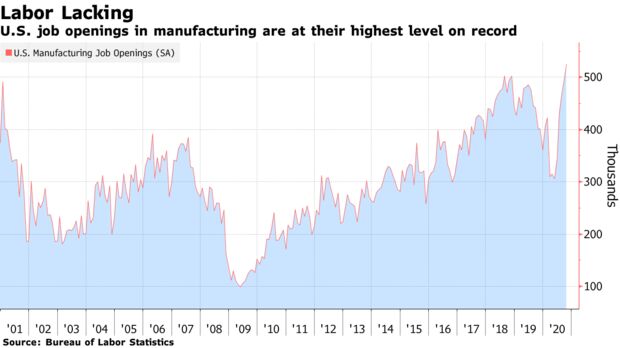
In addition to temporarily absent workers, the manufacturing sector has 525,000 job openings, the most in Labor records back to 2000.
Auto plants are feeling the effects. General Motors Co. put white-collar employees on the production floor in August to cope with high absenteeism amid strong demand. Volkswagen AG Chief Financial Officer Frank Witter has said high levels of missing staff left the automaker “at times struggling to get all the cars built for customer orders.”
U.S. businesses have reported that surging cases precipitated plant closings and infection fears, adding to labor challenges including absenteeism and attrition, according to the Federal Reserve’s latest Beige Book summary of economic conditions. Manufacturers in the Chicago region have used overtime to make up for staff shortages, the Dec. 2 report said.
Sick Leave
For office workers, 90% of professionals said before the pandemic they’d sometimes go to work sick, according to a 2019 study by staffing firm Accountemps. Covid changed the conversation, and more employees are staying home to protect themselves and others.
The Families First Coronavirus Response Act earlier this year made the decision to stay home easier for some Americans by allowing two weeks of paid sick leave for certain employees. The law also allows leave for those unable to work because they must care for a child.
The latest stimulus bill, signed by President Donald Trump on Dec. 27, includes an extension of the act through March 31, but makes paid leave voluntary for employers rather than mandatory as it was in the first iteration. That may continue the trend of workers staying home depending on how many employers choose to grant the leave.
The act, however, excludes essential workers, which means those employed at facilities such as meatpacking plants can’t take advantage of the policy. That in turn can lead to workplace outbreaks and further disrupt production.
With fewer employees at work, slaughter rates at U.S. meat plants fell in the third quarter. Tyson Foods Inc. Chief Executive Officer Dean Banks said on a recent earnings call that absenteeism has “increased the cost and complexity of our operations” and that the company expects that to continue in 2021.