Drug price hikes cost US billions, report finds

https://thehill.com/policy/healthcare/464891-drug-price-hikes-cost-us-billions-report-finds?utm_source=&utm_medium=email&utm_campaign=25262


Drug companies raised prices on seven popular drugs during 2017 and 2018 without clinical evidence that the drugs had been improved in any way, according to a new report.

The increases cost patients and insurers more than $5 billion, the Institute for Clinical and Economic Review (ICER) found in its report. None of the drugs examined showed evidence of improved safety or effectiveness, the analysis found.

The report looked at the seven top-selling drugs by sales revenue that had price increases of more than two times inflation, as measured by the medical consumer price index.

The culprits, and how much they added to drug spending over two years:

  • Humira: $1.9 billion
  • Rituxan: $806 million
  • Lyrica: $688 million
  • Truvada: $550 million
  • Neulasta: $489 million
  • Cialis: $403 million
  • Tecfidera: $313 million

Read more here.


Medicare overpays hospitals $1B each year for graduate medical education, study finds

https://www.beckershospitalreview.com/payer-issues/medicare-overpays-hospitals-1b-each-year-for-graduate-medical-education-study-finds.html?oly_enc_id=2893H2397267F7G

Related image

Medicare overpaid hospitals about $1.3 billion in 2015 for the government’s Teaching Health Center Graduate Medical Education program, according to a study published in JAMA Internal Medicine.

The Graduate Medical Education rate is $150,000 per resident. While 25 percent of hospitals received less than $106,000 per resident in 2015, 25 percent received more than $182,000 per resident. That same year, nearly half of teaching hospitals got more than $150,000 per resident.

If Medicare GME payments were capped at the $150,000 rate, researchers predict Medicare would save more than $1 billion every year.

“Our study suggests Medicare GME may be overpaying some hospitals up to $1.28 billion annually,” said Candice Chen, MD, lead study author and associate professor of health policy and management at the George Washington University Milken Institute School of Public Health in Washington, D.C. “Those funds could be redirected and used to strengthen the physician workforce, especially in underserved areas.”


25% of US healthcare spending is waste, study finds

https://www.beckershospitalreview.com/finance/25-of-us-healthcare-spending-is-waste-study-finds.html?oly_enc_id=2893H2397267F7G

Image result for Journal of the American Medical Association (JAMA) Publishes Humana Study on Health Care Spending


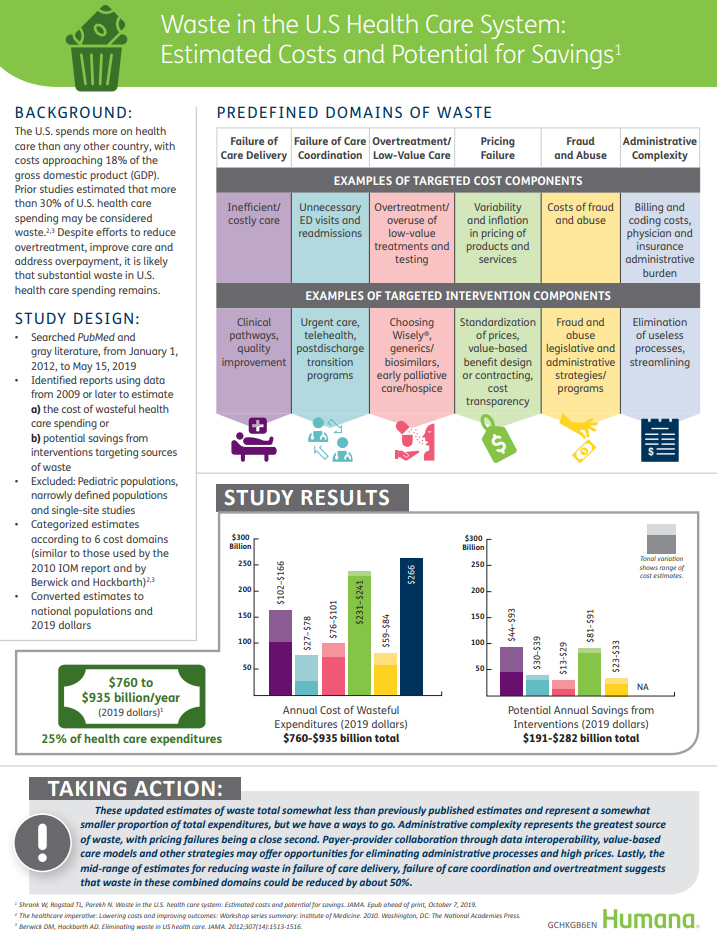
About 25 percent of U.S. healthcare spending can be classified as waste, according to a new study published in JAMA Oct. 7. 

For the study, researchers from Humana and the University of Pittsburgh School of Medicine analyzed 54 peer-reviewed studies, government reports and other medical literature to estimate the levels of waste in the U.S. healthcare system.

Researchers divided waste into six previously developed categories including: failure of care delivery; failure of care coordination; overtreatment or low-value care; pricing failure; fraud and waste; and administrative complexity. 

Administrative complexity accounted for the most waste with $265.6 billion annually, followed by pricing failure or inefficiencies, which accounted for up to $240.6 billion in waste per year.

Approximately $300 billion in waste accrued from failure of care delivery, failure of care coordination and overtreatment. The study estimated that about half of this waste could be avoided.

Overall, the researchers found that the cost of waste in the U.S. healthcare system ranges from $760 billion to $935 billion annually.

Of the $760 billion to $935 billion of waste, researchers estimated that using interventions found to reduce waste could cut between $191 billion and $282.1 billion in healthcare spending.

Access the full report here. 


CommonSpirit ends fiscal year with $582M operating loss, lays out plan for improvement

https://www.beckershospitalreview.com/finance/commonspirit-ends-fiscal-year-582m-operating-loss-lays-out-plan-for-improvement.html?em=&oly_enc_id=2893H2397267F7G

Image result for commonspirit health headquarters

CommonSpirit Health, which operates 142 hospitals in 21 states, reported an operating loss in the fiscal year ended June 30, but top executives say they expect the system’s performance to improve. 

Chicago-based CommonSpirit was formed through the Feb. 1 merger of San Francisco-based Dignity Health and Englewood, Colo.-based Catholic Health Initiatives. Since the merger occurred less than a year ago, financial and operating results were presented on a pro forma basis, using accounting records of CHI and Dignity Health as if they had been combined for the full fiscal 2019.

CommonSpirit reported operating revenues of $28.8 billion in fiscal 2019, down from $29.2 billion in the year prior. The health system said the year-over-year decline in revenue was largely attributable to California provider-fee program income recognized in fiscal 2018. Last year’s results also included income from the operations of U.S. HealthWorks and the gain on its sale.

After factoring in a year-over-year increase in operating expenses, CommonSpirit posted an operating loss of $582 million in fiscal 2019. That’s compared to operating income of $244 million a year earlier. The system’s nonoperating income dropped from $966 million in fiscal 2018 to $328 million.

CommonSpirit CFO Daniel Morissette told Becker’s Hospital Review the results were expected given the scope and complexity of the merger. 

“We’re simply not where we need to be in terms of performance,” he said. “The whole organization is motivated and is aware of the work that needs to be done to improve these results.”

Over the past eight months, CommonSpirit has centralized key functions, such as IT and contracting, and established 11 geographic divisions across 21 states. It has also begun to scale successful service lines and executed a $6.5 billion debt restructuring, which drew demand from investors and support from financial analysts.

Looking ahead, Mr. Morissette said a strong operating model and a systemwide performance plan will help CommonSpirit achieve an 8 percent EBIDA margin within the next four years. The plan will also help the system build healthier communities, which is the real purpose behind the merger, he said.

CommonSpirit’s CEOs Kevin E. Lofton and Lloyd H. Dean reiterated those goals.

“CommonSpirit has made huge strides toward creating a bold new health organization that will deliver care for many years to come and improve the health of communities across the country,” Mr. Dean said in an earnings release. “We know this is not an easy task and that we face challenges in the near term, which is why we are investing in a strong, disciplined business model that will help the organization evolve to meet the changing health care needs of our communities.”