The “Medicare for All” Continuum: A New Comparison Tool for Congressional Health Bills Illustrates the Range of Reform Ideas

https://www.commonwealthfund.org/blog/2019/medicare-all-continuum

Medicare for all paperwork

Several 2020 Democratic presidential candidates have called for “Medicare for All” as a way to expand health coverage and lower U.S. health care costs. Replacing most private insurance with a Medicare-like system for everyone has instilled both hope and fear across the country depending on people’s perspective or financial stake in the current health care system. But a closer look at recent congressional bills introduced by Democrats reveals a set of far more nuanced approaches to improving the nation’s health care system than the term Medicare for All suggests. To highlight these nuances, a new Commonwealth Fund interactive tool launched today illustrates the extent to which each of these reform bills would expand the public dimensions of our health insurance system, or those aspects regulated or run by state and federal government.1

The U.S Health Insurance System Is Both Public and Private

The U.S. health insurance system comprises both private (employer and individual market and marketplace plans) and public (Medicare and Medicaid) coverage sources, as the table below shows. In addition, both coverage sources are paid for by a mix of private and taxpayer-financed public dollars.

Most Americans get their insurance through employers, who either provide coverage through private insurers or self-insure. Employers and employees share the cost through premiums and cost-sharing such as deductibles, copayments, and coinsurance. But the federal government significantly subsidizes employer coverage by excluding employer premium contributions from employees’ taxable income. In 2018 this subsidy amounted to $280 billion, the largest single tax expenditure.

About 27 million people are covered through regulated private plans sold in the individual market, including the Affordable Care Act’s marketplaces. This coverage is financed by premiums and cost-sharing paid by enrollees. The federal government subsidizes these costs for individuals with incomes under $48,560.

For 44 million people, Medicaid or the Children’s Health Insurance Program is their primary source of coverage. These public programs are financed by federal and state governments, and small individual premium payments and cost-sharing in some states. In most states, these benefits are provided through private insurers.

Medicare covers 54 million people over age 65 and people with disabilities. The coverage is financed by the federal government along with individual premiums and significant cost-sharing. About 20 million people get their Medicare benefits through private Medicare Advantage plans and most beneficiaries either buy supplemental private insurance or qualify for additional coverage through Medicaid to help lower out-of-pocket costs and add long-term-care benefits.

Millions Still Uninsured or Underinsured, Health Care Costs High

The coverage expansions of the ACA — new regulation of private insurance such as requirements to cover preexisting conditions, subsidies for private coverage on the individual market, and expanded eligibility for Medicaid — lowered the number of uninsured people and made health coverage more affordable for many. But 28 million people remain uninsured and at least 44 million are underinsured. In addition, overall health care and prescription drug costs are much higher in the United States than in other wealthy countries. U.S. health care expenditures are projected to climb to nearly $6 trillion by 2027.

The Medicare for All Continuum

To address these problems, some Democrats running for president in 2020 are supporting Medicare for All. Meanwhile, in Congress, Democrats have introduced a handful of bills that might be characterized as falling along a continuum, with Medicare for All at one end.

As our new Commonwealth Fund interactive tool illustrates, the bills range from adding somewhat more public sector involvement into the system, to adding substantially more public sector involvement. The bills may be broadly grouped into three categories:

  • Adding public plan features to private insurance. These include increasing regulation of private plans such as requiring private insurers who participate in Medicare and Medicaid to offer health plans in the ACA marketplaces, and enhancing federal subsidies for marketplace coverage.
  • Giving people a choice of public plans alongside private plans. These bills include offering a Medicare-like public plan option through the marketplaces, extending that option to employers to offer to their employees, giving people ages 50 to 64 the option to buy in to Medicare, and giving states the option to allow people to buy in to Medicaid. These bills also bring the federal government’s leverage into provider rate-setting and prescription drug price negotiation.
  • Making public plans the primary source of coverage in the U.S. These are Medicare-for-All bills in which all residents are eligible for a public plan that resembles the current Medicare program, but isn’t necessarily the same Medicare program we have today. The bills vary by whether people would pay premiums and face cost-sharing, the degree to which they end current insurance programs and limit private insurance, how provider rates are set, whether global budgets are used for hospitals and nursing homes, and how long-term care is financed. All of the bills in this category allow people to purchase supplemental coverage for benefits not covered by the plan.

Looking Forward

Many Democratic candidates who have called for Medicare for All are cosponsors of more than one of these bills. The continuum of approaches suggests both the possibility of building toward a Medicare for All system over time, or adopting aspects of Medicare for All without the disruption that a major shift in coverage source might create for Americans. We will continue to update the tool as new bills are introduced or refined. Users also can view a comparison tool of other wealthy countries’ health systems, which shows where select countries fall on a continuum ranging from regulated systems of public and private coverage to national insurance programs.


Trump continues his war on Americans’ health care to pay for his tax cuts

https://www.americanprogress.org/issues/economy/news/2019/03/11/467108/trumps-fy-2020-budget-exposes-false-promises-misplaced-priorities/

Image result for medicare cuts

After repeatedly trying and failing to repeal the ACA legislatively, President Trump and congressional Republicans have resorted to attacking and weakening the law through executive action, federal waivers to the states to undermine Medicaid expansion, and budget proposals to gut funding levels.

Once again, Trump’s budget proposes massive cuts—$777 billion over 10 years—from repealing the ACA and slashing Medicaid.

Like in his previous two budgets, Trump goes beyond these two measures to attack traditional Medicaid, seeking to restrict federal funding on a per-beneficiary basis or transition to block grant funding. Both of these things would lead to a significant decrease in federal funding and could cause millions of people to lose their health care coverage.

Like in last year’s budget, he encourages states to take Medicaid away from jobless and underemployed Americans, including laid-off workers, people who are going to school, and those who are taking care of children or family members. Medicaid is a lifeline for millions of Americans—including children, veterans, people with disabilities, and individuals affected by the opioid crisis. Tearing down this vital program will make it more difficult for people to access the health care they need to find work, including by preventing people with disabilities from accessing the long-term services and supports they need to participate in the labor market.

After he repeatedly promised to protect Medicare as a candidate, Trump makes changes to Medicare that would shrink the program by $845 billion over the coming decade.


Trump’s 2020 budget proposal: 5 healthcare takeaways

https://www.beckershospitalreview.com/finance/trump-s-2020-budget-proposal-5-healthcare-takeaways.html

Image result for medicaid cuts

President Donald Trump released his $4.75 trillion budget for fiscal year 2020 on March 11. The proposal, titled “A Budget for a Better America: Promises Kept. Taxpayers First,” calls for reductions to Medicare and Medicaid over 10 years and includes provisions related to drug pricing and many other health-related issues.

Below are five healthcare-related proposals in the president’s budget:

1. Discretionary funding for HHS. The budget requests $87.1 billion in discretionary spending for HHS, a 12 percent decrease from 2019 funding levels.

2. Efforts to curb HIV. Keeping with President Trump’s promise in his State of the Union address to end the spread of HIV in the U.S. over the next decade, the budget plan calls for HHS to receive $291 million next year to help curb the spread of the virus. A large portion of the funding — $140 million — would go to the CDC to improve diagnosis and testing for HIV in areas of the U.S. where the virus is continuing to infect people not getting proper treatment.

3. Broad overhaul of Medicaid. Under the budget, nearly $1.5 trillion would be cut from Medicaid over 10 years. However, the budget seeks $1.2 trillion over the next decade for block grants or per-person caps that would start in 2021, according to The Washington Post. The budget plan would also end funding for Medicaid expansion.

4. Medicare funding changes. Under the budget, Medicare spending would be reduced by an estimated $800 billion over 10 years. The budget would reduce the growth of various Medicare provider payments and includes changes aimed at addressing waste and abuse in healthcare and lowering drug prices, according to The Washington Post.

5. Medical research. The plan includes a proposal to cut $897 million from the National Cancer Institute’s budget and an additional $1 billion in cuts to other institutes that do medical research, according to Politico.

Read the full budget plan here.


Segment 6 – Why Healthcare Cost is a Problem

Segment 6 – Why Healthcare Cost is a Problem

Slide14

This segment reviews the impact of relentless increase of U.S. healthcare spending on the economy, politics and society.

In Segment 4, we showed some statistics on relentlessly rising healthcare spending. And in Segment 5 we looked at the Perfect Storm — how rising costs are literally built into the system as it is now.

In this Segment, we will ask the question, So, why is it so bad for health spending to increase? After all, health care is good and noble. By the way, it also creates good-paying jobs.

My answer is that healthcare spending is good, of course, but only up to a point. Past a certain point it is not worth the cost, it sucks money from other important purposes, and it fuels social and political unrest.

Let’s look at each of these arguments. First, are we getting our money’s worth?

Here’s the slide from the last lecture showing the benefit from each additional dollar spent. This is what economists call “marginal benefit.” If you’ve already spent 1,000 dollars, what more do we get by spending 10 or 100 more dollars? The answer is, we get less and less, the more we spend.

On the left side is the column of highly valuable health services like public sanitation and immunizations. For very few dollars spent, we prevent disease and save lives. The next column, moving right, are routine services that give good value for the money spent, like kidney dialysis, chemo for treatable cancers and heart bypass up to age 70. The next column are lower-value services like keeping dying patients in uncomfortable ICU beds. Then we reach a cut-point where we get no added benefit from extra spending, what economists call the “flat of the curve.” This is unnecessary testing, treatments, or drugs, which are wasteful. Here is a list of examples.

Slide06

Doctors and specialists have recently gotten together to identify some worthless habits of care that can be eliminated. They call it the Choosing Wisely campaign, and are trying to get all doctors to break the habit of getting these. Here are some other examples.

Slide21

The last column shows that sometimes giving too many treatments or drugs can actually be harmful. As a geriatric specialist taking care of the elderly, I can tell you that over my years of practice I have definitely cured more people by stopping unnecessary drugs than by overprescribing.

The bottom line is that most experts agree that the US is not getting any more bang by spending more bucks, and in some cases actually doing more harm than good.

The next reason is that health spending is taking money away from other equally important purposes. This is what economists call “opportunity costs.” By spending an extra dollar on healthcare, we are missing the opportunity to buy better education, business investment, housing or infrastructure.

The third reason is budget squeezes. Healthcare is driving up Medicare and Medicaid, for example, which increases the federal budget deficit. It also squeezes states’ share of Medicaid costs, driving up taxes. It squeezes corporate expenses, cutting into investments and employee pay. This also hurts US competitiveness abroad, and it drives some jobs overseas.

Slide14

And the last reason I’ll give is its effect on take-home pay. I showed this graph in Segment 3. The RAND think tank calculated that between 1999 and 2009 Americans were 30% more productive and got 30% more wage compensation, but all of that increase went into health premiums (shown in red), not into take home pay (shown in blue). Healthcare costs are making us feel poorer.

Slide05

I think people are finally getting angry about so much healthcare spending. That’s one big reason they voted for Donald Trump, hoping he could do something dramatic to fix it.

Slide19

I am worried that if left unchecked, soaring healthcare costs will cut into defense spending, drive up the national debt, and ultimately weaken us as a nation.

Slide17

And so, what is the conclusion?

The conclusion is that exorbitant spending is the problem. Health spending eventually leads back into your wallet, and my wallet, and our grandchildren’s wallet in the future.

Slide18

In the next episodes we will discuss how to stop the excessive spending. This will require us to fix the whole healthcare system, not just tinker with insurance, Obamacare markets, and Medicaid. We will also look at some of the ethical issues and the political challenges involved. I’ll see you then.


Segment 5 – Why Is U.S. Healthcare So Expensive?

Segment 5 – Why Is U.S. Healthcare So Expensive?

Slide06


This segment reviews the “Perfect Storm” of reasons for unrestrained increase of healthcare spending in the U.S.

In Episode 4, we zeroed in on what I call the Real Problem with healthcare — relentlessly rising costs.

In this Episode, we will look at why the US spends so much on healthcare. As you can imagine, there are many reasons, not just one. In fact, it’s a perfect storm of bad reasons. We will also look whether we are getting our money’s worth.

Here’s the list. Part 1 & Part 2.

Slide06

Slide07

We will go through each one.

Natural Spending Drivers

Let’s start with some natural drivers of health spending, which are understandable and expected. First, as the population grows, so will health spending. Likewise, as the proportion of older people increases, so will spending. We also expect health spending to increase slowly with inflation. New technologies and medicines increase cost, but we hope will give dramatic benefits. For example, during my 40-year practice lifetime I have seen the introduction of new drugs for diabetes, blood pressure, and virus infections including HIV and flu. I have seen new ultrasound, CT and MRI diagnostics. I have seen cardiac caths, by-passes and joint replacements. These new things are expensive but well worth the cost.

Slide08

But health spending grows from 1-1/2 to 4 times the rate of inflation, much more than would be explained by natural drivers, as we saw previously.

Slide09

Fee for Service Payments

So, let’s look at the other reasons. First and foremost, to my way of thinking, is fee-for-service. Doctors in the US – unlike other countries where they are salaried – get paid for piecework. If a surgeon doesn’t operate, he doesn’t get paid. If a specialist doesn’t have a patient scheduled, HE doesn’t get paid. Money is a powerful incentive. So we should not be surprised if doctors increase their own volume of services, many times unconsciously.

Health Insurance Hides Cost

The next big reason is our health insurance. Until recently premiums were paid by the employer and out-of-pocket copays were minimal. Healthcare felt free to most of us. Most of us had no idea what our care was costing the system, and cared little. Talk about a perfect storm!

Imperfect Market 

Why didn’t market forces keep down costs and spending. Many politicians and reformers think competition as the simple solution to the healthcare cost problem. But economists will tell you that healthcare is not a pure market;  they refer to it as “imperfect.” The reasons are first that no one knows the true price of anything. Have you ever tried to sort out a hospital bill? Ridiculous!

Second, markets rely on buyer and seller having equal footing to negotiate, but most patients dare not quibble with their doctor. Doctors get their feathers ruffled when patients challenge their advice. Third, to make matters worse, patients are a “captive market” – they are often suffering, frightened for their life, and desperate for immediate relief, not exactly a strong bargaining position. Fourth, doctors can control demand. There’s an old joke about the level of eyesight loss that needs a cataract operation – if there’s one doctor in town it’s 20/100, if two doctors it’s 20/80 and if three doctors in town it’s only 20/60.

Administrative Costs

Next is administrative costs. Some economists estimate that up to ¼ of all health spending is for administration, not actual care. This is not surprising knowing how complicated we make our delivery system and financing system. Other countries have one delivery system and one payment system. US has 600,000 separate doctors, 5,500 separate hospitals, and 35 different insurance companies, not counting Medicare and Medicaid. Doctors used to drown in papers; now we spend up to 2 hours doing computer work for every hour of patient care. Don’t you love it?

For comparison, Medicare reports only 2% administrative costs (but some other costs are hidden elsewhere in government).

Inefficiency & Waste

Some other spending drivers include inefficiency. I include in this category unnecessary tests and treatments, as well as wasted effort due to incompatible computerized record systems – there are 632 separate electronics vendors in the US. If airports ran this way, each airline at each airport would have its own unique air traffic control computer that did not connect with each other. All in the name of free market.

Regards unnecessary treatments and procedures, a doctor at Dartmouth named John Wennberg pioneered using Big Data in the 1980s to look at numbers of prostate operations in each individual ZIP code, and found that surgeons in some regions were operating 13 times for often in highest areas than the lowest. Since prostate disease is relatively constant everywhere, this can only mean that doctors practice varies widely – the highest utilizers are doing too many operations.

Monopolies

Next is monopolies. Many small- and medium-sized towns and rural areas can only support one hospital. This creates monopolies with no market forces whatsoever to hold down charges.

Cost Shifting

Cost-shifting means that uninsured patients come to the ER for care. Since the ER doesn’t get paid, the ER shifts the Uninsured cost into the bill for INSURED and Medicare patients. The cost-shifting itself doesn’t increase the costs, but getting care in an ER instead of doctor’s office is the most expensive possible place for care.

New-Technology Policy

The FDA new-technology policy means that FDA rules say that it will approve any new drug or treatment if it shows even the slightest statistical benefit, no matter how small. Some cancer drugs are approved that extend life by only a few weeks. Some medicines are approved, even if the number needed to treat is 100. For example, for some new cholesterol medications, 100 patients need to be treated for 5 years before we see even 1 heart attack prevented. That’s a lot of patients, and a lot of doses, and a lot of dollars. By comparison, since half of appendicitis patients die without treatment, and almost all with appendectomy surgery survive and live happily ever after, the calculated number-needed-to-treat is only 2. So appendectomies are a good valued, but cholesterol medication (for otherwise healthy people) is questionable value.

Non-Costworthy Marginal Benefit

Here is another way of looking at value. As we go from left to right in this graph, we are spending more and more on health care. The more we spend, the higher the cumulative health benefit, at least to start. The first section (Roman number I) are very high value interventions like public health, sanitation, immunizations. The next section (Roman number II) are good value routine health treatments, including kidney dialysis and first-line chemotherapy for treatable cancers. But when we reach the third section (Roman number III), the benefits level off. Bypass surgery is less effective for older patients (and more risky); dying patients don’t survive in intensive care units and are miserable with tubes and futile breathing machines. If we spend even more we reach section Roman numeral IV in which no additional benefit is gained, just a lot of extra testing, treatments or drugs – these are wasted dollars. And if we keep spending more yet, we actually do more harm than good, and can even have deaths on the operating table or reactions to too many drugs. The US is well into section IV and in some cases section V. A lot of other richer countries think that they have already reached the point where spending more will give no benefit or possibly do more harm than good, even though they spend less than the US.

Slide19

In the next episode we will look at the ramifications of so much health spending on the US economy, politics and society. We will look at some potential threats if we do not start to control costs better.

I’ll see your then.


Segment 4 – Healthcare Costs

Segment 4 – Healthcare Costs

Slide05


This segment reviews the relentless growth of healthcare spending in the U.S.

In Segments 2 & 3, we looked at the history of medical care in the U.S. and the birth of employer-based health insurance, along with landmark enactment Medicare and Medicaid. We looked at failed healthcare reform initiatives. This history tells us how we got today’s remarkable advances in medical technology but lackluster health system performance overall.

In Segment 4, we will zero in on the perennial problem of rising costs. We will look at how healthcare costs have grown over time and how we compare to other countries.

Then in Segment 5 & 6, we will ask, why is healthcare so expensive in the US, and is it worth the money? And we will talk about the effects of exorbitant healthcare costs on politics, economy, society and even our future success as a nation.

I call healthcare costs the Real Problem.

Let’s start with a startling fact. Between 1999 and 2009 Americans’ productivity grew by 30%. According to a Rand study, average Americans’ total monthly compensation grew from $6,350 dollars to $8,260 dollars. But all this increase went into healthcarepremiums (shown in red), not into their paychecks (shown in blue).

Slide05

Even though employers paid out more for the average American family, we felt no richer. The culprit was the health system.

Here are some more statistics that show the extent of the cost problem.

The first graph compares healthcare inflation (red bars) with general inflation (blue bars). Health care consistently outpaced general inflation, some times by a lot such as 2007, 2009 and 2015.

Slide06

The next graph shows growth in healthcare spending as a percent of total gross domestic product. This graph goes up to 2014 at 17.4% of GDP. The figure for 2015 was 18%, for a total of 3.2 trillion dollars. This is one-sixth of the entire US economy, directly employing one of every 9 workers, according to NY Times.

Slide08

Let’s compare the US with other countries. This first graph shows that in developed countries, health spending goes up as income goes up, until income reaches $100,000 and then levels off. Except in the US, where we spend an inordinate amount on healthcare.

Slide10

Here are the totals for developed countries – blue for public spending and red for private. US is on the left, head and shoulders above the rest.

Slide11

So, what are the repercussions of all this healthcare spending?

We already talked about its effect on paychecks. Healthcare also adds to the cost of goods; for example GM says that healthcare adds 1500 to 2000 dollars to the cost of every automobile in the showroom. This affects both the consumer but also corporate bottom lines. It is also affecting budgets of state and local governments, including pension fund health costs.

Slide12

Health costs have also taken an increasing chunk of federal spending, growing from around 7% after Medicare was passed in 1965 to almost 29% now of the entire federal budget. It competes with defense, education, and infrastructure.

Slide13

Why are costs so high? And why so much more in the US than in other countries? The answer is a perfect storm of bad reasons.

We will cover these in Segment 5. I’ll see you then.


The Public On Next Steps For The ACA And Proposals To Expand Coverage

https://www.kff.org/health-reform/poll-finding/kff-health-tracking-poll-january-2019/

Key Findings:

  • Half of the public disapproves of the recent decision in Texas v. United States, in which a federal judge ruled that the 2010 Affordable Care Act (ACA) is unconstitutional and should not be in effect. While the judge’s ruling is broader than eliminating the ACA’s protections for people with pre-existing conditions, this particular issue continues to resonate with the public. Continuing the ACA’s protections for people with pre-existing conditions ranks among the public’s top health care priorities for the new Congress, along with lowering prescription drug costs.
  • This month’s KFF Health Tracking Poll continues to find majority support (driven by Democrats and independents) for the federal government doing more to help provide health insurance for more Americans. One way for lawmakers to expand coverage is by broadening the role of public programs. Nearly six in ten (56 percent) favor a national Medicare-for-all plan, but overall net favorability towards such a plan ranges as high as +45 and as low as -44 after people hear common arguments about this proposal.
  • Larger majorities of the public favor more incremental changes to the health care system such as a Medicare buy-in plan for adults between the ages of 50 and 64 (77 percent), a Medicaid buy-in plan for individuals who don’t receive health coverage through their employer (75 percent), and an optional program similar to Medicare for those who want it (74 percent). Both the Medicare buy-in plan and Medicaid buy-in plan also garner majority support from Republicans (69 percent and 64 percent­).
  • Moving forward, half of Democrats would rather see the new Democratic majority in the U.S. House of Representatives focus their efforts on improving and protecting the ACA (51 percent), while about four in ten want them to focus on passing a national Medicare-for-all plan (38 percent).


Health care spending is more than just the parts you see

https://www.axios.com/understanding-health-care-spending-46e21c47-79ee-474b-80ff-778a705cdcae.html

Illustration of a red cross spinning to reveal money

People focus on the health costs that are most tangible and sometimes outrageous to them: their deductibles, and drug costs, and surprise medical bills, and the annual increase in the share of the premium they pay. But there’s more that gets less attention because it’s not as visible to them.

Why it matters: To really understand how Medicare for All or any other big change in health care financing would affect them, people need to understand how they would impact their overall family health budgets. Few people think about the other health costs they pay: their taxes to support health care, or what their employers are paying towards premiums (which is depressing their wages).

Between the lines: Consider this hypothetical example of a total family health “budget”:

  • The Browns, a family of four with at least one member in poor health and a $50,000 income, have standard employer coverage much like 156 million other Americans. They spend $9,250 per year (19% of their income) on health.
  • This includes $3,950 (8% of their income) in out-of-pocket health spending, $3,900 (8% of their income) in health insurance premiums, and, although they are almost certainly not aware of it, approximately $1,400 (3% of their income) in state and federal taxes that fund health programs.
  • The Browns are not taxed on the contributions their employer makes toward health insurance premiums, which economists generally say offset wages. Their employer is contributing an additional $13,050 to their health insurance premiums, as well as $750 in Medicare payroll taxes.
  • When combined, the Brown’s spending on health care and the money spent by their employer on their behalf totals a considerable $23,050. And remember, they make $50,000.

A few ideas that could help people learn more about their health total care spending and how reform proposals might affect their health spending:

  • The IRS and states could include a simple pie chart on everyone’s tax forms, showing taxpayers where their tax dollars go today.
  • Along with estimating the impact of health reform legislation on the federal budget, or the number of uninsured, the CBO could estimate its impact on typical family budgets, taking into account all of the forms of health spending families have today. Organizations like ours could do this as well.

What to watch: This could be particularly important when analyzing Medicare for All proposals, since they would so significantly alter the financing of health care by shifting it from premiums and out-of-pocket costs to taxes.

  • A Medicare for All plan would likely reduce what the nation spends on health care by lowering payment rates to providers and creating administrative efficiencies. The average family would likely pay less, but how much is hard to say without more details.
  • However, by changing the financing so significantly, there would likely be both winners and losers. Low-income people and sick people might pay less, and higher-income people and those who are healthy could pay more.

The bottom line: We can only get a clear picture of how family finances would be affected by Medicare for All, or any other significant overhaul of the health care system, by looking at the totality of what they pay now.


Insurers don’t pay full price for medicines, why do you?

https://www.letstalkaboutcost.org/

Image result for health insurance drug discounts

A new study found net prices for medicines grew just 1.5% last year. Unfortunately, it doesn’t feel that way for you. Forty percent of a medicine’s list price is given as a rebate or discount to the government and middlemen, like insurers and pharmacy benefit managers (PBMs).

These rebates and discounts exceed $150 billion annually, but insurers don’t always share these savings with you.

Visit LetsTalkAboutCost.org to find out more.


The Health 202: Jayapal to roll out sweeping Medicare-for-All bill by month’s end

https://www.washingtonpost.com/news/powerpost/paloma/the-health-202/2019/02/14/the-health-202-jayapal-to-roll-out-sweeping-medicare-for-all-bill-by-month-s-end/5c6496121b326b71858c6b85/?noredirect=on&utm_term=.3b80663a6c98

Image result for medicare at 50

Rep. Pramila Jayapal (D-Wash.) is seeking buy-in from more fellow Democrats for a sweeping Medicare-for-all bill she is poised to release near the end of the month.

It’s a proposal that has become a rallying cry for progressives and 2020 presidential candidates, but it is also exposing deep rifts in the Democratic Party over exactly how to achieve universal health coverage in the United States.

The Medicare for All Act of 2019, which Jayapal had planned to roll out this week but delayed because she was seeking more co-sponsors, would create a government-run single-payer health system even more generous than the current Medicare program. Her office hasn’t publicly released the details of the upcoming measure, but Democratic members told me it would cover long-term care and mental health services, two areas where Medicare coverage is sparse.

The bill also proposes to add dental, vision, prescription drugs, women’s reproductive health services, maternity and newborn care coverage to plans that would be available to people of all ages and would require no out-of-pocket costs for any services, according to a letter Jayapal sent to colleagues on Tuesday asking them to consider co-sponsoring the effort.

“Medicare for All is the solution our country needs,” the letter said. “Patients, nurses, doctors, working families, people with disabilities and others have been telling us this for years, and it’s time that Congress listens.”

The 150-page bill had 93 co-sponsors as of Tuesday, although Jayapal spokesman Vedant Patel said more Democrats have signed on since then. That’s still fewer than the 124 Democrats who co-sponsored a much less detailed Medicare-for-all proposal from then-Rep. John Conyers (D-Mich.) last year. A strategist who has been working with Democrats on health-care ideas told me there have been some frustrations that more members haven’t yet signed on to Jayapal’s bill, despite the fact that there are 40 more Democrats in the House this year.

But Jayapal said she’s confident she’ll have 100 co-sponsors by the time of the bill’s planned Feb. 26 release, explaining she’s not surprised members would take more time to consider it given its length.

“It’s a 150-page bill … it’s not an eight-page resolution,” Jayapal told me yesterday. “Now we’re actually putting detail into it, and so we feel confident we will continue to add cosponsors even after introduction.”

Patel also noted it’s still early in the year, saying he “disagrees” with the notion that it’s taking a long time to bring Democrats on board.

“It’s the second week of February and we are at more than 95 co-sponsors,” he said. “Coalition building is a process, but we are on track to introduce this historic legislation with resounding support at the end of the month.”

Yet differences are emerging among Capitol Hill Democrats over how to expand coverage, part of a larger debate roiling the party as 2020 candidates, many of them senators, and a new class of freshmen House Democrats move the party left not only on health care but also on the environment.

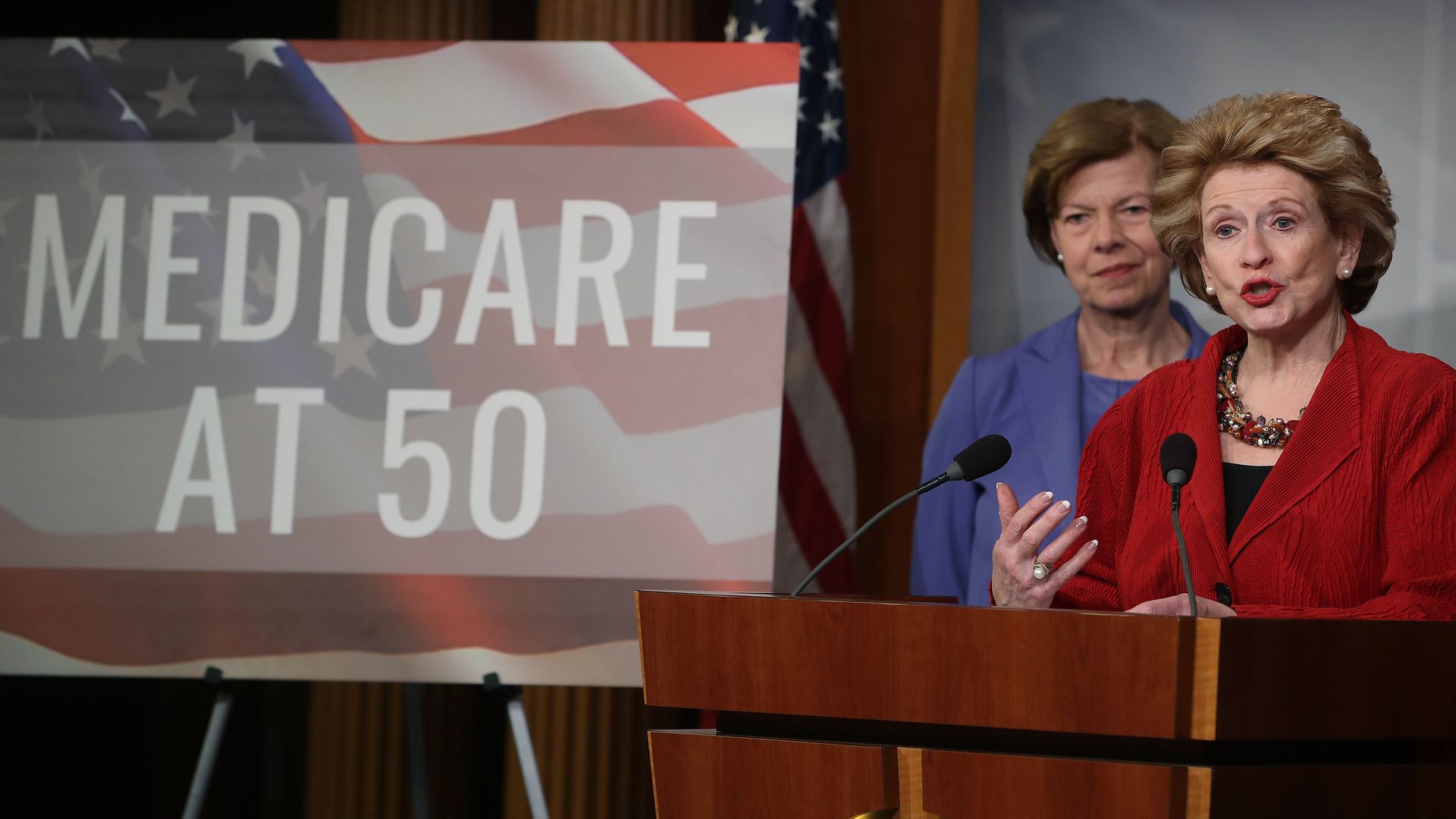
The cracks were especially apparent yesterday, as a separate group of lawmakers gathered to re-introduce their own proposal to allow people to buy in to Medicare starting at age 50. That measure, offered by Sen. Debbie Stabenow (D-Mich.) and Rep. Brian Higgins (D-N.Y.), would take a more incremental approach to expanding health coverage — one that could play better with voters who would stand to lose private coverage under a single-payer program.

Their bill, dubbed the “Medicare at 50 Act,” would allow people to buy Medicare plans instead of purchasing private coverage on the Obamacare marketplaces if they are uninsured or prefer it to coverage offered in their workplace.

And today, Sen. Brian Schatz (D-Hawaii) and Rep. Ben Ray Luján (D-N.M.) are reintroducing their State Public Option Act, which allows people to buy a Medicaid plan regardless of their income. That measure has broad backing from not just lawmakers (20 senators co-sponsored it last year) but also well-known health policy wonks including former Centers for Medicare and Medicaid Services Administrator Andy Slavitt.

Higgins is one of several Democrats on the House Budget Committee who have proposed a total of three separate and contrasting bills to expand Medicare to more people. The others are Reps. Rosa DeLauro (D-Conn.) and Jan Schakowsky (D-Ill.), who have a bill to expand Medicare to all ages while still preserving employer-sponsored coverage, and Jayapal.

Once Jayapal rolls out her legislation, the Congressional Budget Office is expected to release an analysis of how much it would cost by the end of March or the beginning of April, Budget Committee Chairman John Yarmuth (D-Ky.) told me. At that point, the committee will hold a hearing with the CBO to go over the cost and its potential impact on the federal budget.

That’s where Jayapal could run into roadblocks.Given the extensive benefits she’s proposing, her bill would probably come at a steep cost to taxpayers — and paying for things is almost always Congress’s trickiest task. Of course, supporters of the legislation stress its benefits would fill in much-needed gaps in coverage under the current Medicare program.

“The biggest change I give her so much credit for is it has long-term care,” said Rep. Ro Khanna (D-Calif.), who is a co-sponsor of Jayapal’s Medicare-for-all bill. “This is huge.”

And then there’s also the question of how voters might react if told they would lose their current coverage. Sen. Kamala Harris (D-Calif.), who has gone the furthest of all the 2020 candidates in pushing for an overhaul of the U.S. health-care system, attracted widespread attention recently when she suggested she’d be fine with entirely eliminating private coverage in favor of government-run plans.

“We’re very aware that there is anxiety about — however imperfect — a system you know and doctors you know, and that is going to be all part of the hearing process, public input into: How do we build a system in this country that really cares about all Americans?” said Rep. Katherine Clark (D-Mass.), another co-sponsor of the Jayapal bill.