GOP takes heavy fire over pre-existing conditions

http://thehill.com/policy/healthcare/351628-gop-takes-fire-on-pre-existing-conditions

Image result for pre-existing conditions

The new ObamaCare repeal measure from Senate Republicans would give states a way to repeal protections for people with pre-existing conditions, a controversial move that opponents of the bill are denouncing.

The provision attracted widespread attention on Wednesday after late-night host Jimmy Kimmel blasted Sen. Bill Cassidy (R-La.), a lead author of the legislation. Kimmel said the senator is violating the “Jimmy Kimmel test,” which Cassidy coined as a way of saying that no one should be denied care because they can’t afford it.

“This guy Bill Cassidy just lied right to my face,” Kimmel said.

Cassidy denies that his bill would hurt people with health problems. Before getting a waiver from ObamaCare regulations, he notes, states would have to tell the government how they would provide “adequate and affordable” coverage to people with pre-existing conditions.

Sen. Lindsey Graham (R-S.C.), another author of the bill, was blunt about the claim people would be denied coverage.

“It’s garbage,” he told NBC News.

The language in the Cassidy-Graham bill would specifically allow states to waive an ObamaCare rule that prevents people with pre-existing conditions from being charged higher premiums due to their illness.

Without that protection, experts warn that coverage could become unaffordable for many.

“Premiums could be unlimited for people who are sick,” said Larry Levitt, a health policy expert at the Kaiser Family Foundation.

Experts note that there is no clear definition in the bill of what “adequate and affordable” care means. Without such language, the waivers would essentially be a judgment call for the secretary of Health and Human Services, a position now held by Tom Price.

Levitt said there is a “pretty low bar” in the legislation for states to be able to waive the ObamaCare protections.

Dick Woodruff, vice president of the American Cancer Society Cancer Action Network, said he is “extremely worried” about the repeal bill’s effect on cancer patients.

“It would have the effect of undoing the patient protections in the Affordable Care Act,” Woodruff said.

Adding to the anxiety about the bill, it would allow states to waive ObamaCare’s essential health benefits, which require insurance plans to cover a range of services like mental health or prescription drugs.

While Kimmel, whose infant son was born with a congenital heart defect, gave publicity to the pre-existing condition issue this week, GOP senators have mostly been quiet on the issue.

That’s a reversal from the summer, when more moderate Republican senators strenuously objected to efforts by Sen. Ted Cruz (R-Texas) and other conservatives to roll back the ObamaCare protections around pre-existing conditions.

“We’re not going to do anything to change the current law when it comes to pre-existing conditions, I know which was a big concern with the House bill,” Sen. John Cornyn (Texas), the Senate’s No. 2 Republican, said in June, referencing the worries in the Senate GOP conference.

But now, with a new bill that allows states to repeal those protections, GOP senators have not raised the same objections.

The Graham-Cassidy bill suddenly appears to have a real chance of passing, catching Democrats and opponents by surprise.

The legislation has not received as much scrutiny as previous repeal bills and could pass before the Congressional Budget Office is able to fully analyze it.

Cassidy and Graham say their bill is about empowering the states to make decisions about their own health-care systems.

“Democrats are more comfortable with power being in Washington, D.C., and individuals kind of being directed how they live their life,” Cassidy said on MSNBC on Wednesday. “Republicans are more comfortable giving power back to the patient, power back to the state.”

Health-care groups reject that argument.

The American Medical Association warned in a letter to Congress that the bill “would result in millions of Americans losing their health insurance coverage.”

It would also “allow insurers to charge unaffordable premiums based on … pre-existing conditions,” the group said.
Study: Most states would take a hit from GOP health bill

https://apnews.com/a533c012173f4d879bee565f6fe1eec2/Study:-Most-states-would-take-a-hit-from-GOP-health-bill

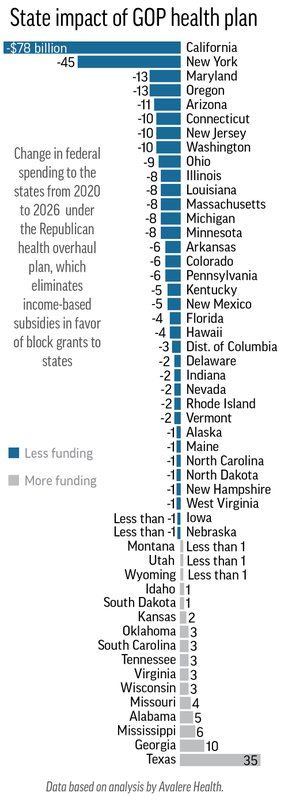
Most states would take a stiff budgetary hit if the latest Senate GOP health care bill becomes law, according to an analysis released Wednesday. That would likely result in more uninsured Americans.

The study by the consulting firm Avalere Health found that the Graham-Cassidy bill would lead to an overall $215 billion cut to states in federal funding for health insurance, through 2026. Reductions would grow over time.

“A reduction in federal subsidies for health insurance is likely to result in more people being uninsured,” said Caroline Pearson, a senior vice president at Avalere, which specializes in health industry research. The study itself did not make estimates of the impact on insurance coverage.

States that voted for President Donald Trump would not be immune from cuts, though deep-blue California and New York face the deepest reductions. West Virginia, a Trump bastion, would see a $1 billion cut from 2020-2026.

The Avalere analysis comes as Senate leaders are rushing a vote on the legislation by the end of the month, before the expiration of special budget rules that allow passage by a simple majority. The findings could take on added importance, because the nonpartisan Congressional Budget Office says it can’t complete a full analysis of the bill by the Sep. 30 vote deadline.

Named for Republican Sens. Lindsey Graham of South Carolina and Bill Cassidy of Louisiana, the bill would repeal much of the Obama-era Affordable Care Act and limit future federal funding for Medicaid. That federal-state health insurance program covers more than 70 million low-income people, ranging from newborns to elderly nursing home residents. Compared to current projected levels, Medicaid spending would be reduced by more than $1 trillion, or 12 percent, from 2020-2036, the study found.

The bill would also end Obama’s health insurance subsidies and put money into a big pot that would distributed among the states. Governors and legislatures would have broad leeway on how to spend the money, and could also seek waivers from ACA insurance requirements. Though insurers would still have to cover people with medical problems, in some states they may be able to charge them more.

The Avalere study also found that over 20 years cuts could potentially total more than $4 trillion, but that scenario appears unlikely. It’s based on a literal reading of the bill, under which legal authority for the big pot of money to subsidize coverage would expire after 2026. Typically, Congress renews expiring programs.

Still, the study found more losers than winners. Thirty-four states would see cuts by 2026, while 16 would see increases. Among the losers are several states that were key for President Donald Trump, including Florida, Pennsylvania, Michigan, and Ohio.

Arizona and Alaska would be losers, a detail that could be important. Sens. John McCain, R-Ariz., and Lisa Murkowski, R-Alaska, are seen as undecided on the legislation, and Republican leaders cannot afford many defections.

New Jersey Republican Gov. Chris Christie said Wednesday he is opposed to the Graham-Cassidy bill because of cuts to his state, estimated by Avalere at $10 billion from 2020-2026.

Texas would be the biggest winner, with a $35-billion funding increase by 2026. Georgia, Alabama, Tennessee and Virginia would also see funding gains, as would Wisconsin and Wyoming.

Within states, the analysis found that there could be winners and losers among people at different income levels. Because the GOP bill focuses on providing money to cover poor people and the near-poor, states may decide to reduce support for middle-class people who now receive subsidies under Obama’s law.

Funding for the Avalere report was provided by the Center for American Progress, a liberal think tank. Avalere said it maintained full control over the research and the think tank did not influence the findings.

GOP leaders and the White House are pushing for a vote next week.


California would lose $78 billion — more than any other state — under GOP health bill

http://www.sfchronicle.com/business/article/California-would-lose-78-billion-more-than-12215611.php

Image result for aca repeal

California would lose more federal funding than any other state under the latest GOP plan to repeal the Affordable Care Act, according to an analysis released Wednesday by the health policy consulting firm Avalere Health.

By 2026, California would lose $78 billion in federal money for the Medi-Cal insurance program for the poor and in federal subsidies for low-income residents who buy health insurance through Covered California, the state exchange created under the ACA. That figure represents a 13 percent drop in federal funding levels, according to the analysis, which was funded by the left-leaning think tank Center for American Progress.

Blue states like California and New York that accepted the ACA’s additional federal dollars to expand Medicaid would be hit disproportionately hard by the bill, advanced by Sens. Lindsey Graham (R-S.C.) and Bill Cassidy (R-La.). By comparison, some red states that did not expand Medicaid would see an increase in federal funding. Texas, for instance, would receive $35 billion more from the federal government in 2026, the analysis found.

“The bill reallocates funding from states that expanded Medicaid to those that did not,” said Caroline Pearson, senior vice president at Avalere Health. “So a large state like California, which has had a big Medicaid expansion under the ACA, (is) going to be worse off.”

The Graham-Cassidy bill is similar to previous GOP bills that failed to gain enough support in the Senate earlier this year. It would eliminate the ACA’s individual and employer mandate and the expansion of Medicaid — which allowed California to enroll 4 million new people. It would also phase out federal subsidies currently used by 1.3 million low-income Californians to buy health insurance through Covered California.

Cassidy and Graham released their own estimates of how the bill would impact states, finding that California would receive roughly the same amount of federal funding under their plan. However, outside analysts said this estimate understates the impact to states because it was based on a misleading comparison. Rather than comparing spending levels under the GOP bill to spending levels under the ACA for the same year, it compares spending levels under the GOP bill for 2026 to spending levels under the ACA for 2020. This comparing apples to oranges, analysts said, because health costs rise over time, regardless of changes to health policy.

The non-partisan Congressional Budget Office plans to release a partial assessment of the bill next week.

The bill proposes grouping together the two streams of federal funding — federal subsidies for those buying Covered California plans and federal funding for Medi-Cal expansion — capping it, and then decreasing the amount over time through a mechanism known as a block grant. The funding for the block grants would end altogether after 2026, though Congress would have authority to reauthorize them.

In addition, the bill would impose a cap on federal funding for the overall Medi-Cal program. Currently, Medi-Cal is an open-ended program, meaning federal contributions increase to accommodate changing health care needs among beneficiaries.

This week, a group of Republican governors, led by Wisconsin’s Scott Walker, expressed support for the bill, saying that block grants give states flexibility and control over spending — though some GOP governors, including John Kasich of Ohio and Brian Sandoval of Nevada, have said they oppose the bill.

While the state would get flexibility in deciding how to spend the block grant, the net loss in federal dollars would be so significant that state officials would likely have to cut benefits for Medi-Cal recipients or make eligibility rules stricter so fewer people would receive benefits, experts said.

“Those caps on federal funding would mean billions of lost Medi-Cal dollars in the state, and the state legislature would have to decide how to respond to that,” said Laurel Lucia, a health policy researcher at the UC Berkeley Labor Center, which released a separate analysis this week on the impact of the Graham-Cassidy bill. “They could cut eligibility, benefits. They could find money in other parts of the budget. But the cuts we’re talking about are at such a large scale it’d be difficult choices they’d face.”

The UC Berkeley analysis found that 6.7 million Californians would lose health insurance in 2027 under the bill: the 4 million enrolled in Medi-Cal expansion, 1.3 million who have subsidized coverage through Covered California, and an additional 1.4 million children, seniors and people with disabilities currently on Medi-Cal. A small percentage of these individuals may be able to buy coverage without subsidies or enroll in employer-sponsored health plans, but the vast majority would become uninsured, researchers said.

The center based its findings on data from the left-learning Center on Budget and Policy Priorities, and the assumption that California would respond to the Medi-Cal funding cap by cutting eligibility or limiting enrollment for certain groups.

“This bill would be more severe than simply rolling back the ACA,” Lucia said. “It rolls back the ACA and makes additional cuts to Medi-Cal on top of that.”


Graham-Cassidy-Heller-Johnson Bill Would Reduce Federal Funding to States by $215 Billion

http://avalere.com/expertise/life-sciences/insights/graham-cassidy-heller-johnson-bill-would-reduce-federal-funding-to-sta

New analysis from Avalere finds that the Graham-Cassidy-Heller-Johnson (GCHJ) bill to repeal and replace the Affordable Care Act (ACA) would lead to a reduction in federal funding to states by $215B through 2026 and more than $4T over a 20-year period.

The proposed legislation would repeal the ACA’s Medicaid expansion, premium tax credits, cost sharing reduction (CSR) payments, individual and employer mandates, and the Basic Health Program (BHP). Instead, the bill would provide states with block grants to fund health insurance coverage in their state. The bill would also change the financing structure for the traditional Medicaid population from an open-ended approach to a fixed per capita cap or block grant approach.

“The Graham-Cassidy bill would significantly reduce funding to states over the long term, particularly for states that have already expanded Medicaid,” said Caroline Pearson, senior vice president at Avalere. “States would have broad flexibility to shape their markets but would have less funding to subsidize coverage for low- and middle-income individuals.”

Avalere’s analysis projects the impact of the bill compared to current law and details the expected cumulative changes in federal funding for each state through 2026, 2027, and 2036.

Who Loses the Most?

The Obamacare replacement bill now being considered in the Senate — and scheduled for a vote next week — would reduce federal funding to states for health care by $215 billion through 2026, and those cuts would shoot up to more than $4 trillion through 2036, according to a new analysis by consulting firm Avalere Health.

What it means for states: The analysis found that the Graham-Cassidy bill’s approach to Medicaid financing, which would award block grants to states and implement a per capita cap, would reallocate federal money, creating near-term winners and losers. Thirty-four states and the District of Columbia would see funding reductions by 2026, with states that expanded Medicaid under Obamacare being hardest hit. Seven states would lose more than $10 billion each, with California losing $78 billion and New York funding dropping by $45 billion.

The block grant funding in the bill expires in 2026, and Congress would have to re-appropriate money for the block grants to continue. “The ability of the Congress to appropriate additional funding is uncertain and could be constrained by the need to offset the cost,” the report says. Without that renewed funding, by 2036 all states would have their funding reduced compared with the current law.

Other winners and losers: “The bill creates a financial incentive for states to direct coverage to very low-income residents near or below the poverty line, potentially at the expense of lower-middle-income individuals who currently receive exchange subsidies,” Avalere’s Chris Sloan said. Separately, analysts at The Commonwealth Fund and the liberal Center for American Progress found that 32 million fewer people would have health coverage after 2026.

Why it matters: The Avalere estimate may be the best available given that the non-partisan Congressional Budget Office said it would only be able to provide a partial assessment of the bill’s effects by early next week and would require at least several weeks to evaluate the legislation’s potential effects on the deficit, health insurance coverage levels and premiums.

The figures are sure to ramp up criticism of the bill, which would repeal Obamacare’s subsidies for health coverage in the individual market and its expansion of Medicaid benefits for low-income Americans, among other things. Health care groups, a number of governors and even talk show host Jimmy Kimmel have come out against the bill as Senate Republicans have worked to round up the 50 votes required to pass it.

Cassidy-Graham’s Waiver Authority Would Gut Protections for People with Pre-Existing Conditions

https://www.cbpp.org/blog/cassidy-grahams-waiver-authority-would-gut-protections-for-people-with-pre-existing-conditions

Image result for Cassidy-Graham Waiver Authority Would Gut Protections for People with Pre-Existing Conditions


The revised Affordable Care Act (ACA) repeal plan from Senators Bill Cassidy and Lindsey Graham, which is also backed by Senators Dean Heller and Ron Johnson, would give states broad waiver authority to eliminate the ACA’s core protections for people with pre-existing health conditions. These waivers would come on top of the proposal’s elimination of the ACA’s marketplace subsidies and Medicaid expansion, its radical restructuring of the rest of the Medicaid program, and its large cuts to total federal funding for health insurance coverage.

Specifically, a little-noticed provision of the block grant funding states would receive under the plan would let them obtain waivers of ACA pre-existing conditions protections and benefit standards for any insurance plan subsidized by block grant funding. For example, a state that used a small portion of its block grant funding to provide even tiny subsidies to all individual market plans could then waive these protections for its entire individual market. Likewise, states that used block grant funding to offer or subsidize coverage for low-income people could offer plans with large gaps in benefits. States seeking waivers would have to explain how they “intend” to maintain access to coverage for people with pre-existing conditions, but they wouldn’t have to prove that their waivers would actually do so.

In particular, states could waive the ACA’s:

  • Prohibitions against insurance companies charging people higher premiums based on their health status. While insurers would still be required to offer coverage to people with pre-existing conditions, they could offer them plans with unaffordable premiums of thousands or tens of thousands of dollars per month. For consumers, an offer like that is no different than a coverage denial.
  • Requirements that plans cover “essential health benefits.” Before the ACA introduced the requirement that all plans cover a defined set of basic services, 75 percent of individual market plans excluded maternity coverage, 45 percent excluded substance use treatment, and 38 percent excluded mental health care, according to analysis by the Kaiser Family Foundation. Under the Cassidy-Graham proposal, states could let insurers restore these exclusions, leaving many people — especially those with pre-existing conditions — without access to the health services they need.

The waiver authority included in the Cassidy-Graham plan is similar to the so-called “MacArthur amendment” waivers that were included in the House-passed ACA repeal bill. Analyzing those waivers, the Congressional Budget Office concluded:

  • States accounting for one-sixth of the nation’s population would choose to let insurers charge higher premiums based on health status. In those states, “less healthy individuals (including those with preexisting or newly acquired medical conditions) would be unable to purchase comprehensive coverage with premiums close to those under current law and might not be able to purchase coverage at all [emphasis added].”
  • States accounting for half of the nation’s population would choose to let insurers exclude essential health benefits. In those states, “services or benefits likely to be excluded … include maternity care, mental health and substance abuse benefits, rehabilitative and habilitative services, and pediatric dental benefits.” People needing these services “would face increases in their out-of-pocket costs. Some people would have increases of thousands of dollars in a year.”

Announcing their revised plan, Senators Cassidy and Graham explained that they sought to revise their prior legislation to accomplish the goal of letting states waive the ACA’s core consumer protections. Apparently, they largely succeeded: if their bill were adopted, millions of people with pre-existing conditions would lose access to these protections, and, as a result, would lose access to needed coverage and care.

5 Ways the Graham-Cassidy Proposal Puts Medicaid Coverage At Risk

5 Ways the Graham-Cassidy Proposal Puts Medicaid Coverage At Risk

Image result for 5 Ways the Graham-Cassidy Proposal Puts Medicaid Coverage At Risk


The Graham-Cassidy proposal to repeal and replace the Affordable Care Act (ACA) is reviving the federal health reform debate and could come up for a vote in the Senate in the next two weeks before the budget reconciliation authority expires on September 30. The Graham-Cassidy proposal goes beyond the American Health Care Act (AHCA) passed by the House in May and the Better Care Reconciliation Act (BCRA) that failed in the Senate in July. The Graham-Cassidy proposal revamps and cuts Medicaid, redistributes federal funds across states, and eliminates coverage for millions of poor Americans as described below:
  1. Ends federal funding for current ACA coverage and partially replaces that funding with a block grant that expires after 2026. The proposal ends both the authority to cover childless adults and funding for the ACA Medicaid expansion that covers 15 million adults. Under Graham-Cassidy, a new block grant, the “Market-Based Health Care Grant Program,” combines federal funds for the ACA Medicaid expansion, premium and cost sharing subsidies in the Marketplace, and states’ Basic Health Plans for 2020-2026. Capped nationally, the block grant would be lower than ACA spending under current law and would end after 2026. States would need to replace federal dollars or roll back coverage. Neither the AHCA nor the BCRA included expiration dates for ACA-related federal funds or eliminated the ability for states to cover childless adults through Medicaid.
  2. Massively redistributes federal funding from Medicaid expansion states to non-expansion states through the block grant program penalizing states that broadened coverage. In 2020, block grant funds would be distributed based on federal spending in states for ACA Medicaid and Marketplace coverage. By 2026, funding would go to states according to the states’ portion of the population with incomes between 50% and 138% of poverty; the new allocation is phased in over the 2021-2025 period. The Secretary has the authority to make other adjustments to the allocation. This allocation would result in a large redistribution of ACA funding by 2026, away from states that adopted the Medicaid expansion and redirecting funding to states that did not. No funding is provided beyond 2026.
  3. Prohibits Medicaid coverage for childless adults and allows states to use limited block grant funds to purchase private coverage for traditional Medicaid populations. States can use funds under the block grant to provide tax credits and/or cost-sharing reductions for individual market coverage, make direct payments to providers, or provide coverage for traditional Medicaid populations through private insurance. The proposal limits the amount of block grant funds that a state could use for traditional Medicaid populations to 15% of its allotment (or 20% under a special waiver). These limits would shift coverage and funds for many low-income adults from Medicaid to individual market coverage. Under current law, 60% of federal ACA coverage funding is currently for the Medicaid expansion (covering parents and childless adults). Medicaid coverage is typically more comprehensive, less expensive and has more financial protections compared to private insurance. The proposal also allows states to roll back individual market protections related to premium pricing, including allowing premium rating based on health status, and benefits currently in the ACA.
  4. Caps and redistributes federal funds to states for the traditional Medicaid program for more than 60 million low-income children, parents, people with disabilities and the elderly. Similar to the BCRA and AHCA, the proposal establishes a Medicaid per enrollee cap as the default for federal financing based on a complicated formula tied to different inflation rates. As a result, federal Medicaid financing would grow more slowly than estimates under current law. In addition to overall spending limits, similar to the BCRA, the proposal would give the HHS Secretary discretion to further redistribute capped federal funds across states by making adjustments to states with high or low per enrollee spending.
  5. Eliminates federal funding for states to cover Medicaid family planning at Planned Parenthood clinics for one year. Additional funding restrictions include limits on states’ ability to use provider tax revenue to finance Medicaid as well as the termination of the enhanced match for the Community First Choice attendant care program for seniors and people with disabilities. Enrollment barriers include the option for states to condition Medicaid eligibility on a work requirement and to conduct more frequent redeterminations.
Much is at stake for low-income Americans and states in the Graham-Cassidy proposal. The recent debate over the AHCA and the BCRA has shown the difficulty of making major changes that affect coverage for over 70 million Americans and reduce federal funding for Medicaid. Medicaid has broad support and majorities across political parties say Medicaid is working well. More than half of the states have a strong stake in continuing the ACA Medicaid expansion as it has provided coverage to millions of low-income residents, reduced the uninsured and produced net fiscal benefits to states. Graham-Cassidy prohibits states from using Medicaid to provide coverage to childless adults. With regard to Medicaid financing changes, caps on federal funding could shift costs to states and result in less fiscal flexibility for states. States with challenging demographics (like an aging population), high health care needs (like those hardest hit by the opioid epidemic), high cost markets or states that operate efficient programs may have the hardest time responding to federal caps on Medicaid spending. Faced with substantially reduced federal funding, states would face difficult choices: raise revenue, reduce spending in other areas, or cut Medicaid provider payments, optional benefits, and/or optional coverage groups.

Like Other ACA Repeal Bills, Cassidy-Graham Plan Would Add Millions to Uninsured, Destabilize Individual Market

https://www.cbpp.org/research/health/like-other-aca-repeal-bills-cassidy-graham-plan-would-add-millions-to-uninsured

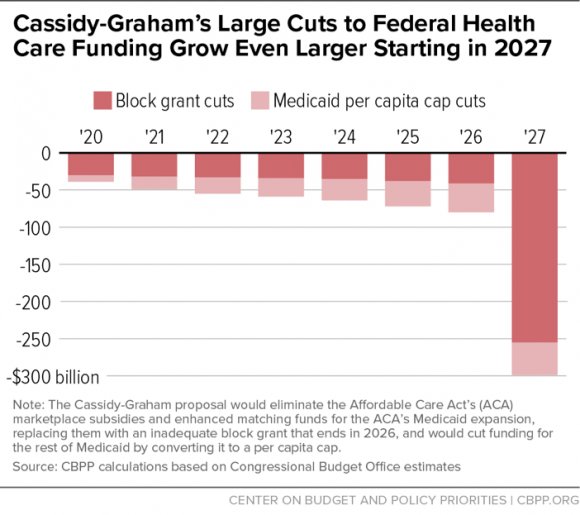
Cassidy-Graham's Large Cuts to Federal Health Care Funding Grow Even Larger Starting in 2027

In releasing a revised version of their legislation to repeal and replace the Affordable Care Act (ACA), Senators Bill Cassidy and Lindsey Graham, along with co-sponsors Dean Heller and Ron Johnson, claimed that their bill isn’t a “partisan” approach and doesn’t include “draconian cuts.” In reality, however, the Cassidy-Graham bill would have the same harmful consequences as those prior bills. IT WOULD CAUSE MANY MILLIONS OF PEOPLE TO LOSE COVERAGE, RADICALLY RESTRUCTURE AND DEEPLY CUT MEDICAID, AND INCREASE OUT-OF-POCKET COSTS FOR INDIVIDUAL MARKET CONSUMERS. It would cause many millions of people to lose coverage, radically restructure and deeply cut Medicaid, eliminate or weaken protections for people with pre-existing conditions, and increase out-of-pocket costs for individual market consumers.

Cassidy-Graham would:

  • Eliminate the ACA’s marketplace subsidies and enhanced matching rate for the Medicaid expansion and replace them with an inadequate block grant. Block grant funding would be well below current law federal funding for coverage, would not adjust based on need, would disappear altogether after 2026, and could be spent on virtually any health care purpose, with no requirement to offer low- and moderate-income people coverage or financial assistance.
  • Convert Medicaid’s current federal-state financial partnership to a per capita cap, which would cap and cut federal Medicaid per-beneficiary funding for seniors, people with disabilities, and families with children.
  • Eliminate or weaken protections for people with pre-existing conditions by allowing states to waive the ACA’s prohibition against charging higher premiums based on health status and the requirement that insurers cover essential health benefits including mental health, substance abuse treatment, and maternity care.
  • Destabilize the individual insurance market in the short run — by eliminating the ACA’s federal subsidies to purchase individual market coverage and eliminating the ACA’s individual mandate to have insurance or pay a penalty —and risk collapse of the individual market in the long run.
  • Eventually result in larger coverage losses than under proposals to repeal ACA’s major coverage provisions without replacement.  The Congressional Budget Office (CBO) has previously estimated that repeal-without-replace would cause 32 million people to lose coverage.  The Cassidy-Graham bill would likely lead to greater numbers of uninsured after 2026, however, because it would not only entirely eliminate its block grant funding — effectively repealing the ACA’s major coverage expansions — but also make increasingly severe federal funding cuts to the rest of the Medicaid program (outside of the expansion) under its per capita cap.

By attempting to push this bill forward now, Senators Cassidy and Graham are reverting to a damaging, partisan approach to repealing the ACA that would reverse the historic coverage gains under health reform and end Medicaid as we know it — even as other members of Congress, with the help of governors and insurance commissioners of both parties, are making progress in crafting bipartisan legislation to strengthen the individual market.

Last-Ditch Effort By Republicans To Replace ACA: What You Need To Know

http://khn.org/news/last-ditch-gop-effort-to-replace-aca-5-things-you-need-to-know/

Related image

Republican efforts in Congress to “repeal and replace” the federal Affordable Care Act are back from the dead. Again.

While the chances for this last-ditch measure appear iffy, many GOP senators are rallying around a proposal by Sens. Lindsey Graham (R-S.C.) and Bill Cassidy (R-La.), along with Sens. Dean Heller (R-Nev.) and Ron Johnson (R-Wis.)

They are racing the clock to round up the needed 50 votes — and there are 52 Senate Republicans.

An earlier attempt to replace the ACA this summer fell just one vote short when Sens. Susan Collins (R-Maine), Lisa Murkowski (R-Alaska) and John McCain (R-Ariz.) voted against it. The latest push is setting off a massive guessing game on Capitol Hill about where the GOP can pick up the needed vote.

After Sept. 30, the end of the current fiscal year, Republicans would need 60 votes ­— which means eight Democrats — to pass any such legislation because special budget rules allowing approval with a simple majority will expire.

Unlike previous GOP repeal-and-replace packages that passed the House and nearly passed the Senate, the Graham-Cassidy proposal would leave in place most of the ACA taxes that generated funding to expand coverage for millions of Americans. The plan would simply give those funds as lump sums to each state. States could do almost whatever they please with them. And the Congressional Budget Office has yet to weigh in on the potential impact of the bill, although earlier estimates of similar provisions suggest premiums would go up and coverage down.

“If you believe repealing and replacing Obamacare is a good idea, this is your best and only chance to make it happen, because everything else has failed,” said Graham in unveiling the bill last week.

Here are five things to know about the latest GOP bill: 

1. It would repeal most of the structure of the ACA.

The Graham-Cassidy proposal would eliminate the federal insurance exchange, healthcare.gov, along with the subsidies and tax credits that help people with low and moderate incomes — and small businesses — pay for health insurance and associated health costs. It would eliminate penalties for individuals who fail to obtain health insurance and employers who fail to provide it.

It would eliminate the tax on medical devices. 

2. It would eliminate many of the popular insurance protections, including those for people with preexisting conditions, in the health law.

Under the proposal, states could “waive” rules in the law requiring insurers to provide a list of specific “essential health benefits” and mandating that premiums be the same for people regardless of their health status. That would once again expose people with preexisting health conditions to unaffordable or unavailable coverage. Republicans have consistently said they wanted to maintain these protections, which polls have shown to be popular among voters.

3. It would fundamentally restructure the Medicaid program.

Medicaid, the joint-federal health program for low-income people, currently covers more than 70 million Americans. The Graham-Cassidy proposal would end the program’s expansion under the ACA and cap funding overall, and it would redistribute the funds that had provided coverage for millions of new Medicaid enrollees. It seeks to equalize payments among states. States that did not expand Medicaid and were getting fewer federal dollars for the program would receive more money and states that did expand would see large cuts, according to the bill’s own sponsors. For example, Oklahoma would see an 88 percent increase from 2020 to 2026, while Massachusetts would see a 10 percent cut.

The proposal would also bar Planned Parenthood from getting any Medicaid funding for family planning and other reproductive health services for one year, the maximum allowed under budget rules governing this bill. 

4. It’s getting mixed reviews from the states.

Sponsors of the proposal hoped for significant support from the nation’s governors as a way to help push the bill through. But, so far, the governors who are publicly supporting the measure, including Scott Walker (R-Wis.) and Doug Ducey (R-Ariz.), are being offset by opponents including Chris Sununu (R-N.H.), John Kasich (R-Ohio) and Bill Walker (I-Alaska).

On Tuesday 10 governors — five Democrats, four Republicans and Walker — sent a letterto Senate leaders urging them to pursue a more bipartisan approach. “Only open, bipartisan approaches can achieve true, lasting reforms,” said the letter.

Bill sponsor Cassidy was even taken to task publicly by his own state’s health secretary. Dr. Rebekah Gee, who was appointed by Louisiana’s Democratic governor, wrote that the bill “uniquely and disproportionately hurts Louisiana due to our recent [Medicaid] expansion and high burden of extreme poverty.”

5. The measure would come to the Senate floor with the most truncated process imaginable.

The Senate is working on its Republican-only plans under a process called “budget reconciliation,” which limits floor debate to 20 hours and prohibits a filibuster. In fact, all the time for floor debate was used up in July, when Republicans failed to advance any of several proposed overhaul plans. Senate Majority Leader Mitch McConnell (R-Ky.) could bring the bill back up anytime, but senators would immediately proceed to votes. Specifically, the next order of business would be a process called “vote-a-rama,” where votes on the bill and amendments can continue, in theory, as long as senators can stay awake to call for them.

Several senators, most notably John McCain, who cast the deciding vote to stop the process in July, have called for “regular order,” in which the bill would first be considered in the relevant committee before coming to the floor. The Senate Finance Committee, which Democrats used to write most of the ACA, has scheduled a hearing for next week. But there is not enough time for full committee consideration and a vote before the end of next week.

Meanwhile, the Congressional Budget Office said in a statement Tuesday that it could come up with an analysis by next week that would determine whether the proposal meets the requirements to be considered under the reconciliation process. But it said that more complicated questions like how many people would lose insurance under the proposal or what would happen to insurance premiums could not be answered “for at least several weeks.”

That has outraged Democrats, who are united in opposition to the measure.

“I don’t know how any senator could go home to their constituents and explain why they voted for a major bill with major consequences to so many of their people without having specific answers about how it would impact their state,” said Senate Minority Leader Chuck Schumer (D-N.Y.) on the Senate floor Tuesday.

No doubt you’ve been hearing about Cassidy-Graham, the GOP’s last-ditch effort to repeal the ACA. See this informative tweetstorm from Edwin Park of the Center on Budget and Policy Priorities to learn about the bill.