Can ACOs survive a repeal and replacement of the Affordable Care Act?

http://www.fiercehealthcare.com/healthcare/future-acos-can-they-survive-a-repeal-and-replace-aca?utm_medium=nl&utm_source=internal&mrkid=959610&mkt_tok=eyJpIjoiWkRjeU1tTTFPVEUyTjJaaCIsInQiOiJBNGU4aWlDQkpcL3l6eURqQUMyR2w3aVFtNStxVzBraUpQcTVOamQ4SVNEVUNDeXFQQ1RDWG5qdmptMjI4VWpiVTdHUDltN0ZTMG5ObWlHOWl0cXRmVEpjQ0h2bFU1NXJKM2YzaHBrcnc2VlVJVkoyTHJrQjBndGI5b3BGWmdJV1oifQ%3D%3D

Doctor patient

Just as the fate of the Affordable Care Act is up in the air, so is the future of accountable care organizations, which were established under the healthcare reform law to improve care and reduce costs.

But one leading health policy expert predicted that even if Republican lawmakers come up with a plan to repeal and replace the healthcare reform law, ACOs will survive. They will just need to adapt to the new regulatory landscape.

“ACOs are here to stay,” wrote Paul Keckley, Ph.D., managing editor of The Keckley Report, in a post for Hospitals & Health Networks. “How they fit into a medical group or health system’s contracting and population health strategies will change as regulations like MACRA kick in and as employers, insurers, Medicare and Medicaid assess their value.”

More than 850 ACOs currently provide care to more than 28 million patients across the country. This year 570 ACOs will participate in Centers for Medicare & Medicaid Services models, including the Shared Savings Program  (MSSP), Next Generation ACO Model and The Comprehensive ESRD Care Model.

Two recent studies showed evidence that ACOs do lead to quality improvements and cost reductions, but those benefits grow over time. The problem is that Tom Price, the new head of the Department of Health & Human Services, doesn’t support some value-based care initiatives, such as Medicare’s mandatory bundled payment initiatives for hip and knee replacements.

But Keckley predicted physician-led ACOs that follow practices to standardize care and incentives for clinicians linked to cost savings will survive. However, in order to survive the organizations must focus on primary care driven care coordination, he said. “From these primary care centric models, virtual ACOs that incorporate rural health and teleconnectivity, and clinical models that include social determinants of health in assessing risks and care coordination tactics will evolve,” he wrote.

He also predicted that CMS will change quality measures and simplify reporting requirements under MSSP ACOs. And if Congress does move to Medicaid block grants, he expects Medicaid ACOs will be a growth opportunity.
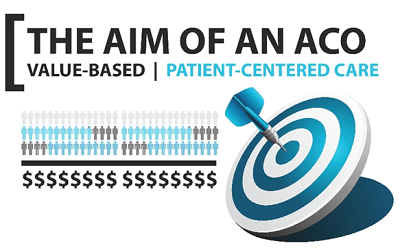
Why some KC-area hospitals are still throwing their hat into ACA payment model

http://www.bizjournals.com/kansascity/news/2017/01/26/prime-healthcare-aco.html

Image result for ACO

A Kansas City-area health network may benefit from its new designation through a pilot program created under the Affordable Care Act — if it isn’t repealed. As an accountable care organization (ACO), physicians affiliated with the Prime Healthcare ACO in Kansas and Missouri could benefit from cost-sharing incentives for Medicare patients.

Specifically, providers and the Centers for Medicare and Medicaid Services would split the savings from reducing costs for a patient through coordinated care, such as not ordering duplicate tests. Of course, ACO providers still must meet key quality metrics.

“It’s looking back at those procedures that have already occurred,” said Paula Ellis, chief nursing officer at Saint John Hospital, a Prime Healthcare affiliate in Leavenworth. “It’s really being a lot more mindful, and looking at all of the information that’s out there. It’s seeing where (the patient) is getting care that their primary care provider doesn’t know about.”

Prime Healthcare also owns Providence Medical Center in Kansas City, Kan., St. Joseph Medical Center in Kansas City, Mo., and St. Mary’s Medical Center in Blue Springs

While savings between different ACO providers have been mixed, Ellis said other markets under Prime Healthcare have found success. The California-based for-profit hospital operator launched its first ACO in California last year.

Its application for the Kansas City ACO model was granted on Jan. 1. It is serving about 10,000 Medicare patients who use Prime Healthcare physicians as their primary care provider.

“The model’s been out there for a few years,” Ellis said. “It has a track record.”

It’s worth noting that the future of ACOs, for the most part, is unknown. The model is part of the Medicare Shared Saving Program, established under the Affordable Care Act, to reduce costs and improve care. A substantial number of providers have adopted it; CMS reported 480 ACOs served a total of 9 million assigned beneficiaries as of January.

Medicare ACO explosion: CMS boasts 570 participants for 2017

http://www.fiercehealthcare.com/healthcare/cms-more-than-570-new-returning-participants-enroll-medicare-acos-for-2017

moneyroll

More than 570 Medicare accountable care organizations will participate this year in Centers for Medicare & Medicaid Service models, including the Shared Savings Program, Next Generation ACO Model and The Comprehensive ESRD Care Model, with 131 in a risk-bearing track.

MSSP added 99 new participants and 79 ACOs renewed their commitment to the program, bringing the total number of MSSP ACOs to 480 across all U.S. states, the District of Columbia and Puerto Rico, according to a CMS announcement. Medicare officials have also revealed a new track under MSSP to begin in 2018, the Medicare ACO Track 1+ Model, that offers lower risk to encourage smaller practices and rural hospitals to participate.

After three high-profile members left the Next Generation ACO program last year, many questions emerged about the future of the model. However, the agency said that 28 new participants have joined the Next Generation program for 2017, bringing the total to 45 and more than doubling the number in the program.

Atrius Health is among the new participants in the program for 2017, and in an announcement officials at the Boston-region health system said its previous experience in the Pioneer ACO program have prepared it to take on the higher financial risks associated with the Next Generation model.

“Our experience as a Pioneer ACO has enabled us to build upon our strengths in providing high-quality, coordinated care for our patients across the continuum,” CEO Steven Strongwater, M.D., said in the announcement. “CMS has been an excellent partner in this work, and we look forward to further collaboration and innovation with them in the years to come.”

Joe Damore, vice president for population health, Premier, said the growing number of participants is a “clear signal” that the shift to value-based care will continue.

In an emailed statement, Cliff Gaus, CEO and president of The National Association of ACOs, agreed. “We, along with the ACO community, are feeling confident about the future of the program and we’re looking forwarding to seeing the ACO program grow and stabilize in the coming years,” he said.

Beyond ‘Repeal and Replace,’ Further Health Reforms Loom

http://www.healthleadersmedia.com/leadership/beyond-repeal-and-replace-further-health-reforms-loom?spMailingID=10175220&spUserID=MTY3ODg4NTg1MzQ4S0&spJobID=1080402683&spReportId=MTA4MDQwMjY4MwS2#

Image result for Health Reforms

The old saying, “May you live in interesting times,” may sound like a blessing.

U.S. healthcare leaders know it is a curse.

All they’ve been working toward and preparing for since the Patient Protection and Affordable Care Act was enacted almost seven years ago has been turned upside down in the wake of the Republican election sweep.

Yet, for all their campaign promises to repeal the ACA, most congressional Republicans and President-elect Donald Trump must know that healthcare costs are too much for many Americans, and abolishing Obamacare with no replacement could be politically dangerous.

A report from consulting firm KPMG and an opinion piece published on LinkedIn by a Navigant executive predict that the Republican Congress and the executive branch will change the healthcare reform efforts initiated through the ACA, but the concept of value-based care will stay.

Why Drug Costs Will Keep Rising in 2017

http://fortune.com/2016/12/19/healthcare-drug-costs-2017-predictions/

Exchange Family Pharmacy

At the start of 2016, we made 10 healthcare predictions for the year ahead. Overall, we were 50% right, which is either a failing grade in high school or a great average in baseball.

In the win column, we predicted that the Federal Trade Commission (FTC) would block a major hospital merger, and they did just that with Advocate and NorthShore health systems in Chicago. We predicted that the technology-enabled insurance startup craze would be a bust, and Oscar promptly lost a ton of money. Finally, we were correct that employers would become more engaged in healthcare cost management with many adding “frozen carrots,” or financial incentives to drive usage of services that lower healthcare costs.

Our biggest bust was on the PCSK9’s—we predicted these new cholesterol drugs would be blockbusters. Thus far, they have been a total flop. We were also wrong when we predicted wearables would become medically useful treatments. And, to our surprise, there were more setbacks than breakthroughs in continuous biosensors, devices such as glucose monitors for diabetics.

We’re hoping to bat above .500 this coming year. Here are our 10 healthcare industry predictions for 2017:

20 Questions for President Trump

20 Questions for President Trump

whitehouse_featured

The last six and a half years have been uncharted territory in our nation’s century-long debate over health reform. For the first time the fight was about how to implement an attempt at near-universal coverage rather over what this plan should look like and what could win enough support in Congress. The Affordable Care Act (ACA) has survived major political, legislative, and legal tests, including dozens of repeal votes, two Supreme Court decisions, the 2012 presidential election, and state-level resistance.

I was outside the Supreme Court on June 25, 2015 when the King v. Burwell decision was released. I was there the moment activists switched their signs from saying “Don’t you dare take my care” to “The ACA is here to stay.” I wrote that we could finally say with some certainty that they were right, the law is here to stay. They were wrong. I was wrong.

Donald Trump’s victory throws the future of health reform into complete chaos. He will take office in January 2017 with Republican majorities in the House and Senate. President Trump, Speaker Ryan, and Senate Majority Leader McConnell have all made repeated promises to get rid of Obamacare. They will face enormous pressure to follow through with their threats of repeal. Approximately 21 million people are projected to lose insurance if they follow through with their initial proposals.

The first step to figuring out where to go from here is understanding what decisions are on the horizon. Here are my first 20 questions about health reform under the Trump administration , in no particular order:

Hospital executives’ 12 most pressing post-election questions, answered

http://www.beckershospitalreview.com/hospital-management-administration/hospital-executives-12-most-pressing-post-election-questions-answered.html

Image result for key health policy issues

https://www.advisory.com/Research/Health-Care-Advisory-Board/Expert-Insights/2016/2016-Election-12-Questions-Every-Executive-Should-Be-Asking

In a stunning upset, Donald Trump took the stage early yesterday morning to claim victory as the next president of the United States while Republicans celebrated retaining control of both the House and the Senate.

While the outcome of the election has long been expected to have a far-reaching impact across a number of policy areas, the Republican sweep of Congress and White House could result in profound changes in health policy after a hard-fought election on both sides of the aisle.

Although the exact implications of the race will become more apparent in the coming days and weeks, we expect Republicans to emphasize the election results as a mandate for change and use the opportunity to pursue significant new initiatives.

So what can providers expect from a Trump administration and a GOP Congress? Let’s take a look at what’s potentially in store for Medicare, Medicaid, and the private insurance market—and what those changes mean for provider strategy—by looking at the most common questions I’ve already received following the election.

Will Consumerism Rein in Healthcare Costs? Why the Answer Is No

Click to access Healthcare-Consumerism_Rising-Costs_LEK-Executive-Insights_1806.pdf

Image result for Will Consumerism Rein in Healthcare Costs? Why the Answer Is No

In the first of our multipart Executive Insights series on consumerism in healthcare, L.E.K. Consulting examines why a more engaged consumer — despite the increasing optimism — will not be nearly enough to bend the healthcare cost curve or even stop the rising rates substantially.

An ACA primer: Much more than insurance

http://www.healthcaredive.com/news/an-aca-primer-much-more-than-insurance/429497/

Remember the Affordable Care Act? Enacted in 2010, it expanded healthcare insurance to millions of uninsured Americans and increased access to care. But the ACA is much more than expanded coverage; it set in motion a variety of reforms in the healthcare delivery systems aimed at lowering costs and improving quality of care.

That fact was lost on presidential candidate Donald Trump, who told Fox News recently, “I don’t use much Obamacare, I must be honest with you, because it is so bad for the people and they can’t afford it.” Trump’s comments imply Obamacare is an insurance plan people can buy, which is not the case. As we wrap up year six since the ACA was enacted, here‘s what the law is really about and how it impacts providers.

Vermont’s all-payer ACO will begin in January

http://www.modernhealthcare.com/article/20161026/NEWS/161029930/vermonts-all-payer-aco-will-begin-in-january

Image result for vermont all payer model

In January, Vermont will become the first state in the nation to move to a voluntary all-payer accountable care organization model, the CMS announced Wednesday.

The Vermont program is modeled after a similar one from Maryland, but the Maryland program covers only hospitals. The Vermont ACO will cover Medicare, Medicaid and commercial payers, requiring those who participate to pay similar rates for all services.

The CMS is giving Vermont $9.5 million in start-up funding to support the transition. The demonstration, funded through a 1115 waiver, will last five years.

“This model is historic in terms of its scope, aiming to include almost all providers and people throughout the state in an all-payer ACO model to drive improved quality, better care coordination, healthier people, and smarter spending,” the CMS’ Chief Medical Officer Patrick Conway said in a statement.

“We will become the first state in America to fundamentally transform our entire health care system so it is geared towards keeping people healthy, not making money,” said Vermont Gov. Peter Shumlin, who earlier this year traveled to Washington to negotiate a deal with HHS Secretary Sylvia Mathews Burwell.

The state aims to have 70% of its insured residents covered by an ACO by 2022. The model will be considered an advanced alternative payment model under the new Medicare reimbursement program, making participants eligible for a performance bonus.