Auditor “shocked” by massive billing schemes at rural hospitals

https://www.cbsnews.com/news/questionable-billing-schemes-rural-hospitals-costing-health-insurance-companies-millions/

Image result for Auditor "shocked" by massive billing schemes at rural hospitals

Rural hospitals across the country are closing at the highest rates in decades. Since 2010, 83 have shuttered. Desperate to stay open, some hospitals got caught up in dubious billing schemes. In March, CBS News investigated questionable billing at rural hospitals in Georgia and Florida.

Insurance companies reimburse rural hospitals at higher rates to help keep critical healthcare in those communities. Those higher rates have made rural hospitals attractive targets for schemes that have generated nearly half a billion dollars in allegedly fraudulent billing.

In 2016, Missouri state auditor Nicole Galloway began examining the finances of several rural hospitals in her state. One was Putnam County Memorial, a 15-bed hospital in Unionville, Missouri, struggling to keep its doors open.

“We were shocked….When we started to look at the financial records and notice that tens of millions of dollars were coming through, I remember sitting down at the table with my audit staff and, you know, I just said we gotta dig deeper on this,” Galloway told CBS News’ Jim Axelrod.

Her team discovered a management company called Hospital Partners had swooped in weeks before Putnam was about to close, promising to turn it around. They made deals with labs around the country to funnel billing for blood tests and drug screens through Putnam, which collects higher reimbursement rates as a rural hospital. Putnam kept about 15 percent; most of the money was wired back to the labs and the management company.

“Essentially the hospital appeared to act as a shell company for these questionable lab billings,” Galloway explained. “In a six-month period, the hospital funneled through about $92 million in revenues. To put that in perspective, the previous year their total revenues were $7.5 million.”

And it wasn’t just happening at Putnam. According to court filings reviewed by CBS News, insurance companies are now attempting to claw back nearly a half a billion dollars they paid rural hospitals across the country with similar billing arrangements which they call “fraudulent.” They all declined our requests for an interview so we sat down with Jason Mehta, a former federal prosecutor who specialized in healthcare fraud.

“The question’s gonna be did the laboratories intend to cheat? Did they intend to trick? Did they mislead the insurance companies? Because simply making extra money isn’t a crime in and of itself. It’s the question of, was someone tricked? Was some deceived?” Mehta said.

Insurance companies say one way labs deceived them was paying kickbacks to healthcare providers for specimens they could then bill at the higher reimbursement rates. CBS News obtained a voicemail of a lab representative soliciting samples from a rehab center in California.

“He would send about, as soon as you guys sent 300 samples he would just send you $100,000 right then and there,” the representative is heard saying on the message.

“If I heard that message and we were talking about Medicare money, I would be very, very concerned and I would be opening an investigation immediately,” Mehta said. “In my experience, some of the most sophisticated actors in this space, some of the ones that….get the most amount of money from the healthcare programs, are those that know exactly where the line is, and skirt right up to that line.”

What Mehta told us could cross the line is a key finding of Nicole Galloway’s audit.

“Several months after the questionable lab billings had started, there was no operating lab in the hospital,” she said.

Which begs the question, how could they be billing for lab tests if there was no lab in the hospital?

In March, Blue Cross Blue Shield filed a $60 million lawsuit against Hospital Partners, alleging their arrangement with labs was a “fraudulent scheme.” Hospital Partners is suing Galloway, claiming she had no right to audit Putnam.

“They (Hospital Partners) are pushing back on us but I will tell you that will not stop me from doing my job on behalf of taxpayers,” Galloway said.

In a statement, Hospital Partners said “Putnam County Memorial Hospital is authorized by law to assign and bill for clinical laboratory testing provided at a reference lab.” On Tuesday, the Missouri Attorney General’s office told “CBS This Morning” it is actively investigating this matter.


Illinois hospitals’ financial struggles likely to continue into 2018

http://www.chicagotribune.com/business/ct-biz-hospital-financial-struggles-20171215-story.html

Image result for Illinois hospitals' financial struggles likely to continue into 2018

he list reads like a who’s who of hospital systems in the Chicago area: Advocate Health Care, Edward-Elmhurst Health, Centegra Health System.

But it’s a list of hospitals systems that cut jobs this year to deal with financial pressures — not a list any hospital is eager to join.

Hospitals in Illinois and across the country faced financial stresses this year and are likely to continue feeling the squeeze into 2018 and beyond, experts say. Those pressures could fuel more cuts, consolidation and changes to patient care and services.

“We have many hospitals doing their best just to survive,” said A.J. Wilhelmi, president and CEO of the Illinois Health and Hospital Association.

Moody’s Investors Service recently downgraded its outlook for not-for-profit health care and public health care nationally from stable to negative, with the expectation that operating cash flow will fall by 2 percent to 4 percent over the next 12-18 months. About three-fourths of Illinois hospitals are not-for-profit.

“(For) almost every hospital and health system we talk to, (financial pressure) is at the top of their list in terms of ongoing issues,” said Michael Evangelides, a principal at Deloitte Consulting.

A number of factors are to blame.

Leaders of Illinois systems say reimbursements from government insurance programs, such as Medicaid and Medicare, don’t cover the full cost of care. And with baby boomers growing older, many hospitals’ Medicare populations are on the rise. It doesn’t help that payments to hospitals from the state were delayed amid Illinois’ recently resolved, two-year budget impasse, Wilhelmi said.

Unpaid medical bills, known as bad debt, are also increasing as more patients find themselves responsible for large deductibles. Payments from private insurers are no longer helping hospitals as much as they once did. Though those payments tend to be higher than reimbursements from Medicare and Medicaid, they’re not growing as fast as they used to, said Daniel Steingart, a vice president at Moody’s.

Growing expenses, such as for drugs and information technology services, also are driving hospitals’ financial woes. And hospitals are spending vast sums on electronic medical record systems and cybersecurity, Steingart said.

Many also expect that the new federal tax bill, passed Wednesday, may further strain hospital budgets in the future. That bill will do away with the penalty for not having health insurance, starting in 2019. Hospital leaders worry that change will lead to more uninsured people who have trouble paying hospital bills and wait until their conditions become dire and complex before seeking care.

With so much going on, it can be tough for hospitals to meet revenue goals.

“You’re talking about a phenomenon taking place across the country,” said Advocate President and CEO Jim Skogsbergh. Advocate announced in May that it planned to make $200 million in cuts after failing to meet revenue targets. In March, Advocate walked away from a planned merger with NorthShore University HealthSystem after a federal judge sided with the Federal Trade Commission, which had challenged the deal. Advocate is now hoping to merge with Wisconsin health care giant Aurora Health Care, although the hospital systems say financial issues aren’t driving the deal.

“Everybody is seeing declining revenues, and margins are being squeezed. It’s a very challenging time,” Skogsbergh said.

Hospitals in Illinois have responded to the pressures in a number of ways, including with job reductions. Advocate laid off about 75 workers in the fall; Centegra announced plans in September to eliminate 131 jobs and outsource another 230; and Edward-Elmhurst laid off 84 employees, eliminating 234 positions in all, mostly by not filling vacant spots.

Hospitals also are changing some of the services they offer patients and delaying technology improvements, said the Illinois hospital association’s Wilhelmi.

Centegra Hospital-Woodstock earlier this year stopped admitting most overnight patients, one of a number of changes meant to save money and increase efficiency. As a result, the system “achieved our goal of keeping much-needed services in our community,” spokeswoman Michelle Green said in a statement.

Many Illinois hospitals have also cut inpatient pediatric services, citing weak demand, and are instead investing in outpatient services.

The challenge is saving money while improving care and patient outcomes, said Evangelides of Deloitte. Hospitals are striving to do both at the same time.

Advocate, for example, opened its AdvocateCare Center in 2016 on the city’s South Side to treat Medicare patients with multiple chronic illnesses and conditions. The clinic offers doctors, pharmacists, physical therapists, social workers and exercise psychologists. It has helped reduce hospital admissions and visits among its patients, said Dr. Lee Sacks, Advocate executive vice president and chief medical officer.

Advocate didn’t open the clinic primarily to help its bottom line. The goal was to improve patient care while also potentially reducing some costs.

But such moves are becoming increasingly important to hospitals.

“It really does impact everyone,” Evangelides said of the financial pressures facing hospitals. “We all have a giant stake in helping and hoping that the systems across the country … can ultimately survive and thrive.”


Next U.S. Restructuring Epidemic: Sick Health-Care Companies

https://www.bloomberg.com/news/articles/2017-11-27/next-u-s-restructuring-epidemic-sick-health-care-companies

  • Rural hospitals seen as among hardest hit by regulatory change
  • Technological shifts and urgent care reshaping industry

A growing number of health-care companies may face near-death experiences of their own.

 A wave of hospitals and other medical companies are likely to restructure their debt or file for bankruptcy in the coming year, following the recent spate of failing retailers and energy drillers, according to restructuring professionals. Regulatory changes, technological advances and the rise of urgent-care centers have created a “perfect storm” for health-care companies, said David Neier, a partner in the New York office of law firm Winston & Strawn LLC.
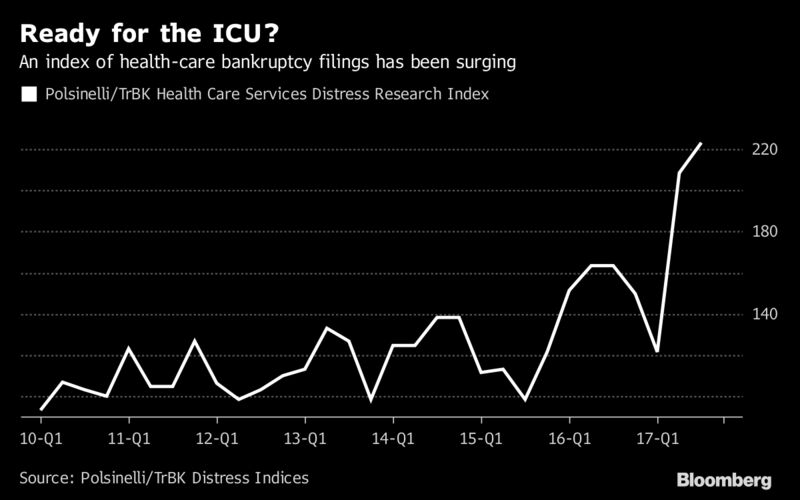
Some signs are already there: Health-care bankruptcy filings have more than tripled this year according to data compiled by Bloomberg, and an index of Chapter 11 filings by companies with more than $1 million of assets has reached record highs in four of the last six quarters, according to law firm Polsinelli PC. Junk bonds from companies in the industry have dropped 1.4 percent this month, a steeper decline than the broader high-yield market, according to Bloomberg Barclays index data.
The pain for the sector comes as bankruptcy filings across the broader economy have plunged since 2010.
Hospitals, including private rural ones, may be among the hardest hit, Winston & Strawn’s Neier said. The Affordable Care Act, known as Obamacare, reduced payments to hospitals that serve a large number of poor and uninsured patients, known as “disproportionate share hospitals,” on the theory that more patients would be insured under the law. Congress delayed those cuts several times, but didn’t do so for the current fiscal year, which may “single-handedly throw hospitals into immediate financial distress — many operate on less than one day’s cash,” he said in an interview.

“Smaller hospitals have already been struggling for years,” said Kristin Going, a partner in the New York office of Drinker, Biddle & Reath LLP. Both lawyers declined to discuss specific companies. Since 2010, a growing number of patients have enrolled in high-deductible health plans that force them to shoulder more of costs when they get treatment, according to the U.S. Centers for Disease Control and Prevention. That has translated into more bad debt from customers for hospitals and other providers.

Some publicly traded hospital companies that were already under pressure from high debt loads have been further buffeted by this year’s hurricanes. Community Health Systems Inc., with $1.9 billion in debt maturing in 2019, has suffered doctor revolts over crumbling, cash-strapped facilities, as well as losses linked to the storms in Texas and Florida earlier this year. A representative for Community Health didn’t return a call seeking comment.

Signs of Distress

Jorian Rose, partner in the New York office of Baker & Hostetler LLP, said many health-care restructurings are already going on under the radar right now. Rose, Going and Neier are members of the Turnaround Management Association, a group for bankruptcy and restructuring professionals.

The Polsinelli Health Care Services Distress Research index, which tracks bankruptcy filings for companies with more than $1 million in assets, shows that activity has surged 123 percent since the fourth quarter of 2010. By comparison, the law firm said, the general index that tracks Chapter 11 filings in the U.S. is down nearly 58 percent from 2010. The Affordable Care Act, which Republican lawmakers have been looking to repeal, replace, defund, or otherwise change, was cited as one of the systemic changes rocking the sector.

Since 1997, health-care cases have made up only 5.25 percent of all U.S. bankruptcy filings, according to Bloomberg data. Year to date, they already comprise 7.25 percent of all filings. Emergency-room operator Adeptus Health, cancer-care provider 21st Century Oncology, and cancer treatment specialist California Proton Treatment are the largest filings. Those statistics exclude pharmaceutical company Concordia, which is restructuring in Canada, and Preferred Care Inc., one of the U.S.’s largest nursing home groups, operating 108 assisted living facilities.

Problems for the sector aren’t limited to U.S. companies. Israeli drugmaker Teva Pharmaceutical Industries Ltd., saddled with debt that’s more than double its market value, is putting together a “detailed restructuring plan” after the company has slashed its profit forecasts, cut its dividend, signaled it may sell new shares, and reduced its goal for paying down debt this year. It announced a management shakeup on Monday.

Distress among health-care companies can spread to other parts of the economy. Quality Care Properties Inc., for example, is a real estate investment trust with a struggling tenant, HCR Manorcare Inc. Moody’s Investors Service said in an October report that if HCR Manorcare files for bankruptcy, Quality Care could also need to amend the terms of its own debt. Representatives for HCR Manorcare and Quality Care didn’t return calls seeking comment.

Troubled hospital giant CHS looking to sell its business

http://www.modernhealthcare.com/article/20160916/NEWS/160919916/troubled-hospital-giant-chs-looking-to-sell-its-business

Image result for community health systems

Earlier this month, Modern Healthcare reported that CHS plans to sell more than the 12 hospitals it has for sale, quoting CFO Larry Cash speaking at the Wells Fargo Securities Healthcare Conference in Boston.

Cash said they are getting interest in additional hospitals. And after examining its portfolio of 159 hospitals, it likely will see “other transactions” before the end of the year, he said.

The hospitals previously up for sale will likely be sold as part of five transactions. Not-for-profit hospital systems are among the prospective buyers, he said.

CHS is not disclosing which hospitals it is negotiating to sell. But the company said that combined, they generate annual revenue of about $1.45 billion and expect to yield net proceeds of $850 million. The proceeds will be used to reduce overall indebtedness, Cash said.

In April, CHS completed the spinoff of 38 mostly small and rural hospitals into a new public company, Quorum Health Corp. That divestiture brought about $1.2 billion in net proceeds, money that also was used to reduce debt.

Plunging earnings complicated by continued low margins at Health Management Associates hospitals that CHS purchased for $3.9 billion in 2014 has caused CHS’ stock price to plummet.

The stock traded at $60 a share a year ago.

Hospital Chain’s CEO Faces Lawsuit Over Business Practices

http://www.wsj.com/articles/hospital-chains-ceo-faces-lawsuit-over-business-practices-1470021573

Prem Reddy, head of Prime Healthcare, is known for his aggressive turnaround strategies.