The Unsung Role of the Pharmacist in Patient Health

The Unsung Role of the Pharmacist in Patient Health

Related image

We know many people end up with a risky pileup of prescribed medications. Many efforts have been made, with varied success, to correct this problem. Yet we’ve usually focused on physician behavior, when there’s another powerful lever: pharmacists.

About 30 percent of older adults in the United States and Canada filled a prescription in the last few years for one of many medications that the American Geriatrics Society recommends they avoid. Such drugs can lead to more harm — like cognitive impairment or falls — than good, and often safer options are available.

“Older adults are taking an awful lot of pills these days — 66 percent take five drugs or more per day, and 27 percent take 10 or more per day — so if some of those pills are no longer necessary and may even be causing harm, why not ask if it is time to deprescribe?” said Dr. Cara Tannenbaum, a professor of medicine and pharmacy at the University of Montreal, and director of the Canadian Deprescribing Network.

It’s not easy to get patients off such drugs, though. Physicians often don’t have enough information about what patients are taking, or may lack the time to talk to patients about these medications. They fear that stopping the drugs might cause harm or make patients upset.

To explore the possible role of pharmacists, Dr. Tannenbaum conducted a large randomized controlled trial over four years in community pharmacies in Quebec. The results of the study were recently published in JAMA.

Patients 65 years or older were randomly assigned to one of two groups. In the intervention group, pharmacists gave both patients and their physicians educational materials on the specific drug that might have been inappropriately prescribed. Such brochures could be delivered by mail or in person. The control group got the usual care, with no educational materials.

Drugs that were targets for deprescribing included sedatives, first-generation antihistamines, glyburide (used to treat diabetes), and certain nonsteroidal anti-inflammatory drugs, like ibuprofen or naproxen. The main outcome of interest was the ending of a prescription for one of the four medication classes six months later.

Almost 500 patients, average age 75, participated in the trial, and about 90 percent of them completed it. The intervention made a difference. Within six months, 43 percent of the patients in the intervention group had stopped taking one of the selected medicines. The corresponding figure was 12 percent in the control group.

In medicine, we often focus on the traditional doctor/patient interaction. We tend to ignore practitioners who come into contact with patients more than physicians, who in this case could hand over brochures personally. In the study, pharmacists were also paid to send information to the patients’ doctors ($19 Canadian, equivalent to $14 American, per physician outreach).


The Personal Toll of Whistle-Blowing

https://www.newyorker.com/magazine/2019/02/04/the-personal-toll-of-whistle-blowing?utm_source=newsletter&utm_medium=email&utm_campaign=newsletter_axiosvitals&stream=top

Why one physician took the risk of becoming an F.B.I. informant to expose alleged Medicare fraud.


Reforming Stark/Anti-Kickback Policies

Reforming Stark/Anti-Kickback Policies

Image result for Reforming Stark/Anti-Kickback Policies

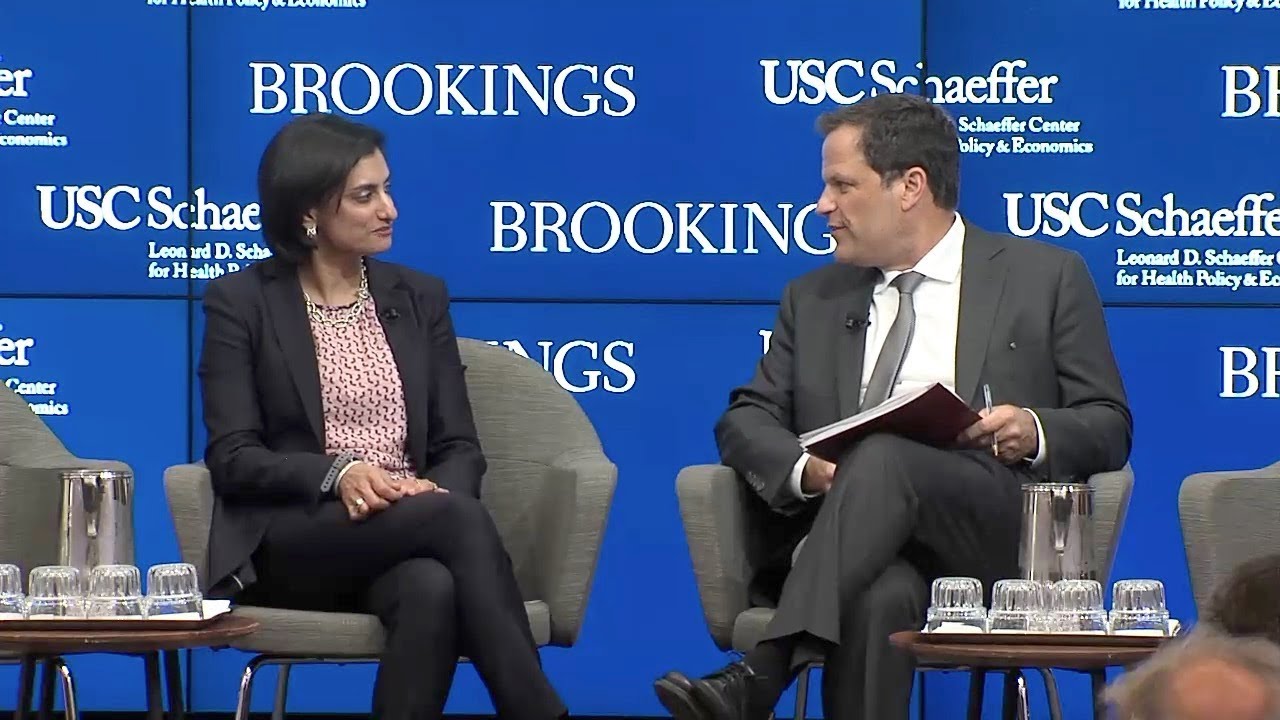
An event from the USC-Brookings Schaeffer Initiative for Health Policy

In recent years, the health care system has accelerated experimentation into new payment and delivery models that reward care coordination, integration, and value.  However, observers and market participants have expressed concerns that long-standing anti-fraud rules in Medicare and Medicaid prevent innovation and hold back potentially promising new arrangements.  In 2018, the Trump administration sought stakeholder feedback on how the regulations implementing those laws might be modified to promote value-based, coordinated, integrated care delivery while protecting taxpayers and beneficiaries from fraud.

On January 30, 2019 the USC-Brookings Schaeffer Initiative for Health Policy will host Eric Hargan, the Deputy Secretary of Health and Human Services, for a discussion about this effort. Following his presentation, experts in health care payment and delivery system reform will discuss the issue and the path forward.


38 hospitals sue HHS over site-neutral payment rule

https://www.healthcarefinancenews.com/news/38-hospitals-sue-hhs-over-site-neutral-payment-rule?mkt_tok=eyJpIjoiT0RrNVpXSmpZV1UzTTJVdyIsInQiOiJNNFh6MElhd0lmVE5Zc09kZTl5d3BPc1h3ZkRpZGNIbWhHSE9RNVp5NkN1MFwvXC9kK3h6WHh5KzRHTWdsQTlWZ203aitRRnhUYWZ5QTVScVZcL01HaTkyUm5LNDRvanVuY0NUdVN4Y0czMzRkMzdNZzMrdVp6WjlmV2N5WHYxMEkrNCJ9

Hospitals named in the suit include Vanderbilt Medical Center, Atrium Health, Rush University Medical Center, Ochsner Clinic Foundation, Montefiore.

A month and a half after several hospital advocacy groups joined together to sue the U.S. Department of Health and Human Services over it’s finalized site-neutral payment policy, 38 hospitals have followed, filing suit against HHS Secretary Alex Azar for a policy they say will deprive hospitals of hundreds of millions of dollars and could compel them to cut patient services due to loss of reimbursement.

The complaint argues that medical services provided in hospital outpatient departments are more “resource-intensive”–and therefore more costly–than those performed in an independent physician’s office. It also sharply criticized Secretary Azar, saying he “has blatantly disregarded a specific and unambiguous statutory directive, acted well beyond his authority and nullified that statutory exemption” that would have had hospital outpatient centers reimbursed for services at the higher grandfathered rate previously legislated.

The hospitals suing include Vanderbilt Medical Center, Atrium Health hospitals, Rush University Medical Center, Ochsner Clinic Foundation, Montefiore Health System and many others.

THE IMPACT

The outpatient prospective payment system seeks to equalize what physician offices and hospital outpatient departments are paid for certain clinical visits, a change that will be phased in over two years. The new rule cuts payments for hospital outpatient clinic visits at off-campus provider- based facilities in order to level them out against what is paid to physician offices. Half of the total reduction, $380 million, will take effect in 2019 and the remaining cuts will be phased the next year.

THE TREND

The Bipartisan Budget Act of 2015 amended the Social Security Act such that Medicare pays the same rates for medical services regardless of whether they are provided in a physician’s office or in an “off campus” hospital department. At the time, Congress provided an exemption from the rule for all off-campus hospital outpatient departments that were providing services before the enactment.

The AHA, in the suit they are part of, said the Azar’s reversal on the grandfathered exemption exceeds the administration’s legal authority. The AHA previously called the OPPS final rule  “unsupportable analyses and erroneous policy rationales,” and said it will have “negative consequences” for patients, with those in rural and vulnerable communities getting hit especially hard. The AHA and other hospital associations are already challenging the 340B policy included in the current outpatient rule.

ON THE RECORD

“The Secretary’s unlawful rate cut directly contravenes clear congressional directives and will impose significant harm on affected off-campus hospital outpatient departments and the patients they serve. Accordingly, this Court should declare the Secretary’s Final Rule to be ultra vires and enjoin the agency from implementing any payment methodology other than OPPS rates for all E/M services provided by excepted off-campus PBDs,” the complaint states.

Mark Polston, a partner with King & Spalding, the firm representing the plaintiffs: “Our clients’ mission is to provide high-quality healthcare. They have relied for years upon their off-campus departments to expand access to care and bring hospital services directly to their communities, many of which are underserved by other providers. Congress preserved their ability to do that work when it excepted them from the changes contained in Section 603 of the Bipartisan Budget Act of 2015. But the Secretary overstepped his bounds when he took that away. We are asking the court to reinstate the decision Congress made to preserve our clients’ ability to bring the best possible care to their patients.” Mark Polston, a partner with King & Spalding, the firm representing the plaintiffs:


Questioning the ethics of pursuing “grateful patients”

Image result for Hospitals Are Asking Their Own Patients to Donate Money


Questioning the ethics of pursuing “grateful patients”

Naming a wing, unit or hospital building after a wealthy donor is nothing new, and hospital executives have long had programs to build relationships with “grateful patients” who wish to make a contribution.

piece this week in the New York Times challenges this practice, and in particular, the ethics of analyzing patient financial data and public records to identify likely donors.

A 2013 change to privacy laws made it easier for hospitals to share information with fundraisers. Now many hospitals have built automated systems to perform “wealth screenings”, combining patient medical records, financial information and publicly-available information such as property records, and political and charitable contributions to identify patients with the means and likelihood of making a large donation. Target patients may receive nicer amenities or a visit from a hospital executive, and follow-up from the hospital’s development staff.

Medical ethicists are split on the practice, with one calling it “unseemly but not illegal or unethical”, but another saying that the practice, and particularly getting physicians involved in the process, is “fraught with danger”.

Previous research has shown that half of oncologists reported being trained to identify potential donors, and a third had been directly asked to solicit donations from patients. The reactions of physicians and patients profiled are mixed. Many doctors feel uncomfortable about the practice but recognize the importance of philanthropy.

Some patients want to express their gratitude through donation—but others expressed concerns about misleading connections between their doctors’ needs and where their donations would be spent.

They also questioned whether large health systems with billions in revenue and millions in profits should be routinely pursuing large donors. Rising public scrutiny around billing practices also highlights the dissonance between asking for philanthropic donations while at the same time aggressively pursuing a schoolteacher or bus driver for thousands of dollars in out-of-network claims.

We’d expect these tensions to continue to grow, as rising margin pressures make philanthropic income even more critical for hospitals—but transparency and a growing healthcare consumer marketplace raise questions of how much of a nonprofit health system’s work truly is “charitable”.


KFF Health Tracking Poll – January 2019: The Public On Next Steps For The ACA And Proposals To Expand Coverage

KFF Health Tracking Poll – January 2019: The Public On Next Steps For The ACA And Proposals To Expand Coverage

Key Findings:

  • Half of the public disapproves of the recent decision in Texas v. United States, in which a federal judge ruled that the 2010 Affordable Care Act (ACA) is unconstitutional and should not be in effect. While the judge’s ruling is broader than eliminating the ACA’s protections for people with pre-existing conditions, this particular issue continues to resonate with the public. Continuing the ACA’s protections for people with pre-existing conditions ranks among the public’s top health care priorities for the new Congress, along with lowering prescription drug costs.
  • This month’s KFF Health Tracking Poll continues to find majority support (driven by Democrats and independents) for the federal government doing more to help provide health insurance for more Americans. One way for lawmakers to expand coverage is by broadening the role of public programs. Nearly six in ten (56 percent) favor a national Medicare-for-all plan, but overall net favorability towards such a plan ranges as high as +45 and as low as -44 after people hear common arguments about this proposal.

    Poll: Majorities favor a range of proposed options to expand public health coverage, including Medicare buy-in and #MedicareForAll 

  • Larger majorities of the public favor more incremental changes to the health care system such as a Medicare buy-in plan for adults between the ages of 50 and 64 (77 percent), a Medicaid buy-in plan for individuals who don’t receive health coverage through their employer (75 percent), and an optional program similar to Medicare for those who want it (74 percent). Both the Medicare buy-in plan and Medicaid buy-in plan also garner majority support from Republicans (69 percent and 64 percent­).


Figure 1: Most Americans Are Unaware Of Federal Judge’s Ruling That ACA Is No Longer Valid

Texas v. United States: The Future of the Affordable Care Act

On December 14, 2018, a federal district court judge in Texas issued a ruling challenging the future of the 2010 Affordable Care Act (ACA).The judge sided with Republican state attorneys general and ruled that, since the 2017 tax bill passed by Congress zeroed out the penalty for not having health insurance, the ACA is invalid. Democrat attorneys general have already taken actions to appeal the judge’s ruling in the case and, due to the government shutdown, the 5th Circuit Court of Appeals has paused the case. Currently, the ACA remains the law of the land. If this ruling is upheld, the consequences will be far-reaching.1 Less than half of the public (44 percent) are aware of the judge’s ruling that the ACA is unconstitutional and most (55 percent) either incorrectly say that the judge ruled in favor of the ACA (20 percent) or are unsure (35 percent).

Overall, a larger share of the public disapprove (51 percent) than approve (41 percent) of the judge’s ruling that the ACA is not constitutional. This is largely divided by party identification with a majority of Republicans (81 percent) approving of the decision while a majority of Democrats disapproving (84 percent). Independents are closely divided (49 percent disapprove v. 44 percent approve).

Figure 2: Partisans Divided On Whether They Approve Or Disapprove Of Federal Judge’s Ruling That The ACA Is No Longer Valid

The Trump administration had originally announced that as part of Texas v. United States, it would no longer defend the ACA’s protections for people with pre-existing medical conditions. While the judge’s ruling was broader than just the ACA’s pre-existing condition protections, KFF polling finds attitudes can shift when the public hears that these protections may no longer exist. Among those who originally approve of the federal judge’s ruling, about three in ten (13 percent of the public overall) change their mind after hearing that this means that people with pre-existing conditions may have to pay more for coverage or could be denied coverage, bringing the share who disapprove of the judge’s ruling to nearly two-thirds (64 percent) of the public.2

Fewer – but still about one-fifth (8 percent of total) – change their minds after hearing that as a result of this decision, young adults would no longer be able to stay on their parents’ insurance until the age of 26, bringing the total share who disapprove of the judge’s ruling to 60 percent.

Figure 3: Majorities Disapprove Of Judge’s Ruling After Hearing How It Impacts Protections For Pre-Existing Conditions And Young Adults

Overall, a slight majority of the public hold a favorable view of the ACA (51 percent) while four in ten continue to hold unfavorable views. (INTERACTIVE)

Public’s Views of Democratic Health Care Agenda

With the new Democratic majority in the U.S. House of Representatives, this month’s KFF Health Tracking Poll examines the public’s view of Congressional health care priorities including a national health plan.

Proposals to Expand Health Care Coverage

Most of the public favor the federal government doing more to help provide health insurance for more Americans and one way for lawmakers to expand coverage is by broadening the role of public programs, such as Medicare or Medicaid. The Kaiser Family Foundation has been tracking public opinion on the idea of a national health plan since 1998 (see slideshow). More than twenty years ago, about four in ten Americans (42 percent) favored a national health plan in which all Americans would get their insurance from a single government plan. In the decades that followed, there has been a modest increase in support – especially since the 2016 presidential election and Bernie Sanders’ rallying cry for “Medicare-for-all.” The most recent KFF Health Tracking Poll finds 56 percent of the public favor “a national health plan, sometimes called Medicare-for-all, where all Americans would get their insurance from a single government plan” with four in ten (42 percent) opposing such a plan.

Figure 5: Majorities Across Partisans Favor Medicare Buy-In And Medicaid Buy-In

MALLEABILITY IN ATTITUDES TOWARDS NATIONAL HEALTH PLAN AND LINGERING CONFUSION ABOUT POSSIBLE IMPACTS

This month’s KFF Health Tracking Poll finds the net favorability of attitudes towards a national Medicare-for-all plan can swing significantly, depending on what arguments the public hears.

Depending on what arguments people hear, the public’s views of #MedicareForAll can swing from 71% in favor to 70% opposed highlighting the importance of any future legislative debate 

Net favorability towards a national Medicare-for-all plan (measured as the share in favor minus the share opposed) starts at +14 percentage points and ranges as high as +45 percentage points when people hear the argument that this type of plan would guarantee health insurance as a right for all Americans. Net favorability is also high (+37 percentage points) when people hear that this type of plan would eliminate all premiums and reduce out-of-pocket costs. Yet, on the other side of the debate, net favorability drops as low as -44 percentage points when people hear the argument that this would lead to delays in some people getting some medical tests and treatments. Net favorability is also negative if people hear it would threaten the current Medicare program (-28 percentage points), require most Americans to pay more in taxes (-23 percentage points), or eliminate private health insurance companies (-21 percentage points).

Figure 8: Four In Ten Say Medicare-For-All Plan Would Not Have Much Impact On People Like Them

MEDICARE-FOR-ALL AND SENIORS

On October 10th, 2018, President Trump wrote an op-ed in USA Today arguing that a Medicare-for-all plan would “end Medicare as we know it and take away benefits they have paid for their entire lives.”3 One-fourth of adults 65 and older (26 percent) say seniors who currently get their insurance through Medicare would be “worse off” if a national Medicare-for-all plan was put into place. Four in ten Republicans, ages 65 and older, say seniors who currently get health coverage through Medicare would be “worse off” under a national Medicare-for-all plan. Overall, a larger share of the public say a Medicare-for-all plan will “not have much impact” on seniors (39 percent) or say that they would be “better off” (33 percent) than say seniors would be “worse off” (21 percent).

Figure 10: Democrats Want House Democrats To Focus On Improving And Protecting The ACA Rather Than Passing Medicare-For-All

PARTISANS HAVE DIFFERENT HEALTH PRIORITIES FOR CONGRESS, EXCEPT FOR PRESCRIPTION DRUG PRICES

A majority of the public say it is either “extremely important” or “very important” that Congress work on lowering prescription drug costs for as many Americans as possible (82 percent), making sure the ACA’s protections for people with pre-existing health conditions continue (73 percent), and protecting people with health insurance from surprise high out-of-network medical bills (70 percent). Fewer – about four in ten – say repealing and replacing the ACA (43 percent) and implementing a national Medicare-for-all plan (40 percent) are an “extremely important” or “very important” priority. When forced to choose the top Congressional health care priorities, the public chooses continuing the ACA’s pre-existing condition protections (21 percent) and lowering prescription drug cost (20 percent) as the most important priorities for Congress to work on. Smaller shares choose implementing a national Medicare-for-all plan (11 percent), repealing and replacing the ACA (11 percent), or protecting people from surprise medical bills (9 percent) as a top priority. One-fourth said none of these health care issues was their top priority for Congress to work on.

Figure 11: Continuing ACA Pre-Existing Conditions Protections And Prescription Drug Costs Top Public’s Priorities For Congress

Continuing the ACA’s pre-existing condition protections is the top priority for Democrats (31 percent) and ranks among the top priorities for independents (24 percent) along with lowering prescription drug costs, but ranks lower among Republicans (11 percent). Similar to previous KFF Tracking Polls, repealing and replacing the ACA remains one of the top priority for Republicans (27 percent) along with prescription drug costs (20 percent).

Table 1: Pre-Existing Condition Protections and Prescription Drug Costs Top Public’s Health Care Priorities for Congress; Republicans Still Focused on ACA Repeal
Percent who say the following is the top priority for Congress to work on: Total Democrats Independents Republicans
Making sure the ACA’s pre-existing condition protections continue 21% 31% 24% 11%
Lowering prescription drug costs for as many Americans as possible 20 20 20 20
Implementing a national Medicare-for-all plan 11 20 8 3
Repealing and replacing the ACA 11 3 7 27
Protecting people from surprise high out-of-network medical bills 9 4 10 8
Note: If more than one priority was chosen as “extremely important,” respondent was forced to choose which priority was the “most important.”

The Role of Independents in the Democratic Health Care Debate

One of the major narratives coming out of the 2018 midterm elections was the role that health care was playing in giving Democratic candidates the advantage in close Congressional races. Consistently throughout the election cycle, KFF polling found health care as the top campaign issue for both Democratic and independent voters. While a majority of Democrats want the new Democratic majority in the U.S. House of Representatives to focus on improving and protecting the ACA, Democratic-leaning independents have more divided opinions of the future of 2010 health care law. These individuals – who tend to be younger and male – would rather Democrats in Congress focus efforts on passing a national Medicare-for-all plan (54 percent) than improving the ACA (39 percent) – which is counter to what Democrats overall report. In addition, when asked whether House Democrats owe it to their voters to begin debating proposals aimed at passing a national health plan or work on health care legislation that can be passed with a divided Congress and a Republican President, Democrats are divided (49 percent v. 44 percent) while Democratic-leaning independents prioritize House Democrats working on bipartisan health care legislation (53 percent) over debating national health plan proposals (39 percent).


Medicare Advantage industry sees slower growth for 2019

https://www.modernhealthcare.com/article/20190116/NEWS/190119927/medicare-advantage-industry-sees-slower-growth-for-2019

Image result for Medicare Advantage industry sees slower growth for 2019

Medicare Advantage insurers added 1.4 million members to their rosters for 2019 coverage, as they looked to grow membership in a market known for being politically safe and predictably lucrative. But Advantage membership is growing at a slower pace compared with previous years. 

According to the latest federal data showing enrollment as of this month, 22.4 million people are enrolled in Medicare Advantage for 2019 coverage—an alternative to the traditional Medicare program in which private insurers contract with the federal government to administer program benefits. That’s an increase of 6.8% since January 2018. Health insurers, however, managed to grow their Advantage membership base by more than 1.5 million in both 2016 and 2017.

Some industry experts were expecting more. “The formula was there: Health plans were aggressive, they got nice rate increases, the rules around benefit design relaxed a little bit,” explained Jeff Fox, president of Gorman Health Group, which provides technology and other services to Medicare Advantage plans.

Fox expected Advantage enrollment to increase by double-digits over the past year, as health plans invested heavily in marketing and the federal government provided one of the biggest rate increases for the plans in years at 3.4%. The Trump administration also granted Advantage plans the flexibility to provide more supplemental benefits in 2019, such as transportation and in-home care.

But Fox said distraction from the craziness of the November midterm elections may have kept some seniors from enrolling during the annual open enrollment that lasted from Oct. 15 to Dec. 7, 2018. While the CMS data captures some of the sign-ups from open enrollment, figures out next month are likely to be higher.

Despite the slower pace, many Advantage insurers still experienced big enrollment increases as they picked up more market share. About half of all members are covered by just three companies. UnitedHealth held onto the top spot, adding nearly 500,000 Advantage members in the past year for a total 5.7 million. UnitedHealth holds more than a quarter of the total Medicare Advantage market share.

Humana remained the No. 2 Advantage insurer with 3.9 million members, an increase of 10.4% over January 2018. But thanks to its acquisition of Aetna, CVS Health took the No. 3 spot with 2.2 million Advantage enrollees. Kaiser Foundation Health Plan and Anthem rounded out the top five insurers with the most Advantage members.

On a percentage basis, Anthem and Aetna grew membership the fastest. Anthem’s Medicare Advantage membership spiked 53% to 1.1 million members compared with the same time last year. The Indianapolis-based insurer has long focused on serving employers, but recently turned its sights to growing Medicare Advantage rolls through acquisitions and expansions in places where it already operates.

Anthem bought Florida-based Medicare plans HealthSun in December 2017 and America’s 1st Choice in February 2018, together giving Anthem about 170,000 more Advantage members. Anthem CEO Gail Boudreaux told investment analysts in July that the company would focus on selling group Medicare Advantage plans and serving medically complex dual-eligible members in 2019.

CVS Health, meanwhile, grew its Medicare membership by 26.7% in 2018 to 2.2 million through its acquisition of Aetna. The deal is still technically awaiting a federal judge’s approval. In a research note Monday, Barclays equity analyst Steve Valiquette noted that Aetna’s membership growth was driven by its expansion into about 360 new counties. Valiquette wrote that the growth experienced by some public health insurers during the annual enrollment period for 2019 coverage was driven more by market share gains than by industry growth.

Medicare Advantage enrollment is climbing as the baby boomer generation ages rapidly into Medicare. Those seniors are used to employer-sponsored managed-care plans and are choosing Advantage over traditional Medicare more often than previous generations did. Seniors also often get more benefits, including dental care, eyeglasses and gym memberships, with an Advantage plan. 

Medicare Advantage also enjoys support from both political parties and is able to weather swings from one federal administration to the next, whereas insurers that sell plans in the individual market, for example, may have to deal with more volatility.

Moreover, Medicare Advantage margins tend to hover between 4% to 5%, whereas Medicaid margins come in at 2% to 3% and the individual market historically has had even lower margins, S&P analyst Deep Banerjee told Modern Healthcare in August. The group employer business has higher margins, but that market isn’t growing like Medicare Advantage is.


Federal Shutdown Has Meant Steep Health Bills For Some Families

https://www.npr.org/sections/health-shots/2019/01/18/686003135/federal-shutdown-has-meant-steep-health-bills-for-some-families

Joseph Daskalakis’ son Oliver was born on New Year’s Eve, a little over a week into the current government shutdown, and about 10 weeks before he was expected.

The prematurely born baby ended up in a specialized neonatal intensive care unit, the only one near the family’s home in Lakeville, Minn., that could care for him.

But Daskalakis, who works as an air traffic controller outside Minneapolis, has an additional worry: The hospital where his newborn son is being treated is not part of his current insurer’s network and the partial government shutdown prevents Daskalakis from filing the paperwork necessary to switch insurers, as he would otherwise be allowed to do.

As a result, he could be on the hook for a hefty bill — all the while not receiving pay. Daskalakis is just one example of federal employees for whom being unable to make changes to their health plans really matters.

Although the estimated 800,000 government workers affected by the shutdown won’t lose their health insurance, an unknown number are in limbo like Daskalakis — unable to add family members such as spouses, newborns or adopted children to an existing health plan; unable to change insurers because of unforeseen circumstances; or unable deal with other issues that might arise.

“With 800,000 employees out there, I imagine that this is not a one-off event,” says Dan Blair, who served as both acting director and deputy director of the federal Office of Personnel Management during the early 2000s and is now senior counselor at the Bipartisan Policy Center. “The longer this goes on, the more we will see these types of occurrences.”

While little Oliver Daskalakis is getting stronger every day — he’s now out of the ICU, according to his father’s local air traffic union representative — it’s unclear how the situation will affect his family’s finances.

That’s because out-of-network charges are generally far higher than being in-network, and NICU care is enormously expensive,no matter what. Those bills could add up, especially as the family’s current insurance plan has an out-of-pocket maximum of $12,000 annually. Because Oliver was born before the new year, the family could face that amount twice — for 2018 and for 2019.

And Daskalakis still isn’t getting paid.

“I don’t know when I’ll be able to change my insurance, or when I’ll get paid again,” Daskalakis wrote to Sen. Tina Smith, D-Minn., who shared the letter on Facebook and before her Senate colleagues last week.

Other families are also worried about paperwork delays, and the financial and medical effects a prolonged shutdown could cause.

Dania Palanker, a health policy researcher at Georgetown’s Center on Health Insurance Reforms, studies what happens when families face insurance difficulties. Now she’s also living it.

After arranging to reduce her work hours because of health problems, Palanker knew her family would not qualify for coverage through her university job. No problem, she thought, as she began the process in December of enrolling her family in coverage offered by her husband’s job with the federal government.

But there was a hitch.

We could not get the paperwork in time to apply for special enrollment through the government and get it processed before the shutdown,” Palanker says.

Georgetown allowed her to boost her work hours this month to keep the family insured through January, but Georgetown’s share of her coverage will end in February.

Palanker’s treatments are expensive, so she is likely to hit or exceed her annual $2,000 deductible in January — then start over with another annual deductible once the family secures new health coverage.

“I’m postponing treatment in hopes that it is just a month and I’m back on the federal plan in February,” says Palanker, who has an autoimmune disease that causes nerve damage. “But I can’t postpone indefinitely, as my condition will get worse.”

Overseeing federal health benefits programs is within the purview of the Office of Personnel Management, whose data hub is operational, according to a spokeswoman. But getting information to that data hub to make the kind of changes Daskalakis, Palanker and others need depends on the individual agencies that employ government workers.

The OPM has told government agencies “that they should have [human resources] staff available during the lapse, specifically to process” such requests, which are called “qualifying life events,” the spokeswoman says.

Workers enrolled in plans under the Blue Cross Blue Shield Association, which covers about 5 million federal workers and retirees in the Federal Employees Health Benefits Program, can make qualifying life event changes directly with the insurer if they can’t get it processed by their workplace, an association spokesman said Friday.

In a written statement Wednesday, Smith said: “Oliver’s story is a powerful reminder that hundreds of thousands of real families have had their financial and personal lives turned upside down by this unnecessary shutdown.” The Minnesota senator called onthe president to come back to the negotiating table.

For Daskalakis, there’s been some recent good news.

His union representative, Tony Walsh, says both the OPM website and Daskalakis’ insurer now indicate that the family’s request to change to an insurance plan that classifies the hospital as “in-network” will be retroactive to Oliver’s birthday — so the out-of-network charges may not play a role.

Just to be safe, “Joe is currently working on an insurance appeal based on no in-network care [being available],” Walsh reports in an emailed statement.

Still, the family has already received an initial $6,000 bill from the hospital, Walsh notes. He says that $6,000 does not include costs associated with Oliver’s birth or his stay in the intensive care unit — those charges likely are still to come.

Walsh says the shutdown is affecting a broad swath of employees in ways many lawmakers never anticipated.

The workers “are essential to the system,” he says, “and it’s unfair they are being treated this way.”


Big Pharma Lobby Group Spent Record Amount as Reform Push Grows

https://www.bloomberg.com/news/articles/2019-01-22/big-pharma-lobby-group-spent-record-amount-as-reform-push-grows

The pharmaceutical industry’s 2 leading trade groups both set records for lobbying spending in 2018 — a sign of just how much the industry believes is on the line in the political battle over drug prices.

By the numbers:

  • PhRMA, the industry’s largest trade organization, spent $27.5 million on lobbying last year, per Bloomberg. That’s the most it has ever spent in 1 year.
  • A full $10 million of that came in the first quarter — the most PhRMA has ever spent in a single quarter.
  • The Biotechnology Innovation Organization, meanwhile, spent just shy of $10 million, according to STAT — also a record.
  • Those totals don’t include the millions individual drug companies spent on their own lobbyists. They also don’t include the industry’s campaign contributions, which topped $17 million in the 2018 cycle, according to the Center for Responsive Politics.

Between the lines: PhRMA set its previous lobbying record during the debate over the Affordable Care Act, trying to stop a fully Democratic government from taking a bite out of its bottom line.

  • It’s remarkable that PhRMA would break that record in a year where Republicans — the industry’s allies — controlled the House, Senate and White House.


U.S. Uninsured Rate Rises to Four-Year High

https://news.gallup.com/poll/246134/uninsured-rate-rises-four-year-high.aspx?utm_source=newsletter&utm_medium=email&utm_campaign=newsletter_axiosvitals&stream=top

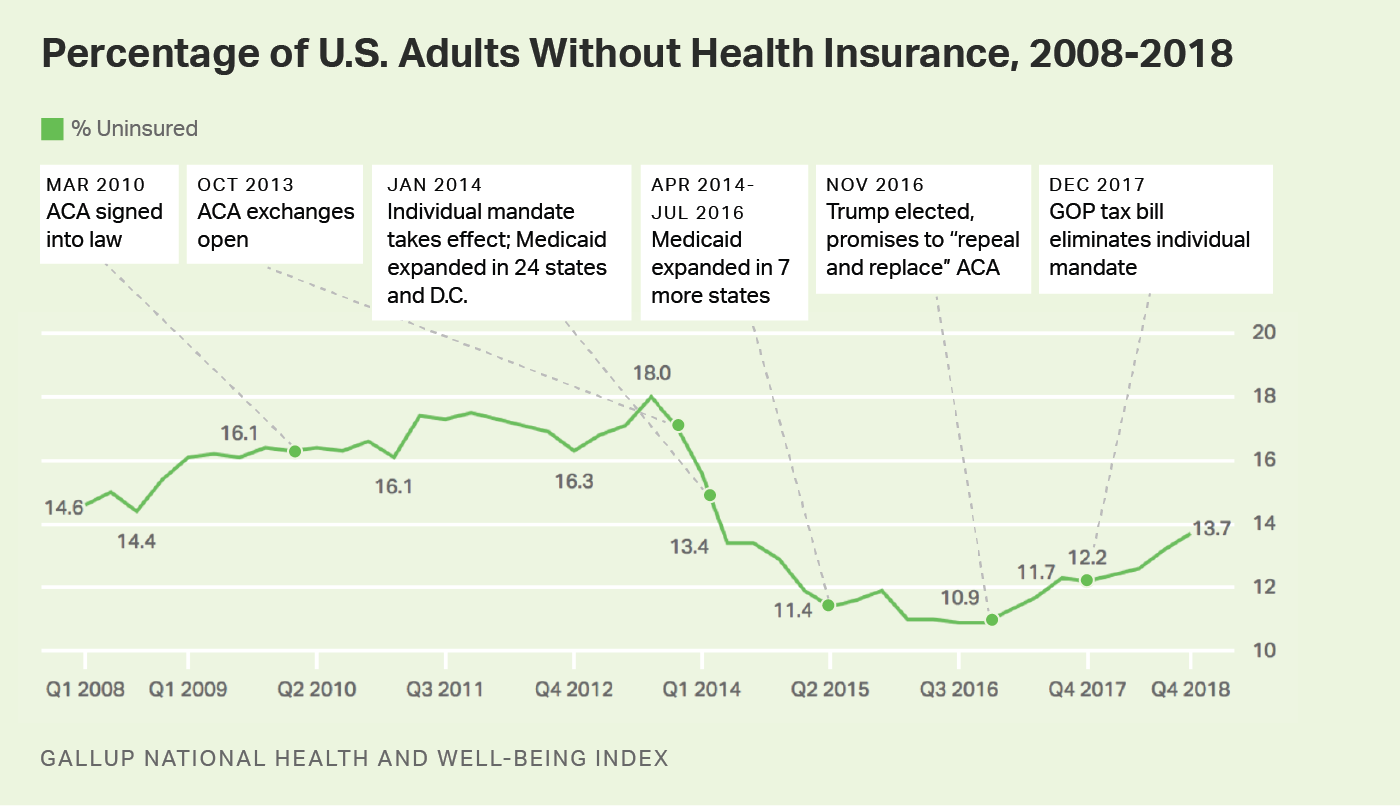
Line graph. The percentage of U.S. adults without health insurance has grown steadily since 2016.

STORY HIGHLIGHTS

  • The U.S. uninsured rate has risen steadily since 2016
  • Women, younger adults, the lower-income have the greatest increases
  • All regions except for the East reported increases

WASHINGTON, D.C. — The U.S. adult uninsured rate stood at 13.7% in the fourth quarter of 2018, according to Americans’ reports of their own health insurance coverage, its highest level since the first quarter of 2014. While still below the 18% high point recorded before implementation of the Affordable Care Act’s individual health insurance mandate in 2014, today’s level is the highest in more than four years, and well above the low point of 10.9% reached in 2016. The 2.8-percentage-point increase since that low represents a net increase of about seven million adults without health insurance.

Nationwide, the uninsured rate climbed from 10.9% in the third and fourth quarters of 2016 to 12.2% by the final quarter of 2017; it has risen steadily each quarter since that time. Since Gallup’s measurement began in 2008, the national uninsured rate reached its highest point in the third quarter of 2013 at 18.0%, and thus, the current rate of 13.7% — although it continues a rising trend — remains well below the peak level.

These data, collected as part of the Gallup National Health and Well-Being Index, are based on Americans’ answers to the question, “Do you have health insurance coverage?” Sample sizes of randomly selected adults in 2018 were around 28,000 per quarter.

The ACA marketplace exchanges opened on Oct. 1, 2013, and most new insurance plans purchased during the last quarter of that year began their coverage on Jan. 1, 2014. Medicaid expansion among 24 states (and the District of Columbia) also began at the beginning of 2014, with 12 more states expanding Medicaid since that time. Expanded Medicaid coverage as a part of the ACA broadens the number of low-income Americans who qualify for it to those earning up to 138% of the federal poverty level. The onset of these two major mechanisms of the ACA at the beginning of 2014 makes the uninsured rate in the third quarter of 2013 the natural benchmark for comparison to measure the effects of that policy.

Uninsured Rates Increase Most Among Women, Young Adults, the Lower-Income

The uninsured rate rose for most subgroups in the fourth quarter of 2018 compared with the same quarter in 2016, when the uninsured rate was lowest. Women, those living in households with annual incomes of less than $48,000 per year, and young adults under the age of 35 reported the greatest increases. Those younger than 35 reported an uninsured rate of over 21%, a 4.8-point increase from two years earlier. And the rate among women — while still below that of men — is among the fastest rising, increasing from 8.9% in late 2016 to 12.8% at the end of 2018.

At 7.1%, the East region, which has in recent years maintained the lowest uninsured rate in the nation, is the only one of the four regions nationally whose rate is effectively unchanged since the end of 2016. Respondents from the West, Midwest and South regions all reported uninsured rates for the fourth quarter of 2018 that represent increases of over 3.0 points. The South, which has always had the highest uninsured rate in the U.S. but has seen some of the greatest declines at the state level, has had a 3.8-point increase to 19.6%.

Implications

A number of factors have likely played a role in the steady increase in the uninsured rate over the past two years. One may be an increase in the rates of insurance premiums in many states for some of the more popular ACA insurance plans in 2018 (although most states saw premiums stabilize for 2019). For enrollees with incomes that do not qualify for government subsidies, the resulting hike in rates could have had the effect of driving them out of the marketplace. Insurers have also increasingly withdrawn from the ACA exchanges altogether, resulting in fewer choices and less competition in many states.

Other factors could be a result of policy decisions. The open enrollment periods since 2018 have been characterized by a significant reduction in public marketing and shortened enrollment periods of under seven weeks, about half of previous periods. Funding for ACA “navigators” who assist consumers in ACA enrollment has also been reduced in 2018 to $10 million, compared with $63 million in 2016. Overall, after open enrollment in the ACA federal insurance marketplace (i.e., healthcare.gov) peaked in 2016 at 9.6 million consumers, it declined by approximately 12.5%, to 8.4 million in 2019, based on recently released figures.

Other potential factors include political forces that may have increased uncertainty surrounding the ACA marketplace. Early in his presidency, for example, President Donald Trump announced, “I want people to know Obamacare is dead; it’s a dead healthcare plan.” Congressional Republicans made numerous high-profile attempts in 2017 to repeal and replace the plan. Although none fully succeeded legislatively, the elimination of the ACA’s individual mandate penalty as part of the December 2017 Republican tax reform law may have reduced participation in the insurance marketplace in the most recent open enrollment period.

Trump’s decision in October 2017 to end cost-sharing reduction could also potentially have affected the uninsured rate. The cost-sharing payments were made to insurers in the marketplace exchanges to offset some of their costs for offering lower-cost plans to lower-income Americans. The Trump administration had previously renewed the payments on a month-by-month basis but later concluded that such payments were unlawful. In April 2018, a federal court granted a request for a class-action lawsuit by health insurers to sue the federal government for failing to make the payments. Such lawsuits continue to be litigated.