Will House Republican Health Proposal and Trustees’ Report Make Medicare a Factor in Election?

http://blogs.wsj.com/washwire/2016/06/24/will-house-republican-health-proposal-and-trustees-report-make-medicare-a-factor-in-election/

Image result for Will House Republican Health Proposal and Trustees’ Report Make Medicare a Factor in Election?

So far Medicare has not been one of the major health-care issues in the presidential campaign. Neither Hillary Clinton nor Donald Trump has talked about it much. The former secretary of state has discussed the idea of a Medicare buy-in for the near-elderly, but that’s been mentioned more as a way of strengthening the Affordable Care Act, not reforming Medicare. Meanwhile, Medicare faces serious long-term challenges, including how to finance care for an aging population, ensure its solvency in the future, fill gaps in coverage, and address cost-sharing burdens that can be onerous for its mostly lower- and moderate-income beneficiaries.

Congress Shouldn’t Pass The 21st Century Cures Act In A Summer Rush

http://healthaffairs.org/blog/2016/07/11/congress-shouldnt-pass-the-21st-century-cures-act-in-a-summer-rush/

Blog_Capitol2

On Saturday June 25, six former FDA commissioners from Democratic and Republican administrations suggested at the Aspen Ideas Festival that Congress make the agency independent of the Department of Health and Human Services — similar to the Securities Exchange Commission, for example. With regulatory purview over products that represent a quarter of the U.S. economy, the group said the FDA is harmed by an unstable federal budget process and persistent political meddling. The group said they would issue a white paper on their proposal for the next administration. That’s another reason why Congress should postpone consideration of these bills until 2017.

Trump: Plan to Revamp Veterans Care Will Save Lives

http://www.nytimes.com/aponline/2016/07/11/us/ap-us-campaign-2016-trump.html?utm_campaign=CHL%3A+Daily+Edition&utm_source=hs_email&utm_medium=email&utm_content=31499894&_hsenc=p2ANqtz-95gg60n08D23FQGKFpBLfAu1j1mtnpE3_NxIAGaHU92xjAY3G7ttRr2f2du6US6m5cRMSj5Q1wAS_NJdxm82TCUpQkXA&_hsmi=31499894


In Nod to Sanders, Clinton Offers New Health Care Proposals

http://www.nytimes.com/aponline/2016/07/09/us/ap-us-dem-2016-clinton-health-care.html?utm_campaign=CHL%3A+Daily+Edition&utm_source=hs_email&utm_medium=email&utm_content=31499894&_hsenc=p2ANqtz-_YVFuV6N-xd__Ij8NeuODTC1G45rv_nDpH-lD8mfWo9RVqCpIS4TlEHahl3hu9_slRYFpZJvUCv1oIF7xCOxVI5gIXnA&_hsmi=31499894&_r=0

Medicare3

Clinton’s campaign says the proposal is part of her plan to provide universal health care coverage in the United States. The presumptive Democratic presidential nominee also is reaffirming her support for a public-option insurance plan and for expanding Medicare by letting people age 55 year and older opt in.

The next stage in health reform

http://www.brookings.edu/blogs/health360/posts/2016/05/26-next-stage-health-reform-aaron?utm_campaign=Brookings+Brief&utm_source=hs_email&utm_medium=email&utm_content=30041023&_hsenc=p2ANqtz-_AGn4Thn8Inuyc_igk7tSjtVMCb-JaqXsYBkb7NQyhEedpzf3Z1b_iYA3tbVpbHWqABocRNpikaooKtyt-j38BLbyOQA&_hsmi=30041023

health-care-reform-logo-001

Health reform (aka Obamacare) is entering a new stage. The recent announcement by United Health Care that it will stop selling insurance to individuals and families through most health insurance exchanges marks the transition. In the next stage, federal and state policy makers must decide how to use broad regulatory powers they have under the Affordable Care Act (ACA) to stabilize, expand, and diversify risk pools, improve local market competition, encourage insurers to compete on product quality rather than premium alone, and promote effective risk management. In addition, insurance companies must master rate setting, plan design, and network management and effectively manage the health risk of their enrollees in order to stay profitable, and consumers must learn how to choose and use the best plan for their circumstances.

How Health Care Factors Into the Presidential Campaign

http://blogs.wsj.com/washwire/2016/04/06/how-health-care-factors-into-the-presidential-campaign/?utm_campaign=KFF-2016-Drew-WSJ-April-6-health-presidential-campaign&utm_medium=email&_hsenc=p2ANqtz-_jUVxiLFykqI9M8jDv5Egwn6DLgLg0exdZlssEVDrrjrflOw4n1yiezfjQ19MmdVixjXyflQ8-vsKKmjB4zlsq1x0Zlg&_hsmi=28151425&utm_content=28151425&utm_source=hs_email&hsCtaTracking=0e6c294a-87bf-418b-9e9b-27c7bd1c5e89%7C19877ff1-2138-41ce-953d-d8c504e9aee8

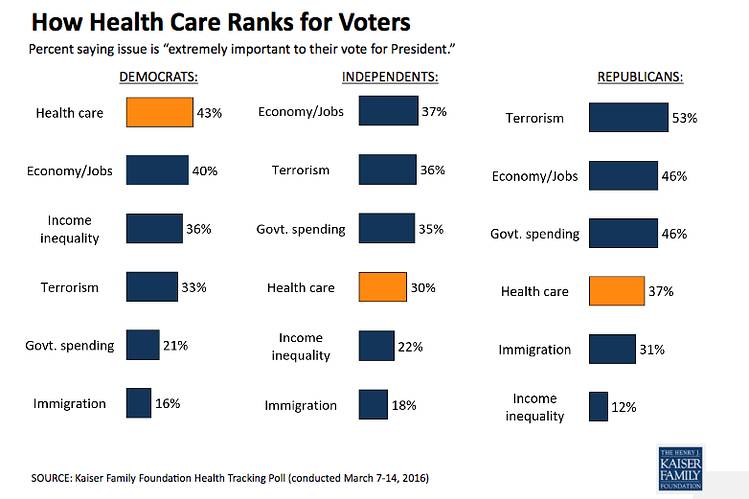
Healthcare Voter Poll

Health care has faded into the background of the election campaign as Donald Trump himself has become the issue on the Republican side and the debate between Hillary Clinton and Bernie Sanders over health care has shifted to other topics. This doesn’t mean that health will be the No. 1 or No. 4 factor when Democrats and Republicans vote in November. As the chart also shows, issue priorities are closely bunched, and my experience has been that voters cast ballots in presidential elections on the basis of their overall views of the candidates rather than candidates’ specific positions on issues.

When people say health care is an extremely important voting issue, they aren’t always thinking of the ACA. Among Republicans who say health is “extremely important” to their vote, about equal shares are thinking about the ACA as are thinking about issues such as access to care and health-care costs. Nor are Democrats always intending to support the ACA when they cite health as a voting issue. They are more likely to cite improving access or addressing costs generally as their reason for naming health a top voting issue.

Why Today’s Poll Numbers on Health Proposals Are Bound to Change

http://blogs.wsj.com/washwire/2016/05/24/why-todays-poll-numbers-on-health-proposals-are-bound-to-change/?utm_campaign=2016-Drew-WSJ-May-24-polls-ideas-legislation&utm_medium=email&_hsenc=p2ANqtz-99JEsdv7eJnUdzjj2w7ZbRJN7Wd9noBGIThqhMyBOHKlc-5lBAWltURMs3EdIT4gYqj_TLYI4KhLxHcSg4KZfO1-ag1w&_hsmi=29882227&utm_content=29882227&utm_source=hs_email&hsCtaTracking=7c94cb34-47b8-4e25-8c1c-cc32f0f28b54%7Cb5c82547-560b-4700-814f-11ce1ecc8232

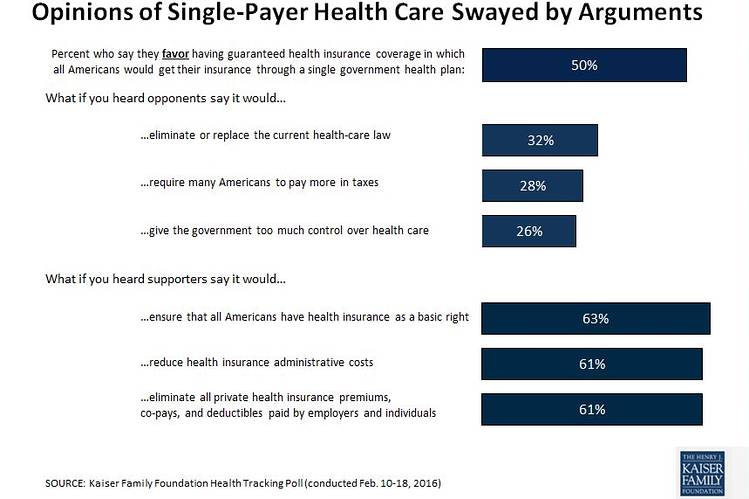
Single Payer Health Poll

Gallup polling released last week showed majority support–58%–for replacing the Affordable Care Act with a federally funded health system. The same poll found 51% support for repealing the ACA. There is a basic point that often gets lost in reaction to poll findings like these: They measure the public’s initial response to ideas and words, and proposals such as single payer or ACA repeal that people associate with candidates–but they don’t tell us much about the likely level of support for a policy if there is a real debate about legislation before Congress, with winners and losers laid bare.

It’s always a fair bet that support would decline for big changes that come with big trade-offs–whether it is single-payer health care or ACA repeal or something else–but there is no way to know those levels in advance, and support could rise or fall depending on how a legislative debate plays out. Consider single-payer health care as an example. In February, the Kaiser Family Foundation monthly tracking poll simulated some of the arguments the public might hear in a debate about single payer.

GOP Promises a Plan to Replace Obamacare … Again

http://www.thefiscaltimes.com/2016/04/18/GOP-Promises-Plan-Replace-ObamacareAgain?utm_campaign=541c47950e351dbe08037e5f&utm_source=boomtrain&utm_medium=email&bt_alias=eyJ1c2VySWQiOiJkZmM5MTQ1OS01OWFlLTRlNDAtOWI5NC1hNDVmYTljZWQwOTYifQ%3D%3D


Significant Shifts Detected In Public Opinion About The ACA

http://healthaffairs.org/blog/2016/04/13/health-affairs-web-first-significant-shifts-detected-in-public-opinion-about-the-aca/

Featured Topic Image - Elsewhere @ Health Affairs (640x360 at 72 PPI)

“The public’s view of health reform is a combination of appreciation of the tangible effects of the ACA and deep reservations about the law flowing from partisan and political distrust,” the authors concluded. “However, the sustained battle over health reform may not preclude incremental changes that advance each party’s agenda within the ACA framework.” Looking ahead, they suggest that “an era of grand vision may transition to one characterized by the slow grind of the legislative process.”