In California, What’s Driving the Variation in Total Cost of Care — Volume or Price?

http://www.chcf.org/articles/2017/02/variation-total-cost-care

Linking Hospital Utilization and Total Cost of Care for Commercially Insured Californians, by Product Type, 2013

As the “repeal and replace” debate continues in Washington over the future of the Affordable Care Act, policymakers considering new legislation should not lose sight of the key concept of the ACA — affordability. High and rising costs are among the most intractable health care issues facing consumers across California and the nation, and any discussion must keep underlying cost drivers at the forefront.

But where should the focus be? At the most elementary level, total health care spending boils down to two main factors: how much care we use (volume, or utilization) and what we pay for that care (price). Teasing out how each factor — utilization or price — contributes to costs is important because cost-control solutions vary depending on the answer.

Across 19 regions in California, the annual risk-adjusted, per capita total cost of care for commercially insured people varies dramatically — from an average high of $5,400 in San Francisco to a low of $3,600 in Kern County, according to 2013 data in the California Regional Health Care Cost & Quality Atlas, a web-based interactive tool produced by the Integrated Healthcare Association (IHA) to monitor cost and quality trends across the state.

Adjusted to reflect differences in population health status, the atlas shows a clear geographic cost pattern. All Northern California regions have higher costs than the statewide average of $4,300, all Southern California regions have lower costs than the state average, and Central California regions have mixed costs.

Three Key Measures

What is driving these differences? Is it variation in per capita utilization, or is it price? While the atlas does not have unit price information, it does include three important hospital utilization measures: emergency department (ED) visits, all-cause readmissions, and inpatient bed days. This allows for basic comparisons of total cost per enrollee vs. three critical measures of utilization. If hospital utilization were driving the overall cost of care, there would be a positive correlation between the cost and utilization measures. However, an analysis of atlas information actually shows the opposite. When considering all commercial health maintenance organization (HMO) and preferred provider organization (PPO) products and regions, cost and volume tend to move moderately in opposite directions.

The quadrant chart below illustrates the relationship between total cost of care and hospital utilization, based on a composite score representing the three utilization metrics. Each orange circle represents a region’s PPO products, and each blue triangle represents a region’s HMO products. With the exception of one outlier region, the data show a moderate negative correlation between hospital utilization and cost. In other words, lower hospital utilization is associated with higher total costs of care.

In the atlas data, total cost of care includes both what the enrollee pays — for example, deductibles and coinsurance — as well as the insurance payments that go to providers. That means cost variation can’t be explained by differences in benefit design among commercial products. Because higher total costs are not driven by greater hospital utilization, and not accounted for by benefit design differences, price seems to be playing a strong role.

There is also an alternative but less likely explanation. Because the atlas only looks at hospital utilization, it’s possible that the total cost of care could be driven by nonhospital utilization as much as the price of care. But because hospital utilization accounts for almost one-third of overall spending on average, it is unlikely that utilization of other services, such as physician and other ambulatory care, has as great an impact on cost variation.

Much of the focus to date on making health care more affordable has involved transferring more financial responsibility to individual patients, the idea being that if consumers have “skin in the game” they will be more discriminating in their care purchases. But if the cost problem is primarily driven by price, which is related to market forces prevalent in a geographic region, is shopping really the solution?

The next version of the atlas, scheduled for release in 2017, will include additional utilization measures and cost information. These will offer a clearer picture of the roles of utilization and price in determining health care costs for commercially insured Californians. Until then the atlas findings stress the need for a better understanding of how pricing differences contribute to total cost variation and encourage us to search for more effective strategies to influence prices as well as utilization.

The right place for the right care

http://www.us.jll.com/united-states/en-us/Research/US-Healthcare-Perspective-2017-JLL.pdf?661ac41b-8177-4716-8c89-a88e24e95f17

Image result for healthcare real estate strategy

How can we improve the health of our communities, while also reducing costs and maintaining high-quality care? And how will we pay for it? These are the most vexing questions facing healthcare executives today.

An expanded patient base will be necessary for survival. Location is an increasingly critical factor in determining future success, with many asking: “Where do we need to be and what kind of service do we need to deliver?”

Uncertainty is unavoidable in the healthcare industry. But regardless of what direction healthcare reform may take, certain facts will not change. Healthcare costs must decrease to provide more care to more people, and keeping patients out of expensive hospital settings can drive down the cost of care and simultaneously improve population health. The right real estate strategy can help hospitals ensure that they have the right places for the right care.


Will Consumerism Rein in Healthcare Costs? Why the Answer Is No

Click to access Healthcare-Consumerism_Rising-Costs_LEK-Executive-Insights_1806.pdf

Image result for Will Consumerism Rein in Healthcare Costs? Why the Answer Is No

In the first of our multipart Executive Insights series on consumerism in healthcare, L.E.K. Consulting examines why a more engaged consumer — despite the increasing optimism — will not be nearly enough to bend the healthcare cost curve or even stop the rising rates substantially.

FL Health System on Path to Save Millions by Standardizing Surgical Practice

http://www.healthleadersmedia.com/leadership/fl-health-system-path-save-millions-standardizing-surgical-practice?spMailingID=9394331&spUserID=MTMyMzQyMDQxMTkyS0&spJobID=981810720&spReportId=OTgxODEwNzIwS0

Ongoing discussions with large employers including Disney have led Florida Hospital to examine granular surgical data in an attempt to wring out unnecessary costs.

Cut Healthcare Spending or Face the Public Option

http://www.healthleadersmedia.com/finance/cut-healthcare-spending-or-face-public-option?spMailingID=9394331&spUserID=MTMyMzQyMDQxMTkyS0&spJobID=981810720&spReportId=OTgxODEwNzIwS0#

“If we don’t get a handle on spending at some point, we will have a government-financed system,” predicts the head of the Pacific Business Group on Health.”

The Next Big Debate in Health Care

http://blogs.wsj.com/washwire/2016/06/30/the-next-big-debate-in-health-care/?utm_campaign=KFF-2016-Drew-WSJ-June-30-adequacy-coverage&utm_medium=email&_hsenc=p2ANqtz–xQ5m7mTzVOQDJ-gEuLbZl7pkPEfb_Iw0ezewQc1ln7AN8seXIMO73B28qbm9dojkj8aBYyKmMoIvL46iTkyv7FWksVw&_hsmi=31195410&utm_content=31195410&utm_source=hs_email&hsCtaTracking=ed044791-0cff-437c-b853-bcb03570f762%7C6f34b697-a7d1-4d2a-b580-e9d37afa69ac

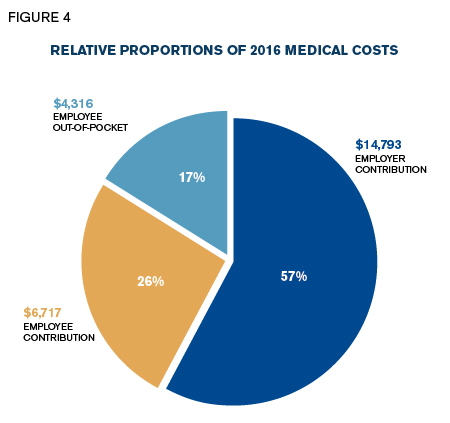
Source: Kaiser Family Foundation analysis of Truven Health Analytics MarketScanCommercial Claims and Encounters Database, 2004-2014; Bureau of Labor Statistics, Seasonally Adjusted Data from the Current Employment Statistics Survey, 2004-2014 (April to April).

With 91% of the population now covered by some form of health insurance, and the coverage rate higher in some states, the next big debate in health policy could be about the adequacy of coverage. That particularly means rising payments for deductibles and their impact on family budgets and access to care. This is about not just Obamacare but also the many more people who get insurance through an employer.

It’s not clear whether deductibles will continue to rise as they have over the past decade. Rising cost-sharing is not employers’ preferred strategy  for containing health costs, but it’s the one they resort to when they need to quickly reduce their annual premium increase. If the economy weakens again employers will feel greater pressure to reduce their health-benefits costs, and the trend toward higher deductibles will be more likely to continue. The question of how much cost-sharing is too much, and what to do about it, could be the next big debate in health care–once the political world moves on from its focus on the ACA.

Health Care Costs for Average American Family Now Exceed $25,000 a Year

http://www.thefiscaltimes.com/2016/05/24/Cost-Health-Care-Average-American-Family-Now-Exceed-25000-Year?utm_campaign=541c47950e351dbe08037e5f&utm_source=boomtrain&utm_medium=email&bt_alias=eyJ1c2VySWQiOiJkYzYxNmI4YS03YTE4LTYyZjAtZWI5Ni02Mzk3ZDdkNDM4YWMifQ%3D%3D

How Health Care Factors Into the Presidential Campaign

http://blogs.wsj.com/washwire/2016/04/06/how-health-care-factors-into-the-presidential-campaign/?utm_campaign=KFF-2016-Drew-WSJ-April-6-health-presidential-campaign&utm_medium=email&_hsenc=p2ANqtz-_jUVxiLFykqI9M8jDv5Egwn6DLgLg0exdZlssEVDrrjrflOw4n1yiezfjQ19MmdVixjXyflQ8-vsKKmjB4zlsq1x0Zlg&_hsmi=28151425&utm_content=28151425&utm_source=hs_email&hsCtaTracking=0e6c294a-87bf-418b-9e9b-27c7bd1c5e89%7C19877ff1-2138-41ce-953d-d8c504e9aee8

Healthcare Voter Poll

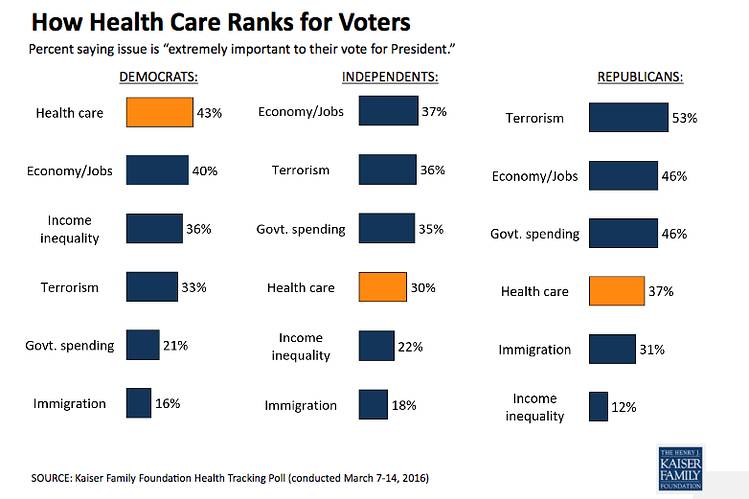
Health care has faded into the background of the election campaign as Donald Trump himself has become the issue on the Republican side and the debate between Hillary Clinton and Bernie Sanders over health care has shifted to other topics. This doesn’t mean that health will be the No. 1 or No. 4 factor when Democrats and Republicans vote in November. As the chart also shows, issue priorities are closely bunched, and my experience has been that voters cast ballots in presidential elections on the basis of their overall views of the candidates rather than candidates’ specific positions on issues.

When people say health care is an extremely important voting issue, they aren’t always thinking of the ACA. Among Republicans who say health is “extremely important” to their vote, about equal shares are thinking about the ACA as are thinking about issues such as access to care and health-care costs. Nor are Democrats always intending to support the ACA when they cite health as a voting issue. They are more likely to cite improving access or addressing costs generally as their reason for naming health a top voting issue.