Healthcare job growth slows; hospitals add 10.6K jobs in June

https://www.beckershospitalreview.com/workforce/healthcare-job-growth-slows-hospitals-add-10-6k-jobs-in-june.html

Image result for Healthcare job growth


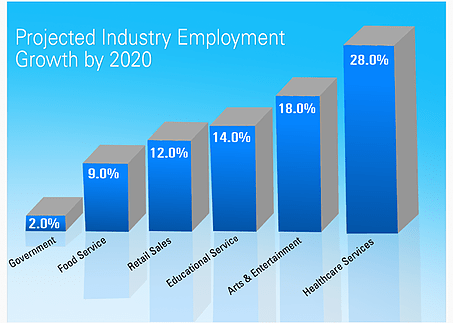
Healthcare added 25,200 jobs in June, with hospitals contributing 10,600 to that total, according to the latest jobs report from the U.S. Bureau of Labor Statistics.

This is down from the 28,900 jobs the industry added in May.

Within healthcare, ambulatory healthcare services continued to show employment growth, adding 13,500 jobs last month. Hospitals added 10,600 jobs in June compared to the 6,200 they added in May. Nursing and residential care facilities gained 1,100 jobs last month.

Overall, healthcare has added 309,000 jobs over the year, according to the BLS.

In total, the U.S. added 213,000 jobs in June.


The future of healthcare: Finding the opportunities that lie beneath the uncertainty

https://www.mckinsey.com/industries/healthcare-systems-and-services/our-insights/the-future-of-healthcare-finding-the-opportunities-that-lie-beneath-the-uncertainty?cid=other-eml-alt-mip-mck-oth-1802&hlkid=352e101e35a1452c983b598f944104cc&hctky=9502524&hdpid=c2f3cd34-a3e9-46d4-bc69-f4a9cc3b0ac9

Image result for The future of healthcare: Finding the opportunities that lie beneath the uncertainty

Healthcare is a dynamic industry with significant opportunity, but cost concerns, uncertainty, and complexity can also make it an unnerving one. Substantial upside exists for players that can deliver value-creating solutions and thrive under uncertainty.

The intrinsic demand for healthcare services continues to rise in the United States, given population aging, the increasing prevalence of chronic disease, and the search for a higher quality of life. In addition to increasing demand, three other major factors make healthcare a dynamic industry with significant opportunity:

  • Consumers, employers, and the government continue to see the financial burden of healthcare grow faster than their incomes or revenues—a long-standing gap unlikely to change soon. Furthermore, new challenges, such as the ongoing opioid crisis, continue to emerge. The result has been a continuing search for fresh solutions and reforms,  which has kept—and will keep—the industry in a state of flux.
  • Major tectonic shifts are occurring, not only in regulations but also in three other areas: technology (both medical science and technology and the onward march of big data, advanced analytics, machine learning, and digital), industry orientation (the move toward B2C and rapidly rising consumer expectations), and reallocation of risk across the value chain. These forces are fundamentally altering the structure of the industry and basis of competition.
  • The available headroom for improvement in healthcare (by most estimates, over $500 billion within the $3 trillion US healthcare economy) provides significant opportunity for value creation.1

Industry growth, major changes, and strong value-creation potential make healthcare an exciting industry. At the same time, cost concerns, uncertainty, and complexity make it an unnerving one. Substantial upside exists for players that can deliver value-creating solutions and thrive under uncertainty. Indeed, our recent research into industry profit pools indicates that, on average, the industry is delivering value-creating solutions and consequently showing attractive profit growth. Between 2012 and 2016, total over-all healthcare industry profit pools (earnings before interest, taxes, depreciation, and amortization, or EBITDA) grew at a faster rate than the combined EBITDA of the top 1,000 US companies.


From premiums to politics: 5 predictions for the health insurance industry in 2018

https://www.fiercehealthcare.com/payer/year-preview-predictions-politics-aca-mergers?mkt_tok=eyJpIjoiTnpreE9HSTFPVFJqWldZMSIsInQiOiJNM0NTa1ZBZW1kU001bkx4SEcwNmtSeEFVNG9oZnpUbEF2UVpMY1lDUWNZYm8zZTFuejJNUGpPOTJuYVlXTlZwWHdXU1hrRm50Z1NFbHJGRjdUMld6U1JoYWo0enNaUlEzNldab2tcL3hxV3NPaTBlK2xKbmVSQmgwMTE2NFZpYzgifQ%3D%3D&mrkid=959610

Businessman uses a crystal ball

After the demise of two major insurer mergers and multiple Affordable Care Act repeal attempts, few could argue that 2017 wasn’t an eventful year for the health insurance industry.

But 2018 is shaping up to be just as interesting—complete with more political wrangling, M&A intrigue and evidence that, despite all this uncertainty, insurers are pushing ahead and embracing innovation.

Read on for our predictions about what’s in store for the industry in the coming months.

1. The CVS-Aetna deal will have a domino effect in the healthcare industry

While the lines between payer, provider and pharmacy benefits manager have been blurring for a while now, CVS’ $69 billion deal to purchase Aetna is undoubtedly a game-changer.

The move was likely motivated by a desire to compete with UnitedHealth’s thriving Optum subsidiary, which has its own PBM and an increasing presence in care delivery. So it stands to reason that other major insurers will try to strike deals of their own that mimic that scale and level of diversification.

Already, Humana has made a bid to purchase part of hospice- and home-health giant Kindred Healthcare. There’s also been speculation that it is preparing to be acquired—possibly by Cigna, or in a deal that would mimic CVS-Aetna, Walmart or Walgreens.

Other insurers may also seek to build PBM capabilities, following in the footsteps of UnitedHealth, a combined CVS-Aetna and Anthem, which announced in October that it would team up with CVS to create an in-house PBM called IngenioRx.

It’s certainly possible, however, that CVS’ purchase of Aetna will not pass regulatory muster. While it would require less divestment than the ill-fated Anthem-Cigna and Aetna-Humana deals, the DOJ’s decision to block another vertical deal—between AT&T and Time Warner—doesn’t bode well for its chances.

2. Republicans and Democrats will be forced to work together on ACA fixes

With one less Republican senator—thanks to Alabama’s election of Democrat Doug Jones—the GOP likely won’t have the votes to pass a repeal bill without bipartisan support. Senate Majority Leader Mitch McConnell acknowledged as much before Congress’ holiday recess, though he clarified the next day that he would be happy to pass an ACA repeal bill if there are enough votes for it.

McConnell also owes Sen. Susan Collins, R-Maine, as he had promised her he’d pass her reinsurance bill and a bill that would fund cost-sharing reduction payments this year. While Collins held up her end of the bargain—voting for the GOP tax bill—the ACA fixes didn’t make it into the stopgap spending bill Congress passed on Dec. 21.

Democrats, meanwhile, will also be motivated to reach across the aisle. The repeal of the individual mandate will likely put the ACA on more unstable footing, lending more urgency than ever to the task of shoring up the exchanges.

Both parties will also likely face pressure from the healthcare industry’s biggest lobbying groups to get some sort of ACA fix passed. The push to do so, however, will be complicated by the full slate of legislative priorities Congress is facing in the new year, including reauthorizing funding for the Children’s Health Insurance Program.

3. There will be more premium hikes and insurer exits in the individual market

The individual mandate is now gone, and arguments about its effectiveness aside, that was one of the mechanisms that encouraged healthy people to buy insurance and stay covered. Even if the effect on coverage levels is minimal, the move is probably going to be enough to push risk-averse insurers to raise rates and even exit more rating areas in 2019.

There is also little indication that large insurers that have exited will come back anytime soon. After all, why invest resources in an unstable market when there are far more steady and lucrative markets like Medicare Advantage?

Adding to the policy uncertainty for the remaining insurers, there is no guarantee that Congress will authorize short-term funding for cost-sharing reduction payments. Many insurers raised their 2018 rates to account for the possibility of them disappearing—which turned out to be a wise move—so it stands to reason they’d have to do the same for 2019.

Perhaps the best harbinger of what’s to come came from a study conducted in November, which noted that the actions insurers and state regulators took to fill in “bare counties” on the ACA exchanges are “temporary and unsustainable without long-term federal action.” And with Republicans in charge, federal action to patch up the exchanges is unlikely.

4. Federal agencies will start to carry out Trump’s executive order—and states will push back

Although it was overshadowed by all the repeal-and-replace drama, Trump’s healthcare-focused executive order has huge implications for the industry. Put simply, it paves the way for expanded use of association health plans, short-term health plans and employer-based health reimbursement arrangements.

In 2018, we’re likely to see the relevant agencies start issuing rules to implement the order, which could dramatically change the individual market as we know it—and not for the better. Such rulemaking would also set the stage for a power struggle between the federal government and left-leaning states.

In fact, a coalition of healthcare organizations have urged state insurance commissioners to take steps to override any rules resulting from the executive order. For example, states could restore the three-month limit on short-term health plans if agencies unwind that Obama-era rule on the federal level.

Since only certain states are likely to heed these suggestions, the upshot of Trump’s executive order will be to create a patchwork of individual market rules across the country. If that sounds strangely like what the individual insurance markets were like before the ACA, well, that’s precisely the point.

5. Payers’ move to value-based payment models will continue, with or without the feds leading the way

On the one hand, the Trump administration clearly wants to scale back the federal government’s role in pushing payers and providers away from fee-for-service payment models. The surest sign was CMS’ announcement late last year that it would endmandatory bundled payment models for hip fractures and cardiac care.

Some have worried that moving away from those mandatory programs would be a setback for the move to value-based payments, given that the feds play a powerful role in galvanizing the industry to change. In addition, the administration wants to take the Center for Medicare and Medicaid Innovation in a “new direction”—one that CMS Administrator Seema Verma said would “move away from the assumption that Washington can engineer a more efficient healthcare system from afar.”

But even if the federal government will take a lighter touch in the move from volume to value, it’s not likely that the private sector will take that as a cue to reverse course. On the payer side, especially, too many industry-leading companies have invested heavily in alternative payment models to turn back now. And they have compelling business reasons to keep investing in those models, given their potential to lower costs and improve care quality.


Humana CMO: “As we improve the quality of healthcare, costs decrease”

Humana CMO: “As we improve the quality of healthcare, costs decrease”

Dr. Roy Beveridge has served as CMO of Louisville, Kentucky-based Humana since 2013. Two years into his tenure, he opened the MedCity ENGAGE conference with a discussion calling for the democratization of healthcare.

In a recent phone interview, Beveridge discussed everything from value-based care to social determinants of health.

This exchange has been lightly edited.

What has been Humana’s biggest accomplishment in 2017?

From a physician and patient standpoint, we’re really moving quickly into value-based arrangements with MACRA and MIPS. There’s been a mind shift around physicians recognizing that in order to accomplish their goals of population health and value-based reimbursement, the whole discussion has changed around the need for analysis of data and a very different type of communication between the payer and the provider. Without that data, they can’t close gaps or improve the quality metrics that are becoming the norm.

A few years ago, I mistakenly thought value-based care was something that was going to be focused on the primary care physician and would not impact the specialist as much. But what you’re seeing is specialists recognize this value-based payment system is something they have to participate in.

From our standpoint, what that has resulted in is this continuous focus around community relationships. If payers like Humana are going to be successful, we need to be engaging our physicians’ patients. Services are needed for patients in the home. That’s the shift we have thought about and been successful at as we continue to recognize that an increasing amount of care will be in the home.

Why is it important to incorporate social determinants of health, and what work is Humana doing in this space?

When I was early in my practice and would see someone with diabetes, I remember having this belief that my role was to recognize what the patient’s diagnosis was and give a prescription for insulin. And then I thought I’d done a good job.

That was the mindset up until recently. Simply giving someone a prescription is the easy part. The more complicated part is explaining what their disease is and helping them take their medicine. We used to think that was a social worker’s problem. But if giving someone a prescription that they can’t fill doesn’t really help them.

As we look into the social determinants of health, transportation is big. Social isolation is a big one, and food insecurity goes hand in hand with diabetes and everything else.

I don’t think five years ago you’d be asking a question about social determinants of health. But at this point, the recognition of social determinant health issues is fundamentally linked to population health.

If you’re looking at a fee-for-service model, writing the prescription is all I need to do. If we shift the model to health outcomes, then you’re aligning everyone’s incentives to make sure people are thinking about these social determinants of health.

The other thing we have learned in the last year or two is that care really is local. We as a society have to recognize that what happens in South Florida is different than what happens in Texas or Minnesota or Massachusetts. There’s not one size that fits everything.

Humana recently released its inaugural value-based care report, which outlines numerous topics, including how Humana Medicare Advantage members affiliated with physicians in value-based models typically have healthier outcomes. Which finding from the report most surprised or shocked you?

I don’t think anything shocked me. There were parts of this that I think a couple years ago would have shocked people.

Five or 10 years ago, I would have said to you that in order to improve quality, you have to make an investment globally and that investment is going to cost the system more.

What’s pretty clear in the report is quality metrics do all the right things, yet at the same time, they lower the global cost of care. I don’t think that’s shocking, but it’s something that’s still hard for people to recognize and internalize. Fundamentally, as we improve the quality of healthcare, costs decrease.

News recently surfaced that Humana will acquire a 40 percent stake in Kindred Healthcare’s home care business for approximately $800 million. What does this mean for Humana?

We’ve only made the proposal. We haven’t gotten government approval for anything.

We’re thinking about, “How can we always get closer to the patient? How do we help improve someone’s health by being where someone is more of the time?” [Patients are] not in the hospital most of the time — they’re at home most of the time. We recognize we need to get closer to where people are if we’re going to help them in their destination of improving health.

What is your number one prediction for healthcare in 2018?

My number one prediction in healthcare is the pace of change within the system is going to continue to be fast.

CMS is pushing — and appropriately so — down a health orientation that moves from fee-for-service to quality-based outcomes.

My prediction for ’18 is that we’re going to hit an inflection point where the light bulb goes off because of the number of patients in the system who have moved from fee-for-service into this health outcomes model. Once it hits a certain amount of engagement within your hospital, then it becomes something everyone is aligned around.


CVS Health to acquire Aetna for $69B: 5 things to know

https://www.beckershospitalreview.com/payer-issues/cvs-health-to-acquire-aetna-for-69b-5-things-to-know.html

Image result for CVS Health to acquire Aetna for $69B: 5 things to know

Image result for CVS Health to acquire Aetna for $69B: 5 things to know

CVS Health inked a definitive merger agreement to acquire all outstanding shares of Aetna for roughly $69 billion in cash and stock.

Here are five things to know.

1. The deal, unanimously approved by the boards of directors of each firm Dec. 3, is one of the largest transactions this year. It values Aetna at about $207 per share, higher than previous estimates of $200 to $205 per share. When including the assumption of Aetna’s debt, the transaction totals $77 billion.

2. Upon closing, Aetna’s Chairman and CEO Mark Bertolini will join CVS Health’s board of directors, along with two other Aetna leaders. Aetna will operate as a standalone business unit under the CVS Health umbrella, and the insurer’s management team will helm the subsidiary.

3. The companies said the deal will provide localized, community-based care across CVS Health’s 9,700-plus pharmacies and 1,100 clinics. Sources familiar with the deal told Reuters CVS Health plans to significantly extend health services at its pharmacies under the merger.

4. The transaction is slated to close in the second half of 2018. It is subject to regulatory approvals.

5. Rita Numerof, PhD, president of Numerof & Associates, said in an emailed statement to Becker’s Hospital Review, “Having the combined market clout puts Aetna more in a position akin to UnitedHealthcare in its ability to leverage an integrated PBM in negotiating prices and establishing preferred tiers with manufacturers.” She added, “With CVS’s large and growing clinical services footprint, Aetna can steer patients to CVS pharmacies and clinics — in many cases avoiding the costs of higher ER or other outpatient services. The merger can make expanded CVS services in-network and others out-of-network, putting additional pressure on conventional health systems to lower the costs of their outpatient services.”

We’re on the brink of a health care M&A binge

Related image

CVS Health is extremely close to cementing its $66 billion takeover of Aetna, the Wall Street Journal reported yesterday. It’d be the biggest deal of the year, and Axios’ Bob Herman notes that more health care deals could also be in the offing:

  • Humana recently altered its executive compensation and severance policies in case the health insurer is bought out or merges with another company. Wall Street views Humana as a ripe acquisition target for Cigna because of Humana’s huge Medicare business.
  • Express Scripts is about to lose its large, lucrative pharmacy benefits contract with Anthem. Express Scripts’ CEO said at a Forbes health care conference yesterday he “would be open” to striking a merger deal with a health insurer or partnering with Amazon.
  • Catholic Health Initiatives and Dignity Health, two large hospital systems, likely will provide more details into their merger discussions when they chat with bondholders next week.

Get smart: Health care mergers and acquisitions have been in vogue for years, and big deals would be almost certain to happen if Congress also passes its tax cut bill — which would give companies more money to play with through vastly lower corporate tax rates.

Image result for axios

Healthcare: Transition refining quality care

http://www.sandiegouniontribune.com/business/economy/sd-fi-outlook-healthcare-20170218-story.html

Image result for Healthcare: Transition refining quality care

Where do you see San Diego’s health care sector headed in 2017?

Along with the trend nationally, I see a continued shift in San Diego to treating patients not in hospitals, but in other locations that provide the right level of care in the right place at the right time. Patients will benefit by getting the care they need in a setting that’s more convenient for them, with easier access to appointments and with an integrated approach to care among all of their care providers. We need to be where patients need us when they need us.

I also see a growing emphasis not just on prolonging a patient’s life — which medicine is good at doing — but improving the quality of that life, as well. End-of-life care should be what the patient wants it to be, where they want it to be.

Scientific advances will continue to transform medicine and the delivery of health care through this year and years to come. There will be more advances in individualized medicine that tailors treatment to patients based on genomics, which will continue to affect everything from which drugs are right for each patient to understanding the best way to treat different cancers. At the same time, there will be advances in helping whole populations of patients as health care’s ability to use data changes the research landscape and helps translate findings to the patient bedside faster. Other technological advances will help perform seeming miracles, like detecting potential heart attacks before they happen.


CHS Chief Leads Discussion on Wall Street’s Healthcare Outlook

http://www.healthleadersmedia.com/leadership/chs-chief-leads-discussion-wall-streets-healthcare-outlook?spMailingID=10315063&spUserID=MTY3ODg4NTg1MzQ4S0&spJobID=1082253801&spReportId=MTA4MjI1MzgwMQS2

Image result for Wall Street's Healthcare Outlook

After a tough 2016, market analysts say that this year they expect a better investment climate in many healthcare sectors.


Top 10 healthcare trends for 2017

https://www.linkedin.com/pulse/top-10-healthcare-trends-2017-steve-valentine?trk=hb_ntf_MEGAPHONE_ARTICLE_POST

Image result for Top 10 healthcare trends for 2017

2017 will be a transition year shaped by changes proposed by President-elect Donald Trump and a Republican Congress. Chief healthcare concerns include legislative proposals to “repeal and replace” the Affordable Care Act (ACA), along with the continued movement to implement alternative payment models (APMs) as called for in the Medicare Access and CHIP Reauthorization Act (MACRA). We will address the potential changes ahead when it comes to shifting health benefits, provider supply, new care models, transparency, and the continued growth of consumerism. 2017 will be a dynamic year as we pivot and move in a new political direction.