There’s one Obamacare repeal bill left standing. Here’s what’s in it.

https://www.washingtonpost.com/graphics/2017/politics/cassidy-graham-explainer/?utm_term=.c90e0ce41aa2

Image result for cartoon dilbert beating a dead horse

After a dramatic series of failed Senate votes in July, there’s one repeal-and-replace plan for the Affordable Care Act left standing. Trump is pushing for a vote, per Politico, and John McCain has announced his support, but the bill has yet to gain significant traction.

The proposal, crafted by Sens. Bill Cassidy (R-La.), Lindsey O. Graham (R-S.C.) and Dean Heller (R-Nev.), essentially turns control of the health-care markets over to the states. Rather than funding Medicaid and subsidies directly, that money would be put into a block grant that a state could use to develop any health-care system it wants. It also allows states to opt out of many ACA regulations. “If you like Obamacare, you can keep it,” Graham has said, using a common nickname for the health-care law. “If you want to replace it, you can.”

In reality, that may not be true. The Medicaid expansion and subsidy funding would be cut sharply compared to current spending, going to zero in a decade.

 “You can’t actually keep the same program if your federal funding is being cut by a third in 2026,” said Aviva Aron-Dine, a senior fellow at the left-leaning Center on Budget and Policy Priorities. And even putting aside the cuts, she said, the block grant structure would fundamentally change the health-care landscape. “[Funding] is capped, so it wouldn’t  go up and down with the economy,” when fewer or more people become eligible for subsidies.

Republicans contest this. The drop in funding “gives strong incentives for the states to be more efficient with their program,” said Ed Haislmaier, a senior fellow at the conservative Heritage Foundation. That is, states may be able to maintain the ACA structure and regulations as long as they streamline operations.

If the streamlining turns out to be insufficient, the cuts would hit liberal states the hardest, according to a report by the Center for Budget and Policy Priorities. This is largely because they tend to be the biggest spenders on health care: They’ve expanded Medicaid and aggressively signed people up for marketplace coverage. They have the most to lose.

 On the whole, Aron-Dine says, “This is a lot more similar to the [Senate repeal bill] than different. All of them end with devastating cuts to marketplace subsidies, Medicaid, and weakening of consumer protections.”

Haislmaier agreed, pointing out the Cassidy-Graham plan was originally intended as an amendment to the Senate bill.

Here’s the nitty gritty of what would change, compared to the ACA and the Senate plan that failed in July:

Who would need to be covered

Under the Cassidy-Graham plan, the mandates would be eliminated at the federal level. States could choose to keep the measure, replace it or get rid of it completely.

How they would pay for coverage

The federal health insurance subsidies that help most people with ACA marketplace plans afford their coverage would change. This bill would shift those subsidies to the state-level, so people in some states may see their subsidy scaled back or eliminated.

Proposed changes to Medicaid

The bill would restructure Medicaid and decrease its funding. That would make it very difficult for states to maintain the Medicaid expansion.


State officials plead for bipartisan ObamaCare fix

State officials plead for bipartisan ObamaCare fix

State officials plead for bipartisan ObamaCare fix

State insurance officials pleaded with senators on Wednesday to quickly act to stabilize the ObamaCare marketscalling for a multiyear extension of key payments to help fund premiums for low-income customers.

Congress must pass a fix by the end of September to shore up the wobbly individual markets, several officials said, in particular funding for key ObamaCare insurer payments known as cost-sharing reductions (CSR).

“The CSR funding issue is the single most critical issue that you can address to help stabilize insurance markets for 2018 and potentially bring down costs,” Tennessee’s insurance commissioner Julie Mix McPeak told the Senate Health Committee.

The panel kicked off a series of hearings Wednesday on stabilizing the markets. If Congress can pass a bill, it would represent the biggest bipartisan update since President Obama signed the law in 2010.

Health committee Chairman Lamar Alexander (R-Tenn.) wants to find consensus by the end of next week. To sell the fix, he and ranking member Patty Murray (D-Wash.) held a private meeting with senators not on the committee and the witnesses who testified as Wednesday’s hearing.

“If we can do two things, that would be two more things that we have agreed on in a bipartisan way in the last seven years in health insurance,” Alexander told reporters.

“And then let the leaders see if we can pass it, and hope the House does and that the president signs it.”

Despite some pushback that could still come from conservatives calling the payments an “insurer bailout,” Alexander and Murray hope to cobble together a bipartisan group that agree some continuation of the payments is necessary.

The cost sharing subsidies, which reimburse insurers for giving discounted deductibles and co-pays to low-income customers, have been made by the Trump administration on a month-to-month basis.

Republicans had sued the Obama administration over the payments, calling them unconstitutional, but many have since acknowledged they need to continue at least in the near term to prevent steep premium hikes.

Insurers have asked for long-term certainty on the payments, threatening to hike premiums and leave the ObamaCare markets altogether if they don’t get it.

Democrats, and some Republicans like Alexander, agree Congress should fund the payments, but there’s disagreement on the time frame.

Alexander wants to fund the payments through 2018 while Murray has pushed for multiple years.

“It is critical that we work toward a multiyear solution in order to provide the kind of certainty that will have the most impact on families’ premiums and choices in the marketplaces,” Murray said.

America’s Health Insurance Plans, the nation’s largest insurer trade association, and other stakeholder groups urged Congress to fund the payments through at least 2019.

“Without two years of CSR funding, uncertainty will persist and the Congress will need to address these same issues early next year,” the groups wrote in a letter to the committee Tuesday.

Meanwhile, Republicans say a bipartisan health bill must include changes to ObamaCare’s state waivers so states have more control over what their insurance plans look like.

Alexander said ObamaCare’s waivers should be amended so “states can have more flexibility to devise ways to provide more coverage with more choices and lower costs.”

“It just hasn’t been very appealing to states because it is a difficult tool to use,” he said.

This point was echoed by Pennsylvania’s insurance commissioner Theresa Miller, who called the process to get approved cumbersome.

“Baseline coverage requirements should be kept intact as much as possible … but make it easier for states to respond to market issues,” she said.

For example, it takes at least six months to get a waiver approved with the federal government, which the commissioners said made it difficult to quickly respond to market issues.

But Democrats have been wary of anything they say could result in coverage losses and the availability of less comprehensive insurance plans.

The Senate GOP’s ObamaCare repeal plan, which failed in a dramatic vote with Sen. John McCain (R-Ariz.) joining two other Republicans in opposition, contained language intended to make it easier for states to approve less comprehensive plans.

However, Democrats say that is going in the wrong direction.

We should be “moving forward not backward on affordability, coverage and quality of care,” Murray said.

“We’re all well aware threading this needle won’t be easy,” she said, “but I do believe an agreement that protects patients and families from higher costs and uncertainty, and maintains the guardrails in our current health care system, is possible.”

Several commissioners also recommended setting up a temporary reinsurance program to help insurers with high cost patients with the intent of lowering premiums for healthier ones.

“Congress should enact a federal reinsurance program with a minimum duration of three years,” said Washington state insurance commissioner Mike Kreidler, adding that it would “significantly help stabilize the individual health insurance market.”

But Alexander indicated it’s unlikely for the bill to include reinsurance funding, noting that the U.S. is already trillions in debt.

“If a reinsurance program is such a good idea … why don’t states do it?” he asked, suggesting states impose small fees on every insurance plan sold to help fund it.

Democrats are also pushing for a bill to restore ObamaCare outreach funding after the Trump administration announced drastic cuts to the program.

Alaska’s insurance director Lori Wing-Heier said the cuts concern her because “these programs reduce the number of uninsured citizens and maximize public participation.”

CBO: ObamaCare premiums could rise 20 percent if Trump ends payments

CBO: ObamaCare premiums could rise 20 percent if Trump ends payments

Image result for congressional budget office

Insurance companies would raise premium prices about 20 percent for ObamaCare plans if President Trump ends key payments to insurers, according to the Congressional Budget Office (CBO).

At the request of House Democratic leadership, CBO estimated what would happen if the payments to insurers ended after December. It found that halting payments would increase the federal deficit by $194 billion through 2026.

Many people would be cushioned from the impact of the increases because federal tax credits rise automatically when premiums do.

If the payments ended, some carriers would withdraw from ObamaCare and about 5 percent of people would live in an area without any options on the exchanges in 2018, according to CBO. But by 2020, CBO estimates more insurers would participate again, so that most areas would be covered.

The number of people without insurance would be slightly higher next year but a little lower in 2020, according to the analysis.

Cost-sharing reduction payments are made to insurers, compensating them for discounting out-of-pocket costs for certain enrollees.

Insurers have been pleading for certainty from the administration on whether they’ll continue to receive the payments, which total about $7 billion for fiscal 2017.

The administration has been making these payments on a monthly basis. But Trump has threatened to halt the funds, calling the money “bailouts” for insurance companies.

The issue has also been caught up in court, and if Trump decides to stop appealing a court ruling against the administration, CSR payments could stop. The deadline for another update is coming up quick — Aug. 20. The case has been on hold for months and could be delayed again.

Additionally, the Senate Health Committee will hold hearings on a bipartisan, short-term stabilization measure the first week of September. The goal, according to Chairman Lamar Alexander (R-Tenn.), is to craft a bill by mid-September that includes funding the payments to insurers.

But insurers are bumping up against major deadlines.

Last week, the administration extended the deadline for carriers to finalize how much their premiums will cost on HealthCare.gov. That date is now Sept. 5, and insurers sign contracts locking them into selling plans Sept. 27.

If insurers don’t know if CSRs will be funded, they could exit the marketplaces, health experts warn. That could possibly lead to some areas have no insurers selling plans on their exchanges.


Why ACA market upheaval still looms large despite failure to repeal the law

http://www.healthcaredive.com/news/why-aca-market-upheaval-still-looms-large-despite-failure-to-repeal-the-law/449117/

Whether lawmakers are done with efforts to repeal the ACA or not, some important changes for healthcare could be on the horizon.

Facing Trump Subsidy Cuts, Health Insurance Officials Seek a Backup Plan

Image result for Facing Trump Subsidy Cuts, Health Insurance Officials Seek a Backup Plan

Congress is on vacation, but state insurance commissioners have no time off. They have spent the past three days debating what to do if President Trump stops subsidies paid to insurance companies on behalf of millions of low-income people.

For administration officials and many in Congress, the subsidies are a political and legal issue in a fight over the future of the Affordable Care Act. But for state officials, gathered here at the summer meeting of the National Association of Insurance Commissioners, the subsidies are a more immediate, practical concern.

The insurance commissioners are frustrated with the gridlock in Washington, which they say threatens coverage for consumers and the solvency of some insurers. Without the payments, they say, consumers will face higher premiums in 2018, and more insurers will pull back from the individual insurance market.

Mr. Trump has repeatedly threatened to cut off the payments, which reimburse insurers for reducing the deductibles, co-payments and other out-of-pocket costs for low-income people.

If the government continues providing funds for the subsidies, insurers will have “a small profit,” said Craig Wright, the chief actuary at the Florida Office of Insurance Regulation. “If the subsidies are not funded, carriers would face the prospect of large financial losses, which could increase the risk to their solvency.”

“It could be very damaging,” Mr. Wright said. “Our market wouldn’t recover.”

With no guidance or clarity from the Trump administration, state officials are agonizing over what to do. Many expressed a sense of urgency, saying they needed to make decisions soon on rates to be charged in 2018.

Trump administration officials were invited to speak to state insurance regulators and were listed in the program for at least one public session, but they did not show up at that event to provide the promised update on federal policy.

“Most of us are hoping and praying that this gets resolved,” said David Shea, a health actuary at the Virginia Bureau of Insurance. “But that’s not the case right now.”

Without the federal subsidies, insurers would need to get the money — estimated at $7 billion to $10 billion next year — from another source. And that means higher premiums, state officials said.

The officials here are wrestling with several questions: How much should premiums be increased? Who should pay the higher premiums? Is there any way to minimize the effect on low-income people? Is it better to assume that the cost-sharing subsidy payments will or will not be made in 2018? What happens if state officials guess wrong?

State officials said they would allow insurers to impose a surcharge on premiums if the federal government cuts off funds for the cost-sharing subsidies.

Paul Lombardo, a health actuary at the Connecticut Insurance Department, said officials there might direct insurers to spread the cost across all of their health plans, both on and off the insurance exchange created under the Affordable Care Act.

By contrast, Florida has asked insurers to load all of the extra cost into the prices charged for midlevel “silver plans” sold on the exchange. The federal government would then absorb almost all of the cost through another subsidy program, which provides tax credits to help low-income people pay premiums, Mr. Wright said. The tax credits generally increase when premiums rise.

J. P. Wieske, the deputy insurance commissioner in Wisconsin, said that two companies, Anthem and Molina Healthcare, were leaving the state’s marketplace in 2018 and that two others, Humana and UnitedHealth, exited in previous years. As a result, he said, more people will be enrolled in smaller local health plans that could be more affected by a termination of federal subsidy payments.

“Carriers left in the Wisconsin market are smaller, local plans,” Mr. Wieske said. “Particular carriers could have huge surges in population, going from 7 or 8 percent of their business in the individual market to 30 or 40 percent. If that’s the case, if it’s 30 or 40 percent of their business in the individual market, that’s obviously a gargantuan risk.”

The risks for consumers are also high, Mr. Wieske said. “Consumers,” he said, “could be stuck in a zombie plan, an insurer that is essentially no longer able to do business in the worst-case scenario, or consumers may have to move to another insurer with different health care providers.”

Officials in many states must decide this month on insurance rates for next year.

“We are holding off making those decisions until the very last possible minute,” said Julie Mix McPeak, the Tennessee insurance commissioner. “In doing so, we are really making it difficult for consumers who need information about open enrollment — who’s participating in the market and what the rates might be. We don’t know the answers to any of those questions.”

The uncertainty stems not only from the White House and Congress, but also from federal courts.

House Republicans challenged the cost-sharing payments in a lawsuit in 2014. A federal judge ruled last year that the Obama administration had been illegally making the payments, in the absence of a law explicitly providing money for the purpose. The case is pending before the United States Court of Appeals for the District of Columbia Circuit, which has held it “in abeyance” at the request of House Republicans and the Trump administration.

The administration has been providing funds for cost-sharing subsidies month to month, with no commitment to pay for the remainder of this year, much less for 2018.

“I am very fearful that we’ll have insurers make a decision to leave markets as a result of the uncertainty,” said Ms. McPeak, who is the president-elect of the National Association of Insurance Commissioners. “It’s somewhat inequitable to ask insurers to sign a contract that binds them but may not bind the federal government.”

The Affordable Care Act requires an annual review of health insurance rate increases, and states are taking different approaches.

Nebraska initially told insurers to file 2018 rates on the assumption that the cost-sharing subsidies would continue. But “because of the confusion in Washington,” said Martin W. Swanson of the Nebraska Insurance Department, the state later told insurers to assume that they would not receive the subsidy payments.

Mike Chaney, the Mississippi insurance commissioner, and Allen W. Kerr, the Arkansas insurance commissioner, said they had instructed companies to assume that they would receive the cost-sharing subsidies next year. Michigan has told insurers to submit two sets of rates, one with the subsidies and one without.

Michael F. Consedine, the chief executive of the National Association of Insurance Commissioners, said that without a firm commitment of federal funds for the cost-sharing subsidies, “we have grave concerns about the long-term viability of the individual health insurance market in a number of states.”

“We need some step right away,” Mr. Consedine said, “either by action of Congress or by direction of the administration, to ensure that Americans continue to have access to coverage.”

Taking A U-Turn On Benefits, Big Employers Vow To Continue Offering Health Insurance

http://khn.org/news/big-employers-embrace-health-plan-status-quo/

The shrinking unemployment rate has been a healthy turn for people with job-based benefits.

Eager to attract help in a tight labor market and unsure of Obamacare’s future, large employers are newly committed to maintaining coverage for workers and often their families, according to new research and interviews with analysts.

Two surveys of large employers — one released Aug. 2 by consultancy Willis Towers Watson and the other out Tuesday from the National Business Group on Health, show companies continue to try to control costs while backing away from shrinking or dropping health benefits. NBGH is a coalition of large employers.

“The extent of uncertainty in Washington has made people reluctant to make changes to their benefit programs without knowing what’s happening,” said Julie Stone, a senior benefits consultant with Willis Towers Watson. “They’re taking a wait-and-see attitude.”

That’s a marked change from three years ago, when many big employers — those with 1,000 employees or more — contemplated ending medical benefits and shifting workers to the Affordable Care Act’s marketplaces.

In 2014, only 25 percent of big companies were “very confident” they would have a job-based health plan for employees in 10 years, according to the Willis Towers Watson survey.

This year, 65 percent expected to offer health benefits in a decade. And 92 percent said they were very confident a company-based health plan would exist in five years.

Many managers once eyed Obamacare marketplaces as workable coverage alternatives despite the law’s requirement that employers offer health insurance, analysts said.

But problems with marketplace plans, including fewer offerings, rising premiums and shrinking medical networks, have made employers think twice, they said.

Another big reason to maintain rich coverage is “the strength of the economy,” said Paul Fronstin, director of health research at the Employee Benefit Research Institute, an industry group. “Employers are doing what they have to do to get the right workers.”

Unemployment has fallen from 9.9 percent when Obamacare became law in 2010 to 4.3 percent last month, which equaled a 16-year low reached in May.

With such a steep decline, he added, “employers are thinking, ‘We need to offer this benefit for recruitment and retention.’”

Second Thoughts On High-Deductible Plans

Companies are even rethinking the long-standing expedient of shifting a portion of rising medical costs to employees through high-deductible plans and a greater share of the premium bill, other research shows.

“Employers are beginning to recognize that cost sharing has its limits,” said a June report from PwC, a multinational professional services network. Low unemployment and competition for workers mean “employers have less appetite for scaling back benefits and continuing with a plan design that has proven largely unpopular.”

At Fidelity Investments, a Boston-based financial firm with more than 45,000 employees, worker contributions have grown to about 30 percent of total health costs.

Jennifer Hanson, the company’s benefits chief who sits on NBGH’s board, doesn’t see that continuing.

As costs grow, “if you continue to shift more of a bigger number to employees, health care becomes unaffordable,” she said in an interview. “As employers, we really do need to pay attention less to who’s paying for what and more to how much everything costs.”

More than half of Americans with job-based insurance face deductibles — out-of-pocket costs for most care before insurance kicks in — of more than $1,000 for single-person coverage. Family deductibles can be much higher.

High On The To-Do List: Controlling Drug Costs

Big employers’ planned changes for next year focus on controlling drug costs and improving health results through telemedicine and steering patients to efficient, high-quality hospitals, noted the Willis Towers Watson report and the NBGH survey.

Employer health costs continue to rise, but not at the double-digit clip seen for many plans sold to individuals and families through the ACA marketplaces.

Employers expect health costs to increase 5.5 percent next year, up from 4.6 percent in 2017, according to the Willis Towers Watson report.

Companies in the NBGH survey predicted health costs will rise 5 percent next year, up from an average 4.1 percent increase for 2016.

That’s still far faster than inflation, which is less than 3 percent, and overall wage growth.

By many accounts, soaring costs for specialty pharmaceuticals used to treat cancer, rheumatoid arthritis, hemophilia and other complex conditions are the biggest factor.

“These are very expensive drugs,” said Brian Marcotte, NBGH’s CEO. “They cost thousands or tens of thousands per treatment.”

Often these drugs require infusion into the blood in a clinical setting, which can drive up their price tag.

For instance, hospital-based infusions have been found to cost as much as seven times more than those performed in, say, a doctor’s office.

Employers are working hard to steer patients to the least expensive, appropriate site, Marcotte said.

Big employers are also offering more on-site nurses and doctors; setting up accountable care organizations with incentives for doctors and hospitals to control costs; and striking deals with particular hospitals for high-cost operations such as transplants and joint replacements, the NBGH survey found.

Job-based insurance covers some 160 million people younger than 65, according to Census and Labor Department data, far more than the 10 million or so insured by plans sold through Obamacare marketplaces.

Government employers and companies with at least 500 workers, which historically have been more likely to offer health benefits than smaller employers, cover more than 90 million employees and dependents.

Willis Towers surveyed 555 large employers with about 12 million workers and dependents. NBGH surveyed 148 large companies with more than 15 million employees and dependents.

Out-of-Pocket Costs, Financial Distress, and Underinsurance in Cancer Care

http://jamanetwork.com/journals/jamaoncology/fullarticle/2648318?utm_source=STAT+Newsletters&utm_campaign=cf53ee7567-MR&utm_medium=email&utm_term=0_8cab1d7961-cf53ee7567-149578673

Image result for Out-of-Pocket Costs, Financial Distress, and Underinsurance in Cancer Care

The financial burden of cancer treatment is a well-established concern.1,2 Owing to cost sharing, even insured patients face financial burden and are at risk for worsened quality of life3 and increased mortality.4 Underinsured patients (those spending more than 10% of their income on health care costs) are a growing population,5 and are at risk given the looming heath policy and coverage changes on the horizon. In this setting, little is known about what expectations patients have regarding those costs and how those cost expectations might impact decision making.

Methods

After approval from the institutional review board at Duke University Medical Center, we conducted a cross-sectional survey study of financial distress and cost expectations among patients with cancer presenting for anticancer therapy. We enrolled a convenience sample of adult patients at a comprehensive cancer center and at 3 affiliated rural oncology clinics. Patients provided written informed consent and were compensated with $10 for completing the survey. Trained interviewers surveyed patients in person.

We abstracted the electronic health record for cancer diagnosis, stage, type of treatment, and duration of treatment at the time of enrollment. Demographics including race and income were obtained from the patient. Patient out-of-pocket expenses were based on patient’s best estimation of recent, averaged monthly costs. We surveyed patients about whether their actual costs met their expectations, and about how much they were willing to pay out-of-pocket for cancer treatment, not including insurance premiums. Financial distress was measured using a validated measure. We measured median relative cost of care, defined as monthly out-of-pocket costs divided by income. Expected financial burden, willingness to pay, and subjective financial distress were dichotomized to assess the impact of unexpected costs and high financial distress. We used hypothesis testing to examine variables associated with burden and distress. Multivariable logistic regression included specific variables of interest along with select variables found to be statistically significant in bivariate testing. Statistical analyses were performed using SAS software (version 9.4, SAS institute).

Results

Of 349 consecutive patients approached, 300 were eligible and agreed to participate, and 3 withdrew (86% response rate). Of the 300 patients, 157 (52%) were men. Patient characteristics, income, and costs are described in the Table along with unadjusted analyses. Forty-nine (16%) patients reported high or overwhelming financial distress (score >7).

The median relative cost of care was 11%. The relative cost of care for patients with high or overwhelming distress was 31% vs 10% for those with no, low, or average financial distress. One hundred eighteen (39%) participants endorsed higher than expected financial burden from cancer care. In unadjusted analysis, unexpected burden was associated with being younger, unmarried, nonwhite, unemployed/not retired, having lower household income, higher costs, colorectal/breast cancer diagnosis, lower quality of life and higher financial distress (Table). In adjusted analysis, experiencing higher than expected financial burden was associated with high or overwhelming financial distress (OR, 4.78; 95% CI, 2.02-11.32; P < .01) and with decreased willingness to pay for cancer care (OR, 0.48; 95% CI, 0.25-0.95; P = .03).

Discussion

More than one-third of insured cancer patients receiving anticancer therapy faced out-of-pocket costs that were greater than expected, and patients with the most distress were underinsured, paying almost one-third of their income in health care-related costs. Patients at risk for unexpected costs had less household income and faced higher out-of-pocket costs.

Facing unexpected treatment costs was associated with lower willingness to pay for care, even when adjusting for financial burden. This suggests that unpreparedness for treatment-related expenses may impact future cost-conscious decision making. Interventions to improve patient health care cost literacy might impact decision making. Indeed, the Institute of Medicine has listed cancer cost-related health literacy as a high priority for future research, and this priority has been included in the Center for Medicare and Medicaid’s Oncology Care Model.6 Future studies should test interventions for cost mitigation through shared decision making.

The different ways your health care costs are going up

https://www.axios.com/the-different-ways-your-health-care-costs-are-going-up-2471186113.html

Image result for The different ways your health care costs are going up


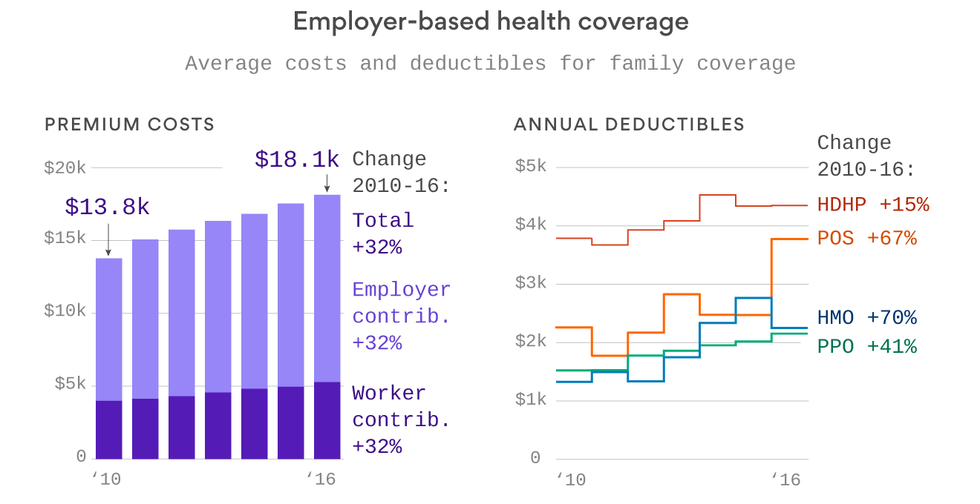
We’ve spent so much time talking about Affordable Care Act costs this year that it’s easy to forget what most people are actually paying for health care — the 156 million Americans who get their health coverage through the workplace. Turns out, most of us aren’t seeing sky-high premium increases. But it’s also worth remembering that deductibles matter too — because that’s what we pay out of pocket before insurance kicks in.

Take a look at these two graphics from Axios datavisuals genius Chris Canipe. The premium increases between 2010 and 2016 weren’t that bad — they’re single digits each year, and just add up over time. But you can see some big increases in deductibles, especially in point-of-service plans and HMOs.

Why it matters: That’s a big reason why people feel their health care costs going up, because it means they’re paying more out of pocket. And when prescription drug prices rise, they’re more likely to feel it directly.

Molina to cut 1,400 positions to improve financial performance

http://www.healthcarefinancenews.com/news/molina-cut-1400-positions-improve-financial-performance?mkt_tok=eyJpIjoiTXpVelkyRXhZMkpqTmpKaSIsInQiOiJFVjFscVRVVDdXZmZqek02STNMSVNjelwvREEwMmZmckZrWmNyZjNrQnVcL0szTGZuNXA4ZGdrOGRhT1V5bnREanBwWitPbTNkQllLZW5BTmd4VDk5TDg0ak1NNStnTllqdEllQlNpQmRZbDUwcm5JdVNaZ1lJcmpVVXJNYWxcL0JcL28ifQ%3D%3D

Image result for molina healthcare

The cuts follow removal of CEO and CFO due to financial losses blamed on Affordable Care Act market.

Molina Healthcare, which fired its CEO and CFO in May due to the poor financial performance of the company, will eliminate about 1,400 jobs over the next few months, according to an internal memo obtained by Reuters.

The cuts are due to financial losses blamed on Molina’s individual business in the Affordable Care Act market, in which it has been a major player.

Molina will reduce its workforce by the elimination of 10 percent of its 6,400 corporate positions and about 10 percent of 7,700 health plan jobs, according to Reuters. It will not affect Molina’s Pathways behavioral health business, which employs about 5,500 people.

Interim CEO and CFO Joe White sent the memo to employees saying the cuts aim to contribute to savings by 2018 in what he called “Project Nickel,” to do more with less.

In March, Molina was touted as an ACA success story.

Former CEO J. Mario Molina, MD, was an outspoken opponent of the Republican plan to repeal and replace the ACA. His brother, John C. Molina, who served as CFO. was also let go in a decision by the board to turn around the company’s financial position.

Last week Molina said it was concerned about Republicans repealing the ACA without having a replacement plan in place, the roll back of Medicaid expansion and the lack of a guarantee of federal cost-sharing reduction payments, which allows insurers to offer lower-income consumers lower deductibles and out-of-pocket expenses.

Molina also argued for the continuation of the individual mandate to get insurance.

“The bedrock of any coverage system is a requirement that people must obtain health insurance,” Molina said. “The lack of such a requirement will be detrimental to the individual market risk pool and will result in adverse selection, which would significantly increase costs.”

In June, Molina said it would file rates for 2018 to remain in the exchange market in Florida.

The California Department of Insurance is releasing on August 1 the insurers which have filed rates for the ACA market in 2018.

When High Deductibles Hurt: Even Insured Patients Postpone Care

When High Deductibles Hurt: Even Insured Patients Postpone Care

In November 2015, Tina Heck was in her garage lifting 40-pound bags of wood pellets to fuel her heating stove, when something went very wrong with her back.

“The next day, I could barely walk,” said the 55-year-old who lives on an acre of land in Nevada City, Calif., 60 miles northeast of Sacramento. The cause: a bulging disc in her lower spine, which shoots pain down her leg and makes her back stiff.

The injury wasn’t Heck’s only setback. The initial MRI, cortisone shot and doctor visit cost her $3,000 because her health plan requires her to shell out $5,000 before insurer payments kick in. She doesn’t want to explore other treatment options because of that high deductible. Heck, who makes $68,000 a year in marketing for a nonprofit, is not willing to add more debt on top of her credit-card and mortgage payments.

“I’m in pain every day,” she said, but “it’s not bad enough to go into debt.”

The concept behind high-deductible plans was to lower premiums and reduce overall health costs by ensuring that consumers shared the financial burden of their own health care decisions. But evidence is mounting: High deductibles have actually forced people to delay care that could prevent health emergencies later or improve their quality of life.

Regardless of what happens to the Affordable Care Act, such plans are likely to become more widespread as health care costs continue to rise. Just over half of people with health plans from their employers now have a deductible of $1,000 or more, up from 10% in 2006, according to the Kaiser Family Foundation. (Kaiser Health News, which produces California Healthline, is an editorially independent program of the foundation.)

“People who have medical problems that can be put off tend to do so much more now because of the high deductible,” said Dr. Ted Mazer, a San-Diego based head and neck surgeon who is president-elect of the California Medical Association.

Dr. Mazer blurb: Dr. Ted Mazer, president-elect of the California Medical Association, says some of his patients delay various tests and treatments because of the high deductibles and copays associated with their health plans.  (Courtesy of Kurt Kohnen)

Annual deductibles can amount to many thousands of dollars on some plans. Covered California bronze plans, with the lowest premiums available on the exchange, carry deductibles of $6,300 for an individual and $12,600 for a family.

A Kaiser Family Foundation survey released this year showed that 43% of insured people reported having trouble paying their deductible, up from 34% in 2015. (Kaiser Health News, which produces California Healthline, is an editorially independent part of the foundation.)

In one study by the liberal advocacy group Families USA, more than a quarter of people in high-deductible plans delayed some type of medical service such as a doctor visit or diagnostic test. And 44% of adults with high out-of-pocket expenses put off medical care, according to a nonpartisan Commonwealth Fund study.

Another recent study by researchers at the University of California-Berkeley and Harvard University found that people with high-deductible plans spent 42% less on health care before meeting their deductibles, primarily by reducing the amount of health care they received, not by shopping around for a better price.

Jonathan Kolstad, associate professor of economics at UC-Berkeley’s business school and co-author of the study, said patients dropped both needed care, such as diabetes medication, and potentially unnecessary care, such as imaging for headaches.

“Left to their own devices, people [in high-deductible plans] seem ill-equipped to make their own decisions” about what care they need, and what care they don’t, Kolstad said.

Mazer said that, in his practice, people have delayed all kinds of treatment that may not save “life or limb” but involved medical conditions that interfered with breathing or sleeping.

He said he’s had patients who needed a biopsy to determine if an abnormal vocal cord was cancerous, and they put it off because of the cost.

“I have to make the phone call and say, ‘We’re looking at a mass that may be malignant and if you put it off you’re putting yourself at risk,’ ” Mazer said. “And I’ll tell you, we’ve had people take that risk.”

Recent Republican proposals to repeal Obamacare have promoted the use of high-deductible plans by allowing people to put away more tax-free dollars into the health savings accounts that consumers use in conjunction with those plans. And experts said the proposals would also spur the growth of these plans — by cutting the subsidies available through exchanges, inducing customers to look for cheaper plans with higher deductibles.

Conservatives say insurance that promotes personal financial responsibility helps tamp down overall health costs. Hoover Institution analysts, for example, argue that high deductibles encourage patients to “choose wisely.”

But new evidence suggests that putting off care can be dangerous and, eventually, more costly to patients.

A March 2017 Harvard study found that low-income patients with diabetes who had high-deductible plans delayed visits for complications such as skin infections and pneumonia. They wound up getting more expensive care later on.

Patients may try to treat their conditions at home, or hope they go away — but if that approach fails, “they then have to seek care at the emergency department,” said Frank Wharam, a health policy researcher at Harvard Medical School and lead author of the study.

Wharam said the middle-income earners he studied didn’t suffer any adverse effects from health care choices they made in high-deductible plans, adding that more studies are needed on that group.

Sabrina Corlette, from the Georgetown University Center on Health Insurance Reforms, said that until national health policy addresses the “underlying costs of care,” patients in high-deductible plans will likely be stuck with the difficult task of figuring out what medical attention they need or can afford.

Heck said the symptoms from her back injury have changed — the pain is in a different part of the body than it was right after the injury. But she’s not even considering a trip to a nearby clinic for a new assessment. That would require another MRI, she said, which could cost at least $1,500, and it might not even help her. If her deductible weren’t as high, she’d feel “freer” to explore other health care options, she said.

For now, she’s taking a lot of ibuprofen and seeing a chiropractor.

“A lot of people get stuck in this place,” she said.