Will Consumerism Rein in Healthcare Costs? Why the Answer Is No

Click to access Healthcare-Consumerism_Rising-Costs_LEK-Executive-Insights_1806.pdf

Image result for Will Consumerism Rein in Healthcare Costs? Why the Answer Is No

In the first of our multipart Executive Insights series on consumerism in healthcare, L.E.K. Consulting examines why a more engaged consumer — despite the increasing optimism — will not be nearly enough to bend the healthcare cost curve or even stop the rising rates substantially.

California’s Drug Price Initiative: Will Voters ‘Send A Signal To Washington’?

California’s Drug Price Initiative: Will Voters ‘Send A Signal To Washington’?

mary_voterguide_770

This year, Mary O’Connor and her father made voting a family affair.

O’Connor’s father is a Vietnam veteran, so she was especially interested in his views on Proposition 61, a California ballot measure that would peg the state’s payments for prescription drugs to prices paid by the Department of Veterans Affairs. It’s widely believed the federal program for military personnel gets some of the deepest discounts in the country.

“We researched it a lot,” said O’Connor, a 24-year-old from Sacramento. Both decided to vote yes because drug prices are “ridiculous” and need to be reined in, she said. “We have seen that things cannot remain the way they are.”

The measure faces strong opposition from the pharmaceutical industry, which has poured at least $109 million into defeating it. In addition, some state policy experts and consumer advocates say the measure may not save taxpayers or patients any money, and could even do more harm than good. Many veterans’ groups have voiced opposition as well, saying the initiative will raise VA drug spending, but proponents have support from some veterans as well.

But these warnings haven’t swayed — or reached — voters who want lawmakers to just do something to lower drug prices.

Former Democratic presidential candidate Bernie Sanders has taken up their cause, suggesting passage of Proposition 61 is important to the nation as a whole.

Clinton vs. Trump: 5 critical election issues

http://managedhealthcareexecutive.modernmedicine.com/managed-healthcare-executive/news/hillary-vs-trump-5-critical-election-issues?cfcache=true&ampGUID=A13E56ED-9529-4BD1-98E9-318F5373C18F&rememberme=1&ts=25102016

While Hillary Clinton vows to forge ahead with Obamacare if she is elected president, Donald Trump would scrap it altogether. The end results would be two very different forms of healthcare, and industry leaders have much to consider.

Brill“Many different factors are weighing on managed care executives such as the costs of pharmaceuticals, diagnostics and devices; the impact of consolidation amongst hospitals, physicians, health plans; and the losses in the exchange marketplace,” says Managed Healthcare Executive editorial advisor Joel V. Brill, MD, chief medical officer, Predictive Health, LLC, which partners with stakeholders to improve coverage of value-driven care. “With each of these factors, plans can, at least at a high level, make some educated guesses about the relative risk of each factor and impact to the bottom line.”

The election results, however, are much less certain, which from a risk perspective, weighs heavily on the minds of healthcare executives, Brill says. “How can you plan for business knowing that whatever you are doing currently could be upended in the beginning of November?”

To help provide some clarity, Managed Healthcare Executive identified five of the top industry issues, reviewed the candidates’ platforms for each, and asked industry experts to weigh in.

Narrow networks: savings at what cost?

Narrow networks: savings at what cost?

Image result for Narrow networks: savings at what cost?

You probably chafe a bit every time you learn that a certain doctor or hospital isn’t part of your insurance network. Narrowing the scope of your network helps insurers save money. They can drive hard bargains with doctors and hospitals to get lower prices and walk away from higher-priced ones.

Increasingly, insurers are offering narrow network plans. Would you enroll in one? So long as quality doesn’t suffer, consumers should welcome the lower premiums they may offer.

Researchers at the Leonard Davis Institute at Penn analyzed the relationship between network size and premiums for plans offered in the Affordable Care Act marketplaces. Plans with very narrow networks (covering care by less than 10 percent of physicians) charged 6.7 percent lower premiums than plans with much broader networks (covering care by up to 60 percent of physicians). This translates into an annual savings for an individual of between $212 and $339, depending on age and family size. For a young family of four, the savings could reach nearly $700 per year.

“Marketplace consumers are looking for value,” said Daniel Polsky, the University of Pennsylvania health economist who led the study. “That level of savings could be a very good deal for consumers, but whether these plans provide value depends on how they are achieving those savings.”

One way plans might save money could make it harder for patients to get care — so that they get less of it. Narrow network plans may do this if they don’t cover enough nearby providers, with the ones they do cover too busy to take new patients in a timely fashion. Clearly this would be especially problematic if appointments with one’s preferred primary care doctor are hard to obtain.

Are today’s narrow network plans actually doing this? Until recently, we had no data to answer this question. But two studies published earlier this year — one focused onMassachusetts, the other on California — provide some insight.

Healthcare Triage News: Health Care Reform, and the Issues We Face

Healthcare Triage News: Health Care Reform, and the Issues We Face

Image result for Healthcare Triage News: Health Care Reform, and the Issues We FaceImage result for Healthcare Triage News: Health Care Reform, and the Issues We FaceImage result for Healthcare Triage News: Health Care Reform, and the Issues We Face

As we approach the election this fall, it seems like the news media report on little else. Unfortunately, too little news coverage addresses health care reform. That’s wackadoo, because there is still so much to be done to improve the cost, quality, and access for patients within the US health care system.

So let’s talk about the major health policy issues we in the US face. This is Healthcare Triage News.

21 statistics on high-deductible health plans

http://www.beckershospitalreview.com/finance/21-statistics-on-high-deductible-health-plans.html

Image result for 21 statistics on high-deductible health plans

Hospital and health system executives are well aware of the affects high-deductible health plans have had on hospital finances, from patient collections to bad debt. To help quantify the impact of increasing patient financial obligations on the business of healthcare, here are 21 statistics to know about high-deductible health plans.

POLITICO-Harvard poll: Americans blame drug companies for rising health costs

http://www.politico.com/story/2016/09/americans-blame-drug-companies-for-rising-health-cost-poll-228866?utm_campaign=KHN%3A+Daily+Health+Policy+Report&utm_source=hs_email&utm_medium=email&utm_content=35091656&_hsenc=p2ANqtz-8PbV9cRcxweGuejnRZArmy5BpOsVlplZlnpP5Tlh3Bb4D0hvTxsoCG-nghADRTV3uBXXBbgZHO8RPcxFGbLEAOLxGfVw&_hsmi=35091656

A pharmacist is pictured. | Getty

The poll found 43 percent of Americans are “very or somewhat” worried about medical costs in the coming year, and the top concern (31 percent) is their out-of-pocket costs.

The Health Care Reform Proposals of Hillary Clinton and Donald Trump

http://www.commonwealthfund.org/publications/blog/2016/trump-clinton-presidential-health-care-proposals?utm_medium=Facebook&utm_campaign=Health+Coverage&utm_source=Candidates+Blog

Image result for The Health Care Reform Proposals of Hillary Clinton and Donald Trump

As president, Hillary Clinton and Donald Trump would take the nation down distinctly different paths on health care. In this post, we summarize the health reform proposals of each candidate, and—drawing on new estimates by Christine Eibner and colleagues at RAND Health—compare the proposals’ implications for the total number of people with insurance coverage, people’s out-of-pocket health care costs, and the federal budget.

RAND’s analysis is based on publicly available health care proposals on the candidates’ websites. Where these proposals lacked sufficient clarity for modeling, RAND sought additional information from the campaigns. When answers were not forthcoming, or did not fully resolve questions, RAND made reasonable assumptions that were reviewed and critiqued by independent experts. RAND modeled only those proposals for which it had adequate detail and technical capacity.

The Starting Point

As a starting point, Clinton and Trump propose dramatically different approaches to the Affordable Care Act (ACA): Clinton would maintain the ACA and Trump would repeal it. In estimating the impact of Trump’s proposal, RAND assumes a full repeal of the law including insurance subsidies, expanded eligibility for Medicaid, and individual market reforms such as bans against preexisting condition exclusions. RAND also assumes that repeal would eliminate the ACA’s financing mechanisms such as its Medicare payment reforms and taxes on health plans and medical devices. Consequently, RAND estimates that compared to maintaining the ACA as is, repeal would cause nearly 20 million people to lose their insurance in 2018, increase average premium and out-of-pocket costs for people who buy insurance on their own, and increase the federal deficit. Trump’s repeal of the ACA would increase the federal deficit because the loss of savings from the law’s Medicare reforms and revenues from fees and taxes would be greater than savings from the elimination of insurance subsidies and the Medicaid expansion.

On Medicare But At Risk: A State-Level Analysis of Beneficiaries Who Are Underinsured or Facing High Total Cost Burdens

http://www.commonwealthfund.org/publications/issue-briefs/2016/may/on-medicare-but-at-risk

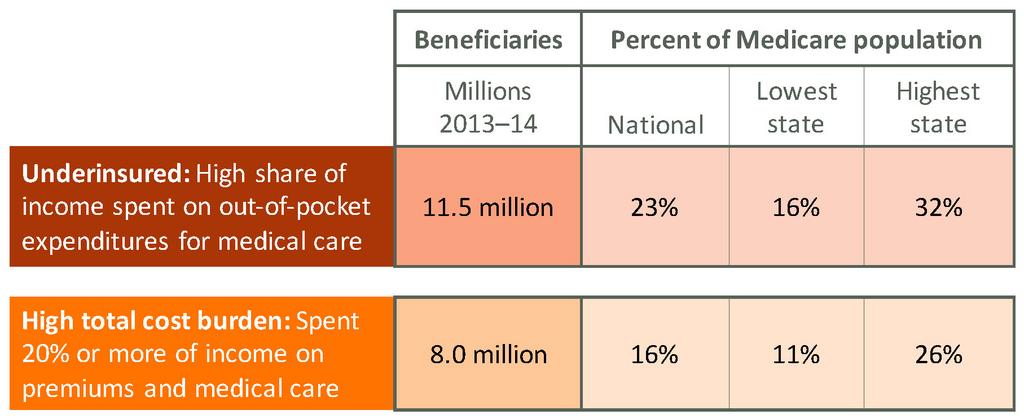
Medicare provides essential health coverage for older and disabled adults, yet it does not limit out-of-pocket costs for covered benefits and excludes dental, hearing, and longer-term care. The resulting out-of-pocket costs can add up to a substantial share of income. Based on U.S. Census surveys, nearly a quarter of Medicare beneficiaries (11.5 million) were underinsured in 2013–14, meaning they spent a high share of their income on health care. Adding premiums to medical care expenses, we find that 16 percent of beneficiaries (8 million) spent 20 percent or more of their income on insurance plus care. At the state level, the proportion of beneficiaries underinsured ranged from 16 percent to 32 percent, while the proportion with a high total cost burden ranged from 11 percent to 26 percent. Low-income beneficiaries were most at risk. The findings underscore the need to assess beneficiary impacts of any proposal to redesign Medicare.

High-Need, High-Cost Patients: Who Are They and How Do They Use Health Care?

http://www.commonwealthfund.org/publications/issue-briefs/2016/aug/high-need-high-cost-patients-meps1

Image result for High-Need, High-Cost Patients: Who Are They and How Do They Use Health Care?

Issue: Finding ways to improve outcomes and reduce spending for patients with complex and costly care needs requires an understanding of their unique needs and characteristics.

Goal: Examine demographics and health care spending and use of services among adults with high needs, defined as people who have three or more chronic diseases and a functional limitation in their ability to care for themselves or perform routine daily tasks.

Methods:Analysis of data from the 2009–2011 Medical Expenditure Panel Survey.

Key findings: High-need adults differed notably from adults with multiple chronic diseases but no functional limitations. They had annual health care expenditures that were nearly three times higher—and which were more likely to remain high over two years of observation—and out-of-pocket expenses that were more than a third higher, despite their lower incomes. On average, rates of hospital use for high-need adults were more than twice those for adults with multiple chronic conditions only; high-need adults also visited the doctor more frequently and used more home health care.

Conclusion: Wide variation in costs and use of services within the high-need group suggests that interventions should be targeted and tailored to those individuals most likely to benefit.