ACA mandate repeal may be less popular than GOP thinks

https://www.axios.com/individual-mandate-repeal-may-be-less-popular-than-republicans-think-2514871844.html

The tax bill that just passed the Senate eliminates the Affordable Care Act’s individual mandate, and the House is likely to go along when Congress writes the final version. With the tax legislation moving so quickly and the mandate lost in the maze of so many other consequential provisions, we are not likely to have much public debate about this big change in health policy.

Why it matters: If we did, even though the mandate has never been popular, our polling shows that the public does not necessarily want to eliminate it as part of tax reform legislation, once they understand how it works and what the consequences of eliminating it might be.

The back story: Republicans have targeted the ACA mandate because they want the $318 billion in savings the Congressional Budget Office says they would get to help them pay for their tax cuts. (The change would save money because fewer people would get federal subsidies on the ACA marketplaces or apply for Medicaid coverage.)

They have also targeted the mandate because they think it’s so unpopular. Our polls have consistently shown that the mandate is the least popular element of the ACA and in the abstract, more Americans (55%) would eliminate the mandate than keep it (42%).

Yes, but: When people know how the mandate actually works, and are told what experts believe is likely to happen if it’s eliminated, most Americans oppose repealing it in the tax plan.

  • When people learn that they will not be affected by the mandate if they already get insurance from their employer or from Medicare or Medicaid, 62% oppose eliminating it.
  • When people are told that eliminating the mandate would increase premiums for people who buy their own coverage, as the CBO says it will, they also flip, with 60% opposing eliminating the mandate.
  • And when they’re told that 13 million fewer people will have health coverage – another CBO projection – 59% oppose eliminating the mandate.

The bottom line: Many people change their minds when they learn more about facts and consequences, which happens as the lights shine brighter on them in legislative debates. This happened to the “skinny repeal” proposal, and it would happen to single payer.

But as the tax legislation rushes through Congress and heads to the final negotiations, there is almost no chance for the public to grasp the tradeoffs that would come from eliminating the mandate and who is affected and who is not. If they did, the polling suggests, eliminating the mandate might prove far less popular than Republicans seem to think it is.
What we learned from Azar’s first hearing

https://www.axios.com/hhs-nominee-drug-prices-are-too-high-2513516063.html

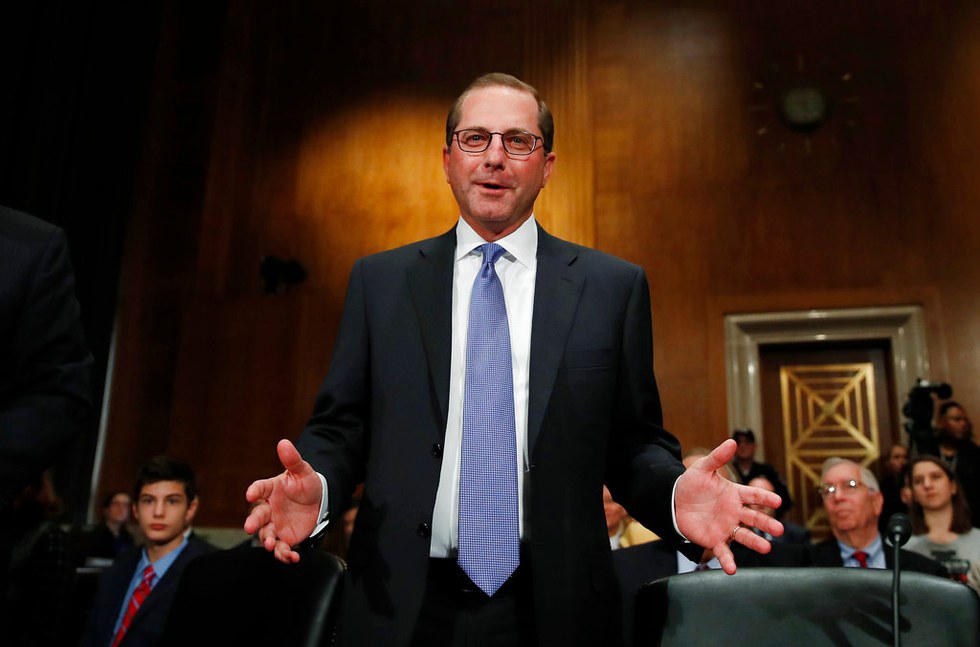
Alex Azar is in line to be the next HHS secretary. Photo: Carolyn Kaster / AP

The biggest cloud hanging over Alex Azar during his Senate confirmation hearing Wednesday was his pharmaceutical industry background. Republicans praised the experience as an advantage to tackle high drug costs, while Democrats said it raises conflicts of interest and encourages a revolving door mentality.

Azar’s response: He will not “implement pharma’s policy agenda. I don’t know what their list of agenda items is.”

Between the lines: Private industry experience doesn’t preclude someone from a public job. But, as my colleague Bob Herman notes, many of Azar’s responses matched up with the pharmaceutical lobby’s playbook:

  • discussing the holes in health insurance plans and high deductibles
  • targeting pharmacy benefit managers and others in the “entire channel”
  • focusing on lowering what people pay at the pharmacy counter instead of systemic issues like the rising list prices that drugmakers set

Yes, but: Azar did mention wanting to reform the drug patent system, which the drug industry almost certainly would oppose.


Stabilization Bill Couldn’t Fix the Damage of Repealing Obamacare’s Mandate

https://www.bloomberg.com/news/articles/2017-11-29/obamacare-stabilization-bill-can-t-fix-harms-of-mandate-repeal

Image result for Healthcare and Tax Cuts


  • CBO has estimated 4 million would lose coverage in 2019
  • Stabilization bill would have no impact on predictions: CBO

Passing a bipartisan Obamacare stabilization bill wouldn’t do much to cushion the blow from repealing the health law’s requirement that all individuals buy health insurance, the Congressional Budget Office said.

 The CBO has estimated that scrapping the mandate would result in 4 million people losing health coverage in 2019 and premiums in the individual market to increase by 10 percent. On Wednesday, the nonpartisan Congressional agency said a stabilization proposal backed by some Republican Senators would have no impact on its calculations.
The CBO’s conclusion could have an impact on the fate of the Senate tax overhaul bill that is expected to get a vote this week. Senate Republicans included the repeal of the Affordable Care Act’s individual mandate in their tax proposal. And several Senators concerned about their states’ health insurance markets, including Susan Collins of Maine and Lisa Murkowski of Alaska, had pushed forward the stabilization bill as a way to mitigate the blow.
President Donald Trump endorsed the proposal, known as the Bipartisan Health Care Stabilization Act, on Tuesday.

“The effects on premiums and the number of people with health insurance coverage would be similar to those referenced above,” the CBO said Wednesday.

The CBO projection comes with caveats. It compares the effect of the stabilization bill to a baseline in which Obamacare’s cost-sharing reduction subsidies are paid. The Trump administration has halted the payments, which lower deductibles and out-of-pocket costs for low-income people, and the funds are the subject of a legal dispute.

“I find it baffling,” Collins said Wednesday. She and Murkowski voted against earlier Republican efforts to repeal the ACA, blocking them.

The CBO report also doesn’t evaluate the effect of giving insurers additional funding, an approach that’s also under discussion. Collins introduced a bill with Senator Bill Nelson of Florida to give states seed money for high-risk pools “which would ensure that people with pre-existing conditions are protected and also to lower premiums,” she said on Tuesday. Alexander specified that Collins’s bill would provide $3 billion to $5 billion to states to set up the high-risk pools. Collins said on Tuesday that Trump also supporters her proposal.

Healthcare bankruptcies more than triple in 2017

https://www.beckershospitalreview.com/finance/healthcare-bankruptcies-more-than-triple-in-2017.html

Image result for hospital bankruptcies

Regulatory changes, the rise of high-deductible health plans and advances in technology are a few of the factors that have taken a toll on healthcare companies’ finances, and these challenges may lead many hospitals and other medical companies to restructure their debt or file for bankruptcy in the coming year, according to Bloomberg.

Although hospitals are expected to face financial challenges in the year ahead, many healthcare companies are already struggling. According to data compiled by Bloomberg, healthcare bankruptcy filings have more than tripled in 2017. Healthcare bankruptcies are on the rise as filings across the broader economy have fallen since 2010, according to the report.

The challenges in the healthcare sector may hit rural hospitals the hardest due to the reduction in Disproportionate Share Hospital payments.

The ACA calls for annual ggregate reductions to DSH payments from fiscal year 2014 through fiscal year 2020. Subsequent legislation delayed the start of the reductions until fiscal year 2018, which began Oct. 1, and pushed the end date back to fiscal year 2025.

David Neier, a partner at Winston & Strawn, told Bloomberg the cuts to DSH payments may “single-handedly throw hospitals into immediate financial distress.”


Skyrocketing out-of-pocket spending outpaces wage growth

https://www.healthcaredive.com/news/skyrocketing-out-of-pocket-spending-outpaces-wage-growth/506734/

Dive Brief:

  • In the latest study to show how out-of-pockets costs could create barriers to care, the Kaiser Family Foundation (KFF) found that out-of-pocket spending is outpacing wage growth.
  • The average deductible for people with employer-based health insurance increased from $303 in 2006 to $1,505 in 2017.
  • Researchers also found that average payments for deductibles and coinsurance skyrocketed faster than overall cost for covered benefits. That’s happened while average copayments have decreased.

Dive Insight:

KFF researchers reviewed health benefit claims from the Truven MarketScan Commercial Claims and Encounters Database to calculate the average that members pay for deductibles, copayments and coinsurance. What they found should not surprise anyone in healthcare or with employer-based health insurance — deductibles and overall out-of-pocket health costs are rising.

The organization found patient cost-sharing “rose substantially faster than payments for care by health plans as insurance coverage became a little less generous” between 2005 and 2015.

Deductibles went from accounting for less than 25% of cost-sharing payments in 2005 to almost half in 2015. The average payments toward deductibles rose 229% from $117 to $386 and the average payments toward coinsurance increased 89% from $134 to $253 in that period.

On the plus side, copayments fell by 36% from $218 to $139 as payers and employers have moved more costs to healthcare utilization.

Overall, patient-cost sharing increased by 66% from an average of $469 in 2005 to $778 in 2015. Average payments by health plans also increased 56% from $2,932 to $4,563.

While out-of-pocket health costs have skyrocketed, wages in the same period increased by 31%.

The KFF study comes on the heels of a JPMorgan Chase Institute report that found Americans are struggling with out-of-pocket costs. In many cases, JPMorgan Chase Institute found that people are delaying healthcare payments until they get “liquid assets.” In fact, healthcare payments spike in March and April when Americans get tax refunds.

In another recent study on the topic, HealthFirst Financial Patient Survey said more than 40% of respondents are “very concerned” or “concerned” about whether they could pay out-of-medical bills over the next two years. More than half said they are worried that they might not be able to afford a $1,000 bill, 35% were concerned about a $500 bill and 16% said they’re worried about paying a bill less than $250.

Those amounts are usually well below health plan deductibles. The Kaiser Family Foundation/Health Research & Educational Trust 2017 Employer Health Benefits Survey recently found that health plan deductibles often exceed $3,000.

That could be a problem not just for those individuals. Providers and hospitals are already struggling with sagging reimbursements and payer cost-saving measures and policies. More bad debt would only make matters worse.


Increases in cost-sharing payments have far outpaced wage growth

Increases in cost-sharing payments continue to outpace wage growth

Image result for Deductibles account for less than a quarter of cost-sharing payments in 2005, but almost half in 2015


Rising cost-sharing for people with health insurance has drawn a good deal of public attention in recent years.  For example, the average deductible for people with employer-provided health coverage rose from $303 to $1,505 between 2006 and 2017.

While we can get a sense of employees’ potential exposure to out-of-pocket costs by looking at trends in deductibles, many employees will never reach their deductibles and other employees may have costs that far exceed their deductibles.  In addition to deductible payments, some employees also have copayments (set dollar amounts for a given service) or coinsurance payments (a percentage of the allowed amount for the service).  To look at what workers and their families actually spend out-of-pocket for services covered by their employer-sponsored plan, we analyzed a sample of health benefit claims from the Truven MarketScan Commercial Claims and Encounters Database to calculate the average amounts paid toward deductibles, copayments and coinsurance.

We find that, between 2005 and 2015, average payments for deductibles and coinsurance rose considerably faster than the overall cost for covered benefits, while the average payments for copayments fell.  As can be seen in the chart below, over this time period, patient cost-sharing rose substantially faster than payments for care by health plans as insurance coverage became a little less generous.

Deductible spending has risen while copayment spending has fallen

The MarketScan claims database contains information about health benefit claims and encounters for several million individuals each year provided by large employers.  The advantage of using claims information to look at out-of-pocket spending is that we can look beyond the plan provisions and focus on actual payment liabilities incurred by enrollees. A limitation of these data is that they reflect cost sharing incurred under the benefit plan and do not include balance-billing payments that beneficiaries may make to health care providers for out-of-network services or out-of-pocket payments for non-covered services.  We use a sample of between 933,000 and 14.8 million enrollees per year to analyze the change from 2005 to 2015 in average health costs for covered benefits overall, the average amount paid by health benefit plans, and the average amounts attributable to deductibles, copayments, and coinsurance.  The analysis of costs for each year was limited to enrollees with more than six months of coverage during that year.

From 2005 to 2015, the average payments by enrollees towards deductibles rose 229% from $117 to $386, and the average payments towards coinsurance rose 89%, from $134 to $253, while average payments for copays fell by 36%, from $218 to $139.  Overall, patient cost-sharing rose by 66%, from an average of $469 in 2005 to $778 in 2015. During that period, average payments by health plans rose 56%, from $2,932 to $4,563. This reflects a modest decline in the average generosity of insurance – large employer plans covered 86.2% of covered medical expenses on average in 2005, decreasing to 85.4% in 2015.  Wages, meanwhile, rose by 31% from 2005 to 2015.

Individuals in the top 15 percent of health spenders (who together account for 75.1% of total health benefit costs for the sample), had substantially higher out-of-pocket costs, averaging $2,766 in 2015, including $1,302 in coinsurance payments, $1,006 in deductible spending, and $458 in copays. The growth in cost-sharing for this group was similar to the sample overall.  As of 2015, 6.5% of all enrollees had deductible payments that exceeded $1,500 and 8.4% had overall cost-sharing payments that exceeded $2,500.

Deductibles account for less than a quarter of cost-sharing payments in 2005, but almost half in 2015

The relatively high growth in payments toward deductibles is evident in the changes over time in the distribution of cost sharing payments: deductibles accounted for 25% of cost sharing payments in 2005, rising to 50% in 2015.  Conversely, copayments accounted for nearly half (46%) of cost sharing payments in 2005, falling to 18% in 2015.  The increase in coinsurance over the period from 29% of total employee cost-sharing in 2005 to 33% in 2015 may reflect the strong growth over the period in plans that qualify a person to establish a health savings account; these plans are more likely to have coinsurance than copayments for physician services.  Patients are more sensitive to the actual price of health care with deductibles and coinsurance than they are with copays, which are flat dollar amounts.  The other difference between a copay and a deductible is that copays may add up over time, while a deductible may need to be met at once, causing affordability challenges.

While average payments towards deductibles are still relatively low in the context of total household budgets, they have increased quite rapidly. Deductibles are the most visible element of an insurance plan to patients, which may help explain why consumers continue to show concern about their out-of-pocket costs for care. Although health insurance coverage continues to pay a large share of the cost of covered benefits, patients in large employer plans are paying a greater share of their medical expenses out-of-pocket. And, while health care spending has been growing at fairly modest rates in recent years, the growth in out-of-pocket costs comes at a time when wages have been largely stagnant.

Next U.S. Restructuring Epidemic: Sick Health-Care Companies

https://www.bloomberg.com/news/articles/2017-11-27/next-u-s-restructuring-epidemic-sick-health-care-companies

  • Rural hospitals seen as among hardest hit by regulatory change
  • Technological shifts and urgent care reshaping industry

A growing number of health-care companies may face near-death experiences of their own.

 A wave of hospitals and other medical companies are likely to restructure their debt or file for bankruptcy in the coming year, following the recent spate of failing retailers and energy drillers, according to restructuring professionals. Regulatory changes, technological advances and the rise of urgent-care centers have created a “perfect storm” for health-care companies, said David Neier, a partner in the New York office of law firm Winston & Strawn LLC.
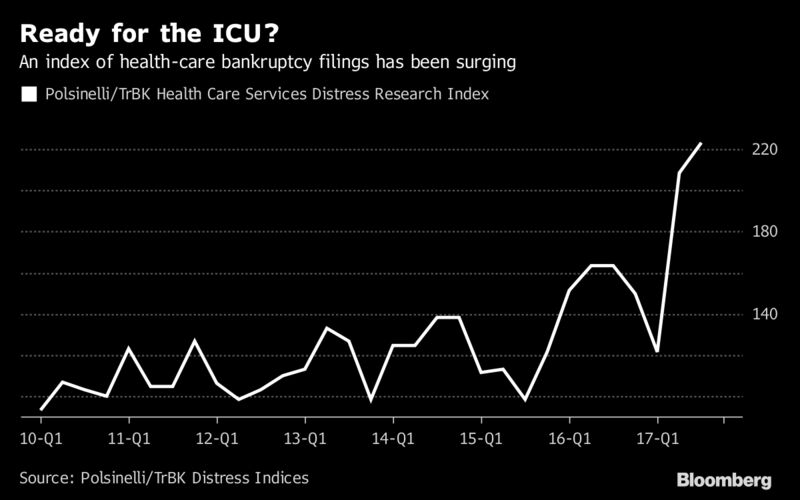
Some signs are already there: Health-care bankruptcy filings have more than tripled this year according to data compiled by Bloomberg, and an index of Chapter 11 filings by companies with more than $1 million of assets has reached record highs in four of the last six quarters, according to law firm Polsinelli PC. Junk bonds from companies in the industry have dropped 1.4 percent this month, a steeper decline than the broader high-yield market, according to Bloomberg Barclays index data.
The pain for the sector comes as bankruptcy filings across the broader economy have plunged since 2010.
Hospitals, including private rural ones, may be among the hardest hit, Winston & Strawn’s Neier said. The Affordable Care Act, known as Obamacare, reduced payments to hospitals that serve a large number of poor and uninsured patients, known as “disproportionate share hospitals,” on the theory that more patients would be insured under the law. Congress delayed those cuts several times, but didn’t do so for the current fiscal year, which may “single-handedly throw hospitals into immediate financial distress — many operate on less than one day’s cash,” he said in an interview.

“Smaller hospitals have already been struggling for years,” said Kristin Going, a partner in the New York office of Drinker, Biddle & Reath LLP. Both lawyers declined to discuss specific companies. Since 2010, a growing number of patients have enrolled in high-deductible health plans that force them to shoulder more of costs when they get treatment, according to the U.S. Centers for Disease Control and Prevention. That has translated into more bad debt from customers for hospitals and other providers.

Some publicly traded hospital companies that were already under pressure from high debt loads have been further buffeted by this year’s hurricanes. Community Health Systems Inc., with $1.9 billion in debt maturing in 2019, has suffered doctor revolts over crumbling, cash-strapped facilities, as well as losses linked to the storms in Texas and Florida earlier this year. A representative for Community Health didn’t return a call seeking comment.

Signs of Distress

Jorian Rose, partner in the New York office of Baker & Hostetler LLP, said many health-care restructurings are already going on under the radar right now. Rose, Going and Neier are members of the Turnaround Management Association, a group for bankruptcy and restructuring professionals.

The Polsinelli Health Care Services Distress Research index, which tracks bankruptcy filings for companies with more than $1 million in assets, shows that activity has surged 123 percent since the fourth quarter of 2010. By comparison, the law firm said, the general index that tracks Chapter 11 filings in the U.S. is down nearly 58 percent from 2010. The Affordable Care Act, which Republican lawmakers have been looking to repeal, replace, defund, or otherwise change, was cited as one of the systemic changes rocking the sector.

Since 1997, health-care cases have made up only 5.25 percent of all U.S. bankruptcy filings, according to Bloomberg data. Year to date, they already comprise 7.25 percent of all filings. Emergency-room operator Adeptus Health, cancer-care provider 21st Century Oncology, and cancer treatment specialist California Proton Treatment are the largest filings. Those statistics exclude pharmaceutical company Concordia, which is restructuring in Canada, and Preferred Care Inc., one of the U.S.’s largest nursing home groups, operating 108 assisted living facilities.

Problems for the sector aren’t limited to U.S. companies. Israeli drugmaker Teva Pharmaceutical Industries Ltd., saddled with debt that’s more than double its market value, is putting together a “detailed restructuring plan” after the company has slashed its profit forecasts, cut its dividend, signaled it may sell new shares, and reduced its goal for paying down debt this year. It announced a management shakeup on Monday.

Distress among health-care companies can spread to other parts of the economy. Quality Care Properties Inc., for example, is a real estate investment trust with a struggling tenant, HCR Manorcare Inc. Moody’s Investors Service said in an October report that if HCR Manorcare files for bankruptcy, Quality Care could also need to amend the terms of its own debt. Representatives for HCR Manorcare and Quality Care didn’t return calls seeking comment.

Is a Medicare option for all the only practical means to solve the healthcare insurance crisis?

https://www.beckershospitalreview.com/payer-issues/is-a-medicare-option-for-all-the-only-practical-means-to-solve-the-healthcare-insurance-crisis.html

Image result for health insurance options

From a healthcare consumer perspective, it increasingly strikes one that the healthcare insurance market is a story of haves and have-nots.

The haves include those that work for companies of a certain size, at which the companies can access insurance at very expensive but somewhat rationalized costs (think $16,000 to $20,000 per family per year, with employees contributing roughly $5,500), people on Medicare, and — crazily enough — people on Medicaid. (Again, the concept of a “have” here solely relates to the availability of healthcare coverage. It is by no means meant to understate the challenge of being in such poverty to be eligible for Medicaid.)

The have-nots include a vast number of people trying to buy insurance directly from insurance companies. Here, one increasingly hears that whether one is rich or poor, the costs are horrendous. Family costs for PPO plans seem to fall in the $20,000 to $25,000 range for many families, and even higher for those with preexisting conditions.

From a provider perspective, Medicare is a mixed bag depending on the type of provider. From a hospital’s perspective, it seems to be fine overall. From a physician’s perspective,  many seem to find it woefully inadequate.

One of the great challenges of the ACA is it set up an additional healthcare system of subsidies around insurance markets, mandates and so forth. It added complexity and costs, but also helped provide an additional basket of coverage for a good deal of uninsured Americans.

Regardless of political perspectives, rather than building another healthcare finance system, it seems that a simple approach would be to build on an existing system that, while imperfect, seems to work fairly well.

As an ardent capitalist at heart, the idea over the years of expanding a government program of any sort, including Medicare, has always led me to a negative conclusion. I.e., would it cause the kind of regression in our healthcare system that exists in systems in England or Canada, where care is famously inadequate or requires waiting months for certain types of care?

In contrast, at some point, does the cost of healthcare for those who don’t work for a large company and aren’t eligible for Medicare or Medicaid make the system so expensive that there is good reason to offer a Medicare option for such people? This demographic makes up a large part of the population, and it seems that the private insurance market is offering them only very expensive choices for health plans.

Much of my sense of the cost of private healthcare insurance comes anecdotally — from listening to diverse family and extended family around the Thanksgiving table, for instance. That stated, I do sense the cost of insurance for a family has moved from quite expensive to extremely and back-breakingly expensive. Sadly, I’m losing confidence that the core free market can fix it.