Five-year decline in hospital-acquired conditions leads to $28B in savings

http://www.fiercehealthcare.com/healthcare/five-year-decline-hospital-acquired-conditions-leads-to-28b-savings

Fewer patients have died due to hospital-acquired conditions over the past five years and hospitals saved more than $28 billion in healthcare costs during the same time period, according to a new federal government report.

The U.S. Department of Health and Human Services credits the 21 percent decline in hospital-acquired conditions in part to the provisions of the Affordable Care Act.

“The Affordable Care Act gave us tools to build a better healthcare system that protects patients, improves quality, and makes the most of our healthcare dollars and those tools are generating results,” said HHS Secretary Sylvia M. Burwell in the announcement. “Today’s report shows us hundreds of thousands of Americans have been spared from deadly hospital-acquired conditions, resulting in thousands of lives saved and billions of dollars saved.”

Indeed, the report, “National Scorecard on Rates of Hospital-Acquired Conditions,” by the Agency for Healthcare Research and Quality, finds that roughly 125,000 fewer patients died during 2010 to 2015. In total, hospital patients experienced more than 3 million fewer hospital-acquired conditions, such as adverse drug events, catheter-associated urinary tract infections, central line associated bloodstream infections, pressure ulcers and surgical site infections, during that time period.

Building A System That Works: The Future Of Health Care

http://healthaffairs.org/blog/2016/12/12/building-a-system-that-works-the-future-of-health-care/?utm_source=RealClearHealth+Morning+Scan&utm_campaign=4e312288c8-EMAIL_CAMPAIGN_2016_12_12&utm_medium=email&utm_term=0_b4baf6b587-4e312288c8-84752421

Blog_Burwell2

Nearly a century after Theodore Roosevelt’s Bull Moose Party first called for health insurance reform, the United States has made major advances in access, quality, and affordability.

In the six years since President Obama signed the Affordable Care Act (ACA) into law, 20 million more people have health insurance, and, for the first time in our history, more than nine out of every 10 Americans are insured. Growth in both premiums for employer coverage and overall Medicare spending has also slowed. The Centers for Medicare and Medicaid Services’ Actuaries now project that we are on track to spend $2.6 trillion less over the ACA’s first decade than was projected without the ACA back in 2010.

Even with this slow down, any increase in costs can be challenging for businesses monitoring expenses or families working through their budgets. That’s why stakeholders nationwide have been coming together to reshape the future of health care. Using new advancements in data, medicine, and the tools and resources provided by the Affordable Care Act, institutions across the country are building a health care system that works better for all Americans.

This work has gone on steadily for years — through political turmoil and challenges in the courts. Yet through each challenge, these reforms have endured.

They must continue to endure. The 20 million Americans who gained coverage cannot lose it again. The more than 129 million people with pre-existing conditions do not want to go back to a time when insurers could discriminate against them, or block them from coverage. Eleven million Medicare Part D beneficiaries cannot afford to lose the $2,000 they have each saved, on average, from the law’s work to begin closing the “donut hole.” The American people do not want to turn back our nation’s progress. Improvements need to be made, but they need to build on progress and not take us backwards in terms of access (the number of insured), affordability (costs to individuals, businesses, and taxpayers), and quality (the benefits that are being provided).

As the Obama Administration comes to a close, this piece lays out my vision for the future of health care. I share the steps we have taken to change how we pay for health care, incentivize coordination, and unlock health care data. This is the path forward—a system where innovative actors are putting the patient at the center—and, despite differences in health care, I firmly believe it is a vision on which we can all agree.

An ACA primer: Much more than insurance

http://www.healthcaredive.com/news/an-aca-primer-much-more-than-insurance/429497/

Remember the Affordable Care Act? Enacted in 2010, it expanded healthcare insurance to millions of uninsured Americans and increased access to care. But the ACA is much more than expanded coverage; it set in motion a variety of reforms in the healthcare delivery systems aimed at lowering costs and improving quality of care.

That fact was lost on presidential candidate Donald Trump, who told Fox News recently, “I don’t use much Obamacare, I must be honest with you, because it is so bad for the people and they can’t afford it.” Trump’s comments imply Obamacare is an insurance plan people can buy, which is not the case. As we wrap up year six since the ACA was enacted, here‘s what the law is really about and how it impacts providers.

Public Health Officials Struggle To Identify Sepsis Before It Becomes Deadly

http://khn.org/news/public-health-officials-struggle-to-identify-sepsis-before-it-becomes-deadly/?utm_campaign=KHN%3A+Daily+Health+Policy+Report&utm_source=hs_email&utm_medium=email&utm_content=33278487&_hsenc=p2ANqtz-_8KIyYxXNIF-21jTIsaT1TCz3UXX37BTMaIxr7_hnAyIOw4I6NhoeCq28LgUM3bjzRgNkA6fCTpslqrXZ1qMCGsCvXeQ&_hsmi=33278487

After Rory Staunton fell at the gym and cut his arm in March of 2012, the 12-year-old became feverish and vomited during the night, complaining of a sharp pain in his leg. When his parents called his pediatrician the next day, she wasn’t worried. She said there was a stomach virus going around New York City, and his leg pain was likely due to his fall.

However, she advised his parents, Orlaith and Ciaran Staunton, to take the youngster to the emergency department because he might be dehydrated. There hospital workers did some blood work, gave him fluids and sent him home.

The next day Rory’s pain and fever were worse. His skin was mottled and the tip of his nose turned blue. The Stauntons raced back to the hospital, where he was admitted to intensive care. The diagnosis: septic shock. Rory was fighting a system-wide infection that was turning his skin black and shutting down his organs. On Sunday, four days after he dove for the ball in gym class, Rory died.

“It was frightening to think that something could kill my son so fast and it would be something that I had never heard of,” said Orlaith Staunton.

She’s not alone. Sepsis kills more than 250,000 people every year. People at highest risk are those with weakened immune systems, the very young and elderly, patients with chronic diseases such as diabetes, cancer or kidney disease and those with illnesses such as pneumonia or who use catheters that can cause infections. But it can strike anyone, even a healthy child like Rory.

Sepsis is a body’s overwhelming response to infection. It typically occurs when germs from an infection get into the bloodstream and spread throughout the body. To fight the infection, the body mounts an immune response that may trigger inflammation that damages tissues and interferes with blood flow. That can lead to a drop in blood pressure, potentially causing organ failure and death.

One in Five U.S. Hospitals Fail to Adopt Crucial “Never Events” Policies

http://www.4-traders.com/CASTLIGHT-HEALTH-INC-16000944/news/Castlight-Health-One-in-Five-U-S-Hospitals-Fail-to-Adopt-Crucial-Never-Events-Policies-22497774/

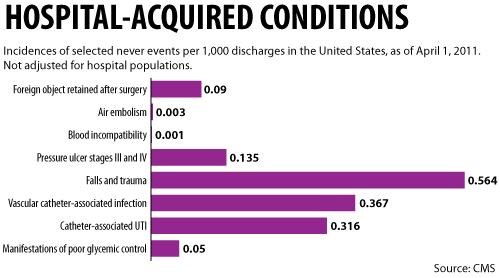
Hospital Acquired Conditions

“Never Events are egregious and they truly should never happen, but at the very least if they do happen, we expect hospitals to take the most humane and ethical approach,” said Leah Binder, president and CEO of Leapfrog. “Unfortunately, many hospitals still won’t commit to doing the right thing, including apologizing to the patient or family and not charging for the event. We should see 100% of hospitals with the Leapfrog policy.”

CMS Penalizes 758 Hospitals Over Hospital-Acquired Conditions

http://www.californiahealthline.org/articles/2015/12/11/cms-penalizes-758-hospitals-over-hospital-acquired-conditions

How Safe is Your Hospital

Are Masks a Good Alternative to Flu Shots for Healthcare Workers?

http://www.medpagetoday.com/HospitalBasedMedicine/InfectionControl/54905

At some hospitals, it’s vaccinate or be fired

HHS: Dramatic Downturn in Hospital-Acquired Conditions

http://www.medpagetoday.com/HospitalBasedMedicine/GeneralHospitalPractice/54954?xid=nl_mpt_DHE_2015-12-02&eun=g885344d0r#

Big reductions in adverse drug events, pressure ulcers