We can’t afford to hire you

We can’t afford to hire you

Abstract:  This article looks further into the value proposition of a sophisticated Interim Executive.

I have become accustomed to being ruled out of a beauty pageant for an Interim Executive consulting position based on rate alone.  In most cases, I am told by the decision maker about this problem after the fact.  It is common for the decision to be made without consulting me or giving me a chance to negotiate.  While I could have been flexible, my flexibility is limited by the opportunity cost of existing or potential competitive opportunities.  When I talked with the decision makers, they were frequently operating from the assumption that the gap was too big to close.  Instead, they lost an opportunity to get a resource with my background and experience while settling for an alternative solely based on cost.  It is clear that these decision makers severely discounted the potential value of engaging a more experienced resource.  Or, I could have simply been beat on price by an equally or better-qualified competitor but I doubt it.  I have seen too many cases of decision makers making what could be a critical decision based on the hourly rate alone.  Lest this come across as bitter, I have not failed to end up with a desirable engagement and I am generally happy with the outcome.  I have learned that as Mick Jagger said, “You can’t always get what you want.  But if you try sometime (sic), you find you get what you need.”  I cannot help but wonder how things are going in the organizations that passed me by.

What would some of the common excuses for a supposedly otherwise intelligent decision maker making a choice solely on rate?

We are in financial distress.  Interim Executive Services typically price on the experience and relevance of a proposed interim to a specific situation.  This is analogous to hiring a lawyer.  One of my friends liked to say that one of the worst things that can happen to you is to end up with the second best attorney in a critical situation.  To gain access to the best and most experienced talent in a law firm, you must be willing to pay the firm’s highest rates.  The reason that older, more experienced law firm partners’ rates are higher is that the market will bear their rates whatever they are because their time and expertise are in very high demand.  For those of us that make a living selling time, you are limited as to how much you can sell.  A firm in financial distress can end up in bankruptcy.  Another bad outcome for a firm in distress is to default on debt obligations that can result in the Board and leadership team losing control of the organization.  Banks and bondholders can and will accelerate the debt and take other actions to preserve their interests.  The pertinent question for the decision maker to make in this situation is what is the best resource available to avoid the undesired outcome regardless of cost because the cost of failure is infinitely higher.  If you think an Interim Executive is expensive, check the rates of bankruptcy attorneys and debtor in possession consultants.

I can get someone else for less money.  Inexperienced or ignorant people do not understand the differences between physicians.  They assume a doctor is a doctor is a doctor.  They do not understand the difference between a pathologist and a proctologist.  This is the kind of logic used by a decision maker that assumes that there is no difference in interim executives and places the first and/or cheapest resource they can find in an effort to get someone, anyone with a heartbeat into a position.  The pertinent question in this situation is what is the cost of failure and how small is this cost as a percentage of the cost of the cheapest resource available vs. a competent, experienced advisor.  I followed an interim CFO in a hospital that had somehow managed to miss a growing over-valuation of accounts receivable that ultimately led to a write-down of A/R in excess of $50 million and a number of executives including the CEO of the place losing their jobs.  Maybe the CEO should have looked at my article on how to avoid getting whacked.  In my experience, hiring decision makers rarely account for the personal career risk they may be taking by thier involvement in bringing an interim aboard.

We can absorb the workload.  This is one of my favorites.  Really?  Are you telling me that the departed executive did so little that a potentially prolonged vacancy of their position will not be missed and there is no risk in not having the role filled?  If this is the case, the decision maker should eliminate the position.  Just because the departed executive may have not been meeting the organization’s needs does not translate to their role not being worth filling with someone that knows what they are doing.  As a matter of fact, putting an experienced interim into a key role say CEO or CFO, might go a long way towards demonstrating to the organization how the role should be filled and carried out.  If you engage a sophisticated interim, there is a very good chance that the permanent executive you hire to ultimately fill the position will not come close to the value-adding potential of an experienced interim executive.  On this point, it is not a good idea nor is it fair to candidates to benchmark them against an experienced interim.  This makes it hard on everyone by unnecessarily delaying the recruiting process in some cases and potentially creating unreasonable expectations for a permanent candidate when there is a successful recruitment.

These are but a few of the excuses I have heard as reasons to rule me out of an Interim gig.  I am sure my readers can contribute others possibly spawning a series of articles on this topic.  One of the key things to remember if you are an interim executive as I said in my article about the value proposition of interim executives is what Zig Ziglar said, ‘You cannot control what someone else is going to do.  All you can control is how you respond.”  Don’t take rejection personally.  Remember, in baseball, a hitting failure rate of 70% or more is considered to be an excellent performance.  Another thing to think about is you never know what you may be saved from.  I can say from experience that I have been fortunate on more than one occasion to not get something I desperately wanted at the time.  You may never know the degree to which fate or divine intervention may be bearing on the outcome of one of your proposals.  If you are a decision maker, you owe it to yourself and those around you whose fate may be tied to yours to undertake the most objective, evidence-based decision-making process you are capable of whether the decision has to do with engaging an interim or any other key decision for that matter.

Contact me to discuss any questions or observations you might have about these articles, leadership, transitions or interim services.  I might have an idea or two that might be valuable to you.  An observation from my experience is that we need better leadership at every level in organizations.  Some of my feedback is coming from people that are demonstrating an interest in advancing their careers, and I am writing content to address those inquiries.

The easiest way to keep abreast of this blog is to become a follower.  You will be notified of all updates as they occur.  To become a follower, click the “Following” bubble that usually appears near the bottom of each web page.

I encourage you to use the comment section at the bottom of each article to provide feedback and stimulate discussion.  I welcome input and feedback that will help me to improve the quality and relevance of this work.

This is an original work.  I claim copyright of this material with reproduction prohibited without attribution.  I note and provide links to supporting documentation for non-original material.  If you choose to link any of my articles, I’d appreciate notification.

If you would like to discuss any of this content, provide private feedback or ask questions, I may be reached at ras2@me.com.


Patient Perception of Hospital Affiliations Influences Care

https://revcycleintelligence.com/news/patient-perception-of-hospital-affiliations-influences-care?eid=CXTEL000000093912&elqCampaignId=7597&elqTrackId=22665a87f2b6456d8a0257a5829fa32f&elq=8c464455b5764b358a94a8541d0fc832&elqaid=8029&elqat=1&elqCampaignId=7597

Hospital affiliation and healthcare mergers

About 85 percent of individuals said they would forgo local care and travel one hour based on hospital affiliation with a top-ranked system, a study reveals.

Hospital affiliations can influence patient volume, a new study by the Yale Cancer Center shows.

The study recently published in the journal Annals of Surgical Oncology revealed that 85 percent of individuals about to receive complex cancer surgery would travel one hour away to receive care at a top-ranked hospital specializing in cancer care. The respondents said they would travel to a top-ranked affiliated hospital rather than go to their local hospital.

However, almost one-third of the respondents (31 percent) would change their mind about where to seek care if their local hospital was affiliated with a top-ranked hospital or system.

Researchers at Yale Cancer Center explained that the trend in where patients seek care indicated that individuals believe that hospital affiliation with top-rank hospitals means that both hospitals – the top-ranked and affiliate organizations – offer similar quality care. And about one-half of the 1,000 individuals surveyed said that safety and quality of care were identical at both the top=ranked and affiliate hospitals.

But the perception that top-ranked hospitals and their affiliates offer the same level of care quality is not necessarily true, researchers warned.

“There is no evidence that the care is the same, and no regulation that governs the advertising and marketing of these affiliations,” explained the study’s senior author, Daniel J. Boffa, MD, professor of surgery (thoracic surgery), program leader of the Thoracic Oncology Program at Smilow Cancer Hospital at Yale Cancer Center, and investigator at Yale’s Cancer Outcomes, Public Policy, and Effectiveness Research Center (COPPER).

Boffa and his colleagues further investigated how brand-sharing, like hospital affiliations, via the internet impact an individual’s healthcare decision-making process. Researchers asked the over 1,000 individuals about their hospital preferences for complex cancer surgery between large top-ranked organizations and small, local hospitals.

When researchers asked the respondents to compare top-ranked and small hospitals, the survey showed:

  • 47 percent of respondents said that surgical safety, 66 percent felt that guideline compliance, and 53 percent reported cure rates would be the same at both hospitals
  • 47 percent of respondents thought that the surgical care at a top-ranked hospital and its affiliates would be the same across all four safety features (rate of complications, readmissions rate, length of stay, and postoperative mortality rate)
  • 44 percent of respondents thought the affiliated hospital would be the same in terms of surgical quality standards, including surgical cure rate

“It is completely understandable that the public would make assumptions that hospitals advertising the same name offer the same care,” Boffa stated in a press release. “Some hospital advertising could be even be interpreted as encouraging this line of thinking.”

“The truth is that we do not yet know if care received at an affiliated hospital is the same as care at the brand name center, whether that is for complex cancer care or other procedures,” he continued. “Currently hospitals are free to share their brand with almost any hospital they choose. The hospitals are not required to inform patients of any differences in the quality or safety of care provided by the different hospitals within a network. This study suggests that the public is making assumptions in care equality that are potentially influencing their choice for hospital care.”

The perception about hospital affiliations could be problematic for the healthcare industry as providers rapidly consolidate.

Healthcare organizations announced 115 merger and acquisition transactions in 2017, consulting firm Kaufman Hall reported. And that was the highest number of transactions in recent history, the firm pointed out.

2018 is likely to meet or even exceed the number of healthcare mergers and acquisitions, healthcare experts predict. For example, recent data from Kaufman Hall show 255 healthcare merger and acquisition deals announced in the second quarter of 2018.

Many leaders of healthcare organizations engaging in a merger and/or acquisition claim the deal will improve care quality while lowering costs for patients.

But Boffa et al. pointed out that care quality may not necessarily be the same across affiliate hospitals, creating confusion among individuals seeking high-quality, low-cost care.

“I see these findings as a wake-up call to the medical community to investigate if there are important differences in care between affiliated hospitals and their mother ship, as well as a wake-up call to name brand medical centers to take ownership for outcomes at hospitals that share their names,” Boffa stated.

“What is known is that the issue of where to receive complex cancer care is seen as crucial to patient outcome,” he added. “Studies have found that the quality and safety of such complex cancer care is particularly prone to outcome variability across hospitals, and the risk of dying after an operation can be up to four times greater at hospitals that perform procedures infrequently. Yet other data suggests that, in general, outcomes at top-ranked hospitals can vary widely, and are not always superior to non-ranked hospitals.”

Hospital affiliations, however, do have the potential to increase patient access to high quality care, the researchers elaborated. But stakeholders need to provide patients with quality of care data to help them make informed healthcare decisions.

“To our knowledge, this is the first survey to focus on the difference in the public’s perception of care between these two environments, but it is likely that affiliation status and co-branding has already impacted the distribution of patients across the healthcare spectrum,” Boffa said. “The development of affiliations could, potentially, bring cancer expertise closer to patients— but without facts that is just a theory.”


Kaiser’s net income dips 23% in first 9 months of 2018

https://www.beckershospitalreview.com/finance/kaiser-s-net-income-dips-23-in-first-9-months-of-2018.html

Related image

Oakland, Calif.-based Kaiser Permanente reported higher revenue for its nonprofit hospital and health plan units in the first nine months of this year, but the system ended the period with lower net income.

Here are four things to know:

1. Kaiser’s operating revenue climbed to $59.7 billion in the first nine months of 2018, according to recently released bondholder documents. That’s up 9.6 percent from revenue of $54.5 billion in the same period of 2017.

2. Kaiser’s health plan membership increased from 11.8 million members in December 2017 to 12.2 million members as of Sept. 30, 2018.

3. During the first nine months of this year, Kaiser’s operating expenses totaled $57.7 billion. That’s up from $52.2 billion in the first nine months of 2017. In the third quarter of 2018 alone, Kaiser’s expenditures included capital spending of $760 million, which includes investments in upgrading and opening new facilities, as well as in technology.

4. Kaiser ended the first nine months of 2018 with net income of $2.9 billion, down 23 percent from net income of $3.8 billion in the same period of 2017.


Hospitals look to value-based contracting in healthcare supply chain

https://www.healthcarefinancenews.com/news/hospitals-look-value-based-contracting-healthcare-supply-chain?mkt_tok=eyJpIjoiWVdZeU9ETTJaR1ZqWWpJNSIsInQiOiJZYWlKXC9DcnN5YitocXRMMXIxb1VJdXdLVGNoRWgwXC83cm15ZzlGbmR5SGNRZ3A5MHRaVHl4OXZCbUVRWHdLcXhUOU45bU5KVXhzMVFTV3Qyd3RkS1pZWGFRNzFlbVEzaFNvVHZHQ2I2VmhUY0NQeWdUR0dHZTBjbkpMZm9nQ05HIn0%3D

Almost three-quarters of C-suite and supply chain leaders say their health systems prioritize value-based contracting, although barriers remain.

Most hospital and health system leaders are interested in value-based contracting when it comes to their supply chains, but a new Premier survey shows a lack of opportunities to lock down contracts with suppliers.

Among 200 C-suite executives and supply chain leaders, 73 percent said their health systems prioritize value-based contracting when looking to improve their return on investment.

IMPACT

In perhaps another sign of the inevitability of value-based care, 81 percent of respondents said they would be interested in more suppliers offering value-based contracting options.

Despite that, only 38 percent said they had participated in value-added or risk-based contracting with suppliers or pharmaceutical companies.

There are some barriers. When asked if they had considered participating in value-based contracts with suppliers with both up- and downside risk/reward, 55 percent said they didn’t know enough about shared risk contracts. Another 20 percent said they’re actively considering such contracts; 16 percent are already participating in them.

As for why many providers haven’t yet taken part in value-based or risk-based contracting with suppliers, 67 percent said it’s due to not having been engaged by a supplier. About 11 percent said it doesn’t align with the organization’s strategy.

WHAT ELSE YOU SHOULD KNOW

Respondents provided some examples of value-based contracts they had implemented, and at the top of the list was surgical services at 13 percent.

Following that was purchased services (11 percent); cardiovascular (11 percent); pharmacy and materials management (9 percent); nursing (8 percent), imaging and lab (6 percent); and facilities (5 percent).

Data was the most common challenge, cited by 22 percent of respondents. That was followed by internal communications (14 percent); coordination with suppliers (12 percent); infrastructure support (11 percent); and physician buy-in (10 percent).

THE TREND

Research this year from Sage Growth Partners highlighted the challenges providers face in succeeding under value-based contracting. Slightly more than two-thirds of the survey’s 100 respondents said value-based care has provided them with a return on investment, but many have had to supplement their electronic health records with third-party population health management solutions to get the most bang for their buck.

What goes into a CFO’s dashboard for artificial intelligence and machine learning

https://www.healthcarefinancenews.com/news/what-goes-cfos-dashboard-artificial-intelligence-and-machine-learning?mkt_tok=eyJpIjoiWVdZeU9ETTJaR1ZqWWpJNSIsInQiOiJZYWlKXC9DcnN5YitocXRMMXIxb1VJdXdLVGNoRWgwXC83cm15ZzlGbmR5SGNRZ3A5MHRaVHl4OXZCbUVRWHdLcXhUOU45bU5KVXhzMVFTV3Qyd3RkS1pZWGFRNzFlbVEzaFNvVHZHQ2I2VmhUY0NQeWdUR0dHZTBjbkpMZm9nQ05HIn0%3D

Artificial intelligence and machine learning can be leveraged to improve healthcare outcomes and costs — here’s how to monitor AI.

The use of artificial intelligence in healthcare is still nascent in some respects. Machine learning shows potential to leverage AI algorithms in a way that can improve clinical quality and even financial performance, but the data picture in healthcare is pretty complex. Crafting an effective AI dashboard can be daunting for the uninitiated.

A balance needs to be struck: Harnessing myriad and complex data sets while keeping your goals, inputs and outputs as simple and focused as possible. It’s about more than just having the right software in place. It’s about knowing what to do with it, and knowing what to feed into it in order to achieve the desired result.

In other words, you can have the best, most detailed map in the world, but it doesn’t matter if you don’t have a compass.

AI DASHBOARD MUST HAVES

Jvion Chief Product Officer John Showalter, MD, said the most important thing an AI dashboard can do is drive action. That means simplifying the outputs, so perhaps two of the components involved are AI components, and the rest is information an organization would need to make a decision.

He’s also a proponent of color coding or iconography to simplify large amounts of information — basic measures that allow people to understand the information very quickly.

“And then to get to actionability, you need to integrate data into the workflow, and you should probably have single sign-on activity to reduce the login burden, so you can quickly look up the information when you need it without going through 40 steps.”

According to Eldon Richards, chief technology officer at Recondo Technology, there have been a number of breakthroughs in AI over the years, such that machine learning and deep learning are often matching, and sometimes exceeding, human capability for certain tasks.

What that means is that dashboards and related software are able to automate things that, as of a few years ago, weren’t feasible with a machine — things like radiology, or diagnosing certain types of cancer.

“When dealing with AI today, that mostly means machine learning. The data vendor trains the model on your needs to match the data you’re going to feed into the system in order to get a correct answer,” Richards said. “An example would be if the vendor trained the model on hospitals that are not like my hospital, and payers unlike who I deal with. They could produce very inaccurate numbers. It won’t work for me.”

A health system would also want to pay close attention to the ways in which AI can fail. The technology can still be a bit fuzzy at times.

“Sometimes it’s not going to be 100 percent accurate,” said Richards. “Humans wouldn’t be either, but it’s the way they fail. AI can fail in ways that are more problematic — for example, if I’m trying to predict cancer, and the algorithm says the patient is clean when they’re not, or it might be cancer when it’s not. In terms of the dashboard, you want to categorize those types of values on data up front, and track those very closely.”

KEY PERFORMANCE INDICATORS FOR AI AND ML

Generally speaking, you want a key performance indicator based around effectiveness. You want a KPI around usage. And you want some kind of KPI that tracks efficiency — Is this saving us time? Are we getting the most bang for the buck?

The revenue cycle offers a relevant example, where the dashboard can be trained to look at something like denials. KPIs that track the efficiency of denials, and the total denials resolved with a positive outcome, can help health systems determine what percentage of the denials were fixed, and how many they got paid for. This essentially tracks the time, effort, and ultimately the efficacy of the AI.

“You start with your biggest needs,” said Showalter. “You talk about sharing outcomes — what are we all working toward, what can we all agree on?”

“Take falls as an example,” Showalter added. “The physician maybe will care about the biggest number of falls, and the revenue cycle guy will care about that and the cost associated with those falls. And maybe the doctors and nurses are less concerned about the costs, but everybody’s concerned about the falls, so that becomes your starting point. Everyone’s focused on the main outcome, and then the sub-outcomes depend on the role.”

It’s that focus on specific outcomes that can truly drive the efficacy of AI and machine learning. Dr. Clemens Suter-Crazzolara, vice president of product management for health and precision medicine at SAP, said it’s helpful to parse data into what he called limited-scope “chunks” — distinct processes a provider would like to tackle with the help of artificial intelligence.

Say a hospital’s focus is preventing antibiotic resistance. “What you then start doing,” said Suter-Crazzolara, “is you say, ‘I have these patients in the hospital. Let’s say there’s a small-scale epidemic. Can I start collecting that data and put that in an AI methodology to make a prediction for the future?’ And then you determine, ‘What is my KPI to measure this?’

“By working on a very distinct scenario, you then have to put in the KPIs,” he said.

PeriGen CEO Matthew Sappern said a good litmus test for whether a health system is integrating AI an an effective way is whether it can be proven that its outcomes are as good as those of an expert. Studies that show the system can generate the same answers as a panel of experts can go a long way toward helping adoption.

The reason that’s so important, he said, is that the accuracy of the tools can be all over the place. The engine is only as good as the data you put into it, and the more data, the better. That’s where electronic health records have been a boon; they’ve generated a huge amount of data.

Even then, though, there can be inconsistencies, and so some kind of human touch is always needed.

“At any given time, something is going on,” said Sappern. “To assume people are going to document in 30-second increments is kind of crazy. So a lot of times nurses and doctors go back and try to recreate what’s on the charts as best they can.

“The problem is that when you go back and do chart reviews, you see things that are impossible. As you curate this data, you really need to have an expert. You need one or two very well-seasoned physicians or radiologists to look for these things that are obviously not possible. You’d be surprised at the amount of unlikely information that exists in EMRs these days.”

Having the right team in place is essential, all the more so because of one of the big misunderstandings around AI: That you can simply dump a bunch of data into a dashboard, press a button, and come back later to see all of its findings. In reality, data curation is painstaking work.

“Machine learning is really well suited to specific challenges,” said Sappern. “It’s got great pattern recognition, but as you are trying to perform tasks that require a lot of reasoning or a lot of empathy, currently AI is not really great at that.

“Whenever we walk into a clinical setting, a nurse or a number of nurses will raise their hands and say, ‘Are you telling me this machine can predict the risk of stroke better than I can?’ And the immediate answer is absolutely not. Every single second the patient is in bed, we will persistently look out for those patterns.”

Another area in which a human touch is needed is in the area of radiological image interpretation. The holy grail, said Suter-Crazzolara, would be to have a supercomputer into which one could feed an x-ray from a cancer patient, and which would then identify the type of cancer present and what the next steps should be.

“The trouble is,” said Suter-Crazzolara, “there’s often a lack of annotated data. You need training sets with thousands of prostate cancer types on these images. The doctor has to sit down with the images and identify exactly what the tumors look like in those pictures. That is very, very hard to achieve.

“Once you have that well-defined, then you can use machine learning and create an algorithm that can do the work. You have to be very, very secure in the experimental setup.”

HOW TO TELL IF THE DASHBOARD IS WORKING

It’s possible for machine learning to continue to learn the more an organization uses the system, said Richards. Typically, the AI dashboard would provide an answer back to the user, and the user would note anything that’s not quite accurate and correct it, which provides feedback for the software to improve going forward. Richards recommends a dashboard that shows failure rate trends; if it’s doing its job, the failure rate should improve over time.

“AI is a means to an end,” he said. “Stepping back a little bit, if I’m designing a dashboard I might also map out what functions I would apply AI to, and what the coverage looks like. Maybe a heat map showing how I’m doing in cost per transaction.”

Suter-Crazzolara sees these dashboards as the key to creating an intelligent enterprise because it allows providers to innovate and look at data in new ways, which can aid everything from the diagnosis of dementia to detecting fraud and cutting down on supply chain waste.

“AI is at a stage that is very opportune,” he said, “because artificial intelligence and machine learning have been around for a long time, but at the moment we are in this era of big data, so every patient is associated with a huge amount of data. We can unlock this big data much better than in the past because we can create a digital platform that makes it possible to connect and unlock the data, and collaborate on the data. At the moment, you can build very exciting algorithms on top of the data to make sense of that information.”

MARKETPLACE

If a health system decides to tap a vendor to handle its AI and machine learning needs, there are certain things to keep in mind. Typically, vendors will already have models created from certain data sets, which allows the software to perform a function that was learned from that data. If a vendor trained a model with a hospital whose characteristic differ from your own, there can be big differences in the efficacy of those models.

Richards suggested reviewing what data the vendor used to train its model, and to discuss with them how much data they need in order to construct a model with the utmost accuracy. He suggests talking to vendor to understand how well they know your particular space.

“In most cases I think they’ve got a good handle on the technology itself, but they need to know the space and the nuances of it,” said Richards. He would interview them to make sure he was comfortable with their depth of knowledge.

That will ensure the technology works as effectively as possible — an important consideration, since AI likely isn’t going away anytime soon.

“We’re seeing not just the hype, but we’re definitely seeing some valuable results coming,” said Richards. “We’re still somewhat at the beginning of that. Breakthroughs in the space are happening every day.”

Alternative Payment Models: Unintended Consequences

https://www.medpagetoday.com/blogs/ap-cardiology/76490?xid=nl_mpt_DHE_2018-11-24&eun=g885344d0r&pos=&utm_source=Sailthru&utm_medium=email&utm_campaign=Daily%20Headlines%202018-11-24&utm_term=Daily%20Headlines%20-%20Active%20User%20-%20180%20days

Image result for Alternative Payment Models: Unintended Consequences

The way we pay for medical care is changing. In this second episode of a two-part podcast series with Karen Joynt Maddox, MD, MPH, of Washington University in St. Louis, she delves into the unintended consequences of alternative payment models. She has also written in the New England Journal of Medicine on the topic here.

A transcript of the podcast follows:

Perry: … In your editorial, you mentioned that some of these quality metrics can have the unintended side effects of resulting in underutilization for vulnerable populations. Can you elaborate on that?

Maddox: Yeah, so there’s a couple different ways that policies can have negative impacts, and actually, harkening back to a prior question about “Did we roll these out in a systematic fashion and study their effect?” No. When policies are rolled out, we sometimes look for efficacy, we rarely look for unintended consequences, which we’d never do with a drug or a device or something else we were putting out into the ether. If you imagine that every policy is going to have both positive and negative effects just like a drug would or a device would, you would never approve … a medication that reduced heart attacks if it increased bleeding by six times the amount it reduced heart attacks or increased mortality.

We don’t actually hold policies to those same standards. We don’t even measure the positive and negative effects. What are the negative effects of policy? I think there are a few. First, there’s risk aversion. That can be seen in a number of ways. Your example of having a sick patient who was having these complications raises questions of risk aversion. Would that person even have gotten access to a cardiac procedure if someone was very worried about what adverse outcomes were going to be tracked and then paid on?

The concern would be that if we put a lot of money behind PCI [percutaneous coronary intervention] outcomes, mortality after PCI, and we don’t adequately account for how sick or how poor or how vulnerable certain patients are, hospitals are going to look bad, lose money, have negative billboards about them on public reporting for no fault of their own. It’s just not going to be fair, and it will create risk aversion. But then someone is going to say, “We really shouldn’t be doing caths on high-risk patients because we’re just going to get in trouble for it. We really shouldn’t be taking on these people who are going to bleed, because if we have to give them a transfusion, our quality is going to look bad.” That means you’re closing off access to an entire group of people who very well could benefit from a procedure. That’s an obvious unintended consequence, so risk aversion is a big one.

Closely linked to that is the consequences of taking care of very sick patients and then being penalized. If risk adjustment is inadequate, then hospitals that take care of really sick patients are going to look a lot worse than they really are, and hospitals that take care of a lot of really simple patients are going to look better than they are, and you’re going to move money all over the country based on severity of illness as opposed to quality of care.

Perry: Could we actually spend a minute and maybe dig into some of the minutia on that, because I think that’s an important point about different hospitals, different locations, serving different risk populations. How does CMS [the Centers for Medicare and Medicaid] currently adjust for risk currently, because my impression is that the attempt to adjust for your baseline risk is, perhaps, insufficient as how it currently stands?

Maddox: I would agree. Now when you think about the things that we measure hospitals on, some things shouldn’t be risk adjusted. Those are the easy ones. Aspirin for a heart attack. I keep going back to that one because it’s just such a basic quality of care element. It doesn’t matter if you’re poor. It doesn’t matter if you’re black or Hispanic. It doesn’t matter if you’re frail. If you don’t have a contraindication to aspirin and you are having a heart attack, you should receive aspirin. We don’t have to risk adjust that. You can exclude people who have just had a bleeding ulcer. But if you qualify for the measure, you should receive the quality measure. That’s standard care and there we don’t need to adjust. We just need to hold people to high standards.

Perry: Okay.

Maddox: When you move one notch down the line, now let’s think about something we consider an intermediate outcome, so diabetes control, hypertension control. Clearly that, to some degree, is controlled by the clinician. I decide whether or not I recommend someone get insulin or I titrate up their calcium channel blocker or I add on some other agent. It’s also under control of the patient, and it’s also partly determined by how sick the patient is to begin with. It’s pretty easy for me to control high blood pressure in someone who started out with a systolic pressure of 142. I have many, many choices. Almost no matter what I do, I can get that person under better control.

That’s very different than a dialysis patient who’s had 15 years of persistent resistant hypertension like the gentleman I admitted this afternoon who comes in with a blood pressure of 260 systolic. Me getting that guy down to a controlled blood pressure would take probably some sort of divine intervention.

Perry: Yeah.

Maddox: In addition to a whole lot of hard work on his part and his dialysis facility. It’s a complex undertaking. Now we should all be working together to do it, but if we don’t take into consideration the fact that treating those two people was very, very different, we are going to not really be looking at quality. We’re just looking at how sick the patient is. If you take that one step farther to something like readmissions, which is largely a product of what happens to someone outside the hospital walls and has a ton to do with social determinants of health and access to care and access to exercise and food and the ability to afford medications, you can sort of see how the farther away from a clean process measure you get, the more the ultimate outcome is driven by things out of your control.

If we don’t take into account the things that make those patients different, then we’re not really measuring quality. Right now, CMS does, I think, a reasonable starting point job of trying to control for risk. When they look at a patient, they have claims. They don’t go talk to the patient. They don’t know where they live. They don’t know if they can read. They don’t know if they speak English. They have claims, and so they use the claims to try to adjust to the degree they can for outcome measures. They don’t actually adjust process measures or those intermediate measures, but for outcome measures, they do. If you take something like readmission, they make a logistic regression model and it has patient characteristics on it. Age, gender, whether or not there’s a history of kidney problems, whether or not there’s any history of liver disease, sort of a list of things. There’s somewhere between 70 and 80, depending on which list you’re using, which year. Those elements all go into a risk-adjustment model.

With something like in-hospital mortality, you can actually do a pretty good job of risk adjusting. We think about C-statistics and we think about logistic-regression models. You can get a C-statistic in sort of the 0.8 range. 0.5 would be a coin flip. You’re right half the time. The C-statistic basically compares the probability that your model said something would happen with whether it did or didn’t. 0.5 would be coin flip — model didn’t do anything beyond random. Under 0.5 would be the models worse than random. 0.8 is pretty good. You get some ability to differentiate. For readmissions, the models are closer to 0.6, so just better than a coin flip — probably because so much of what matters to readmission is things that we’re not measuring and whether or not someone has kidney or liver disease, but it’s where they live, do they have access to care, all the things that we just talked about.

You can also imagine that the models work pretty well for people in the middle of the distribution. They do not work well for people who are very sick. A yes/no diabetes, a yes/no kidney function is only going to predict a certain level of risk. We both know from rounding in the hospital that you have people who are at exorbitant risk. They have really poor functional status. They have comorbid substance abuse disorder. They have extreme frailty. They’re institutionalized, whatever the stuff is. Or they’ve had seven admissions this year already for heart failure. The models don’t account for that. What the models typically fail to do is account for that type of risk.

If you had two 75-year-old men, one with diabetes and one not and they otherwise looked the same, the models would be completely adequate. That’s not who we serve, and so right now the models do a reasonable starting point job, but they’re, I don’t think, anywhere near where we need to be if we’re going to actually predicate millions of dollars moving around the country based on them.

We’re really lacking sort of the basic science of risk adjustments in some ways. We’re running logistic regression models because they were the height of technology in the early 2000s. We’ve not moved forward with this data management and data use and modeling in the same speed with which we’re moving forward in devices and cloud-based technologies. We can do crazy things for people, but we can’t systematically measure hospital quality well, yet. I think we really need this sort of big data movement that’s happening. There’s a lot of hype around artificial intelligence and natural language processing and these sort of buzzwords, but somewhere in that hype is real improvement in how we manage data and how we measure quality and how we measure patients, how we compare them to each other and how we use what we know about patients to measure quality and ultimately to incent quality, right? This shouldn’t all be about being punitive. It should be eventually about feedback and improvement and let’s get everyone high-quality care.

I hope we’re going to move into quality measurement 2.0 or 3.0 or whatever we are as we move into these payment models, because the more money we put on the line, the more important it is that we avoid unintended consequences and the bigger those unintended consequences are ultimately going to be if we don’t start doing this a little better.

Perry: Gotcha, okay. Thanks. Now I think I had interrupted you when we were discussing about how these bodies measuring quality outcomes have kind of led to an underutilization. There was one paper that you had cited in your editorial about I think it was specifically about myocardial infarctions in New York and I think they used PCI during that time. Could you give us a summary of what that study showed?

Maddox: Yep, so when someone is coming in for a PCI, it’s a decision whether or not to give them or not give them the procedure. It’s not like when someone gets admitted for heart failure. They kind of show up and they get admitted and that’s that. You have to select into getting a PCI. Someone has to give it to you. In the mid-2000s in Massachusetts, earlier than that in New York and Pennsylvania, there was a big public reporting push. This is actually pre pay-for-performance. This is all just public reporting.

Perry: Okay.

Maddox: Hospital performance, and in some cases, individual interventional cardiologist performance was posted on a website for PCI. We did a research project looking at over time in Massachusetts when this program went into place, and then looking cross-sectionally in New York, Massachusetts, and Pennsylvania versus other states, what did people do in response to that program? What we found is that people got risk averse. The rates of use of PCI for people having heart attacks dropped off significantly in Massachusetts when they started publicly reporting performance. The people who stopped getting the access were the sicker ones.

I think it’s hard to think about how as a physician you would turn away someone who needs something. Certainly, my experience in seeing that and coming to Massachusetts as a fellow from North Carolina as a resident where there were no such pressures was what led us to start thinking about this project, because it really was pretty emotionally striking to see that people weren’t getting access to this procedure because of the concern about their publicly-reported performance.

But then I saw on the front page of the Boston Globe, Massachusetts General cath lab closed because of performance report. Then BI, Beth-Israel, cath lab closed because of performance report. In both of those cases, once they did the deep-dive into why the mortality rates had exceeded their threshold for saying that there was bad things going on, it was because they had accepted very sick patients as salvage from other hospitals who had tried to save them and had been unable to do so. Those deaths counted against them and their cath labs were then shut down for quality-improvement purposes.

They were ultimately found to have no wrongdoing, but it was extremely disruptive, canceled our cases. You’re on the front page of the Boston Globe being outed as this low-quality program when, in fact, that wasn’t true in either case. But that is the effect of making even very, very good people very risk averse. Massachusetts has actually done a lot of good work in trying to make their risk adjustment models better and in trying to carve people out of those programs, so if someone is coding, they’re no longer counted against you. Things like that to really try to be thoughtful about how we can use these programs to measure quality but try to reduce the unintended consequences that goes along with them. They have seen the rates start to go back up. New York has done some similar stuff with shock, having shock as a separate category and not counting folks in shock against you for doing PCIs. And they’re seeing a rebound in the proportion of patients having access to that procedure.

In public reporting, in this case, I think was so dangerous because it was so specific. It was a single procedure. It was attributed to either a hospital or even a person. Many of the other pay-for-performance programs are so broad, I think they are probably both less powerful in incenting change and less dangerous. If you’re looking at a hospital program, value-based purchasing, for example, it’s got multiple domains. It’s looking at multiple different conditions. It’s got 26 measures or something like that. No one of those measures is going to be driving someone’s behavior to try to keep someone out of the hospital or to try to be sort of guarding against performance, whereas a very targeted program like public reporting and public shaming for PCI, I think, really probably had some pretty profound negative consequences. It also really drove people to work on quality. It was a program that terrified lots of people, so that’s the tradeoff.

It’s where do you draw the line between trying to incent quality and doing things that are really going to change access and hurt patients. What ultimately should be the goals underpinning every single one of these programs should be how can we use these financial incentives to drive better outcomes for patients? If we don’t look for the unintended consequences, we’re going to miss that. If you don’t give PCI to sick people, your mortality for PCI looks great.

These are not easy things to think through. For a bunch of policymakers in D.C. or Boston or Jefferson City or wherever, who are not clinicians, it’s not easy. Health care is complicated as we learned. It’s actually not easy to think through what the best way to design these programs is to really try to move the needle on quality and say, “We do not accept substandard care,” while at the same time not hurting providers that care for vulnerable populations or those patients themselves.

Perry: I’m going to ask, probably, an impossible question, but if you could rewrite how hospitals are reimbursed starting from scratch, throw away everything that we have now and just say, “Some magical person is going to reimburse the hospital to ensure the best quality,” how would you write that? How would you design that? Then maybe later we’ll talk about what things are being done now on a local and national level.

Maddox: I’ll give you two scenarios. One scenario under our current health care system, meaning that hospitals have all the money and the power, and most decision-making around healthcare that really impacts healthcare dollar is still directed at hospitals and one scenario in which we would actually rethink the system entirely.

Conditional on the current system, I think we could do a lot with the quality programs to make them more equitable and to make them have stronger positive effect and weaker negative effect by doing things like rewarding improvement, which is done in some programs, but not all, by judging hospitals against their peer groups as opposed to assuming that we can judge large economic centers against small rural centers against small safety net hospitals in the south versus big urban centers. Those are not all the same. The patients are not all the same. We don’t have the data, as we discussed, to adequately risk adjust, so we need to make some decisions about what fair comparison would look like. Within the current system, I think we could make things better just by being more thoughtful about how we make comparisons and how we drive quality, and then putting money behind that to incent people to actually do something about it.

But ultimately, why do we care about readmissions and not admissions? Why do we care about bleeding after a PCI and not whether or not someone had a heart attack in the first place? The reset to how we really ought to be trying to do this is incenting more care out of the hospital. We should be trying to keep people out of the hospital, for one thing. There’s no reimbursement for the kinds of sort of multidisciplinary team-based care that we know can help people who are chronically ill. Until recently, there was almost no reimbursement for telehealth. We sort of grossly underutilized community health workers and other low-cost ways that we could really start to improve health in the community to keep people out of the hospital.

A payment program that focuses on a hospital is never going to succeed in keeping people out of the hospital. You wouldn’t pay Apple to not sell people iPhones, right? That’s both odd and actually highly economically inefficient. You’re paying to not do something. Many of these programs that start to shift towards alternative payment models are functionally saying we’re going to pay you not to do things. That doesn’t make a ton of sense to me.

Perry: No.

Maddox: But reimagining the system as one that rewards health is not so simple because it probably involves taking a lot of things out of the hospitals. Why does someone have to come to the hospital and stay in the hospital when they have heart failure? In Australia and in a few other countries, there’s a lot of use of what they call it hospital at home. When you think about our heart failure patients that we see for 5 minutes every morning, and then they diurese all day long, and we check a lab in the afternoon, and then we see them for 5 minutes the next morning. There is no reason they couldn’t be doing that in the comfort of their own home with some sort of a patch taped to their chest that gives us their telemetry monitoring with labs being drawn a couple times a day, with the nurse visiting to help out.

That would be fundamentally disruptive to the system in the kind of way that would promote all sorts of cost reductions and probably much happier patients and better outcomes, certainly a lot less of in-hospital infectious disease transmission. But there’s absolutely no reason that a hospital would ever sign up for that program unless we change how they’re paid.

Perry: It’s because it’s eliminating the cost for the bed in the hospital itself is the most expensive thing. The nebulous bed, whatever it is so magical about that really uncomfortable, poorly-functioning bed.

Maddox: What if you have a heart failure, I keep using heart failure as an example. I should think of something else. Let’s say you’re a dialysis facility. Why do you not have a monitor at every patient’s home on their scale or something that tells you when people are missing dialysis or when their weight starts to go up or if their potassium is 6 and lets you do something about it, that lets you get people in early if you need to or postpone? Maybe not everyone needs exactly the same amount of dialysis three times a week.

Why when we’re monitoring our diabetics do we say, “Come back in a year or come back in 6 months?” There’s no basis for come back in a year or come back in 6 months. This is an incredibly diverse group of people that need different management strategies. Some need intensive weight loss. Some need counseling on nutrition. Some need a ton of insulin. Figuring out how to sort of manage people to keep something bad from happening requires a total rethinking of how we actually deploy health resources. It’s probably not a lot of doctor time, for one thing, which is obviously the most highly reimbursed thing. It’s probably not as much hospital time as we have right now.

I think the industry is moving in that direction, so if you follow the JP Morgan health conferences and the Amazons of the world and the business side of the world is coming out and saying, “This is crazy. This system is insane.” We’re paying just absurd amounts of money to support this infrastructure that for a lot of what we do isn’t necessary. Every time someone comes to the emergency department and gets treated for something that doesn’t need to be in an emergency department just gets paid.

Part of that payment is going to the fact that there’s an ECMO team on call, right? That’s part of the fixed cost of maintaining a big academic medical center. There’s a helicopter. All these costs are built in to so much that we do that the hospital, then, is sort of required to pay for all of that fixed cost to provide a set of services that are essential. But somewhere in there is a real loss of efficiency, because we’re no longer connecting services to cost to prices to people. It’s all just sort of the system we have built right now, and it doesn’t make a ton of sense.

Dismantling that is not straightforward and I think the kind of disruptions that are going to really change things are not going to come from the hospitals. They’re probably going to come from insurers and I include in insurers the self-insured large companies. Most large companies self-insure, meaning that rather than pay for a plan, rather than pay for everyone to get Blue Cross and then Blue Cross assume all the risk…

Perry: They just pay the cost of the hospitalization themselves.

Maddox: They just pay for what happens, so they’re essentially acting as the insurer and they have a middleman processing claims, but they essentially take on all the financial risk. It makes more sense for most big companies to do that. Their incentives are therefore in line to keep people out of the hospital and to say, “You can have your MRI at a community-based MRI building that will charge you $500 instead of $3,500 to go have it in the hospital where all these extra sort of fixed costs are built in to the payment for that.” That kind of disruption is not going to come from payment models from Medicare, ultimately. It’s going to come from disruptions in industry and in innovation from some of the payers and potentially from patients who are increasingly recognizing this is not a very patient-centered system, and I think appropriately demanding a more holistic patient-centered approach to how this is all going to work.

But that’s the many years down the road of how a health system could be better, and in the short term, we’re living with the system that we’re living with, so we need to work on this one while we look toward the future for someone to really dismantle it.

Perry: What are things that are being done now?

Maddox: Some of it I mentioned. Some of the real innovative, some of the real disruptive stuff, who knows what Amazon and Berkshire Hathaway or whoever else will do. I think Medicare is in a bit of a holding pattern right now. They had been pushing towards more alternative payment models. They have now more and more financial incentives for people that get into these alternative payment models. That would be something like a bundle or an accountable care organization where you’re on the hook for spending for a year, which then gives you incentive, obviously, to reduce spending. They had planned to push out a lot of experimental models from the innovation center, from the Center for Medicare and Medicaid Innovation, or CMMI. A lot of that got put on hold when we had a secretary of HHS [Health and Human Services] who then was no longer the secretary of HHS, and the initial secretary under this administration, Tom Price, as the surgeon, had been a very outspoken opponent of essentially meddling with the doctor-patient relationship. He had done all these payment models, all these changes, anything that gets in the way of doctors making decisions independently about what they’re going to do is not okay. His big thing was to rollback a lot of this type of stuff.

The good thing that comes out of that is that people are thinking a little more consciously about burden and about the burden that we’re putting onto clinicians by all these measures and payment models and all this sort of stuff, when most people just want to take care of patients. But the bad thing that came out of it was a real slowdown in what was coming out of CMMI around testing some of these things.

In contrast to what a lot of the policies have been in the early 2000s and through the early teens, the last administration put a big push over the last term, basically, around trying to use this innovation center as a test ground, so to do what you had suggested. Let’s roll this out in a limited sense. Let’s learn. Let’s figure out what works and what doesn’t, and if things work, then let’s push them out more broadly. A lot of that stuff has slowed down. The ones that had already started in the prior administration are still running, so there’s some neat models for cancer care, for dialysis, but we haven’t seen much new coming out of them. There’s now a new head of HHS who has actually been quite outspoken about the need to keep moving toward value in health care. Also pushing burden reduction, which I think is good, and a new CMMI director was just named. We’ll see in the next year whether or not we start to see more of these experimental kind of models coming online.

I think one thing that has been really lacking in the development of these models is the engagement of the physician community, I should say not just the clinician community, not just physicians, but also nurses, therapists, all the sort of people that make up the clinician community have really not been involved in developing most of these models. We can sit here and say, “That model sounds crazy,” but if clinicians haven’t sort of stepped up to be part of it, it’s not clear why a policymaker would know that sounds crazy.

I hope that as things start ramping back up there’s more attention paid to finding models that people can agree on, that a group of cardiologists could come together and say:”Yeah, actually, as a profession, we think that anticoagulation for atrial fibrillation, that appropriate secondary preventative medications for coronary disease, that this bundle of medications for heart failure, reducing admissions for heart failure, and I don’t know, reducing admissions for stroke are our core goals. We, as a clinical community, are going to put financial incentives in place or we’re going to accept risk or do whatever, but we agree that these things we all ought to be working on together. Let’s grow in the same direction and let’s improve cardiovascular care. Here’s a way we can design reimbursement to help reward that.”

That, to me, sounds much, much more reasonable than some of the stuff that has come out policy-wise that basically says here’s a Frankenstein payment model that’s going to pay you 1% more for sending in data on one of 270 quality measures, which is what the current outpatient payment program is. I think getting clinicians involved in actually designing things that incent innovation, that free up money to invest in monitoring or nurses or whatever we think as a group will make our patients better would be good. I just don’t know if this next year will show us moving in that direction or not. We’ll have to see what this group decides to do.

Perry: A lot of interesting ideas and things to chew on. I appreciate it. I want to be respectful of your time. Thank you so much for meeting with me.

Maddox: Sure, I always glad to talk about this stuff. Sometimes I wish it were less of what we had to deal with when we’re rounding or when we’re in the hospital or when we’re seeing patients in clinic, but ultimately, this stuff really does impact clinical care, so I feel lucky that I get the chance to work on it and think about it and hopefully help be part of the solution.

Perry: Thank you so much.

Maddox: Thank you.

Perry: To recap from today, we learned about how quality payment models have had an unintended consequence of limiting access to care for some vulnerable populations. Specifically, we discussed about the example of cardiac cath in Boston in the 1990s, when after quality measures had been reported publicly, it then resulted in hesitancy from providers to offer cardiac caths to their sickest patients. I think this is an important issue and I’m glad I was able to have the time to discuss with Dr. Maddox about some of the details of this. I hope you found it as useful and as interesting as I did. Thank you for listening to today’s episode and we’ll see you next time.


Michigan hospital rejects woman’s heart transplant, recommends she raise $10K

https://www.beckershospitalreview.com/finance/michigan-hospital-denies-woman-s-heart-transplant-recommends-fundraising-to-pay-for-it.html?origin=rcme&utm_source=rcme

Image result for crowd funding for medical expenses


After rejecting a 60-year-old woman’s request for a heart transplant for lack of “a more secure financial plan,” Grand Rapids, Mich.-based Spectrum Health recommended that she start a $10,000 fundraiser to come up with the money, according to a Detroit Free Press report.

The recommendation came via a Nov. 20 letter from a nurse with Spectrum Health’s Heart & Lung Specialized Care Clinics. In the letter, the nurse told Hedda Martin of Grand Rapids that the multidisciplinary heart transplant committee determined she is “not a candidate at this time for a heart transplant due to needing more secure financial plan for immunosuppresive medication coverage.”

Immunosuppresive drugs help prevent a person’s body from rejecting a new heart or other transplanted organ. The nurse also told Ms. Martin the transplant committee “is recommending a fundraising effort of $10,000.”

The letter was reportedly posted on social media, sparking backlash from some commentators over the committee’s decision. According to the report, some commentators on Twitter compared the committee to a “death panel.”

A Spectrum representative was not available to speak with Detroit Free Press on Nov. 25.

The health system posted a statement on its website stating that Spectrum does not comment on specific patient situations due to privacy, but it “cares deeply about every patient that enters its doors.”

“While it is always upsetting when we cannot provide a transplant, we have an obligation to ensure that transplants are successful and that donor organs will remain viable. We thoughtfully review candidates for heart and lung transplant procedures with care and compassion, and these are often highly complex, difficult decisions,” Spectrum said.

“While our primary focus is the medical needs of the patient, the fact is that transplants require lifelong care and immunosuppression drugs, and therefore costs are sometimes a regrettable and unavoidable factor in the decision-making process. We partner with our patients throughout their care and work closely with them to identify opportunities for financial assistance. Our clinical team has an ongoing dialogue with patients about their eligibility, holding frequent in-person meetings and inform patients in-person to ensure they fully understand their specific situation,” the health system added.

As of Nov. 26, a GoFundMe page set up by Ms. Martin’s son had raised $15,675 for the anti-rejection drugs. 

Access the full Detroit Free Press report here.


300 nurses walk off job at Pennsylvania hospital

https://www.beckershospitalreview.com/human-capital-and-risk/300-nurses-walk-off-job-at-pennsylvania-hospital.html

Image result for nurses strike

More than 300 Indiana (Pa.) Regional Medical Center nurses went on strike on Nov. 26, according to a KDKA report.

Nurses walked off the job at 7 a.m., despite hospital leaders previously asking them to cancel the strike due to the $1.5 million in estimated costs to hire temporary workers.

Nurses initially scheduled a one-day strike. But hospital leaders have said striking nurses who don’t report to work Nov. 26 won’t be able to return to work for an additional four days because of a minimum five-day commitment required to hire temporary staff.

According to the report, no scheduled surgeries and appointments were canceled due to the strike.

The hospital has been in negotiations with the Indiana Registered Nurses Association, which represents about 380 nurses at the hospital. Health insurance costs and wages reportedly have been key sticking points in the negotiations.

Both sides are scheduled to return to the bargaining table Nov. 29.

California DOJ approves CHI-Dignity merger, with conditions

https://www.beckershospitalreview.com/hospital-transactions-and-valuation/california-doj-approves-chi-dignity-merger-with-conditions.html

Related image

The California Department of Justice conditionally approved the proposed merger of Englewood, Colo.-based Catholic Health Initiatives and San Francisco-based Dignity Health on Nov. 21.

Here are five things to know:

1. Under the California Justice Department’s conditions, the combined system, called CommonSpirit Health, is required to maintain emergency services and women’s healthcare services for 10 years.

2. To make any changes to emergency or women’s healthcare services during years six through 10, CommonSpirit will be required to notify the Justice Department to determine how the changes will affect the community.

3. CommonSpirit is also required to allocate $20 million over six fiscal years to create and implement a Homeless Health Initiative to support services for patients experiencing homelessness.

4. Starting in 2019, CommonSpirit’s California hospitals are required to alter their financial assistance policies to offer a 100 percent discount to patients earning up to 250 percent of the federal poverty level.

5. CHI and Dignity signed a definitive agreement to merge in December 2017, and the organizations expect to complete the transaction by the end of this year. The new $28.4 billion health system will include more than 700 care sites and 139 hospitals.


Doctors Are Fed Up With Being Turned Into Debt Collectors

https://www.bloomberg.com/news/articles/2018-11-15/doctors-are-fed-up-with-being-turned-into-debt-collectors

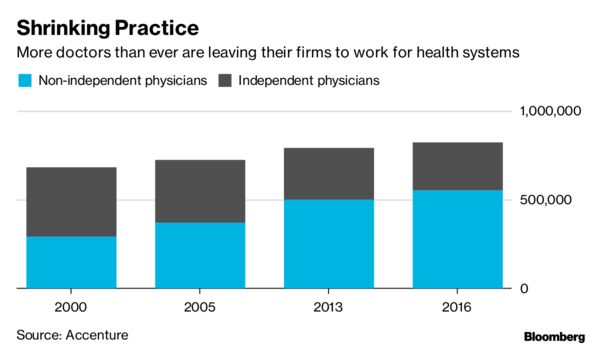
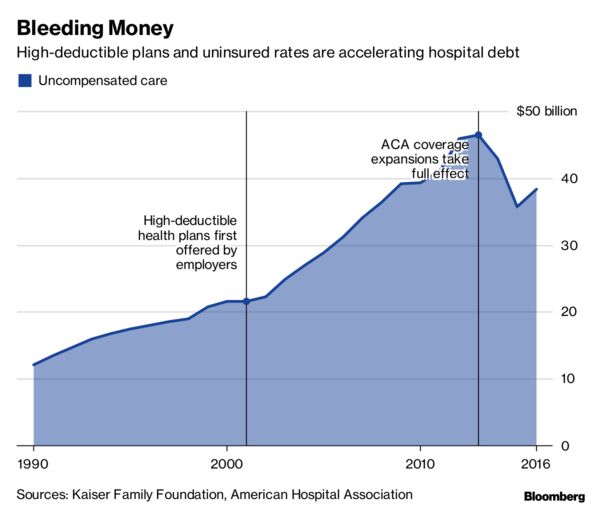
Highlighting a key implication of the rise in high-deductible health plans, both on the ACA exchanges and in employer-sponsored insurance, the article describes a question now commonly faced by doctors and hospitals—how best to collect their patients’ portion of the fees they charge? As one Texas doctor tells Bloomberg, reflecting the experience of the Maldonados from the other side of the equation, “If [patients] have to decide if they’re going to pay their rent or the rest of our bill, they’re definitely paying their rent.” He reports that the number of people dodging his calls to discuss payment has increased “tremendously” since the passage of the ACA. Another Texas doctor reports that his small practice had to add an additional full-time staff member just to collect money owed by patients, adding further overhead to his practice’s costs and making it more likely that he, like many other doctors, will eventually seek shelter by being employed by a larger delivery organization. That trend, as has been repeatedly shown, further increases the cost of care, exacerbating the increase in insurance costs for families like the Maldonados. This Gordian knot of increasing costs, rising deductibles, and growing premiums has left us with a healthcare system that’s forcing difficult decisions at every turn, for patients and providers.

Physicians, hospitals and medical labs are grappling with the rise in high-deductible insurance.

Doctors, hospitals and medical labs used to be concerned about patients who didn’t have insurance not paying their bills. Now they’re scrambling to get paid by the ones who do have insurance.

For more than a decade, insurers and employers have been shifting the cost of care onto their workers and customers, tamping down premiums by raising patients’ out-of-pocket costs. Last year, almost half of privately insured Americans under age 65 had annual deductibles ranging from $1,300 to as high as $6,550, government data show.

Now, instead of getting paid by insurance companies on a predictable schedule, health-care providers have to engage in an awkward dance. One moment they’re removing a pre-cancerous skin mole. The next, they’re haranguing patients to pay what’s become a growing portion of the total medical bill.

“It’s harder to collect from the patient than it is from the insurance,” said Amy Derick, a doctor who heads a dermatology practice outside Chicago. “If the plans change to a higher deductible, it’s harder to get the patients to pay.”

Independent physicians cited reimbursement pressures as their biggest concern for staying in business, according to a report by Accenture Plc in 2015.

“If they have to decide if they’re going to pay their rent or the rest of our bill, they’re definitely paying their rent,” said Gerald “Ray” Callas, president of the Texas Society of Anesthesiologists, whose Beaumont, Texas, practice treats about 40,000 people annually. “We try to work with the patient, but on the other hand, we can’t do it for free because we still maintain a small business.”

Accenture

In 2016, Callas introduced payment options that allow patients with expensive plans to pay a portion of the bill upfront or on a monthly basis over several years. Even so, Callas said the number of people avoiding his calls after surgery has increased “tremendously” each year since the Affordable Care Act passed in 2010.

Derick instituted a “time-out” option a few years back that gives patients the billing codes before a procedure, allowing them to call their insurance companies for estimates. Even with the program, collection rates are slower, especially at the beginning of the year when insurance plan deductibles reset.

Even large medical companies with national operations are facing the problem. Quest Diagnostics Inc., the lab-testing giant, said 20 percent of services billed to patients in the third quarter of this year went unpaid, costing the company about $80 million in lost revenue.

“We certainly have a high bad-debt rate for the uninsured,” Chief Financial Officer Mark Guinan said in a telephone interview. “But really the biggest driver is people with insurance. It’s their coinsurance and their high deductibles, and they don’t always pay their bills.”

Another testing company, Laboratory Corp. of America Holdings, reported its first year-over-year uptick in unpaid bills in the first quarter of 2016. At the time, Chief Executive Officer David King said high-deductible plans, higher copays and greater incidences of non-covered services led to more dollars being shifted to patients. LabCorp declined requests for comment.

Northwell Healthcare Inc., a network of more than 700 hospitals and outpatient facilities, lost $106.9 million to unpaid services in 2015. Others have reported the same: Acute-care and critical-access hospitals reported$55.9 billion in bad debt for 2015, according to data compiled by the American Hospital Directory Inc. 

“High-deductible plans have had a very big impact,” said Richard Miller, Northwell’s chief business strategy officer.

Kaiser Family Foundation, American Hospital Association

When it comes to reimbursement, a common denominator across the health-care industry is the archaic process through which bills are processed — a web of medical records, billing systems, health insurers and contractors.

High deductibles only add to the red tape. Providers don’t have real-time, fully accurate information on patient deductibles, which fluctuate based on how much has already been paid. That forces providers to constantly reach out to insurance companies for estimates.

Tarek Fakhouri, a Texas surgeon specializing in skin cancer, had to hire an additional staff member just to reason through bills with patients and their insurers, a big expense for an office of six or seven employees. About 10 percent of Fakhouri’s patients need payment plans, delay their skin-cancer surgeries until they’ve met their deductibles, or have to choose an alternative treatment.

According to a study earlier this year by the Journal of American Medical Association, primary-care physicians at academic health-care systems lose about 15 percent of their revenue to billing activities like calling insurance companies for estimates.

“It’s an unnecessary added cost to the health-care system to have to hire staff just to sit there on hold with insurance companies to find out what a patient’s deductible status is,” said Fakhouri.

Callas, Derick, and Fakhouri said they all know physicians who have left private practice altogether, some for the sole purpose of ending their dual roles as bill collectors. According to a study by the American Medical Association, less than half of doctors were self-employed as of 2016 — the lowest total ever. Many left their own practices in favor of hospitals and large physician groups with more resources.

To cope with the challenge, labs and hospitals are investing millions in programs designed to help patients understand what they owe at the point of care. Northwell has been implementing call centers and facilities where patients can ask questions about their bills.

“There’s a burden on both sides,” said Callas. “But health-care providers get caught in the middle.”