What Will You Do When One of Your Employees Is Outed Online For Their Activism?

https://www.eremedia.com/tlnt/what-will-you-do-when-one-of-your-employees-is-outed-online-for-their-activism/?utm_source=Marketo&utm_medium=Email&utm_campaign=TLNT%20Daily-2017-08-17T05:30:00.000-07:00&mkt_tok=eyJpIjoiTUdRek5UTTVaREpoTWpnMyIsInQiOiJRSTl0K210V003czlJRDJ3bmtzNW9IbVBiSHhcL3BvbzdFK0pGMlBOK2E0YUFhRmlaTElCWmYxV2hGV1VVMEpHTm43Wm1GMHlUekl0SnZ5cHA0QUdaUXJRVExJNkIzcWhhWDhlbjAzUXA5K3hoU0prTHZITnhDbGd0S1l1bFBicTUifQ%3D%3D

It should be no secret to anyone that political activity and tensions are currently high in the US. And by now, everyone in HR has heard about the Top Dog restaurant employee who resigned as a result of his participation in the Charlottesville turmoil and the Google employee who was fired because of his controversial “diversity manifesto.”

Rather than just being news items, these cases should be treated as illustrative examples of the recent dramatic increase in political sensitivity in and around the corporate world. Executives and HR should treat them as a wake-up call and begin asking themselves a question that has become extremely pertinent. And that question is:

Does our firm have a formal plan of action covering what to do and how to limit the damage if one of our employees is publicly ridiculed as a result of what is known as Internet shaming?

If you’re not familiar with the term “Internet shaming” in the corporate world, it is when a firm’s employee is publicly exposed and ridiculed on the Internet for something they did that was controversial.

The need for a social controversy plan

The need for a policy and an action plan relating to political and social controversy increases every day for a variety of reasons. They include the combined impact of a higher number of public marches, the proliferation of mobile phone videos of these protests and the rise of Internet and social media websites (e.g. YesYoureRacist Twitter account) that actively use pictures/videos to shame individuals and their employer. Unfortunately, this shaming often results in the public making the connection (fairly or not) between an individual’s actions and the company that employs them. And that becomes a major corporate issue when that employee shaming leads to on-site protests, a loss of customers and damage to your firm’s product and employer brand image.

In the past, at least in the US, many firms have been operating under the legal principle that activities outside of work and that an employee’s personal beliefs are none of an employer’s business. However, when an employee’s actions or publicly exposed beliefs hurt the company or its employees, in my view a firm must at least consider revisiting its existing approach to employee activities.

Top 10 “Should I fire a controversial employee” action steps to consider

You should of course always consult with legal counsel before taking any action. But as part of your policy review process, here are 10 steps you should consider.

  1. Make a strong business case – You can’t expect executives to take action until they fully understand the dollar consequences of an action. So start by working with the CFO’s office to identify and then quantify in dollars all of the possible negative consequences that may result when an employee is publicly shamed. These consequences should include on-site protests, boycotts, employee turnover, employee brand/recruiting damage and damage to product sales and your product brand image.
  2. Consult with your corporate counsel – There are many complex legal issues involved so work closely with legal counsel. Also be aware that some states (e.g. California) specifically prohibit the firing of employees for lawful activities outside of work. And it’s also true that the laws and employee expectations are completely different in each country around the world. If you have a union, you should also consider involving them.
  3. Be aware that every available solution has negative consequences – Be aware from the start that, unfortunately, there are no perfect solutions to political controversies surrounding your employees. And that means that whatever solution you select will have many negative downsides. Prevention is the highest impact action, so begin by warning your employees to avoid controversy. Ignoring the problem is the solution with the highest negative consequences. However, firing or releasing controversial employees can also result in a backlash (e.g. marches are planned this weekend on Google headquarters and elsewhere protesting the firing of the employee who wrote the diversity manifesto).
  4. Educate your employees and applicants – Because your employees will likely be thinking about this issue already. It’s critical that you quickly let them know your expectations and provide them with illustrative examples of activities that they should avoid. You should also have a process for answering anonymous questions in this area. And if your policy extends to job applicants, you may want to add a social media check to your hiring process so that you don’t hire already controversial employees.
  5. Clearly define the activities that are prohibited/questionable – Perhaps the most difficult task is clearly defining what is acceptable behavior and what is not. Start by assuring employees that you are politically neutral and that you will look at damaging behaviors across the political spectrum. Whatever boundaries you set, it’s critical that you pretest them to ensure that they are clear to your employees. In most cases, it is easier to legally terminate an employee if violence or illegal activities are involved. It is also sometimes easier to terminate if the controversial employee is highly visible or if they are a manager.
  6. Specify the possible outcomes – If you are going to sanction or even fire employees for controversial beliefs or actions, you need to make those punishments crystal-clear. Some possible actions include: asking the employee to disavow, suspension, encouraging them to resign, or termination. In some cases, it may be wise to simply provide the employee with a severance package if they voluntarily leave and agree not to sue and if they stay out of the public limelight.
  7. Monitor what’s happening – As long as the political climate is highly charged, your social media employees could be asked to pass on any possible social media issues in this area. Internal employee forums and affinity groups could also be monitored. You might also encourage your employees to make HR aware when they spot potential issues.
  8. React quickly – No one that I have encountered has ever suggested that a delay is a good thing. So be able to react within a day or two if you want to minimize the damage to your firm.
  9. Reveal the actions that you take – The company’s image may continue to be damaged if you fail to make the public aware of the corporate actions that you took to resolve the controversy.
  10. Learn from each event – Finally, because this problem will be continually evolving, it’s important to learn from your errors and those made by other firms. And then, continually update your policies and processes to reflect the latest best practice approach.

Final thoughts

The free-speech article of the Constitution only protects citizens against government actions. So if you are a private employer, rather than the Constitution, you need to consider other elements including local employment laws and the best interests of your employees, customers and shareholders.

Because this is a highly complex and risky area, I expect many firms to do nothing. However, that can be a major mistake because in the near future you are likely to see many more protests that are videoed, an increase in Internet shaming and many more controversial tweets and Internet exchanges covering your employees and contractors. As a result, in my view, the time to at least begin the conversation on how to improve your reaction is today.

CBO: Ending cost-sharing reduction payments will increase premiums, federal deficit

http://www.fiercehealthcare.com/aca/cbo-ending-cost-sharing-reduction-payments-will-increase-premiums-federal-deficit?mkt_tok=eyJpIjoiTVdKa1pEazNOMll5WVRreiIsInQiOiJkaVJDVnRHOXNNXC9ENmt6WFpTTFwvZGVQeThhQVRjZHR2VE9jUEVQQUtlZ3BxUFg0akRMM0FOK2hWZUc4ajJ4WVdzOUV3Z21GM1cyU1VVOWNDekZ2aVwvZG11VnFVVDQ3WEJvejBQU3ZVZTM4bjZyK3A1VjlcL3Q0Mmtsc3VJUTErS0wifQ%3D%3D&mrkid=959610&utm_medium=nl&utm_source=internal

Image result for congressional budget office

If the Trump administration stops funding cost-sharing reduction payments, silver-plan premiums on the Affordable Care Act exchanges will rise considerably and the federal deficit will increase, the Congressional Budget Office said Tuesday.

Officially, the administration remains undecided about how long it will continue making CSR payments, which are at the center of a federal court case that challenges their legality. Many insurers have had to factor this uncertainty into their preliminary rate filings.

To map out the consequences of one possible move by the administration, the CBO examined what would happen if federal officials announced at the end of August that they would continue CSR payments through the end of the year but discontinue them after that.

That policy would result in silver-plan premiums rising by an average of 20% in 2018 and 25% by 2020, the CBO estimates. Because tax credits rise in tandem with premiums, most eligible enrollees would not pay higher rates than they would if CSR payments continued—though the report also notes that overall, “the share of people facing slight increases would be higher during the next two years.”

Since more people would likely receive premium tax credits and in greater amounts, the CBO predicts that ending CSR payments would raise the federal deficit by $6 billion in 2018, $21 billion in 2020 and $26 billion in 2026.

The CBO also predicts that ending CSR payments would cause some insurers to exit the individual marketplaces, leaving about 5% of people living in areas that have no ACA exchange insurer in 2018. However, the agency predicts that more insurers would likely return to the exchanges in 2020 after having adjusted to the new policy.

Overall, the number of uninsured people would be slightly higher in 2018 but slightly lower starting in 2020 under the scenario the CBO examined, per the report.

A snapshot into why some providers are eliminating positions

http://www.healthcaredive.com/news/healthcare-workforce-growth-cuts/446182/

Employment in the healthcare industry has risen since the ACA was passed, but many health systems have been trimming their workforce under financial pressure.

It’s clear there have been a fair amount of hospital and provider layoffs in 2017.

In the past few months, hospitals of all sizes, and in all parts of the country, have said they are cutting jobs or eliminating open positions. Major providers affected have included Memorial HermannBrigham and Women’s HospitalNYC Health + HospitalsSumma Health and Hallmark Health. In May, Becker’s Hospital Review listed 48 layoffs across the industry the publication had reported on in 2017.

The layoffs come in contrast with the sharp rise in hiring in the healthcare sector ever since the Affordable Care Act (ACA) was enacted. While the hiring growth is a long-term trend — though it’s yet to be determined at what rate in 2017 — these layoffs are due in part to the short-term trends of softening admissions and flattening reimbursements. Many providers cited similar problems: declining reimbursements, lower admissions and shrinking operating incomes. Layoffs aren’t the only play for struggling organizations, but hospital expenses are rising on multiple fronts, and executives have to make some hard choices.

Big drivers of the growth are the aging population and the pending retirement of many registered nurses. It’s unclear how or when the layoff and healthcare job growth trends will change, but the underlying themes are not going away. The Bureau of Labor Statistics (BLS) is scheduled to release 2016-2026 occupational projections in October, while layoffs will continue to be tracked throughout the year.

Then there’s the elephant in the room over the buzzword of 2017: Uncertainty. Whether it be in Congress or in the executive branch, uncertainty over U.S. healthcare policy is making providers nervous as the insurance open enrollment period nears with no clear ACA reform or repeal in sight.

Healthcare hiring still on the rise, but the pace may be slowing

To date, the healthcare employment bubble hasn’t burst. Healthcare jobs, including hospital jobs, still are on the rise. While job growth is a different metric than layoffs and require different considerations, both underscore the themes affecting the industry’s workforce.

Ani Turner, co-director of Altarum Institute’s Center for Sustainable Health Spending, told Healthcare Dive there have been some clear trends in hospital job growth in recent years. In 2013, there was little job growth but the expanded coverage affect — where more individuals gained health insurance for the first time under the ACA — helped spur hospital job growth in 2014.

This expanded coverage helped hospitals experience new revenue opportunities thanks to more people entering the care delivery space, especially in states that expanded Medicaid. In addition, since the implementation of the ACA, the level of uncompensated care nationwide has gone down from $46.4 billion in 2013 to $35.7 billion in 2015.

Since that time, hospitals experienced great growth from a jobs perspective. In a 2015 Forbes article, Politico’s Dan Diamond noted that healthcare job growth surged at its fastest pace since 1991 starting in July 2014 up through May of 2015. In fact, healthcare practitioners and healthcare support positions are expected to be among the fastest growing jobs from 2014 to 2024. BLS notes the aging population and expanded insurance coverage will help fuel this growth as demand for healthcare services increases.

The recent surge is “somewhat unexpected,” Turner says. “One would think hospitals would be conservative in their hiring. Everything I’m seeing is flat or slightly declining volumes, especially on inpatient side.”

“The data don’t always cooperate with the story that makes sense,” Turner added.

Brian Augustian, principal at Deloitte, believes the job growth is going to continue to slow this year in part because there will be a push for greater automation and productivity. “As organizations are able to use machine learning, artificial intelligence and better utilize technology to get tasks done, it will not only result in…needing fewer people but also different types of people,” he told Healthcare Dive.

The rate of job growth will be an issue to watch throughout the year. As shown above, just two months worth of data changes the story from a narrative of “slowing growth” to “continuing to soar.” The looming retirement of registered nurses and the aging population do point to hospitals and providers arming themselves to smooth the transition of both the workforce as well as the pending flood of baby boomers entering into the care space.

Job growth doesn’t stop financial troubles for providers

However, as seen in the job cut announcements and recent quarterly earnings for hospital operators, providers are facing challenges that are affecting their bottom lines.

One of the biggest challenges for providers is declining or flattening admissions. In 2010, all hospital admissions totaled 36.9 million admissions. By 2013, admissions had dropped by 1.5 million; 35 million patients were admitted in 2015.

In the latest rounds of quarterly earnings, most for-profit hospital operators took a lashing, all acknowledging softening markets and weaker-than-expected patient volumes. Community Health Systems (CHS) reported it underperformed in Q2 2017 and is exploring more divestitures while HCA Healthcare reported it missed Q2 estimates due in part to higher expenses and lower-than-expected patient admissions. On Monday, Tenet Health reported a 4.5% decline in total admissions for the first six months of 2017.

Indiana University Health’s operating income suffered a 46% loss while seeing less individuals coming into the facilities, Modern Healthcare reported.

As seen in HCA Healthcare’s Q2 earnings call, lower acuity visits declined in the last quarter. At CHS, emergency department volume declined on the outpatient side, which Tim Hingtgen, president and COO of CHS, attributed to “industry dynamics, including urgent care growth, freestanding ED competition in select markets.” As Turner notes, the average person seeking a care setting visit is likely going to a physician’s office. This puts pressure on operators to rethink their lower acuity setting strategies and not rest on the strength of organic patient growth seen in previous years.

Another major issue for providers are expenses. More jobs equals more expenses, for example. Facility maintenance, equipment, electricity, telephone lines, internet, etc. all add up. According to the American Hospital Association, expenses for all U.S. registered hospitals are currently $936 billion, up from $859.4 billion in 2013. In addition to these changes, turning toward value-based care exposes providers more to risk-based contracts which can affect reimbursement formulas.

Hospitals know they need to lower cost structures, and personnel changes is one means

Ben Isgur, director of PricewaterhouseCoopers’ Health Research Institute, adds that squeezing costs isn’t a new concept for hospitals. There are many options for executives to manage out costs from its overhead. Supply chain, infrastructure and third party contracts are all go-to areas for such efforts. If two systems merge, departments can be streamlined or share services. In some cases, third-party contractors may be more beneficial to a provider than hiring for internal positions.

Igor Belokrinitsky, healthcare strategist at Strategy&, a member of the PwC network of firms, told Healthcare Dive in March many administrators faced with financial challenges tell their departments during the budgeting process to budget for zero cost increases or even for a reduction. “In the longer run, we are seeing and are working with health systems to take out pretty significant amounts of cost out of their operations, both clinical and nonclinical, and setting targets like 15-20%, which is a transformative change,” he said. “When talking about a 20% cost improvement, you’re questioning, ‘Do we need this facility? Do we need to provide this service at this location? Does this service need to be provided by a physician?'”

The current political landscape isn’t helping matters either

Isgur tells Healthcare Dive that healthcare industry layoffs should be watched closely and agrees with Turner that one of the biggest reasons is uncertainty in the industry.

As an example, he points to the Congressional Budget Office’s figure that 15 million individuals could have lost health coverage in 2018 if the Senate ACA repeal bill had become law. “Providers look at that and have to be ready for an environment where they have potentially fewer paying patients,” Isgur told Healthcare Dive.

During the heady time when ACA repeal-and/or-replace was on Congress’ plate this summer, many projections showed healthcare jobs would’ve been affected. One analysis of the House ACA bill estimated 725,000 jobs across the entire industry would be lost by 2026 if it had become law. The primary cause of the job disappearances and state economic downturns would have been attributable to cuts to healthcare funding, such as more than $800 billion to Medicaid, and lower premium subsidies.

Moody’s Investor Services projected the Senate ACA repeal bill would have caused uncompensated care costs to rise at hospitals.

The fight over healthcare policy is likely now headed to the executive branch, as Congress has failed to pass a bill that repeals or replaces the ACA. President Donald Trump has cost-sharing reduction payments to insurers hanging in the balance, and hasn’t publicly stated if the White House will continue to make these payments.

If these payments are discontinued, Fitch Ratings found in a new report that premiums could increase to the point where customers won’t be able to pay for coverage, thus increasing the chance for uncompensated payments to rise.

In addition, state Medicaid waivers will have to be looked at. Some applications, such as the Maine’s, could include work requirements, mandatory premiums and asset testing. It would be one of the most conservative state programs, and some health policy experts warn that the restrictions would push out many low-income adults who would otherwise qualify.

“When you add uncertainty to what’s already been going on in the reimbursement environment around how many more uninsured there may be going forward, that’s not the cause of [layoffs] but it’s certainly going to accelerate the thinking of executive teams to make sure [their organizations] are efficient and ready for anything,” Isgur said.

Isgur does think the industry will see more layoff announcements this year, but that it is an important trend to watch, especially as more decisions come out of Washington.


The collapse of Community Health Systems

https://www.axios.com/the-collapse-of-community-health-systems-2471839258.html

Image result for The collapse of Community Health Systems


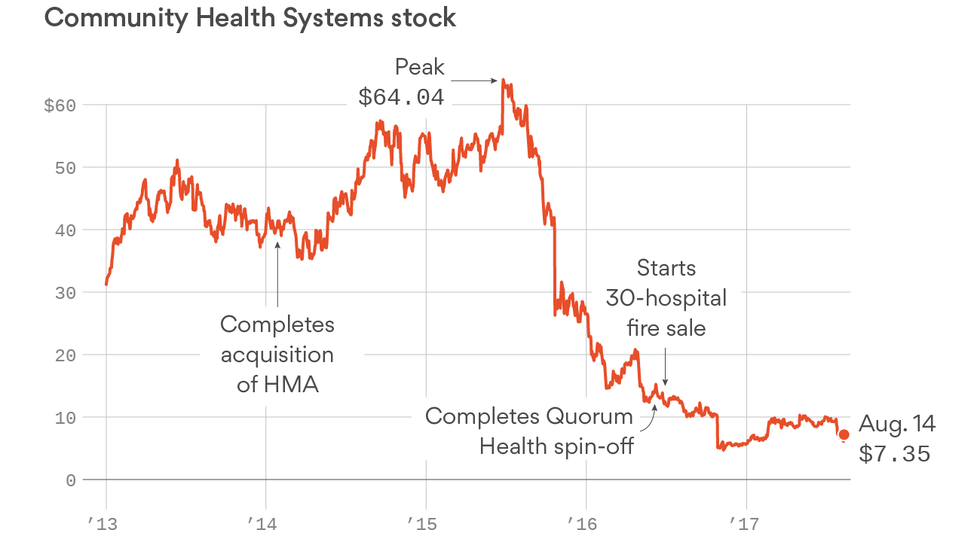
Just three years ago, Community Health Systems was the largest for-profit operator of hospitals with more than 200 facilities scattered in rural and suburban areas with growing populations. Now, the company is hemorrhaging money, sitting atop a mountain of debt and teetering on the edge of bankruptcy — all major reasons why CHS has lost almost 90% of its market value.

“I think the company has a nontrivial chance of defaulting,” said one CHS investor who asked to be unnamed because of the sensitivity of the issue. Tomi Galin, a CHS spokeswoman, did not make any company officials available for an interview, but said the company is confident it will have “a stronger core group of hospitals that are better positioned for long-term growth.”

Why it matters: CHS sits in a massive hole after a string of missteps, according to industry insiders. And it’s not likely to get better for CHS, or the local communities that rely on a CHS facility, as more people get treated in lower-cost outpatient centers instead of the hospital.

The collapse: It began in 2013 and continued into January 2014. That’s when CHS completed its acquisition of Health Management Associates, a for-profit hospital chain that had a slew of financial and legal problems. The deal was worth $7.6 billion, including debt, and made CHS the largest for-profit hospital company by number of facilities.

“That was the death knell,” a health care investment banker said. “HMA was a troubled company, and (CHS) thought bigger would be better.”

Here’s what has happened at CHS since then:

  • A market cap that crumbled from roughly $7.5 billion in 2015 to less than $800 million today.
  • Net losses of almost $1.9 billion from the start of 2016 through the second quarter of this year.
  • A ballooning debt load totaling $14.7 billion as of June 30.
  • Larry Robbins, a prominent hedge fund manager, dumped his entire portfolio of CHS stock. Paul Singer of Elliott Management did the same earlier this year.
  • A fire sale of 30 hospitals to get cash to pay down debt.
  • Some of those sold hospitals were HMA remnants, while others were considered CHS’ better, more profitable hospitals. “It’s almost like they’re burning the furniture,” the banker said. An investor said CHS was “selling off the fine china” to meet debt payments.
  • A completed spin-off of Quorum Health that, in essence, threw many struggling rural hospitals off CHS’ books. Quorum isn’t faring well either.
  • High amounts of uncompensated care. CHS owns many hospitals in the South, and most of those states did not expand Medicaid under the Affordable Care Act. That means CHS has absorbed more uncompensated care than hospitals in Medicaid expansion states.

Looking ahead: CHS plans on divesting even more hospitals, executives said during their latest earnings call. They likely will be profitable hospitals, as buyers won’t touch money-losing inpatient facilities with dwindling admissions.

But large debt payments are due in 2019 through 2022. Short-term cash from transactions appears to be a bandage, and a subsequently smaller profit base won’t solve the big debt picture, making bankruptcy a real possibility, an investor said.

Galin, the CHS spokeswoman, said the money from the hospital sales “are being used to reduce our debt” and that “cash flow generation remains strong.”

Leadership questions: Many CHS executives have retired or left in the past two years, including longtime CFO Larry Cash. Wayne Smith, the CEO of the hospital chain since 1997, remains in his position. Smith is one of the highest earners among hospital executives and reaped more than $1 million in bonuses alone the past two years even though CHS’ stock price tanked.

Numerous sources would not go on the record to talk about CHS. One hospital industry analyst said this when asked how Smith still had his job despite the company’s problems: “Your question is very valid.”

Nursing strikes can cause harm well beyond labor relations

http://www.healthcaredive.com/news/nursing-strikes-can-cause-harm-well-beyond-labor-relations/447627/

Image result for hospital labor strike

hen officials at Tufts Medical Center in Boston refused to allow nurses just off of a one-day strike return to their jobs, the footage spread across TV news programs and social media. Boston Mayor Martin Walsh, a former labor leader, spoke in favor of the striking nurses and the hospital found itself in an uncomfortable spotlight.

About 1,200 nurses went on a one-day strike after their union, the Massachusetts Nurses Association, and Tufts couldn’t come to a new contract agreement after more than a year of negotiations. Tufts, in turn, locked out the nurses when they attempted to return to work the next day.

Officials said the lockout was required because they needed to give at least five-day contracts to 320 temporary nurses brought in to fill the gap. The nurses are back on the job now without a new contract, but the strike and subsequent lockout got the public’s attention.

Hospital strikes aren’t that common — usually, the sides agree to a new contract. Strikes or threatened strikes in recent years have typically involved conflicts over pay, benefits and staff workloads.

When strikes do happen, however, they can hurt a hospital’s reputation, finances and patient care.

Strike’s effect on patient safety

study on nurses’ strikes in New York found that labor actions have a temporary negative effect on a hospital’s patient safety.

Study authors Jonathan Gruber and Samuel A. Kleiner found that nurses’ strikes increased in-patient mortality by 18.3% and 30-day readmission by 5.7% for patients admitted during the strike. Patients admitted during a strike got a lower quality of care, they wrote.

“We show that this deterioration in outcomes occurs only for those patients admitted during a strike, and not for those admitted to the same hospitals before or after a strike. And we find that these changes in outcomes are not associated with any meaningful change in the composition of, or the treatment intensity for, patients admitted during a strike,” they said.

They said a possible reason for the lower quality is fewer major procedures performed during a strike, which could lead partially to diminished outcomes. The study authors found that patients that need the most nursing care are the ones who make out worst during strikes.

“We find that patients with particularly nursing-intensive conditions are more susceptible to these strike effects, and that hospitals hiring replacement workers perform no better during these strikes than those that do not hire substitute employees,” they wrote.

Allina Health’s Abbott Northwestern Hospital in Minneapolis faced a patient safety issue during a strike last year that resulted in the CMS placing the hospital in “immediate jeopardy” status after a medication error. A replacement nurse administered adrenaline to an asthmatic patient through an IV rather than into the patient’s muscle. The patient, who was in the emergency room (ER), wound up in intensive care for three days because of the error. Allina said the error was not the nurse’s fault, but was the result of a communication problem.

The CMS accepted the hospital plan of correction, which included having a nurse observer when needed and retraining ER staff to repeat back verbal orders.

A strike’s financial impact

Hospitals also take a financial hit during strikes. Even the threat of a one- or two-day nurse strike can cost a hospital millions.

Bringing in hundreds or thousands of temporary nurses from across the country is costly for hospitals. They need to advertise the positions, pay for travel and often give bonuses to lure temporary nurses.

The most expensive recent nurse strike was when about 4,800 nurses went on strike at Allina Health in Minnesota two times last year. The two strikes of seven days and 41 days cost the health system $104 million. The hospital also saw a $67.74 million operating loss during the quarter of those strikes.

To find temporary replacements, Allina needed to include enticing offers, such as free travel and a $400 bonus to temporary nurses.

Even the threat of a strike can cost millions. Brigham and Women’s Hospital in Boston spent more than $8 million and lost $16 million in revenuepreparing for a strike in 2016. The 3,300-nurse union threatened to walk out for a day and much like Tufts Medical Center, Brigham & Women’s said the hospital would lock out nurses for four additional days if nurses took action.

At that time, Dr. Ron Walls, executive vice president and chief operating officer at Brigham and Women’s Hospital, said the hospital spent more than $5 million on contracting with the U.S. Nursing Corp. to bring on 700 temporary nurses licensed in Massachusetts. The hospital also planned to cut capacity to 60% during the possible strike and moved hundreds of patients to other hospitals. They also canceled procedures and appointments in preparation of a strike.

The Massachusetts Nurses Association and Brigham & Women’s were able to reach a three-year agreement before a strike, but the damage was already done to the hospital’s finances.

Richard L. Gundling, senior vice president of healthcare financial practices at Healthcare Financial Management Association, told Healthcare Dive that healthcare organizations need to plan for business continuity in case of an event, such as a labor strike, natural disaster or cyberattack.

“Business continuity is directly related to the CFO’s responsibility for maintaining business functions. The plan should include having business continuity insurance in place to replace the loss associated with diminished revenue and increased expenses during the event,” Gundling said.

These plans should provide adequate staffing, training, materials, supplies, equipment and communications in case of a strike. Hospitals should also keep payers, financial agencies and other important stakeholders informed of potential issues.

“It’s also key to keep financial stakeholders well informed; this includes insurance companies, bond rating agencies, banks, other investors, suppliers and Medicare/Medicaid contractors,” he said.


“Business continuity is directly related to the CFO’s responsibility for maintaining business functions. The plan should include having business continuity insurance in place to replace the loss associated with diminished revenue and increased expenses during the event.”

Richard Gundling

Senior vice president of healthcare financial practices, Healthcare Financial Management Association


Impact to a hospital’s reputation

Hospital strikes, particularly nurses’ strikes, can also wreak havoc on a hospital’s reputation. Nurses are a beloved profession. They work hard, often long hours and don’t make a fortune doing it. The median registered nurses’ salary is about $70,000, according to the Bureau of Labor Statistics.

Nurses’ contract disputes involving staffing levels are a sticky situation for hospitals. Nurses will almost always win the PR battle against hospital executives.

If a hospital can’t avoid a strike, Seitel said two keys for the organization are telling the truth and not being passive about untrue statements from the other side. They don’t want to be adversarial and escalate the situation, but go with a more measured approach.

Fraser Seitel, president of Emerald Partners, a communications management consulting company, told Healthcare Dive there are two ways that hospital leadership can avoid a strike.

“The best way to prevent a strike is by the management of the hospital having a robust communications program with the staff of the hospital as well as keeping competitive in terms of salaries and benefits,” said Seitel, who has helped hospitals during times of labor strife.

Seitel said labor issues often crop up when management isn’t communicative. Communication, transparency and competitive compensation are the best preventative medicine for a strike, he said.

UPMC moves ahead on purchase of PinnacleHealth

http://www.healthcaredive.com/news/upmc-moves-ahead-on-purchase-of-pinnaclehealth/449305/

Image result for upmc

Dive Brief:

  • UPMC have reached a definitive agreement to with Harrisburg-based PinnacleHealth to be acquired, Philly.com reports.
  • The deal paves the way for UPMC to expand its market share in central Pennsylvania and compete directly with the University of Pennsylvania Health System, which owns Lancaster General Health.
  • Last month, Pinnacle bought four central Pennsylvania hospitals from Community Health Systems, a Tennessee-based hospital chain. The purchase included Lancaster Regional Medical Center and Heart of Lancaster Regional Medical Center.

Dive Insight:

The deal, first announced in March, is UPMC’s largest ever and the first to involve an entire health system. Previous purchases have involved single hospitals, the most recent being Sunbury Community Hospital and Lock Haven Hospital from Quorum Health. Those hospitals will become part of Williamsport, Pa.-based UPMC Susquehanna, which was added to the UPMC system last fall.

With Pinnacle’s acquisition now on track, UPMC also stands to boost its health insurance product line, which accounted for close to half of its 2016 operating revenue. The move will pit UPMC Health Plan against Capital BlueCross and Highmark, which together have 75% of the central Pennsylvania market. Aetna holds the rest.

Gaining a foothold in the Harrisburg region could help to compete with Highmark, which four years ago bought Pittsburgh-based Allegheny Health Network, putting it in direct competition with UPMC’s medical and coverage operations.

Merger and acquisition activity has kept up a steady pace this year, with no signs of abating. Reasons for deals include declining admissions, rising costs and a desire to expand into new regions or service lines.

In May, Cleveland Clinic and Dover, Ohio-based Union Hospital signed a letter of intent to merge Union into Cleveland Clinic. The move will expand Cleveland Clinic’s footprint into southern Ohio, while bringing new services and resources to Union, officials said at the time.

Cleveland Clinic CEO Toby Cosgrove, who is stepping down later this year, said in April that consolidation and a greater focus on telemedicine would help providers transition from volume to value payment as healthcare reform continues to evolve.

UPMC expects to complete the acquisition September 1, pending regulatory approvals. For the fiscal year ended June 30, 2016, Pinnacle reported revenue of $1.05 billion.

47 Hospitals Slashed Their Use Of 2 Key Heart Drugs After Huge Price Hikes

http://www.npr.org/sections/health-shots/2017/08/09/542485307/47-hospitals-slashed-their-use-of-two-key-heart-drugs-after-huge-price-hikes?utm_source=Sailthru&utm_medium=email&utm_campaign=Newsletter%20Weekly%20Roundup:%20Healthcare%20Dive%2008-12-2017&utm_term=Healthcare%20Dive%20Weekender

Even before media reports and a congressional hearing vilified Valeant Pharmaceuticals International for raising prices on a pair of lifesaving heart drugs, Dr. Umesh Khot knew something was very wrong.

Khot is a cardiologist at the Cleveland Clinic, which prides itself on its outstanding heart care. The health system’s internal monitoring system had alerted doctors about the skyrocketing cost of the drugs, nitroprusside and isoproterenol. But these two older drugs, frequently used in emergency and intensive care situations, have no direct alternatives.

“If we are having concerns, what is happening nationally?” Khot wondered.

As it turned out, a lot was happening.

Following major price increases, use of the two cardiac medicines has dramatically decreased at 47 hospitals, according to a research letter Khot and two others published Wednesday in the New England Journal of Medicine.

The number of patients in these hospitals getting nitroprusside, which is given intravenously when a patient’s blood pressure is dangerously high, decreased 53 percent from 2012 to 2015, the researchers found. At the same time, the drug’s price per 50 milligrams jumped more than 30-fold — from $27.46 in 2012 to $880.88 in 2015.

The use of isoproterenol, key to monitoring and treating heart-rhythm problems during surgery, decreased 35 percent as the price per milligram rose from $26.20 to $1,790.11.

The two drugs, which are off patent, have long been go-to medicines for doctors.

“This isn’t like a cholesterol medicine; these are really, very specialized drugs,” says Khot, who is lead author on the peer-reviewed research letter. When patients get the drugs, he says, “they are either sick beyond sick in intensive care or they’re under anesthesia [during] a procedure.”

Valeant bought the drugs in early 2015 from Marathon Pharmaceuticals. Last year, Valeant announced a rebate program to lower the price hospitals paid for the drugs.

And Valeant’s Lainie Keller, a vice president of communications, says the company is committed to limiting price increases.

“The current management team is committed to ensuring that past decisions with respect to product pricing are not repeated,” Keller says.

Pharmacist Erin Fox, the director of drug information at University of Utah Health Care, said the findings by Khot and his colleagues reveal “exactly what a lot of pharmacists have been talking about. When prices are unsustainable, you have to stop using the drug whenever you can. You just can’t afford it.”

Fox says her Utah health system has removed isoproterenol from its bright-red crash carts, which are stocked for emergencies like heart attacks. But Nitroprusside is more difficult to replace.

“If you need it, you need it,” Fox says. “That’s exactly why the usage has not gone down to zero, even with the huge price increases.”

Cleveland Clinic leaders spent months investigating each drug’s use and potential alternatives, Khot says.

“We’re not going to ration or restrict this drug in any way that would negatively impact these patients,” Khot says, adding that he hopes to do more research on how the decreased use of both drugs has affected patients.

Dr. Richard Fogel is a cardiologist and electrophysiologist at St. Vincent, an Indiana hospital that’s part of Ascension, a large nonprofit chain with facilities in 22 states and the District of Columbia. He told a Senate committee last year that the cost of the two drugs alone drove a nearly $12 million increase in Ascension’s spending over one year.

“While we understand a steady, rational increase in prices, it is the sudden, unfounded price explosions in select older drugs that hinder us in caring for patients,” Fogel told the committee.

The NEJM letter also analyzed the use of two drugs that remained stable in price over that time period, as a control group — nitroglycerin and dobutamine. The number of patients treated with nitroglycerin, a drug used for chest pain and heart failure, increased by 89 percent. Khot warns that the drugs can’t always be used as substitutes.

Study: No link between offering price transparency tool and lower healthcare spending

http://www.beckershospitalreview.com/finance/study-no-link-between-offering-price-transparency-tool-and-lower-healthcare-spending.html

Image result for Study: No link between offering price transparency tool and lower healthcare spending


Offering a price transparency tool to a large insured population in California did not result in decreased healthcare spending, according to a study published in Health Affairs.

For the study, researchers analyzed the experience of beneficiaries of the self-insured California Public Employees’ Retirement System, a benefit manager for the state’s public employees, their dependents and retirees. CalPERS offered beneficiaries enrolled in an Anthem Blue Cross preferred provider organization a commercial price transparency tool called Castlight. Castlight was introduced to beneficiaries on July 1, 2014, and researchers conducted the study from July 1, 2012, to Sept. 30, 2015. Researchers said they specifically focused on “shoppable” services such as lab tests, office visits and advanced imaging services.

The study found no link between shoppable services spending and Castlight. Researchers said only 12.3 percent of beneficiaries offered the price transparency tool used it to conduct a price search at least once in the 15 months after it was introduced. Only 2.4 percent of beneficiaries used it at least three times during the 15 months, and 3.9 percent used it at least twice for searches with at least 30 days between searches.

The study found beneficiaries that did a price search prior to receiving imaging services on average paid 14 percent less than those who did not do a price search prior to those services. Researchers said only 1 percent of beneficiaries who received advanced imaging conducted a price search.

“We did not find evidence that offering a price transparency tool was associated with a reduction in spending on shoppable services. Patients’ use of the tool was associated with lower-price imaging services, but because use of the tool was so limited, this result did not translate into meaningful spending reductions among the population offered the tool,” the study’s authors concluded.

Former healthcare CFO sentenced to more than 3 years in prison for fraud

http://www.beckershospitalreview.com/legal-regulatory-issues/former-healthcare-cfo-sentenced-to-more-than-3-years-in-prison-for-fraud.html

Related image

U.S. District Judge Malcolm J. Howard sentenced William Canupp, former CFO of Beulaville, N.C.-based Eastpointe Human Services, to 3 1/2 years for wire fraud, tax fraud and conspiracy to commit federal program fraud, according to The Wilson Times.

Mr. Canupp served as Eastpointe’s CFO from March 2010 to April 2013. Eastpointe manages the public sector behavioral health system for several counties in eastern North Carolina.

On May 24, 2016, a federal grand jury returned a 47-count indictment against Mr. Canupp, charging him with conspiracy, bribery, organization fraud, wire fraud and money laundering. The indictment was issued nearly one year after a state audit found Mr. Canupp had facilitated kickbacks from two Eastpointe contractors. The audit revealed Eastpointe paid two contractors more than $1 million for renovations from 2010 to 2013. Each time a check was received from Eastpointe, the contractor wrote a personal check to Mr. Canupp. The contractors paid the former CFO a total of $547,595.

Mr. Canupp pleaded guilty in March to conspiracy to commit federal program fraud, wire fraud and tax fraud, according to The Wilson Times.


Auditor: 15-bed Missouri hospital at heart of $90M billing fraud scheme

http://www.beckershospitalreview.com/finance/auditor-15-bed-missouri-hospital-at-heart-of-90m-billing-fraud-scheme.html

Image result for fraud and abuse

Putnam County Memorial Hospital, a 15-bed hospital in Unionville, Mo., received $90 million in insurance payments in less than a year for lab services that were performed at other facilities across the country, according to The St. Louis Post-Dispatch, which cited a report released Wednesday by Missouri State Auditor Nicole Galloway.

According to Ms. Galloway’s report, Putnam County Memorial Hospital contracted with Hospital Laboratory Partners in September 2016 to operate a clinical laboratory on behalf of the hospital.

“Immediately upon signing the management contract with the hospital, the CEO and his associates began billing significant amounts of out-of-state lab activity through the hospital,” according to the auditor’s report.

Putnam County Hospital allegedly acted as a shell company by submitting claims for other labs and funneling the insurance payments through the hospital.

“Based on our review of hospital accounts, the vast majority of laboratory billings are for out-of-state lab activity for individuals who are not patients of hospital physicians,” states the auditor’s report.

Ms. Galloway has turned her findings over to the Missouri attorney general, the FBI and the Putnam County prosecuting attorney, according to KCUR.

On Thursday, Hospital Laboratory Partners said the auditor’s report mischaracterizes the payments. The company said Putnam County Hospital, a critical access hospital, is authorized to bill for off-site lab work.

“The assignment of non-patient lab specimens has been standard practice for rural and critical access hospitals for many years,” Hospital Laboratory Partners attorney Mark Thomas said in a statement to The Kansas City Star“The purpose of the rural/critical access exceptions is to give rural healthcare facilities a fighting chance to survive and serve their local communities.”