Considering “Single Payer” Proposals in the U.S.: Lessons from Abroad

https://www.commonwealthfund.org/publications/2019/apr/considering-single-payer-proposals-lessons-from-abroad

Flags and sky 21x9

ABSTRACT

  • Issue: When discussing universal health insurance coverage in the United States, policymakers often draw a contrast between the U.S. and high-income nations that have achieved universal coverage. Some will refer to these countries having “single payer” systems, often implying they are all alike. Yet such a label can be misleading, as considerable differences exist among universal health care systems.
  • Goal: To compare universal coverage systems across three areas: distribution of responsibilities and resources between levels of government; breadth of benefits covered and extent of cost-sharing in public insurance; and role of private insurance.
  • Methods: Data from the Organisation for Economic Co-operation and Development, the Commonwealth Fund, and other sources are used to compare 12 high-income countries.
  • Key Findings and Conclusion: Countries differ in the extent to which financial and regulatory control over the system rests with the national government or is devolved to regional or local government. They also differ in scope of benefits and degree of cost-sharing required at the point of service. Finally, while virtually all systems incorporate private insurance, its importance varies considerably from country to country. A more nuanced understanding of the variations in other countries’ systems could provide U.S. policymakers with more options for moving forward.

Background

Despite the gains in health insurance coverage made under the Affordable Care Act, the United States remains the only high-income nation without universal health coverage. Coverage is universal, according to the World Health Organization, when “all people have access to needed health services (including prevention, promotion, treatment, rehabilitation, and palliation) of sufficient quality to be effective while also ensuring that the use of these services does not expose the user to financial hardship.”1

Several recent legislative attempts have sought to establish a universal health care system in the U.S. At the federal level, the most prominent of these is Senator Bernie Sanders’ (I–Vt.) Medicare for All proposal (S. 1804, 115th Congress, 2017), which would establish a federal single-payer health insurance program. Along similar lines, various proposals, such as the Medicare-X Choice Act from Senators Michael Bennet (D–Colo.) and Tim Kaine (D–Va.), have called for the expansion of existing public programs as a step toward a universal, public insurance program (S. 1970, 115th Congress, 2017).

At the state level, legislators in many states, including Michigan (House Bill 6285),2 Minnesota (Minnesota Health Plan),3 and New York (Bill A04738A)4 have also advanced legislation to move toward a single-payer health care system. Medicare for All, which enjoys majority support in 42 states, is viewed by many as a litmus test for Democratic presidential hopefuls.5 In recent polling, a majority of Americans supported a Medicare for All plan.6

Medicare for All and similar single-payer plans generally share many common features. They envision a system in which the federal government would raise and allocate most of the funding for health care; the scope of benefits would be quite broad; the role of private insurance would be limited and highly regulated; and cost-sharing would be minimal. Proponents of single-payer health reform often point to the lower costs and broader coverage enjoyed by those covered under universal health care systems around the world as evidence that such systems work.

Other countries’ health insurance systems do share the same broad goals as those of single-payer advocates: to achieve universal coverage while improving the quality of care, improving health equity, and lowering overall health system costs. However, there is considerable variation among universal coverage systems around the world, and most differ in important respects from the systems envisioned by U.S. lawmakers who have introduced federal and state single-payer bills. American advocates for single-payer insurance may benefit from considering the wide range of designs other nations use to achieve universal coverage.

This issue brief uses data from the Organisation for Economic Co-operation and Development (OECD), the Commonwealth Fund, and other sources to compare key features of universal health care systems in 12 high-income countries: Australia, Canada, Denmark, England, France, Germany, the Netherlands, Norway, Singapore, Sweden, Switzerland, and Taiwan.

We focus on three major areas of variation between these countries that are relevant to U.S. policymakers: the distribution of responsibilities and resources between various levels of government; the breadth of benefits covered and the degree of cost-sharing under public insurance; and the role of private health insurance. There are many other areas of variation among the health care systems of other high-income countries with universal coverage — such as in hospital ownership, new technology adoption, system financing, and global budgeting — that are beyond the scope of this discussion.


How “Medicare for All” changes health care financing

https://www.axios.com/newsletters/axios-vitals-f500be38-f71e-4984-955b-efc69e20a435.html?utm_source=newsletter&utm_medium=email&utm_campaign=newsletter_axiosvitals&stream=top

Image result for medicare for all

Sen. Bernie Sanders’ “Medicare for All” plan would drastically change not only how health care is paid for, but who ultimately pays for it.

  • While the wealthy and the poor usually pay the same premium for today’s employer-based insurance, Sanders’ plan would beef up insurance coverage for everyone and pay for it by increasing taxes on the wealthy.

Driving the news: As part of yesterday’s rollout, Sanders released a white paper with several “options” on how to raise the additional revenue it would take for the government to pay for everyone’s health care without any premiums or out-of-pocket costs.

  • While most people’s taxes would go up, the wealthy would pay for a much greater portion of the nation’s health care system than they currently do.
  • A 4% “income-based premium” for workers who make more than $29,000 and a 7.5% “income-based premium” on employers (exempting the first $2 million in payroll) are two of the financing options. Most economists assume that the employer tax would get passed onto employees through lost wages.
  • Other options include increasing the individual tax rate on high earners, taxing “unearned” income at the same rate as earned, and establishing a wealth tax.

What they’re saying: Even if all of these payment options were implemented, they still wouldn’t cover the total cost of Sanders’ plan, said the Committee for a Responsible Federal Budget’s Marc Goldwein.

  • He said there could also be unintended consequences of such high taxes on the wealthy, such as discouraging investment.

The bottom line: “More progressive tax-based financing of health care is a feature, not a bug, of Medicare for all,” the Kaiser Family Foundation’s Larry Levitt said.

  • “The idea of financing health care through taxes rather than premiums and out-of-pocket costs would be fairer in some people’s minds, but also disruptive,” he said.


Obamacare fight obscures America’s real health care crisis: Money

https://www.politico.com/story/2019/04/03/obamacare-health-care-crisis-1314382

Image result for obscure glass

The ceaseless battle over the 2010 law has made it difficult to address the high cost of American health care.

The Obamacare wars have ignored what really drives American anxiety about health care: Medical costs are decimating family budgets and turning the U.S. health system into a runaway $3.7 trillion behemoth.

Poll after poll shows that cost is the number one issue in health care for American voters, but to a large extent, both parties are still mired in partisan battles over other aspects of Obamacare – most notably how to protect people with pre-existing conditions and how to make insurance more affordable, particularly for people who buy coverage on their own.

That leaves American health care consumers with high premiums, big deductibles and skyrocketing out-of-pocket costs for drugs and other services. Neither party has a long-term solution — and the renewed fight over Obamacare that burst out over the past 10 days has made compromise even more elusive.

Democrats want to improve the 2010 health law, with more subsidies that shift costs to the taxpayer. Republicans are creating lower-cost alternatives to Obamacare, which means shifting costs to older and sicker people.

Neither approach gets at the underlying problem — reducing costs for both ordinary people and the health care burden on the overall U.S. economy.

Senate HELP Committee chair Lamar Alexander, the retiring Tennessee Republican with a reputation for deal-making, has reached out to think tanks and health care professionals in an attempt to refocus the debate, saying the interminable fights about the Affordable Care Act have “put the spotlight in the wrong place.”

“The hard truth is that we will never get the cost of health insurance down until we get the cost of health care down,” Alexander wrote, soliciting advice for a comprehensive effort on costs he wants to start by summer.

But given the partisanship around health care — and the fact there have been so many similar outreaches over the years for ideas, white papers and commissions — it’s hard to detect momentum. Truly figuring how to fix anything as vast, complex and politically charged as health care is difficult. Any serious effort will create winners and losers, some of whom are well-protected by powerful K Street lobbies.

And the health care spending conversation itself gets muddled. People’s actual health care bills aren’t always top of mind in Washington.

“Congress is looking at federal budgets. Experts are looking at national health spending and the GDP and value. And the American people look at their own out-of-pocket health care costs and the impact it has on family budgets,” said Drew Altman, the president and CEO of the Kaiser Family Foundation, which extensively tracks public attitudes on health.

But Congress tends to tinker around the edges — and feud over Obamacare.

“We’re doing nothing. Nothing. We’re heading toward the waterfall,” said former CBO director Doug Elmendorf, now the dean of the Harvard Kennedy School, who sees the political warfare over the ACA as a “lost decade,” given the high stakes for the nation’s economic health.

The solutions championed by the experts — a mix of pricing policies, addressing America’s changing demographics, delivering care more efficiently, creating the right incentives for people to use the right care and the smarter use of high-cost new technologies — are different than what the public would prescribe. The most recent POLITICO-Harvard T.H. Chan School of Public Health poll found the public basically wants lower prices, but not a lot of changes to how — or how much — they consume health care, other than spending more on prevention.

Lawmakers are looking at how to start chipping away at high drug prices, or fix “surprise” medical bills that hit insured people who end up with an out-of-network doctor even when they’re at an in-network hospital. Neither effort is insignificant, and both are bipartisan. While those steps would help lower Americans’ medical bills, health economists say they won’t do enough to reverse the overall spending trajectory.

Drug costs and surprise bills, which patients have to pay directly, “have been a way the public glimpses true health care costs,” said Melinda Buntin, chair of the Department of Health Policy at Vanderbilt University School of Medicine. “That information about how high these bills and these charges can be has raised awareness of health care costs — but it has people focused only on that part of the solution.”

And given that President Donald Trump has put Obamacare back in the headlines, the health law will keep sucking up an outsized share of Washington’s oxygen until and quite likely beyond the 2020 elections.

Just in the last week, the Justice Department urged the courts to throw out Obamacare entirely, two courts separately tossed key administration policies on Medicaid and small business health plans, and Trump himself declared he wants the GOP to be the “party of health care.” Facing renewed political pressure over the party’s missing Obamacare replacement plan, Trump last week promised Republicans would devise a grand plan to fix it. He backtracked days later and said it would be part of his second-term agenda.

Democrats say Trump’s ongoing assaults on the ACA makes it harder to address the big picture questions of cost, value and quality. “That’s unfortunately our state of play right now,” said Rep. Raul Ruiz (D-Calif.). “Basic health care needs are being attacked and threatened to be taken away, so we have to defend that.”

The ACA isn’t exactly popular; more than half the country now has a favorable view of it, but it’s still divisive. But for Republicans and Democrats alike, the new POLITICO-Harvard poll found the focus was squarely on health care prices — the cost of drugs, insurance, hospitals and doctors, in that order.

The Republicans’ big ideas have been to encourage less expensive health insurance plans, which are cheaper because they don’t include the comprehensive benefits under Obamacare. That may or may not be a good idea for the young and healthy, but it undoubtedly shifts the costs to the older and sicker. The GOP has also supported spending hundreds of millions less each year on Medicaid, which serves low-income people — but if the federal government pays less, state governments, hospitals and families will pay more.

Last week, courts blocked rules in two states that required many Medicaid enrollees to work in order to keep their health benefits, and also nixed Trump’s expansion of association health plans, which let trade groups and businesses offer coverage that doesn’t include all the benefits required under the ACA.

House Democrats last week introduced a package of bills that would boost subsidies in the Obamacare markets and extend that financial assistance to more middle-class people. The legislation would also help states stabilize their insurance markets — something that the Trump administration has also helped some states do through programs backstopping health insurers’ large costs.

These ideas may also bring down some people’s out-of-pocket costs, which indirectly lets taxpayers pick up the tab. These steps aren’t meaningless — more people would be covered and stronger Obamacare markets would stabilize premiums — but they aren’t an overall fix.

The progressive wing of the Democratic party backs “Medicare for All,” a brand new health care system that would cover everyone for free, including long-term care for elderly or disabled people. Backers say that the administrative simplicity, fairness, and elimination of the private for-profit insurance industry would pay for much of it.

The idea has moved rapidly from pipe dream to mainstream, but big questions remain even among some sympathetic Democrats about financing and some of the economic assumptions, including about how much of a role private insurance plays in Medicare today, and how much Medicare puts some of its costs onto other payers. Already a political stretch, the idea would face a lot more economic vetting, too.

The experts, as well as a smattering of politicians, define the health cost crisis more broadly: what the country spends. Health care inflation has moderated in recent years; backers of the Affordable Care Act say the law has contributed to that. But health spending is still growing faster than the overall economy. CMS actuaries said this winter that if current trends continue, national health expenditures would approach nearly $6 trillion by 2027 — and health care’s share of GDP would go from 17.9 percent in 2017 to 19.4 percent by 2027. There aren’t a lot of health economists who’d call that sustainable.

And ironically, the big fixes favored by the health policy experts — the ones that Alexander is collecting but most politicians are ignoring — might address many of the problems that keep aggravating U.S. politics. If there were rational prices that reflected the actual value of care provided for specific episodes of illness and treatment, instead of the fragmented system that largely pays for each service provided to patients, then no medical bill would be a surprise, noted Mark McClellan, who was both FDA and CMS chief under the President George W. Bush and now runs the Duke-Margolis Center for Health Policy.

“But taking those steps take time and will be challenging,” McClellan noted. “And they’ll be resisted by a lot of entrenched forces.”


FURTHER MEDICARE EXPANSION COULD DIMINISH HOSPITAL REVENUES, BUT ACTION REQUIRED

https://www.healthleadersmedia.com/finance/further-medicare-expansion-could-diminish-hospital-revenues-action-required?utm_source=silverpop&utm_medium=email&utm_campaign=ENL_190321_LDR_FIN%20(1)&spMailingID=15334448&spUserID=MTY3ODg4NTg1MzQ4S0&spJobID=1601649422&spReportId=MTYwMTY0OTQyMgS2

Medicare for All

Potential Medicare expansion plans would drastically impact the financial standing of health systems, though some may be more pragmatic solutions than others.


KEY TAKEAWAYS

Implementing Medicare for All as a single payer healthcare system is estimated to create a 22.1% negative impact on a mid-size regional provider’s net margin.

However, a voluntary buy-in plan, also known as ‘Medicare for more,’ might result in only a slight dip to the net margin compared to the status quo.

Regardless, some amount of legislative action regarding Medicare expansion will be necessary in the next five years, according to the study’s authors.

Hospital and health systems should remain aware of the financial impact that several Medicare expansion proposals could have on their respect organizations, according to a Navigant study released Friday afternoon.

Fresh off the 2018 midterm elections where healthcare played a critical role in the electoral shift that saw Democrats retake the House of Representatives, 2020 presidential candidates are heralding sweeping policy proposals to expand coverage through Medicare. 

While several versions of Medicare for All legislation exist, other policy proposals such as ‘Medicare for more’ or the public option have drawn consideration from lawmakers as potentially more viable or pragmatic solutions to America’s healthcare problems.

In its analysis, Navigant found a medium-sized, nonprofit, multi-hospital system with revenues of more than $1 billion and a current operating margin of 2.3% would endure vastly different financial implications under several proposed federal healthcare policy changes.

Medicare for All would reduce revenues by around $330 million, a margin drop of just over 22%, the public option proposal would cause revenue declines in the neighborhood of $153 million, a margin impact of -6.3%, and the ‘Medicare for more’ expansion plan is estimated to have a neutral impact compared to the status quo.

Still, Navigant’s study points out that if Congress does not act on Medicare expansion until after the next presidential election, hospitals could face a scenario with a financial impact comparable to the public option proposal.

Using the model health system as an example, status quo projections without any cost reduction initiatives would see the organization’s net margin decline from 2.3% to negative 6.2% from 2018 to 2023, with operating costs rising between 4.5% to 5% per year and revenues growing at 2.5% to 3% per year.

“There’s going to be a need to control hospital cost structures going forward, regardless of whether it’s in the status quo with baby boomers aging into Medicare and payer mix shifts occurring, or in a scenario that has limited expansion, moderate expansion, or robust Medicare for All,” Jeff Leibach, director at Navigant, told HealthLeaders in an interview. “There are obviously varying degrees of impact on hospitals, but all of them are going to require a level of attention and and management of revenue strategy and cost structure that I think hospital CFOs are struggling with today and will benefit from through continued focus on performance improvement and revenue strategy.”

PLANS, DETAILS, AND IMPACT:

‘Medicare for more’

  • Voluntary buy-in at age 50 and over
  • In one scenario, choice between employer coverage and Medicare
  • No Medicare payment relief
  • No reduction in revenue cycle management operations compared to the status quo
  • 15% reduction in current disproportionate share hospital payments

Public option

  • All lives covered regardless of age
  • Choice between employer coverage and Medicare
  • Range from no Medicare payment relief to payments at 110% of Medicare rate
  • 1.5% reduction in revenue cycle management operations compared to the status quo
  • 70% reduction in current disproportionate share hospital payments

Medicare for All

  • All lives covered regardless of age
  • Single payer healthcare coverage
  • Range from no Medicare payment relief to payments at 120% of Medicare rate
  • 2.5% reduction in revenue cycle management operations compared to the status quo
  • 100% reduction in current disproportionate share hospital payments

Leibach said that the analysis arrives at the early part of the conversation surrounding widespread Medicare expansion at the federal level, which makes it difficult to gauge how health system leaders will react to Navigant’s findings.

Some may be hesistant to support plans that are projected to create such a negative material impact on their respective bottom lines, but others may be willing to consider a policy proposal that significant decreases or even eliminates bad debt costs associated with a large uninsured population.

Even before the report was released, however, the American Hospital Association declined to voice support for Medicare for All late last month. 

Leibach added that he was surprised by the “nominal impact” of the voluntary buy-in plan, arguing that could hospital leaders may rally around that proposal as a compromise to expanding Medicare without fully deteriorating their financial standing.

This approach would also be the least disruptive to the commercial insurance market, according to Leibach, assuming that the Medicare for All proposal would be a true single-payer platform that eliminates private insurers.


Congress Warns Against Medicaid Cuts: ‘You Just Wait for the Firestorm’

Image result for Congress Warns Against Medicaid Cuts: ‘You Just Wait for the Firestorm’

WASHINGTON — If President Trump allows states to convert Medicaid into a block grant with a limit on health care spending for low-income people, he will face a firestorm of opposition in Congress, House Democrats told the nation’s top health official on Tuesday.

The official, Alex M. Azar II, the secretary of health and human services, endured more than four hours of bipartisan criticism over the president’s budget for 2020, which would substantially reduce projected spending on Medicaid, Medicare and biomedical research. Democrats, confronting Mr. Azar for the first time with a House majority, scorned most of the president’s proposals.

But few drew as much heat as Mr. Trump’s proposed overhaul of Medicaid. His budget envisions replacing the current open-ended federal commitment to the program with a lump sum of federal money for each state in the form of a block grant, a measure that would essentially cap payments and would not keep pace with rising health care costs.

Congress rejected a similar Republican plan in 2017, but in his testimony on Tuesday before the Health Subcommittee of the House Energy and Commerce Committee, Mr. Azar refused to rule out the possibility that he could grant waivers to states that wanted to move in that direction.

Under such waivers, Mr. Azar said, he could not guarantee that everyone now enrolled in Medicaid would keep that coverage.

“You couldn’t make that kind of commitment about any waiver,” Mr. Azar said. He acknowledged that the president’s budget would reduce the growth of Medicaid by $1.4 trillion in the coming decade.

Representative G. K. Butterfield, Democrat of North Carolina, said that “block-granting and capping Medicaid would endanger access to care for some of the most vulnerable people” in the country, like seniors, children and the disabled.

Mr. Trump provoked bipartisan opposition by declaring a national emergency to spend more money than Congress provided to build a wall along the southwestern border. If the president bypasses Congress and allows states to convert Medicaid to a block grant, Mr. Butterfield said, he could face even more of an outcry.

“You just wait for the firestorm this will create,” Mr. Butterfield said, noting that more than one-fifth of Americans — more than 70 million low-income people — depend on Medicaid.

As a candidate, Mr. Trump said he would not cut Medicare, but his new budget proposes to cut more than $800 billion from projected spending on the program for older Americans in the next 10 years. Mr. Azar said the proposals would not harm Medicare beneficiaries.

“I don’t believe any of the proposals will impact access to services,” Mr. Azar said. Indeed, he said, the cutbacks could be a boon to Medicare beneficiaries, reducing their out-of-pocket costs.

After meeting an annual deductible, beneficiaries typically pay 20 percent of the Medicare-approved amount for doctor’s services and some prescription drugs administered in doctor’s offices and outpatient hospital clinics.

Mr. Azar defended a budget proposal to impose work requirements on able-bodied adults enrolled in Medicaid. Arkansas began enforcing such requirements last year under a waiver granted by the Trump administration. Since then, at least 18,000 Arkansans have lost Medicaid coverage.

Mr. Azar said he did not know why they had been dropped from Medicaid. It is possible, he said, that some had found jobs providing health benefits.

Representative Joseph P. Kennedy III, Democrat of Massachusetts, said it would be reckless to extend Medicaid work requirements to the entire country without knowing why people were falling off the rolls in Arkansas.

If you are receiving free coverage through Medicaid, Mr. Azar said, “it is not too much to ask that you engage in some kind of community engagement.”

Representative Fred Upton, Republican of Michigan, expressed deep concern about Mr. Trump’s proposal to cut the budget of the National Cancer Institute by $897 million, or 14.6 percent, to $5.2 billion.

Mr. Azar said the proposal was typical of the “tough choices” in Mr. Trump’s budget. He defended the cuts proposed for the National Cancer Institute, saying they were proportional to the cuts proposed for its parent agency, the National Institutes of Health.

The president’s budget would reduce funds for the N.I.H. as a whole by 12.6 percent, to $34.4 billion next year.

Mr. Azar was also pressed to justify Mr. Trump’s proposal to cut federal payments to hospitals serving large numbers of low-income patients. Representative Eliot L. Engel, Democrat of New York, said the cuts, totaling $26 billion over 10 years, would be devastating to “safety net hospitals” in New York and other urban areas.

Mr. Azar said that the Affordable Care Act, by expanding coverage, was supposed to “get rid of uncompensated care” so there would be less need for the special payments.

While Democrats assailed the president’s budget, Mr. Azar relished the opportunity to attack Democrats’ proposals to establish a single-payer health care system billed as Medicare for all.

Those proposals could eliminate coverage provided to more than 20 million people through private Medicare Advantage plans and to more than 155 million people through employer-sponsored health plans, he said.

But Mr. Azar found himself on defense on another issue aside from the president’s budget: immigration. He said he was doing his best to care for migrant children who had illegally entered the United States, were separated from their parents and are being held in shelters for which his department is responsible.

He said he was not aware of the “zero tolerance” immigration policy before it was publicly announced in April 2018 by Attorney General Jeff Sessions. If he had known about the policy, Mr. Azar said, “I could have raised objections and concerns.”

Representative Anna G. Eshoo, Democrat of California and the chairwoman of the subcommittee, summarized the case against the president’s budget.

“The Trump administration,” she said, “has taken a hatchet to every part of our health care system, undermining the Affordable Care Act, proposing to fundamentally restructure Medicaid and slashing Medicare. This budget proposes to continue that sabotage.”


The “Medicare for All” Continuum: A New Comparison Tool for Congressional Health Bills Illustrates the Range of Reform Ideas

https://www.commonwealthfund.org/blog/2019/medicare-all-continuum

Medicare for all paperwork

Several 2020 Democratic presidential candidates have called for “Medicare for All” as a way to expand health coverage and lower U.S. health care costs. Replacing most private insurance with a Medicare-like system for everyone has instilled both hope and fear across the country depending on people’s perspective or financial stake in the current health care system. But a closer look at recent congressional bills introduced by Democrats reveals a set of far more nuanced approaches to improving the nation’s health care system than the term Medicare for All suggests. To highlight these nuances, a new Commonwealth Fund interactive tool launched today illustrates the extent to which each of these reform bills would expand the public dimensions of our health insurance system, or those aspects regulated or run by state and federal government.1

The U.S Health Insurance System Is Both Public and Private

The U.S. health insurance system comprises both private (employer and individual market and marketplace plans) and public (Medicare and Medicaid) coverage sources, as the table below shows. In addition, both coverage sources are paid for by a mix of private and taxpayer-financed public dollars.

Most Americans get their insurance through employers, who either provide coverage through private insurers or self-insure. Employers and employees share the cost through premiums and cost-sharing such as deductibles, copayments, and coinsurance. But the federal government significantly subsidizes employer coverage by excluding employer premium contributions from employees’ taxable income. In 2018 this subsidy amounted to $280 billion, the largest single tax expenditure.

About 27 million people are covered through regulated private plans sold in the individual market, including the Affordable Care Act’s marketplaces. This coverage is financed by premiums and cost-sharing paid by enrollees. The federal government subsidizes these costs for individuals with incomes under $48,560.

For 44 million people, Medicaid or the Children’s Health Insurance Program is their primary source of coverage. These public programs are financed by federal and state governments, and small individual premium payments and cost-sharing in some states. In most states, these benefits are provided through private insurers.

Medicare covers 54 million people over age 65 and people with disabilities. The coverage is financed by the federal government along with individual premiums and significant cost-sharing. About 20 million people get their Medicare benefits through private Medicare Advantage plans and most beneficiaries either buy supplemental private insurance or qualify for additional coverage through Medicaid to help lower out-of-pocket costs and add long-term-care benefits.

Millions Still Uninsured or Underinsured, Health Care Costs High

The coverage expansions of the ACA — new regulation of private insurance such as requirements to cover preexisting conditions, subsidies for private coverage on the individual market, and expanded eligibility for Medicaid — lowered the number of uninsured people and made health coverage more affordable for many. But 28 million people remain uninsured and at least 44 million are underinsured. In addition, overall health care and prescription drug costs are much higher in the United States than in other wealthy countries. U.S. health care expenditures are projected to climb to nearly $6 trillion by 2027.

The Medicare for All Continuum

To address these problems, some Democrats running for president in 2020 are supporting Medicare for All. Meanwhile, in Congress, Democrats have introduced a handful of bills that might be characterized as falling along a continuum, with Medicare for All at one end.

As our new Commonwealth Fund interactive tool illustrates, the bills range from adding somewhat more public sector involvement into the system, to adding substantially more public sector involvement. The bills may be broadly grouped into three categories:

  • Adding public plan features to private insurance. These include increasing regulation of private plans such as requiring private insurers who participate in Medicare and Medicaid to offer health plans in the ACA marketplaces, and enhancing federal subsidies for marketplace coverage.
  • Giving people a choice of public plans alongside private plans. These bills include offering a Medicare-like public plan option through the marketplaces, extending that option to employers to offer to their employees, giving people ages 50 to 64 the option to buy in to Medicare, and giving states the option to allow people to buy in to Medicaid. These bills also bring the federal government’s leverage into provider rate-setting and prescription drug price negotiation.
  • Making public plans the primary source of coverage in the U.S. These are Medicare-for-All bills in which all residents are eligible for a public plan that resembles the current Medicare program, but isn’t necessarily the same Medicare program we have today. The bills vary by whether people would pay premiums and face cost-sharing, the degree to which they end current insurance programs and limit private insurance, how provider rates are set, whether global budgets are used for hospitals and nursing homes, and how long-term care is financed. All of the bills in this category allow people to purchase supplemental coverage for benefits not covered by the plan.

Looking Forward

Many Democratic candidates who have called for Medicare for All are cosponsors of more than one of these bills. The continuum of approaches suggests both the possibility of building toward a Medicare for All system over time, or adopting aspects of Medicare for All without the disruption that a major shift in coverage source might create for Americans. We will continue to update the tool as new bills are introduced or refined. Users also can view a comparison tool of other wealthy countries’ health systems, which shows where select countries fall on a continuum ranging from regulated systems of public and private coverage to national insurance programs.


The Public On Next Steps For The ACA And Proposals To Expand Coverage

https://www.kff.org/health-reform/poll-finding/kff-health-tracking-poll-january-2019/

Key Findings:

  • Half of the public disapproves of the recent decision in Texas v. United States, in which a federal judge ruled that the 2010 Affordable Care Act (ACA) is unconstitutional and should not be in effect. While the judge’s ruling is broader than eliminating the ACA’s protections for people with pre-existing conditions, this particular issue continues to resonate with the public. Continuing the ACA’s protections for people with pre-existing conditions ranks among the public’s top health care priorities for the new Congress, along with lowering prescription drug costs.
  • This month’s KFF Health Tracking Poll continues to find majority support (driven by Democrats and independents) for the federal government doing more to help provide health insurance for more Americans. One way for lawmakers to expand coverage is by broadening the role of public programs. Nearly six in ten (56 percent) favor a national Medicare-for-all plan, but overall net favorability towards such a plan ranges as high as +45 and as low as -44 after people hear common arguments about this proposal.
  • Larger majorities of the public favor more incremental changes to the health care system such as a Medicare buy-in plan for adults between the ages of 50 and 64 (77 percent), a Medicaid buy-in plan for individuals who don’t receive health coverage through their employer (75 percent), and an optional program similar to Medicare for those who want it (74 percent). Both the Medicare buy-in plan and Medicaid buy-in plan also garner majority support from Republicans (69 percent and 64 percent­).
  • Moving forward, half of Democrats would rather see the new Democratic majority in the U.S. House of Representatives focus their efforts on improving and protecting the ACA (51 percent), while about four in ten want them to focus on passing a national Medicare-for-all plan (38 percent).


Health care spending is more than just the parts you see

https://www.axios.com/understanding-health-care-spending-46e21c47-79ee-474b-80ff-778a705cdcae.html

Illustration of a red cross spinning to reveal money

People focus on the health costs that are most tangible and sometimes outrageous to them: their deductibles, and drug costs, and surprise medical bills, and the annual increase in the share of the premium they pay. But there’s more that gets less attention because it’s not as visible to them.

Why it matters: To really understand how Medicare for All or any other big change in health care financing would affect them, people need to understand how they would impact their overall family health budgets. Few people think about the other health costs they pay: their taxes to support health care, or what their employers are paying towards premiums (which is depressing their wages).

Between the lines: Consider this hypothetical example of a total family health “budget”:

  • The Browns, a family of four with at least one member in poor health and a $50,000 income, have standard employer coverage much like 156 million other Americans. They spend $9,250 per year (19% of their income) on health.
  • This includes $3,950 (8% of their income) in out-of-pocket health spending, $3,900 (8% of their income) in health insurance premiums, and, although they are almost certainly not aware of it, approximately $1,400 (3% of their income) in state and federal taxes that fund health programs.
  • The Browns are not taxed on the contributions their employer makes toward health insurance premiums, which economists generally say offset wages. Their employer is contributing an additional $13,050 to their health insurance premiums, as well as $750 in Medicare payroll taxes.
  • When combined, the Brown’s spending on health care and the money spent by their employer on their behalf totals a considerable $23,050. And remember, they make $50,000.

A few ideas that could help people learn more about their health total care spending and how reform proposals might affect their health spending:

  • The IRS and states could include a simple pie chart on everyone’s tax forms, showing taxpayers where their tax dollars go today.
  • Along with estimating the impact of health reform legislation on the federal budget, or the number of uninsured, the CBO could estimate its impact on typical family budgets, taking into account all of the forms of health spending families have today. Organizations like ours could do this as well.

What to watch: This could be particularly important when analyzing Medicare for All proposals, since they would so significantly alter the financing of health care by shifting it from premiums and out-of-pocket costs to taxes.

  • A Medicare for All plan would likely reduce what the nation spends on health care by lowering payment rates to providers and creating administrative efficiencies. The average family would likely pay less, but how much is hard to say without more details.
  • However, by changing the financing so significantly, there would likely be both winners and losers. Low-income people and sick people might pay less, and higher-income people and those who are healthy could pay more.

The bottom line: We can only get a clear picture of how family finances would be affected by Medicare for All, or any other significant overhaul of the health care system, by looking at the totality of what they pay now.


The Health 202: Jayapal to roll out sweeping Medicare-for-All bill by month’s end

https://www.washingtonpost.com/news/powerpost/paloma/the-health-202/2019/02/14/the-health-202-jayapal-to-roll-out-sweeping-medicare-for-all-bill-by-month-s-end/5c6496121b326b71858c6b85/?noredirect=on&utm_term=.3b80663a6c98

Image result for medicare at 50

Rep. Pramila Jayapal (D-Wash.) is seeking buy-in from more fellow Democrats for a sweeping Medicare-for-all bill she is poised to release near the end of the month.

It’s a proposal that has become a rallying cry for progressives and 2020 presidential candidates, but it is also exposing deep rifts in the Democratic Party over exactly how to achieve universal health coverage in the United States.

The Medicare for All Act of 2019, which Jayapal had planned to roll out this week but delayed because she was seeking more co-sponsors, would create a government-run single-payer health system even more generous than the current Medicare program. Her office hasn’t publicly released the details of the upcoming measure, but Democratic members told me it would cover long-term care and mental health services, two areas where Medicare coverage is sparse.

The bill also proposes to add dental, vision, prescription drugs, women’s reproductive health services, maternity and newborn care coverage to plans that would be available to people of all ages and would require no out-of-pocket costs for any services, according to a letter Jayapal sent to colleagues on Tuesday asking them to consider co-sponsoring the effort.

“Medicare for All is the solution our country needs,” the letter said. “Patients, nurses, doctors, working families, people with disabilities and others have been telling us this for years, and it’s time that Congress listens.”

The 150-page bill had 93 co-sponsors as of Tuesday, although Jayapal spokesman Vedant Patel said more Democrats have signed on since then. That’s still fewer than the 124 Democrats who co-sponsored a much less detailed Medicare-for-all proposal from then-Rep. John Conyers (D-Mich.) last year. A strategist who has been working with Democrats on health-care ideas told me there have been some frustrations that more members haven’t yet signed on to Jayapal’s bill, despite the fact that there are 40 more Democrats in the House this year.

But Jayapal said she’s confident she’ll have 100 co-sponsors by the time of the bill’s planned Feb. 26 release, explaining she’s not surprised members would take more time to consider it given its length.

“It’s a 150-page bill … it’s not an eight-page resolution,” Jayapal told me yesterday. “Now we’re actually putting detail into it, and so we feel confident we will continue to add cosponsors even after introduction.”

Patel also noted it’s still early in the year, saying he “disagrees” with the notion that it’s taking a long time to bring Democrats on board.

“It’s the second week of February and we are at more than 95 co-sponsors,” he said. “Coalition building is a process, but we are on track to introduce this historic legislation with resounding support at the end of the month.”

Yet differences are emerging among Capitol Hill Democrats over how to expand coverage, part of a larger debate roiling the party as 2020 candidates, many of them senators, and a new class of freshmen House Democrats move the party left not only on health care but also on the environment.

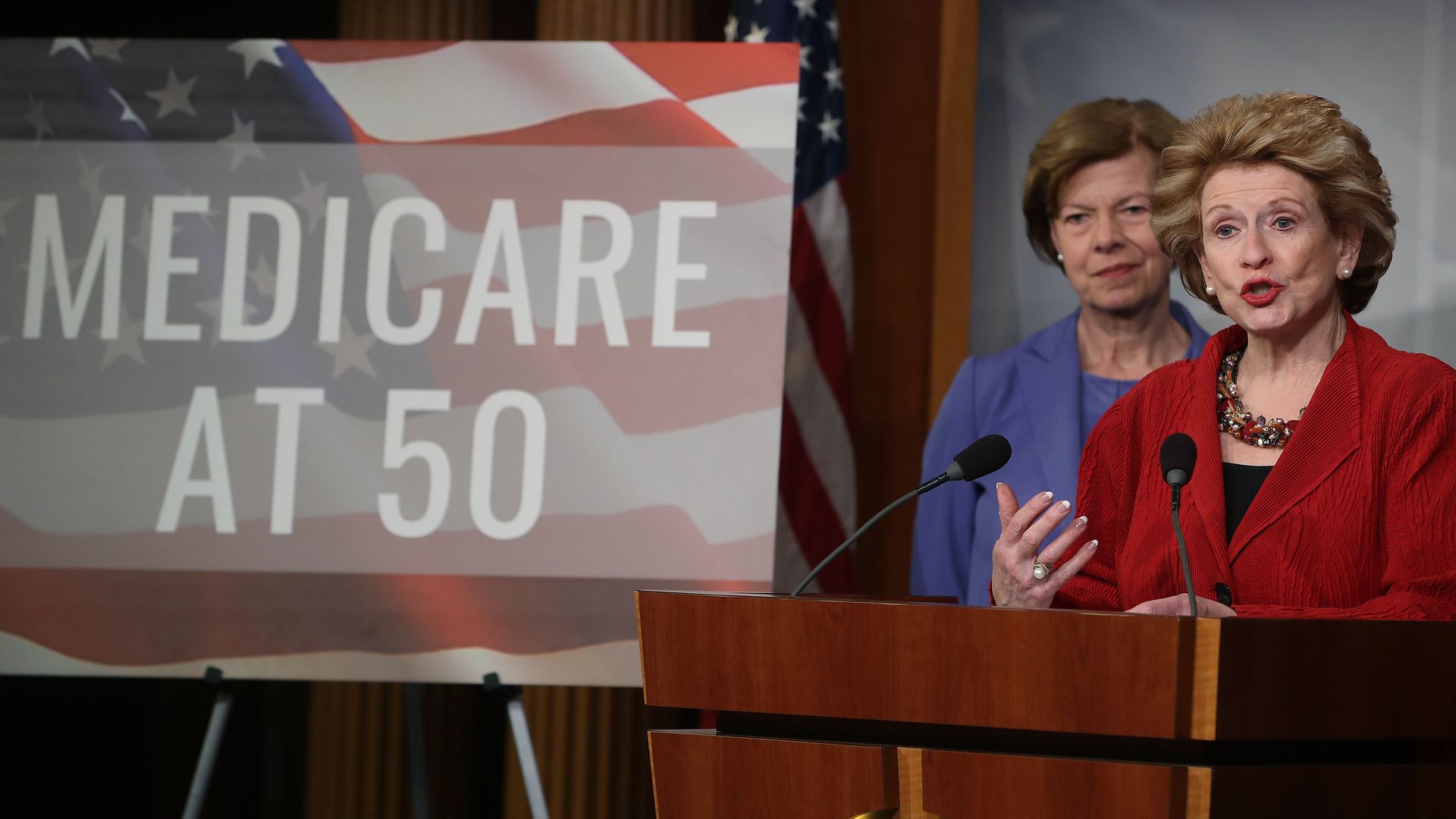
The cracks were especially apparent yesterday, as a separate group of lawmakers gathered to re-introduce their own proposal to allow people to buy in to Medicare starting at age 50. That measure, offered by Sen. Debbie Stabenow (D-Mich.) and Rep. Brian Higgins (D-N.Y.), would take a more incremental approach to expanding health coverage — one that could play better with voters who would stand to lose private coverage under a single-payer program.

Their bill, dubbed the “Medicare at 50 Act,” would allow people to buy Medicare plans instead of purchasing private coverage on the Obamacare marketplaces if they are uninsured or prefer it to coverage offered in their workplace.

And today, Sen. Brian Schatz (D-Hawaii) and Rep. Ben Ray Luján (D-N.M.) are reintroducing their State Public Option Act, which allows people to buy a Medicaid plan regardless of their income. That measure has broad backing from not just lawmakers (20 senators co-sponsored it last year) but also well-known health policy wonks including former Centers for Medicare and Medicaid Services Administrator Andy Slavitt.

Higgins is one of several Democrats on the House Budget Committee who have proposed a total of three separate and contrasting bills to expand Medicare to more people. The others are Reps. Rosa DeLauro (D-Conn.) and Jan Schakowsky (D-Ill.), who have a bill to expand Medicare to all ages while still preserving employer-sponsored coverage, and Jayapal.

Once Jayapal rolls out her legislation, the Congressional Budget Office is expected to release an analysis of how much it would cost by the end of March or the beginning of April, Budget Committee Chairman John Yarmuth (D-Ky.) told me. At that point, the committee will hold a hearing with the CBO to go over the cost and its potential impact on the federal budget.

That’s where Jayapal could run into roadblocks.Given the extensive benefits she’s proposing, her bill would probably come at a steep cost to taxpayers — and paying for things is almost always Congress’s trickiest task. Of course, supporters of the legislation stress its benefits would fill in much-needed gaps in coverage under the current Medicare program.

“The biggest change I give her so much credit for is it has long-term care,” said Rep. Ro Khanna (D-Calif.), who is a co-sponsor of Jayapal’s Medicare-for-all bill. “This is huge.”

And then there’s also the question of how voters might react if told they would lose their current coverage. Sen. Kamala Harris (D-Calif.), who has gone the furthest of all the 2020 candidates in pushing for an overhaul of the U.S. health-care system, attracted widespread attention recently when she suggested she’d be fine with entirely eliminating private coverage in favor of government-run plans.

“We’re very aware that there is anxiety about — however imperfect — a system you know and doctors you know, and that is going to be all part of the hearing process, public input into: How do we build a system in this country that really cares about all Americans?” said Rep. Katherine Clark (D-Mass.), another co-sponsor of the Jayapal bill.


Medicare for All Emerges as Early Policy Test for 2020 Democrats

Related image

Senator Elizabeth Warren spoke at length this week about her vision for improving the American health care system, like strengthening the Affordable Care Act and making prescription drugs more affordable. Twice, though, she ignored a question posed to her: Would she support eliminating private health insurance in favor of a single-payer system?

“Affordable health care for every American” is her goal, Ms. Warren said on Bloomberg Television, and there are “different ways we can get there.”

To put it another way: I am not walking into that political trap.

Ms. Warren of Massachusetts and three other liberal presidential candidates support a Medicare for All bill, which would create a single-payer health plan run by the government and increase federal spending by at least $2.5 trillion a year, according to several estimates. But Ms. Warren’s determination to sidestep an essential but deeply controversial issue at the heart of the single-payer model — would people lose the choices offered by private insurance? — illustrated one of the thorniest dilemmas for several Democrats as the 2020 primary gets underway.

Their activist base, inspired by Senator Bernie Sanders of Vermont, believes that the party should unabashedly pursue universal health care, ending private insurance entirely. But polls indicate that the broader electorate, particularly the moderate- and high-income voters who propelled the party’s sweeping suburban gains in the midterms, is uneasy about this “Medicare for all” approach in which many would lose their current insurance options and pay higher taxes.

Senator Kamala Harris of California drew immediate attacks from Republicans this week by taking on the issue that Ms. Warren dodged. Ms. Harris breezily acknowledged in a CNN town hall forum that she would “eliminate all of that,” referring to ending private insurance in a country where almost 60 percent of the population receives coverage through an employer.

Her remark triggered an intraparty debate about an issue that until now had been largely theoretical: A decade after Democrats pushed through the most significant expansion of health care since the Great Society, should they build incrementally on the Affordable Care Act or scrap the insurance sector entirely and create a European-style public program?

Four Democratic presidential candidates — Ms. Harris, Ms. Warren, Senator Kirsten Gillibrand of New York and Senator Cory Booker of New Jersey — are among the co-sponsors of Mr. Sanders’s Medicare for All bill, which would replace the Affordable Care Act with a single government health plan for all Americans. Medicare is the federal program providing health coverage to people 65 and older.

The concept of Medicare for all has become popular with Democrats: 81 percent support it, according to a recent Kaiser poll. Yet voter opposition to surrendering the insurance they are used to led to a backlash over President Barack Obama’s repeated promise that “if you like your plan, you can keep your plan” after it proved false for several million people under his health law. Many Democrats are keenly aware of that backlash, and the 2020 presidential race will be the first where many of the party’s leading candidates will have to explain and defend the meaning of Medicare for all.

For now, as Ms. Warren demonstrated, many candidates do not want to wrestle publicly with the details. After Ms. Harris’s comment, her aides hastened to add that she would also support less sweeping changes to health care; like most other candidates, Ms. Harris declined an interview request. And by Friday, Mr. Booker, hours after announcing his presidential bid, sought to curtail the matter by offering a brisk “no” when asked if he supported eliminating private coverage.

Yet there is one likely 2020 contender who is thrilled to discuss Medicare for all.

Mr. Sanders, in an interview, did not mince words: The only role for private insurance in the system he envisioned would be “cosmetic surgery, you want to get your nose fixed.”

“Every candidate will make his or her own decisions,” Mr. Sanders said, but “if I look at polling and 70 percent of the people support Medicare for All, if a very significant percentage of people think the rich, the very rich, should start paying their fair share of taxes, I think I’d be pretty dumb not to develop policies that capture what the American people want.”

But Michael R. Bloomberg, the former New York City mayor who is considering a 2020 bid on a centrist Democratic platform, said it would be folly to even consider a single-payer system. “To replace the entire private system where companies provide health care for their employees would bankrupt us for a very long time,” Mr. Bloomberg told reporters in New Hampshire on Tuesday.

The Congressional Budget Office has not scored Mr. Sanders’s Medicare for All bill, but a study last year by the Mercatus Center of George Mason University predicted it would increase federal spending by at least $32.6 trillion over the first decade. The cost could be even greater, the study says, if the bill overestimated the projected savings on administrative and drug costs, as well as payments to health care providers.

The divide between Mr. Sanders, a democratic socialist, and Mr. Bloomberg, a Republican-turned-independent-turned-Democrat, reflects the large chasm in a party that has been reshaped by President Trump.

The president’s hard-line nationalism has simultaneously nudged Democrats to the left, emboldening them to pursue unambiguously liberal policies, and drawn independents and moderate Republicans to the party because they cannot abide his incendiary conduct and demagogy on race. These dueling forces have created a growing but ungainly coalition that shares contempt for Mr. Trump but is less unified on policy matters like health care.

And these divisions extend to what is wisest politically.

Liberals argue that the only way to drive up turnout among unlikely voters or win back some of the voters uneasy with Hillary Clinton’s ties to corporate interests is to pursue a bold agenda and elevate issues like Medicare for all.

“Those who run on incremental changes are not the ones who are going to get people excited and get people to turn out,” said Representative Pramila Jayapal of Washington, the co-chair of the Congressional Progressive Caucus.

And by preserving their options, Democrats risk alienating liberal primary voters, some of whom consider support for Medicare for all a litmus test.

“The center is not a good place to be on these policies anymore,” said Mary O’Connor, 61, a substitute teacher and horse farmer in Middleburg, Va., who wants a single-payer system. “I’ll be watching extremely closely, and I will most likely jump on board and volunteer for whoever it is that’s going to be the most forceful for this.”

But moderates believe that most Democratic primary voters are more fixated on defeating Mr. Trump than applying litmus tests — and that terminating employer-sponsored insurance would only frighten the sort of general election voters who are eager to cast out Mr. Trump but do not want to wholly remake the country’s health care system.

“Most of the freshmen who helped take back the House got elected on: ‘We’re going to protect your health insurance even if you have a pre-existing condition,’ not ‘We’re going to take this whole system and throw it out the window,’” said Kenneth Baer, a Democratic strategist.

While polling does show that Medicare for all — a buzz phrase that has lately been applied to everything from single-payer health care to programs that would allow some or all Americans to buy into Medicare or Medicaid — has broad public support, attitudes swing significantly depending on not just the details, but respondents’ age and income.

On the House side, a bill similar in scope to Mr. Sanders’s is under revision and will soon be reintroduced with Ms. Jayapal as the main sponsor. Other Democrats have introduced less expansive “Medicare buy-in” bills, which would preserve the current system but would give certain Americans under 65 the option of paying for Medicare or a new “public option” plan. Another bill would give every state the option of letting residents buy into Medicaid, the government health program for poor Americans.

The buy-in programs would generally cover between 60 and 80 percent of people’s medical costs and would require much less federal spending because enrollees would still pay premiums and not everyone would be eligible. Some proponents, like Senator Jeff Merkley, Democrat of Oregon, have described them as a steppingstone on the way to a full single-payer system; some of the Democrats running for president are co-sponsoring these “Medicare for more” bills as well as Mr. Sanders’s.

Mr. Sanders has suggested options to raise the money needed for his plan, such as a new 7.5 percent payroll tax and a wealth tax on the top 0.1 percent of earners. He has also predicted several trillion dollars in savings over 10 years from eliminating the tax exclusion that employers get on what they pay toward their workers’ insurance premiums, and other tax breaks.

But Robert Blendon, a health policy professor at Harvard who studies public opinion, said it would be wise not to delve into financing details for now.

“The reason it failed in Vermont and Colorado was taxes,” Professor Blendon said, referring to recent efforts to move to a near-universal health care system in those states, which flopped resoundingly because they would have required major tax increases. “But Democratic primary voters will not go deep into asking how these plans will work. What they will say is, ‘Show me you have a principle that health care is a human right.’”

The general election will be a different story, Professor Blendon added. If Ms. Harris were to become the Democratic nominee and keep embracing the idea of ending private coverage, he argued, “she’s going to have terrible problems.”

The difficulty for Democrats, added Ezekiel Emanuel, a former Obama health care adviser, is that many voters look at the health care system the same way they view politics. “They say Congress is terrible but I like my congressman,” as Mr. Emanuel put it.

According to the Gallup poll, 70 percent of Americans with private insurance rate their coverage as “excellent” or “good;” 85 percent say the same about the medical care they receive. The Kaiser poll found that the percentage of Americans who support a national health plan drops by 19 percentage points when people hear that it would eliminate insurance companies or that it would require Americans to pay more in taxes.

Among those who make over $90,000 a year — the sort of voters in the House districts that several Democrats captured in the midterms — those surveyed in the Kaiser poll were particularly wary of an all-government system: 64 percent in this income group said they would oppose a Medicare for all plan that terminated private insurance.

“My constituents are tired of bumper sticker debates about complex issues,” said Representative Lizzie Pannill Fletcher of Texas, a freshman from an affluent Houston district. “We don’t want ideologues in charge.”

In Vermont, where former Gov. Peter Shumlin shelved his ambitious plan for a single-payer system in 2014 after conceding it would require “enormous” new taxes, advocates for universal health care are now resigned to a more incremental approach.

Dr. Deb Richter, a primary care doctor who helped lead the state’s single-payer movement, said that while the Democratic field is “going to have to face the T word,” being upfront about the required tax increases, she now thinks phasing in a government-run system is a better approach.

“There’s ways of doing this that don’t have to happen all at once,” she said, pointing to a push in Vermont to start with universal government coverage for primary care only. “But you need to talk about the end goal: We are aiming for Medicare for all, and this is a way of getting it done.”