Hospital profits in Massachusetts shriveling due to financial pressure

https://www.healthcarefinancenews.com/news/hospital-profits-massachusetts-shriveling-due-financial-pressure?mkt_tok=eyJpIjoiWWpFek9EVm1ZbU5tT0RWaSIsInQiOiI2YVwvTFhvMGpzWkpHSkttMFgrS253RWU5RlNJRE51ZzF0Zkdadjd4MmRKVVwvTUpYZW5qTjF2OU1LQnJcL3hDN1l4aGRnRmo0cWxGZk9CcXBRdm9Ga21iUkNhVG9XVTQ5UFZUbGZpbHRXTUgwcng4M081S3hpQ1dQMCt2N2lCQU5VTyJ9

Image result for hospital profits


Hit especially hard were Massachusetts’ community hospitals, with median operating margins plunging to 0.9 percent.

Acute care hospitals in Massachusetts are turning a profit for the most part, but in many cases those profits are less than robust. The state’s Center for Health Care Information and Analysis found that many are in a financially precarious position.

According to the report, about 65 percent of the commonwealth’s hospitals have operating margins below three percent. Overall, hospitals’ operating margins hovered around 1.6 percent. That’s down from 2.8 percent during the previous fiscal year.

While 49 of 62 hospitals were profitable in the fiscal year ending Sept. 30, many low margins low enough not to be considered financially healthy.

Hit especially hard were Massachusetts’ community hospitals, with median operating margins plunging to 0.9 percent — down two full percentage points from the previous year.

The northeastern part of the state saw the lowest margins geographically, at 1.6 percent, with some facilities operating on negative margins and hemorrhaging cash. North Shore Medical Center in Salem was among the hardest hit, seeing $57.7 million evaporate in fiscal year 2017.

Not all Massachusetts hospitals are feeling those kinds of pressures. Northeast Hospital enjoyed a 9 percent operating margin during the past fiscal year, translating into a $33.1 million surplus.

That the state’s rural hospitals are struggling isn’t surprising, given the national trend. A recent report found that nearly half are operating at negative margins, fueled largely by a high rate of uninsured patients. Eighty rural hospitals closed from 2010 to 2016, and more have shut their doors since.

Aside from the high uninsured rate, a payer mix heavy on Medicare and Medicaid with lower claims reimbursement rates is a contributing factor. More patients are seeking care outside rural areas, which isn’t helping, and many areas see a dearth of employer-sponsored health coverage due to lower employment rates. Many markets are also besieged by a shortage of primary care providers, and tighter payer-negotiated reimbursement rates.


How Medicare Was Won

https://www.thenation.com/article/how-medicare-was-won/

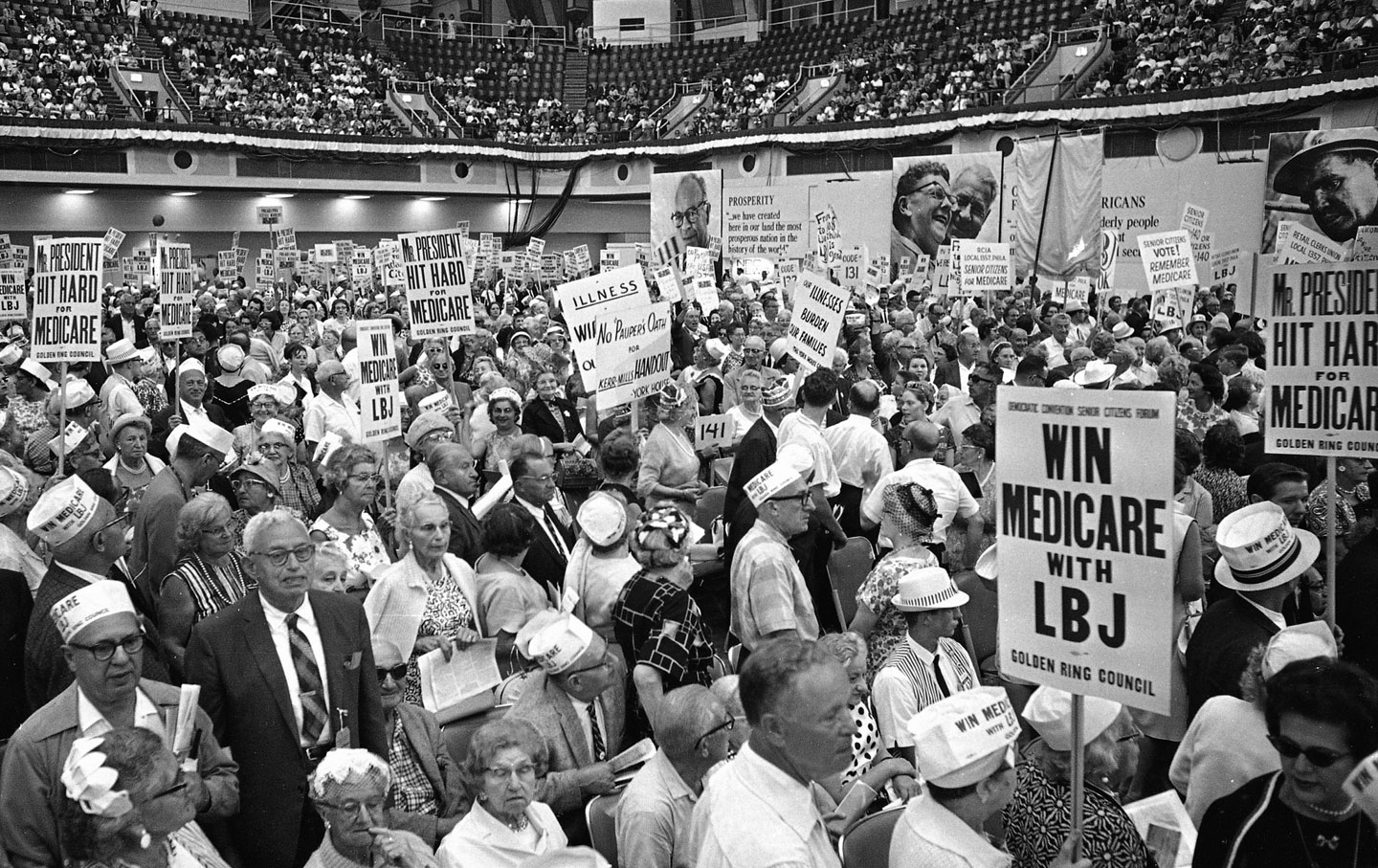
senior citizens supporting Medicare at the 1964 Democratic National Convention


The history of the fight for single-payer health care for the elderly and poor should inform today’s movement to win for Medicare for All.

In August of 1964, 14,000 retirees arrived by the busload in Atlantic City. Representing the National Council of Senior Citizens (NCSC), the former railroad workers, dressmakers, and auto assemblers marched 10 blocks up the fabled New Jersey boardwalk to the Democratic National Convention at the Convention Hall. The group, which was organized and bankrolled by the AFL-CIO, moved en masse in floral housecoats and sandwich boards with slogans like “Our Illnesses Burden Our Families” and “Senior Citizens Vote, Remember Medicare.” They intended to push President Johnson to extend public health insurance to millions of Americans.

Astonishingly, less than a year later, they won. Medicare was signed into law in July of 1965 in Independence, Missouri, at a ceremony attended by former president Harry S. Truman, whose push for national health insurance (NHI) had collapsed nearly two decades before. The landmark law created a public-sector insurance pool for Americans 65 and over, which remains today the closest thing to a robust universal entitlement in the US health-care system. Its successful passage (which also passed Medicaid, to insure the very poor) stands in sharp contrast to multiple failed efforts to install a universal single-payer system.

A half-century later, we’re witnessing the early stages of yet another popular thrust toward single payer, increasingly billed as “Medicare for All.” The nomenclature intends to evoke associations with the popular, trusted program, and is perhaps easier for Americans to latch onto than a phraseology that threatens to trigger a tedious lesson in comparative health policy. But if the conceptual jump from Medicare to Medicare for All can serve as a rough model for achieving universal health care in the United States, we should also look to the history of the social movements that achieved something that then, too, seemed impossible.

No one imagines expanding Medicare to all Americans will be easy. Nothing quite like this has ever been accomplished in the United States. Yes, dozens of peer countries have built coherent, humane, universal health-care systems out of entrenched private ones. Yes, mass movements have won major leftist reforms. Yes, advanced private industries of various nations have been nationalized. But human history offers no examples of these things happening in combination, which is what winning Medicare for All will require.

The most viable push toward NHI in American history crumbled in the late 1940s, ruthlessly crushed by not only insurers and pharmaceutical companies but also the American Medical Association. (Physicians, whose already handsome salaries began to rise in the postwar era, feared the blow that NHI could strike to their paychecks, professional prestige, and autonomy, since a government payer would also reduce their control over prices.) As such, the AMA famously shook down its membership for $25 apiece to fund the multimillion-dollar campaign that injected the phrase “socialized medicine” into mainstream American culture.

In this context, it’s perhaps tempting to view Medicare as a capitulation to industry pressure and political challenges, rather than as evidence they can be flouted. After all, Medicare (and, for that matter, Medicaid) targeted the most vulnerable patients. Many single-payer skeptics insist that Medicare managed to pass because it covered the people private insurance left behind. In his book Harry S. Truman Versus the Medical Lobby: The Genesis of Medicare, historian Monte Poen presents Medicare as a sort of compromise between the unfettered free market and the dashed dreams of the 1940s.

While it’s true that the enactment of Medicare didn’t pose nearly the threat to certain health-care-industry stakeholders that the NHI did or that Medicare for All would, it would be a mistake to fully dismiss its applicability to the current political fight. For one thing, the common talking point that Medicare extended insurance to a population who didn’t have it, rather than squashing existing private infrastructure, doesn’t bear out. A full half of elderly Americans did have private insurance plans when Medicare was signed into law. Commercial health insurers initially opposed the program, and began to support it only when it became clear a large administrative role would be preserved for for-profit insurers.

More importantly, while insurance companies certainly fought against health-care-financing reforms, physicians associations and hospitals are typically considered to have been the more significant opponents—they believed Medicare to be a likely conduit for eventual full-scale single payer (and all the government interference they assumed would come with it), and struck back with more or less the same zeal that they mustered decades earlier. As historian Jill Quadagno puts it, the AMA fought Medicare with “every propaganda tactic it had employed during the Truman era.” Such tactics included a widespread media blitz, advertising in doctors’ offices, and visits to congressmen from physicians in their districts. One tactic, called “Operation Coffee Cup,” deputized physicians’ wives to host ladies’ gatherings, at which they’d play their guests an anti-Medicare PSA starring actor Ronald Reagan.

This time, the AMA and its allies failed, but not for lack of trying. So it’s unfair to ascribe Medicare’s triumph to a lack of industry resistance, which was actually quite strong. The more crucial variable distinguishing Medicare from the NHI battles that fizzled before and since was a mass movement of people demanding it, having coalesced at a moment when powerful liberatory struggles against white supremacy and poverty had transformed what could be deemed politically possible.

Organized labor went all-in for Medicare, which took substantial pressure off unions for their retirees’ mounting health-care costs. Their enthusiasm contrasted with their relationship with universal initiatives before and since, despite their largely supporting most on paper. The reasons for labor’s tepid support for single payer have been debated by historians: For one thing, the unions’ success at collectively bargaining for employer-provided health benefits during the Truman-era reform battles perhaps reduced their motivation to prioritize national health-care solutions, the ongoing absence of which almost certainly highlighted the advantage of union membership. Since the 1970s, ever-rising health-care costs strengthened the case that labor’s interests would be served by removing health-care benefits from tense contract negotiations, but declining labor power during America’s rightward political shift tied them to a Democratic Party establishment unwilling to back single payer during the health-care debates of the 1970s and ’90s.

Today, with a slim majority of congressional Democrats vocally warming up to Medicare for All, and the ACA’s so-called “Cadillac Tax” poised to hit hard-won union-bargained health plans, the pro-labor case for single payer has never been more obvious. Indeed, each of the high-profile wildcat teachers’ strikes widely cited health-care benefits as a central demand. While the AFL-CIO has endorsed single payer, the question of whether workers will rally around Medicare for All they way they did for its namesake could well depend on how the movement’s stakeholders deal with those who stand to be displaced by the streamlining effect of large-scale reform.

But beyond institutional heft or the weight of its endorsements, the most impactful contribution organized labor made to the Medicare fight was a committed army of thousands of boots on the ground, many of them seniors who stood to benefit from the legislation or the family members who worried about how they’d care for them. Even the most precursory survey of 20th-century universal-health-care movements makes their most egregious failure stunningly obvious: They were nearly all top-down operations practically devoid of participation of ordinary people intent on changing the status quo.

By the time the NCSC marched in Atlantic City, this movement was already years in the making. It had been building momentum for the idea that would become Medicare in the 1950s, under a Republican president who, in is 1954 State of the Union address, had affirmed he was “flatly opposed to the socialization of medicine.” Rather than standing by waiting for better electoral luck, the Medicare movement fought to make theirs a winning campaign issue that would help to elect Democrats, not the other way around.

For years, the NCSC spearheaded letter-writing campaigns targeting media outlets and elected officials, and did any media outreach it could. It churned out brochures to counter the messaging of the powerful medical lobby, printing and distributing millions of pamphlets and fliers. As Blue Carstenson, then head of the NCSC, recounted later, “We had to make it a cause and we made it a cause…. We charged the atmosphere like a campaign…. We were always jammed in there and there was a hustle and bustle atmosphere. And when reporters came over they were always impressed by telephones ringing and the wild confusion and this little bitty outfit here that was tackling the whole AMA in a little apartment on Capitol Hill…. This was news. It used to make every reporter chuckle or smile.”

So too did the NCSC learn to push the buttons of electoral politics: It organized groups to testify before Congress about insurance premiums, which rose as much as 35 percent some years, like some ACA marketplace plans. And of course, Carstenson’s formidable elderly army turned out to campaign events. When Democrat George Smathers declined to support Medicare before the 1964 election, NCSC members organized town-hall meetings throughout the state—including one in Fort Lauderdale that was allegedly so successful that the organizers had to upgrade to a bigger venue three different times. Their message made appeals to all ages: Relief for seniors’ medical costs, they argued, will also reduce financial pressure on their working-age children, who’d in turn have more room in the budget to raise their own kids.

If the participants in today’s movement for Medicare for All intend to succeed, they must preempt the imminent counterattack of a health-care industry with far more fortunes at stake than the one their counterparts vanquished in 1965. This will require a mass mobilization of people making themselves seen and heard, whose demands for universal public insurance must reach a fever pitch to force candidates and current officials to capitulate. Doing so will demand a broad variety of tactics, including direct action, canvassing, printed materials, and public events, geared toward not only  persuading regular voters but also inspiring new ones.

Finally, this vision of justice must extend beyond the realm of health care alone. It is nearly impossible to imagine Medicare passing outside the political context set forth by the civil-rights movement, and the so-called War on Poverty. These years-long mobilizations of oppressed people had forced the political reckoning that fostered large-scale reform. It is no coincidence that the New Deal and the Great Society—however short they may have fallen—came about in large bursts rather than undetectable spurts.

Paradigm-shifting reforms have been delivered by broad coalitions confronting a common enemy. It’s up to advocates to compel people living under the US health-care system to see themselves and one another as part of a single constituency, from the poorest uninsured to those saddled with punishing paperwork, office staff chained to bad jobs for benefits, providers-turned-pawns of corporate conglomerates, and expectant mothers bracing themselves for exorbitant out-of-pocket costs atop weeks of unpaid maternity leave. And it must be done in solidarity with struggles on behalf of all oppressed Americans—people of color, the unhoused, the disabled, and others—whose subjugation benefits the very moneyed interests who’d prefer to keep things as they are.

All the evidence tells us that robust universal programs build solidarity, and create an impassioned base that enthusiastically defends them. Once Medicare for All is in place we can expect the same. Until then, it’s up to advocates to compel as many people as possible to envision the radically different society that stands to inherit it—and to accept nothing less.

Welcome to the New Health-Care Debate

https://www.bloomberg.com/view/articles/2018-08-03/health-care-debate-helps-republicans-hurts-conservatives

America’s health-care debate is entering a new phase. Liberals, inspired by self-described socialists such as Senator Bernie Sanders and Representative-to-be Alexandria Ocasio-Cortez, are excited about the possibility of “Medicare for All.” Republicans have at the same time largely abandoned efforts to enact major reforms of health care.

This new phase of the debate is full of opportunity for Republicans, and peril for conservatives.

But perhaps it would be better to say that the debate is reverting to an older pattern. For roughly four decades, liberals have highlighted the flaws of the existing health-care system, chiefly high costs and unequal access, and proposed increased governmental involvement as the solution. Conservatives talked up the dangers of bigger government, chiefly even higher costs and the disruption of existing arrangements, and reminded voters of the virtues of the status quo.

Most of the time, health care has been a back-burner issue, and discontent with the system has been a modest source of political strength for liberals. When health care has become a dominant issue, however, public fear of disruption has helped conservatives. From 2009 through 2016, Republicans were able to exploit public unhappiness with the changes that Obamacare first threatened to make and then did make.

There have been two brief exceptions to this pattern. In 1995-96 and 2017-18, Republicans advanced their own sweeping changes to health policy. Led by Newt Gingrich 20 years ago, they tried to reform Medicare and Medicaid. Over the last two years, they tried to replace Obamacare and reform Medicaid. 1

Both times the public’s fear of change was turned against Republican politicians, who did not like the pressure one bit. Most of them are relieved to have dropped their party’s Obamacare and Medicaid proposals. They are eager to settle into the familiar role of criticizing liberal health-care proposals.

There’s plenty to criticize. In polls, most people say they like their existing insurance policies — which may be a way for them to signal to politicians that they fear their meddling with those policies. The single-payer plans that are ascending among Democrats would by definition threaten most existing coverage.

These plans pose much bigger political risks than Obamacare did. Obamacare was carefully designed to insulate Democrats from charges that they were turning people’s coverage upside down.

In selling the legislation, President Barack Obama spent much of his time reassuring people that they could keep their doctors and their insurance plans if they liked them. The law mostly avoided changes to the employer-provided coverage through which most Americans get health care.

Yet Obamacare still provoked a backlash. That backlash was especially intense when, in the fall of 2013, it resulted in a significant number of plan cancellations. But many voters have also resented the narrower networks and higher premiums and deductibles that Obamacare has foisted on them.

As even more sweeping left-wing proposals move to the center of the debate, Republicans can reclaim the advantage of opposing disruption. But they may also again be saddled with the disadvantage of being associated with an unsatisfactory status quo.

They are in charge of Congress and the White House; they have been talking about reworking the health-care system for years; and they have succeeded in making significant changes, albeit much less ambitious ones than they sought. They have, for example, ended the fines on people without health insurance that were a major part of Obamacare. In addition, the Trump administration is in the process of liberalizing the rules for short-term insurance plans that do not have to comply with the regulations Obamacare imposes on most other plans.

The Republicans therefore have some, and growing, political ownership of the health-care system. The more they argue against left-wing proposals to change the system, the more ownership they will have.

For Republican politicians, defending even a flawed status quo is probably preferable to trying to impose disruptive changes to it. But if they adopt that position, it will mean that the only solutions on offer to popular concerns about health care will be left-wing ones.

It will mean, as well, that occasionally liberals will have enough political power to enact some, and maybe a lot, of their preferred changes to the system. We will move, that is, toward a health-care system with a larger and larger degree of governmental control even as Republicans make political gains by resisting that trend.

The new shape of the debate may be good news for Republican politicians, then, but it’s bad news for conservatives who favor limited government and free markets.

  1. Arguably there was a third exception: In 2011 and 2012, Paul Ryan led congressional Republicans to endorse increasing competition within Medicare as part of their budget proposals. They did not, however, attempt to advance legislation that would actually change Medicare.


CMS’ proposed outpatient payment rule for 2019: 10 things to know

https://www.beckershospitalreview.com/finance/cms-proposed-outpatient-payment-rule-for-2019-10-things-to-know.html

Related image


CMS released its 2019 Medicare Outpatient Prospective Payment System proposed rule July 25, which calls for site-neutral payments and would make changes to the 340B program.

Here are 10 things to know about the 2019 proposed rule:

Payment update

1. CMS proposed increasing the OPPS rates by 1.25 percent in 2019. The agency arrived at its proposed rate increase through the following updates: a positive 2.8 percent market basket update, a negative 0.8 percentage point update for a productivity adjustment and a negative 0.75 percentage point adjustment for cuts under the ACA.

Site-neutral payment proposal

2. Under the proposed rule, CMS would make payments for clinic visits site-neutral by reducing the payment rate for hospital outpatient clinic visits provided at off-campus provider-based departments to 40 percent of the OPPS rate. The clinic visit is the most common service billed under the OPPS, and CMS estimates the payment proposal would save the Medicare program and Medicare recipients a combined $760 million in 2019.

3. This change is projected to reduce OPPS payments by 1.2 percent, which would largely offset the 1.25 percent payment rate increase under the proposed rule.

Proposed 340B program changes

4. CMS scaled back the 340B drug discount program in 2018, and the agency proposed additional cuts for next year.

5. On Jan. 1, 2018, CMS began paying hospitals 22.5 percent less than the average sales price for drugs purchased through the 340B program. That’s compared to the previous payment rate of average sales price plus 6 percent.

6. Under the proposed rule, CMS would extend the average sales price minus 22.5 percent payment rate to 340B drugs provided at nonexcepted off-campus provider-based departments.

7. CMS also proposed to pay for separately payable biosimilars acquired under the 340B program at the average sales price minus 22.5 percent of the biosimilar’s own ASP, rather than ASP minus 22.5 percent of the reference product’s ASP.

Hospital Outpatient Quality Reporting Program changes

8. For 2019, CMS proposed removing one measure from the Hospital Quality Reporting Program beginning with the 2020 payment determination and removing nine other measures beginning with the 2021 payment determination.

9. “The proposals to remove these measures are consistent with the CMS’ commitment to using a smaller set of more meaningful measures and focusing on patient-centered outcomes measures, while taking into account opportunities to reduce paperwork and reporting burden on providers,” CMS said in the fact sheet for the proposed rule.

Comment period

10. CMS will accept comments on the proposed rule until 5 p.m. EST Sept. 24.


CMS terminates Idaho hospital’s Medicare contract

https://www.beckershospitalreview.com/finance/cms-terminates-idaho-hospital-s-medicare-contract-072718.html

Image result for critical access hospital


CMS ended its provider agreement with Blackfoot-based Idaho Doctors’ Hospital July 20.

Under rules enacted last September, a healthcare facility must average at least two inpatients per day and an at least two-night average length of stay to be considered an inpatient hospital for Medicare reimbursement. In April, CMS determined Doctors’ Hospital is not primarily engaged in providing care to inpatients and does not meet the new federal requirements for Medicare participation. The agency subsequently sent Doctors’ Hospital a Medicare termination notice.

“To go from being OK just 18 months ago, when we had our last survey, to now being told that we don’t meet the CMS conditions of participation because of new interpretations of the regulations is just difficult to comprehend,” Dave Lowry, administrative manager at Idaho Doctors’ Hospital, told KIFI earlier this month. “Like any business that is regulated by government agencies, we fully expect there to be changes to rules and their interpretations, but this drastic level of change just goes to show how much uncertainty there is in healthcare right now.”

After receiving the termination notice from CMS, Doctors’ Hospital sent letters to all patients affected by the contract termination, a spokesperson told Becker’s Hospital Review.

“We have worked with other area hospitals who provide the same services, and our staff provides this information for any patients who call with questions on where to go for care,” the Doctors’ Hospital spokesperson said.


Walmart drug program cheaper for many Medicare patients

https://www.nbcnews.com/health/health-news/walmart-drug-program-cheaper-many-medicare-patients-n893811

Grand Opening At A New Wal-Mart Store

Walmart’s $4 generic prescription drug program ends up being cheaper for some Medicare patients than their own health insurance, according to a new study released Monday.

It’s more evidence that patients cannot always rely on their health insurance to get them the lowest prices for their prescription drugs, said Dr. Joseph Ross of the Yale School of Medicine, who led the study.

“Patients were paying more out of pocket when they were using their insurance than when they went to Walmart,” Ross told NBC News.

The study, published in the Annals of Internal Medicine, documents that Walmart provides a better deal than the government’s health insurance plan for people over 65. And that is bad news for Medicare, because if people don’t take their drugs, whether for cost or for other reasons, they tend to get sicker and then end up costing even more to treat.

“Everyone’s talking about pharmacy costs these days,” Ross said. “We did this study in part because of all the discussion about pharmacy gag rules.”

Pharmacy gag rules prevent pharmacists from telling patients that they could save money on drugs, for instance by not using their health insurance.

Pharmacy benefit managers are the middlemen between drug companies and pharmacies, and some of those companies have agreements forbidding talk of discounts. But some states have also banned pharmacists from giving this information to customers.

According to the National Conference of State Legislatures, at least 22 states have some kind of gag rule legislation.

One way patients can get around this is to ask, but few people think to do so.

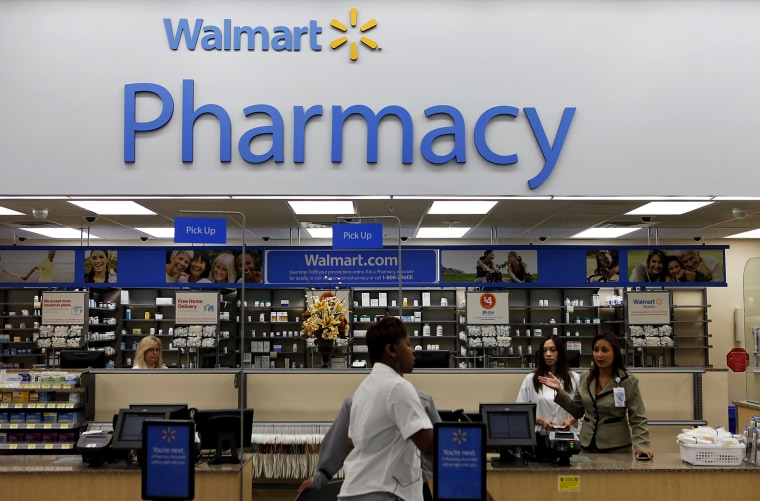
Ross and colleagues decided to see what would happen if Medicare patients just took advantage of Walmart’s program offering $4 generic prescription drugs.

They looked at Walmart’s generic list for drugs commonly used to treat heart conditions, including high blood pressure and high cholesterol.

“Next, we used Medicare prescription drug plan data from June 2017 to determine beneficiary out-of-pocket costs for the lowest-priced dose of each drug in each plan,” they wrote. They got data on more than 2,000 Medicare prescription drug plans, including Medicare Advantage plans.

Overall, 21 percent of the plans asked patients to pay more out of pocket for the drugs than they would pay if they just got them for $4 at Walmart, the team reported.

Medicare Advantage plans were the most expensive for patients, Ross said. And the higher-tier programs were the worst, he found.

“Twenty percent of the time, at least, we should go to Walmart,” Ross said.

It doesn’t help that Medicare is very complicated. Patients can choose from dozens of different plans, depending on where they live, and it can take a great deal of research to find out which plan is most likely to cover a particular person’s health conditions for the least amount of money.

“Each Medicare drug plan has its own list of covered drugs (called a formulary),” the Center for Medicare and Medicaid Services says on its website.

“Many Medicare drug plans place drugs into different ‘tiers’ on their formularies. Drugs in each tier have a different cost. A drug in a lower tier will generally cost you less than a drug in a higher tier.”

Ross said it is time-consuming to compare one Medicare plan to another. But understanding one of the many plans tells people very little about what the others might offer.

“If you have read through the details and material for one plan, you have read through the details and materials for one plan. It’s very hard to compare,” he said.

In addition, any given plan may change the drugs that it covers and their prices throughout the year.

Ross said he studied Walmart because its $4 price for a 30-day supply of a generic drug seemed like the least expensive option, but other retailers also have inexpensive drug plans. Some grocery-based pharmacies even offer free drugs, such as antibiotics.

These offers get customers into the store, and the hope is that they’ll buy something else while they are there.

Ross said no patient should decide on a Medicare plan based solely on whether Walmart offers a better deal on prescriptions.

Switching plans might not be the best idea, because different plans provide different levels of coverage for doctor visits, medical procedures and other health needs.

“What we are showing is there may be some ways to save some money on some drugs by going to Walmart,” Ross said.

According to the Kaiser Family Foundation, about 90 percent of prescriptions filled in the U.S. are for generic drugs. Most people get health insurance through an employer, and the typical co-pay for a generic drug for a patient covered by employer-provided health insurance is $11, Kaiser found. For a brand-name drug, the average co-pay is $33.

Walmart is moving aggressively to get a big share of the U.S. health care market. Besides having large pharmacies, stores offer free health screenings and the company has said it intends to expand its locations of retail walk-in health clinics.

Walmart is also negotiating a closer partnership with health insurer Humana, including the possibility of buying it outright, according to CNBC.

The discount retailer’s $4 generic prescriptions beat Medicare’s co-pays 21 percent of the time, a study found.


Trump Administration Seeks a Big Change in How Medicare Pays Doctors

http://www.thefiscaltimes.com/2018/07/23/Trump-Administration-Seeks-Big-Change-How-Medicare-Pays-Doctors

The Trump administration wants to change the way Medicare pays doctors for office visits by creating a flat payment of about $135 for all appointments. The change is intended to reduce paperwork significantly but is meeting resistance from specialists who say they will be underpaid for their services, which could result in more doctors refusing to see Medicare patients.

Currently, there are five levels of Medicare office visits, each with its own payment amount, ranging from a short visit with a nurse (level 1) to an in-depth evaluation from a specialist (level 5). Visits with doctors typically start at level 2, with a current billing rate for new patients of $76, and move up in complexity to level 5, with a billing rate of $211.

Not all doctors would lose out, since less complex visits would be billed at a higher rate under the proposal, but the specialists currently billing at the top level would see a reduction in fees. “This proposal is likely to penalize physicians who treat sicker patients, even though they spend more time and effort and more resources managing those patients,” Deborah J. Grider, an expert on the subject, told The New York Times.

On the other hand, the proposal would reduce the time-intensive requirement to document the different levels of services, particularly at the upper end. “The differences between Levels 2 to 5 are often really difficult to discern and time-consuming to document,” Dr. Kate Goodrich, Medicare’s chief medical officer, toldthe Times.

One thing the proposed billing system won’t change is the overall cost of spending on physician services under Medicare. While the proposal would redirect some of the fees from one set of doctors to another, spending would remain at roughly $70 billion a year.


Sniffles? Cancer? Under Medicare Plan, Payments for Office Visits Would Be Same for Both


Image result for Sniffles? Cancer? Under Medicare Plan, Payments for Office Visits Would Be Same for Both

The Trump administration is proposing huge changes in the way Medicare pays doctors for the most common of all medical services, the office visit, offering physicians basically the same amount, regardless of a patient’s condition or the complexity of the services provided.

Administration officials said the proposal would radically reduce paperwork burdens, freeing doctors to spend more time with patients. The government would pay one rate for new patients and another, lower rate for visits with established patients.

“Time spent on paperwork is time away from patients,” said Seema Verma, the administrator of the Centers for Medicare and Medicaid Services. She estimated that the change would save 51 hours of clinic time per doctor per year.

But critics say the proposal would underpay doctors who care for patients with the greatest medical needs and the most complicated ailments — and could discourage some physicians from taking Medicare patients. They also say it would increase the risk of erroneous and fraudulent payments because doctors would submit less information to document the services provided.

Medicare would pay the same amount for evaluating a patient with sniffles and a head cold and a patient with complicated Stage 4 metastatic breast cancer, said Ted Okon, the executive director of the Community Oncology Alliance, an advocacy group for cancer doctors and patients. He called that “simply crazy.”

Dr. Angus B. Worthing, a rheumatologist, said he understood the administration’s objective. “Doctors did not go to medical school to type on a computer all day,” he said.

But, he added: “This proposal is setting up a potential disaster. Doctors will be less likely to see Medicare patients and to go into our specialty. Patients with arthritis and osteoporosis may have to wait longer to see the right specialists.”

Private insurers often follow Medicare’s lead, so the proposed change has implications that go far beyond the Medicare program.

The proposal, part of Medicare’s physician fee schedule for 2019, is to be published Friday in the Federal Register, with an opportunity for public comment until Sept. 10. The new policies would apply to services provided to Medicare patients starting in January.

“We anticipate this to be a very, very significant and massive change, a welcome relief for providers across the nation,” Ms. Verma said, adding that it fulfills President Trump’s promise to “cut the red tape of regulation.”

“Evaluation and management services” are the foundation of an office visit. Medicare now recognizes five levels of office visits, with Level 5 involving the most comprehensive medical history and physical examination of a patient, and the most complex decision making by the doctor.

Level 1 is mostly for nonphysician services: for example, a five-minute visit with a nurse to check the blood pressure of a patient recently placed on a new medication.

A Level 5 visit could include a thorough hourlong evaluation of a patient with heart failure, chronic obstructive pulmonary disease, high blood pressure and diabetes with blood sugar out of control.

“The differences between Levels 2 to 5 are often really difficult to discern and time-consuming to document,” said Dr. Kate Goodrich, Medicare’s chief medical officer.

Medicare payment rates for new patients now range from $76 for a Level 2 office visit to $211 for a Level 5 visit. The Trump administration proposal would establish a single new rate of about $135. That could mean gains for doctors who specialize in routine care, but a huge hit for those who deal mainly with complicated patients, such as rheumatologists and oncologists.

For established patients, the proposal calls for a payment rate of about $93, in place of current rates ranging from $45 to $148 for the four different levels of office visits.

“This proposal is likely to penalize physicians who treat sicker patients, even though they spend more time and effort and more resources managing those patients,” said Deborah J. Grider, who has audited tens of thousands of medical records and written a book on the subject.

Dr. Atul Grover, the executive vice president of the Association of American Medical Colleges, said, “The single payment rate may not reflect the resources needed to treat patients we see at academic medical centers — the most vulnerable patients, those who have complex medical needs.”

While the proposal would redistribute money among doctors, it is not intended to cut spending under Medicare’s physician fee schedule, which totals roughly $70 billion a year.

If the new rules really do simplify their work, doctors say, they will be elated.

“We can focus more on patient care and less on the administrative burden of documentation and billing,” said Dr. David B. Glasser, an assistant professor of ophthalmology at the Johns Hopkins University School of Medicine. “We sometimes joke that it can be more complicated trying to get the coding level right than it is to figure out what’s wrong with the patient.”

But, Dr. Glasser said, the financial impact of the proposal on eye doctors is not yet clear.

Documentation requirements have increased in response to growing concerns about health care fraud and improper payments that cost Medicare billions of dollars a year.

In many cases, federal auditors could not determine whether services were actually provided or were medically necessary. In some cases, they found that doctors had billed Medicare — and patients — for more costly services than they actually performed.

In a report required by federal law, officials estimated early this year that 18 percent of Medicare payments for office visits with new patients were incorrect or improper, about three times the error rate for established patients.

To prevent fraud and abuse, Medicare officials have repeatedly told doctors to document their claims. “If it is not documented, it has not been done” — that is the principle set forth in Medicare’s billing manual for doctors.

The Trump administration is moving away from that policy.

“We have proposed to move to a system with minimal documentation requirements for Levels 2 to 5 and one single payment rate,” Dr. Goodrich said.

Doctors now must provide more documentation for higher levels of care. Under the proposal, “practitioners would only need to meet documentation requirements currently associated with a Level 2 visit.” That would reduce the need for audits to verify the level of office visits.

Medicare officials acknowledged that doctors who typically bill at Levels 4 and 5 could see financial losses under the proposal. But they said some of the losses could potentially be offset by “add-on payments” for primary care doctors and certain other medical specialists.

With such adjustments, Medicare officials said, the impact on most doctors would be relatively modest. A table included in the proposed rule indicates that obstetricians and gynecologists would gain the most, while dermatologists, rheumatologists and podiatrists would lose the most.


“The Inevitable Math behind Entitlement Reform”

“The Inevitable Math behind Entitlement Reform”

Image result for Entitlement Reform


That’s the title of a new NEJM Perspective by Michael Chernew and me. After crunching the numbers, our argument is that for long term cost control we will probably need to address growth in per capita health care utilization. The easy “solutions” won’t be enough.

Much of the projected increase in inflation-adjusted spending on health care entitlements, particularly for Medicare, stems from assumed increases in utilization (e.g., 2.75 percentage points of the 5.33% annual projected growth for Medicare spending). Strategies for holding utilization growth below projections (and more in line with very recent historical growth) will thus be central to the success of any attempt at cost containment.

[One approach] is to dissuade patients from seeking care by charging them more at the point of service. About 85% of Medicare beneficiaries have supplemental plans (e.g., Medigap) that reduce their out-of-pocket costs. Policies that limit the generosity of such plans could reduce Medicare spending considerably. However, such strategies would increase beneficiaries’ financial risks, reduce access to care, and probably exacerbate health disparities.

A second strategy is to help beneficiaries improve their health by enhancing long-term care management and preventive services with the goal of avoiding more expensive services. Evidence suggests that although this type of approach is probably beneficial to patients and may be cost-effective, it is generally not cost saving.

The piece continues with some more promising approaches, in our view. Click to read it in full (unfortunately pay-walled though).


Hidden From View: The Astonishingly High Administrative Costs of U.S. Health Care

Hidden From View: The Astonishingly High Administrative Costs of U.S. Health Care

Related image

It takes only a glance at a hospital bill or at the myriad choices you may have for health care coverage to get a sense of the bewildering complexity of health care financing in the United States. That complexity doesn’t just exact a cognitive cost. It also comes with administrative costs that are largely hidden from view but that we all pay.

Because they’re not directly related to patient care, we rarely think about administrative costs. They’re high.

A widely cited study published in The New England Journal of Medicine used data from 1999 to estimate that about 30 percent of American health care expenditures were the result of administration, about twice what it is in Canada. If the figures hold today, they mean that out of the average of about $19,000 that U.S. workers and their employers pay for family coverage each year, $5,700 goes toward administrative costs.

Such costs aren’t all bad. Some are tied up in things we may want, such as creating a quality improvement program. Others are for things we may dislike — for example, figuring out which of our claims to accept or reject or sending us bills. Others are just necessary, like processing payments; hiring and managing doctors and other employees; or maintaining information systems.

That New England Journal of Medicine study is still the only one on administrative costs that encompasses the entire health system. Many other more recent studies examine important portions of it, however. The story remains the same: Like the overall cost of the U.S. health system, its administrative cost alone is No. 1 in the world.

Using data from 2010 and 2011, one study, published in Health Affairs, compared hospital administrative costs in the United States with those in seven other places: Canada, England, Scotland, Wales, France, Germany and the Netherlands.

At just over 25 percent of total spending on hospital care (or 1.4 percent of total United States economic output), American hospital administrative costs exceed those of all the other places. The Netherlands was second in hospital administrative costs: almost 20 percent of hospital spending and 0.8 percent of that country’s G.D.P.

At the low end were Canada and Scotland, which both spend about 12 percent of hospital expenditures on administration, or about half a percent of G.D.P.

Hospitals are not the only source of high administrative spending in the United States. Physician practices also devote a large proportion of revenue to administration. By one estimate, for every 10 physicians providing care, almost seven additional people are engaged in billing-related activities.

It is no surprise then that a majority of American doctors say that generating bills and collecting payments is a major problem. Canadian practices spend only 27 percent of what U.S. ones do on dealing with payers like Medicare or private insurers.

Another study in Health Affairs surveyed physicians and physician practice administrators about billing tasks. It found that doctors spend about three hours per week dealing with billing-related matters. For each doctor, a further 19 hours per week are spent by medical support workers. And 36 hours per week of administrators’ time is consumed in this way. Added together, this time costs an additional $68,000 per year per physician (in 2006). Because these are administrative costs, that’s above and beyond the cost associated with direct provision of medical care.

In JAMA, scholars from Harvard and Duke examined the billing-related costs in an academic medical center. Their study essentially followed bills through the system to see how much time different types of medical workers spent in generating and processing them.

At the low end, such activities accounted for only 3 percent of revenue for surgical procedures, perhaps because surgery is itself so expensive. At the high end, 25 percent of emergency department visit revenue went toward billing costs. Primary care visits were in the middle, with billing functions accounting for 15 percent of revenue, or about $100,000 per year per primary care provider.

“The extraordinary costs we see are not because of administrative slack or because health care leaders don’t try to economize,” said Kevin Schulman, a co-author of the study and a professor of medicine at Duke. “The high administrative costs are functions of the system’s complexity.”

Costs related to billing appear to be growing. A literature review by Elsa Pearson, a policy analyst with the Boston University School of Public Health, found that in 2009 they accounted for about 14 percent of total health expenditures. By 2012, the figure was closer to 17 percent.

One obvious source of complexity of the American health system is its multiplicity of payers. A typical hospital has to contend not just with several public health programs, like Medicare and Medicaid, but also with many private insurers, each with its own set of procedures and forms (whether electronic or paper) for billing and collecting payment. By one estimate, 80 percent of the billing-related costs in the United States are because of contending with this added complexity.

“One can have choice without costly complexity,” said Barak Richman, a co-author of the JAMA study and a professor of law at Duke. “Switzerland and Germany, for example, have lower administrative costs than the U.S. but exhibit a robust choice of health insurers.”

An additional source of costs for health care providers is chasing patients for their portion of bills, the part not covered by insurance. With deductibles and co-payments on the rise, more patients are facing cost sharing that they may not be able to pay, possibly leading to rising costs for providers, or the collection agencies they work with, in trying to get them to do so.

Using data from Athenahealth, the Harvard health economist Michael Chernew computed the proportion of doctors’ bills that were paid by patients. For relatively small bills, those under $75, over 90 percent were paid within a year. For larger ones, over $200, that rate fell to 67 percent.

“It’s a mistake to think that billing issues only reflect complex interactions between providers and insurers,” Mr. Chernew said. “As patients are required to pay more money out of pocket, providers devote more resources to collecting it.”

A distinguishing feature of the American health system is that it offers a lot of choice, including among health plans. Because insurers and public programs have not coordinated on a set of standards for pricing, billing and collection — whatever the benefits of choice — one of the consequences is high administrative burden. And that’s another reason for high American health care prices.