New competitor poses big risk for Community Health Systems

Image result for Indiana University Health

IU Health is getting into the Fort Wayne market.

The News-Sentinel in Fort Wayne, Indiana, is reporting Indiana University Health, the dominant not-for-profit health system in the state, is expanding into the city. Brian Bauer — the former CEO of Lutheran Health Network in Fort Wayne who was fired by Lutheran’s for-profit parent, Community Health Systems — will lead the IU Health region.

Why it matters: This is not just a small regional deal in Indiana. CHS is on the brink of collapse. And now Lutheran, one of CHS’ most profitable hospital systems, faces a powerful competitor that likely will nab Lutheran’s patients as well as doctors, nurses and other employees.

Inside Fort Wayne: Two sources familiar with Lutheran told me the environment is “toxic” and “adversarial.” Lutheran already has lost employees to a separate nearby system, Parkview Health, the sources said. They also said Lutheran’s profitability has dwindled this year. IU Health did not respond to inquiries.

  • IU Health plans to build hospitals and outpatient centers in the Fort Wayne area, and that would be a giant blow to Lutheran, which many Wall Street analysts say is the “crown jewel” of CHS. One source said Lutheran’s earnings before interest, tax, depreciation and amortization last year were around $280 million.
  • That will make it even tougher for CHS to pay down its mountain of debt if profits get sucked out of its most lucrative region.
  • CHS, which is in the process of selling off hospitals, turned down a buyout offer of Lutheran last year.
What to watch: CHS will report third-quarter earnings after markets close Nov. 1, and the investor call will be the following morning.

How U.S. Hospitals and Health Systems Can Reverse Their Sliding Financial Performance

https://hbr.org/2017/10/how-u-s-hospitals-and-health-systems-can-reverse-their-sliding-financial-performance

Image result for declining


Since the beginning of 2016, the financial performance of hospitals and health systems in the United States has significantly worsened. This deterioration is striking because it is occurring at the top of an economic cycle with, as yet, no funding cuts from the Republican Congress.

The root cause is twofold: a mismatch between organizations’ strategies and actual market demand, and a lack of operational discipline. To be financially sustainable, hospitals and health systems must revamp their strategies and insist that their investments in new payment models and physician employees generate solid returns.

For the past decade, the consensus strategy among hospital and health-system leaders has been to achieve scale in regional markets via mergers and acquisitions, to make medical staffs employees, and to assume more financial risk in insurance contracts and sponsored health plans. In the past 18 months, the bill for this strategy has come due, posing serious financial challenges for many leading U.S. health systems.

MD Anderson Cancer Center lost $266 million on operations in FY 2016 and another $170 million in the first months of FY 2017. Prestigious Partners HealthCare in Boston lost $108 million on operations in FY 2016, its second operating loss in four years. The Cleveland Clinic suffered a 71% decline in its operating income in FY 2016.

On the Pacific Coast, Providence Health & Services, the nation’s second largest Catholic health system, suffered a $512 million drop in operating income and a $252 million operating loss in FY 2016. Two large chains — Catholic Health Initiatives  and  Dignity Health — saw comparably steep declines in operating income and announced merger plans. Regional powers such as California’s Sutter Health, New York’s NorthWell Health, and  UnityPoint Health, which operates in Iowa, Illinois, and Wisconsin, reported sharply lower operating earnings in early 2017 despite their dominant positions in their markets.

While some of these financial problems can be traced to troubled IT installations or losses suffered by provider-sponsored health plans, all have a common foundation: Increases in operating expenses outpaced growth in revenues. After a modest surge in inpatient admissions from the Affordable Care Act’s coverage expansion in the fall of 2014, hospitals have settled in to a lengthy period of declining hospital admissions.

At the same time, hospitals have seen their prices growing at a slower rate than inflation. Revenues from private insurance have not fully offset the reductions in Medicare payments stemming from the Affordable Care Act and federal budget sequestration initiated in 2012. Many hospitals and health systems strove to gain market share at the expense of competitors by deeply discounting their rates for new “narrow network” health planstargeted at public and private health exchanges, enrollments from which have far underperformed expectations.

The main cause of the operating losses, however, has been organizations’ lack of discipline in managing the size of their workforces, which account for roughly half of all hospital expenses. Despite declining inpatient demand and modest outpatient growth, hospitals have added 540,000 workers in the past decade.

To achieve sustainable financial performance, health systems must match their strategy to the actual market demand. The following areas deserve special management attention.

The march toward risk. Most health system leaders believe that population-based payment is just around the corner and have invested billions of dollars in infrastructure getting ready for it. But for population-based payment to happen, health plans must be willing to pay hospitals a fixed percentage of their income from premiums rather than pay per admission or per procedure. Yet, according to the American Hospital Association, only 8% of hospitals reported any capitated payment in 2014 (the last year reported by the AHA) down from 12% in 2003.

Contrary to widely held belief, the market demand from health insurers for provider-based risk arrangements has not only been declining nationally but even fell in California where it all began more than two decades ago. This decline parallels the decline in HMO enrollment. Crucially, there is marked regional variation in the interest of insurers in passing premium risk to providers. In a 2016 American Medical Group Association survey, 64% of respondents indicated that either no or very limited commercial risk products were offered in their markets.

The same mismatch has plagued provider-sponsored health-plan offerings. Instead of asking whether there are unmet needs in their markets reachable by provider-sponsored insurance or what unique skills or competencies they can bring to the health benefits market, many health systems have simply assumed that their brands are attractive enough to float new, poorly configured insurance offerings.

Launching complex insurance products in the face of competition from well-entrenched Blue Cross plans with lavish reserves and powerful national firms like UnitedHealth Group, Kaiser, and Aetna is an extremely risky bet. Many hospital-sponsored plans have drowned rapidly in poor risks or failed to achieve their enrollment goals. A recent analysis for the Robert Wood Johnson Foundation shows that only four of the 37 provider-sponsored health plans established since Obamacare was signed into law were profitable in 2015.

The regular Medicare and commercial business. Most hospitals are losing money on conventional fee-for-service Medicare patients because their incurred costs exceed Medicare’s fixed, per-admission, DRG payments. Moreover, there is widespread failure to manage basic revenue-cycle functions for commercial patients related to “revenue integrity” (having an appropriately documented, justifiable medical bill that can be  collected), billing, and collection. All these problems contribute to diminished cash flows.

Physician employees. For many health care system, physician “integration” — making physicians employees of the system — seems to have become an end in itself. Yet many hospitals are losing upwards of $200,000 per physician per year with no obvious return on the investment.

Health systems should have a solid reason for making physicians their employees and then should stick to it. If the goal is control over hospital clinical processes and episode-related expenses, then the physician enterprise should be built around clinical process managers (emergency physicians, intensivists, and hospitalists). If the goal is control over geographies or increasing the loyalty of patients to the health care system, the physician enterprise should be built around primary care physicians and advanced-practice nurses, whose distribution is based on the demand in each geography. If the goal is achieving specialty excellence, it should be built around defensible clusters of subspecialty internal medicine and surgical practitioners in key service lines (e.g., cardiology, orthopedics, oncology).

To create value by employing physicians, health systems must actually manage their physicians’ practices. This means standardizing compensation and support staffing, centralizing revenue-cycle functions and the negotiations of health plan rates, and reducing needless variation in prescribing and diagnostic-testing patterns. Health system all too often neglect these key elements.

***

If health systems are to improve their financial performance, they must achieve both strategic and operational discipline. If they don’t, their current travails almost certainly will deepen.

Why for-profit hospitals in Chicago are losing

http://www.modernhealthcare.com/article/20171002/NEWS/171009998?utm_source=Sailthru&utm_medium=email&utm_campaign=Newsletter%20Weekly%20Roundup:%20Healthcare%20Dive%2010-07-2017&utm_term=Healthcare%20Dive%20Weekender#

Image result for hospitals losing money

The Chicago-area hospital market is notoriously fragmented, competitive and dominated by not-for-profits. The few for-profit players there, notably national hospital chains Quorum Health and Tenet Healthcare Corp., have failed to gain share while their charitable rivals bulk up and expand. Tenet and Quorum each accounted for roughly 2% of the market in 2015, according to an analysis by independent Minneapolis-based consultant Allan Baumgarten.

Now the for-profits might be skipping town. Quorum, which owns Vista Health System in north suburban Waukegan, has already inked a deal to sell one of Vista’s two hospitals to a for-profit behavioral health company. Tenet is apparently entertaining offers from potential suitors for its four Chicago-area hospitals. In fact, the entire company might be for sale, according to the Wall Street Journal.

So why is it so hard for investor-run health systems to succeed in the Chicago area?

For one, for-profit health systems have shareholders to answer to, so they aren’t inclined to balance services that generate revenue like orthopedics and cancer treatments with ones that don’t. Plus, Chicago’s population isn’t growing. Actually, it’s shrinking. And unlike in some other states, Illinois regulators control the fate of big-ticket items, like a new hospital wing or a pricey outpatient building.

“If you think about the amount of capital a for-profit has, where are they going to place their bets?” asks Elyse Forkosh Cutler, president of Chicago-based Sage Health Strategy. “If they’re looking for low regulatory barriers and population growth, Chicago is not going to be where they come.”

There’s also this: The hospital industry in the Chicago metro area is one of the most fragmented in the nation, with 95 medical centers in the six-county area. Of those, 16 are defined as for-profit, and nearly half are general hospitals. The rest are specialty, according to 2015 state records, the most recent available.

The competition for patients and doctors is fierce. Add margin pressures for for-profits, and it’s even tougher.

“Each (hospital) fights in its own little niche for something,” says Brian Sanderson, Chicago-based national managing partner for healthcare at tax and advisory firm Crowe Horwath. “If you can’t differentiate, and there’s a number of ways to do that, then you can’t really position yourself any better to garner more market share.”

Representatives for Dallas-based Tenet, Quorum in Brentwood, Tenn., and some of its hospitals in the Chicago area didn’t return phone calls or declined to comment.

Large local not-for-profits, such as Advocate Health Care (the biggest hospital network in the state), UChicago Medicine, Northwestern Medicine and Rush are either scooping up community hospitals, forging less formal affiliations with them or investing heavily in outpatient facilities to feed back patients to their main campuses. “They’re leveraging themselves to create volume and expand the breadth of services,” says Dan Marino, a Chicago-based executive vice president at consultancy GE Healthcare Camden Group. “I don’t see the for-profits doing that. Historically, it’s a very traditional old-school model.”

To be sure, Vista has tried. With fewer dollars (about $203.2 million in 2015 net patient revenue) and a higher share of low-income patients than billionaire rivals such as Advocate and Northwestern, the system in recent years has expanded its intensive-care unit at its main general hospital, Vista Medical Center East in Waukegan, and opened a free-standing emergency center in wealthier Lindenhurst.

The system won state regulators’ approval to make all patient rooms at Vista East private, too, a move many hospitals have already made. But in June, Quorum put that project on hold, according to a letter interim Vista CEO Norman Stephens sent to state regulators. Perhaps the biggest blow was regulators rejecting Vista’s pitch to build a hospital in Lindenhurst, which the system argued would have been a lifeline to support its Waukegan facilities.

Quorum also owns MetroSouth Medical Center, a community hospital in south suburban Blue Island.

Some winners, more losers

Tenet arrived in the Chicago area in 2013, paying a premium for Vanguard Health Systems, which had four local hospitals. They are Weiss Memorial Hospital in Chicago’s Uptown neighborhood and three hospitals in the western suburbs: Westlake Hospital in Melrose Park, West Suburban Medical Center in Oak Park and MacNeal Hospital in Berwyn.

MacNeal was the most profitable of its sister hospitals by far, with $48.2 million in net income in 2015, according to Baumgarten’s analysis. Weiss and Westlake were money-losers, with losses of $2.8 million and $4.3 million, respectively, he said.

Weiss in particular is in one of the most competitive pockets of the Chicago area. Located along Lake Shore Drive, Weiss sits within a few miles of several hospitals with stronger branding power and cachet, including Advocate, and big Catholic provider Presence Health. Doctors and patients alike have plenty of options in terms of employment and care.

The Tenet hospitals in recent years have focused on smaller investments, too. Instead of glitzy new towers, improvements include renovations to an operating room waiting area, building a food pantry and buying software, state records show.

It’s not clear what the fate of Tenet’s investment is in the Chicago market. The company has been hustling to sell off weak hospitals in markets across the country that aren’t core to the brand. That could include Chicago: Piper Jaffray research analyst Sarah James says the market isn’t considered a major one for Tenet.

With a potential sale of the entire company, not-for-profit hospitals in the Chicago area would continue to dominate.

PeaceHealth’s operating performance improves as Epic EHR costs fall

https://www.beckershospitalreview.com/finance/peacehealth-s-operating-performance-improves-as-epic-ehr-costs-fall.html

Image result for peacehealth


Vancouver, Wash.-based PeaceHealth reported operating income before interest, taxes, depreciation and amortization of $229.4 million in fiscal year 2017, up 43.4 percent compared to $160 million the year prior.

The 10-hospital system attributed the improved results to a year-over-year $47.1 million decrease in nonrecurring costs associated with its implementation of Epic’s EHR software. PeaceHealth’s acute and ambulatory facilities completed the CareConnect EHR project as of the fiscal year ended June 30, according to recent financial filings.

While PeaceHealth saw expenses rise to $2.4 billion in fiscal year 2017, up from $2.37 billion the year prior, revenues also increased. The nonprofit health system saw revenues grow to $2.5 billion in fiscal year 2017, up from $2.4 billion in fiscal year 2016. The increase reflected a year-over-year increase in patient service revenues and admissions.

PeaceHealth ended fiscal year 2017 with net income of $315.1 million compared to a net loss of $68.3 million the year prior.

Moody’s: Proposed changes to 340B program will hurt the finances of nonprofit hospitals

http://www.fiercehealthcare.com/finance/moody-s-proposed-changes-to-340b-program-will-hurt-finances-nonprofit-hospitals?utm_medium=nl&utm_source=internal&mrkid=959610&mkt_tok=eyJpIjoiTURSbU5qazJZbU5sWlRKayIsInQiOiJJTnUxcUsyUm42Y3FjKzBZZXkzQytVR09NYzB0TzNZXC9rXC9YNnBFNXowa0duZGM1SU4yRGJYM2EraXk2TitOa3lwODlWVFNEXC9rc001WUJvcXNjc1U5ZDlYb3FWclNEUjBwbnNlNHc4RVwvc3dGWDVQclJtMDYyZXU4ZmJBNU1lcVkifQ%3D%3D

drugs

Inpatient drug costs will continue to rise for nonprofit and public U.S. hospitals, but the pace of drug price increases will likely slow down amid growing scrutiny of drug manufacturers’ pricing practices.

But even with the slowing rate of price increases, the rising drug costs and potential changes to Medicare 340B payments for outpatient drugs would further reduce hospital margins, according to a new report from Moody’s Investors Service.

Pharmaceutical costs have outpaced hospital revenue growth in recent years, contributing to weaker operating margins, Moody’s finds. “Price increases in recent years were extraordinarily high for certain branded hospital inpatient drugs, but drug manufacturers are pulling back on these increases,” said Diana Lee, a Moody’s vice president. “On the generic drug side, we expect that some of the pressure will ease as the U.S. Food and Drug Administration approves more generic drugs for the first time.”

However, the government’s proposed reduction of Medicare Part B outpatient drug reimbursement to 340B hospitals by roughly 30% would hurt hospital margins.

“Hospitals and health systems of varying size and across the rating spectrum have noted anecdotally that they have benefited from cost savings from this discount drug program,” Lee says. “In some instances, the savings and income gained from this program can be meaningful relative to total operating cash flow. While about half of hospitals in the nation are 340B providers, those that have limited financial flexibility would be most exposed to possible changes to the 340B program.”

Hospitals and industry trade groups have urged the Centers for Medicare & Medicaid Services to withdraw its proposal to cut the drug payments to hospitals in the federal drug discount program. Hospitals use the savings to waive copays and provide drugs and other services for free or reduced costs to low-income patients.

Last week a bipartisan group of more than 220 members of the House of Representatives also told CMS in a letter (PDF) they oppose the proposal.

“This program is a lifeline for the hospitals that serve our most vulnerable patients. These arbitrary cuts will do nothing to improve patient care, or address rising costs in the Medicare program. Instead they simply jeopardize access to the treatments and services that 340B hospitals provide,” said Rep. Mike Thompson (D-Calif.) in an announcement. “There is robust bipartisan agreement that CMS should go back to the drawing board to prevent harm to patients across the country.”

Rep. David P. McKinley (R-W.Va.) said CMS’ proposal was “misguided.” “Our letter shows strong bipartisan opposition to this proposed rule, and hopefully will convince CMS to change course. We must address the high costs of drugs, but this is not the way to do it,” he said.

Meanwhile, the Health Resources and Services Administration has once again delayed (PDF) the effective date of a different 340B final rule that would set drug price ceilings and penalties for drug manufacturers that knowingly overcharge hospitals for drugs purchased under the program. The Department of Health and Human Services said it has delayed the effective date to July 1, 2018, to give more time to make changes to facilitate compliance. “After reviewing the comments received from stakeholders regarding objections on the timing of the effective date and challenges associated with the complying with the final rule, HHS has determined that delaying the effective date to July 1, 2018, is necessary to consider some of the issues raised.”

4 financial, strategic and revenue cycle issues health systems are facing

https://www.beckershospitalreview.com/finance/4-financial-strategic-and-revenue-cycle-issues-health-systems-are-facing.html

Image result for 4 financial, strategic and revenue cycle issues health systems are facing

From uncertainty around the future of the ACA to dwindling reimbursement, hospitals and health systems across the nation are facing a myriad of challenges.

Four healthcare industry experts discussed some of the most pressing challenges facing healthcare organizations today at the Becker’s Hospital Review 3rd Annual Health IT + Revenue Cycle conference in Chicago.

1. Hospitals across all credit rating categories are feeling financial pressure. A few years ago, hospitals with an A+ or higher credit rating typically had strong margins and a lot of options for improvement. “The big difference today is we’re seeing more hospitals that are struggling with operating margin, regardless of rating,” said Charles Alston, market executive and senior vice president at Bank of America Merrill Lynch. To address this issue, hospitals and health systems must examine how to fix the problem and then determine how to sustain those results long term, he said.

2. Hospitals are faced with uncertainty around the future of health reform. “I’m really worried about the future of the ACA and how much bad debt we’re going to have,” said Charles Ayscue, senior vice president of finance and CFO of Asheville, N.C.-based Mission Health. “We’re going to see a lot more self pay and we don’t have the workforce to handle that self pay.” He said Mission Health is taking proactive steps to prepare for the influx of patients with high deductible health plans, with a focus on revenue cycle improvement. “We’ve tried our best to educate our physicians on documentation and coding,” he said.

3. Health system mergers can create new challenges. Chicago-based Presence Health was formed in 2011 through the merger of Resurrection Healthcare in Chicago and Provena Health in Mokena, Ill. Presence Health CFO Mark Rafalski said hospitals involved in the transaction operated on disparate IT systems, which led to some revenue cycle management issues. “We’ve struggled in the area of [claim] denials,” he said. In an effort to turn around its finances, Presence has made a lot of changes in its revenue cycle, including using analytics and outsourcing to key partners, said Mr. Rafalski.

4. Healthcare organizations need to simultaneously cut costs and innovate.  Hospitals and health systems across the nation are facing cost pressure. “On the flipside, you have to change your strategy and innovate. You have to invest in the patient experience and the physician experience,” said Keith Lohkamp, senior director of industry strategy at Workday, a provider of cloud-based applications for finance and human resources. These competing priorities have fueled consolidation in the industry, as hospitals look for ways to drive efficiency and improve quality of care.


Temple University Health’s $5.7M operating loss anchored by Epic installation

https://www.beckershospitalreview.com/finance/temple-university-health-s-5-7m-operating-loss-anchored-by-epic-installation.html

Image result for temple university hospital

Philadelphia-based Temple University Health System reported an operating loss in the 12 months ended June 30, largely due to costs associated with the implementation of an Epic EHR system, according to recently released bondholder documents.

Temple University Health System reported revenues of $1.75 billion in fiscal year 2017, up from $1.64 billion in the year prior. Although the system reported revenue growth, rising expenses offset those gains.

The increase in expenses was largely attributable to higher than expected staffing costs related to the Epic EHR implementation. The health system spent $15.1 million on staffing needs related to the Epic go-live.

Temple University Health System Senior Vice President, Treasurer and CFO Robert Lux told The Inquirer the higher staffing costs were necessary, as it was vital “to give all the physicians and nurses all the right kind of elbow-to-elbow support they needed for there to be a smooth clinical implementation.”

The system ended the most recent fiscal year with an operating loss of $5.76 million, compared to an operating surplus of $4.36 million in the year prior.

Geisinger’s operating income tumbles 34%

https://www.beckershospitalreview.com/finance/geisinger-s-operating-income-tumbles-34.html

Image result for geisinger

Danville, Pa.-based Geisinger recorded an operating surplus of $109.6 million in the fiscal year ended June 30, down 34.6 percent from an operating surplus of $167.5 million in the year prior, according to recently released bondholder documents.

Geisinger’s revenues climbed 14.3 percent year over year to $6.3 billion in fiscal year 2017. The growth was primarily due to a 13.9 percent increase in patient service revenue and a 15.8 percent increase in premium revenue. Geisinger’s health plan membership climbed 5.8 percent year over year.

The system’s expenses also grew in the most recent fiscal year. Geisinger’s expenses totaled $6.2 billion in the most recent fiscal year, compared to expenses of $5.5 billion in the year prior.

“We view fiscal 2017 as a successful year for Geisinger,” Kevin Brennan, executive vice president and CFO of Geisinger, said in a statement to Becker’s Hospital Review. In addition to the growth in patient and premium revenues, Mr. Brennan said the system completed a successful $587 million bond offering in May and ended fiscal year 2017 with 242 days cash on hand.

“Fiscal 2017’s operating income reduction in comparison to the previous year reflects significant investments in operational improvement planning and the implementation of revenue growth and expense efficiency initiatives,” said Mr. Brennan. “Aside from launching innovative care redesign initiatives intended to ensure Geisinger’s long term success, we also successfully integrated the Geisinger Commonwealth School of Medicine (formerly The Commonwealth Medical College).”

Geisinger ended fiscal year 2017 with a net surplus of $444.5 million, compared to a net surplus of $667.3 million in fiscal year 2016.

Debt Sickened a Hospital Giant. Now the Doctors Are Revolting

https://www.bloomberg.com/news/articles/2017-09-21/debt-sickened-a-hospital-giant-now-the-doctors-are-revolting?


The standoff over Lutheran shows how for-profit chain CHS, once the nation’s largest, allowed its facilities to decay, compromising care and destroying investor value.

Four doctors from Lutheran Hospital in Fort Wayne, Ind., showed up at parent company Community Health Systems Inc. in May with a message for Chief Executive Officer Wayne Smith and his board. Physicians were in widespread revolt, they said. Facilities were cash-strapped and crumbling. Powerful locals wanted CHS to reinvest or leave.

The doctors urged Smith to sell the eight-hospital Lutheran Health Network to their physician group, which already owned a 20 percent stake, and an investor partner, for $2.4 billion—triple CHS’s current market value. The combative 71-year-old CEO denied authorizing cost cuts in Fort Wayne and demanded the names of those who did, say people in the meeting. The board refused the offer, and rather than pursue the budget-cutters, Smith fired Lutheran’s CEO, who’d sided with the doctors.

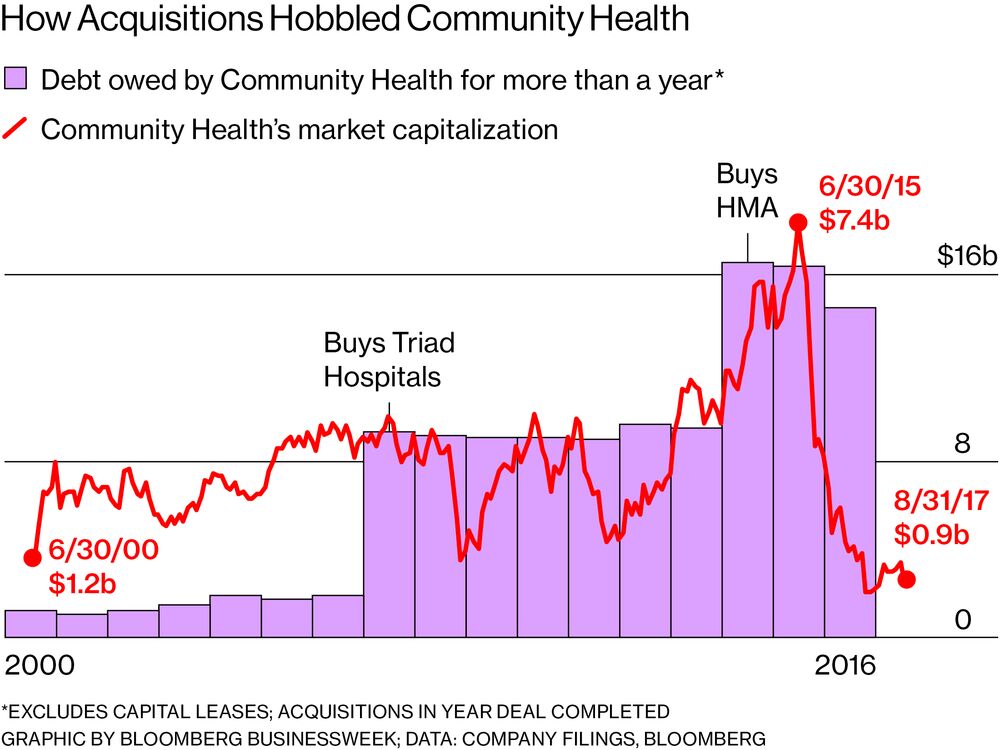
The standoff over Lutheran provides a window into how CHS, once the largest for-profit hospital chain in the U.S., has allowed facilities to languish, possibly compromising care and destroying investor value in the process. Smith presided over a decade-long acquisition binge that saddled CHS with total debt of almost eight times its earnings and a network of underperforming facilities. The company lost $2 billion in the past six quarters, during which doctors from Key West to Spokane have accused the chain of pinching pennies and regulators have fined it for overcharging Medicare. Says Indiana Republican Representative Jim Banks, who’s sided with the Fort Wayne doctors: “It’s buy, squeeze, and repeat.”

“At some point you reach a dead end, and you can’t cut the expenses anymore”

Smith took CHS public in 2001, just four years after coming to the company from Humana Inc., where he’d been head of hospital operations. The big acquisitions began in 2007, when the chain bought Texas-based Triad Hospitals Inc. for $6.4 billion, more than quadrupling its debt. Smaller deals followed. By the end of 2014, CHS had nearly doubled its debt again to finance its buyout of Health Management Associates LLC (HMA), a Florida-based group of mostly rural facilities that required costly upgrades.

Smith’s plan was to try to increase doctor productivity and slash costs, often replacing experienced doctors with loyal patients for younger ones who were willing to work longer hours. Like most for-profit operators, “they focused on cost control,” says Joshua Nemzoff of Nemzoff & Co., who advises hospitals on sale transactions. “At some point you reach a dead end, and you can’t cut the expenses anymore.”

Along with the rest of the hospital industry, CHS expected the Affordable Care Act to provide a windfall of insurance money from the newly covered. Investor enthusiasm soured when 19 states—including Florida and Texas, two key CHS markets—declined to expand Medicaid eligibility, leaving many low-income people without coverage. At the same time, insurers and other government programs began working to divert patients from hospitals into doctors’ offices, outpatient clinics, and other less expensive venues. The combined effect was particularly hard on rural hospitals, a large share of CHS’s network.

Raising prices while slashing costs has been a hallmark of CHS under Smith. In Fort Wayne, Lutheran charges more than rival Parkview Medical Center Inc. for 8 of 10 common medical procedures. During the first half of this year, patients were placed in beds in Lutheran’s emergency room hallways because the wards they should have been moved to were understaffed, and a leaking air conditioner in the neonatal care unit was dripping water on infants’ beds, according to people familiar with the conditions. While Parkview invested in its cancer and cardiac units, Lutheran doctors said at the board meeting that the CHS hospital was using lower-priced monitors they feared would miss potentially fatal heart rhythms.

Company spokeswoman Tomi Galin said in an email that many other hospitals use the same monitors. Nevertheless, CHS plans to spend $500 million on improvements and will recruit new doctors at Lutheran, she wrote, adding that employee retention there is rising.

Other critics of Smith have taken their complaints to court. After Gregg Becker quit his job as chief financial officer of CHS’s Rockwood Clinic in Spokane, Wash., in 2012, he filed a whistleblower claim with the U.S. Department of Labor, saying his superiors told him to reduce the facility’s forecast loss from $12.8 million to $4 million and threatened to fire him if he didn’t. Becker was awarded a settlement of almost $1.9 million by an administrative law judge, according to court documents. CHS has appealed the case to the Washington Supreme Court and the federal Arbitration and Review Board. (CHS sold Rockwood earlier this year.)

In 2014, CHS agreed to pay $98.15 million to the Department of Justice to settle lawsuits in five different districts accusing the company of charging for higher-cost inpatient services at hospitals, including Lutheran, when less expensive outpatient services would have been sufficient. CHS didn’t admit wrongdoing. But the DOJ in a statement said the company had “engaged in a deliberate corporate-driven scheme to increase inpatient admissions of Medicare, Medicaid, and the Department of Defense’s Tricare program.”

With losses mounting and the stock down more than 80 percent from its peak in June 2015, Smith has resorted to selling hospitals to pay off debt. One result: CHS will soon be about the same size it was before it attempted to digest HMA. Hedge fund ASL Strategic Value, a CHS shareholder, sent a letter to the board on Aug. 8 asking directors to replace Smith. Tom Kelley, a Fort Wayne car dealer whose employees rely on Lutheran for care, quit the Lutheran board in July and says he’s reviewing his employee medical plan. He tried and failed to broker a peace deal between the doctors and Smith.

“He’s a street fighter,” Kelley says of Smith. “He has survived government actions against him. He has survived lawsuits. He has survived all of this by being a tough SOB.”

BOTTOM LINE – Community Health Systems used acquisitions to become a major for-profit hospital operator. But the added heft wasn’t matched by profitability gains.


5 Ways the Graham-Cassidy Proposal Puts Medicaid Coverage At Risk

5 Ways the Graham-Cassidy Proposal Puts Medicaid Coverage At Risk

Image result for 5 Ways the Graham-Cassidy Proposal Puts Medicaid Coverage At Risk


The Graham-Cassidy proposal to repeal and replace the Affordable Care Act (ACA) is reviving the federal health reform debate and could come up for a vote in the Senate in the next two weeks before the budget reconciliation authority expires on September 30. The Graham-Cassidy proposal goes beyond the American Health Care Act (AHCA) passed by the House in May and the Better Care Reconciliation Act (BCRA) that failed in the Senate in July. The Graham-Cassidy proposal revamps and cuts Medicaid, redistributes federal funds across states, and eliminates coverage for millions of poor Americans as described below:
  1. Ends federal funding for current ACA coverage and partially replaces that funding with a block grant that expires after 2026. The proposal ends both the authority to cover childless adults and funding for the ACA Medicaid expansion that covers 15 million adults. Under Graham-Cassidy, a new block grant, the “Market-Based Health Care Grant Program,” combines federal funds for the ACA Medicaid expansion, premium and cost sharing subsidies in the Marketplace, and states’ Basic Health Plans for 2020-2026. Capped nationally, the block grant would be lower than ACA spending under current law and would end after 2026. States would need to replace federal dollars or roll back coverage. Neither the AHCA nor the BCRA included expiration dates for ACA-related federal funds or eliminated the ability for states to cover childless adults through Medicaid.
  2. Massively redistributes federal funding from Medicaid expansion states to non-expansion states through the block grant program penalizing states that broadened coverage. In 2020, block grant funds would be distributed based on federal spending in states for ACA Medicaid and Marketplace coverage. By 2026, funding would go to states according to the states’ portion of the population with incomes between 50% and 138% of poverty; the new allocation is phased in over the 2021-2025 period. The Secretary has the authority to make other adjustments to the allocation. This allocation would result in a large redistribution of ACA funding by 2026, away from states that adopted the Medicaid expansion and redirecting funding to states that did not. No funding is provided beyond 2026.
  3. Prohibits Medicaid coverage for childless adults and allows states to use limited block grant funds to purchase private coverage for traditional Medicaid populations. States can use funds under the block grant to provide tax credits and/or cost-sharing reductions for individual market coverage, make direct payments to providers, or provide coverage for traditional Medicaid populations through private insurance. The proposal limits the amount of block grant funds that a state could use for traditional Medicaid populations to 15% of its allotment (or 20% under a special waiver). These limits would shift coverage and funds for many low-income adults from Medicaid to individual market coverage. Under current law, 60% of federal ACA coverage funding is currently for the Medicaid expansion (covering parents and childless adults). Medicaid coverage is typically more comprehensive, less expensive and has more financial protections compared to private insurance. The proposal also allows states to roll back individual market protections related to premium pricing, including allowing premium rating based on health status, and benefits currently in the ACA.
  4. Caps and redistributes federal funds to states for the traditional Medicaid program for more than 60 million low-income children, parents, people with disabilities and the elderly. Similar to the BCRA and AHCA, the proposal establishes a Medicaid per enrollee cap as the default for federal financing based on a complicated formula tied to different inflation rates. As a result, federal Medicaid financing would grow more slowly than estimates under current law. In addition to overall spending limits, similar to the BCRA, the proposal would give the HHS Secretary discretion to further redistribute capped federal funds across states by making adjustments to states with high or low per enrollee spending.
  5. Eliminates federal funding for states to cover Medicaid family planning at Planned Parenthood clinics for one year. Additional funding restrictions include limits on states’ ability to use provider tax revenue to finance Medicaid as well as the termination of the enhanced match for the Community First Choice attendant care program for seniors and people with disabilities. Enrollment barriers include the option for states to condition Medicaid eligibility on a work requirement and to conduct more frequent redeterminations.
Much is at stake for low-income Americans and states in the Graham-Cassidy proposal. The recent debate over the AHCA and the BCRA has shown the difficulty of making major changes that affect coverage for over 70 million Americans and reduce federal funding for Medicaid. Medicaid has broad support and majorities across political parties say Medicaid is working well. More than half of the states have a strong stake in continuing the ACA Medicaid expansion as it has provided coverage to millions of low-income residents, reduced the uninsured and produced net fiscal benefits to states. Graham-Cassidy prohibits states from using Medicaid to provide coverage to childless adults. With regard to Medicaid financing changes, caps on federal funding could shift costs to states and result in less fiscal flexibility for states. States with challenging demographics (like an aging population), high health care needs (like those hardest hit by the opioid epidemic), high cost markets or states that operate efficient programs may have the hardest time responding to federal caps on Medicaid spending. Faced with substantially reduced federal funding, states would face difficult choices: raise revenue, reduce spending in other areas, or cut Medicaid provider payments, optional benefits, and/or optional coverage groups.