Taking A U-Turn On Benefits, Big Employers Vow To Continue Offering Health Insurance

http://khn.org/news/big-employers-embrace-health-plan-status-quo/

The shrinking unemployment rate has been a healthy turn for people with job-based benefits.

Eager to attract help in a tight labor market and unsure of Obamacare’s future, large employers are newly committed to maintaining coverage for workers and often their families, according to new research and interviews with analysts.

Two surveys of large employers — one released Aug. 2 by consultancy Willis Towers Watson and the other out Tuesday from the National Business Group on Health, show companies continue to try to control costs while backing away from shrinking or dropping health benefits. NBGH is a coalition of large employers.

“The extent of uncertainty in Washington has made people reluctant to make changes to their benefit programs without knowing what’s happening,” said Julie Stone, a senior benefits consultant with Willis Towers Watson. “They’re taking a wait-and-see attitude.”

That’s a marked change from three years ago, when many big employers — those with 1,000 employees or more — contemplated ending medical benefits and shifting workers to the Affordable Care Act’s marketplaces.

In 2014, only 25 percent of big companies were “very confident” they would have a job-based health plan for employees in 10 years, according to the Willis Towers Watson survey.

This year, 65 percent expected to offer health benefits in a decade. And 92 percent said they were very confident a company-based health plan would exist in five years.

Many managers once eyed Obamacare marketplaces as workable coverage alternatives despite the law’s requirement that employers offer health insurance, analysts said.

But problems with marketplace plans, including fewer offerings, rising premiums and shrinking medical networks, have made employers think twice, they said.

Another big reason to maintain rich coverage is “the strength of the economy,” said Paul Fronstin, director of health research at the Employee Benefit Research Institute, an industry group. “Employers are doing what they have to do to get the right workers.”

Unemployment has fallen from 9.9 percent when Obamacare became law in 2010 to 4.3 percent last month, which equaled a 16-year low reached in May.

With such a steep decline, he added, “employers are thinking, ‘We need to offer this benefit for recruitment and retention.’”

Second Thoughts On High-Deductible Plans

Companies are even rethinking the long-standing expedient of shifting a portion of rising medical costs to employees through high-deductible plans and a greater share of the premium bill, other research shows.

“Employers are beginning to recognize that cost sharing has its limits,” said a June report from PwC, a multinational professional services network. Low unemployment and competition for workers mean “employers have less appetite for scaling back benefits and continuing with a plan design that has proven largely unpopular.”

At Fidelity Investments, a Boston-based financial firm with more than 45,000 employees, worker contributions have grown to about 30 percent of total health costs.

Jennifer Hanson, the company’s benefits chief who sits on NBGH’s board, doesn’t see that continuing.

As costs grow, “if you continue to shift more of a bigger number to employees, health care becomes unaffordable,” she said in an interview. “As employers, we really do need to pay attention less to who’s paying for what and more to how much everything costs.”

More than half of Americans with job-based insurance face deductibles — out-of-pocket costs for most care before insurance kicks in — of more than $1,000 for single-person coverage. Family deductibles can be much higher.

High On The To-Do List: Controlling Drug Costs

Big employers’ planned changes for next year focus on controlling drug costs and improving health results through telemedicine and steering patients to efficient, high-quality hospitals, noted the Willis Towers Watson report and the NBGH survey.

Employer health costs continue to rise, but not at the double-digit clip seen for many plans sold to individuals and families through the ACA marketplaces.

Employers expect health costs to increase 5.5 percent next year, up from 4.6 percent in 2017, according to the Willis Towers Watson report.

Companies in the NBGH survey predicted health costs will rise 5 percent next year, up from an average 4.1 percent increase for 2016.

That’s still far faster than inflation, which is less than 3 percent, and overall wage growth.

By many accounts, soaring costs for specialty pharmaceuticals used to treat cancer, rheumatoid arthritis, hemophilia and other complex conditions are the biggest factor.

“These are very expensive drugs,” said Brian Marcotte, NBGH’s CEO. “They cost thousands or tens of thousands per treatment.”

Often these drugs require infusion into the blood in a clinical setting, which can drive up their price tag.

For instance, hospital-based infusions have been found to cost as much as seven times more than those performed in, say, a doctor’s office.

Employers are working hard to steer patients to the least expensive, appropriate site, Marcotte said.

Big employers are also offering more on-site nurses and doctors; setting up accountable care organizations with incentives for doctors and hospitals to control costs; and striking deals with particular hospitals for high-cost operations such as transplants and joint replacements, the NBGH survey found.

Job-based insurance covers some 160 million people younger than 65, according to Census and Labor Department data, far more than the 10 million or so insured by plans sold through Obamacare marketplaces.

Government employers and companies with at least 500 workers, which historically have been more likely to offer health benefits than smaller employers, cover more than 90 million employees and dependents.

Willis Towers surveyed 555 large employers with about 12 million workers and dependents. NBGH surveyed 148 large companies with more than 15 million employees and dependents.

Healthcare Triage News: The Trump Administration Has Many Options to Undermine Obamacare

Healthcare Triage News: The Trump Administration Has Many Options to Undermine Obamacare

Image result for Healthcare Triage News: The Trump Administration Has Many Options to Undermine Obamacare


While the Senate and the House haven’t been very effective in passing a repeal of Obamacare, the ACA’s provisions are still at risk. There’s a lot that Donald Trump’s administration can do (or not do) to undermine Obamacare’s provisions and marketplaces.

Out-of-Pocket Costs, Financial Distress, and Underinsurance in Cancer Care

http://jamanetwork.com/journals/jamaoncology/fullarticle/2648318?utm_source=STAT+Newsletters&utm_campaign=cf53ee7567-MR&utm_medium=email&utm_term=0_8cab1d7961-cf53ee7567-149578673

Image result for Out-of-Pocket Costs, Financial Distress, and Underinsurance in Cancer Care

The financial burden of cancer treatment is a well-established concern.1,2 Owing to cost sharing, even insured patients face financial burden and are at risk for worsened quality of life3 and increased mortality.4 Underinsured patients (those spending more than 10% of their income on health care costs) are a growing population,5 and are at risk given the looming heath policy and coverage changes on the horizon. In this setting, little is known about what expectations patients have regarding those costs and how those cost expectations might impact decision making.

Methods

After approval from the institutional review board at Duke University Medical Center, we conducted a cross-sectional survey study of financial distress and cost expectations among patients with cancer presenting for anticancer therapy. We enrolled a convenience sample of adult patients at a comprehensive cancer center and at 3 affiliated rural oncology clinics. Patients provided written informed consent and were compensated with $10 for completing the survey. Trained interviewers surveyed patients in person.

We abstracted the electronic health record for cancer diagnosis, stage, type of treatment, and duration of treatment at the time of enrollment. Demographics including race and income were obtained from the patient. Patient out-of-pocket expenses were based on patient’s best estimation of recent, averaged monthly costs. We surveyed patients about whether their actual costs met their expectations, and about how much they were willing to pay out-of-pocket for cancer treatment, not including insurance premiums. Financial distress was measured using a validated measure. We measured median relative cost of care, defined as monthly out-of-pocket costs divided by income. Expected financial burden, willingness to pay, and subjective financial distress were dichotomized to assess the impact of unexpected costs and high financial distress. We used hypothesis testing to examine variables associated with burden and distress. Multivariable logistic regression included specific variables of interest along with select variables found to be statistically significant in bivariate testing. Statistical analyses were performed using SAS software (version 9.4, SAS institute).

Results

Of 349 consecutive patients approached, 300 were eligible and agreed to participate, and 3 withdrew (86% response rate). Of the 300 patients, 157 (52%) were men. Patient characteristics, income, and costs are described in the Table along with unadjusted analyses. Forty-nine (16%) patients reported high or overwhelming financial distress (score >7).

The median relative cost of care was 11%. The relative cost of care for patients with high or overwhelming distress was 31% vs 10% for those with no, low, or average financial distress. One hundred eighteen (39%) participants endorsed higher than expected financial burden from cancer care. In unadjusted analysis, unexpected burden was associated with being younger, unmarried, nonwhite, unemployed/not retired, having lower household income, higher costs, colorectal/breast cancer diagnosis, lower quality of life and higher financial distress (Table). In adjusted analysis, experiencing higher than expected financial burden was associated with high or overwhelming financial distress (OR, 4.78; 95% CI, 2.02-11.32; P < .01) and with decreased willingness to pay for cancer care (OR, 0.48; 95% CI, 0.25-0.95; P = .03).

Discussion

More than one-third of insured cancer patients receiving anticancer therapy faced out-of-pocket costs that were greater than expected, and patients with the most distress were underinsured, paying almost one-third of their income in health care-related costs. Patients at risk for unexpected costs had less household income and faced higher out-of-pocket costs.

Facing unexpected treatment costs was associated with lower willingness to pay for care, even when adjusting for financial burden. This suggests that unpreparedness for treatment-related expenses may impact future cost-conscious decision making. Interventions to improve patient health care cost literacy might impact decision making. Indeed, the Institute of Medicine has listed cancer cost-related health literacy as a high priority for future research, and this priority has been included in the Center for Medicare and Medicaid’s Oncology Care Model.6 Future studies should test interventions for cost mitigation through shared decision making.

Taxpayers Will Pay the Price for Uncertainty Over Obamacare in 2018

https://www.thefiscaltimes.com/2017/08/10/Taxpayers-Will-Pay-Price-Uncertainty-Over-Obamacare-2018

The health insurance industry remains in the throes of a largely unnecessary crisis of confidence, according to an analysis released by the Kaiser Family Foundation on Thursday.

With the open enrollment period approaching for Obamacare insurance plans sold through state exchanges, Kaiser Foundation experts were able to analyze the proposals for 2018 submitted by insurance companies to 20 states and the District of Columbia — the only places where enough information is made public to allow an assessment of what health care costs would look like for an average policyholder under the insurers’ requested rate structures.

“Insurers attempting to price their plans and determine which states and counties they will service next year face a great deal of uncertainty,” the authors wrote. “They must soon sign contracts locking in their premiums for the entire year of 2018, yet Congress or the Administration could make significant changes in the coming months to the law – or its implementation – that could lead to significant losses if companies have not appropriately priced for these changes. Insurers vary in the assumptions they make regarding the individual mandate and cost-sharing subsidies and the degree to which they are factoring this uncertainty into their rate requests.”

What that means for consumers is a bit of a mixed bag. Almost all insurers are seeking rate increases, with some approaching a 50 percent jump. But the actual impact on consumers varies depending on where they buy their insurance and how much money they earn. One thing is for sure, though: The federal government, and therefore taxpayers, will be on the hook for larger subsidy payments.

Because the majority of Americans obtain health insurance through an employer-sponsored plan or from federal programs like Medicare and Medicaid, the impact of the premium increases of exchange-based policies will mean little to a large element of the population.

Of those who buy insurance on the exchanges, the overwhelming majority receive tax credits meant to keep their premium payments to a specific fraction of their annual income. The remaining 16 percent, depending on their income, receive either a smaller subsidy or no subsidy at all. It is these people who, if they live in some of the regions facing large premium increases, who will be hurt the most.

The Kaiser study gathered information from the largest city in each of the 20 states plus the District of Columbia. (Benchmark levels for tax credits are based on the second-cheapest Silver Level plan available in the largest city in a state.) They estimated the change in costs for a 40-year-old non-smoker earning $30,000 a year.

In only one state was the annual premium expected to fall in 2018: Rhode Island, which anticipates a 5 percent drop. Vermont’s premiums will remain static in 2018 if the data holds. The other 19 states can all expect increases, from a modest 3 percent in Michigan to a whopping 49 percent in Delaware.

The average increase in the data collected by Kaiser is 17 percent.

However, none of those costs would be passed on to the consumer making $30,000 a year. In fact, because of adjustments to the tax credit, he could expect to see monthly costs fall by 3 percent, to $201, next year, regardless of what premium levels do where he lives.

But somebody has to pay when premiums go up, and if it isn’t the consumer, it’s the Treasury and by extension, the taxpayer.

The change in premium payments required to keep that 40-year-old’s health insurance premium at $201 per month will increase very sharply in many states, depending greatly on how far from the premium cap a silver plan was in 2017.

In Washington State, according to Kaiser, the premium tax credit would increase 239 percent, from $31 per month to $105. In New Mexico, it would jump 183 percent, from $51 to $144. In Rhode Island it would fall 13 percent, while in Vermont it would rise a modest 2 percent. On average, though, the amount of premium payment picked up by the federal government will increase by about 63 percent in the states reviewed by Kaiser.

Perversely, as Kaiser points out, that fiscal wound is largely self-inflicted. While it is impossible to gauge just how much of this year’s rate increases are attributable to insurers being nervous about whether the federal government would slash support payments in the middle of the 2018 policy year, the answer is surely non-trivial, and the dollars are coming out of the pockets of taxpayers.

The different ways your health care costs are going up

https://www.axios.com/the-different-ways-your-health-care-costs-are-going-up-2471186113.html

Image result for The different ways your health care costs are going up


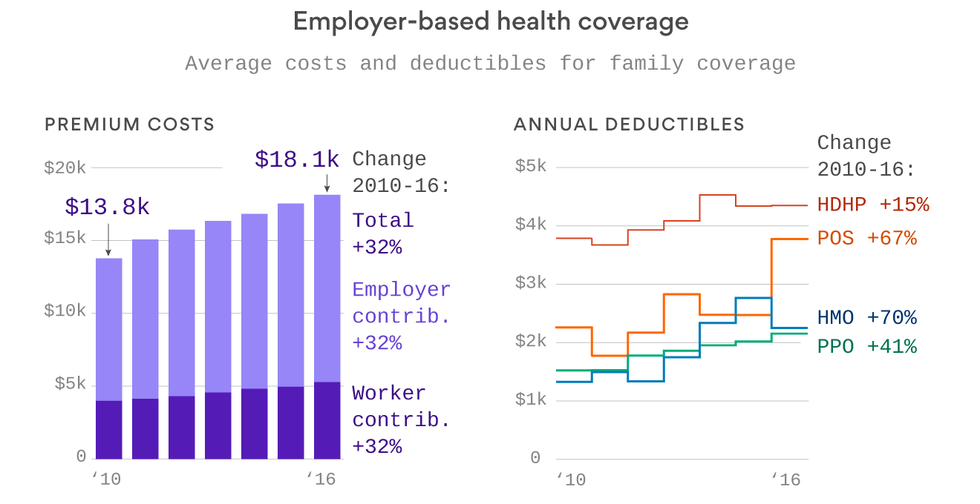
We’ve spent so much time talking about Affordable Care Act costs this year that it’s easy to forget what most people are actually paying for health care — the 156 million Americans who get their health coverage through the workplace. Turns out, most of us aren’t seeing sky-high premium increases. But it’s also worth remembering that deductibles matter too — because that’s what we pay out of pocket before insurance kicks in.

Take a look at these two graphics from Axios datavisuals genius Chris Canipe. The premium increases between 2010 and 2016 weren’t that bad — they’re single digits each year, and just add up over time. But you can see some big increases in deductibles, especially in point-of-service plans and HMOs.

Why it matters: That’s a big reason why people feel their health care costs going up, because it means they’re paying more out of pocket. And when prescription drug prices rise, they’re more likely to feel it directly.

Outside Of Washington, There Is A New Vital Center In Health Care Reform

http://healthaffairs.org/blog/2017/07/31/outside-of-washington-there-is-a-new-vital-center-in-health-care-reform/

Larissa Pisney of Denver joins others during a protest outside the office of U.S. Rep. Mike Coffman, R-Colo., over the health care overhaul bill up for a vote in the U.S. House Thursday, May 4, 2017, in Aurora, Colo. (AP Photo/David Zalubowski)

Republicans in Congress are mired in political quicksand. Following passage of the Affordable Care Act (ACA) in 2010, they locked themselves into a promise to repeal and replace it at the behest of ultra-conservative donors and party activists who control the GOP’s nomination process. Since 2010, however, Americans and rank-and-file Republicans increasingly came to expect help meeting the rising costs of medical care and insurance and to accept the ACA’s tangible programs to address these concrete challenges.

The Democrats created their own political trap. They passed the ACA on the promise of making health care affordable but deductibles and rising premiums continued to present a burden to many Americans.

Both parties are missing, however, the vital center on health reform that has formed since 2010. Americans are frustrated with Democrats for not delivering on their promise of affordability, and they are now alarmed with Republican efforts to repeal—instead of improve—the ACA’s coverage of costs.

Tracking Changes In Public Opinion

Most public opinion polls are unable to track these changes in opinion about health care because they are only snapshots, drawn from a moment in time. To remedy this, we have been gathering panel data, tracking the views of the same group of Americans every two years since the ACA’s passage in 2010. This equips us to study how individuals respond to the ACA as they experience or learn more about the law’s provisions over time. Specifically, we conducted four waves of interviews in the two-month period leading up to national elections from 2010 to 2016 when health reform received heightened attention; this avoided the risk of choosing an arbitrary month when health reform might have arbitrarily lost or gained salience.

The first wave was conducted by the Survey Research Institute (SRI) at Cornell University and consisted of a national sample of 1,200 adults. Abt SRBI (now part of Abt Associates) conducted the last three waves, returning to the same individuals. All waves asked identical questions and were administered by telephone, using only landlines in 2010 and adding mobile phones in 2012, 2014, and 2016. Forty-nine percent of the original 2010 survey (587 individuals) responded to all four waves. Survey weights were applied to each survey to match representative demographic targets and allow us to generalize from our panel to the adult population in the United States.

Why Americans Dislike Health Reform

Republicans have been eager to highlight the unpopularity of the Affordable Care Act, also known as “Obamacare.” Exhibit 1 shows that unfavorable assessments of the ACA have steadily increased since its passage. Unfavorability rose from 44 percent in 2010 to 58 percent in 2016.

Exhibit 1: Increasingly Unfavorable Views Of The Affordable Care Act (Percent)

Question: “As you may know, a major health care bill was signed into law in 2010. Given what you know about this law, do you have a generally favorable or generally unfavorable opinion of it, or do you have a neutral opinion, neither favorable nor unfavorable?” Exhibit 1 presents the “unfavorable” responses.

Why are Americans increasingly disenchanted with the ACA? The public’s displeasure emanates to a large extent from frustrations with health care costs. Democrats promised to lower the costs of medical care and insurance with the enactment of the ACA. They did succeed to slow the rate of increase in national health care spending and insulate most subsidized enrollees in its insurance Marketplace from premium increases, as the Congressional Budget Office reports (Note 1). Yet, the costs of medical care remain high, and premiums and deductibles are out of the reach of some Americans.

The source of the public’s rising frustration with health care costs is picked up in Exhibit 2. The first grouping of bars on the left shows increasing frustration with costs for medical treatments that are not covered by insurers. By 2016, 14 percent expressed dissatisfaction with the amount and number of treatments that their insurance covered, a 6-point increase from 2014. One-third of Americans also expressed dissatisfaction in 2016 with the out-of-pocket costs that they were forced to pay because of gaps in their insurance coverage, as shown in the middle cluster. This is an 8-point increase from 2014.

Exhibit 2: Rising Concerns About Affordability (Percent)

Question: Several questions asked respondents to indicate their satisfaction or dissatisfaction with individual features of the health care system—“The number and kind of treatments your health insurance will cover” and “The amount you spend out of pocket on health care costs your insurance doesn’t cover.” A separate item asked respondents to indicate their agreement or disagreement with the statement: “Public officials care about making health care more affordable for people like me.” (Exhibit 2 shows “disagreement” with the statement.)

The public’s disappointment with the persistent burden of health care costs leads it to blame lawmakers for a lack of responsiveness. The bars on the right in Exhibit 2 indicate that a growing majority of Americans disagree with the statement that, “Public officials care about making health care more affordable for people like me.” Fifty-eight percent of Americans disagreed with this statement in 2016, a 10-point increase since 2012.

In addition, the sense that the ACA has not delivered the affordability that Democrats promised may help account for the sharply stronger conclusion in recent years that the ACA’s taxes present a heavier burden. Exhibit 3 shows that the proportion of Americans who believe that their taxes have increased a lot or a little has risen from 43 percent in 2012 to 56 percent in 2016. This growing perception that the ACA has increased taxes rests on inaccurate assumptions. The ACA’s financing primarily relies on two taxes on individuals whose yearly income exceeds $200,000 or for married couples earning more than $250,000—an increase in Medicare’s tax on earnings by 0.9 percent and a new 3.8 percent tax on capital gains from investments. These taxes fall on less than 2 percent of tax filers, according to the non-partisan Tax Policy Center (Note 2).

Exhibit 3: Growing Perception That The Affordable Care Act Increased Taxes (Percent)

Question: “Do you think that the new health care law enacted in 2010 has increased the taxes that you pay, decreased the taxes that you pay, or has it had no impact on the taxes that you pay?”

Americans Oppose Repeal Because They Appreciate The Effects Of Health Reform

Considering the strong public disapproval of repeal, President Donald Trump and congressional Republicans are discovering that it is a mistake to equate the public’s frustrations with the ACA with support for repealing its programs. When respondents reported “unfavorable” views of the law, we followed up with a question asking them whether they would prefer either “repeal[ing] [the ACA] as soon as possible,” or “giving the law more time to have a chance to work, with lawmakers making necessary changes along the way.” In Exhibit 4, we combined those who favored giving it “a chance to work” with those who expressed “favorable” overall views of the law. This shows that since 2010 more Americans favored the law or wanted to give it time to be improved than backed repeal. Although support for repeal inched up since 2010, a greater percentage of Americans consistently favored the ACA and improving it over repeal by a 41-to-37 margin in 2010 and by 49-to-43 in 2016.

Exhibit 4: More Americans Prefer To Keep And Improve The Affordable Care Act Than Repeal It (Percent)

Question: This figure is based on two survey questions. The first is the following: “As you may know, a major health care bill was signed into law in 2010. Given what you know about this law, do you have a generally favorable or generally unfavorable opinion of it, or do you have a neutral opinion, neither favorable nor unfavorable?” Respondents who had an unfavorable view were asked a second question about their view about the law’s future: “The law should be given more time to have a chance to work, with lawmakers making necessary changes along the way, OR the law should be repealed as soon as possible?” The repeal bar reports responses from the second question; the other bar adds together favorable responses in the first question with the “law should be given more time” responses.

Support for keeping and improving the ACA stems from a growing appreciation for its concrete effects. Exhibit 5 shows that rising percentages pinpoint the ACA’s tangible programs as having either “a great deal” or “quite a bit” of an impact on themselves and their family (other options included “some,” “a little,” and “none”). There is greater recognition in 2016 compared to 2010 or 2012 of the impact of allowing parents with insurance to continue to cover their children until they are 26 years old. More than one in five Americans now report that the ACA expanded their access to health insurance. In addition, nearly one in four Americans, 24 percent, voiced appreciation for the impact of the ACA’s assistance to seniors to pay for prescription medications. Moreover, recognition of a personal impact resulting from the ACA’s tax credits and other subsidies to help people purchase health insurance has remained stable since 2014 and is higher than in earlier years.

Exhibit 5: Rising Appreciation Of The Impact Of The Affordable Care Act (Percent)

Question: “I’m going to read to you a list of some of the features of the health care law that was enacted in 2010. For each one, please answer this question: “How much of an impact has this feature had on you and your family: a great deal, quite a bit, some, a little, none?” Respondents are asked about the following features of health reform: coverage of adult children on their parents’ insurance plans until they are 26 years old; access to health insurance or medical care supported or provided by government; help for seniors to pay for prescription drugs; and tax credits and other subsidies to help people pay for health insurance. Exhibit 5 combines “a great deal” and “quite a bit.”

The New Vital Center On Health Reform

Overall evaluations of the ACA follow the partisan pattern that is familiar today: 68 percent of Democrats have favorable views versus 9 percent of Republicans. What stands out, however, is that the ACA’s tangible effects are starting to loosen rigid partisan dividing lines. Exhibit 6 shows the percentage of Americans reporting a personal impact from at least one of the four provisions presented in Exhibit 5. Democratic elected officials enacted the ACA, and, not surprisingly, majorities of rank-and-file Democrats have generally singled out the law’s effects from early on: 51 percent of Democrats reported an impact from at least one of the law’s features in 2010; by 2016, this recognition remained largely stable, inching up to 54 percent. Strikingly, however, the percentage of Republicans perceiving an impact on themselves or their families has increased by 8 percentage points, from 26 percent in 2010 to 34 percent in 2016 despite vociferous GOP attacks on the ACA. Among independents, the proportion soared by 23 points, from 28 percent to 51 percent. These findings indicate that appreciation for the ACA has expanded beyond the ranks of Democratic partisans who were predisposed to favor it; growing numbers of Americans across the political spectrum increasingly value the impacts of health reform in their own lives.

Exhibit 6. Widening Appreciation Of The Affordable Care Act’s Impact (Percent Reporting Impact Of A New Benefit)

Exhibit 6 presents the percentage of respondents who reported that at least one of the four provisions presented in Exhibit 5 had a “great deal” or “quite a bit” of impact on themselves or their family.

The crux of the public discontent with the ACA—and the repeal proposals by Republicans—is the amount paid for insurance coverage. Respondents to the survey appear to share the complaint of ACA critics that insurance costs are too high. After high expectations following the ACA’s enactment, satisfaction with the cost of health coverage has dropped by 10 points—from 73 percent satisfied in 2010 to 63 percent in 2016. This general assessment misses, however, a crucial condition—whether or not individuals are covered by government programs such as Medicare, Medicaid, or a subsidy financed by the ACA. We found a striking pattern among Republicans, Democrats, and independents: By a margin of 20 points or more, individuals with government coverage were consistently more satisfied with the cost of insurance than those who rely on private health plans. For instance, 79 percent of Republicans with government coverage were content with insurance costs as compared to 56 percent without this coverage. Independents outside the sway of either major party expressed the highest satisfaction when experiencing government coverage (100 percent) and exhibit the largest gap between those covered and those without coverage (41 points).

In short, Republican public officials continue to spotlight what they perceive as the disappointment of Americans with ACA coverage, but the reality is that the most dissatisfied are those who lack government insurance. In fact, most Americans (including Republicans) who benefit from government insurance are content with their coverage.

Health Reform’s New Vital Center

Public opinion toward the ACA has been poorly understood because of an apparent contradiction. On the one hand, a growing share of the public harbor unfavorable views of the ACA as a whole, and proponents of repeal have seized on this dissatisfaction to claim a popular mandate. On the other hand, the discontent of Americans stemmed from disappointment with the ACA for not satisfying their expectations of genuine protection from the burden of costs. Far from wanting to be rid of the ACA, Americans are looking to it to deliver more effective protection.

In the immediate aftermath of World War II, the historian Arthur Schlesinger, Jr., wrote of the “vital center” about the direction of America that was supported by both major political parties and most Americans. Despite today’s fractiousness in Washington over health reform, everyday Americans are converging toward a new vital center of support for health care reform.

Awareness of the ACA’s tangible impacts fits into a robust notion of collective responsibility instead of the individualist approach advocated by conservatives. Since the ACA’s passage, nearly nine out of 10 Americans have consistently embraced access to health care as a “basic right.” Not surprisingly, nearly all Democrats embrace the principle of health care as a right. What stands out is that rank-and-file Republicans overwhelming and increasingly hold the same view—rising from 64 percent in 2010 to 72 percent in 2016. Contrary to the position of Washington Republicans, establishing health care as a birthright owed to Americans is now widely shared. Republican proposals, such as those that would allow states to opt out of some of the ACA’s core consumer protections (including those guaranteeing coverage for individuals with preexisting medical conditions), may well tap into this strain of public opinion and provoke broad opposition.

Elected officials in Washington and, particularly, steadfast opponents of health reform are sliding to the margins of public opinion. The daily problems that Americans face in paying for medical care and insurance mean that pragmatism is trumping ideology. In the past, federal lawmakers responded to broad public agreement and worked across the aisle to improve the flaws in the original legislation that produced Social Security in 1935 and Medicare in 1965. The question today is whether Washington can return to that pragmatic tradition and catch up to the emerging vital center in Americans’ attitudes toward health reform.

Note 1

Congressional Budget Office. American Health Care Act: cost estimate. Washington (DC): CBO; 2017 Mar 13.

Note 2

Tax Policy Center. Tax units above and below the $250,000/$200,000 threshold, 2013–2022. Washington (DC): TPC; 2012 Nov 26

Trump’s threats to end CSR payments may mean hospitals will see a rise in uncompensated care costs

http://www.fiercehealthcare.com/finance/trump-s-threats-to-end-csr-payments-may-mean-hospitals-will-see-a-rise-uncompensated-care?utm_medium=nl&utm_source=internal&mrkid=959610&mkt_tok=eyJpIjoiT0RKaVpETTRORE5sTURNeSIsInQiOiJ0QlwvRURDeTZRRnpcL2g1eVp4ek4yVTgwM3hcL1lqcjVJdzlqcER3S0JMbFpcL3FwVzI4VEhkYktjWDdiZ3VRcTdBVVZmMml0cHIrc3lrRmhTYWlcL1wvaVRTZTA5VlczZ3I3Z3JkN0FYYTI4VWlJb3grTXZ2UDA5XC9hVTVVN2M3U2UxT3gifQ%3D%3D

Image result for Uncompensated Care

Hospitals had better brace themselves for a possible rise in uncompensated care costs if President Donald Trump makes good on an implied threat to end cost-sharing reduction payments to health insurers.

Trump indicated on Twitter this weekend that he may end “bailouts” for both insurance companies and Congress. Those bailouts refer to CSR payments, which subsidize the out-of-pocket healthcare costs of low-income Affordable Care Act exchange customers.

And if he follows through and decides this week to end those payments, the individual marketplaces could see disastrous consequences. And that means doctors and hospitals may see a spike in uncompensated care costs and bad debt, reports Forbes.

Hospitals have seen a drop in uncompensated care costs and bad debt in the years under the ACA. A recent Politico report found that spending on charity care at the top seven hospitals in the U.S. dropped from $414 million in 2013 to $272 million in 2015.

Furthermore, a recent Kaiser Family Foundation report said that if the CSR payments are withheld, premiums for silver plans would rise by 19% and more payers will likely leave the marketplaces. Doctors and hospitals are concerned that means millions of patients who have purchased insurance through the ACA exchanges won’t be able to afford their out-of-pocket costs for care.

And they have reason to be concerned, Marc Harrison, M.D., president and CEO of Intermountain Healthcare, which operates nonprofit hospitals and clinics and insures more than 800,000 people in Utah, told NPR. Without the CSR payments, rate increases will likely skyrocket. “We’ll see [the number of] people who are uninsured, or functionally uninsured, go way, way up,” he said.

“The American people need this funding to lower what they pay for coverage and be able to see their doctor,” Kristine Grow, a spokeswoman for America’s Health Insurance Plans told Forbes.

Molina to cut 1,400 positions to improve financial performance

http://www.healthcarefinancenews.com/news/molina-cut-1400-positions-improve-financial-performance?mkt_tok=eyJpIjoiTXpVelkyRXhZMkpqTmpKaSIsInQiOiJFVjFscVRVVDdXZmZqek02STNMSVNjelwvREEwMmZmckZrWmNyZjNrQnVcL0szTGZuNXA4ZGdrOGRhT1V5bnREanBwWitPbTNkQllLZW5BTmd4VDk5TDg0ak1NNStnTllqdEllQlNpQmRZbDUwcm5JdVNaZ1lJcmpVVXJNYWxcL0JcL28ifQ%3D%3D

Image result for molina healthcare

The cuts follow removal of CEO and CFO due to financial losses blamed on Affordable Care Act market.

Molina Healthcare, which fired its CEO and CFO in May due to the poor financial performance of the company, will eliminate about 1,400 jobs over the next few months, according to an internal memo obtained by Reuters.

The cuts are due to financial losses blamed on Molina’s individual business in the Affordable Care Act market, in which it has been a major player.

Molina will reduce its workforce by the elimination of 10 percent of its 6,400 corporate positions and about 10 percent of 7,700 health plan jobs, according to Reuters. It will not affect Molina’s Pathways behavioral health business, which employs about 5,500 people.

Interim CEO and CFO Joe White sent the memo to employees saying the cuts aim to contribute to savings by 2018 in what he called “Project Nickel,” to do more with less.

In March, Molina was touted as an ACA success story.

Former CEO J. Mario Molina, MD, was an outspoken opponent of the Republican plan to repeal and replace the ACA. His brother, John C. Molina, who served as CFO. was also let go in a decision by the board to turn around the company’s financial position.

Last week Molina said it was concerned about Republicans repealing the ACA without having a replacement plan in place, the roll back of Medicaid expansion and the lack of a guarantee of federal cost-sharing reduction payments, which allows insurers to offer lower-income consumers lower deductibles and out-of-pocket expenses.

Molina also argued for the continuation of the individual mandate to get insurance.

“The bedrock of any coverage system is a requirement that people must obtain health insurance,” Molina said. “The lack of such a requirement will be detrimental to the individual market risk pool and will result in adverse selection, which would significantly increase costs.”

In June, Molina said it would file rates for 2018 to remain in the exchange market in Florida.

The California Department of Insurance is releasing on August 1 the insurers which have filed rates for the ACA market in 2018.

When High Deductibles Hurt: Even Insured Patients Postpone Care

When High Deductibles Hurt: Even Insured Patients Postpone Care

In November 2015, Tina Heck was in her garage lifting 40-pound bags of wood pellets to fuel her heating stove, when something went very wrong with her back.

“The next day, I could barely walk,” said the 55-year-old who lives on an acre of land in Nevada City, Calif., 60 miles northeast of Sacramento. The cause: a bulging disc in her lower spine, which shoots pain down her leg and makes her back stiff.

The injury wasn’t Heck’s only setback. The initial MRI, cortisone shot and doctor visit cost her $3,000 because her health plan requires her to shell out $5,000 before insurer payments kick in. She doesn’t want to explore other treatment options because of that high deductible. Heck, who makes $68,000 a year in marketing for a nonprofit, is not willing to add more debt on top of her credit-card and mortgage payments.

“I’m in pain every day,” she said, but “it’s not bad enough to go into debt.”

The concept behind high-deductible plans was to lower premiums and reduce overall health costs by ensuring that consumers shared the financial burden of their own health care decisions. But evidence is mounting: High deductibles have actually forced people to delay care that could prevent health emergencies later or improve their quality of life.

Regardless of what happens to the Affordable Care Act, such plans are likely to become more widespread as health care costs continue to rise. Just over half of people with health plans from their employers now have a deductible of $1,000 or more, up from 10% in 2006, according to the Kaiser Family Foundation. (Kaiser Health News, which produces California Healthline, is an editorially independent program of the foundation.)

“People who have medical problems that can be put off tend to do so much more now because of the high deductible,” said Dr. Ted Mazer, a San-Diego based head and neck surgeon who is president-elect of the California Medical Association.

Dr. Mazer blurb: Dr. Ted Mazer, president-elect of the California Medical Association, says some of his patients delay various tests and treatments because of the high deductibles and copays associated with their health plans.  (Courtesy of Kurt Kohnen)

Annual deductibles can amount to many thousands of dollars on some plans. Covered California bronze plans, with the lowest premiums available on the exchange, carry deductibles of $6,300 for an individual and $12,600 for a family.

A Kaiser Family Foundation survey released this year showed that 43% of insured people reported having trouble paying their deductible, up from 34% in 2015. (Kaiser Health News, which produces California Healthline, is an editorially independent part of the foundation.)

In one study by the liberal advocacy group Families USA, more than a quarter of people in high-deductible plans delayed some type of medical service such as a doctor visit or diagnostic test. And 44% of adults with high out-of-pocket expenses put off medical care, according to a nonpartisan Commonwealth Fund study.

Another recent study by researchers at the University of California-Berkeley and Harvard University found that people with high-deductible plans spent 42% less on health care before meeting their deductibles, primarily by reducing the amount of health care they received, not by shopping around for a better price.

Jonathan Kolstad, associate professor of economics at UC-Berkeley’s business school and co-author of the study, said patients dropped both needed care, such as diabetes medication, and potentially unnecessary care, such as imaging for headaches.

“Left to their own devices, people [in high-deductible plans] seem ill-equipped to make their own decisions” about what care they need, and what care they don’t, Kolstad said.

Mazer said that, in his practice, people have delayed all kinds of treatment that may not save “life or limb” but involved medical conditions that interfered with breathing or sleeping.

He said he’s had patients who needed a biopsy to determine if an abnormal vocal cord was cancerous, and they put it off because of the cost.

“I have to make the phone call and say, ‘We’re looking at a mass that may be malignant and if you put it off you’re putting yourself at risk,’ ” Mazer said. “And I’ll tell you, we’ve had people take that risk.”

Recent Republican proposals to repeal Obamacare have promoted the use of high-deductible plans by allowing people to put away more tax-free dollars into the health savings accounts that consumers use in conjunction with those plans. And experts said the proposals would also spur the growth of these plans — by cutting the subsidies available through exchanges, inducing customers to look for cheaper plans with higher deductibles.

Conservatives say insurance that promotes personal financial responsibility helps tamp down overall health costs. Hoover Institution analysts, for example, argue that high deductibles encourage patients to “choose wisely.”

But new evidence suggests that putting off care can be dangerous and, eventually, more costly to patients.

A March 2017 Harvard study found that low-income patients with diabetes who had high-deductible plans delayed visits for complications such as skin infections and pneumonia. They wound up getting more expensive care later on.

Patients may try to treat their conditions at home, or hope they go away — but if that approach fails, “they then have to seek care at the emergency department,” said Frank Wharam, a health policy researcher at Harvard Medical School and lead author of the study.

Wharam said the middle-income earners he studied didn’t suffer any adverse effects from health care choices they made in high-deductible plans, adding that more studies are needed on that group.

Sabrina Corlette, from the Georgetown University Center on Health Insurance Reforms, said that until national health policy addresses the “underlying costs of care,” patients in high-deductible plans will likely be stuck with the difficult task of figuring out what medical attention they need or can afford.

Heck said the symptoms from her back injury have changed — the pain is in a different part of the body than it was right after the injury. But she’s not even considering a trip to a nearby clinic for a new assessment. That would require another MRI, she said, which could cost at least $1,500, and it might not even help her. If her deductible weren’t as high, she’d feel “freer” to explore other health care options, she said.

For now, she’s taking a lot of ibuprofen and seeing a chiropractor.

“A lot of people get stuck in this place,” she said.

Would your plan cover John McCain’s treatment?

https://www.healthinsurance.org/blog/2017/07/25/would-your-plan-cover-john-mccains-treatment/

Image result for adequate health insurance coverage

The Arizona Senator’s health plan will ensure top-notch glioblastoma treatment, but how would Americans with other health coverage fare?

Last week, we heard the sad news that Senator John McCain has been diagnosed with glioblastoma. McCain had surgery at Phoenix’s Mayo Clinic in mid-July, and it’s expected that he’ll also receive chemotherapy and radiation, along with other potential treatments. Senator McCain has proven time and again that he’s tough as nails, and appears to be facing this latest battle head-on. One thing that he likely has on his side is top-notch health insurance.

McCain is 80, which means he’s presumably been on Medicare for 15 years. Currently serving federal lawmakers are able to obtain employer-subsidized coverage in the Washington DC small-business exchange, and they can have this coverage in addition to Medicare.

How good is McCain’s coverage?

McCain hasn’t said publicly exactly what insurance he has, and his office has not responded to my inquiry. But the most likely scenario is that he has Medicare plus employer-sponsored coverage through the DC exchange – a very comprehensive benefits package.

There are certainly lots of other people who have similar coverage arrangements – either because they’re still working after turning 65, like McCain, or because they receive generous retiree health benefits that supplement their Medicare coverage. For those who don’t, there are private Medicare supplements available that cover virtually all of the out-of-pocket costs associated with Medicare.

But health coverage in the United States is a bit of a mixed bag, with some people having much better coverage than others. A serious illness tends to shine a spotlight on the flaws that exist in some health plans, so let’s take a look at how the average American facing a glioblastoma diagnosis would fare under various health plans.

Employer-sponsored health insurance

Most employer-sponsored health insurance plans provide pretty solid health coverage. According to a 2016 Kaiser Family Foundation analysis, the average deductible for covered workers was about $1,500, and that doesn’t count the 17 percent of covered workers whose plans had no deductible at all.

In addition, the average employer paid more than two-thirds of the total premiums. And the tax exclusion of employer-sponsored insurance premiums amounts to a subsidy that cost the federal government $250 billion in fiscal year 2016.

However, employer-sponsored health insurance is, by definition, linked to employment. A person going through a serious illness like glioblastoma might not be able to continue working, depending on the specifics of the treatment.

As long as the employer has at least 20 employees, the employee will be able to continue the coverage under COBRA for 18 months, even if he or she is unable to work. But COBRA is expensive, as the employer contribution to the premiums and the tax exclusion of the premiums are eliminated. (COBRA premiums are counted as a medical expense for the purpose of itemized medical deductions, but only expenses that exceed 10 percent of your income can be deducted this way.)

Although most employer-sponsored plans provide good coverage, that’s due in part to the ACA. It was not uncommon – particularly in low-wage, high turnover industries – for employers to offer “mini-meds” before the ACA, with exceedingly low benefit caps. (The ACA’s ban on lifetime and annual benefit limits means that these plans are no longer offered to employees.)

A mini-med with a $2,000 or $5,000 annual benefit maximum would not have done much in the face of glioblastoma. Vox reported that just the initial craniotomy to remove a blood clot above Senator McCain’s eye would likely have been billed at more than $76,000. And that was before the cancer diagnosis.

ACA-compliant individual market coverage

The pre-ACA individual market included plenty of solid plans. But dubious coverage also abounded, and regulations varied considerably from one state to another.

The ACA imposed a bevy of regulations on the individual health insurance market, bringing all new (as of 2014) plans up at least a basic minimum standard. Individual major medical coverage can no longer be sold without the ACA’s essential health benefits.

And for those benefits, insurers cannot limit how much they’ll pay during a year or over the course of an insured’s lifetime. (Sadly, another Arizona resident with cancer, Arijit Guha, died in 2013 at age 32. Guha’s health insurance plan had a $300,000 lifetime cap – which is no longer allowed, thanks to the ACA – and his treatment, including chemotherapy that cost $11,000 per session, quickly exceeded that limit.)

Individual-market plans also cannot discriminate against people with pre-existing conditions, either by charging them higher prices or declining their applications (both of those were standard practice in nearly every state prior to 2014). Notably, Senator McCain has a history of melanoma, which would have virtually guaranteed a declined application in the individual market pre-ACA if he had been in need of non-group coverage for some reason.

A person with ACA-compliant individual market coverage would have solid coverage for glioblastoma. The maximum out-of-pocket costs during 2017 would be $7,150, although most plans have out-of-pocket maximums below that threshold. And 57 percent of people who enrolled through the exchanges in 2017 have cost-sharing subsidies, which further reduce the out-of-pocket costs.

The American Cancer Society explains in more detail how the ACA improves access to care for people with cancer. But the short story is that a person facing glioblastoma with a 2017 individual health insurance policy has a much more secure financial safety net than someone with the same diagnosis a decade ago.

Medicaid

Medicaid provides comprehensive coverage. Although the benefits available under traditional Medicaid vary from one state to another, Medicaid expansion coverage is required to include the ACA’s essential health benefits. (The Senate’s Better Care Reconciliation Act – BCRA – would eliminate this requirement after 2019.)

Medicaid has minimal cost-sharing, limited to no more than 5 percent of a family’s annual income.

It’s true that compared with private health insurance and Medicare, fewer medical providers accept Medicaid. But the majority do work with Medicaid. (According to a Kaiser Family Foundation analysis, about 69 percent of office-based physicians accept new Medicaid patients, while about 85 percent accept new privately-insured patients.)

Short-term health insurance

The ACA implemented regulations that apply to virtually all types of health insurance. But some plans are not regulated by the law, including short-term health insurance.

As evidenced by the name, short-term plans are limited in their duration. As of 2017, a short-term plan can last no more than three months, although people who remain healthy can purchase a second short-term plan after the first one ends.

Short-term plans do not cover pre-existing conditions. So if you were to be diagnosed with glioblastoma while covered under a short-term plan, the first thing the insurer would do is go back through your medical records to make sure that you didn’t have any symptoms prior to enrolling in the plan.

Assuming you were healthy before you enrolled, your short-term plan would start to cover your treatments. But you would be facing a looming and inflexible coverage termination date, along with annual and lifetime benefit maximums. Short-term plans vary considerably in quality – some have lifetime benefit maximums of $250,000 or less, while others provide benefits well in excess of a million dollars. In the case of a glioblastoma diagnosis, coverage would end when the policy reached its predetermined end date, or when you hit your benefit maximum – whichever happened first.

Either way, you’d want to hope that you had other coverage already lined up and ready to go at that point. The cancer diagnosis would make it impossible to obtain another short-term policy.

And since a short-term plan is not considered minimum essential coverage, the termination of the short-term policy would not trigger a special enrollment period for individual or employer-sponsored insurance. You would still be able to enroll in a regular individual-market plan, or an employer plan if you’re eligible for one, during regular annual open enrollment. But you might experience a significant gap in coverage, which can be disastrous in the middle of cancer treatment.

A limited-benefit plan

Limited-benefit plans are another category of coverage that’s not regulated by the ACA (despite attempts by the Obama Administration to place some regulations on certain types of fixed indemnity coverage).

Fixed indemnity means that the plan pays a specific dollar amount if the insured has a covered claim. For example, the plan might pay $1,000 per day for hospitalization, or $50 for a doctor visit. There’s no cap on how much the patient has to pay, and these plans often have very low annual and lifetime benefit limits.

So imagine a plan that will pay $2,000 per day for hospitalization, for up to 25 days. It will also pay $2,500 for an outpatient surgical procedure and $2,500 for an inpatient surgical procedure. And it will pay $625 for anesthesia, but it does not cover prescriptions (these numbers are from a real plan currently available in the limited benefit market).

Remember that McCain’s craniotomy – before the glioblastoma was even diagnosed – likely cost $70,000. He was home very soon after the surgery, so if he was hospitalized at all, it wasn’t more than a day or two. A limited benefit plan like the one described above would have paid $2,000 for each day in the hospital (which amounts to zero dollars if the procedure didn’t result in an inpatient stay), $2,500 for the surgery, and $625 for the anesthesia. That would leave a sizeable chunk of the $70,000 bill as the patient’s responsibility.

And all of that is before the treatment for the glioblastoma even begins.

A Cruz Amendment plan

In mid-July, Senator Ted Cruz introduced an amendment to the BCRA aimed at reducing regulations on health insurance plans. The Cruz Amendment, if included in the BCRA, would allow insurers to offer non-ACA-compliant plans as long as they also offered at least one Silver plan, one Gold plan, and one plan that complies with the BCRA’s benchmark standards (58 percent actuarial value).

The non-compliant plans would likely range from decent to terrible, since they would have wide latitude in terms of the consumer protections they’d be able to waive. Essentially, it would be a return to the pre-ACA days when there was more of an “anything goes” approach to health insurance. Plans would be available without essential health benefits, would not have to cover pre-existing conditions, and could be offered with higher out-of-pocket limits than ACA compliant plans.

These plans would likely appeal to healthy people, as they would be less expensive than ACA compliant plans. But a person who seems perfectly healthy can be diagnosed with glioblastoma, at which point the holes in the coverage become glaringly apparent.

What about those who lack McCain’s coverage

In glioblastoma, Senator McCain is facing a fierce battle, and our hearts go out to him and his family. But thanks to McCain’s health coverage, he won’t have to worry about how to pay for his treatment. I’m glad he has that health coverage.

Senator McCain is not alone in his battle. There are more than 12,000 Americans who will be diagnosed with glioblastoma this year. Unfortunately, many of them do not have the level of health coverage that McCain has. Even with the best health insurance, the diagnosis plunges each family into an immensely challenging situation. With lesser – or no – coverage, the challenge becomes even more insurmountable.

Nobody deserves cancer. And nobody deserves to have to fight cancer with less-than-adequate health insurance. With our current medical know-how, we can’t keep everyone from getting cancer. But we can make sure that as many people as possible are covered by high-quality health insurance. We owe it to all the lesser-known John McCains out there to work towards that goal.

That means pushing back against any sort of “reform” that would result in fewer people with insurance. It also means rejecting proposals that would allow junk insurance plans to flood the market, lulling consumers into a false sense of security – until they’re diagnosed with brain cancer.