The impossibility of bipartisan health-care compromise

https://theweek.com/articles/811962/impossibility-bipartisan-healthcare-compromise

People yelling at each other.

If there’s one thing political centrists claim to value, it’s compromise. It’s “the way Washington is supposed to work,” writes Third Way’s Bill Schneider. “Centrists, or moderates, are really people who are willing to compromise,” The Moderate Voice‘s Robert Levine tells Vice.

What does this mean when it comes to health care and the developing lefty push for Medicare-for-all? The fresh new centrist health-care organization, the Partnership for America’s Health Care Future (PAHCF), says it is a “diverse, patient-focused coalition committed to pragmatic solutions to strengthen our nation’s health-care system.” In keeping with the moderate #brand, PAHCF may not support Medicare-for-all. But perhaps they might support a quarter-measure compromise, like allowing people under 65 to buy into Medicare?

Haha, of course not. Their offer is this: nothing.

Valuing compromise in itself in politics is actually a rather strange notion. It would make a lot more sense to determine the optimal policy structure through some kind of moral reasoning, and then work to obtain an outcome as close as possible to that. Compromise is necessary because of the anachronistic (and visibly malfunctioning) American constitutional system, but it is only good insofar as it avoids a breakdown of democratic functioning that would be even worse.

However, “moderation” is routinely not even that, but instead a cynical veneer over raw privilege and self-interest. The American health-care system, as I have written on many occasions, is a titanic maelstrom of waste, fraud, and outright predation — ripping off the American people to the tune of $1 trillion annually.

And so, Adam Cancryn reports on the centrist Democrats plotting with Big Medical to strangle the Medicare-for-all effort:

Deep-pocketed hospital, insurance, and other lobbies are plotting to crush progressives’ hopes of expanding the government’s role in health care once they take control of the House. The private-sector interests, backed in some cases by key Obama administration and Hillary Clinton campaign alumni, are now focused on beating back another prospective health-care overhaul, including plans that would allow people under 65 to buy into Medicare. 

Behind the preposterously named “PAHCF” stands a huge complex of institutions that benefit from the wretched status quo. This includes the PhRMA drug lobby (Americans spend twice what comparable countries do on drugs, almost entirely because of price-gouging), the Federation of American Hospitals (Americans overpay on almost every medical procedure by roughly 2- to 10-fold), the American Medical Association (U.S. doctors, especially specialists, make far more than in comparable nations), America’s Health Insurance Plans, and BlueCross BlueShield (the cost of average employer-provided insurance for a family of four has increased by almost $5,000 since 2014, to $28,166).

The human carnage inflicted by this bloody quagmire of corruption and waste is nigh unimaginable. Perhaps 30,000 people die annually from lack of insurance, and 250,000 annually from medical error. America is a country where insurance can cost $24,000 before it covers anything, where doctors can conspire to attend each other’s surgeries so they can send pointless six-figure balance bills, where hospitals can charge the uninsured 10 times the actual cost of care, where gangster drug companies can buy up old patents and jack up the price by 57,500 percent, and on and on.

One might think this is all a bit risky. Wouldn’t it be more prudent to accept some sensible reforms, so these institutions don’t get completely driven out of business?

But wealthy elites almost never behave this way. John Kenneth Galbraith, explaining the French Revolution, once outlined one of the firmer rules of history: “People of privilege almost always prefer to risk total destruction rather than surrender any part of their privileges.” One reason is “the invariable feeling that privilege, however egregious, is a basic right. The sensitivity of the poor to injustice is a small thing as compared with that of the rich.”

And so we see with the Big Medical lobby. The vast ziggurat of corpses piled up every year from horrific health-care dysfunction is just a minor side issue compared to the similar-sized piles of profits these companies accumulate — which they will fight like crazed badgers to preserve.

As Paul Waldman points out, this means a big resistance to the prospect of doing anything at all, let alone Medicare-for-all. However, the political implication is clear. If compromise is impossible, then liberals and leftists who want to improve the quality and justice of American health care should write off the corrupt pseudo-centrists, and go for broke. Democrats should write a health-care reform bill so aggressive that it drastically weakens the profitability of Big Medical, and drives many of them out of business entirely. If you cannot join them, beat them.


340B FINAL RULE WILL LAUNCH ON JANUARY 1, 2019

https://www.healthleadersmedia.com/340b-final-rule-will-launch-january-1-2019

HHS shortens the 340B final rule implantation by six months after determining that it would not ‘interfere’ with the departments ‘comprehensive policies’ to address high drug costs.


KEY TAKEAWAYS

PhRMA says the ‘overly burdensome’ final rule fails to address hospital abuse of the program.

The new rule provides drug pricing information to 340B participants through a closed website.  

Proponents scoff at drug makers’ claims that more time is needed before the oft-delayed final rule is implemented.

After several delays, hundreds of public comments, a lawsuit, and an eight-year-old Congressional mandate, the federal government on Thursday bumped up the starting date of its 340B drug pricing final rule by six months.

In a notice published this week in the Federal Register, the Department of Health and Human Services said the final rule—which is designed to protect hospitals from being overcharged by drug manufacturers—would take effect on January 1, 2019, instead of July 1, 2019.

The final rule was supposed to take effect on January. 5, 2017, but HHS delayed implementation because it said it was in the midst of “developing new comprehensive policies to address the rising costs of prescription drugs.”

Hospitals got tired of waiting and filed suit, asking a federal judge to order the Trump Administration to launch the final rule on January 1, 2019. The hospitals allege that the delays are causing significant financial harm to the nearly 2,500 hospitals nationwide that participate in the 340B Drug Pricing Program.

In late October, the Trump Administration said it was considering accelerating implementation.

In bumping up the final rule implantation by six months, HHS said it “has determined that the finalization of the 340B ceiling price and civil monetary penalty rule will not interfere with HHS’s development of these comprehensive policies.”

Under the new rule, federal regulators will provide pricing information to 340B hospitals through a closed website, which proponents of the rule say is essential for ceiling price enforcement.

As expected, hospitals praised the action, and drug makers expressed disappointment.

“This rule is good for patients and for essential hospitals, which rely on 340B savings to make affordable drugs and health care services available to vulnerable people and underserved communities,” said America’s Essential Hospitals President and CEO Bruce Siegel, MD.

“It also ends years of delay for much-needed measures to hold drug companies accountable for knowingly overcharging covered entities in the 340B program,” Siegel said.

Maureen Testoni, interim president and CEO of 340B Health, called the announcement “a big step toward stopping drug companies from overcharging 340B hospitals, clinics, and health centers.”

“The next step toward ensuring true 340B drug maker transparency is for the administration to launch its ceiling price website so hospitals, clinics, and health centers can ascertain that they are paying the correct amounts for 340B medications,” Testoni said.

“We are encouraged that HHS says it will release that pricing reporting system shortly and that the department will communicate additional updates through its website,” she said.

PhRMA said it was “disappointed the Administration did not issue new proposals for this rule as it repeatedly stated it would.”

The pharmaceutical industry advocates said HHS “ignored the numerous concerns raised by stakeholders on the proposed ceiling price calculations, offset policy and civil monetary penalty provisions.”

Drug makers allege that hospitals have been scamming the 340B program, and PhRMA said Thursday that the final rule’s “flawed policies are not in line with the 340B statute and fail to address root problems in the 340B program that have enabled private 340B hospitals to generate record profit without commensurate benefit to patients.”

“Not only is the final rule itself overly burdensome in its requirements, but moving up its effective date also leaves manufacturers with very little time to make operational changes to systems and procedures,” PhRMA said.

Testoni scoffed at claims that more time was needed.

“The regulation now will be going into effect more than eight years after Congress mandated it—and only after a lawsuit filed by 340B Health and other hospital organizations to stop repeated administrative delays to the effective date,” Testoni said.

“As today’s final rule notes, these delays have given drug makers ‘more than enough time to prepare for its requirements.'”

“THESE DELAYS HAVE GIVEN DRUG MAKERS MORE THAN ENOUGH TIME TO PREPARE FOR ITS REQUIREMENTS.”


Trump Administration Invites Health Care Industry to Help Rewrite Ban on Kickbacks

The Trump administration has labored zealously to cut federal regulations, but its latest move has still astonished some experts on health care: It has asked for recommendations to relax rules that prohibit kickbacks and other payments intended to influence care for people on Medicare or Medicaid.

The goal is to open pathways for doctors and hospitals to work together to improve care and save money. The challenge will be to accomplish that without also increasing the risk of fraud.

With its request for advice, the administration has touched off a lobbying frenzy. Health care providers of all types are urging officials to waive or roll back the requirements of federal fraud and abuse laws so they can join forces and coordinate care, sharing cost reductions and profits in ways that would not otherwise be allowed.

From hundreds of letters sent to the government by health care executives and lobbyists in the last few weeks, some themes emerge: Federal laws prevent insurers from rewarding Medicare patients who lose weight or take medicines as prescribed. And they create legal risks for any arrangement in which a hospital pays a bonus to doctors for cutting costs or achieving clinical goals.

The existing rules are aimed at preventing improper influence over choices of doctors, hospitals and prescription drugs for Medicare and Medicaid beneficiaries. The two programs cover more than 100 million Americans and account for more than one-third of all health spending, so even small changes in law enforcement priorities can have big implications.

Federal health officials are reviewing the proposals for what they call a “regulatory sprint to coordinated care” even as the Justice Department and other law enforcement agencies crack down on health care fraud, continually exposing schemes to bilk government health programs.

“The administration is inviting companies in the health care industry to write a ‘get out of jail free card’ for themselves, which they can use if they are investigated or prosecuted,” said James J. Pepper, a lawyer outside Philadelphia who has represented many whistle-blowers in the industry.

Federal laws make it a crime to offer or pay any “remuneration” in return for the referral of Medicare or Medicaid patients, and they limit doctors’ ability to refer patients to medical businesses in which the doctors have a financial interest, a practice known as self-referral.

These laws “impose undue burdens on physicians and serve as obstacles to coordinated care,” said Dr. James L. Madara, the chief executive of the American Medical Association. The laws, he said, were enacted decades ago “in a fee-for-service world that paid for services on a piecemeal basis.”

Melinda R. Hatton, senior vice president and general counsel of the American Hospital Association, said the laws stifle “many innocuous or beneficial arrangements” that could provide patients with better care at lower cost.

Hospitals often say they want to reward doctors who meet certain goals for improving the health of patients, reducing the length of hospital stays and preventing readmissions. But federal courts have held that the anti-kickback statute can be violated if even one purpose of the remuneration is to induce referrals or generate business for the hospital.

The premise of the kickback and self-referral laws is that health care providers should make medical decisions based on the needs of patients, not on the financial interests of doctors or other providers.

The Trump administration is calling its effort a “regulatory sprint to coordinated care.”CreditSarah Silbiger/The New York Times.

Health care providers can be fined if they offer financial incentives to Medicare or Medicaid patients to use their services or products. Drug companies have been found to violate the law when they give kickbacks to pharmacies in return for recommending their drugs to patients. Hospitals can also be fined if they make payments to a doctor “as an inducement to reduce or limit services” provided to a Medicare or Medicaid beneficiary.

Doctors, hospitals and drug companies are urging the Trump administration to provide broad legal protection — a “safe harbor” — for arrangements that promote coordinated, “value-based care.” In soliciting advice, the Trump administration said it wanted to hear about the possible need for “a new exception to the physician self-referral law” and “exceptions to the definition of remuneration.”

Almost every week the Justice Department files another case against health care providers. Many of the cases were brought to the government’s attention by people who say they saw the bad behavior while working in the industry.

“Good providers can work within the existing rules,” said Joel M. Androphy, a Houston lawyer who has handled many health care fraud cases. “The only people I ever hear complaining are people who got caught cheating or are trying to take advantage of the system. It would be disgraceful to change the rules to appease the violators.”

But the laws are complex, and the stakes are high. A health care provider who violates the anti-kickback or self-referral law may face business-crippling fines under the False Claims Act and can be excluded from Medicare and Medicaid, a penalty tantamount to a professional death sentence for some providers.

Federal law generally prevents insurers and health care providers from offering free or discounted goods and services to Medicare and Medicaid patients if the gifts are likely to influence a patient’s choice of a particular provider. Hospital executives say the law creates potential problems when they want to offer social services, free meals, transportation vouchers or housing assistance to patients in the community.

Likewise, drug companies say they want to provide financial assistance to Medicare patients who cannot afford their share of the bill for expensive medicines.

AstraZeneca, the drug company, said that older Americans with drug coverage under Part D of Medicare “often face prohibitively high cost-sharing amounts for their medicines,” but that drug manufacturers cannot help them pay these costs. For this reason, it said, the government should provide legal protection for arrangements that link the cost of a drug to its value for patients.

Even as health care providers complain about the broad reach of the anti-kickback statute, the Justice Department is aggressively pursuing violations.

A Texas hospital administrator was convicted in October for his role in submitting false claims to Medicare for the treatment of people with severe mental illness. Evidence at the trial showed that he and others had paid kickbacks to “patient recruiters” who sent Medicare patients to the hospital.

The owner of a Florida pharmacy pleaded guilty last month for his role in a scheme to pay kickbacks to Medicare beneficiaries in exchange for their promise to fill prescriptions at his pharmacy.

The Justice Department in April accused Insys Therapeutics of paying kickbacks to induce doctors to prescribe its powerful opioid painkiller for their patients. The company said in August that it had reached an agreement in principle to settle the case by paying the government $150 million.

The line between patient assistance and marketing tactics is sometimes vague.

This month, the inspector general of the Department of Health and Human Services refused to approve a proposal by a drug company to give hospitals free vials of an expensive drug to treat a disorder that causes seizures in young children. The inspector general said this arrangement could encourage doctors to continue prescribing the drug for patients outside the hospital, driving up costs for consumers, Medicare, Medicaid and commercial insurance.


Americans are still struggling with drug costs

https://www.axios.com/americans-struggling-drug-costs-goodrx-0b487b1b-a362-4776-8f43-8b118651d606.html?utm_source=newsletter&utm_medium=email&utm_campaign=newsletter_axiosvitals&stream=top

Image result for Americans are still struggling with drug costs


More than 2 out of 5 Americans say paying for their prescription drugs in the past year was difficult, even though most have health insurance, according to a new survey from GoodRx, a consumer site that compares drug costs.

Why it matters: Drug prices are a top public concern because many people take medications every day and see the toll on their wallets. The survey shows people aren’t really feeling any relief amid the political promises to address the issue.

By the numbers: The GoodRx survey, which mirrors other public tracking polls, found:

  • A third of people have skipped filling a prescription in the last year due to the cost. Rising coinsurance rates and deductibles often are the culprits.
  • Almost 20% of Americans said they’ve had to use money from their savings to pay for their drugs. (Separately, another 12% said they didn’t have any savings to draw from.)
  • The survey got responses from more than 1,000 people, 70% of whom take at least one medication.


The Health 202: Lame-duck health initiatives look unlikely in Congress

https://www.washingtonpost.com/news/powerpost/paloma/the-health-202/2018/11/15/the-health-202-11152018-health202/5bec9afc1b326b3929054827/?utm_term=.5274e9154858

Image result for lame duck sessions

Republicans have a health-care checklist they would like to accomplish before losing their House majority early next year. But they’re well aware Democrats have little incentive to help them out — especially given the growing resistance top House Democrat Nancy Pelosi appears to be facing in her quest to assume the speakership.

Drug and medical device makers are lobbying hard for Congress to roll back legislation that cuts into their bottom lines. The pharmaceutical industry wants a reversal of a requirement passed in a budget deal earlier this year for companies to pay more into the so-called “doughnut hole” in Medicare’s prescription drug program. The medical device industry wants a sales tax imposed through the Affordable Care Act repealed.

There’s also talk of passing a bill with strong bipartisan support — notably from members on both the far right and the far left — that could move the needle toward lower drug prices by making it easier for drug companies to develop generic alternatives. (The Health 202 wrote about this CREATES Act in February).

Hypothetically, there could be room for Congress to advance these initiatives by lumping them into a must-pass bill to keep the government funded past Dec. 7. But lobbyists said they’re pessimistic anything substantial will happen, and aides told me a lot is up in the air.

For one thing, Democrats are already unenthusiastic about giving any ground to the health-care industry, particularly drugmakers. They’re on the cusp of taking charge of the House, a perch from which it will be much easier to advance their own priorities.

For another, Pelosi is unlikely to want to give any reason to incoming Democrats — some of whom vowed on the campaign trail to vote against her — to criticize her for surrendering to Republicans. She’s been furiously courting this new class of freshmen, as Politico detailed, hosting private dinners and receptions in preparation for a Nov. 28 vote inside the Democratic Caucus and a final Jan. 3 vote on the House floor. Rep. Marcia Fudge (D-Ohio), a member of the Congressional Black Caucus, emerged yesterday as a possible challenger to Pelosi, arguing there should be a minority woman in the top echelons of House leadership.

Republicans appear cognizant of these realities. Rep. Greg Walden (R-Ore.), who leads the Energy and Commerce Committee, told a private group yesterday that while he would like to get some of these priorities accomplished, it’s hard to imagine Democrats agreeing to any of them, a lobbyist at the meeting told me.

Still, lawmakers have just arrived back in Washington this week after the midterm elections, and negotiations are just at the beginning stages. Here are the things to be watching on the health policy front:

1. Reversing drugmakers’ extra “doughnut hole” contributions.

The drug industry has been fighting tooth and nail to reverse part of a February spending bill requiring them to give deeper discounts to Medicare enrollees whose spending on drugs is high enough to reach a coverage gap known as the “doughnut hole.” The discount is currently 50 percent for brand-name drugs but is set to rise to 70 percent next year.

The aim of the provision was to reduce out-of-pocket spending for seniors — who are often on a fixed income and struggle to pay for their medications — but it also represented an unusual financial hit for the powerful pharmaceutical industry.

2. Passing the CREATES Act.

Legislators have floated passing this popular bill as a way to get Democrats on board with making the doughnut-hole fix that drugmakers want so badly. As I wrote in February, the CREATES Act tried to even the playing field for generic drug developers who often run up against blockades from branded pharmaceutical companies seeking to keep their competition at bay.

It would allow generic companies to sue branded companies for failing to provide them with samples needed for testing and has an unusually wide range of support from lawmakers, although the Pharmaceutical Research and Manufacturers of American predictably hates it.

3. Repealing the medical device tax.

This tax nearly always comes up in discussions about the ACA because the device industry has spent considerable energy trying to chip away at it. The 2.3 percent sales tax was included in the 2010 health-care law as a way to help pay for its insurance subsidies, but Congress has delayed its implementation until 2020. Because that’s still a year away, the long timeline might remove a sense of urgency that could otherwise push Congress to repeal it.


The Health 202: Here’s how Trump and Bernie Sanders agree on lowering drug prices

https://www.washingtonpost.com/news/powerpost/paloma/the-health-202/2018/11/21/the-health-202-here-s-how-trump-and-bernie-sanders-agree-on-lowering-drug-prices/5bf42bd91b326b3929054956/?utm_term=.143e3b258cb2

Image result for high drug prices

Have you heard about the trendy new approach to lowering prescription drug spending? Copy other countries.

The Trump administration and Sen. Bernie Sanders (I-Vt.) are strange bedfellows on drug prices. But they’re both eyeing similar approaches to lowering the country’s astronomically high spending on prescription medicines: pegging U.S. drug prices to lower international levels.

Sanders proposed a bill Tuesday incentivizing companies to develop cheaper generic versions of brand-name medications that the government determines to be “excessively priced” in comparison to the median price in Canada, the United Kingdom, Germany, France and Japan.

This is similar to an idea advanced in October by Health and Human Services Secretary Alex Azar, whose agency is experimenting with pegging some Medicare payments to an index based on sales prices in those five countries plus 11 more: Austria, Belgium, the Czech Republic, Finland, Greece, Ireland, Italy, Portugal, Slovakia, Spain and Sweden.

Both proposals stem from the reality that drug prices are much higher in the United States because the government doesn’t engage in price-setting, unlike in many other countries with similar economies. That means pharmaceutical companies pocket a lot more money in this country — and rely more heavily on their U.S. profits to pay for developing new medications.

Trump and Sanders have adopted similar rhetoric when they talk about the issue, even though the Republican president and the self-described democratic socialist senator couldn’t be further apart on other topics such as taxes and immigration. The United States pays unfairly high prices for prescription drugs, they argue, even as other countries demand — and obtain – steep discounts.

It’s not the first time Trump and Sanders have shared common ground. During their 2016 campaigns, both candidates advocated allowing Medicare’s prescription drug program to directly negotiate lower prices with drugmakers and private companies. Trump has since backed away from that idea, but HHS surprised many with its bold suggestion of  creating an international price index (which I explained in this Health 202).

Granted, HHS’s experiment is quite limited in scope. It applies only to drugs administered to Medicare patients by doctors themselves and will last just five years. The experiment — called a “demonstration” in administration-speak — won’t start until sometime after the Centers for Medicare and Medicaid Services propose a rule early next year.

Sanders’s proposal, also sponsored by Rep. Ro Khanna (D-Calif.), would go much further by affecting all drugs, including those purchased by Americans with private health insurance. If HHS determined a drug price to be excessive, the secretary would be directed to strip its maker of exclusivity rights and open the door for competitors to develop a generic version.

Sanders gave a nod to Trump’s Part B proposal but emphasized that his approach would help the more than 150 million Americans who get private health coverage from their employer. The monthly cost for the popular insulin Lantus (used for diabetes) could fall from $387 to $220 and the medication Humira (used for arthritis) could fall from $2,770 to $1,576, according to some examples provided by Sanders’s office.

There’s little to no chance Sanders’s bill will advance in Congress. Many Republicans aren’t enthused even about Trump’s limited Part B demonstration, because it smacks of government price-setting.

There is something else Sanders shares with the president: strong resistance from the pharmaceutical industry. A spokeswoman for the Pharmaceutical Research and Manufacturers of America said both proposals would be “devastating” if implemented.

“This legislation would have the same devastating impact on patients as the administration’s proposed International Pricing Index model,” PhRMA spokeswoman Nicole Longo said in a statement provided to The Health 202.

“Patients in countries whose governments set prices wait years for new medicines and have far fewer treatment options,” she added. “These policies reduce investment in research and development, slow progress in creating tomorrow’s cures and will result in Americans having access to fewer new medicines.”


On Health Care, Dems Go From Running to Baby Steps

https://www.rollcall.com/news/policy/health-care-democrats-congress-baby-steps?utm_source=rollcallheadlines&utm_medium=email&utm_campaign=newsletters&utm_content=102918&bt_ee=laxMKcbLquOQ38r3vgGpAMJX0zq6rDqxygOXbPDfSwKSHMjaEgq8JGZkmOJJy/1x&bt_ts=1542196035790&utm_source=rollcallheadlines&utm_medium=email&utm_campaign=newsletters&utm_content=102918&bt_ee=tH6eZI6YXwNy2ZGbobMIrH2ZCUu8d3EvTOK0U9Cxlbepc1ICeXiBfznzGL6Gj8mS&bt_ts=1542196035723

Image result for health policy

Incremental measures will dominate action on the health law in a largely gridlocked Congress.

The midterm elections all but ended the Republican push to repeal the 2010 law known as Obamacare, but as a defining issue for Democrats in their takeover of the House, health care will likely remain near the top of lawmakers’ policy and political agenda.

Newly emboldened Democrats are expected to not only push legislation through the House, but use their majority control of key committees to press Trump administration officials on the implementation of the health law, Medicaid work requirements, and insurance that does not have to comply with Obamacare rules.

Both parties are looking to address issues that voters prioritized, such as lowering prescription drug prices, though different approaches by Republicans and Democrats could mean incremental changes stand a better chance of enactment than any major bill.

Early on, lawmakers may find themselves dealing with the fallout of a court ruling that could overturn the law’s mandate that health insurance cover pre-existing conditions, putting Congress on the spot in the face of widespread voter support for those protections.

All of these issues, which dominated this year’s elections, will play out against the backdrop of the next congressional and presidential contests.

“In a lot of ways, the purpose of legislation in this Congress for the Democrats is going to be to set the agenda for the 2020 election,” said Dan Mendelson, the founder of the consulting firm Avalere.

Drug prices

Lowering drug prices is a top priority for House Democrats and President Donald Trump. Leaders of both parties identified this issue last week as a possible area for bipartisanship.

But Democrats’ more ambitious plans, like allowing Medicare to negotiate drug prices, aren’t expected to advance in the Republican Senate. Instead, issues like increasing transparency or speeding up approvals for new treatments could be ones where both parties can find agreement.

Texas Democratic Rep. Lloyd Doggett, a contender to lead the Ways and Means Health Subcommittee, is pushing a measure that would require HHS to negotiate prices for drugs covered by the Medicare Part D program. While most Democrats say they back price negotiations, there will likely be debate within the party about the details, particularly if they seem to be close to the government setting prices.

“When you start getting into anything that looks like price controls, you might get some bipartisan support for, but you also might get bipartisan support against,” said Ben Isgur, the leader of PwC’s Health Research Institute.

Democrats’ other focal points center on price-gouging for pharmaceuticals, which gained significant attention in recent years. The House Democrats’ “Better Deal” legislative agenda envisions a “price-gouging” enforcer, which would be a Senate-confirmed position to lead a new agency focused on stopping significant price increases for prescription drugs. Democrats also hope to require drug manufacturers to provide data to justify significant price increases.

Their plan would require drugmakers to justify price increases of certain amounts at least 30 days before they take effect.

Leaders in both parties have said since the election that drug pricing will be on the agenda, but have appeared skeptical of whether their efforts would yield a successful outcome.

“The jury’s out in my mind,” Democratic Rep. Pramila Jayapal said in a call with reporters last week. “If he is serious about taking on those pharmaceutical drug companies and ensuring that we can really get prescriptions filled for our seniors and negotiate prices for our pharmaceutical drugs the way we do for our VA, then we might have something we can work on.”

Mendelson predicted that even if a major bipartisan agreement to lower prices doesn’t advance in the next Congress, the Trump administration will keep taking steps that could eventually lower prices. Food and Drug Commissioner Scott Gottlieb has earned bipartisan praise for speeding new drug approvals, for instance.

The Trump administration could try to stay in command of drug pricing politics ahead of the 2020 election, he added, although Democrats will also seek to control the issue.

“There could well be significant progress over the next year or two because the administration has a lot of authority and they will use it to neutralize the issue before the 2020 election,” said Mendelson, a former Clinton administration official.

Health care law

The electrifying election-year issue of pre-existing condition protections is likely to win a House vote as Democrats seek to prove their commitment to that popular part of the law.

Both parties are bracing for a ruling from U.S. District Court Judge Reed O’Connor of Texas in a lawsuit filed by 20 state officials seeking to overturn the 2010 law. O’Connor heard oral arguments in September, although the Trump administration asked to delay a ruling until after the open enrollment period ends on Dec. 15.

If O’Connor strikes down all or part of the health care law, Democrats expect a group of state attorneys general defending the law to seek an immediate injunction and appeal the decision. Legal scholars on both sides of the aisle question the arguments of those attempting to kill the law, but the case could reach the Supreme Court.

House Democrats plan to consider a bill by Rep. Jacky Rosen of Nevada who won a Senate bid last week, that would allow the House to intervene in the case and defend the health law, aides say.

Across the Capitol, 10 Senate Republicans introduced a bill this summer to guarantee coverage of pre-existing conditions, which GOP aides say could be part of a response to the lawsuit.

Democrats have criticized the Senate GOP bill because it doesn’t require insurers to cover certain services for patients with pre-existing conditions. Republicans like North Carolina Sen. Thom Tillis, who sponsored the measure, defend it.

“If they do strike down large parts of the legislation, Sen. Tillis’ bill could be one important part of a larger health care legislative effort,” said Adam Webb, a spokesman for Tillis.

Senate Majority Leader Mitch McConnell of Kentucky declined to reveal after the election how the chamber would respond to a ruling striking down parts of the law, but called for bipartisan fixes to the health law.

A draft bipartisan stabilization bill, which has been at an impasse for nearly a year, could re-emerge in the next Congress, but it’s not clear if lawmakers can resolve a fight over abortion restrictions that blocked an agreement or how that measure could change a year later.

“The first thing we need to do is stop Republican attacks on coverage of pre-existing conditions, stop any movement toward extending these short-term plans,” Iowa Rep.-elect Cindy Axne, who defeated Rep. David Young, said in a call with reporters last week.

Top Democrats — Frank Pallone Jr.Richard E. Neal of Massachusetts, and Robert C. Scott of Virginia, who are expected to chair the Energy and Commerce, Ways and Means, and Education and Workforce committees, respectively — introduced legislation this year to shore up the health law. It would increase the size of the tax credits that help people pay their premiums and expand eligibility. It would also block Trump administration rules to expand health plans that don’t meet the 2010 law’s requirements.

Aides caution the bill could see minor changes next year based on developments since it was introduced in March and say it could be tied into a stabilization debate.

Since falling short in their efforts to overhaul the law last year, Senate Republicans pivoted to rising health care costs, a focus that will likely extend into next year. Several senators showed interest in legislation to prevent surprise medical bills, but it’s not clear what other topics could lead to bipartisan agreement, which will still be needed in the Senate even with a larger Republican majority.

Oversight

Oversight of the health care law will dominate House action on the health law in a largely gridlocked Congress. House Democrats plan to bring administration officials to Capitol Hill to explain what critics call “sabotage” of the law’s insurance exchanges.

“We’ll be looking at what they’re doing administratively to undermine the operations of the Affordable Care Act and what consequences they may have caused to literally millions of people,” Minority Whip Steny H. Hoyer told reporters in September.

Oversight could touch on issues such as Trump’s funding cuts to outreach and advertising for the exchanges, reductions in enrollment help and the effects of repealing the law’s mandate to get coverage.

Maryland Rep. Elijah E. Cummings, who is expected to lead the House Oversight Committee, will likely rev up an investigation into drug companies high prices that he has been conducting as ranking member and could bring executives in to testify before the panel.

In a post-election press conference, the presumed incoming House speaker, Nancy Pelosi of California, highlighted the Energy and Commerce Committee as another “big oversight committee” that will be active.

“We do not intend to abandon or relinquish our responsibility … for accountability, for oversight and the rest,” said Pelosi. “This doesn’t mean we go looking for a fight, but it means that if we see a need to go forward, we will.”


Pharma’s grip on the health care economy

https://www.axios.com/pharma-health-care-economy-q3-profits-53b950b2-5515-4d79-b1f5-7067bf3652d1.html

Image result for Pharma's grip on the health care economy

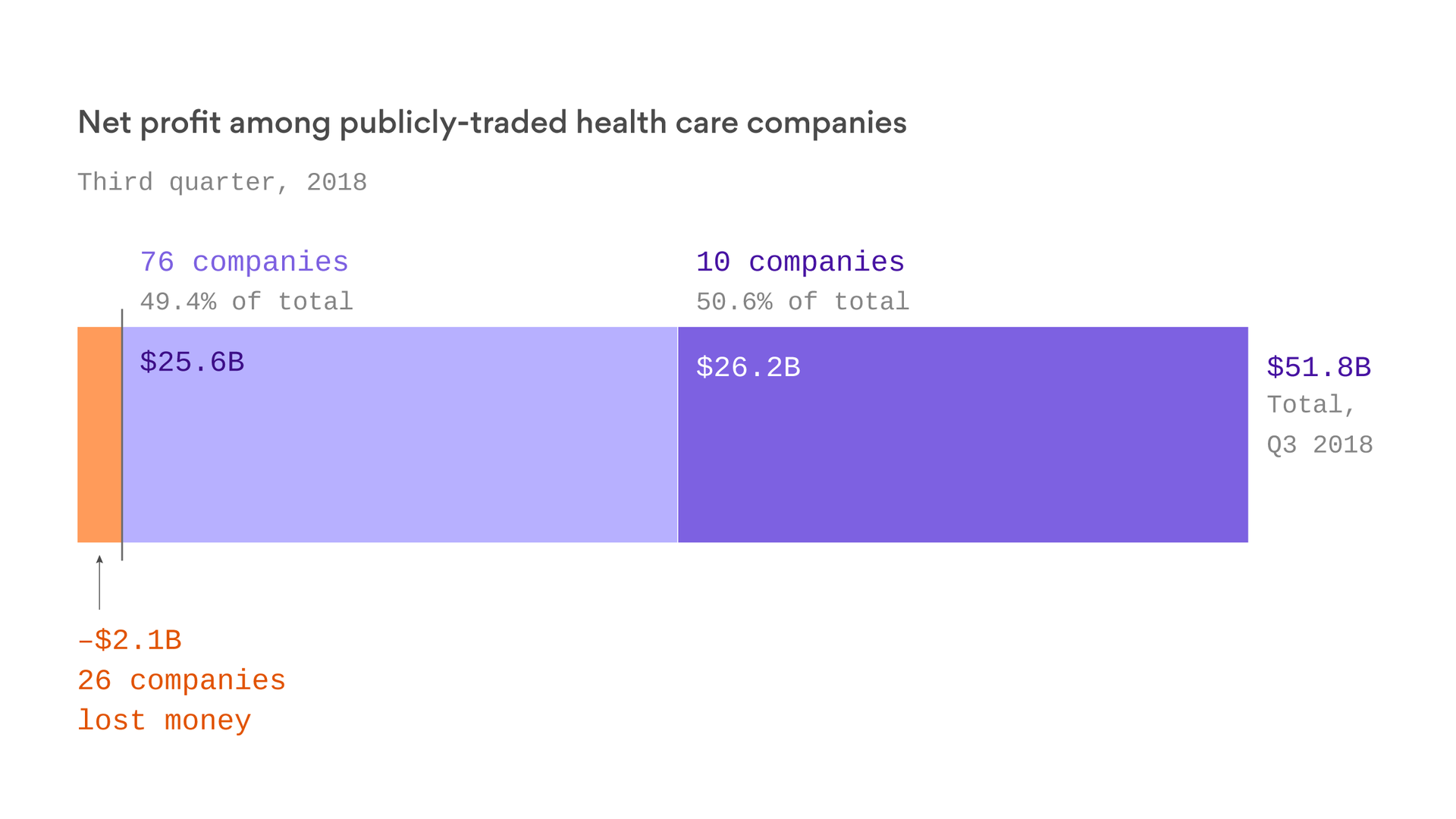
Ten companies controlled half of the health care industry’s $50 billion of global profit in the third quarter of this year, according to an analysis of financial documents for 112 publicly traded health care corporations. Nine of those 10 companies at the top are pharmaceutical firms.

The bottom line: Americans spend a lot more money on hospital and physician care than prescription drugs, but pharmaceutical companies pocket a lot more than other parts of the industry.

By the numbers: The health care industry’s $50 billion of profit came from $636 billion of revenue, equating to a cumulative profit margin of almost 8%. Those are the highest figures of the past four quarters.

  • Approximately 63% of the profit total went to drug companies, even though they collected 23% of the revenue — numbers that mirror our past analyses.
  • Pfizer had the highest profit total ($4.1 billion) of any publicly traded health care company in the third quarter. Pfizer also said it will go back to its “normal” routine of raising drug prices after a public skirmish with President Trump.
  • Of the 19 companies that tallied at least $1 billion of third-quarter profit, 14 were drug companies. The others were either health insurers (UnitedHealth Group and Aetna) or involved in the drug supply chain (Walgreens, CVS Health, Express Scripts).
  • The analysis does not include not-for-profit hospital systems, but early returns still show the biggest systems have a lot of money.

Between the lines: The Republican tax law, which slashed the corporate tax rate, also continues to bolster the industry.

  • Drug firm AbbVie paid $14 million of income taxes on $2.76 billion of pre-tax earnings in the third quarter — an effective tax rate of just 0.5%. Pfizer’s effective tax rate in Q3 was 1.6%.

The big picture: The health care industry arguably has more financial power now than at any point in its history, and a split Congress likely won’t change that in the short term — even though patients are fed up with the system.


How Will the Midterm Elections Impact Healthcare?

https://mailchi.mp/burroughshealthcare/pc9ctbv4ft-1586513?e=7d3f834d2f

Image result for 2018 Midterm Elections Impact Healthcare

With the midterms less than a week away,  a new poll published October 18th by the non-partisan Kaiser Family Foundation got a lot of attention. Over seventy percent of voters say health care is a very important issue in deciding who to vote for. 

But exactly what happens to key healthcare initiatives, especially the Affordable Care Act including expansion of Medicaid in many states—which tends to be more popular among Democratic lawmakers than Republicans–depends on whether it’s the Democrats or Republicans who get control of the House, says Eric Feigl-Ding, MPH, Ph.D., a health economist and visiting scientist at the Harvard Chan School of Public Health in Cambridge, Mass.

Based on multiple polls, the New York Times reported on October 23 that a likely outcome is that Democrats will gain the majority in the House of Representatives and the Republicans will keep the majority in the Senate. But the Times and many other news outlets continually point out that many factors including the news of each day make it difficult to predict the outcome.

Feigl-Ding says having opposing parties in the House, Senate and White House could make it harder to pass national legislation. Changes can still happen to the ACA, however, because the President can continue to make certain executive level decision such as ending the penalty for not having health insurance which he did last year. That change takes effect in 2019.

In terms of new legislation, Feigl-Ding says a split Congress and White House means that passing legislation will be difficult because what comes from the House side, if most members are Democrats in the next sessions, could be more liberal and the corresponding bills from the Senate, likely to remain Republican, could be more conservative. So, says Feigl-Ding, either a bill won’t pass at all, or there will have to be much more of a compromise. “And assuming they would get to compromise is a big assumption, that then requires the president to agree to sign that legislation,” adds Feigl-Ding.

A report this week by strategy and policy group Manatt Health, based in Washington, DC lists the health care issues the firm thinks will dominate in states and the federal government after the elections:

  • The role of Medicaid as either a welfare program or health insurance for low-income Americans: While Democrats generally support continued expansion of Medicaid with no cost or work requirements for low-income adults, Republican governors in a number of states—with the approval of the Trump administration– have introduced premiums, work requirements, increased paperwork and penalties for falling off on requirements those that can keep many adults from applying for or remaining on Medicaid.
  • Differences in states about expanding and stabilizing the Affordable Care Act (ACA) Marketplace or promoting non-ACA coverage: The ACA allows states to open their own health insurance marketplaces or simply offer access to the federal marketplace. According to 2017 data from the National Academy for State Health Policy, more consumers sign up for health care coverage in states that run their own marketplaces
  • Drug prices: According to the Organization for Economic Development, an international forum with 36-member countries, consumers in the U.S. spend just over $1,100 on prescription drugs each year, more than consumers in any other country. President Trump has promised to help lower drug prices and on October 25 he released a plan that would tie some drug prices for patients on Medicare to an index based on international prices. Those prices are often far lower than Americans pay. PhRMA, the largest drug trade association announced its opposition to the plan the same day it was announced.

According to the report what states do will depend on the election outcomes for governors in more than a dozen states and many of those races are as impossible to predict as the Congressional races.

Other important health care issues for 2019-20120 include:

Pre-Existing Conditions 

Listening to ads for some Republicans candidates for Congress makes it appears protecting pre-existing conditions will be a top priority for some Republicans, even among some who voted against them previously. But Feigl-Ding says keeping coverage for preexisting conditions in health insurance plans also requires figuring out how to pay for it. Under the original ACA legislation, the hope was that a financial penalty for not having health coverage would keep more healthy people in the plans—along with the prohibition against letting insurers “cherry pick” only healthy consumers. But that penalty is now gone. “Take that away and you probably can’t sustain the preexisting conditions, says Feigl-Ding.

Medicaid Work Requirements and Other Conditions of Eligibility.

Legal challenges in several states could impact the implementation of work requirements. Some governors have said they’ll cut the number of state Medicaid beneficiaries to save money if work requirements are overturned.

ACA Repeal. Twenty states are challenging the constitutionality of the ACA in Texas v. The U.S., a case that could make it to the Supreme Court.

Association Health Plans and Short-Term Plans. Several Democratic state attorneys general have filed a lawsuit against the administration’s rule promoting association health plans that allow individuals and small businesses to join to purchase health care coverage and short-term plans. The suit argues that the new rules for both avoid protection for people with pre-existing conditions, according to Manatt.

No one has a crystal ball for what will happen, but everyone has hindsight. According to the Manatt report, in 2010 Republicans replaced Democratic governors in eleven states, and all but one of those states ended plans to establish a state-based health insurance marketplace (SBM). In five states where Democrats replaced Republicans, all those states set up those marketplaces.

And whatever the outcome of the 2018 elections, their impact on healthcare may only be short lived. At a foundation briefing on the midterm elections earlier this week Mollyann Brody, Executive Director, Public Opinion and Survey Research at the Kaiser Family Foundation reminded the crowd that “the day the 2018 elections are over the 2020 campaign starts.”

Still the end of the week also brought a glimmer of hope. In response to President Trumps remarks on October 25thabout his administration’s plan to test new drug pricing models in Medicare Part B help to lower drug prices Frederick Isasi, executive director of FamiliesUSA, a liberal leaning health insurance advocacy group, released a statement that said, in part, “I hope this is a serious policy that will be formally proposed and finalized by the Trump administration. If so, it is an important step forward for our nation’s seniors and taxpayers.”


A Little-Known Windfall for Some Hospitals, Now Facing Big Cuts

A Little-Known Windfall for Some Hospitals, Now Facing Big Cuts

Image result for 340B cuts

Most hospitals are nonprofit and justify their exemption from taxation with community service and charity care. But the Trump administration could require some of them to do more to help the poor, and the hospitals that are in the cross-hairs are those benefiting from an obscure drug discount program known as 340B.

The 340B program requires pharmaceutical manufactures to sell drugs at steep discounts to certain hospitals serving larger proportions of low-income and vulnerable people, such as children or cancer patients. The participating hospitals may charge insurers and public programs like Medicare and Medicaid more for those drugs than they paid for them and keep the difference.

By one estimate, the program saved hospitals $6 billion in 2015 alone. The original intent of the program, enacted in 1992, was for hospitals to use the revenue to provide more low-income patients a broader range of services.

Many institutions that serve mostly low-income and uninsured populations say they need the program. “Most nonprofit hospitals have very slim profit margins, and they’ve come to rely on this revenue,” said Melinda Buntin, chairwoman of the Department of Health Policy at Vanderbilt School of Medicine. A hospital lobbying group said that for some rural hospitals, the funding cut “could actually be the difference between staying open and closing.”

But there is concern that 340B has come to include hospitals that don’t need the extra help and are not using its windfall as originally intended.

The program has grown considerably, most recently as a result of an expansion included in the Affordable Care Act. As of 2004, about 200 hospitals benefited from the 340B program; by 2015, over 1,000 were participating. The program now encompasses 40 percent of all hospitals and an even larger number of hospital-affiliated clinics and pharmacies.

It might seem odd to give discounts on drugs to help hospitals offer care to low-income patients. How can we be sure they’ll use the money for that?

An increasing number of hospitals are not.

A study published in JAMA Internal Medicine found that the early participating hospitals were more likely to be located in poor communities with higher levels of uninsured people, to spend more of their budget on uncompensated care, and to offer more low-profit services than hospitals that started participating later.

“The 340B program may produce the results intended at some hospitals,” said Sayeh Nikpay, an assistant professor at Vanderbilt University and a co-author on the study. “But as the program grew, it benefited many hospitals with less need for assistance in serving low-income populations.”

Other research corroborates that hospitals aren’t using the 340B program as intendedA study in The New England Journal of Medicine was unable to find any evidence that profits from 340B have led to more access to care for low-income patients, or reductions in mortality rates among them. Another study in Health Affairs found that 340B hospitals have increasingly expanded into more affluent communities with higher rates of insurance.

The 340B program may have also inadvertently raised costs — for example, by encouraging care in 340B-eligible hospitals that could have been provided less expensively elsewhere. A study in Health Services Research found that hospital participation in 340B is associated with a shift of cancer care from lower-cost physician offices to higher-cost hospital settings.

The program may also encourage providers to use more expensive drugs. The more hospitals can charge insurers and public programs for a drug — relative to how much they have to pay for it under the program — the greater the revenue they receive. They also receive more revenue when the drugs are prescribed more often.

In January, Medicare lowered the prices it pays for 340B drugs by 27 percent. Although this move chips away at how much hospitals can benefit financially, it does little to address how much insurers and individuals pay for prescription drugs or the value they obtain from them. In addition, the move does nothing to increase hospital spending that could help the poor.

It may even harm some health care organizations, leading to lower-quality care at those institutions that are helping the poor. Studies have shown that, by and large, when hospitals lose financial resources, they make cuts that could harm some patients.

This can happen if cuts lead to reductions in workers who perform important clinical functions. A study in Health Services Research found that hospitals cut nursing staff in response to Medicare payment cuts in the late 1990s. Heart attack mortality rates improved less at hospitals that had larger cuts.

Another response to reduced revenue is cuts to specific services, which would harm patients who rely on them. A study by economists from Northwestern’s Kellogg School of Management found that some hospitals that endured financial setbacks during the Great Recession cut less profitable services like trauma centers and alcohol- and drug-treatment facilities.

Another study looked at a 1998 California law that required hospitals to comply with seismic safety standards — imposing a large cost on those institutions, without providing additional funding. Hospitals that were hit harder financially by this law were more likely to close; government hospitals responded by reducing charity care.

Hospitals could absorb cuts without harming care if they could become more productive — by doing more with less. Historically, there is very little evidence they have been able to do that.

Two powerful lobbies are now battling each other, with the pharmaceutical industry arguing that 340B has grown well beyond its original intent. Hospital lobbying groups are fighting back and also squaring off against the government, suing over the planned federal cuts.

Those are big clashes over a program that began modestly a quarter of a century ago to help the poor, albeit in a most convoluted way.