Sutter Health|Aetna adds Stanford Health Care to network

https://www.healthcarefinancenews.com/news/sutter-healthaetna-adds-stanford-health-care-network?mkt_tok=eyJpIjoiWldGbU16WmxOak00TmprMiIsInQiOiIzeGkycUpwcmtPUk42Z2R0b1k4RHd0NUVoY0k3UmE5TktUSkhMUzVtNVVWOWtWY3BhWkdUbjcrZndNS0tZRnA1cWFSajhWdmlZcUc4VE5DbFB4VEZNNkJyYTkyXC9XK3hxZVMwVzhSaVF2ZjZIdUFjbzZwcnF6aGE0UmowZ2w1eHcifQ%3D%3D

Image result for healthcare market consolidation

The joint venture between provider and payer, which launched last year, has grown to about 50 plan sponsors across 15 counties.

Sutter Health|Aetna has added Stanford Health Care to its network of providers.

Sutter Health|Aetna is the joint venture launched last year between the Sacramento, California-based health system and the national insurer. It offers self-insured preferred provider organization health plans to businesses in the Northern California area.

It has grown to about 50 plan sponsors across 15 counties.

WHY THIS MATTERS

This represents another expanded partnership between a provider and payer, though this is in the commercial space.

Other recent partnerships, such as the one announced between Duke Health and Blue Cross Blue Shield of North Carolina, have capitalized on the Medicare Advantage market.

Stanford Health Care recently launched a Medicare Advantage plan with Lumeris called the Stanford Health Care Advantage, in northern California.

The partnerships allow providers and insurers to expand their reach and get access to population health data to lower costs and improve outcomes.
The addition of Stanford Health Care gives Sutter Health|Aetna’s network members in Northern California access to the network’s more than 1,500 specialists and nearly 200 primary care physicians throughout the San Francisco Bay Area.

THE TREND

With the addition of Stanford Health Care, the Sutter Health|Aetna joint venture features two nationally recognized healthcare systems and access to a Northern California network that includes 33 hospitals, more than 1,700 primary care physicians, more than 9,400 specialists, 74 urgent care locations and 25 walk-in clinics.

ON THE RECORD

“The inclusion of Stanford Health Care, with its physicians from across Stanford Medicine, to our high-quality network will not only expand the provider network for our plan sponsors and members, but also provide access to another highly ranked health care system,” said Steve Wigginton, CEO of Sutter Health|Aetna. “This addition will help us in our goal to create a unique offering for Northern California employers and their employees centered around a superior consumer experience and market-leading value.”


The different ways your health care costs are going up

https://www.axios.com/the-different-ways-your-health-care-costs-are-going-up-2471186113.html

Image result for The different ways your health care costs are going up


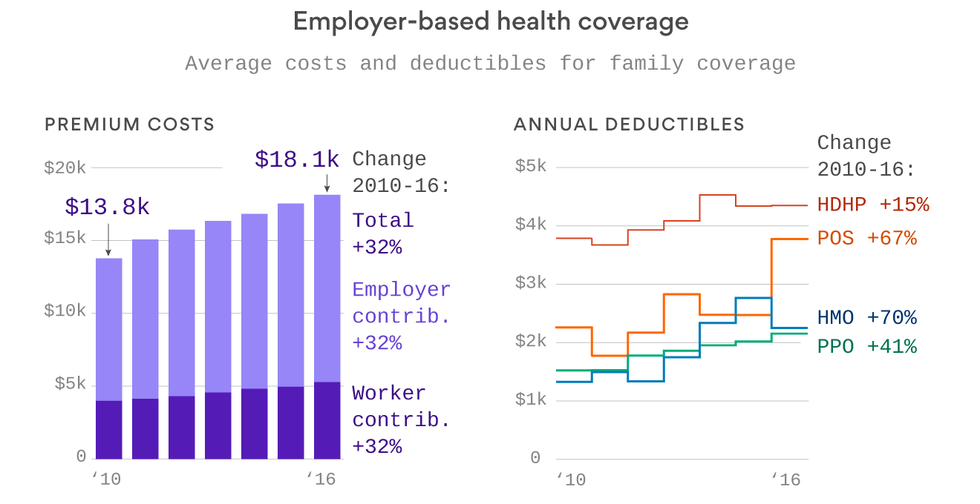
We’ve spent so much time talking about Affordable Care Act costs this year that it’s easy to forget what most people are actually paying for health care — the 156 million Americans who get their health coverage through the workplace. Turns out, most of us aren’t seeing sky-high premium increases. But it’s also worth remembering that deductibles matter too — because that’s what we pay out of pocket before insurance kicks in.

Take a look at these two graphics from Axios datavisuals genius Chris Canipe. The premium increases between 2010 and 2016 weren’t that bad — they’re single digits each year, and just add up over time. But you can see some big increases in deductibles, especially in point-of-service plans and HMOs.

Why it matters: That’s a big reason why people feel their health care costs going up, because it means they’re paying more out of pocket. And when prescription drug prices rise, they’re more likely to feel it directly.

Dynamics of Decline: The Truth About HMOs

http://www.chcf.org/articles/2016/11/dynamics-decline-truth-hmos

California Commercial HMO Enrollment, Kaiser Foundation Health Plan ("Kaiser") vs. Non-Kaiser, 2004-2015

California’s commercial health maintenance organization population shrank from 11.9 million to 9.8 million enrollees between 2004 and 2015 (see figure below), a 17.5% decline. But the decline has not been consistent across all HMOs — Kaiser’s commercial enrollment has actually grown during this period.

Two new publications from CHCF take a closer look at how commercial managed care enrollment (including individual enrollment) and the public sector’s embrace of managed care are shifting the way physician organizations are paid — important trends that could affect California’s delivery system.

The first report, As Commercial Capitation Sinks, Can California’s Physician Organizations Stay Afloat?, by Laura Tollen uses quantitative data and findings from stakeholder interviews to shed light on the extent to which commercial capitation is losing ground in California.

A companion set of charts and graphics compiled by Katherine Wilson provides additional detail on health plan enrollment and changes in HMO participation over the past decade.

It is important to look separately at Kaiser and non-Kaiser enrollment. Kaiser is characterized by a mutually exclusive relationship between the health plan (Kaiser Foundation Health Plan) and its two associated Permanente Medical Groups in Northern and Southern California. While Kaiser is by far the largest HMO in California, the health plan offers capitated contracts only to these two medical groups.

Kaiser HMO enrollment increased from 5.6 million to 6.1 million in the last decade, while commercial HMO enrollment for all non-Kaiser plans plummeted, from 6.3 million in 2004 to the current 3.6 million — a loss of more than 40%.

Uncertain Future

The impact of these trends on the state’s non-Permanente physician organizations is uncertain. While declining commercial capitation has not yet had a big effect on their operations, medical group leaders suspect it will soon, according to interviews. The change in commercial payment methods has been slow enough that their organizations have been able to adapt, repurposing some of their HMO-based infrastructure (utilization management tools, for example) for value-oriented payment programs that are FFS-based, such as private accountable care organizations (ACOs).

Among the other findings from the interviews were:

  • Declining capitation and rising fee-for-service will not influence individual physicians’ clinical decisions. All interviewees noted that their organizations’ strong culture of providing high-value care would prevent them from fundamentally changing the way they practice, regardless of payment type.
  • Despite commercial trends, capitation from Medicare Advantage and Medi-Cal managed care plans is on the rise. However, neither of these types of capitation is seen as a substitute for commercial capitation in terms of supporting infrastructure. While the perception is that Medicare Advantage capitation rates are generous, there is also recognition that these patients are costly. Interviewees said Medi-Cal capitation rates are inadequate.
  • Along with the decline in commercial capitation, interviewees expressed alarm at the large increases they observed in patient cost-sharing requirements. All said they fear that patients will not obtain the care recommended by their providers because of high out-of-pocket costs, and some said they already see this happen frequently.

Why This Matters

As more employers shift coverage from HMOs to preferred provider organizations (PPOs) and other non-capitated plans to achieve lower premium rates, they are sacrificing quality and financial protection for employees in exchange for short-term premium savings.

A recent CHCF blog post by Jeff Rideout of the Integrated Healthcare Association highlights the patterns of higher quality / lower cost that distinguish HMO plans in the state (compared to PPOs and other plan types). Large multispecialty physician organizations, which have flourished in California, have a long history and significant expertise in managing risk and coordinating care. These are the very skills that health care purchasers demand from value-based payment programs. Without sufficient infrastructure — which is supported by capitation/prepayment — the foundation of high-value care could crumble.

Given these trends, are employers being penny-wise but pound-foolish in pursuing short-term savings at the expense of longer-term value?


In California, What’s Driving the Variation in Total Cost of Care — Volume or Price?

http://www.chcf.org/articles/2017/02/variation-total-cost-care

Linking Hospital Utilization and Total Cost of Care for Commercially Insured Californians, by Product Type, 2013

As the “repeal and replace” debate continues in Washington over the future of the Affordable Care Act, policymakers considering new legislation should not lose sight of the key concept of the ACA — affordability. High and rising costs are among the most intractable health care issues facing consumers across California and the nation, and any discussion must keep underlying cost drivers at the forefront.

But where should the focus be? At the most elementary level, total health care spending boils down to two main factors: how much care we use (volume, or utilization) and what we pay for that care (price). Teasing out how each factor — utilization or price — contributes to costs is important because cost-control solutions vary depending on the answer.

Across 19 regions in California, the annual risk-adjusted, per capita total cost of care for commercially insured people varies dramatically — from an average high of $5,400 in San Francisco to a low of $3,600 in Kern County, according to 2013 data in the California Regional Health Care Cost & Quality Atlas, a web-based interactive tool produced by the Integrated Healthcare Association (IHA) to monitor cost and quality trends across the state.

Adjusted to reflect differences in population health status, the atlas shows a clear geographic cost pattern. All Northern California regions have higher costs than the statewide average of $4,300, all Southern California regions have lower costs than the state average, and Central California regions have mixed costs.

Three Key Measures

What is driving these differences? Is it variation in per capita utilization, or is it price? While the atlas does not have unit price information, it does include three important hospital utilization measures: emergency department (ED) visits, all-cause readmissions, and inpatient bed days. This allows for basic comparisons of total cost per enrollee vs. three critical measures of utilization. If hospital utilization were driving the overall cost of care, there would be a positive correlation between the cost and utilization measures. However, an analysis of atlas information actually shows the opposite. When considering all commercial health maintenance organization (HMO) and preferred provider organization (PPO) products and regions, cost and volume tend to move moderately in opposite directions.

The quadrant chart below illustrates the relationship between total cost of care and hospital utilization, based on a composite score representing the three utilization metrics. Each orange circle represents a region’s PPO products, and each blue triangle represents a region’s HMO products. With the exception of one outlier region, the data show a moderate negative correlation between hospital utilization and cost. In other words, lower hospital utilization is associated with higher total costs of care.

In the atlas data, total cost of care includes both what the enrollee pays — for example, deductibles and coinsurance — as well as the insurance payments that go to providers. That means cost variation can’t be explained by differences in benefit design among commercial products. Because higher total costs are not driven by greater hospital utilization, and not accounted for by benefit design differences, price seems to be playing a strong role.

There is also an alternative but less likely explanation. Because the atlas only looks at hospital utilization, it’s possible that the total cost of care could be driven by nonhospital utilization as much as the price of care. But because hospital utilization accounts for almost one-third of overall spending on average, it is unlikely that utilization of other services, such as physician and other ambulatory care, has as great an impact on cost variation.

Much of the focus to date on making health care more affordable has involved transferring more financial responsibility to individual patients, the idea being that if consumers have “skin in the game” they will be more discriminating in their care purchases. But if the cost problem is primarily driven by price, which is related to market forces prevalent in a geographic region, is shopping really the solution?

The next version of the atlas, scheduled for release in 2017, will include additional utilization measures and cost information. These will offer a clearer picture of the roles of utilization and price in determining health care costs for commercially insured Californians. Until then the atlas findings stress the need for a better understanding of how pricing differences contribute to total cost variation and encourage us to search for more effective strategies to influence prices as well as utilization.

Healthcare Triage News: Health Care Reform, and the Issues We Face

Healthcare Triage News: Health Care Reform, and the Issues We Face

Image result for Healthcare Triage News: Health Care Reform, and the Issues We FaceImage result for Healthcare Triage News: Health Care Reform, and the Issues We FaceImage result for Healthcare Triage News: Health Care Reform, and the Issues We Face

As we approach the election this fall, it seems like the news media report on little else. Unfortunately, too little news coverage addresses health care reform. That’s wackadoo, because there is still so much to be done to improve the cost, quality, and access for patients within the US health care system.

So let’s talk about the major health policy issues we in the US face. This is Healthcare Triage News.

A parents guide to insurance for college students

http://www.latimes.com/business/la-fi-insurance-college-students-20160818-snap-story.html?utm_campaign=CHL%3A+Daily+Edition&utm_source=hs_email&utm_medium=email&utm_content=33162087&_hsenc=p2ANqtz–oGMdL54bGWmXuheSaar3exrxVK9X6tFYcawqTveZbG4oIT-peCnS7CSZ_NVuEy9ojjYFtMushXGqBCzJ9QZT3sjObyA&_hsmi=33162087

College student

Saying the last goodbye in the dorm parking lot, you realize more than ever that you can’t protect your child from every risk. It’s time to let go.

But back at home, you can assemble a strong financial safety net. Knowing what your current insurance will pay for — and whether you need to buy extra coverage — is a good first step.

Here’s how to evaluate your auto, homeowners, life and health insurance needs as your child heads to college.

Are insurers ditching PPOs?

http://www.healthcaredive.com/news/are-insurers-ditching-ppos/423291/

Insurers that have been offering PPO plans in the healthcare marketplace appear to be cutting back on the number of offerings or eliminating PPOs from the marketplace altogether, leaving consumers with fewer options. Is this becoming an industry-wide trend?

“In the large group market, traditional PPO offerings have been on the decline for the last several years as Consumer Driven Health Plans have gained popularity,” says John Greenbaum, senior vice president and employee benefits practice leader at national insurance brokerage Risk Strategies Company. “In the group market, the move has largely been driven by market concern over the now-delayed Cadillac tax.”

According to Greenbaum, insurers offering products on the public exchanges have curtailed their PPO offerings in favor of high-deductible plans. “Their motivation has been the difficulty of achieving profitability in a regulated market with no ability to underwrite the quality of risk,” he says.

Teri Mullaney, President and CEO of DST Health Solutions, says there are benefits to both payers and consumers to moving away from PPOs:

Brown & Toland leaves Pioneer ACO, declines to join Next Generation

http://www.healthcarefinancenews.com/news/brown-toland-declines-participate-pioneer-next-gen-despite-success?mkt_tok=3RkMMJWWfF9wsRonuqnJde%2FhmjTEU5z16ukvX6%2B%2Fh4kz2EFye%2BLIHETpodcMTcBmPL3YDBceEJhqyQJxPr3MLtINwNlqRhPrCg%3D%3D

Company cites upcoming program changes as reason for exiting the program, despite some success in first three years.

BCBS of MA to expand use of global budgets to PPOs

http://www.healthcaredive.com/news/bcbs-of-ma-to-expand-use-of-global-budgets-to-ppos/375168/?utm_source=Sailthru&utm_medium=email&utm_term=Healthcare%20Dive&utm_campaign=Issue%3A%202015-03-16%20Healthcare%20Dive