


Cartoon – Uninsurable Pre-Existing Condition
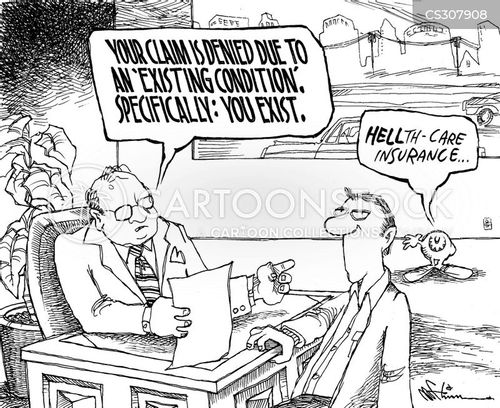


Moderate Republicans are largely withholding their support for the Obamacare repeal bill, arguing it would hurt people with pre-existing conditions
House Republican leaders hoped that the House Freedom Caucus’s endorsement of the latest Obamacare repeal bill would light a fire under enough moderates to get their whip count to the 216 votes needed to pass the measure. Instead, the holdouts are digging in, saying that the latest changes only moved the bill to the right and could put more Americans at risk of losing their health insurance.
“My concern has always been and what a lot of us talked about: people with pre-existing conditions, the elderly,” said Rep. Mario Díaz-Balart (R-Fla.). “How this makes the original bill better? Where is the part that is better for the folks I’m concerned about it? I’m not seeing it at this stage.”
Protections for people with pre-existing conditions have only been in effect for seven years, but proven to be one of the most popular and well-known features of the Affordable Care Act. Moderate Republicans are worried about stripping the safeguards without a reliable replacement. If the resistance from moderates holds, it would be enough to block Obamacare repeal in the House — or send the effort back to square one.
GOP leaders have been buttonholing moderates for two days, arguing that the latest changes — drafted by Rep. Tom MacArthur (R-N.J.) with consultation from the House Freedom Caucus — would ensure people with pre-existing conditions wouldn’t be priced out of a reconfigured market, pointing to high-risk pool requirements in state that choose to opt out of Obamacare provisions.
Backers of the repeal measure say the bill protects people with pre-existing conditions, arguing that people with coverage, for instance, can’t be priced out if they maintain it.
But buying into the plan would pose big political risks for centrists in swing districts. Voicing concerns about pre-existing conditions could prevent a tough vote on an issue that Democrats would surely spotlight in the 2018 election.
Several Republican sources say at least some moderates have climbed aboard, but they’re not inclined to say so publicly. House Appropriations Chairman Rodney Frelinghuysen (R-N.J.), who was widely panned by fellow Republicans for not supporting an earlier version of the repeal bill given his high-profile post, is expected to now support it, according to several sources.
Other than Frelinghuysen, there are no moderates who have publicly flipped to support the bill.
Republicans can absorb no more than 22 defections (depending on how many members are seated when the vote is held) from the 238-member Republican conference. The leaders still need fewer than 10 votes, according to several sources.
Rep. Ryan Costello (R-Pa.) said the latest changes to the bill didn’t bring him to a yes.
“Protections for those with pre-existing conditions without contingency and affordable access to coverage for every American remain my priorities for advancing healthcare reform, and this bill does not satisfy those benchmarks for me,” he said in a statement.
Rep. Barbara Comstock (R-Va.), one of the most vulnerable Republicans in 2018, said she is still a no. Rep. Carlos Curbelo of Florida is undecided— he’s still talking with leadership but claims no one is twisting his arm.
“They know better than to pressure me,” he said.
It’s not just traditional moderates who have qualms. Rep. Chris Smith (R-N.J.), who is very conservative on most social issues, is still a no.
Rep. Pete King (R-N.Y.) doesn’t want Obamacare’s Medicaid expansion repealed under the latest GOP plan, but told POLITICO he would vote to move the bill forward and assumes the Senate would restore Medicaid expansion. If the bill were to come back with Medicaid repealed, “it would be a problem,” he said.
The latest changes may have even eroded the support of moderates who backed the earlier repeal bill that was pulled in March. Rep. Adam Kinzinger of Illinois said he’s undecided. Rep. Steve King of Iowa, one of the House’s most conservative members, told reporters he’s undecided now, too.
Rep. Jim Renacci (R-Ohio), who supported the original repeal bill, is undecided but inclined to move the process forward.
“My biggest concern is that we’re changing things based on amendments written in backrooms and not everyone knows what is said and what’s part of the deal,” he said.
Some Republicans just don’t want to talk about it.
Rep. Darrell Issa of California paused to hear a reporter’s question on his vote, then kept walking.
House Republicans are mounting yet another effort to tear down Obamacare and remake the health care system — but the path to delivering on one of the GOP’s longest-standing priorities remains complicated and fraught with uncertainty.
House GOP leadership is working furiously to rally support for its Obamacare repeal bill amid threats of a government shutdown, rebellion within its ranks and dire warnings about the consequences for the nation’s most vulnerable Americans. The Trump administration and Republican leaders contend they’re drawing closer to a deal. Still, the situation is more fluid than ever. Here’s where things stand on the biggest outstanding questions:
Give it to us straight: Is the House going to vote on Obamacare repeal this week?
The official answer is no — at least not yet. The Republican leaders are working behind the scenes to win over enough lawmakers to get the 216 votes they need. They’re not there, and there’s little expectation that enough holdouts will flip in time for a Friday vote.
“We’re going to go when we have the votes,” Speaker Paul Ryan said this morning. “It takes time to do that.”
Republicans can only absorb 22 defections — and preliminary counts suggest there are more than that number either opposed to the bill or still undecided. Most are moderate Republicans still wary of provisions in the bill that would roll back Obamacare’s expansion of Medicaid and give states new opportunities to opt out of some of the health law’s core provisions.
The bill has changed a lot since it was first introduced. What would the latest version actually do?
The core elements of the GOP’s original American Health Care Act remain intact — the measure would eliminate big parts of Obamacare, such as its requirement that everybody purchase health insurance, and it would replace the law’s subsidies with a new set of tax credits to help pay for coverage. Those credits would be less generous than what’s offered under Obamacare, and the amount people would receive is based on their age.
The legislation also would overhaul Medicaid, rolling back its expanded coverage and capping its federal funding.
Originally, Republicans planned to keep several other major Obamacare provisions intact. But the changes proposed by the new Tom MacArthur amendment would let states apply for waivers to opt out of federal requirements that insurance plans cover a minimum set of benefits, and reopen the door to charging more based on a person’s health status under certain circumstances. States that take advantage of that flexibility would have to set up a high-risk pool or some other program to ensure that people would not be priced out of the market.
Those changes were essential to winning support from conservatives who complained that the original bill didn’t go far enough to repeal Obamacare. But that shift also threatens to alienate moderates, who were already nervous about leaving more people uninsured.
Who are these moderates? And what will it take to get them on board?
Many of the Republican holdouts belong to the Tuesday Group, the caucus of some 50 centrist House members. Their opposition was key to the GOP’s last-minute decision to abandon a planned vote on Obamacare repeal last month, and they’re still standing in the way. The moderates’ objections vary, but they essentially have one concern: That the repeal bill would leave far more people uninsured than there are with Obamacare.
So far, it looks like that concern hasn’t yet been addressed. The latest version of the bill would retain the phase-out of Obamacare’s Medicaid expansion and wouldn’t make the tax credits more generous. On top of that, the new state waivers could result in more people seeing higher premiums and fewer benefits. The AHCA’s proponents disagree, maintaining that the legislation would incentivize states to customize the health care system to residents’ needs. But it’s not clear that the argument has won over many centrists.
Exactly how many more uninsured are we talking about under the AHCA?
That’s not clear, and won’t be without an updated estimate from the nonpartisan Congressional Budget Office. The agency’s evaluation of the original bill predicted that 24 million more people would end up without coverage over a decade, than there are with Obamacare — losses that would come largely as a result of the restructuring of Medicaid.
But the legislation has changed several times since then, and the CBO hasn’t had an opportunity to take a second look. In fact, it may not do so until after the House votes, assuming that Republicans bring the bill to the floor in the next couple of weeks. The CBO told lawmakers’ offices that it won’t have time to fully reevaluate the revised bill, according to Democrats, and Republicans already under pressure to show progress on the bill don’t seem worried about plowing ahead without a new score.

The recent U.S. House decision to pull the first iteration of the American Health Care Act (AHCA) off the floor doesn’t necessarily mean efforts to reform health care are at an end. As members of Congress work to develop legislation that will change the current health care system, they must develop policy that ensures people with pre-existing conditions will receive coverage without additional costs in premiums, deductibles or coinsurance for their pre-existing condition.
As it stands, the Affordable Care Act (ACA) prohibits insurers from denying coverage to Americans with pre-existing conditions – no matter how severe or costly their medical care might be. Had the AHCA passed, a new provision would have required that patients with pre-existing conditions maintain continuous coverage without a lapse of more than 63 days.
Theoretically, this provision should ensure all Americans have constant coverage. In reality, however, it’s possible many patients with pre-existing conditions would have difficulty meeting this requirement. For starters, many individuals with chronic conditions, such as spina bifida or sickle cell disease, often earn lower incomes precisely because of their medical needs – which in turn makes it difficult for them to afford meaningful insurance that covers their care. Further, millions of sick patients with chronic diseases rely on Medicaid for coverage. Any health reform legislation must ensure that these patients don’t lose coverage altogether by 2020.
These changes could inflict grave harm on Americans. A recent report from the Department of Health and Human Services estimates that anywhere from 61 million to 133 million non-elderly Americans have pre-existing conditions. All of these Americans could have been denied coverage, or offered coverage at extraordinarily steep prices, had they needed to shop for individual health insurance before 2014, when the ACA’s coverage provisions went into effect. In fact, between 2010 and 2014, the number of uninsured Americans with pre-existing conditions fell by 22 percent – a clear sign of the impact of the ACA’s market reforms.
The ACA is not perfect. Changes such as reducing prescription costs, addressing cost barriers created by high deductible plans and reducing unnecessary administrative burdens on physicians and patients would improve the law.
However, the current law’s provisions like the ban on discriminating against Americans with pre-existing conditions have led to an historically low number of uninsured Americans – estimated at 8.9 percent last November. In turn, that coverage, combined with access to primary physicians, leads to more timely prevention and treatment of disease and, ultimately, improved public health for all Americans.
Family physicians serve on the front lines of our health care system, and we know how important it is that chronically ill patients receive the care the need to get healthy. We have witnessed firsthand the positive effects of the ACA’s prohibition on discriminating against Americans with pre-existing conditions, and we urge our leaders in Washington – both in Congress and in the administration – to continue to protect them.
http://www.commonwealthfund.org/publications/blog/2017/apr/amendment-aca-repeal-and-replace-bill

News outlets report that House Republicans are close to agreeing on an amended version of the American Health Care Act (AHCA), their proposed repeal and replacement of the Affordable Care Act (ACA). The all-important legislative language for the revised bill is not yet available, nor are Congressional Budget Office (CBO) projections of its effects on coverage and the budget, so any analyses are necessarily tentative.
Nevertheless, the summaries leaked to the media offer insight on the amended bill. If accurate, those summaries suggest that the revised AHCA will significantly increase the numbers of uninsured Americans, raise the cost of insurance for many of the nation’s most vulnerable citizens, and, as originally proposed in the AHCA, cut and reconfigure the Medicaid program. The new amendment specifically allows states to weaken consumer protections by, for example, permitting insurers to charge people with preexisting conditions higher premiums.
The amended proposed bill does little to change many provisions of the original AHCA including:
The CBO estimated in March that the combined effects of these provisions would increase the number of people without health insurance by 24 million by 2026. Older Americans would be particularly hard hit by the bill, experiencing much higher premiums relative to the ACA and the greatest coverage losses.
The amendment offers states the option to apply for waivers to reduce ACA consumer protections that have enabled people with health problems to buy private health insurance. States could waive the ban on charging people with preexisting conditions higher premiums, as long as states set up high-risk pools for people with conditions like cancer or heart disease who could no longer afford coverage. States could also change the ACA’s required minimum package of health benefits for health plans sold in the individual and small-group markets.
Despite the fact the federal ban on preexisting condition exclusions would remain under the AHCA, as Tim Jost points out, insurers could reach the same end by not covering services like chemotherapy that sick people need, or by charging very high premiums for individuals with expensive, preexisting problems. In addition, waiving the ACA’s essential benefit requirement could weaken other consumer protections like bans on lifetime and annual benefit limits and caps on out-of-pocket costs.
While states that allowed higher premiums for people with health problems would be required to use a high-risk pool under the amendment, prior research has found that such pools operated by states before the ACA were expensive both for states and for people enrolled in them, and covered only a small fraction of the individuals who would have benefited. An amendment proposed earlier in the month would provide federal funds for a so-called “invisible risk-sharing” program, a hybrid between a high-risk pool and reinsurance for high claims costs, but the allocated funding would likely need to be much higher to have an impact on costs.
The number of states that would apply for these waivers is unknown, but it seems reasonable to expect that many states with governors and legislatures that have opposed the ACA would do so. For a substantial part of the country, therefore, the amendment could seriously undermine the ACA’s protections for people with preexisting health conditions.

Repealing protections for people with pre-existing health conditions could be on Congress’ agenda as early as next week. Facing pressure from the Trump administration, Congress may be ready once again to try to repeal the Affordable Care Act, or ACA. This time around, Congress is discussing including an amendment that would allow insurance companies in the individual market to charge higher rates to consumers based on health status.
Under the deal that was leaked, states would be able to waive protections for pre-existing conditions for any reason, as long as they set up a high-risk pool or participated in a federal risk-sharing program. Before the ACA, all but seven states allowed insurance companies to charge higher premiums to people with pre-existing conditions.
Without pre-existing condition protections, health care would become prohibitively expensive for those who need it most. People with asthma, a relatively minor chronic condition, would face a markup of about $4,000 for coverage, while those with severe illnesses such as heart trouble or cancer would face premiums tens of thousands of dollars above standard rates.
The cost of care varies by state, and health insurance costs do too. The Center for American Progress has estimated the premium surcharges that consumers in each state—and the District of Columbia—would face for five conditions under the new congressional Republican proposal: breast cancer; pregnancy; major depression; diabetes; and asthma. We have also accounted for the federal risk-sharing program that Republicans in Congress have put forward as a means of limiting premium increases. The numbers in the table are the average increases that people currently experiencing the listed conditions would pay on top of the standard rate for health coverage, including the new risk-sharing program.
However, as evidence from before the passage of the ACA shows, insurance companies would also set rates based on previous ailments. More than 130 million nonelderly Americans have pre-existing conditions, and the return of rating on health status would subject them to thousands of dollars of extra expenses for individual market coverage.
Seven states had pre-existing condition protections in place before the ACA: Maine; Massachusetts; New Jersey; New York; Oregon; Vermont; and Washington. We assume that these states would not seek an AHCA waiver to allow rating based on health status and therefore did not calculate health-based surcharges for these states.
During the recent effort to repeal and replace the Affordable Care Act (ACA), some members of Congress and the Trump administration seemed to be experiencing a certain nostalgia for high-risk pools, which operated in 35 states before the ACA was enacted. At a CNN Town Hall Meeting in January, Speaker of the House Paul Ryan responded to a question about coverage for people with preexisting conditions by saying:
We believe that state high-risk pools are a smart way of guaranteeing coverage for people with preexisting conditions. We had a really good one in Wisconsin. Utah had a great one . . . . What I mean when I say this is, about 8 percent of all the people under 65 have that kind of preexisting condition . . . . So, by financing state high-risk pools to guarantee people get affordable coverage when they have a preexisting condition, what you’re doing is, you’re dramatically lowering the price of insurance for everybody else. So, if we say let’s just, as taxpayers—and I agree with this—finance the coverage for those 8 percent of Americans under 65 in a condition like yours, they don’t have to be covered or paid for by their small business or their insurer who is buying the rates for the rest of the people in their insured pool, and you’d dramatically lower the price for the other 92 percent of Americans.
As high-risk pools and other changes to the ACA continue to be debated, it is critical to deconstruct statements such as these and remind ourselves of how high-risk pools really worked and how unaffordable they were. It is important to remember that high rates of uninsurance and lack of affordability for all buyers in the individual market existed before the ACA, even in states with high-risk pools. In addition, policymakers seem to substantially underestimate the number of Americans with preexisting conditions who might be forced to purchase coverage through a high-risk pool if insurers are allowed to deny coverage in the marketplace.
The reality is that high-risk pool coverage was prohibitively expensive and there is little evidence to suggest that the existence of such pools made coverage less costly for others in the individual insurance market. Without substantially more federal funding than currently proposed, these facts are not likely to change. People with preexisting conditions may have “access” to coverage, but most will not be able to afford it and those who can will face limited benefits and extremely high deductibles and out-of-pocket payments.
 HENRY KOTULA