Trump is reading the GOP base wrong on the Affordable Care Act

https://www.axios.com/trump-reading-base-wrong-aca-b6e2521c-d386-4c94-81e8-b018a6aaf3b1.html?utm_source=newsletter&utm_medium=email&utm_campaign=newsletter_axiosvitals&stream=top

Image result for Trump is reading the GOP base wrong on the Affordable Care Act


The only plausible explanation for President Trump’s renewed effort through the courts to do away with the Affordable Care Act, other than muscle memory, is a desire to play to his base despite widely reported misgivings in his own administration and among Republicans in Congress.

Reality check: But the Republican base has more complicated views about the ACA than the activists who show up at rallies and cheer when the president talks about repealing the law. The polling is clear: Republicans don’t like the ACA, but just like everyone else, they like its benefits and will not want to lose them.

The big picture: About three quarters of Republicans still have an unfavorable view of the ACA, and seven in 10 say repealing the law is a top health priority for Congress — higher than other priorities such as dealing with prescription drug costs. And yes, 7 in 10 Republicans still want to see the Supreme Court overturn the law.

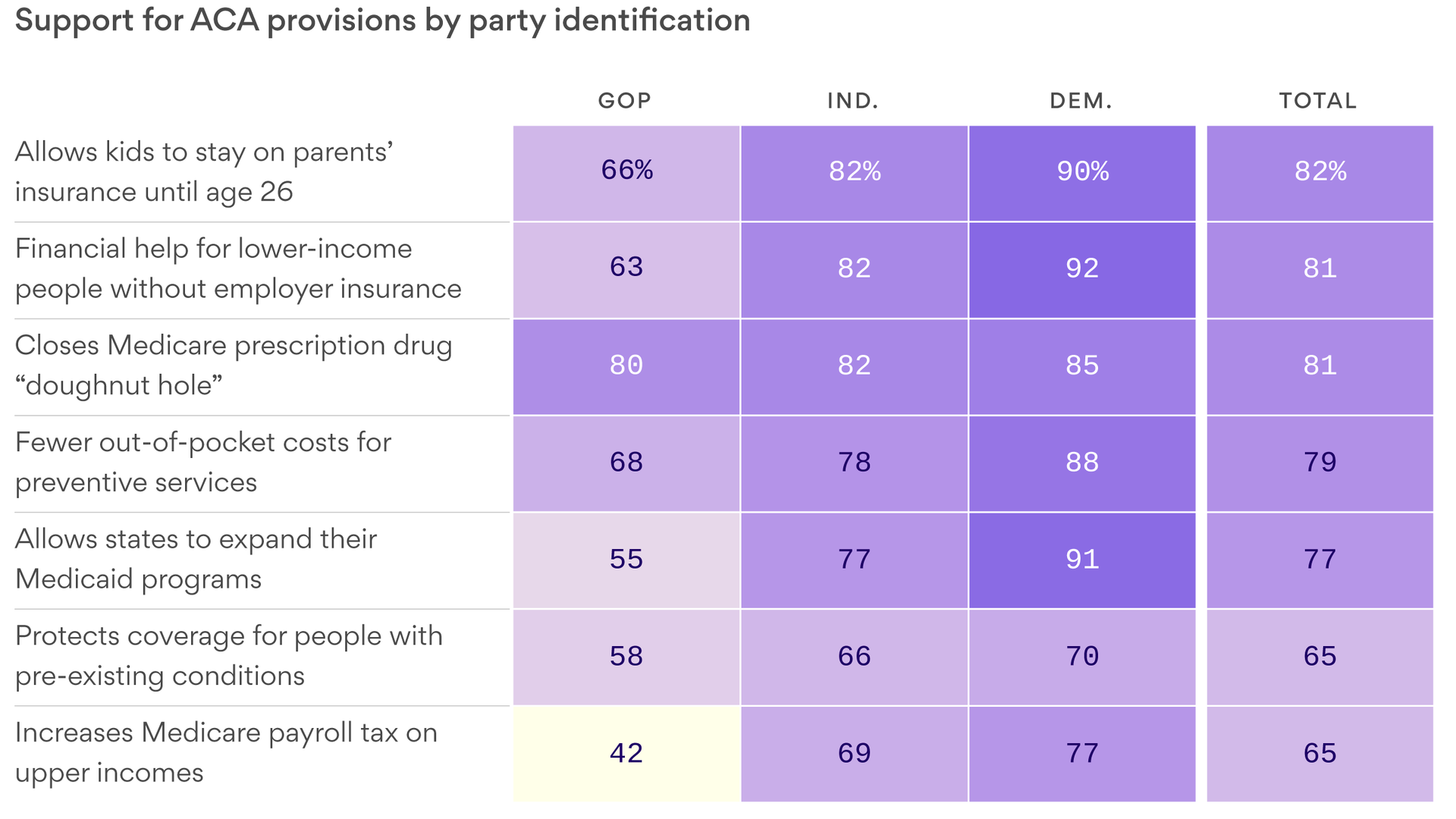
But as the chart shows, majorities of Republicans like many elements of the ACA —especially closing the “donut hole” in Medicare prescription drug coverage (80%), eliminating copayments for preventive services (68%), keeping young adults under 26 on their parents’ plans (66%) and subsidies for low and middle-income households (63%).

  • Nearly half of Republicans want the Supreme Court to keep the protections for pre-existing conditions (49%), and even more show general support for the pre-existing conditions protections (58%).
  • During the repeal and replace debate in 2017, even Republicans were nervous to hear that these sorts of things would go away. The 2020 campaign would drive home to the public, and to Republicans, what they have to lose — and it would become especially real to them if the 5th Circuit Court of Appeals upholds the ruling striking down the ACA.

Maybe Republicans would forget about these lost benefits if they could agree on a replacement plan they liked? But there isn’t one, and many of the ideas thought to be elements of one — such as cutting and block granting both Medicaid and ACA subsidies — are non-starters with Democrats and moderate Republicans on Capitol Hill. They’re unpopular with the public, too. 

The bottom line: It is widely accepted that a renewed debate about repeal hands Democrats a powerful new political opportunity. Deeper in the polling, it’s also clear that’s it’s more of a mixed bag for Republicans than President Trump may realize.  


So, about being the “party of health care”

https://www.axios.com/newsletters/axios-vitals-4b66c0e1-2525-4bb1-a974-f97c9e3e5392.html?utm_source=newsletter&utm_medium=email&utm_campaign=newsletter_axiosvitals&stream=top

Image result for kicking the can

GOP leaders are trying their best to put a lid on President Trump’s talk of a new and wonderful health care plan that would define the Republican Party for 2020.

“Not any longer,” Senate Majority Leader Mitch McConnell said yesterday when asked whether he and Trump differ on health care.

  • McConnell said he spoke to Trump Monday and “made it clear to him that we were not going to be doing that in the Senate.”
  • RNC Chair Ronna McDaniel and Trump campaign manager Brad Parscale also “tried to tell the president they could not understand what he was doing,” The New York Times reports.

Rhetorically, Trump has kicked the can past 2020, just after pushing his administration to dive back into — and escalate — the legal fight that hurt Republicans so badly in 2018.

  • “I wanted to delay it myself,” Trump said in the Oval Office yesterday, denying that McConnell forced his hand. “I want to put it after the election, because we don’t have the House.”

Reality check: It’s still the Justice Department’s position that the courts should strike down the Affordable Care Act. As long as this lawsuit is still active — and that will be a while — it’ll be accurate for Democrats to say on the campaign trail that Trump is trying to end protections for pre-existing conditions.

  • In the short term, Trump’s rhetorical punt to 2021 may dampen the intensity of questions about how Republicans would rebuild a new system for individual coverage — questions the party has struggled to answer for the past 9 years.
  • But in the end, the only good way out is for the Trump administration to lose this case.


The winning health care message will be about out of pocket costs

https://www.axios.com/winning-2020-health-care-out-of-pocket-costs-d5708e35-b308-4c91-a636-121e45f82032.html

Illustration of a wallet full of band-aids

As the 2020 campaign ramps up, Democrats may be able to rally their base by talking about universal coverage and making health care a right through Medicare-for-all. Republicans may be able to motivate their core voters by branding progressive Democratic ideas as socialism.

The catch: But it’s the candidates who can connect their plans and messages to voters’ worries about out of pocket costs who will reach beyond the activists in their base. And the candidates aren’t speaking to that much, at least so far.

By the numbers:

  • The anxiety over out of pocket costs is real. In a January 2017 Kaiser poll, 48 percent of voters worried about paying their health care bills.
  • People who are sick are especially concerned, with 66 percent worried and 49 percent very worried.
  • It isn’t just in their heads: a whopping half of people who are sick have a problem paying their medical bills over the course of a year. The health insurance system is not working for people who are sick.

Thanks in part to the Affordable Care Act, only 10 percent of the population remains uncovered. But that means many Americans are less focused on getting to universal coverage, even though candidate after candidate talks about it. They have insurance and are focused on their own, often crippling health care costs.

  • Most Americans are healthy and don’t use much care, but almost everyone, not just people with a major illness, worries about what might happen if they or a family member get cancer or heart disease or suffer a permanent injury.
  • That’s what fuels health care as an issue: the fear of facing costs people know they cannot afford. And that’s why protections for people with pre-existing conditions broke through as a prominent issue in the midterm election.
  • The debate and the Democratic message could shift back to the ACA again, after President Trump and the Justice Department’s surprise decision to push for throwing out the entire law in the courts. That move handed Democrats a political opportunity they will not ignore: a pre-existing conditions debate on steroids.

Recent trends have made problems with out of pocket costs worse:

Some of the administration’s policies are exacerbating the problem, such as their efforts to push cheaper short term insurance plans for the healthy, which drive up costs for the sick because they leave fewer healthy people in the regular insurance plans to help pay for sick people’s costs.

  • Several of the candidates’ plans address out of pocket costs, including the Bernie Sanders plan, which eliminates them. Their advocates just don’t talk about it much.

The bottom line: It’s hard to see the new debate about the health system breaking out of familiar boxes unless the messaging changes. And when the general election comes, both parties will have to convince voters that they will do something about out of pocket costs if they want to reach beyond core base voters. 


DOJ supports striking entire ACA: 5 things to know

https://www.beckershospitalreview.com/legal-regulatory-issues/doj-supports-striking-entire-aca-5-things-to-know.html

Image result for severability

In a March 25 court filing, the Department of Justice said it supports a judge’s ruling that the entire Affordable Care Act should be invalidated, according to CNN.

Five things to know:

1. In December, a federal judge in Texas held that the ACA is unconstitutional. He sided with the Republican-led states that brought the lawsuit, Texas v. United States, calling for the entire ACA to be struck down because Congress eliminated the healthcare law’s individual insurance mandate penalty.

2. The case is now pending in the 5th Circuit Court of Appeals. In a filing with the appellate court on March 25, the Justice Department said it supports the federal judge’s ruling that invalidated the ACA.

3. “The Department of Justice has determined that the district court’s judgment should be affirmed,” lawyers for the Justice Department wrote to the 5th Circuit Court of Appeals, according to Politico. “[T]he United States is not urging that any portion of the district court’s judgment be reversed.”

4. The filing signals a major shift in the Justice Department’s position. When Jeff Sessions was attorney general, the administration argued only certain parts of the ACA, like protections for people with pre-existing conditions, should be struck down, but the rest of the law could stand, according to CNN.

5. A coalition of Democratic-led states is challenging the Texas ruling. Regardless of the outcome, the 5th Circuit’s ruling is likely to be appealed to the Supreme Court, according to Politico.

Access the full CNN article here.

Access the full Politico article here.


Judge rules Trump AHP expansion unlawful ‘end-run’ around ACA

https://www.healthcaredive.com/news/judge-rules-trump-ahp-expansion-unlawful-end-run-around-aca/551601/

Image result for association health plans

Dive Brief:

  • A federal judge on Thursday struck down a Trump administration expansion of association health plans, which aren’t bound by the requirements of the Affordable Care Act. U.S. District Judge John Bates said the June rule from the Department of Labor that loosened restrictions on what groups could band together to offer AHPs “is clearly an end-run around the ACA.”
  • The ruling stems from a lawsuit 11 states and the District of Columbia filed to challenge the DOL rule. It comes the same week the Trump administration stepped up its attacks against the ACA, arguing in a court filing Monday the law should be eliminated in its entirety following a Texas judge’s decision the act is unconstitutional without the individual mandate penalty.
  • The judge had strong language condemning the administration’s attempt to allow for easier creation and use of AHPs, calling the regulatory change a “magic trick” that allowed for “absurd results” undermining the intent of Congress.

Dive Insight:

The ruling is a blow to the Trump administration’s efforts to circumvent the ACA, which ramped up significantly with the administration’s filing this week seeking complete repeal of the law. Another hit to those efforts came down Wednesday when a different federal judge struck down Medicaid work requirements in Arkansas and Kentucky.

The renewed fight comes as Democrats lining up for a 2020 presidential run are pushing for more progressive policies than have previously gained public traction. Some Democratic contenders are making Medicare for all and other single-payer models a central part of their platforms as healthcare shapes up to be a major issue for the next presidential election.

Experts have argued extended use of AHPs could siphon away young and healthy people looking for minimum coverage at a lower cost. If they choose AHPs they upset the balance on risk pools for more comprehensive coverage. Also, many consumers don’t understand the tradeoff and could be surprised by what isn’t covered when they are in need.

But even though the plans aren’t required to meet ACA standards, some that have formed have been adamant they provide adequate coverage, including the 10 essential ACA benefits. The plans are less obstructive to the regulatory environment than short-term health plans, which have also been granted more leeway under the Trump administration.

Land O’Lakes, for example, which said it was the first to offer an AHP under the more relaxed rules, said its plan covered essential benefits and pre-existing conditions, as well as “broad network coverage.”

The Society of Actuaries has said as many as 10% of people in ACA plans could leave for AHPs, which would also drive up premiums for plans in the individual market. Avalere predicted about 3.2 million people would shift and premiums would rise by 3.5%.

Supporters of AHPs decried the judge’s decision Thursday. Kev Coleman, founder of AssocationHealthPlans.com, said in a statement the ruling will hurt small businesses throughout the country.

“Thousands of employees and family members within the small business community have already enrolled in association health plans — which help lower health care costs — since they first became available last fall,” he said. “They have provided a means by which broad benefits may be accessed at more economical prices. While I do not believe today’s ruling will survive appeal, I believe Judge Bates’ decision is an unnecessary detour on small businesses’ path toward more affordable health coverage.”


Trump’s all-or-nothing gamble

https://www.axios.com/newsletters/axios-vitals-2bc1069a-f66e-4a33-8406-763284c3a0e1.html?utm_source=newsletter&utm_medium=email&utm_campaign=newsletter_axiosvitals&stream=top

The Trump administration’s new legal argument against the Affordable Care Act is a political risk. It may also be a liability in court.

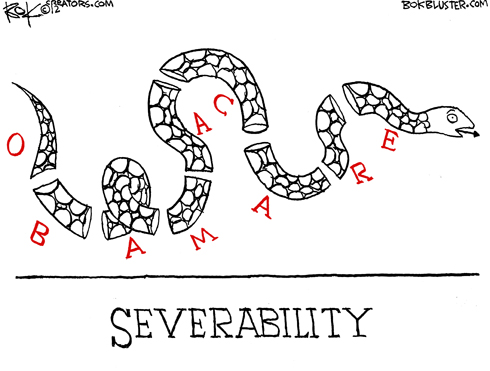
How it works: The legal issue here is “severability” — if the ACA’s individual mandate is unconstitutional, can it be struck down in isolation? Or is it too intertwined with other parts of the law?

Flashback: We’ve seen this movie before — in 2012, at the Supreme Court.

  • According to behind-the-scenes reporting from the 2012 ACA case, four conservative justices wanted to strike down the entire law. Chief Justice John Roberts reportedly wanted to strike down the mandate and protections for pre-existing conditions while leaving the rest intact.
  • But the other conservatives wouldn’t budge, and faced with a choice between upholding or striking down the whole thing, Roberts chose the former.

The Justice Department has now forced that same all-or-nothing decision into the case now pending before the 5th Circuit Court of Appeals.

“There’s no way they were getting Roberts’ vote anyway … but this won’t help,” said Jonathan Adler, a law professor at Case Western Reserve University who helped spearhead a different challenge to the ACA.

  • “It’s contrary to everything he’s ever said and done on severability,” Adler argues.

It may not get that far. “I think the states ultimately lose,” Adler said. “I think the most likely outcome is they lose in the 5th Circuit. If they don’t lose at the 5th Circuit, they will lose at the Supreme Court.”

If that’s what happens, adopting this riskier legal strategy may ultimately be the only thing that saves Republicans from the political nightmare of wiping out 20 million people’s health care coverage with no strategy on how to replace it.

  • I’ll spare you a long list of quotes from President Trump’s trip to Capitol Hill yesterday. Suffice it to say that no, Republicans still do not have a plan for what happens next if they finally succeed in killing the ACA. Some things never change.


Justice Dept. now wants the entire ACA struck down

https://www.axios.com/newsletters/axios-vitals-badd31d3-c5eb-4423-9cfa-b5d6ea8e7daa.html?utm_source=newsletter&utm_medium=email&utm_campaign=newsletter_axiosvitals&stream=top

The Justice Department now wants the courts to strike down the entire Affordable Care Act — not just its protections for people with pre-existing conditions.

This is a stunning escalation, raising both the real-world and political stakes in a lawsuit where both the real-world and political stakes were already very high.

Where it stands: Judge Reed O’Connor ruled in December that the ACA’s individual mandate has become unconstitutional, and that the whole law must fall along with it.

  • At the time, the Trump administration argued that the courts should only throw out the mandate and protections for pre-existing conditions — not the whole law.
  • But in a one-page filing last night, DOJ said the 5th Circuit Court of Appeals should affirm O’Connor’s entire ruling.

Why it matters: If DOJ ultimately gets its way here, the ripple effects would be cataclysmic. The ACA’s insurance exchanges would go away. So would its Medicaid expansion. Millions would lose their coverage.

  • The FDA would lose have the authority to approve an entire class of drugs.
  • The federal government would lose a lot of its power to test new payment models — in fact, the administration is relying on some of those ACA powers as it explores conservative changes to Medicaid.

Politically, this makes no sense. Chuck Schumer and Nancy Pelosi must be dancing in the streets.

  • Health care — specifically pre-existing conditions — was overwhelmingly a winning issue for Democrats in 2018.
  • This lawsuit already had Republicans in an unpleasant bind.
  • Now the administration is doubling down, putting even more people’s coverage on the chopping block.

What they’re saying:

  • “The bad faith on display here is jaw-dropping,” pro-ACA legal expert Nick Bagley writes.
  • “I was among those who cheered the selection of William Barr as Attorney General and hoped his confirmation would herald the elevation of law over politics within the Justice Department. I am still hopeful, but this latest filing is not a good sign,” said Jonathan Adler, a conservative law professor who helped spearhead the last big ACA lawsuit.


The Trump Administration Now Thinks the Entire ACA Should Fall

The Trump Administration Now Thinks the Entire ACA Should Fall

Image result for aca court ruling

In a stunning, two-sentence letter submitted to the Fifth Circuit today, the Justice Department announced that it now thinks the entire Affordable Care Act should be enjoined. That’s an even more extreme position than the one it advanced at the district court in Texas v. Azar, when it argued that the court should “only” zero out the protections for people with preexisting conditions.

The bad faith on display here is jaw-dropping. Does the administration really think that the very position it advanced just month ago is so untenable that it must now adopt an even crazier view?

Much as it may dislike the fact, the Trump administration has an obligation to defend acts of Congress. Absent that obligation, the sitting administration could pick and choose which laws it wants to defend, and which it wants to throw under the bus. Indeed, the decision not to defend is close cousin to a decision not to enforce the law. If the ACA really is unconstitutional, wouldn’t continuing to apply the law would violate the very Constitution that empowers the President to act?

Even apart from that, the sheer reckless irresponsibility is hard to overstate. The notion that you could gut the entire ACA and not wreak havoc on the lives of millions of people is insane. The Act  is now part of the plumbing of the health-care system. Which means the Trump administration has now committed itself to a legal position that would inflict untold damage on the American public.

And for what? Every reputable commentator — on both the left and the right — thinks that Judge O’Connor’s decision invalidating the entire ACA is a joke. To my knowledge, not one has defended it. This is not a “reasonable minds can differ” sort of case. It is insanity in print.

Yet here we are. An administration that claims to support protections for people with preexisting conditions has now called for undoing not only the parts of the ACA that protect such conditions, but also the entire Medicaid expansion and parts of the law that shield those with employer-sponsored insurance from punitive annual or lifetime caps. Not to mention hundreds of rules having nothing to do with health insurance, including a raft of new taxes, mandatory labeling of calorie counts at chain restaurants, and rules governing biosimilars.

Maybe you think this level of disdain for an Act of Congress is to be expected from the Trump administration. Maybe it’s too much to process because of Russia and immigration and North Korea. But this is not business as usual. This is far beyond the pale. And it is a serious threat to the rule of law.


The “Medicare for All” Continuum: A New Comparison Tool for Congressional Health Bills Illustrates the Range of Reform Ideas

https://www.commonwealthfund.org/blog/2019/medicare-all-continuum

Medicare for all paperwork

Several 2020 Democratic presidential candidates have called for “Medicare for All” as a way to expand health coverage and lower U.S. health care costs. Replacing most private insurance with a Medicare-like system for everyone has instilled both hope and fear across the country depending on people’s perspective or financial stake in the current health care system. But a closer look at recent congressional bills introduced by Democrats reveals a set of far more nuanced approaches to improving the nation’s health care system than the term Medicare for All suggests. To highlight these nuances, a new Commonwealth Fund interactive tool launched today illustrates the extent to which each of these reform bills would expand the public dimensions of our health insurance system, or those aspects regulated or run by state and federal government.1

The U.S Health Insurance System Is Both Public and Private

The U.S. health insurance system comprises both private (employer and individual market and marketplace plans) and public (Medicare and Medicaid) coverage sources, as the table below shows. In addition, both coverage sources are paid for by a mix of private and taxpayer-financed public dollars.

Most Americans get their insurance through employers, who either provide coverage through private insurers or self-insure. Employers and employees share the cost through premiums and cost-sharing such as deductibles, copayments, and coinsurance. But the federal government significantly subsidizes employer coverage by excluding employer premium contributions from employees’ taxable income. In 2018 this subsidy amounted to $280 billion, the largest single tax expenditure.

About 27 million people are covered through regulated private plans sold in the individual market, including the Affordable Care Act’s marketplaces. This coverage is financed by premiums and cost-sharing paid by enrollees. The federal government subsidizes these costs for individuals with incomes under $48,560.

For 44 million people, Medicaid or the Children’s Health Insurance Program is their primary source of coverage. These public programs are financed by federal and state governments, and small individual premium payments and cost-sharing in some states. In most states, these benefits are provided through private insurers.

Medicare covers 54 million people over age 65 and people with disabilities. The coverage is financed by the federal government along with individual premiums and significant cost-sharing. About 20 million people get their Medicare benefits through private Medicare Advantage plans and most beneficiaries either buy supplemental private insurance or qualify for additional coverage through Medicaid to help lower out-of-pocket costs and add long-term-care benefits.

Millions Still Uninsured or Underinsured, Health Care Costs High

The coverage expansions of the ACA — new regulation of private insurance such as requirements to cover preexisting conditions, subsidies for private coverage on the individual market, and expanded eligibility for Medicaid — lowered the number of uninsured people and made health coverage more affordable for many. But 28 million people remain uninsured and at least 44 million are underinsured. In addition, overall health care and prescription drug costs are much higher in the United States than in other wealthy countries. U.S. health care expenditures are projected to climb to nearly $6 trillion by 2027.

The Medicare for All Continuum

To address these problems, some Democrats running for president in 2020 are supporting Medicare for All. Meanwhile, in Congress, Democrats have introduced a handful of bills that might be characterized as falling along a continuum, with Medicare for All at one end.

As our new Commonwealth Fund interactive tool illustrates, the bills range from adding somewhat more public sector involvement into the system, to adding substantially more public sector involvement. The bills may be broadly grouped into three categories:

  • Adding public plan features to private insurance. These include increasing regulation of private plans such as requiring private insurers who participate in Medicare and Medicaid to offer health plans in the ACA marketplaces, and enhancing federal subsidies for marketplace coverage.
  • Giving people a choice of public plans alongside private plans. These bills include offering a Medicare-like public plan option through the marketplaces, extending that option to employers to offer to their employees, giving people ages 50 to 64 the option to buy in to Medicare, and giving states the option to allow people to buy in to Medicaid. These bills also bring the federal government’s leverage into provider rate-setting and prescription drug price negotiation.
  • Making public plans the primary source of coverage in the U.S. These are Medicare-for-All bills in which all residents are eligible for a public plan that resembles the current Medicare program, but isn’t necessarily the same Medicare program we have today. The bills vary by whether people would pay premiums and face cost-sharing, the degree to which they end current insurance programs and limit private insurance, how provider rates are set, whether global budgets are used for hospitals and nursing homes, and how long-term care is financed. All of the bills in this category allow people to purchase supplemental coverage for benefits not covered by the plan.

Looking Forward

Many Democratic candidates who have called for Medicare for All are cosponsors of more than one of these bills. The continuum of approaches suggests both the possibility of building toward a Medicare for All system over time, or adopting aspects of Medicare for All without the disruption that a major shift in coverage source might create for Americans. We will continue to update the tool as new bills are introduced or refined. Users also can view a comparison tool of other wealthy countries’ health systems, which shows where select countries fall on a continuum ranging from regulated systems of public and private coverage to national insurance programs.