Trump’s Debate Claim On Health Care Costs: It Depends What You Mean By ‘Cost’

http://khn.org/news/trumps-debate-claim-on-health-care-costs-it-depends-what-you-mean-by-cost/

ST LOUIS, MO - OCTOBER 09:  Republican presidential nominee Donald Trump (L) speaks as Democratic presidential nominee former Secretary of State Hillary Clinton listens during the town hall debate at Washington University on October 9, 2016 in St Louis, Missouri. This is the second of three presidential debates scheduled prior to the November 8th election.  (Photo by Win McNamee/Getty Images)

Health care finally came up as an issue in the second presidential debate in St. Louis Sunday night. But the discussion may have confused more than clarified the issue for many voters.

During the brief exchange about the potential fate of the Affordable Care Act, Republican Donald Trump said this: “Obamacare is a disaster. You know it. We all know it. It’s going up at numbers that nobody’s ever seen worldwide. Nobody’s ever seen numbers like this for health care.”

Let’s parse that discussion of costs piece by piece. Because when it comes to health care, there are many different types of costs: those for governments, employers and individuals. And those costs don’t always go up and down at the same time.

First, the federal government’s spending on the Affordable Care Act’s insurance is coming in under budget projections. According to the official scorekeeper, the Congressional Budget Office (CBO), in March, the net cost of the insurance coverage provisions of the law — including tax credits to subsidize some lower-income customers’ premiums and costs for adding people to Medicaid — “is lower by $157 billion, or 25 percent” than the estimate when the law was enacted in 2010.

Much of that is because CBO originally estimated that large numbers of employers would stop providing insurance to workers and send them to the law’s online marketplaces, where many of them would get federal subsidies. That didn’t happen. Medicaid spending increased more than CBO projected, but that was more than offset by the lower spending on tax credits.

What Would A Public Insurance Option Look Like In California?

What Would A Public Insurance Option Look Like In California?

Image result for Health Insurance California Public OptionImage result for Health Insurance California Public Option

The “public option,” which stoked fierce debate in the run-up to the Affordable Care Act, is making a comeback — at least among Democratic politicians.

The proposal to create a government-funded health plan, one that might look like Medicare or Medicaid but would be open to everyone, is being reconsidered at both the federal and state levels.

Amid news that two major insurers were pulling out of Affordable Care Act exchanges, 33 U.S. Senators recently renewed the call for a public option. The idea was first floated, then rejected, during the drafting of the federal health reform law, which took effect in 2010.

Democratic presidential candidate Hillary Clinton includes a public option in her campaign platform, and President Barack Obama urged Congress to revisit the idea in a JAMA article published in August.

Dave Jones, the elected regulator of California’s private insurance industry, endorsed the idea of a state-specific public option in an interview last month with California Healthline, though he did not specify how it might work.
“It would look just like an insurance plan,” except that the state would pay for medical care, potentially set up the network of doctors and hospitals, and make rules about paying providers, Kominski said. Private industry could be involved in these or other aspects of running the health plan, much as they do in Medicare Advantage and managed care Medi-Cal.California may be uniquely poised for a public plan — but the state may not need one, according to Gerald Kominski, Director of the UCLA Center for Health Policy Research.

Creating a public option in California may not be necessary at present, since the state currently has sufficient competition in the private insurance market, Kominski said. But he said policymakers could choose to implement a public option now as a backstop against a potential future scenario in which private insurers scaled back their California plan offerings.

U.S. Uninsured Rate at New Low of 10.9% in Third Quarter

http://www.gallup.com/poll/196193/uninsured-rate-new-low-third-quarter.aspx

Uninsured by Quarter Q3 2016

STORY HIGHLIGHTS

  • Uninsured rate reaches nine-year low
  • Rate down 6.2 points since individual mandate took effect
  • Uninsured rate has dropped most among low-income households, Hispanics

In the third quarter of 2016, 10.9% of U.S. adults were without health insurance, representing a new low in Gallup’s and Healthways’ nearly nine years of trending the rate of uninsured. This is down from 11.9% in the fourth quarter of 2015, before the 2016 open enrollment period that allowed U.S. adults to obtain insurance through the government health insurance exchanges.

The uninsured rate has declined 6.2 percentage points from 17.1% in the fourth quarter of 2013, right before the Affordable Care Act’s requirement that Americans carry health insurance took effect in early 2014.

Results for the third quarter are based on approximately 44,000 interviews with U.S. adults aged 18 and older from July 1- Sept. 30, 2016, conducted as part of the Gallup-Healthways Well-Being Index. Gallup asks 500 U.S. adults each day whether they have health insurance, which, on an aggregated basis, allows for precise and ongoing measurement of the percentage of Americans with and without health insurance.


Understanding the Value of Medicaid

View at Medium.com

Today, Medicaid provides coverage to nearly 73 million people — kids, low-income working adults, seniors, and people with disabilities — making it the nation’s largest insurer.

Hillary Clinton’s Health Care Reform Proposals: Anticipated Effects on Insurance Coverage, Out-of-Pocket Costs, and the Federal Deficit

http://www.commonwealthfund.org/Publications/Issue-Briefs/2016/Sep/Clinton-Presidential-Health-Care-Proposal

Image result for Impact of Hillary Clinton Proposed Reforms on the number of people with insurance coverage

Issue: Presidential candidate Hillary Clinton has proposed modifications to the Affordable Care Act to limit consumers’ out-of-pocket health spending.

Goal: We analyzed four of these policies—cost-sharing tax credits to offset spending above 5 percent of income; reduced premium contributions for marketplace enrollees; a fix to the ACA’s “family glitch,” which leaves some families with expensive employer coverage; and the introduction of a public option on the marketplaces.

Methods: RAND’s COMPARE microsimulation model.

Key findings and conclusions: These policies would increase the number of insured individuals by 400,000 to 9.6 million, and decrease consumers’ health spending relative to current law. Cost-sharing tax credits have the biggest effect—increasing coverage by 9.6 million and decreasing average spending by up to 33 percent for those with moderately low incomes. However, the policies with the largest coverage gains also increase the federal deficit, with impacts ranging from –$0.7 billion to $90 billion.

Donald Trump’s Health Care Reform Proposals: Anticipated Effects on Insurance Coverage, Out-of-Pocket Costs, and the Federal Deficit

http://www.commonwealthfund.org/Publications/Issue-Briefs/2016/Sep/Trump-Presidential-Health-Care-Proposal

Image result for Donald Trump's Health Care Reform Proposals: Anticipated Effects on Insurance Coverage, Out-of-Pocket Costs, and the Federal Deficit

Issue: Republican presidential candidate Donald Trump has proposed to repeal the Affordable Care Act (ACA) and replace it with a proposal titled “Healthcare Reform to Make America Great Again.” Proposed reforms include allowing individuals to deduct the full amount of premiums for individual health plans from their federal tax returns, providing block grants to finance state Medicaid programs, and allowing insurers to sell insurance across state lines.

Goal: To assess how each of these reforms, when implemented individually, would affect insurance coverage, consumer out-of-pocket spending on health care, and the federal deficit in 2018.

Methods: RAND’s COMPARE microsimulation model.

Key findings and conclusions: The policies would increase the number of uninsured individuals by 16 million to 25 million relative to the ACA. Coverage losses disproportionately affect low-income individuals and those in poor health. Enrollees with individual market insurance would face higher out-of-pocket spending than under current law. Because the proposed reforms do not replace the ACA’s financing mechanisms, they would increase the federal deficit by $0.5 billion to $41 billion.

The Health Care Reform Proposals of Hillary Clinton and Donald Trump

http://www.commonwealthfund.org/publications/blog/2016/trump-clinton-presidential-health-care-proposals?utm_medium=Facebook&utm_campaign=Health+Coverage&utm_source=Candidates+Blog

Image result for The Health Care Reform Proposals of Hillary Clinton and Donald Trump

As president, Hillary Clinton and Donald Trump would take the nation down distinctly different paths on health care. In this post, we summarize the health reform proposals of each candidate, and—drawing on new estimates by Christine Eibner and colleagues at RAND Health—compare the proposals’ implications for the total number of people with insurance coverage, people’s out-of-pocket health care costs, and the federal budget.

RAND’s analysis is based on publicly available health care proposals on the candidates’ websites. Where these proposals lacked sufficient clarity for modeling, RAND sought additional information from the campaigns. When answers were not forthcoming, or did not fully resolve questions, RAND made reasonable assumptions that were reviewed and critiqued by independent experts. RAND modeled only those proposals for which it had adequate detail and technical capacity.

The Starting Point

As a starting point, Clinton and Trump propose dramatically different approaches to the Affordable Care Act (ACA): Clinton would maintain the ACA and Trump would repeal it. In estimating the impact of Trump’s proposal, RAND assumes a full repeal of the law including insurance subsidies, expanded eligibility for Medicaid, and individual market reforms such as bans against preexisting condition exclusions. RAND also assumes that repeal would eliminate the ACA’s financing mechanisms such as its Medicare payment reforms and taxes on health plans and medical devices. Consequently, RAND estimates that compared to maintaining the ACA as is, repeal would cause nearly 20 million people to lose their insurance in 2018, increase average premium and out-of-pocket costs for people who buy insurance on their own, and increase the federal deficit. Trump’s repeal of the ACA would increase the federal deficit because the loss of savings from the law’s Medicare reforms and revenues from fees and taxes would be greater than savings from the elimination of insurance subsidies and the Medicaid expansion.

Why the U.S. Needs Medicaid

http://www.commonwealthfund.org/publications/blog/2016/oct/value-of-medicaid?omnicid=EALERT1104254&mid=henrykotula@yahoo.com

Image result for Why the U.S. Needs Medicaid

While most news stories about Medicaid focus on states’ decisions on whether to expand eligibility, the collective impact of the program on beneficiaries, health providers and systems, and state economies is rarely discussed. Given the large share of federal funds devoted to Medicaid, it’s reasonable to assume that policymakers on both sides of the aisle will be considering programmatic or financing changes for the program—or both—early in a new presidential administration. To inform that process, it’s helpful to look at the multifaceted role Medicaid plays in our health system.

When it was signed into law in 1965 as an extension of welfare, few would have anticipated Medicaid would evolve into the nation’s largest health insurer, covering nearly 73 million Americans.1 Today, Medicaid is at the center of the American health care safety net, providing benefits to adults and children otherwise unable to afford care—and helping to support and drive innovation in the hospitals and clinics that treat these patients, as well as supporting state economies.

Medicaid provides people with good insurance. While the program can vary somewhat by state, a growing body of evidence finds that Medicaid provides a comprehensive set of benefits as well as strong financial protections. A 2015 analysis of the Commonwealth Fund Biennial Health Insurance Survey suggests that people with Medicaid coverage have better access to health care services, including proven preventive care, and fewer medically related financial burdens than those who lack insurance (Exhibit 1). The same study found that Medicaid enrollees have nearly equivalent access to care as those with private coverage in many areas.

Value-Based Drug Pricing: Watch Out for Side Effects

http://www.commonwealthfund.org/publications/blog/2016/jul/value-based-drug-pricing

What would penicillin cost under value-based pricing, a system in which drug makers set prices based on the benefits of their products to consumers and the larger society, rather than drugs’ costs of production? Penicillin has saved millions of lives since its first use in 1942, and it still works for many patients despite growing bacterial resistance to the drug. (Fortunately, many fewer patients get infections with pneumococcus now because we have a good vaccine for it.) Surely, under value-based pricing, penicillin would sell for thousands or tens of thousands of dollars a dose.

Medicine depends on many cheap generic drugs like penicillin to treat conditions as diverse as acne, gout, hypertension, heart disease, and cancer. Pricing these drugs according to their value would make them unaffordable to uninsured and underinsured patients and dramatically increase the aggregate costs of pharmaceuticals.

There is a compelling superficial logic to value-based pricing. Why shouldn’t manufacturers charge the full value of the products they produce? Why shouldn’t consumers have to pay it? That logic begins to fray, however, when you think about how other markets work in our capitalist system.

On Medicare But At Risk: A State-Level Analysis of Beneficiaries Who Are Underinsured or Facing High Total Cost Burdens

http://www.commonwealthfund.org/publications/issue-briefs/2016/may/on-medicare-but-at-risk

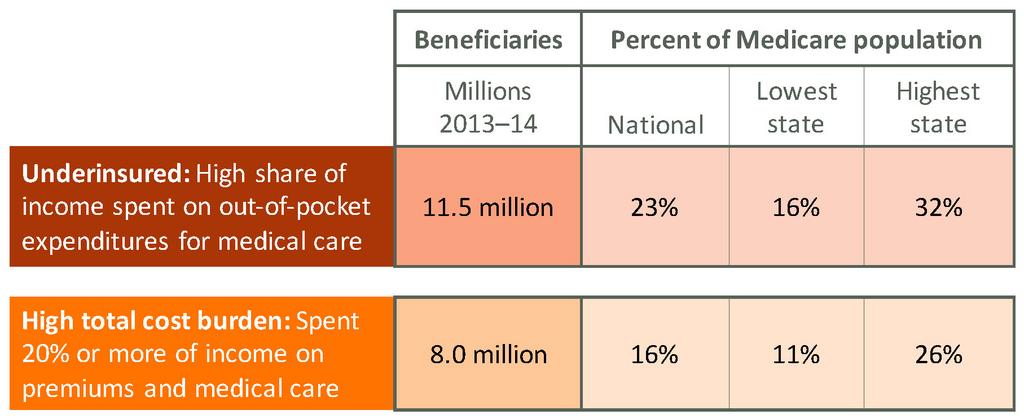
Medicare provides essential health coverage for older and disabled adults, yet it does not limit out-of-pocket costs for covered benefits and excludes dental, hearing, and longer-term care. The resulting out-of-pocket costs can add up to a substantial share of income. Based on U.S. Census surveys, nearly a quarter of Medicare beneficiaries (11.5 million) were underinsured in 2013–14, meaning they spent a high share of their income on health care. Adding premiums to medical care expenses, we find that 16 percent of beneficiaries (8 million) spent 20 percent or more of their income on insurance plus care. At the state level, the proportion of beneficiaries underinsured ranged from 16 percent to 32 percent, while the proportion with a high total cost burden ranged from 11 percent to 26 percent. Low-income beneficiaries were most at risk. The findings underscore the need to assess beneficiary impacts of any proposal to redesign Medicare.