Priced Out of Health Insurance, Americans Rig Their Own Safety Nets

https://www.bloomberg.com/news/features/2018-08-22/priced-out-of-health-insurance-americans-rig-their-own-safety-nets

Risking It: Stories From America's Uninsured

Consumers frustrated by high costs are bypassing the bureaucracy with patchwork plans.

When their son Sky was born four years ago, Lindsie and Chris Bergevin were hit with a big surprise: $7,000 in bills for the birth that their health plan didn’t cover. Sky was two when the couple jettisoned their medical insurance, which helped them eventually pay off the debt.

Now that they’re ready to have a second child, they’re not going back to their old coverage, with its premiums of more than $350 a month. Instead, they’ve patched together an alternative through a religious group and a primary-care doctor whom they can visit anytime for a monthly fee.

“I was so jaded with the whole health-care insurance situation,” Lindsie, 35, says. “I just didn’t want to deal with it.”

The Bergevins, who rent a snug little house near downtown Boise, Idaho, are joining a small but growing number of Americans rigging their own medical safety nets. They’re frustrated by the high costs, opaque pricing, and maddening bureaucracy of health insurance.

In their quest for a different way, they’re meeting doctors like Julie Gunther who are also fed up. These physicians have opted to reject insurance, instead charging patients directly in return for more personalized care.

“I like to think we can protect people in vulnerable moments where they’re going to get lost like a widget,” Gunther said, “because they’re not a widget for us.”
We Want to Hear Your Insurance Story:

Bloomberg News wants to hear about being uninsured in America in 2018 and what it means to you.
Please click here to tell us your story.

Bloomberg News is following people who are uninsured in a year-long effort to tell the story of Americans struggling to afford the rising costs of health care, and the financial and medical trade-offs they make.

No reliable data exist on how many people are replacing insurance with arrangements like the Bergevins’, but the trend appears to be gaining momentum.
The number of people joining so-called health-care sharing ministries—religion-based cost-sharing plans—rose 74 percent from 2014 to 2016, according to the latest Internal Revenue Service data. An alliance for the groups said that more than 1 million people now participate in such programs. Similarly, primary-care clinics like the one Julie Gunther started in 2014 have grown to almost 900 from just a handful in the early 2000s, according to the Direct Primary Care Coalition, a trade group for the clinics.

The number of people without traditional insurance is expected to increase. The Trump Administration lifted the Affordable Care Act’s penalty for those who go without insurance, while also encouraging the growth of lightly regulated products such as short-term health plans. Proponents of Obamacare fear the administration’s actions will draw healthy people out of the ACA marketplaces, raising costs for those who remain.

Though the ACA expanded coverage to 19 million Americans, some of those gains are reversing. About 28 million remain uninsured. A study by the Kaiser Family Foundation, a health-research nonprofit, determined that most uninsured families simply found health insurance too expensive.

The Bergevins are one of those families.
Lindsie is a freelance graphic designer who focuses on clients in the craft industry. Chris, 34, is a supervisor at the auto shop the Bergevins jointly own with another couple. Though the business is growing, things were tight enough that Chris didn’t draw a salary until last summer. Last year, the couple took home from $40,000 to $50,000, after taxes.

In 2014, when Lindsie was pregnant with Sky, the couple still had coverage through her job at the Idaho Statesman newspaper.
A calculator on her Aetna health plan’s website estimated the Bergevins would need to pay about $3,000 or $4,000 out-of-pocket for Sky’s birth. When the total bill came, the sum for prenatal care, hospital costs, anesthesia, and other care was triple the estimate.

They were still paying off Sky’s birth in 2016 when Lindsie had surgery to remove her tonsils and correct a deviated septum, leaving them with several thousands of dollars more in bills.

She put the sum on a CareCredit medical credit card and is paying $300 each month toward that debt.
As the couple thought more about it, maintaining their coverage made little sense. They were falling deeper into medical debt, despite having insurance which itself cost thousands of dollars a year. In 2016, Lindsie left her newspaper job to devote herself full-time to her thriving freelance design business—and they went uninsured.

“I couldn’t justify it,” she says. The cheapest policy she could find through the Affordable Care Act, she recalls, was $547 a month—more than half the family’s $875 monthly rent at the time. It had a high deductible that could leave them with out-of-pocket costs of more than $10,000.

“If something were to happen to us, we would have been in trouble,” she acknowledges. To hedge, the couple bought an inexpensive accident policy from Aflac that would cover some costs from an injury if, for example, Chris hurt himself working.

A friend told them about a small primary-care clinic called SparkMD less than a mile from their house. The doctors didn’t accept insurance. Instead, they charged a monthly fee of $130 per family. That allowed visits as needed without any limits. When Lindsie went to check it out, a physician began with an in-depth conversation about the family’s health.

“It was amazing. She sat down with me for an hour and talked about everything,” Lindsie says.

Gunther, the Bergevins’ new physician, had long wanted to be a family doctor in her hometown. Working for a large hospital system, though, she was soon chafing under a bureaucracy that seemed to make too many of her clinical decisions for her, down to what tools and equipment she could use. Even worse, Gunther was paid based on her volume of patients and services billed.

She saw patients in 15-minute intervals and says she felt like a factory line worker. She’d later joke that she spent longer waiting in line for her morning coffee than she did with a patient.

“I was saying ‘I’m sorry’ all the time,” Gunther, 42, recalls. “I’m sorry I’m late, I’m sorry this didn’t get called in, I’m sorry this got forgotten, I’m sorry they didn’t give me the message.”

Burned out, she quit her job in 2014 and started her own practice. She borrowed about $200,000 to renovate an old red-brick law office on a leafy corner of downtown Boise, a few blocks from one of the city’s big hospital campuses.

Along with a nurse practitioner and a small office staff, she cares for about 600 patients. A typical primary-care doctor carries at least double or triple that load. More than half of Gunther’s patients have health insurance, often in high-deductible plans. Others are small business owners like the Bergevins. Most are disenchanted with the health-care system.

Last year, Lindsie Bergevin had a bad fever and what she described as “the worst pain I think I ever had in my head.” She called Gunther at 9:30 p.m. on a Saturday. Gunther met her at the clinic 15 minutes later. “She’s like, ‘Girl, you have a double ear infection, and the worst I’ve ever seen.’”

Bergevin walked out with an antibiotic and says that if Gunther hadn’t seen her, she would’ve gone to the emergency room, which could have resulted in a bill for hundreds or thousands of dollars.

Gunther tells her patients that belonging to her practice is not a replacement for having health insurance.

“There’s a whole bunch of things I can’t take care of,” Gunther says. “If you’re not standing upright, or bleeding doesn’t stop, do not call me.”

In April, knowing that they wanted to conceive this year, the Bergevins paid to join a Christian nonprofit called Liberty HealthShare. Organizations like Liberty, sometimes called faith-based plans, help like-minded members share some medical costs. To join, members must pledge to adhere to Christian principles. They are required to make fixed payments each month, and the money is disbursed to cover health-care needs for other families.

Though health-sharing ministries function like insurance in some ways, they aren’t regulated by states, don’t have capital requirements to protect against large losses and don’t have to adhere to rules about minimum benefits. They decline to cover medical expenses that result from behavior they deem immoral. They won’t pay medical costs for a drunk driver in a car crash, for example, or for contraception.

There are other restrictions too: Liberty limits coverage of pre-existing conditions for up to three years, according to its guidelines. Members can also get bounced for “failure to fully disclose known or suspected pre-existing condition information” when they join. Those limits are part of the reason why they’re cheaper—and potentially riskier.

The Bergevins originally expected to pay $450 per month for Liberty. Because Lindsie is overweight, they pay a surcharge of $80 per month—a fee regulated insurers are barred from charging. When they joined, their plan had an “annual unshared amount”—the equivalent of a deductible—of $1,500. Two months later, they learned that amount would increase to $2,250. Lindsie wasn’t thrilled, but she calls it “a ton cheaper than a typical deductible.” And on the plus side, Liberty would reimburse them for some of the cost of membership in SparkMD.

In early June, Lindsie sat at her kitchen table with a stack of medical bills going back four years. Sky ran in from the living room, where Dr. Seuss cartoons played on the TV, looking for dessert before he  finished his dinner.

The Bergevins’ improvised plan has pros and cons. They didn’t have to pay premiums for almost two years while they were uninsured, easing their finances significantly while their businesses grew. They love the personalized care they get from Gunther. And their costs for having another child should be capped at a lower level under the Liberty plan.

But between Liberty and SparkMD, the Bergevins pay more than they did for health coverage through Lindsie’s old job, and, she estimates, about as much as Obamacare insurance would cost. The family is still exposed to considerable risk. Liberty caps reimbursements at $1 million—a limit that insurance companies can’t impose. They have two friends who have had cancer, and, Chris says, “a million’s definitely not enough.”

The Bergevins have their fingers crossed that their choices will allow them to expand their family without incurring the kind of debt that Sky’s birth and Lindsie’s surgery left them with. But they know their improvised approach isn’t for everyone.

“It’s not like I’m trying to say, just go without insurance,” Lindsie says. “You have to find something that’s going to work for you.”

Ohio Gov. Kasich Stumps Again In Support Of Medicaid Expansion

https://www.npr.org/sections/health-shots/2018/08/21/640636316/ohio-gov-kasich-stumps-again-in-support-of-medicaid-expansion

Four years after going out on a limb to get Medicaid expansion enacted in Ohio, outgoing Republican Gov. John Kasich is worried about the future of the program. So he is now defending it — through a study and through the stories of people who have benefited from the coverage expansion.

One of those people is Brenda Jean Searcy, a 55-year-old law student who lives with her 93-year-old father in the Columbus suburb of Westerville. She says she had always been healthy but was felled by Lyme disease and then Graves’ disease; the diagnosis of the latter came after she had signed up for Medicaid through the expansion.

“I am very grateful to have Medicaid. It has made my life much better and made me much healthier,” Searcy says at a press conference.
Searcy is one of the 653,000 Ohioans who gained coverage through the Medicaid expansion, four years after Kasich defied his fellow Republican legislators in pushing Medicaid expansion through.

He claimed it would bring $13 billion in federal funding to help low-income people in Ohio get health care — especially those struggling with mental illness and addiction. Kasich is nearing the end of his second term and will leave office in January. He wants the Medicaid expansion to continue, and his Medicaid department commissioned an independent study on the effects of the expansion to support it.

Ohio Medicaid Director Barbara Sears says the analysis shows Medicaid expansion has cut in half the number of uninsured Ohioans. Ninety-six percent of people in the program with opioid addiction got treatment, and 37 percent of smokers were able to quit. One-third reported improved health, including better access to medical care for high blood pressure and diabetes. ER visits went down 17 percent, and there was a 10 percent increase in the number of people seeing primary care doctors. And most recipients said Medicaid expansion made it easier to find work, earn more money and care for their families.

The state’s budget office, part of the executive branch, estimates Medicaid expansion will cost nearly $5.2 billion in 2021, the first year Ohio will pay its full share of the costs as determined by the Affordable Care Act.

Ohio budget director Tim Keen says the state’s projected share would amount to $354.1 million. However, with drug rebates, assessments on managed care plans, a 1 percent tax on premiums and other offsets, the state’s share drops to $163.1 million. “Medicaid expansion is a significantly better deal for the states and for Ohio than the traditional program, and that’s important as one considers our ability to fund this program,” Keen says.

But Republican lawmakers have long had concerns about the program’s cost.

And so does the Republican candidate to replace Kasich, Attorney General Mike DeWine. After stating for months that he feels the Medicaid expansion is financially unsustainable, DeWine says he’ll keep it but makes changes, such as implementing work requirements and wellness programs. DeWine hasn’t made clear how much those changes would save the program – for instance, 96 percent of Medicaid expansion recipients in Ohio would be exempt from work requirements.

Kasich says he has talked to DeWine’s team about supporting the program. “I worry a little bit about somebody kind of nickeling and diming it away somehow — a little bit here, a little bit there — but I think they’ll be for it,”


California Legislature bans short-term health insurance

https://www.sfchronicle.com/business/article/Defying-Trump-California-legislature-bans-13169686.php

Image result for california legislature


The California Legislature has passed a bill banning the sale of short-term health insurance plans — a type of insurance the Trump administration is seeking to expand.

The bill, SB910, authored by State Sen. Ed Hernandez (D-West Covina), was approved by the Senate on Monday and the Assembly last week. It will need the signature of Gov. Jerry Brown to become law.

Short-term plans are generally cheaper but do not need to cover all the benefits required under the Affordable Care Act, such as preventive care, essential health benefits and protections for people with pre-existing conditions. An estimated 10,000 people in California are currently enrolled in such plans.

The U.S. Department of Health and Human Services this month finalized a rule extending the amount of time consumers can be on short-term plans from three months to almost 12 months, after which they can be renewed for up to three years. However, the HHS rule allows states to regulate the sale of such plans on their own terms.

California had long capped the amount of time consumers could be on short-term plans to six months; the Obama administration limited it even further, to three months. Hernandez’s bill eliminates the sale of such plans altogether, for any amount of time.

If Brown signs the bill, California would join a handful of states, including New Jersey, Massachusetts and New York, that have severely restricted or banned short-term plans, according to the California Health Care Foundation.

If the bill becomes law, it would take effect in January 2019. Californians would still be able to buy short-term coverage — if they are in between jobs, for instance — through the state insurance exchange Covered California, or directly from health insurers like Blue Shield or Kaiser. These plans do comply with Affordable Care Act consumer protections like essential health benefits. Consumers would be able to do this at any time during the year, not just during annual enrollment, because losing job-based coverage counts as a qualifying life event.


It’s not just the uninsured — it’s also the cost of health care

https://www.axios.com/not-just-uninsured-cost-of-health-care-cdcb4c02-0864-4e64-b745-efbe5b4b7efc.html

Image result for It's not just the uninsured — it's also the cost of health care

We still have an uninsured problem in the U.S., but we have a far broader health care affordability problem that hits sick people especially hard.

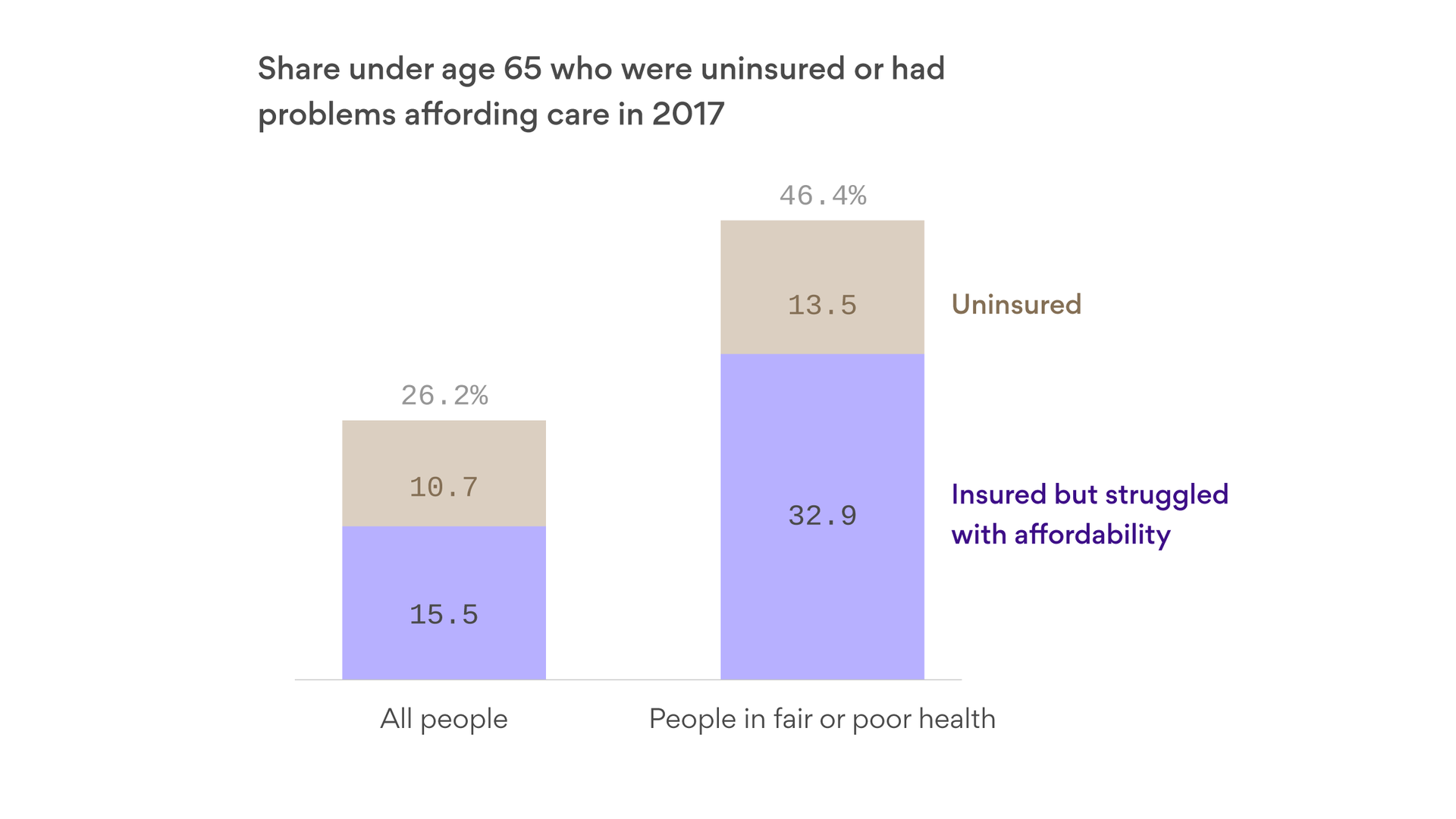
Why it matters: It’s time to think more broadly about who’s having trouble paying for the health care they need. The combination of lack of insurance and affordability affects about a quarter of the non-elderly population at any one time, but almost half of people who are sick.


Now that the Affordable Care Act has expanded health coverage, the percentage of the non-elderly population that is uninsured is now just under 11%, the lowest level ever recorded. But as the chart shows:

  • Another 15.5% who have insurance either skipped or delayed care because of the cost or reported that they or someone in their family faced problems paying their bills in 2017.
  • That brings the total percentage of non-elderly people with insurance and affordability problems to 26.2%.


More striking: nearly half of all people in fair or poor health — 46.4% — are uninsured or have affordability problems despite having coverage.

  • That includes 13.5% who were uninsured and in fair or poor health — arguably the worst off in the entire system — and another 32.9% percent who have insurance but said they or a family member have had a problem affording care in the last year.


It’s not surprising that people who are sicker and need more care would have more problems paying for it. But arguably an insurance system should work best for people who need it the most.


All this says a lot about current health care politics.

  • It helps explain why so many people name health their top issue, despite the progress that has been made in covering the uninsured. And everyone who’s sick and can’t afford medical care has family members and friends who see what they are going through, creating a political multiplier effect.
  • It is also why health care is substantially an economic issue as well as an issue of access to care. When people have trouble paying medical bills, it’s a hard hit to their family budgets — causing many people to take a second job, roll up more debt, borrow money, and forego other important family needs.


For as long as I have been in the field, we have used two measures more than any others to gauge the performance of the health system: the number of Americans who are uninsured and the percentage of GDP we spend on health. Both measures remain valid today.

The bottom line: If we want a measure that captures how people perceive the system when the number of uninsured is down and overall health spending has moderated, we need better ways of counting up the much larger share of the population who are having problems affording care.

And whatever big policy idea candidates are selling, from single payer on the left to health care choices on the right, the candidate who connects that idea to the public’s worries about paying their medical bills is the one who will have found the secret sauce.


Hospital profits in Massachusetts shriveling due to financial pressure

https://www.healthcarefinancenews.com/news/hospital-profits-massachusetts-shriveling-due-financial-pressure?mkt_tok=eyJpIjoiWWpFek9EVm1ZbU5tT0RWaSIsInQiOiI2YVwvTFhvMGpzWkpHSkttMFgrS253RWU5RlNJRE51ZzF0Zkdadjd4MmRKVVwvTUpYZW5qTjF2OU1LQnJcL3hDN1l4aGRnRmo0cWxGZk9CcXBRdm9Ga21iUkNhVG9XVTQ5UFZUbGZpbHRXTUgwcng4M081S3hpQ1dQMCt2N2lCQU5VTyJ9

Image result for hospital profits


Hit especially hard were Massachusetts’ community hospitals, with median operating margins plunging to 0.9 percent.

Acute care hospitals in Massachusetts are turning a profit for the most part, but in many cases those profits are less than robust. The state’s Center for Health Care Information and Analysis found that many are in a financially precarious position.

According to the report, about 65 percent of the commonwealth’s hospitals have operating margins below three percent. Overall, hospitals’ operating margins hovered around 1.6 percent. That’s down from 2.8 percent during the previous fiscal year.

While 49 of 62 hospitals were profitable in the fiscal year ending Sept. 30, many low margins low enough not to be considered financially healthy.

Hit especially hard were Massachusetts’ community hospitals, with median operating margins plunging to 0.9 percent — down two full percentage points from the previous year.

The northeastern part of the state saw the lowest margins geographically, at 1.6 percent, with some facilities operating on negative margins and hemorrhaging cash. North Shore Medical Center in Salem was among the hardest hit, seeing $57.7 million evaporate in fiscal year 2017.

Not all Massachusetts hospitals are feeling those kinds of pressures. Northeast Hospital enjoyed a 9 percent operating margin during the past fiscal year, translating into a $33.1 million surplus.

That the state’s rural hospitals are struggling isn’t surprising, given the national trend. A recent report found that nearly half are operating at negative margins, fueled largely by a high rate of uninsured patients. Eighty rural hospitals closed from 2010 to 2016, and more have shut their doors since.

Aside from the high uninsured rate, a payer mix heavy on Medicare and Medicaid with lower claims reimbursement rates is a contributing factor. More patients are seeking care outside rural areas, which isn’t helping, and many areas see a dearth of employer-sponsored health coverage due to lower employment rates. Many markets are also besieged by a shortage of primary care providers, and tighter payer-negotiated reimbursement rates.


2018 Mid-Term Healthcare Issues

https://www.washingtonpost.com/news/powerpost/paloma/the-health-202/2018/08/15/the-health-202-senate-democrats-stay-focused-on-health-care-even-during-short-august-recess/5b72f0901b326b4f9e90a72c/?utm_term=.2403975557c2

Senate Democrats used their truncated August recess to talk to their constituents about one key issue: Health care. 

And though they are returning to Washington tonight, they have no plans to stop talking about it. 

That’s a remarkable turnaround for Democrats who have been on the defensive about health care for the better part of a decade. Obamacare played a major role in their loss of control of the House in the first midterm election of President Obama’s presidency in 2010. But now, they’re hoping to take back the House and retain their seats in the Senate largely by running on the merits of the Affordable Care Act.

Over their 10-day mini break, Sen. Joe Donnelly (D-Ind.) held a roundtable discussion with voters about health care, as did Sen. Joe Manchin (D-W.Va.), who held his third roundtable this year focused specifically on pre-existing conditions. And Sen. Claire McCaskill (D-Mo.) also met with voters with pre-existing conditions on Tuesday.

“Cutting people off from insurance and making it harder for people to get insurance, we’re all still gonna pay the bill because in America we’re not going to stop people at the door at the emergency room and I’m sorry you don’t have health insurance, we’re gonna let you die,” she said, according to Missourinet.

In Nevada, Democratic Rep. Jacky Rosen, who is hoping to unseat GOP Sen. Dean Heller, also held a public meeting with voters with pre-existing conditions.  Sen. Bob Casey (D-Pa.) met with health care providers and patients to talk pre-existing conditions, and Rep. Kyrsten Sinema (D-Ariz.), who is vying for the open Senate seat there, also met with constituent groups to discuss health care.

“It doesn’t matter which community you are in, health care is the number-one issue that Arizonans are talking about,” Sinema told the Arizona Daily Star. “It is not just Arizonans who don’t have health-care coverage, many of those who are expressing concerns and fear are Arizonans who do have coverage but cannot afford it.”

As campaign cycles go, it’s still early in this one. And the deluge of ads will really heat up come fall. Republicans still see an opening to talk about rising costs of health care and President Trump continues to declare that the ACA is dead. But unlike years past when the GOP could run on an anti-Obamacare message, this year the party is more likely to focus on other issues like tax cuts and job creation. 

It’s harder for GOP candidates to make their case that health care policy is failing in the first election where they are in control of both houses in Congress and the White House. And recent scuttlebutt that Republicans would consider another repeal effort if they held Congress may not be helpful this cycle.

And so Democrats, if August activity is the precursor to the fall campaign, are going all in on health care. 

Earlier this month, the New York Times’ Margot Sanger-Katz had a great anecdote from an event with McCaskill. The senator, who may be in the toughest fight of her career, asked voters to stand if they have a pre-existing condition. There were reportedly few people left in their seats.

The Democrats and the groups who support them have homed in specifically on the warning that if the ACA is struck down, people with pre-existing conditions would lose protection. Notably, McCaskill and Manchin, two of the Democrats’ most vulnerable members, are running against state attorneys general who joined a lawsuit arguing the ACA should be deemed unconstitutional. If the law were struck down, it would take with it protections for people with past and current health conditions.

Before the Senate left, Minority Leader Chuck Schumer (N.Y.)  pledged to keep health care front and center this month in Congress, which is in keeping with Democrats’ election strategy this year.  Schumer’s office declined to show its hand, but on the floor he detailed exactly what the Democrats would be pushing for, including votes to protect people with pre-existing conditions and a Medicare buy-in program. They’re unlikely to get those votes, but that’s all part of the game plan to keep the attention on health care.

“The number one thing Americans want is health care, and we Democrats will spend August recess focusing on that issue, and forcing Republicans to cast votes or deny votes on those important issues,” Schumer said. “It’s a great opportunity, not just for Democrats, not just for Republicans, but for America. We are going to do it.”

The first television ad the campaign arm for the Democrats released in 2017 was about health care. It showed a man selling his car and a woman pawning her engagement ring. Then it cuts to them sitting at the hospital bedside of a sick child.

Most of the heavy ad buys are still to come, but an independent analysis of political ads so far this cycle found pro-Democrat ads have been overwhelmingly about health care.  According to Kantar Media/CMAG data by the Wesleyan Media Project, “An astounding 63 percent of pro-Democratic ads for U.S. House discuss healthcare, and 16 percent contain an explicit statement about being in favor of the Affordable Care Act. U.S. Senate contests are less likely to feature health care, but it is still the top issue, appearing in over a quarter (28 percent) of all ad airings.”

Take Rosen, the congresswoman running against Heller. She has a television ad that shows her talking to voters about their anxieties over the ACA being repealed. She says in the ad that ACA has “real problems,” but repealing it isn’t the answer. 

It’s a strategy divergent from previous years when Democrats were defensive of their support for Obamacare. They’d make macro arguments about the millions of people who would lose coverage without it. But now, with the focus on pre-existing conditions, they’ve found a way to make it personal and accessible for voters. 

“What we’re seeing on the trail is that health care remaining the defining issue of the election and voters are aware and concerned that GOP policies will increase their costs and jeopardize their coverage and voters are preparing to hold GOP candidates accountable on this issue,” said David Bergstein, a spokesman for the Democratic Senatorial Campaign Committee.

When asked, most Republicans will say they support keeping protections for pre-existing conditions. For example, when asked, McCaskill’s opponent, Missouri Attorney General Josh Hawley, said he thinks“insurance companies should be forced to cover pre-existing conditions.”

For his part, Hawley’s first television ad of the campaign was about his work as a clerk on the Supreme Court and accused McCaskill of supporting “liberal activist judges.”

In a press release in response to the ad, McCaskill’s campaign said, “Josh Hawley is suing to strip protections for nearly 2.5 million Missourians with pre-existing conditions.”


Trump’s undermining of Obamacare violates the Constitution, new lawsuit charges

https://www.nbcnews.com/politics/donald-trump/trump-s-undermining-obamacare-violates-constitution-new-lawsuit-charges-n896626

Image: People Sign Up For Health Care Coverage Under The Affordable Care Act During First Day Of Open Enrollment

ASHINGTON — After congressional Republicans repeatedly failed last year to repeal the Affordable Care Act, President Donald Trump promised to “let Obamacare implode” on its own.

A new lawsuit being filed Thursday argues that Trump’s efforts to make good on that promise violate the U.S. Constitution.

Trump has “waged a relentless effort to use executive action alone to undermine and, ultimately, eliminate the law,” the complaint charges, according to a draft obtained by NBC News. The lawsuit is being filed in Maryland federal court by the cities of Baltimore, Chicago, Cincinnati and Columbus, Ohio.

Since Trump’s first executive order directing federal agencies to claw back as much of the Affordable Care Act as possible, his directives have increased health coverage costs and depressed enrollment, the complainants say.

Specifically, the suit argues that Trump is violating Article II of the Constitution, requiring the president to “take care that the laws be faithfully executed.”

“There’s a clear case of premeditated destruction of the Affordable Care Act,” said Zach Klein, Columbus city attorney.

This includes making it easier for individuals and trade groups to purchase coverage outside the law’s insurance markets; threatening to eliminate cost-sharing reduction payments; cutting funding for “navigators,” or those who help individuals enroll in the program; and using federal funds Congress dedicated to implementing the law toward making videos criticizing it.

On Wednesday, Health and Human Services Secretary Alex Azar announced a plan for cheaper, short-term insurance plans, the latest example of actions that critics say will drive up costs on Obamacare exchanges.

During a call-in appearance on Rush Limbaugh’s radio show Wednesday, Trump took credit for all but ending the Affordable Care Act.

“I have just about ended Obamacare. We have great health care,” he said. “We have a lot of great things happening right now. New programs are coming out.”

The suit also relies on a list of Trump’s tweets indicating his intent to unravel the law, according to a lawyer involved in the case.

Constitutional scholars have long debated the extent to which the chief executive must “faithfully” execute U.S. laws under Article II — from Franklin Roosevelt’s objections to legislative veto provisions and Harry Truman’s seizure of steel mills.

Citing the same “take care” clause, Republicans took issue with President Barack Obama’s executive orders on immigration as well as his delayed implementation of the health law.

This case stands apart from all others, says Abbe Gluck, a Yale University law professor and expert on Article II, because it’s not about the extent to which Trump is “faithfully” implementing a law. Rather Trump has been frank that he is sabotaging the law, she said.

“That’s what makes this case novel, first of its kind and really important,” Gluck said. “No scholar or court has ever said the president can use his discretion to implement a statute to purposely destroy it.”

“If there’s ever going to be a violation of the ‘take care’ clause, this is it,” she said.

If successful, the suit would strike down aspects of a Trump rule designed to undercut insurance markets; render a judgment he’s violating his constitutional obligation to enforce the statute; and issue an injunction that he implement the law faithfully.

LOCAL IMPACT

The suit also cites Trump scaling back oversight of insurance issuers, cutting open enrollment in half, urging a federal court to throw out Obamacare’s protections for pre-existing conditions and undermining the individual mandate.

All of these actions, they say, undercut confidence in the program and enrollment, the keys to its success. The whole concept of insurance, whether it’s for cars, homes or people, is to minimize risk by creating a diverse pool — in this case of healthy and unhealthy, young and old participants.

John Yoo, a law professor at the University of California, Berkeley, and former Bush Justice Department official, said a president can’t refuse to enforce a law just because he disagrees with it.

Still, Obamacare was written in a way that gives great leeway to the executive, said Yoo.

“Is there something specific in the statute that he is refusing?” he said, adding that funding reductions don’t qualify. “That’s the constitutional standard,” said Yoo.

In 2017, there was a 37 percent average increase in premiums nationwide, and 3 million more people lacked health insurance than did in 2016. In Columbus, city-subsidized health centers saw almost 3,000 more uninsured patients in 2017. As the uninsured rate increases, Columbus must also pay more for ambulance transports, draining millions of dollars from localities.

“The accumulation of these (acts) has cost Americans thousands of dollars more, and it was done in a way that can be clearly traced” to Trump’s orders, said Andy Slavitt, former acting administrator of the Centers for Medicare and Medicaid under Obama.

The budget strain is also hampering efforts to address the opioid crisis. Ohio has the second-highest drug overdose death rate, according to the Centers for Disease Control and Prevention, with the city of Columbus averaging nine or 10 Naloxone administrations a day to prevent deaths.

“The time for criticism is over,” Klein said. “We have no ability to recoup that money. We just have to eat it due to the Trump administration’s efforts to sabotage the law.”

HEALTH CARE POLITICS

The plaintiffs deny politics play a role in the timing of the suit, which they say they have been building for the past year.

But it will likely serve as a reminder to voters of Trump’s hand in rising premiums just as they are set to skyrocket. Trump’s 2016 campaign platform was built in part on greater economic security for working-class Americans.

Insurance companies are hiking rates in the individual market, citing decisions being made in Washington. And premiums are set to surge in 2019, with a majority of states proposing increases over and above the previous year.

After several elections in which Republicans used Obamacare to attack Democrats, the party says it’s regained the advantage on the health care issue. In the past few years, the Republican-led Congress has voted dozens of times to try and repeal the law, failing each time. “People got to see they (the GOP) have no better alternative,” said Slavitt.

“Most Democrats are saying ‘look we never said the ACA is perfect, but the other person is trying to take away your coverage,” said Slavitt.

Trump’s former Health and Human Services Secretary Tom Price has also faulted Congress’s repeal of the individual mandate for coming premium increases. Further, Trump’s Justice Department is taking aim at Obamacare’s most popular provisions: a ban on insurance companies’ discriminating against individuals with pre-existing conditions.

CONSTITUTIONAL OBLIGATION

The suit seeks to force Trump to adopt policies intended to expand rather than shrink enrollment; reduce rather than increase premiums; and promote instead of attack the ACA.

Among the specific rules plaintiffs seek to reverse are allowing exchanges to strip individuals of tax credits without notification and reducing oversight of insurance agents and brokers, as well as oversight of the law in general.

“What’s insidious here is the administration is doing it knowing that confidence in the act is key to its success,” said Adam Grogg, senior counsel at Democracy Forward and the lead litigator on the case. The fewer Americans who enroll in the program, the more volatile the market, he said.

“The overall picture here is one of sabotage that drives up the rates of uninsured and underinsured and leaves cites and counties holding the bag,” Grogg said.

Four cities are charging that the president is failing to execute the law by actively undercutting the Affordable Care Act.


SHORT-TERM HEALTH PLANS ALLOWED UP TO 3 YEARS

https://www.healthleadersmedia.com/finance/short-term-health-plans-allowed-3-years

A final rule expands access to non-ACA-compliant plans, which the Trump administration has touted as cheaper alternatives to full coverage.


KEY TAKEAWAYS

Only about 200,000 people are expected to exit the ACA exchange market as a result of the final rule.

Gross premiums for marketplace plans are expected to rise 1% next year attributable to this policy change.

The administration notes that ‘these products are not for everyone,’ so buyers should review their options carefully.

Beginning this fall, consumers will be allowed to buy short-term limited-duration health plans renewable for up to three years, the Trump administration announced Wednesday morning with a newly finalized rule.

The policy change expands access to lower-grade coverage options the Obama administration had restricted to three months, without a renewal option, in light of the Affordable Care Act. The looser rules finalized Wednesday allow terms up to 12 months, renewable up to 36 months.

While critics contend the short-term options will pull younger healthier beneficiaries out of ACA-compliant exchange plans, driving up premiums for sicker populations left behind, the administration says any negative effects will be minimal and outweighed by the market benefits of having more options.

James Parker, MBA, a former Anthem executive who serves as director of the Health and Human Services Office of Health Reform and as one of four key senior advisors to HHS Secretary Alex Azar, said the administration doesn’t expect a mass exodus from the ACA exchanges to these short-term options.

“What we do believe, however, is that there will be significant interest in these policies from individuals who today are not in the exchange and, in many cases, have been priced out of coverage as insurance premiums have significantly increased over the past four to five years,” Parker said during a call with reporters Tuesday evening.

Randy Pate, a deputy administrator of the Centers for Medicare & Medicaid Services who oversees individual and small-group markets as director of the Center for Consumer Information and Insurance Oversight, said the administration expects about 600,000 people to enroll in the short-term plans next year as a result of the expanded access. Only an estimated 200,000 will leave the exchange market as a result of the final rule, he said.

This shift is expected to increase gross premiums for marketplace plans by 1% next year, with net premiums decreasing by 6%, Pate said during the call.

  • The wrong direction? When the administration announced its plans earlier this year to expand access to short-term coverage options, American Hospital Association President and CEO Rick Pollack called it “a step in the wrong direction for patients and health care providers.” If consumers are unaware of the limits on their skimpy coverage, it could ultimately drive bad debt for hospitals, he said.
  • Disclosure requirements beefed up: The final rule includes additional language to make sure consumers know what they are buying, Pate said. “We fully recognize these products are not necessarily for everyone, but we do think they will provide an affordable option to many, many people who have been priced out of the current market under the Obamacare regulation,” he said.
  • There’s an opportunity for insurers. As consumers gain interest in their short-term options, insurers will have an opportunity to meet the rising demand. “The impact is going to vary depending on the insurer, whether this is a business they have been in in the past and whether they have been longing to get back into it when consumer interest reached an acceptable level,” Christopher Holt, director of healthcare policy with D.C.-based think tank American Action Forum, told HealthLeaders Media. “There also could be some who see it as a new opportunity to claim a share of the marketplace they’re not reaching.”
  • But insurers have some skepticism. Matt Eyles, president and CEO of America’s Health Insurance Plans, wrote a letter to HHS in April. “We are concerned that substantially expanding access to short-term, limited duration insurance will negatively impact conditions in the individual health insurance market, exacerbating problems with access to affordable comprehensive coverage for all individual market consumers,” Eyles wrote.
  • Trump administration boosters: Beyond simply opening a door to longer short-term plans, the Trump administration has touted these and other non-ACA-compliant options as viable rescue mechanisms for individuals squeezed by rising premiums. Navigators, who have been tasked in past years with helping people sign up for exchange coverage, will now be encouragedto provide information on short-term and association health plans as well.
  • States can block: The final rule released Wednesday addresses the federal government’s definition of short-term limited-duration health insurance, but states retain the authority to impose stricter regulations, Pate said. They can limit or even ban the plans altogether.

While lawmakers seem to have backburnered their aspirations for broad healthcare reform in the near-term, Parker said the administration will continue taking incremental steps to improve affordability of coverage.


Individual market enrollment dropping amid premium increases

Individual market enrollment dropping amid premium increases

Individual market enrollment dropping amid premium increases

Enrollment in the individual health insurance market — the market for people who don’t get coverage through work — has declined 12 percent in the first quarter of 2018, compared to the same period last year, according to a new analysis released Tuesday.

The analysis from the Kaiser Family Foundation showed enrollment in the individual market grew substantially after the implementation of the Affordable Care Act (ACA) and remained steady in 2016, before dropping by 12 percent in 2017.

There were 17.4 million people enrolled in the individual market in 2015, compared to 15.2 million in 2017 and 14.4 million in the first quarter of 2018.

The study notes that much of the decline is concentrated in the off-exchange market, where a number of enrollees are not eligible for ObamaCare subsidies and therefore not protected from significant premium increases in 2017 and 2018.

In this market, enrollment numbers dropped by 38 percent from the first quarter of 2017 to the first quarter of 2018.

The Trump administration last year canceled key ObamaCare subsidies for insurers, leading insurers to increase premiums substantially.

The anticipation of the repeal of ObamaCare’s individual mandate has also contributed to premium increases.

While ObamaCare enrollees who receive subsidies are mostly shielded from these increases, those who don’t are left to pay the full price.

“While the vast majority of exchange consumers receive subsidies that protect them from premium increases, off-exchange consumers bear the full cost of premium increases each year,” the analysis notes.

“In 2017, states that had larger premium increases saw larger declines in unsubsidized ACA-compliant enrollment, suggesting a relationship between premium hikes and enrollment drops.”

Despite the rises in premiums, enrollment in the ObamaCare exchanges has remained stable. There were 10.6 million people on the exchanges in the first quarter of this year, compared to 10.3 million in the first quarter of last year.


California’s ACA Rates To Rise 8.7% Next Year

California’s ACA Rates To Rise 8.7% Next Year

Premiums in California’s health insurance exchange will rise by an average of 8.7 percent next year, marking a return to more modest increases despite ongoing threats to the Affordable Care Act.

The state marketplace, Covered California, said the rate increase for 2019 would have been closer to 5 percent if the federal penalty for going without health coverage had not been repealed in last year’s Republican tax bill.

The average increase in California is smaller than the double-digit hikes expected around the nation, due largely to a healthier mix of enrollees and more competition in its marketplace. Still, health insurance prices keep growing faster than wages and general inflation as a result of rising medical costs overall, squeezing many middle-class families who are struggling to pay their household bills.

The 8.7 percent increase in California ends two consecutive years of double-digit rate increases for the state marketplace.

“It’s not great that health care costs are still increasing that much, but the individual market is not sticking out like a sore thumb like it has in other years,” said Kathy Hempstead, senior adviser at the Robert Wood Johnson Foundation. “It’s falling back to earth.”

The future may be less bright. An estimated 262,000 Californians, or about 10 percent of individual policyholders in and outside the exchange, are expected to drop their coverage next year because the ACA fines were eliminated, according to the state. Peter Lee, executive director of Covered California, warned that the exodus of healthier consumers will drive up insurance costs beyond 2019 — not just for individual policyholders but for California employers and their workers.

“We are paying, in essence, a surcharge for federal policies that are making coverage more expensive than it should be,” Lee said in an interview. “There will be more of the uninsured and more uncompensated costs passed along to all of us.”

Critics of the Affordable Care Act say it has failed to contain medical costs and left consumers and taxpayers with heavy tabs . Nearly 90 percent of Covered California’s 1.4 million enrollees qualify for federal subsidies to help them afford coverage.

Foiled in its attempt to repeal Obamacare outright, the Trump administration has taken to rolling back key parts of the law and has slashed federal marketing dollars intended to boost enrollment. Instead, the administration backs cheaper alternatives, such as short-term coverage or association health plans, which don’t comply fully with ACA rules and tend to offer skimpier benefits with fewer consumer protections.

Taken together, those moves are likely to draw healthier, less expensive customers out of the ACA exchanges and leave sicker ones behind.

Nationally, 2019 premiums for silver plans — the second-cheapest and most popular plans offered — are expected to jump by 15 percent, on average, according to an analysis of 10 states and the District of Columbia by the Avalere consulting firm. Prices vary widely across the country, however. Decreases are expected in Minnesota while insurers in Maryland are seeking 30 percent increases.

In California, exchange officials emphasized, consumers who shop around could pay the same rate as this year, or even a little less.

Christy McConville of Arcadia already spends about $1,800 a month on a Blue Shield plan for her family of four, opting for “platinum” coverage, the most expensive type. Her family doesn’t qualify for federal subsidies in Covered California.

She’s worried about further increases and doesn’t want to switch plans and risk losing access to the doctors she trusts. “We’re getting right up to the limit,” McConville said.

Amanda Malachesky, a nutrition coach in the Northern California town of Petrolia, said the elimination of the penalty for being uninsured makes dropping coverage more palatable. Her family of four pays almost $400 a month for a highly subsidized Anthem Blue Cross plan that has a $5,000 deductible.

“I’ve wanted to opt out of the insurance model forever just because they provide so little value for the exorbitant amount of money that we pay,” said Malachesky, who recently paid several hundred dollars out-of-pocket for a mammogram. “I’m probably going to disenroll … and not give any more money to these big bad insurance companies.”

Covered California is aiming to stem any enrollment losses by spending more than $100 million on advertising and outreach in the coming year. In contrast, the Trump administration spent only $10 million last year for advertising the federal exchange across the 34 states that use it.

Also, California lawmakers are looking at ways to fortify the state exchange. State legislators are considering bills that would limit the sale of short-term insurance and prevent people from joining association health plans that don’t have robust consumer protections.

However, California hasn’t pursued an insurance mandate and penalty at the state level, which both health plans and consumer advocates support. New Jersey and Vermont have enacted such measures.

Lee said it’s up to lawmakers to decide whether a state mandate makes sense.

David Panush, a Sacramento health care consultant and a former Covered California official, said some lawmakers may be reluctant to push the idea, even in deep-blue California.

“The individual mandate has always been the least popular piece of the Affordable Care Act,” he said.

Despite the constant uncertainty surrounding the health law, many insurers nationally are posting profits from their ACA business and some plans are looking to expand further on the exchanges.

In California, the same 11 insurers are returning, led by Kaiser Permanente and Blue Shield of California. Together, those two insurers control two-thirds of exchange enrollment. (Kaiser Health News, which publishes California Healthline, is not affiliated with Kaiser Permanente.)

The Covered California rate increases are fairly uniform across the state. Premiums are climbing 9 percent across most of Southern California as well as in San Francisco. Monterey, San Benito and Santa Cruz counties faced the highest increase at 16 percent, on average.

The rates are subject to state regulatory review but are unlikely to change significantly. Open enrollment on the exchange starts Oct. 15.

The ACA’s expansion of coverage has dramatically cut the number of uninsured Californians. The proportion of Californians lacking health insurance fell to 6.8 percent at the end of last year, down from 17 percent in 2013, federal data show.