


Cartoon – Don’t Bother Replying




Suzanne Richards, CEO of Hahnemann University Hospital in Center City, Pa., and St. Christopher’s Hospital for Children in Philadelphia, is no longer employed at the organizations, according to The Inquirer.
A spokesperson for Paladin Healthcare, the owner of the two hospitals, confirmed to The Inquirer March 7 that Ms. Richards was dismissed. The spokesperson did not comment on the reason for her dismissal.
Ms. Richards assumed the role two months ago, after several years of experience at hospitals in Southern California.
In 2018, Paladin created an affiliate, El Segundo, Calif.-based American Academic Health System, to buy the two hospitals as well as their related operations from Dallas-based Tenet Healthcare. American Academic Health System replaced several top executives at Hahnemann University Hospital after its purchase.
Segment 8 – Applying Our Values & Philosophy to Healthcare Reform

This segment reviews traditional American values and philosophical principles that can help resolve the core dilemma that has stopped us from fixing US healthcare for years – the unresolved conflict between “social justice” and “market justice.”
In the first six Segments, we reviewed the relentless growth of healthcare spending. And how rising costs are literally built into the system as it is now.
In Segment 7 we talked about some landmines that lurk beneath the surface of fixing healthcare – power and politics.
In this Segment, we will look at traditional American values and at philosophical principles that can help us resolve the core dilemma that has stopped us from fixing US healthcare all these years.
Let’s start with the American traditions. Some of these have been a bit romanticized in our imagination. So we’ll look at each of them in more detail.

Freedom of the individual is pretty clear. It brings to mind the pioneer spirit of early adventurers and settlers.

There is a presumption for rugged individualism and against government entanglement. But even by the time of the Revolutionary War and Constitutional Convention growing colonial cities were developing governmental and civic services like fire departments and sanitation programs.
Free enterprise is a core American value. But here again, there are examples from earliest Colonial days of collective projects, such as the Boston Commons, schools, and toll roads that stood alongside freestanding farms and shops.

Next is “Yankee ingenuity.” Americans are entrepreneurs, innovators, practical problem solvers. We have never been bound by tired old ideas from Europe or elsewhere. We come up with our own ideas and forge ahead with progress. We’ll come back to these concepts.
There is an American tradition to distrust government. But if we look more closely at what this meant to the Founding Fathers, it was not government itself that they distrusted. In fact, Americans never embraced anarchy; they always set up orderly civic structures in every settlement and colony. What they abhorred was tyranny, the concentration of power in the hands of a sometimes capricious and self-serving autocrat. Further, they distrusted any individual person wielding authority. And so the Constitutional Framers crafted a government with the right balance between too much and too little authority, separate branches, and checks and balances. Today’s institutions – including healthcare – will do well to build in the same kind of accountability, transparency and checks and balances, especially since so much money and power is involved.
And so I am going to rename this tradition, Distrust of Tyranny (and of Human Fallibility).
Lastly is our tradition to protect under the law outcasts, the weak, and the vulnerable. Colonial settlers were often themselves oddballs or failures, seeking the opportunity for a new life in America. They enshrined protections for themselves in law, notably the Bill of Rights.
Since a large group of Americans today express misgivings that government involvement in healthcare would be a betrayal of our Founding traditions, I would like to offer several more reflections.
Look at the principles listed in the Declaration of Independence and the Preamble to the Constitution – life, liberty and pursuit of happiness.


More perfect union, justice, domestic tranquility, general welfare, and the blessings brought by liberty to ourselves and our posterity. These sound to me like values that would flow from a people who don’t worry about getting care when they become sick, and who willingly embrace practical healthcare reforms that advance the common good. This is a far cry from the notion that the Framers would have wanted to freeze us into their time – 1788, to be exact. I have a feeling that the Founding Fathers were too practical minded, ingenious and adaptable to lock themselves into even their own ideas. Rather, I think they would try to honor American traditions, compromise over seemingly different viewpoints, seek solutions that bring us together and bind us together, promote the common good, and maximize our freedom, wellbeing (or “welfare,” to use their terminology), and stewardship of our great blessings.

Not to belabor this point, but I’d like to look back at Dr. Benjamin Rush, who we met in Segment 2 as a prominent doctor in the Revolutionary period who signed the Declaration of Independence. Recollect that he received his medical training at University of Edinburgh, the foremost medical school of that time, which in the European system was state-run. He supported publicly-funded mental asylums and is considered to be the father of American psychiatry. In 1794 he was inducted as a foreign member of Swedish Academy of Medicine, which is the historic root of Sweden’s modern-day national healthcare system. Rush supported public health and sanitation initiatives, such as rerouting Dock Creek and draining its surrounding swamp on the east side of Philadelphia to eliminate mosquito breeding grounds. He established a public dispensary for low income patients. And he founded the Pennsylvania Prison Society to protect rights of prisoners and promote their humane treatment.

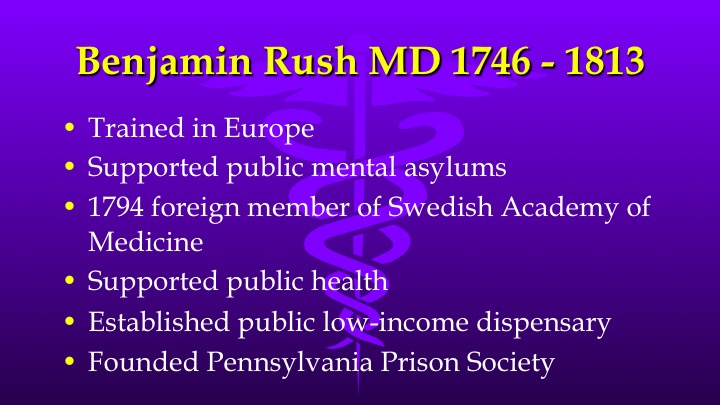
Based on this profile, I don’t think it’s a stretch to believe that this 18th century Founding Father might support innovative public and private partnerships ensuring healthcare for all citizens if a time machine could transport him into the 21st century.
Now let’s now look at what some healthcare philosophers in this century say about fair ways to run the system. The basic principles of healthcare ethics are autonomy (which is self-determination), justice (fair distribution of costs and benefits), beneficence (the most good for all), and professional integrity (meaning that society has a stake in the independence of doctors).

One philosopher who has applied these principles to modern healthcare is Paul Menzel from Pacific Lutheran University in Washington state.

He has been writing on the ethics of the healthcare system since 1983, when he came to Washington DC to apply his philosopher’s methodology to the issue, until his retirement in 2012. Here are his view of the features of a fair system of healthcare delivery and financing.
Two other philosophers, one an ethicist and the other a doctor, have laid out fair, publicly acceptable ways to set limits on healthcare spending. There needs to be:
Let’s end on a key philosophical controversy in the US – market justice versus social justice. Market justice means, in starkest form, that consumers can buy only what they can afford, and that giving them something they have not earned is ethically and economically wrong. Social justice sees equitable distribution of health-care as a societal responsibility, without regard to ability to pay. (Note that I am purposely avoiding the loaded words – “rights” and “privileges,” which tend to inflame this controversy.)
It has been said that progress on healthcare reform is stymied by our country’s inability to choose one or the other – we’ve been caught between the two ideas of justice.
In the next Segment I will ask whether the two sides of the argument can come together. Does it need to be either-or? Or can we blend market justice and social justice? Can the US take what’s best from both the commercial business world and the public sector world?
My answer is Yes. And we’ll look at a successful plan that did just that 20 years ago.
I’ll see you then.
This segment reviews preconditions for having a focused discussion of healthcare reform necessitated by powerful vested interests, and it discusses how to overcome political polarization.
In the first six Segments, we have reviewed the relentless growth of healthcare spending. And how rising costs are literally built into the system as it is now. This review should give us some ideas on how to fix the system.
But before we talk about how to fix the healthcare system, we must first tackle some landmines that lurk beneath the surface. The landmines are power, politics and philosophy. They are the subject of the next 2 Segments.
In this Segment, we will discuss both preconditions necessary for a calm, focused discussion of healthcare reform as well as what I call “loaded” political words. Then in the following Segment we will look at traditional American values and principles that can be brought to bear on resolving the core philosophical dilemma that has kept us from fixing US healthcare all these years.
Let’s start with preconditions. The idea here is that healthcare now comprises 1/6 of the entire US economy. So, there are powerful interests, lots of money, and fierce political convictions that could derail any discussion before it even gets started.
So, I suggest setting preconditions to be agreed on beforehand. Only then can we calmly get into the meat of the discussion. Here are the preconditions.

First, for purposes of discussion, let’s agree to keep dollar spending at the 2017 level – no winners, no losers, everything the same.
Second, let’s keep power the same. Keep the AMA, the hospital association, the VA, Health & Human Services, etc. No power struggles.
Third, strive to keep partisan politics out of the discussion. Make it a joint problem-solving project. Give credit where it’s due: to politicians or policy writers who contribute constructively. The motto is: “U.S. spells us.” Healthcare employs 1/6 of us and touches all of us.
Fourth, here’s where I will insert a viewpoint from my 40 years experience as a doctor: Human beings all get the same illnesses, all suffer, all are interconnected mind/body/spirits. I – like all doctors — have taken care of rich and poor, all races and nationalities, religious and non-religious, social outcasts and VIPs, saints and sinners. In a hospital bed or in the doctor’s office, we’re all the same. We should remember, “We’re all in this together”
Lastly, since healthcare is “too big to fail,” whatever is done should be done deliberately, slowly, with monitoring along the way and mid-course corrections when needed. If we accept these preconditions, we can have a Win-Win Discussion.
This kind of discussion should look at Facts, Goals, Values and lastly Methods, the actual Fix.
We have already discussed the Facts. The key facts are:
– the US health system has grown to 3.2 trillion dollars, representing 1/6 of the entire economy
– Cost growth is built into the system, has always outpaced inflation, and has resisted attempts to restrain the growth
– Healthcare spending is draining vitality from the economy, government and individual household budgets

Here are the key Goals:
– We must stop excess healthcare growth beyond the natural increase expected from population increase, aging, and innovation.
– To do so will require fundamental reform of the system, not just tinkering with public finance and private insurance
– Since healthcare is “too big to fail”, a key goal is Avoid short-term disruption, again proceed slowly.

The last things to discuss before we get to specific Methods – what I am calling the Fix of healthcare – are Politics and Values.
We all know that our country is polarized to an unhealthy extent. This has contributed to political paralysis – not getting anything done. I’m not a political scientist and cannot tackle the whole subject of healthcare politics.
But I do want to look at what I call “loaded words” that creep into our debates on healthcare. These words lock us into a closed, rigid mindset and can shut down discussion.
Let’s look at a few “loaded words” and suggest more neutral words to help keep the discussion open-minded.

First is “socialized medicine.” This terminology stirs up the negative connotations of the so-called “Prussian menace” after World War I and “Red scare” after World War II. A more neutral term would be “publicly financed medicine.” The truth of the matter is that currently almost 50% of healthcare is already publicly financed through Medicare, Medicaid and other government programs. The issues behind the loaded words, which do need thoughtful discussion, are accountability; and also advantages and disadvantages of uniformity and nationwide scale, instead of the current fragmented system.
The next loaded terms are “free market” and “competition.” The connotations are freedom from government interference, freedom from politics, consumer freedom, and efficiency. The grain of truth behind the terms is that the law of supply and demand does drive down prices to a balance point in pure markets. The reality, however, is that healthcare is not a pure market, as we saw in Segment 5. Also, markets sometimes leave aside consumers who are poor or powerless, which includes many of the sick. A more neutral term is commercial market.
Next is “rationing.” The connotation is forcibly withholding something from an individual. A more neutral term is “limit-setting” or “prioritizing.” We will talk more about this in the next Segment, and about the need for patients’ to consent to limits on their health service or health insurance. The reality is that we already have de facto rationing by zip code, income level, government budgeting, and hospital technology policies. Prioritizing is not bad – it’s necessary.

Another loaded word is “choice.” The connotation is that the government will interfere in choice of doctor or into the doctor-patient relationship itself. This was one of the scare tactics used by the insurance association in 1993 to bring down the President Clinton’s health reform plan. But the reality is that insurance network plans restrict patient choice of doctor more than government rules do. In addition, doctor inclusion in Medicaid – and other insurance plans, for that matter — is often a matter of the pay scales set by Medicaid or insurance companies, not the choices made by patients.
And the last loaded term I’ll mention is “big government.” The connotation goes back to President Reagan saying, “Government is not the solution to the problem; government is the problem.” We always hear about the Army’s 100-dollar toilet seats (in 1986 dollars) and the disastrous roll-out of the Obamacare website.

And the truth is that government is big and can be just as flawed as any big institution. However, national government, unlike private companies, is legally transparent and accountable. Also, Government can fulfill some functions more effectively and efficiently than some private sector piecemeal approaches. Here are examples: FAA, FDA, FCC. Currently the military enjoys a high regard. Some examples of public-private partnerships are the moon shot, internet and healthcare research. Medicare has an enviable customer satisfaction rating of 77%.
The reality is that we are now a nation (and world) of big institutions – for-profit, non-profit, government, academic. All have institutional governance and administrative challenges, which are studied by the disciplines of public administration and business administration. Public administration and business administration tell us how best to run big institutions so as to fulfill their mission and to remain accountable and transparent. More neutral terms instead of “big government” are: public sector programs or taxpayer-funded program.
So we have some better neutral terminology to use for discussing healthcare to avoid inflammatory polemical words.
In the next Segment we will look at American values at stake in health care. We will also look at what philosophers say is a fair way to run US healthcare.
I’ll see you then.

After repeatedly trying and failing to repeal the ACA legislatively, President Trump and congressional Republicans have resorted to attacking and weakening the law through executive action, federal waivers to the states to undermine Medicaid expansion, and budget proposals to gut funding levels.
Once again, Trump’s budget proposes massive cuts—$777 billion over 10 years—from repealing the ACA and slashing Medicaid.
Like in his previous two budgets, Trump goes beyond these two measures to attack traditional Medicaid, seeking to restrict federal funding on a per-beneficiary basis or transition to block grant funding. Both of these things would lead to a significant decrease in federal funding and could cause millions of people to lose their health care coverage.
Like in last year’s budget, he encourages states to take Medicaid away from jobless and underemployed Americans, including laid-off workers, people who are going to school, and those who are taking care of children or family members. Medicaid is a lifeline for millions of Americans—including children, veterans, people with disabilities, and individuals affected by the opioid crisis. Tearing down this vital program will make it more difficult for people to access the health care they need to find work, including by preventing people with disabilities from accessing the long-term services and supports they need to participate in the labor market.
After he repeatedly promised to protect Medicare as a candidate, Trump makes changes to Medicare that would shrink the program by $845 billion over the coming decade.
https://www.beckershospitalreview.com/finance/12-health-systems-with-strong-finances-031219.html

Here are 12 health systems with strong operational metrics and solid financial positions, according to recent reports from Moody’s Investors Service, Fitch Ratings and S&P Global Ratings.
1. Dallas-based Baylor Scott & White Health has an “Aa3” rating and stable outlook with Moody’s. The health system has strong cash flow margins, and its favorable demographics will contribute to volume and revenue growth, according to Moody’s.
2. Newark, Del.-based Christiana Care has an “Aa2” rating and stable outlook with Moody’s. The health system has solid margins and a robust balance sheet, according to Moody’s.
3. Durham, N.C.-based Duke University Health System has an “Aa2” rating and stable outlook with Moody’s. The health system is a leading provider of tertiary and quaternary services and has solid margins and cash levels, according to Moody’s.
4. Chicago-based Northwestern Memorial HealthCarehas an “Aa2” rating and stable outlook with Moody’s. Moody’s expects that the health system’s operating model and comprehensive IT systems will enable it to execute growth strategies while maintaining strong margins.
5. Winston-Salem, N.C.-based Novant Health has an “Aa3” rating and stable outlook with Moody’s. The credit rating agency expects Novant to continue generating strong cash flow margins in favorable markets.
6. Boston-based Partners HealthCare has an “Aa3” rating and stable outlook with Moody’s and an “AA-” rating and stable outlook with S&P. The health system has an excellent reputation in the clinical and research spaces, a long track record of fundraising, and adequate balance sheet measures, according to Moody’s.
7. St. Louis-based SSM Health Care has an “AA-” rating and stable outlook with Fitch. SSM has a strong financial profile, and Fitch expects the system to continue growing unrestricted liquidity and to maintain improved operational performance.
8. Appleton, Wis.-based ThedaCare has an “AA-” rating and stable outlook with Fitch. The health system has a leading market share in a stable service area and strong operating performance, according to Fitch.
9. Cincinnati-based TriHealth has an “AA-” rating and stable outlook with Fitch. Fitch expects the health system to maintain good operating ratios, leading to liquidity growth.
10. Iowa City-based University of Iowa Hospitals & Clinics has an “Aa2” rating and stable outlook with Moody’s. The system’s strong brand and position as the only academic medical center in Iowa will continue to translate into strong market share and high patient demand, according to Moody’s.
11. York, Pa.-based WellSpan Health has an “AA-” rating and stable outlook with Fitch. The health system has a leading market position in south-central Pennsylvania and a strong financial profile, according to Fitch.
12. Yale New Haven (Conn.) Health has an “Aa3” rating and stable outlook with Moody’s. The health system has a leading market position in Connecticut, with a broad reach for tertiary and quaternary patients from throughout the state, and strong brand recognition, according to Moody’s.

President Donald Trump released his $4.75 trillion budget for fiscal year 2020 on March 11. The proposal, titled “A Budget for a Better America: Promises Kept. Taxpayers First,” calls for reductions to Medicare and Medicaid over 10 years and includes provisions related to drug pricing and many other health-related issues.
Below are five healthcare-related proposals in the president’s budget:
1. Discretionary funding for HHS. The budget requests $87.1 billion in discretionary spending for HHS, a 12 percent decrease from 2019 funding levels.
2. Efforts to curb HIV. Keeping with President Trump’s promise in his State of the Union address to end the spread of HIV in the U.S. over the next decade, the budget plan calls for HHS to receive $291 million next year to help curb the spread of the virus. A large portion of the funding — $140 million — would go to the CDC to improve diagnosis and testing for HIV in areas of the U.S. where the virus is continuing to infect people not getting proper treatment.
3. Broad overhaul of Medicaid. Under the budget, nearly $1.5 trillion would be cut from Medicaid over 10 years. However, the budget seeks $1.2 trillion over the next decade for block grants or per-person caps that would start in 2021, according to The Washington Post. The budget plan would also end funding for Medicaid expansion.
4. Medicare funding changes. Under the budget, Medicare spending would be reduced by an estimated $800 billion over 10 years. The budget would reduce the growth of various Medicare provider payments and includes changes aimed at addressing waste and abuse in healthcare and lowering drug prices, according to The Washington Post.
5. Medical research. The plan includes a proposal to cut $897 million from the National Cancer Institute’s budget and an additional $1 billion in cuts to other institutes that do medical research, according to Politico.
Read the full budget plan here.
 HENRY KOTULA