Learning to live on Medicare margins

https://mailchi.mp/0ee433170414/the-weekly-gist-february-14-2020?e=d1e747d2d8

Image result for Learning to live on Medicare margins

“If Democrats take back the Senate and win the White House, there’s a good chance they’ll implement some version of a public option or Medicare buy-in, and that would be devastating for the fragile economics of our health system.” That was the message delivered by the CEO of a system we were visiting recently, in her report to the board of directors.

That kind of alarmist message might seem career-limiting, but given the way the politics of healthcare are playing out at both the national and state levels (see Colorado and Washington State), it’s past time for executives to get beyond the rhetoric and begin to prepare for the real financial consequences of public option proposals.

That’s what this CEO had done—what followed the dire warning was a detailed analysis (which we helped assemble) of what would happen in various scenarios—what if one percent of our revenue shifted from commercial rates (around 250 percent of Medicare) to possible public option rates (somewhere between 140 and 180 percent of Medicare)? That’s a knowable number, and you can begin to make assumptions about how much business would shift under different scenarios, and how quickly.

The reality for health systems is that most of the margin comes from the 55-to-65-year-old population—who use more healthcare services but whose care is reimbursed at commercial rates. That cohort cross-subsidizes much of the rest of a typical hospital’s business.

The presentation to the board laid those economic realities out in concise detail—and provided a bracing wake-up call that the system needs to be prepared to live on a different level of margin than they enjoyed in the past.

That means radical cost controls, sharp reductions in “system bloat”, and a laser-like focus on shifting care to lower-cost settings. For years, hospital leaders have tossed around the notion that “we have to learn to live on Medicare margins”.

Given the rising popularity of public option policies (67 percent of Americans support the idea according to a recent poll, as do 42 percent of Republicans), that lesson may need to be learned sooner rather than later.


The attractive economics of Medicare Advantage

https://mailchi.mp/0ee433170414/the-weekly-gist-february-14-2020?e=d1e747d2d8


After years of subsidizing Medicare Advantage (MA) plans in an effort to attract more insurers and beneficiaries to the market, the government has succeeded in its goal: the average beneficiary can now choose from 28 plans in 2020, and recent studies have shown MA plans are outperforming fee-for-service (FFS) Medicare on several key quality measures.

As shown above, this subsidy has decreased in recent years—as mandated by the Affordable Care Act—and per-beneficiary MA payments are roughly equal to those of FFS Medicare. (These numbers may be underreported, however, due to aggressive risk adjustment measures on the part of MA plans.) However, risk-adjusted average Medicare cost per MA beneficiary is actually 13 percent lower than per Medicare FFS beneficiary, due mainly to lower utilization of high-cost services and other efficiencies.

Insurers offering MA plans are profiting from this lucrative “spread.” 

Growth in MA plans in recent years ensures that private insurers will continue to play an important role in the future of Medicare—the most recent projections estimate that 47 percent of Medicare beneficiaries will be in MA plans within a decade.

But inefficiencies in traditional Medicare may not make it the best standard on which to base MA payments. And ultimately, relative MA payment rates will have to continue to drop for the program to sustainably manage the healthcare costs of the gigantic Baby Boom generation.


Appeals court strikes down Trump approval of Medicaid work requirements

Appeals court strikes down Trump approval of Medicaid work requirements

Image result for Appeals court strikes down Trump approval of Medicaid work requirements

A federal appeals court on Friday struck down the Trump administration’s approval of Medicaid work requirements in Arkansas, the latest legal blow to one of President Trump‘s signature health initiatives. 

The U.S. Court of Appeals for the D.C. Circuit affirmed a lower court ruling that the approval of the work requirements was “arbitrary and capricious.

More than 18,000 people lost coverage in Arkansas due to the work requirements before they were halted by a lower court.

The court found that the Trump administration disregarded the statutory purpose of Medicaid — to provide health coverage — and did not adequately account for the coverage losses that would result from the work requirements. 

“Failure to consider whether the project will result in coverage loss is arbitrary and capricious,” Judge David Sentelle, an appointee of President Reagan, wrote in the opinion.

Requiring Medicaid recipients to work or else lose coverage is a top priority of Centers for Medicare and Medicaid Services Administrator Seema Verma. She argues that the policy helps lift people out of poverty by getting them jobs and out of Medicaid into employer-based insurance.

But Democrats and health care advocates have denounced the move, saying it imposes burdensome paperwork requirements on low-income people that cause them to lose coverage even if they are working.

The policy has also faced a string of legal losses, with courts ruling that Congress would need to act to authorize the work requirements. 

Arkansas was the only state where the requirements went into effect before being blocked by the courts. Several other states’ efforts were approved, but the initiatives have been halted as the issue works its way through the courts.

“The Court recognized the tragic harm that these work requirements have caused people in Arkansas doing their best to get ahead,” said Kevin De Liban, an attorney at Legal Aid of Arkansas, which helped challenge the requirements. “Now, more than two hundred thousand Arkansans on the program can rest easier knowing that they’ll have health care when they need it.”

Conservative changes to Medicaid have been a leading priority of the Trump administration, which also recently announced plans to let states block-grant their funding for the program. That move was also denounced by Democrats as inevitably leading to coverage losses and is also likely to be challenged in court.

Kentucky had originally also been part of the work requirement litigation, but a Democratic governor, Andy Beshear, was elected last year and ended the initiative.


Cartoon – I can’t afford that diagnosis

Image result for Cartoon high cost of medical care

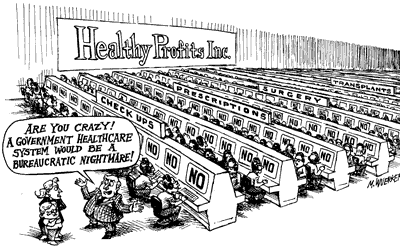
Cartoon – A Bureaucratic Nightmare?

Image result for Cartoon high cost of medical care


Cartoon – We found the Problem

Image result for Cartoon high cost of medical care

California Health Policy Poll Released

https://elink.clickdimensions.com/m/1/52313696/02-b20044-0c24a5f919b04c9baf7a61e0f9656ec6/6/989/a24990fd-e009-4b4b-be17-ea9b7c8eef0e

Increases in Worry Over Health Care Costs and Skipping/ Postponing Treatment Due to Cost Over the Last Year

PERCENTAGE WHO SAY THEY ARE VERY OR SOMEWHAT WORRIED ABOUT…


President Trump’s budget cuts target Medicaid, Medicare

https://www.healthcarefinancenews.com/news/president-trumps-budget-cuts-target-medicaid-medicare?mkt_tok=eyJpIjoiWVRnM01UZzNaR0V6TTJFNSIsInQiOiJ6aXpsQnNCRjhHdCs4SnN0UytlZnJVUlZUeFdreEZyQ2V6RWE0YklvYmFMOGJnbWpXT3ZHeG0rOHMwNkJPcE9rMUlGb3NzVkpId3NrZHNkZmR2VlZISXZCVGgrbU94cFV3aVlNR1NYamlhazF1R1kzaXd3RXVISm9OSGJoYmVrVCJ9

Image result for medicaid cuts

Blueprint includes cuts for care in hospital outpatient departments, teaching hospitals and post-acute care providers, AHA says.

President Trump’s proposed $4.8 trillion budget slashes billions of dollars from Medicaid, food stamps and other safety net programs in an attempt to shrink the federal deficit.

Medicaid and the Affordable Care Act see about $1 trillion in cuts over the next decade, according to The Hill. The budget eliminates the enhanced federal match for Medicaid expansion enrollees. An additional $150 billion is expected to be shaved off of Medicaid from the implementation of work requirements, which is expected to result in people losing their healthcare coverage.

The “President’s health reform vision” to ax the Affordable Care Act takes $844 billion over 10 years from the ACA, the report said.

The decrease in federal spending on Medicare would total about $750 billion over 10 years, but that includes shifting two programs out of the budget. After accounting for those changes, the reduction is just over $500 billion, according to CNN. Much of that cut comes from reducing payments to providers.

The budget needs Congressional approval and is not expected to get past a Democratic-controlled House without changes.

House Speaker Nancy Pelosi tweeted: “The budget is a statement of values. Once again, the #TrumpBudget makes it painfully clear how little the President values the good health, financial security and well-being of America’s hard-working families.”

Ways and Means Committee Chairman Richard E. Neal, D-MA, said, “When I saw the President’s proposed budget today, I felt an immense sense of relief – relief that there is absolutely no chance of his ruthless cuts to critical programs ever becoming law. Slashing billions from Medicare and Medicaid will only make it harder for Americans to access the healthcare they need.

Cutting nutrition assistance and Social Security benefits for the disabled won’t enable people to get back on their feet financially.”

Senator Lamar Alexander, R-Tenn said, “Under the Constitution, it is Congress’ job to set spending priorities and pass appropriations bills, and as a member of the Senate Appropriations Committee, my priorities will continue to be making sure our national defense, national laboratories, the National Institutes of Health and national parks have the resources they need. I am encouraged to see the president is calling to end surprise medical billing.”

The budget adds money to the National Institutes of Health. The NIH will invest $50 million for new research on chronic diseases, using AI and related approaches, according to the White House briefing. It adds $7 billion over 10 years to fight opioid abuse and for mental health in the Medicaid program.

WHY THIS MATTERS

Cuts to Medicare and Medicaid mean uncompensated care to providers, or a reduction in the government payments.

The American Hospital Association said, “The budget request, which is not binding, proposes hundreds of billions of dollars in reductions to Medicare and Medicaid over 10 years.”

AHA President and CEO Rick Pollack said, “Every year, we adapt to a constantly changing environment, but every year, the Administration aims to gut our nation’s healthcare infrastructure. The proposals in this budget would result in hundreds of billions of dollars in cuts that sacrifice the health of seniors, the uninsured and low-income individuals. This includes the one in five Americans who depend on Medicaid, of which 43% of enrollees are children.

“In addition to the hundreds of billions in proposed reductions to Medicare, the blueprint includes cuts we strongly oppose for care in hospital outpatient departments, teaching hospitals and post-acute care providers. These cuts fail to recognize the crucial role hospitals serve for their communities, such as providing 24/7 emergency services. Post-acute cuts threaten care for patients with the most medically complex conditions.”