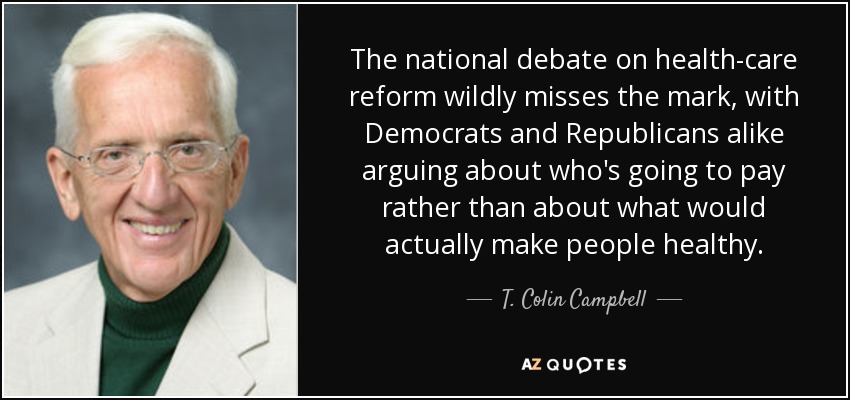
Democrats are making Republican arguments about health care. Why?

https://www.washingtonpost.com/opinions/2019/07/26/democrats-are-making-republican-arguments-about-health-care-why/?fbclid=IwAR1mA1uEcNMiO12elygl_lSLxDD12kvHhzfYOO78Z50u7HAEv56yEVGL2Pc&utm_term=.e2f83bcb12ec

Image result for Democrats are making Republican arguments about health care. Why?

The Democratic argument over health care is beginning to get heated, which unfortunately means that things are becoming more problematic. In fact, the candidates making what is arguably the most sensible policy choice are justifying it with some absolutely abominable arguments — arguments that should warm the heart of the Republican Party.

Right now there’s a divide within the party, with some of the presidential candidates including Bernie Sanders and Elizabeth Warren supporting single payer (though Warren hasn’t been specific), and most of the others including Joe Biden, Amy Klobuchar and Pete Buttigieg suggesting some form of public option that would be voluntary, not Medicare For All but Medicare For All Who Want It.

I’ve come to believe that for all the benefits of a single payer system, trying to move immediately to one is a task with such overwhelming political obstacles and policy complications that it’s probably a better idea to achieve universal coverage through a dramatic expansion of public insurance while, for the moment, leaving substantial portions of the private system intact, even if that’s in many ways distasteful. I realize many readers will disagree with that, which is fine; we should continue to debate it.

But let’s at least grant that it’s a reasonable position to take. The problem with what’s happening now is that some advocates of the public option approach are sounding a lot like, well, Republicans.

Their most common talking point when defending their plan is some variation of “We can’t kick 150 million people off their insurance,” referring to the number of people who are covered by employer plans:

  • “We should have universal health care, but it shouldn’t be the kind of health care that kicks 150 million Americans off their health care,” says John Delaney.
  • Beto O’Rourke says Medicare-for-all “would force 180 million Americans off their insurance.”
  • “I am simply concerned about kicking half of America off their health insurance within four years, which is what [Medicare-for-all] would do,” says Amy Klobuchar.

The generous interpretation of this line is that it’s warning about widespread disruption; the other interpretation is that it’s meant to stoke the fear that if you now have coverage and single payer passes, you could be left with no insurance at all, which is just false. If we passed single payer, you’d move from your current plan to a different plan, one that depending on how it’s constructed would probably offer as good or better coverage at a lower cost.

The further danger is that that kind of talk inevitably leads one toward the promise that got Barack Obama into such trouble, “If you like your plan, you can keep it.” In fact, here’s O’Rourke saying that under his plan, “For those who have private, employer-sponsored insurance or members of unions who have fought for health care plans … they’ll be able to keep that.” And here’s Biden saying much the same thing: “If you like your health care plan, your employer-based plan, you can keep it. If in fact you have private insurance, you can keep it.”

Haven’t they learned anything?

While there may be political value in communicating to people that a public option would be voluntary, we have to tell them the truth, which is that if you’re going to open it to employers and not just individuals, some people will be moved to the public plan whether they want to or not, since their employers will make that choice for them. That’s how employer coverage works: What plan you’re on is seldom up to you, it’s a decision made by your employer.

And the broader truth is that no one, I repeat, no one gets to keep their plan if they like it even under the status quo. “If you like your plan, you can keep it” is a fantasy. If you have insurance through your employer, you’ve probably had the experience of your employer changing insurers or changing plans; many do it every year. Sometimes the new plan is better; often it’s not. But if you liked your plan, you didn’t get to keep it.

That’s even true of people on public insurance plans, though to a far lesser degree. Medicare and Medicaid go through changes, and benefits are added or taken away. It’s not up to you.

The trouble is that we have a situation where change is constant yet everyone is afraid of change, which makes it awfully tempting to encourage that fear. But the more we propagate the fiction that Americans, especially those with private insurance, aren’t vulnerable under the current system, the easier it will be to crush any reform effort.

Apart from the praise of the Affordable Care Act, this video could almost have been scripted by the Republican National Committee, with its paeans to private health insurance. Of particular note is the woman’s explanation of how she and her husband “earned” health coverage through decades of work, which implies that health care is not a right, as most Democrats believe, but a privilege one has to earn.

To top it off, Biden’s caption to the video says that “Because a union fought for their private health insurance plan, Marcy and her husband were able to retire with dignity and respect,” which is why Biden wants to let them stay on their existing insurance.

Let me suggest a crazy idea: What if retiring with dignity and respect wasn’t something you only got if you were lucky enough to be represented by a union (as a mere 1 in 10 American workers is, and 1 in 16 private sector workers), and only if that union happened to be successful in its fight to get you health benefits? What if everybody got dignity and respect? Isn’t that the world Joe Biden is trying to create?

You can make a strong case for both a single payer plan and one built around a public option. But please, Democrats, when you’re arguing for your preferred solution, don’t undermine the entire philosophical approach your party takes to health care. That only makes the job of reform more difficult.


Governors Weigh Health Care Plans as They Await Court Ruling

https://www.usnews.com/news/business/articles/2019-07-25/governors-weigh-health-care-plans-as-they-await-court-ruling

The Associated Press

As they gather at a conference in Utah, governors from around the country are starting to think about what they would do if an appeals court upholds a lower court ruling overturning President Obama’s signature health care law.

More than 20 million Americans would be at risk of losing their health insurance if the 5th U.S. Circuit Court of Appeals agrees with a Texas-based federal judge who declared the Affordable Care Act unconstitutional last December because Congress had eliminated an unpopular tax it imposed on people who did not buy insurance.

The final word on striking down law will almost certainly come from the Supreme Court, which has twice upheld the 2010 legislation.

Nevada Gov. Steve Sisolak, a Democrat, signed a bill earlier this year prohibiting health insurers from denying coverage to patients due to pre-existing conditions, a pre-emptive move in case the Affordable Care Act were struck down.

He said this week in Salt Lake City at the summer meeting of the National Governors Association that he would ask his recently created patient protection commission to come up with recommendations for how to ensure patients don’t lose coverage if the law is overturned, which would impact about 200,000 people enrolled in Medicaid expansion in Nevada.

“To rip that away from them would be devastating to a lot of families,” Sisolak said.

Nevada is among a coalition of 20 Democratic-leaning states led by California that appealed the lower court ruling and is urging the appeals court to keep the law intact.

At a news conference Thursday, Democrats touted the protections they’ve passed to prevent people from losing health coverage.

New Mexico Gov. Michelle Lujan Grisham signed laws this year that enshrine provisions of the Affordable Care Act into state law, including guarantees to insurance coverage for patients with pre-existing conditions and access to contraception without cost-sharing. She said half of the state’s residents use Medicaid, prompting New Mexico officials to research creating a state-based health care system.

California Gov. Gavin Newsom said his state is already deep in contingency planning because five million people could lose health insurance if the law is struck down and the state doesn’t have enough money to make up for the loss of federal funds. He said the decision this year to tax people who don’t have health insurance, a revival of the so-called individual mandate stripped from Obama’s model, was the first step. That tax will help pay for an expansion of the state’s Medicaid program, the joint state and federal health insurance program for the poor and disabled.

Newsom said the state is looking at Massachusetts‘ state-run health care program and investigating if a single-payer model would work as possible options if the law is spiked.

“The magnitude is jaw-dropping,” Newsom said. “You can’t sit back passively and react to it.”

Arkansas Gov. Asa Hutchinson, a Republican, said states need Congress to be ready to quickly pass a new health care plan if the court overturns Obama’s law, since doing so would cut off federal funding for Medicaid expansion.

A court decision in March blocked Arkansas from enforcing work requirements for its Medicaid expansion program, which has generated seemingly annual debate in that state’s Legislature about whether to continue the program.

“Congress can’t just leave that out there hanging,” Hutchinson said.

The 2018 lawsuit that triggered the latest legal battle over the Affordable Care Act was filed by a coalition of 18 Republican-leaning states including Arkansas, Arizona and Utah.

Arizona Gov. Doug Ducey, a Republican, said he wants to see how the court rules before he makes any decisions about how his state would deal with the loss of Medicaid funds but that Arizona has backup funds available.

“They’re going to rule how they’re going to rule and we’ll deal with the outcome,” Ducey said. “The best plans are to have dollars available.”

It is unknown when the three-judge panel will rule.

The government said in March that 11.4 million people signed up for health care via provisions of the Affordable Care Act during open enrollment season, a dip of about 300,000 from last year.

Utah Gov. Gary Herbert, a Republican, said if the law is overturned, it would provide a perfect opportunity for Congress to try to craft a better program with support from both political parties.

He said his state, which rolled out its partial Medicaid expansion in April, probably will not start working on a contingency plan for people who would lose coverage until the appeals court rules.

“It’s been talked about for so long, people are saying ‘Why worry about it until it happens?'” Herbert said. “I think there’s a little bit more of a lackadaisical thought process going on.”

President Donald Trump, who never produced a health insurance plan to replace Obama’s health care plan, is now promising one after the elections.

Newsom warned Americans not to rely on that.

“God knows they have no capacity to deal with that,” Newsom said. “The consequences would be profound and pronounced.”


Trump’s next move on drug prices

https://www.axios.com/newsletters/axios-vitals-2f43e920-50d7-4650-b95c-112de9060f9f.html?utm_source=newsletter&utm_medium=email&utm_campaign=newsletter_axiosvitals&stream=top

Sens. Ron Wyden and Chuck Grassley

The White House is preparing another big executive order on drug prices, Reuters scooped last night.

  • Citing industry sources who had discussed the plan with the administration, Reuters reports that it would likely seek to lower prices in Medicare Part D, which covers drugs you pick up at the pharmacy counter.
  • The administration’s most sweeping proposal to date — to piggyback off of the lower prices in European countries — was limited to Part B, which covers drugs administered by a doctor.
  • It’s not clear whether the new Part D proposal would also rely on international pricing, per Reuters. Part D is much bigger than Part B.

Between the lines: It’s probably no coincidence that this threat is being floated just as the White House is trying to build support for the Senate Finance Committee’s drug-pricing bill, despite Republican objections.

  • In fact, Sen. Chuck Grassley made that point explicitly, The Hill reports.
  • “Who knows what he’s going to do at the last minute,” he said, referring to Trump. “If he would join forces with Pelosi, look at what that would do to everything that we Republicans stand for.”
  • “It seems to me that the Grassley-Wyden approach is a very moderate approach [compared] to what could come out,” he added.

Where it stands in the Senate.

Finance approved the Grassley-Wyden bill yesterday, but the proceedings left no doubt that there are still stark divisions within the GOP over drug pricing, and more resistance than we’re used to seeing on policies Trump supports.

The intrigue: Nine of the committee’s 15 Republicans voted against the bill. All of the Democrats supported it, leading to a final vote of 19-9.

  • The bill’s proposal to cap price increases within Part D is clearly the biggest sticking point for Republicans. An amendment to strike that provision, offered by Sen. Pat Toomey, failed on a 14-14 vote.

What’s next: Pharma’s best bet is probably to stop the Senate from passing anything.

  • That would prevent an eventual conference between the House and Senate, in which Pelosi and Trump could make good on Grassley’s predictions and strike up an alliance (if she wanted to help Trump claim a win on drug prices, which is far from a sure thing).
  • But that’s a tall order, so expect pharma and its allies to keep trying to water down the Senate package while waging that bigger-picture fight.

The bottom line: “This bill is not anywhere near action on the floor,” Sen. John Cornyn said yesterday, per The Hill.


Nobel Economist Says Inequality is Destroying Democratic Capitalism

Nobel Economist Says Inequality is Destroying Democratic Capitalism

Image result for Nobel Economist Says Inequality is Destroying Democratic Capitalism

At the launch of the IFS Deaton Review, a 5-year review of rising inequalities in the UK, Sir Angus Deaton decried extreme inequality and the system that allows it. “As it is, capitalism is not delivering to large fractions of the population.”

We are about to embark on a large, ambitious, and open-ended review of inequalities. We are bringing together a distinguished group of scholars and writers from different disciplines. Each thinks about inequality differently, and together they encompass a wide range of methodological, political, and philosophical perspectives. At a first stage, currently underway, the guiding panel is asking each member of this larger group to write about one or other aspect of the topic; this collective effort will be one of our main products. At the second stage, the panel will write a synthetic volume. We will think about inequalities broadly—note my use of “inequalities” rather than “inequality”—and will not be confined to the traditional economic concerns with measures of the distribution of income and wealth, important although those are. Our main focus is the United Kingdom, but there is a great deal of recent thinking and evidence from other countries, particularly the United States, Scandinavia, and other European countries, and we shall repeatedly have to assess its relevance, and are often asking authors or combinations of authors to make the links.

As at no other time in my lifetime, people are troubled by inequality. In 2016, Theresa May, in her first speech as Prime Minister, said “we believe in a union not just between the nations of the United Kingdom but between all of our citizens, every one of us, whoever we are and wherever we’re from. That means fighting against the burning injustice that, if you’re born poor, you will die on average 9 years earlier than others.” Jeremy Corbyn has called for a new economics to address what he called “Britain’s grotesque inequality.” President Obama said that he believed that the defining challenge of our time is to make sure that the US economy works for every American. Across the rich world, not only in America, large groups of people are currently questioning whether their economies are working for them. The same can be said of politics. Two-thirds of Americans without a college degree believe that there is no point in voting, because elections are rigged in favor of big business and the rich. Britain is divided as never before and, once again, many believe that their voice doesn’t count either in Brussels or in Westminster. And one of the greatest miracles of the 20th century, the miracle of falling mortality and rising lifespans, is no longer delivering for everyone, and is now faltering or reversing.

Yet when people say that they are worried about inequality, it is frequently unclear what they mean or why they care. Economists think they know what they mean when they talk about inequality, and they produce charts of gini coefficients of income and of wealth, and when other social scientists say that they have wider concerns, economists—among whom I count myself—have often been too ready to tell them that they don’t know what they are talking about. What we would like to do in this review, even with its large quota of economists, is to get a better understanding of exactly what it is that bothers people about inequality.

We will also think about how we might address concerns about inequality and which concerns need to be addressed. If the concern with inequality is simply envy—as is often claimed by the right—it is perhaps better to address the concern than the inequality. If the inequality comes from incentives that work for a few but benefit many, then we may want to do a better job of documenting the need for incentives and what they do for the economy as a whole. If working people are losing out because corporate governance is set up to favor shareholders over workers, or because the decline in unions has favored capital over labor and is undermining the wages of workers at the expense of shareholders and corporate executives, then we need to change the rules. Why are the myriad differences between men and women so persistent and so difficult to erase?

Given that we are just starting, it is perhaps presumptuous of me to say anything substantive at this point. But what I am going to say is what I myself think, or at least what I think today, and I look forward to changing my mind as we go; I wouldn’t be chairing this review if I didn’t expect that to happen. I am also perhaps too much influenced by my own work—particularly my recent work with Anne Case—and this work is primarily about the United States, though we have been doing quite a bit of thinking about how it applies to Britain.

At the risk of grandiosity, I think that today’s inequalities are signs that democratic capitalism is under threat, not only in the US, where the storm clouds are darkest, but in much of the rich world, where one or more of politics, economics, and health are changing in worrisome ways. I do not believe that democratic capitalism is beyond repair nor that it should be replaced; I am a great believer in what capitalism has done, not only to the oft-cited billions who have been pulled out of poverty in the last half-century, but to all the rest of us who have also escaped poverty and deprivation over the last two and a half centuries. It also provides our jobs and the cornucopia of goods and services that we take for granted. And Milton Friedman, whose starry-eyed view of capitalism has much to answer for, was not entirely wrong when he extolled the freedom that free markets can bring. Though history has not been kind to his view that equality would be guaranteed by using markets to pursue freedom.

But we need to think about repairs for democratic capitalism, either by fixing what is broken, or by making changes to head off the threats; indeed, I believe that those of us who believe in social democratic capitalism should be leading the charge to make repairs. As it is, capitalism is not delivering to large fractions of the population; in the US, where the inequalities are clearest, real wages for men without a four-year college degree have fallen for half a century, even at a time when per capita GDP has robustly risen. Mortality rates are rising for the less-educated group at ages 25 through 64, and by enough that life expectancy for the entire population has fallen for three years in a row, the first time such a reversal has happened since the end of the first world war and the great influenza epidemic. Less educated Americans are dying by their own hands, from suicide, from alcoholic liver disease, and from overdoses of drugs. Morbidity is rising too, and they are also suffering from an epidemic of chronic pain that, for many, makes a misery of daily life.

In Britain, these inequalities are not so stark, at least not yet. But median real wages in Britain have not risen for more than a decade. One decade is much better than five decades, but we surely do not want to wait to find out whether the American experience will be replicated here. There have also been prolonged periods of real wage stagnation in recent years in Italy and in Germany. In those countries too, increasing overall prosperity is not reaching everyone. And as I noted above, democracy too does not seem to be working for everyone. The sense of being left behind, of not being represented at Westminster, is much the same as the sense of not being represented in Washington.

In Clement Attlee’s 1945 cabinet—the cabinet that implemented the Beveridge Report and built the first modern welfare state—there were seven men who had begun their working lives at the coal face. When labor MPs from Glasgow set off to London, local bands and choirs came to the station to see them off as if they were going to war, which indeed they were. Only three percent of MPs elected in 2015 were ever manual workers, compared with sixteen percent as recently as 1979. The union movement, which once produced talents like those in Attlee’s cabinet, has been gutted by the success of postwar meritocracy. Attlee’s warriors would today have gone to university and become professionals; they would never have been down the pit, nor in a union hall. Meritocracy has many virtues, but, as predicted by Michael Young in 1958, it has deprived those who didn’t pass the exams, not only of social status and of the higher incomes that degrees bring, but even of the kind of political representation that comes from having people like themselves in parliament. Young wrote, “The bargaining over the distribution of national expenditure is a battle of wits, and defeat is bound to go to those who lost their clever children to the enemy.” He referred to the less educated group as “the populists” who, in turn, refer to the elite as “the hypocrisy.”

What does history tell us? Not surprisingly, we have been here before. There have been several episodes where capitalism seemed broken, but was repaired, either on its own, or by deliberate policy, or by a combination of the two.

In Britain at the beginning of the 19th century, inequality was vast compared with today. The hereditary landowners not only were rich, but also controlled parliament through a severely limited franchise. After 1815, the notorious Corn Laws prohibited imports of wheat until the local price was so high that people were at risk of starving; high prices of wheat, even if they hurt ordinary people, were very much in the interests of the land-owning aristocracy, who lived off the rents supported by the restriction on imports. The Industrial Revolution had begun, there was a ferment of innovation and invention, and national income was rising. Yet working people were not benefitting. Mortality rates rose as people moved from the relatively healthy countryside to stinking, unsanitary cities. Each generation of military recruits was shorter than the last as their childhood nutrition worsened, from not getting enough to eat and from the nutritional insults of unsanitary conditions. Churchgoing fell, removing a major source of community and support for working people, if only because churches were in the countryside, not in the new industrial cities. Wages were stagnant and would remain so for half a century. Profits were rising, and the share of profits in national income rose at the expense of labor. It would have been hard to predict a positive outcome of this process.

Yet by century’s end, the Corn Laws were gone, the rents and fortunes of the aristocrats had fallen along with the world price of wheat. Reform Acts had extended the franchise, from one in ten males at the beginning of the century to more than a half by its end, though the enfranchisement of women would wait until 1918. Wages had begun to rise in 1850, and the more than century-long decline in mortality had begun. All of this happened without a collapse of the state, without a war, or a pandemic, through a gradual change in institutions that slowly gave way to the demands of those who had been left behind.

America’s first Gilded Age is another case. It also shows that the fundamental rules of the game can be changed. In the Progressive Era, four constitutional amendments were passed, all designed to limit inequality of one form or another. One instituted the income tax, one gave women the vote, one prohibited alcohol—strongly supported by women, who believed that alcohol abuse was an instrument of their oppression—and one an electoral reform that instituted the direct election of senators, as opposed to their previous appointment by state legislatures that were often dominated by business.

I have already mentioned the case that is most on my mind, the construction of the modern welfare state by Attlee’s government after the Second World War. The Great Depression, like the stagnation of wages in the early 1800s, spawned a large literature on how to modify or abolish capitalism, and according to one version of the story, it was Attlee’s government that tamed the beast and that made it possible for the tamed beast to deliver the unprecedented shared growth that many of us grew up on. Joe Stiglitz has recently written that he grew up in the golden age of capitalism though, as he wryly notes, it was only later that he discovered that it was the golden age. And, of course, it wasn’t a golden age—at least in terms of material living standards or in terms of health—but perhaps it was such in terms of the rules of the game that allowed growing prosperity to be widely shared. I don’t think that anyone would argue that the late 1940s was a golden age in Britain— there was bread rationing, petrol rationing, and to a young Angus Deaton, the terrible deprivation of sweet rationing, but the safety net that was built in those years played a role in fairly sharing, and perhaps even in helping generate, the prosperity that was to come.

That safety net is needed just as much today. Globalization and automation are challenging us today just as they did in the early 19th century. Safety nets are most needed when change is rapid, and it is one of the reasons why America is doing so much worse—most obviously in deaths of despair—than are wealthy European countries. But what is happening today is also a real threat to Britain and to Europe.

The argument that Anne Case and I are making in our new book is that less-educated white men and women in America have had their lives progressively undermined, starting in the 1970s, and showing up, since 1990, in rising numbers of deaths from suicide, alcoholic liver disease, and drug overdoses. African Americans experienced a similar disaster thirty years earlier and the improvements in their lives since then have protected them to an extent. In the face of globalization and innovation, many of us would argue that American policy, instead of cushioning working people, has instead contributed to making their lives worse, by allowing more rent-seeking, reducing the share of labor, undermining pay and working conditions, and changing the legal framework in ways that favor business over workers. Inequality has risen not only due to wealth generation from innovation or creation, but also through upward transfers from workers. It is not inequality itself that is hurting people, but the mechanisms of enrichment.

How much is this a threat in Britain? Some of the mechanisms of enrichment are not operative here. The US wastes about a trillion dollars a year on a healthcare system that is very good at enriching providers, hospitals, device manufacturers, and pharmaceutical companies, but very bad at delivering health. You do not have that problem. The US has licensed pharma companies to sell opioids to the general public, including for chronic pain, which ignited an epidemic of addiction and death with a cumulative death toll larger than all Americans lost in both World Wars. You too use opioids, but usually in hospitals, not in the general population. Yet the opioid manufacturers are following the model of tobacco manufacturers, and working hard, when blocked in the US, to expand elsewhere. Purdue Pharma has a subsidiary, Mundipharma, that agitates on behalf of the greater pain relief that they argue opioids can bring. As I write this, Matt Hancock, the Minister of Health, noted that “things are not as bad here as in America, but we must act now to protect people from the darker side of painkillers.” The BBC news report on this carries a chart showing the extraordinary geographical inequality in opioid prescriptions in England, with prescription rates five times larger in Cumbria and the North East than in London. As the briefing note for this launch shows, deaths of despair are rising in Britain, particularly in less successful parts of Britain, just as they are in other English-speaking countries, though the numbers (and death rates) are small compared with the US.

What about wages? The US has extensive business lobbying, which the UK does not have, or at least not in the same overt form. (The US also had very little prior to 1970, so it could happen here too.) As in the US, unions have become much less powerful in Britain, a decline that many have welcomed, but their countervailing power in boardroom decisions may have protected wages and working conditions. Unions provided social life and political power for many people who have less of both today. The replacement of stakeholder capitalism by shareholder value maximization is widespread in the US and has been remarked on here, too. Paul Collier has noted that Imperial Chemical Industries, once the crown jewel of British industry, used to boast “we aim to be the finest chemical company in the world,” but that, before it was lost to takeovers and mergers in 2006, it had changed its slogan to “we aim to maximize shareholder valuation.”

In Britain, as in America, some cities and towns are doing much better than other cities and towns, and the easy mobility that tended to keep these differences in check seems to have been much reduced. America has no city that is as dominant or as uniquely prosperous as is London.

Political dysfunction in Britain is different, but there is a common thread that many voters believe that they are not well represented. And there are sharp differences across groups, with age, education, ethnicity, gender and geography important in both countries.

I think that people getting rich is a good thing, especially when it brings prosperity to others. But the other kind of getting rich, “taking” rather than “making,” rent-seeking rather than creating, enriching the few at the expense of the many, taking the free out of free markets, is making a mockery of democracy. In that world, inequality and misery are intimate companions.


UnitedHealth to jumpstart Q2 results with eyes on volume, ‘Medicare for All’

https://www.healthcaredive.com/news/unitedhealth-to-jumpstart-q2-results-with-eyes-on-volume-medicare-for-all/558855/

UnitedHealth Group on Thursday kicks off second quarter earnings as the first major healthcare firm to report results, setting the tone and expectations for the quarter. Wall Street analysts expect the insurance giant to post a strong showing, buoyed by its Optum business.

Volume trends, talk of “Medicare for All” on the campaign trail and emerging CMS payment models are among the topics likely to bubble up as payers begin reporting their earnings over the next few weeks.

Utilization subdued

Utilization is slowing in the second quarter, according to a June survey of 48 hospital administrators. SVB Leerink analysts noted this is a positive for payers and their medical cost trends and for hospital operators heavily invested in outpatient settings, including HCA and Tenet Healthcare with its outpatient surgical unit, USPI.

“Share of procedures in [inpatient] declined across all service lines except for spine, reinforcing the shift from [inpatient],” SVB Leerink analysts said.

Lab data is another good indicator of overall utilization and volume trends, Brian Tanquilut, an analyst with Jefferies, said. Tanquilut said he’ll be watching LabCorp and Quest closely next week to get a better idea of utilization trends for the quarter.

Drug rebate reform may not be dead

The White House last week pulled its proposal to ban drugmaker rebates to pharmacy benefit managers in Medicare and Medicaid in a win for payers. Stocks for UnitedHealth, CVS and Cigna rose sharply following the announcement.

That may not be the end for the proposal, however.

“It’s still alive and moving along in Congress,” Tanquilut said, referencing the Lower Health Care Costs Act sponsored by Sen. Lamar Alexander, R-Tenn., which was passed out of committee and is expected to be brought to the floor soon.

That legislation is broad reaching and includes efforts to ban surprise billing and boost price transparency, other payer hotspots.

With the rebate proposal, the administration had proposed to fundamentally alter the way drugs are paid for in the U.S. But federal budget forecasters warned it would increase spending by $177 billion over the next decade, given many of those rebates are used to lower premiums for Part D beneficiaries.

PBMs, most of which are owned by major payers, have come under fire as many grow skeptical of whether rebates really drive down drug spending.

The Alexander bill includes limitations on spread pricing — which have also garnered intense criticism — and would require PBMs to pass all of the rebates back to insurance plans.

Kidney overhaul positive for most payers

One issue on payers’ minds is the Trump administration’s recent effort aimed at overhauling the country’s approach to kidney care. The plan includes an executive order intended to incentivize home dialysis, increase prevention, make more organs available for transplant and spur development of artificial and wearable kidneys.

The Center for Medicare and Medicaid Innovation also introduced five new payment models, including one that’s mandatory. The center’s chief, Adam Boehler, told reporters the plan would “be broad and sweeping, impacting half the country.”

Analysts at SVB Leerink called the announcement a medium-term win for payers like CVS, Humana, UnitedHealth Group and Anthem. Humana in particular has upside potential because of its focus on Medicare Advantage and with Kindred at Home, which it acquired a year ago.

Cigna stands to benefit from its investment in Cricket Health, which aims to improve early detection of high-risk kidney patients, and UnitedHealth’s Optum arm continues to invest in home dialysis, analysts said.

They also noted CVS executives discussed early detection of kidney disease at the company’s recent investor day, saying home hemodialysis could drive as much as $1 billion in new business through 2022 (possibly accelerated by the CMS announcement). With CVS’ experience in complex patient home care and chronic disease management and the acquisition of Aetna, the company is “an ideal partner to manage chronic kidney disease.”

‘Medicare for All’ debate continues

With the 2020 campaign heating up among Democrats, Medicare for All was a hot topic during last quarter’s calls. A number of executives singled the idea out for criticism, sending payer stocks tumbling.

Since then, talk on the campaign trail of expanding government coverage has continued, although Medicare for All is just one of the ideas being discussed. This week, former Vice President Joe Biden rolled out a plan for building on the Affordable Care Act and increasing premium subsidies for people on the exchanges.

The issue will certainly resurface at the end of this month when candidates have their second primary debate.


Rising health insurance deductibles fuel middle-class anger and resentment

https://www.latimes.com/politics/la-na-pol-health-insurance-angry-patients-20190628-story.html?utm_source=newsletter&utm_medium=email&utm_campaign=newsletter_axiosvitals&stream=top

Image result for Rising health insurance deductibles fuel middle-class anger and resentment

The IRS rolled out new rules yesterday to help people who have chronic diseases, but are also on the hook for thousands of dollars of their medical bills.

How it works: The new rules allow insurers to cover treatment for chronic conditions, like diabetes and high blood pressure, before patients have met their deductibles.

  • This only applies to high-deductible plans that also offer a health savings account — which is an increasingly common arrangement.

My thought bubble: High-deductible plans and chronic disease are both pretty ubiquitous, and this will surely help sick people get the care they need.

  • As the Wall Street Journal notes, there’s a broad base of support for these new rules, including patients, insurers and policymakers from both parties.

But it’s hard to look at this change without asking some more fundamental questions about the rise of deductibles.

  • After all, making people pay for more of their own care is the whole point. High-deductible plans were designed to give people more “skin in the game.”
  • It only stands to reason that when you require people to pay a couple thousand dollars of their own bills before insurance kicks in, that’s primarily going to affect people who have a couple thousand dollars in health care bills.

Deductibles are a large and growing source of frustration for middle-class families, the L.A. Times’ Noam Levey writes.

  • Neither high deductibles nor health savings accounts have put a dent in health care prices, as their advocates thought they would.
  • And families with the highest deductibles are among the least satisfied with their employer coverage.

Go deeper: Workers’ health care costs just keep rising


Medicaid should be a bigger part of the “Medicare for All” debate

https://www.axios.com/medicare-for-all-bernie-sanders-medicaid-states-b3c5eceb-0f3c-4c4b-9317-6a1f9434232b.html?utm_source=newsletter&utm_medium=email&utm_campaign=newsletter_axiosvitals&stream=top

Illustration of a pills capsule opening with state-shaped pills falling out

The fact that “Medicare for All” would eliminate Medicaid hasn’t gotten nearly as much attention as its elimination of private insurance. But it’s a move that would largely eliminate states’ role in the health care system.

Why it matters: State Medicaid programs are leaders in experimenting with delivery and payment reforms, efforts to control drug costs, and addressing social causes of ill health, such as poverty and poor housing. All of those projects would still be important in a single-payer world.

How it works: Sen. Bernie Sanders’ bill would move most Americans into its new single-payer system, including people with private insurance but also virtually all of the 73 million people covered by Medicaid and the Children’s Health Insurance Program.

Winners: States would reap huge savings. Medicaid is the single largest item in most state budgets.

  • The effects on safety-net hospitals and clinics would vary, depending largely on how payment rates under the new plan compare to today’s Medicaid rates.
  • The uninsured in states that have not expanded Medicaid also would be big winners.

Yes, but: The change would all but eliminate states’ role in health care, where they have been leaders not just in providing coverage, but also driving efficiency and testing new models of care.

  • Those reforms — and the idea of states as laboratories of reform — would pretty much disappear, and the balance of federalism in health would fundamentally change.

The bottom line: For advocates of a single national plan, eliminating the patchwork of state Medicaid programs would be progress. For fans of a federal-state balance, it’s a big problem.

  • Either way, Medicaid is a large and generally popular program, and its future at least deserves a bigger role in the debate.


There Is No Single, Best Policy for Drug Prices

There Is No Single, Best Policy for Drug Prices

Image result for There Is No Single, Best Policy for Drug Prices

A majority of Americans prefer greater regulation of prescription drug prices, meaning government intervention to lower them.

But don’t count on a single policy to address a nuanced problem.

“All low-priced drugs are alike; all high-priced drugs are high priced in their own way,” Craig Garthwaite, a health economist from Northwestern University’s Kellogg School of Management, wrote with a colleague.

Outside of a few government programs — like Medicaid and the Veterans Health Administration — low-priced drugs are alike in that competition is the sole source of downward pressure on prices. When many generic versions of a brand-name drug enter the market, competition can push their prices 80 percent below the brand price, or sometimes even more.

In contrast, high-priced drugs lack competition for various reasons, “not all of which imply our goal should be to reduce prices,” Mr. Garthwaite said.


Family of four faces $25,000 in average annual unsubsidized ACA costs in 2019

https://www.healthcarefinancenews.com/news/families-four-face-25000-average-annual-unsubsidized-aca-costs-2019?mkt_tok=eyJpIjoiTjJVNE9HTm1OelEwTlRkaiIsInQiOiJsaDZIK0JaczhmMFBzWElmSDluT1VROHc3ckM2azFCZ0NvUnR2U2NmYlRIa2VnYkw2dnR1NmJEMnFrcEFVZUVVSEpVTjlBcXkxaXZaSFFlUFR6djBvRjBTM2NpRFFQMXBDQkRVaFpQSEVtMVFTRlNqUTRBaUxTUmg2MnNrVXFiYiJ9

Costs for two- and four-person families rose despite overall premiums being relatively flat compared to last year.

Average 2019 health insurance premiums are $1,403 per month for families of four who don’t qualify for subsidies under the Affordable Care Act, according to a report released today by eHealth.

The 2019 Health Insurance Index Report analyzes costs and trends among unsubsidized consumers who purchased individual and family coverage for the 2019 plan year at eHealth during the ACA’s most recent open enrollment period. eHealth, Inc. dba as eHealthInsurance, is a private online marketplace for health insurance.

The data and research is focused on ACA market consumers who earn too much per year to qualify for government subsidies that help to reduce what they spend on insurance premiums and out-of-pocket costs. The new report is based on individual and family health insurance applications submitted by unsubsidized eHealth consumers between November 1 and December 15, 2018.

WHAT’S THE IMPACT

While overall premiums were relatively flat compared to the 2018 open enrollment period, costs for two- and four-person families hit a couple of new milestones.

The first is that total combined annual premiums plus deductibles for a four-person family topped $25,000 for 2019. The second is that average premiums for two-person families broke $1,000 per month for the first time this year.

Deductibles marked their first significant decline since 2014, when the ACA took effect. he average individual deductible decreased 6% for 2019, while the average family deductible decreased 8%.

Plan selection trends for 2019 show that HMO plans continue to dominate the market, representing 56% of all plan selections, the same as in 2018.

Meanwhile, exclusive provider organization, or EPO plans reach 26% of all plan selections, up from 20% in 2018; and silver plans reach 35% of all plan selections, up from 30% over last year.

THE LARGER TREND

An estimated 87% of Healthcare.gov customers received subsidies. Their premium cost after subsidies is $87 a month, according to the report. But costs borne by the unsubsidized are significantly greater. At eHealth during the fourth quarter of 2018, which included the ACA’s 2019 open enrollment period, 64% of applications were for consumers purchasing ACA-compliant plans not eligible for use with subsidies.

Premiums for those with employer-sponsored health insurance plans have also been on the rise.

Between 2008 and 2018, such premiums increased 55 percent — twice as fast as workers’ earnings, according to a June report from Kaiser Family Foundation. And since 2006, the average health insurance deductible for covered workers soared by more than 200 percent — from an inflation-adjusted average of $379 to more than $1,300 today.


Bernie Sanders pitches $20B hospital bailout plan

https://philadelphia.cbslocal.com/2019/07/15/bernie-sanders-hahnemann-university-hospital-rally-center-city/

Image result for Bernie Sanders Joins Rally In Philadelphia To Protest Hahnemann University Hospital Closure