MetroHealth fires CEO over more than $1.9M in unreported bonuses

The board of trustees at Cleveland-based MetroHealth System has fired President and CEO Akram Boutros, MD.

Dr. Boutros was fired Nov. 21 after the board received findings of a probe into compensation issues involving more than $1.9 million in supplemental bonuses, Vanessa Whiting, chair of the board, said in a statement posted on the health system’s website. The probe found that between 2018 and 2022, Dr. Boutros authorized the compensation for himself, without disclosure to the board.

“We have taken these actions mindfully and deliberately but with sadness and disappointment,” Ms. Whiting said. “We all recognize the wonderful things Dr. Boutros has done for our hospital and for the community. However, we know of no organization permitting its CEO to self-evaluate and determine their entitlement to an additional bonus and at what amount, as Dr. Boutros has done.”

Dr. Boutros took the helm of MetroHealth in 2013. Last year, Dr. Boutros announced his plans to retire at the end of 2022. In September, MetroHealth named Airica Steed, EdD, RN, its next president and CEO. Dr. Steed, who is executive vice president and system COO of Sinai Chicago Health System, will take the helm of MetroHealth Dec. 5, according to Ms. Whiting’s statement. Meanwhile, Nabil Chehade, MD, executive vice president and chief clinical transformation officer at MetroHealth, will assume the CEO’s duties on an interim basis.

Ms. Whiting said MetroHealth discovered the compensation issues related to Dr. Boutros while preparing for the CEO transition, and an internal investigation took place, led by the Tucker Ellis law firm.

She said Dr. Boutros admitted to conducting self-assessments of his performance under specific metrics he established and authorizing payment to himself of more than $1.9 million in supplemental bonuses between 2018 and 2022.

According to Ms. Whiting, Dr. Boutros repaid more than $2.1 million in October, representing the supplemental bonus money paid without board approval for performance in calendar years 2017 through 2021, plus more than $124,000 in interest.

She said the board has also implemented immediate CEO spending and hiring limitations through Dec. 31, 2022, and Dr. Boutros has self-reported to the Ohio Ethics Commission.

MetroHealth’s internal investigation is ongoing.

Among Dr. Boutros’ accomplishments at MetroHealth were helping annual revenue increase from $785 million to more than $1.5 billion; growing the health system’s workforce from 6,200 to nearly 8,000 while seeing employee minimum wage increase to $15 per hour; and developing Ohio’s only Ebola treatment center.

Healthcare CEO, physicians sentenced to prison for $27M fraud

Thirteen people involved in a $27 million healthcare fraud scheme have been sentenced to a combined 84 years in federal prison, the Justice Department announced Aug. 31. 

The defendants allegedly participated in a fraud scheme that involved Novus Health Services, a Dallas-based hospice agency. The defendants allegedly defrauded Medicare by submitting false claims for hospice services, providing kickbacks for referrals and violating HIPAA to recruit beneficiaries. Novus employees also dispensed controlled substances to patients without the guidance of medical professionals, according to the Justice Department. 

Novus CEO Bradley Harris admitted to the fraud and testified against two physicians who elected to go to trial. Mr. Harris pleaded guilty to one count of conspiracy to commit healthcare fraud and one count of healthcare fraud and aiding and abetting. He was sentenced to 159 months in federal prison in January. 

The 12 others convicted in the scheme include three physicians, four nurses and several executives. 

Read more here

The wave of CEO retirements is upon us

https://mailchi.mp/11f2d4aad100/the-weekly-gist-august-12-2022?e=d1e747d2d8

 In just the first half of this year, more than 60 hospital CEOs have retired or left their roles, according to search firm Challenger, Gray and Christmas. Retirements are up 48 percent from the same time last year. Part of this is generational, as many Baby Boomer leaders are at retirement age, but the latest wave comes after many delayed planned exits during the pandemic to guide their organizations through the crisis. 2

Now, after two-plus grueling years of leading through COVID, executives are ready to pass the baton. The latest high-profile announcement came this week, with Salt Lake City-based Intermountain Healthcare’s CEO Marc Harrison announcing his plans to leave the system for a role at venture firm General Catalyst. 

The Gist: As a recent piece from Modern Healthcare points out, many systems have known their CEOs were exiting well in advance, but the significant cultural and financial consequences associated with choosing a new leader, especially during a period of industry-wide change, are presenting boards with hiring decisions as difficult as they are important.

Astute organizations have been planning ahead for these transitions, developing a bench of next-generation leaders, and providing them exposure to the board. COVID also served as a helpful stress test to identify talent who rose to the occasion to lead confidently and calmly through the crisis, while simultaneously weeding others out who floundered under uncertainty. 

The next generation of leaders will need different skills to navigate current and future challenges, including rethinking the role of the health system in response to a new class of disruptors, and managing through a workforce crisis that will require evolving the labor model while meeting new demands for workforce diversity and engagement.   

CEO resignations hit record high

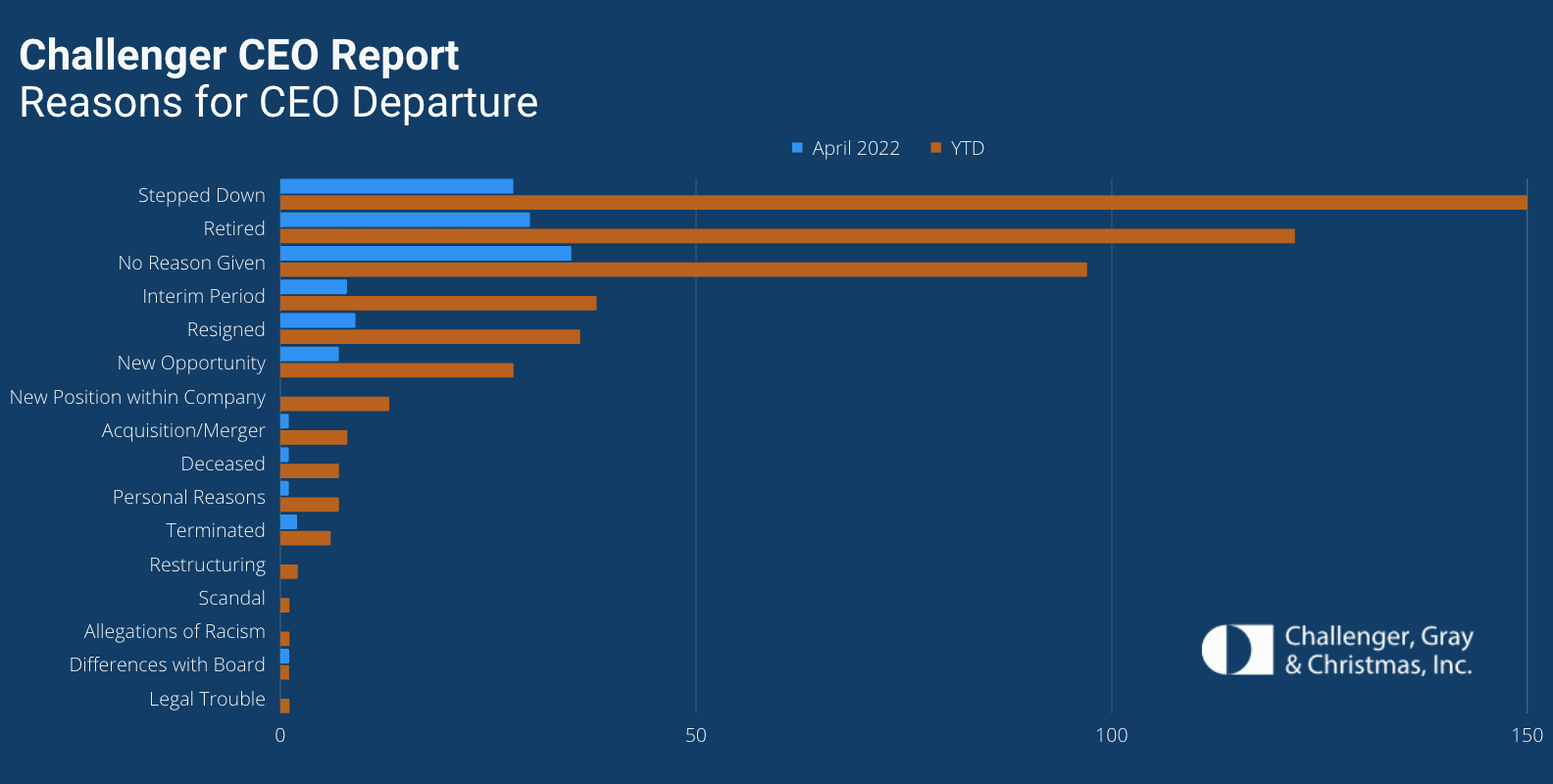
Dozens of hospital CEOs have resigned this year as a record number of chiefs across all industries have exited their roles, according to a May 18 Challenger, Gray & Christmas report. 

Nearly 520 CEOs left their posts between Jan. 1 and the end of April, the highest total since the executive outplacement and coaching firm began tracking CEO changes in 2002. The total is up 18 percent from the 440 CEO exits announced in the same period of 2021. 

Thirty-six hospital CEOs exited their roles in the first four months of this year. That’s up from the 20 hospital chiefs who resigned in the same period last year, according to the report. 

CEOs are leaving their positions and businesses are making changes at the top for several reasons, Challenger, Gray & Christmas Senior Vice President Andrew Challenger said. 

“Inflation, staffing shortages, and possible recession concerns are giving more cause for companies to reevaluate leadership,” Mr. Challenger said. “This, after years of companies trying to figure out the right formula to attract and retain talent and create a culture of inclusion, issues that often start at the top.”

Hospital CEOs are joining the Great Resignation

The number of departing hospital CEOs is on the rise as C-level executives are grappling with challenges tied to the COVID-19 pandemic. 

Twelve hospital CEOs exited their roles in January, double the number who stepped down from their positions in the same month a year earlier, according to a report from Challenger, Gray & Christmas, an executive outplacement and coaching firm. 

While some hospital and health system CEOs are retiring, others are stepping down from their posts into C-level roles at other organizations. At least eight hospital and health system CEOs have stepped down from their positions since mid-February. 

The increase in CEO departures isn’t unique to healthcare. More than 100 CEOs of U.S.-based companies left their posts in January, up from 89 in the same month a year earlier, according to the Challenger, Gray & Christmas report.  

The uptick in executive exits shouldn’t be surprising given the challenges presented by the COVID-19 pandemic, experts told NBC News. CEOs and other executives aren’t immune to the pressures that are prompting people to leave their jobs.

It’s many factors — the burnout, the pandemic, the school closures, the need to take stock of life,” Julia Pollack, chief economist at ZipRecruiter, told NBC News in January. “It’s a whole wide range of shocks.”

CFOs might find PCAOB evidence-quality guide a useful auditor check

An opinion that’s supported by irrelevant or unreliable data might not be accurately capturing company performance.

How well is the opinion of your company’s performance supported by the evidence the auditor’s using?

Public Company Accounting Oversight Board (PCAOB) staff have released guidance on what constitutes relevant and reliable evidence for supporting audit opinions.

If evidence auditors are using isn’t relevant or from a reliable source, or if the reliability of the evidence itself is questionable, that can call into question the soundness of the opinion.

“In some cases, information that was determined by the auditor to be more relevant may not be the most reliable, and vice versa,” the guidance, released October 7, says.

Data availability

PCAOB was created in 2002 as part of the Sarbanes-Oxley Act to help ensure auditors don’t allow accounting problems in public companies to get past them and put investors at risk. 

The new guidance tries to put guardrails around auditors’ growing use of external evidence to support their opinions. 

The use of external evidence, like so many things today, is fueled by the widespread availability of data that companies, regulators and other entities collect and release. The question the guidance tries to answer is which data is relevant and reliable and which isn’t.

“Advancements in technology in recent years have improved accessibility and expanded the volume of information available to companies and their auditors from traditional and newer external sources,” the document says. 

Reliability

In general, data generated by regulators or entities that are themselves regulated — stock exchanges are mentioned — can be counted on to be more reliable than data generated by other types of organizations. 

Similarly for data that’s generated by organizations vs. data that is derived through analyses of other organizations’ data. The more raw the data is, in other words, the better chance it’s reliable.

Relevance

Relevance is the other big issue, and the guidance provides several use cases for thinking about that. For example, weather data can be relevant evidence for assessing the accuracy of a company’s sales data, presumably because bad weather can reduce brick-and-mortar sales, but only if the data is used correctly. 

“Before using the weather data in developing certain expectations – e.g., for substantive analytical procedures related to product revenue – the auditor would need to understand the relationship between weather data and company activities,” the guidance says.

A company’s year-end stock price, obtained from an exchange, is another example. That data can be used to compare against the price the company is using to support its valuation of an instrument.

“The exchange price would represent the fair value of the instrument,” the document says. 

The guidance is directed at auditors, but it’s relevant to CFOs for checking whether their auditor is using external evidence appropriately in its assessment of company performance.

A mounting wave of post-COVID CEO retirements

https://mailchi.mp/097beec6499c/the-weekly-gist-april-30-2021?e=d1e747d2d8

The Great Reset - YouTube

A recently retired health system CEO pointed us to a working paper from the National Bureau of Economic Research, which indicates that leading an organization through an industry downturn takes a year and a half off a CEO’s lifespan.

It’s not surprising, he said, that given the stress of the past year, we will face a big wave of retirements of tenured health system CEOs as their organizations exit the COVID crisis. Part of the turnover is generational, with many Baby Boomers nearing retirement age, and some having delayed their exits to mitigate disruption during the pandemic.

As they look toward the next few years and decide when to exit, many are also contemplating their legacies. One shared, “COVID was enormously challenging, but we are coming out of it with great pride, and a sense of accomplishment that we did things we never thought possible.

Do I want to leave on that note, or after three more years of cost cutting?” All agreed that a different skill set will be required for the next generation of leaders. The next-generation CEOs must build diverse teams capable of succeeding in a disruptive marketplace, and think differently about the role of the health system.

“I’m glad I’m retiring soon,” one executive noted. “I’m not sure I have the experience to face what’s coming. You won’t succeed by just being better at running the old playbook.” Compelling candidates exist in many systems, and assessing who performed best under the “stress test” of COVID should prove a helpful way to identify them.